

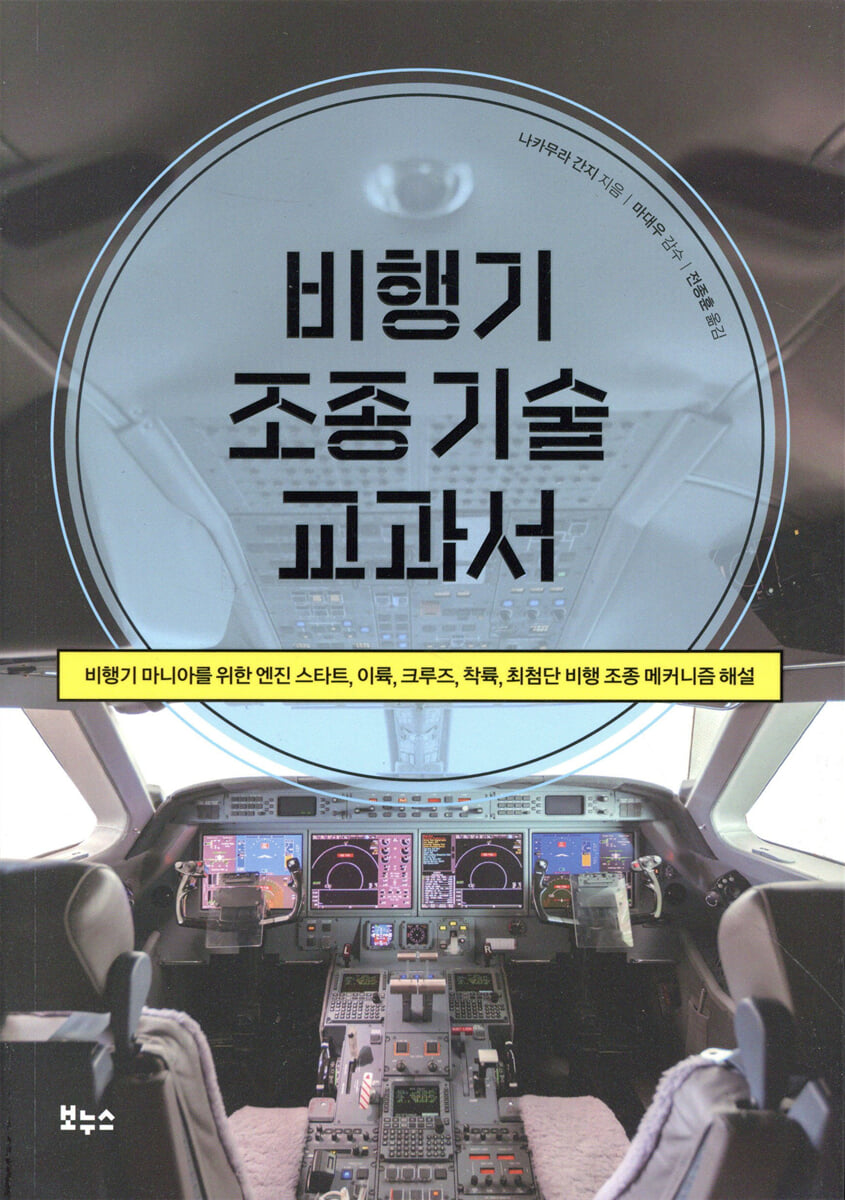
Airplane Piloting Techniques Textbook
 |
Description
Book Introduction
How do the best pilots fly their planes?
Departure preparation, engine start, ascent, takeoff, cruise, descent, landing
Controlling an airplane begins by waking up the sleeping engine.
After setting up all the systems and panels in the cockpit and receiving permission from the control tower, the switches that control the ignition and fuel valves are pressed to start the airplane.
After setting the flaps in the takeoff position, pull back on the control stick while powerfully running down the runway at 300 km/h, and the plane soars high into the sky.
All flight activities are completed when the aircraft has flown according to the route and altitude, and has completed descent and landing.
Pilots must operate numerous devices properly.
From preparing for departure of an aircraft weighing hundreds of tons to ascent, takeoff, cruise, descent, and landing, let's look at the systems and devices required for operation based on the aircraft operating manual.
Based on the basic devices and principles of piloting, you will be able to determine the cruising altitude and speed that provide the best fuel economy, and even understand the relationship between flight weight and center of gravity location.
Departure preparation, engine start, ascent, takeoff, cruise, descent, landing
Controlling an airplane begins by waking up the sleeping engine.
After setting up all the systems and panels in the cockpit and receiving permission from the control tower, the switches that control the ignition and fuel valves are pressed to start the airplane.
After setting the flaps in the takeoff position, pull back on the control stick while powerfully running down the runway at 300 km/h, and the plane soars high into the sky.
All flight activities are completed when the aircraft has flown according to the route and altitude, and has completed descent and landing.
Pilots must operate numerous devices properly.
From preparing for departure of an aircraft weighing hundreds of tons to ascent, takeoff, cruise, descent, and landing, let's look at the systems and devices required for operation based on the aircraft operating manual.
Based on the basic devices and principles of piloting, you will be able to determine the cruising altitude and speed that provide the best fuel economy, and even understand the relationship between flight weight and center of gravity location.
- You can preview some of the book's contents.
Preview
index
Introduction: What is essential for a pilot to fly an airplane?
Introduction | Let's take a seat in the cockpit INFORMATION
Flight Phase of a Passenger Aircraft
Jet airliner control surfaces
Boeing 787 cockpit
Division of duties between the captain and first officer
Chapter 1 | What to Prepare Before Your Flight
Setting up the Departure Preparation Panel
IRS Selector / Pre-departure Check / Flight Management System (FMS) - Various preparations for FMS before departure - FMS is much more powerful than PMS / Departure preparation tasks for the captain and first officer
CDU operation order of Column PF and PM
Chapter 2 | Starting the Engine
Boarding begins
Takeoff Briefing
Engine start preparation
Setting up the hydraulic panel / Setting up the fuel panel
Engine start
Turn the start selector / raise the fuel control switch
Column Communication between Pilot and Ground Maintenance
Chapter 3 | Take Off
Ground driving
Set the APU selector to OFF / Operate the flap lever to place the flaps in the takeoff position / Check the control system
take-off
Turn on the strobe lights / Turn on the landing lights / Operate the TO/GA switch / Check 80 knots / When you hear 'V1' / Call 'Rotate' / On the 'Positive' call, command 'Gear up'
Column callout
Chapter 4 | CLIMB
rising
Post-takeoff checklist / Connect autopilot to flight controls / Altimeter transition, adjustment, and review / Verify economical climb method / Call "One Thousand Feet to Level Off"
Column Pilot and Autopilot
Chapter 5 | Cruise along the Sky Road
Cruise
Flight mode / TEVC (Trailing Edge Variable Camber) / Cruise mode / Step-up cruise / Step-up timing / Economy cruise / Buffett margin / Point where fuel and consumption are equal / Operating flight path restrictions and drift down / Emergency descent due to rapid depressurization / Amount of fuel to carry
Column Fuel Management
Chapter 6 | Descend Back to Earth
descent
Calculate the descent start point / Initiate descent / Descent method / Set the altitude of the landing airport / Prepare to operate the speed brake and autobrake / Obtain instructions from the control center / Turn
Column Cumulonimbus
Chapter 7 | Approach and Landing
Entry and landing
Approach Clearance / Automatic Landing (Autolanding) / Instrument Landing System (ILS) / Balance of Forces on Approach / VREF (Reference Landing Speed) / Runway Approach to Touchdown / Speed Break-up / '60 Knots' Call / Touchdown to a Stop / 'Go Around' Call / Taxiway Entry Clearance Request
Column Auto Landing and Auto Takeoff
Chapter 8 | Flight Weight and Balance
Flight weight and balance
Payload/Distance/Airworthiness Required Weight/Basic Airframe Weight/Basic Airframe Weight for Operation/Allowable Takeoff Weight/Center of Gravity Location and Horizontal Stabilizer/Center of Gravity Location and Stabilizer Trim/Center of Gravity Location Calculation Method
Column Aircraft Weight and Balance Manifest
Conclusion: Flying in the sky is truly a joy.
Search
Introduction | Let's take a seat in the cockpit INFORMATION
Flight Phase of a Passenger Aircraft
Jet airliner control surfaces
Boeing 787 cockpit
Division of duties between the captain and first officer
Chapter 1 | What to Prepare Before Your Flight
Setting up the Departure Preparation Panel
IRS Selector / Pre-departure Check / Flight Management System (FMS) - Various preparations for FMS before departure - FMS is much more powerful than PMS / Departure preparation tasks for the captain and first officer
CDU operation order of Column PF and PM
Chapter 2 | Starting the Engine
Boarding begins
Takeoff Briefing
Engine start preparation
Setting up the hydraulic panel / Setting up the fuel panel
Engine start
Turn the start selector / raise the fuel control switch
Column Communication between Pilot and Ground Maintenance
Chapter 3 | Take Off
Ground driving
Set the APU selector to OFF / Operate the flap lever to place the flaps in the takeoff position / Check the control system
take-off
Turn on the strobe lights / Turn on the landing lights / Operate the TO/GA switch / Check 80 knots / When you hear 'V1' / Call 'Rotate' / On the 'Positive' call, command 'Gear up'
Column callout
Chapter 4 | CLIMB
rising
Post-takeoff checklist / Connect autopilot to flight controls / Altimeter transition, adjustment, and review / Verify economical climb method / Call "One Thousand Feet to Level Off"
Column Pilot and Autopilot
Chapter 5 | Cruise along the Sky Road
Cruise
Flight mode / TEVC (Trailing Edge Variable Camber) / Cruise mode / Step-up cruise / Step-up timing / Economy cruise / Buffett margin / Point where fuel and consumption are equal / Operating flight path restrictions and drift down / Emergency descent due to rapid depressurization / Amount of fuel to carry
Column Fuel Management
Chapter 6 | Descend Back to Earth
descent
Calculate the descent start point / Initiate descent / Descent method / Set the altitude of the landing airport / Prepare to operate the speed brake and autobrake / Obtain instructions from the control center / Turn
Column Cumulonimbus
Chapter 7 | Approach and Landing
Entry and landing
Approach Clearance / Automatic Landing (Autolanding) / Instrument Landing System (ILS) / Balance of Forces on Approach / VREF (Reference Landing Speed) / Runway Approach to Touchdown / Speed Break-up / '60 Knots' Call / Touchdown to a Stop / 'Go Around' Call / Taxiway Entry Clearance Request
Column Auto Landing and Auto Takeoff
Chapter 8 | Flight Weight and Balance
Flight weight and balance
Payload/Distance/Airworthiness Required Weight/Basic Airframe Weight/Basic Airframe Weight for Operation/Allowable Takeoff Weight/Center of Gravity Location and Horizontal Stabilizer/Center of Gravity Location and Stabilizer Trim/Center of Gravity Location Calculation Method
Column Aircraft Weight and Balance Manifest
Conclusion: Flying in the sky is truly a joy.
Search
Detailed image

Publisher's Review
The science of piloting that moves and flies cutting-edge aircraft
What is essential for a pilot to fly an airplane?
Airplanes are using autopilots, which allow them to control their own flight ahead of any other means of transportation.
In addition to the software aspect, advancements in aircraft structure, such as the development of engine compressors and starters, and changes in the shape of auxiliary wings and main wings, are also noticeable.
Indeed, airplanes are a culmination of cutting-edge technology.
So, pilots must undergo separate training to fly a new type of aircraft other than the one they normally fly.
This is to ensure smooth operation of new technologies or instruments applied to airplanes.
And before starting training, you first receive the aircraft operation manual for that type of aircraft.
Pilots read the aircraft operating manual and mentally replay the flight several times to prepare for the long training ahead.
The aircraft operating manual that pilots actually see contains all the information needed from takeoff preparation to landing, including 'detailed information and operation methods for various systems' and 'normal procedures', 'emergency and breakdown procedures', and 'performance'.
This book explains the 'procedures that must be performed' from departure preparation to arrival, and 'the situation in which the system operates through those procedures', focusing on the above content.
It includes methods for determining the cruising altitude and cruising speed that provide the best fuel efficiency, as well as determining the flight weight and center of gravity location.
Let's read this book and imagine flying a cutting-edge aircraft based on the aircraft operating manual seen by actual pilots.
What will unfold before your eyes when you sit in the cockpit?
Description and operation of the panel, display, lever, switch, and control system
Seeing is believing.
It would be difficult to understand the numerous instruments and devices in the cockpit without seeing them firsthand and just reading about them.
Let's directly view and understand flight and navigation information on displays like the ND and PFD located on the panel directly in front of the cockpit, and examine the types and operating methods of the various levers and switches on the stand between the seats. Looking at the MFD, we can see how to check the engine oil level and onboard fuel level before departure, and how to operate the flap levers and joystick to move the flaps, ailerons, and flaperons as desired. This vivid experience allows us to see everything a pilot actually checks and operates in the cockpit, from preparing for departure to landing.
Not only that, you can easily understand how to check the required speed for takeoff, how to check that the PFD is indicating the correct flight mode, and how to set the altimeter according to the instructions of the air traffic control to steer to the correct orbit through illustrations.
An easy introduction to the science behind piloting an airplane.
Force relationships, engine operation, fuel quantity, flight speed and time, aircraft attitude
To understand the movement of an airplane, you need to understand a lot of science.
This book explains the science behind piloting an airplane in an easy-to-understand way using graphs, diagrams, and illustrations.
First, we introduce the roles and relationships of various forces, from the forces that propel an airplane through the sky, such as lift, gravity, thrust, and drag, to the forces that move an airplane, such as centrifugal and centrifugal forces.
Next, it contains a formula for calculating the basic operating weight, such as the weight that does not cause problems when the airplane takes off and lands, and the operating fluids and equipment.
The method of calculating the amount of fuel needed for an airplane to safely complete a single flight, the internal workings of the engine, and the changes in the airplane's attitude, flight speed, angle, and cruising speed over time are all easily shown through illustrations.
Let's understand all the science needed to fly an airplane at a glance.
What is essential for a pilot to fly an airplane?
Airplanes are using autopilots, which allow them to control their own flight ahead of any other means of transportation.
In addition to the software aspect, advancements in aircraft structure, such as the development of engine compressors and starters, and changes in the shape of auxiliary wings and main wings, are also noticeable.
Indeed, airplanes are a culmination of cutting-edge technology.
So, pilots must undergo separate training to fly a new type of aircraft other than the one they normally fly.
This is to ensure smooth operation of new technologies or instruments applied to airplanes.
And before starting training, you first receive the aircraft operation manual for that type of aircraft.
Pilots read the aircraft operating manual and mentally replay the flight several times to prepare for the long training ahead.
The aircraft operating manual that pilots actually see contains all the information needed from takeoff preparation to landing, including 'detailed information and operation methods for various systems' and 'normal procedures', 'emergency and breakdown procedures', and 'performance'.
This book explains the 'procedures that must be performed' from departure preparation to arrival, and 'the situation in which the system operates through those procedures', focusing on the above content.
It includes methods for determining the cruising altitude and cruising speed that provide the best fuel efficiency, as well as determining the flight weight and center of gravity location.
Let's read this book and imagine flying a cutting-edge aircraft based on the aircraft operating manual seen by actual pilots.
What will unfold before your eyes when you sit in the cockpit?
Description and operation of the panel, display, lever, switch, and control system
Seeing is believing.
It would be difficult to understand the numerous instruments and devices in the cockpit without seeing them firsthand and just reading about them.
Let's directly view and understand flight and navigation information on displays like the ND and PFD located on the panel directly in front of the cockpit, and examine the types and operating methods of the various levers and switches on the stand between the seats. Looking at the MFD, we can see how to check the engine oil level and onboard fuel level before departure, and how to operate the flap levers and joystick to move the flaps, ailerons, and flaperons as desired. This vivid experience allows us to see everything a pilot actually checks and operates in the cockpit, from preparing for departure to landing.
Not only that, you can easily understand how to check the required speed for takeoff, how to check that the PFD is indicating the correct flight mode, and how to set the altimeter according to the instructions of the air traffic control to steer to the correct orbit through illustrations.
An easy introduction to the science behind piloting an airplane.
Force relationships, engine operation, fuel quantity, flight speed and time, aircraft attitude
To understand the movement of an airplane, you need to understand a lot of science.
This book explains the science behind piloting an airplane in an easy-to-understand way using graphs, diagrams, and illustrations.
First, we introduce the roles and relationships of various forces, from the forces that propel an airplane through the sky, such as lift, gravity, thrust, and drag, to the forces that move an airplane, such as centrifugal and centrifugal forces.
Next, it contains a formula for calculating the basic operating weight, such as the weight that does not cause problems when the airplane takes off and lands, and the operating fluids and equipment.
The method of calculating the amount of fuel needed for an airplane to safely complete a single flight, the internal workings of the engine, and the changes in the airplane's attitude, flight speed, angle, and cruising speed over time are all easily shown through illustrations.
Let's understand all the science needed to fly an airplane at a glance.
GOODS SPECIFICS
- Date of issue: September 5, 2022
- Page count, weight, size: 224 pages | 380g | 148*210*15mm
- ISBN13: 9788964945766
- ISBN10: 896494576X
You may also like
카테고리
korean


korean

![GQ KOREA Mark (Monthly): December [2025]](http://librairie.coreenne.fr/cdn/shop/files/8ef265dbbfbf186523ed75ba7319009d.jpg?v=1765340328&width=3840)


