

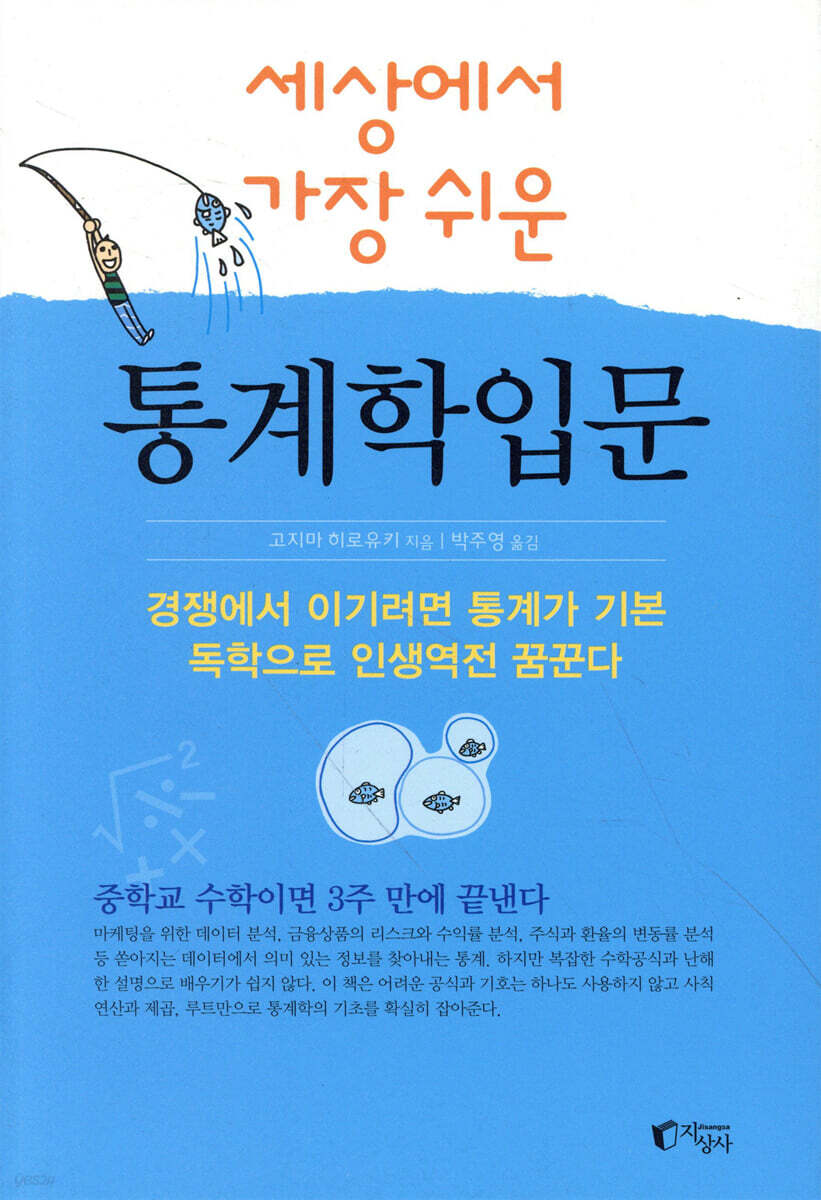
The world's easiest introduction to statistics
 |
Description
Book Introduction
This book introduces statistics as a method for extracting meaningful information from a flood of data, such as data analysis for marketing, risk and return analysis of financial products, and analysis of stock and exchange rate fluctuations.
This book helps you build a solid foundation in statistics using only basic middle school mathematics, such as arithmetic operations, squares, and roots, without using any complicated formulas or symbols.
By analyzing various phenomena expressed in numbers, such as market price trends, consumer spending trends, fluctuations in stocks and exchange rates, and fluctuations in real estate prices, and extracting the information necessary for oneself and the company one belongs to, and accurately predicting them, one can establish a successful and winning strategy. It also helps even the most beginners to understand 'testing' and 'interval estimation', the most important subjects in statistics, in the easiest and fastest way possible.
It consists of a total of 21 lectures, so even the busiest businessperson can master the basics of statistics in about three weeks by investing about 30 minutes a day.
This book helps you build a solid foundation in statistics using only basic middle school mathematics, such as arithmetic operations, squares, and roots, without using any complicated formulas or symbols.
By analyzing various phenomena expressed in numbers, such as market price trends, consumer spending trends, fluctuations in stocks and exchange rates, and fluctuations in real estate prices, and extracting the information necessary for oneself and the company one belongs to, and accurately predicting them, one can establish a successful and winning strategy. It also helps even the most beginners to understand 'testing' and 'interval estimation', the most important subjects in statistics, in the easiest and fastest way possible.
It consists of a total of 21 lectures, so even the busiest businessperson can master the basics of statistics in about three weeks by investing about 30 minutes a day.
- You can preview some of the book's contents.
Preview
index
As we begin
Lecture 0
The goal is to understand 'statistics' efficiently, step by step.
1.
Why is this book divided into two parts?
2.
What is Statistics? Descriptive and Inferential Statistics
3.
Standard deviation is the most important factor
4.
'Probability' is rarely discussed
5.
Explained as a '95% predictive accuracy range'
6.
Mathematical symbols or formulas are rarely used.
7.
Self-study is possible with simple practice problems that involve filling in parentheses.
Part 1
From standard deviation to testing and interval estimation all at once
Lecture 1
Frequency tables and histograms: Tools that highlight the characteristics of your data.
1.
We use statistics because data itself doesn't tell us anything.
2.
Creating a histogram
[Summary of Lecture 1]
[Practice Problems]
Lecture 2
The Role of the Mean and How to Understand It: The Mean is the point at which the lever is balanced.
1.
Statistics are numbers that summarize data.
2.
What is the average?
3.
Mean value in the frequency distribution table
4.
The role of the mean in a histogram
5.
How should we understand the average?
[Summary of Lecture 2]
[Practice Problems]
[Column] There are several ways to find the average.
[Supplementary Explanation] Why the fulcrum on which the lever is balanced becomes the 'arithmetic mean'
Lecture 3
Variance and standard deviation: statistics that estimate the state of scattered data.
1.
It is important to know irregular statistics.
2.
Understanding dispersion by bus arrival time
3.
Meaning of standard deviation
4.
How to calculate standard deviation using a frequency distribution table
[Summary of Lecture 3]
[Practice Problems]
[Supplementary explanation] Proof that the mean of the deviations must be 0.
Lecture 4
Standard deviation ①: Evaluating the specificity of data
1.
Standard deviation is the 'roughness of the wave'
2.
Assessing the 'uniqueness' of data with standard deviation
3.
Standard deviation when comparing multiple data sets
4.
Mean and standard deviation of processed data
[Summary of Lecture 4]
[Practice Problems]
Lecture 5
Standard Deviation②: Used as an indicator of stock risk (stock price volatility).
1.
What is the average return of stocks?
2.
Average return alone cannot determine whether a company is a good company.
3.
What Stock Volatility Means
[Summary of Lecture 5]
[Practice Problems]
Lecture 6
Standard Deviation ③: Understanding High Risk, High Return, and the Sharpe Ratio
1.
High risk and high return, low risk and low return
2.
How to determine the superiority of financial products
3.
Sharpe ratio, a measure of financial product quality
[Summary of Lecture 6]
[Practice Problems]
Lecture 7
Normal distribution: a distribution commonly seen in height, coin tossing, etc.
1.
The most common data distribution you'll find
2.
How to view the general normal distribution
3.
Key data follows a normal distribution
[Summary of Lecture 7]
[Practice Problems]
[Supplementary Explanation] Why the World is Full of Normal Distributions
Lecture 8
Starting Point for Statistical Estimation: Predicting Using Normal Distributions
1.
You can make predictions using the properties of the normal distribution.
2.
95% predictive accuracy interval of the standard normal distribution
3.
95% predictive accuracy interval of the general normal distribution
[Summary of Lecture 8]
[Practice Problems]
[Column] The Fortune Teller's Skill of Accurately Predicting Prophecies
Lecture 9
Hypothesis testing: inferring a population from a single piece of data
1.
Statistical estimation is inferring the whole from a part.
2.
Estimate a more accurate population
3.
The validity of the hypothesis is judged by the 95% predictive accuracy interval.
[Summary of Lecture 9]
[Practice Problems]
[Column] Groundbreaking Points and Limitations of Statistical Testing
Lecture 10
Interval Estimation: Finding a 95% Accuracy Confidence Interval
1.
Reversely utilizing the predictive accuracy interval for estimation
2.
What does a '95%' confidence interval mean?
3.
Interval estimation of the mean of a normal population with known standard deviation
[Summary of Lecture 10]
[Practice Problems]
Part 2
Guessing the vast world behind the observation data
Lecture 11
Populations and Statistical Inference: Inferring the Whole from the Part
1.
The population is a virtual jar
2.
Random sampling and population mean
[Summary of Lecture 11]
[Practice Problems]
Lecture 12
Population variance and population standard deviation: statistics that indicate the distribution of population data.
1.
Understand the distribution status of data
2.
Calculation of population variance and population standard deviation
[Summary of Lecture 12]
[Practice Problems]
Lecture 13
Sample mean ①: The average of multiple data is closer to the population mean than the average of a single data.
1.
What can we tell from one piece of observed data?
2.
Why calculate the sample mean?
[Summary of Lecture 13]
[Practice Problems]
Lecture 14
Sample Mean②: As the observed data increases, the prediction interval narrows.
1.
Properties of the sample mean seen in a normal distribution
2.
95% predictive accuracy interval for the sample mean in a normal population
[Summary of Lecture 14]
[Practice Problems]
Lecture 15
Interval estimation of a population mean using a sample mean: What is the population mean of a normal population with known population variance?
1.
Methods for estimating population mean or population variance
2.
Interval estimation of the population mean using the sample mean
[Summary of Lecture 15]
[Practice Problems]
Lecture 16
Chi-square distribution: How to calculate sample variance and the chi-square distribution
1.
How to calculate sample variance
2.
What is the chi-square distribution?
[Summary of Lecture 16]
[Practice Problems]
Lecture 17
Estimating the population variance of a normal population: Estimating the population variance using the chi-square distribution
1.
95% predictive accuracy interval of the chi-square distribution
2.
Estimating the population variance of a normal population
[Summary of Lecture 17]
[Practice Problems]
Lecture 18
The distribution of the sample variance is the chi-square distribution: a statistic W proportional to the sample variance
1.
How to create a statistic W proportional to the sample variance
2.
The chi-square distribution of the sample variance is a number with one less degree of freedom.
[Summary of Lecture 18]
[Practice Problems]
[Supplementary Explanation] Why W degrees of freedom are 1 less than V degrees of freedom
Lecture 19
Interval estimation of a normal population with an unknown mean: The population variance can be estimated even if the population mean is unknown.
1.
Estimating population variance without knowing population mean
2.
A concrete example of estimating the population variance
[Summary of Lecture 19]
[Practice Problems]
Lecture 20
t distribution: A statistic that can be calculated using 'a sample observed in reality' other than the population mean
1.
t distribution
2.
Histogram of the t distribution
3.
Calculation of statistic T
4.
Formal definition of the t distribution
[Summary of Lecture 20]
[Practice Problems]
[Column] The discovery of the t-distribution is thanks to Guinness beer.
Lecture 21
Interval estimation with the t-distribution: Estimating the population mean when the population variance is unknown in a normal population.
1.
The most natural interval estimation - the t distribution
2.
Interval estimation method using t-variance
[Summary of Lecture 21]
[Practice Problems]
In closing the book
Practice Problem Answers
Search
Lecture 0
The goal is to understand 'statistics' efficiently, step by step.
1.
Why is this book divided into two parts?
2.
What is Statistics? Descriptive and Inferential Statistics
3.
Standard deviation is the most important factor
4.
'Probability' is rarely discussed
5.
Explained as a '95% predictive accuracy range'
6.
Mathematical symbols or formulas are rarely used.
7.
Self-study is possible with simple practice problems that involve filling in parentheses.
Part 1
From standard deviation to testing and interval estimation all at once
Lecture 1
Frequency tables and histograms: Tools that highlight the characteristics of your data.
1.
We use statistics because data itself doesn't tell us anything.
2.
Creating a histogram
[Summary of Lecture 1]
[Practice Problems]
Lecture 2
The Role of the Mean and How to Understand It: The Mean is the point at which the lever is balanced.
1.
Statistics are numbers that summarize data.
2.
What is the average?
3.
Mean value in the frequency distribution table
4.
The role of the mean in a histogram
5.
How should we understand the average?
[Summary of Lecture 2]
[Practice Problems]
[Column] There are several ways to find the average.
[Supplementary Explanation] Why the fulcrum on which the lever is balanced becomes the 'arithmetic mean'
Lecture 3
Variance and standard deviation: statistics that estimate the state of scattered data.
1.
It is important to know irregular statistics.
2.
Understanding dispersion by bus arrival time
3.
Meaning of standard deviation
4.
How to calculate standard deviation using a frequency distribution table
[Summary of Lecture 3]
[Practice Problems]
[Supplementary explanation] Proof that the mean of the deviations must be 0.
Lecture 4
Standard deviation ①: Evaluating the specificity of data
1.
Standard deviation is the 'roughness of the wave'
2.
Assessing the 'uniqueness' of data with standard deviation
3.
Standard deviation when comparing multiple data sets
4.
Mean and standard deviation of processed data
[Summary of Lecture 4]
[Practice Problems]
Lecture 5
Standard Deviation②: Used as an indicator of stock risk (stock price volatility).
1.
What is the average return of stocks?
2.
Average return alone cannot determine whether a company is a good company.
3.
What Stock Volatility Means
[Summary of Lecture 5]
[Practice Problems]
Lecture 6
Standard Deviation ③: Understanding High Risk, High Return, and the Sharpe Ratio
1.
High risk and high return, low risk and low return
2.
How to determine the superiority of financial products
3.
Sharpe ratio, a measure of financial product quality
[Summary of Lecture 6]
[Practice Problems]
Lecture 7
Normal distribution: a distribution commonly seen in height, coin tossing, etc.
1.
The most common data distribution you'll find
2.
How to view the general normal distribution
3.
Key data follows a normal distribution
[Summary of Lecture 7]
[Practice Problems]
[Supplementary Explanation] Why the World is Full of Normal Distributions
Lecture 8
Starting Point for Statistical Estimation: Predicting Using Normal Distributions
1.
You can make predictions using the properties of the normal distribution.
2.
95% predictive accuracy interval of the standard normal distribution
3.
95% predictive accuracy interval of the general normal distribution
[Summary of Lecture 8]
[Practice Problems]
[Column] The Fortune Teller's Skill of Accurately Predicting Prophecies
Lecture 9
Hypothesis testing: inferring a population from a single piece of data
1.
Statistical estimation is inferring the whole from a part.
2.
Estimate a more accurate population
3.
The validity of the hypothesis is judged by the 95% predictive accuracy interval.
[Summary of Lecture 9]
[Practice Problems]
[Column] Groundbreaking Points and Limitations of Statistical Testing
Lecture 10
Interval Estimation: Finding a 95% Accuracy Confidence Interval
1.
Reversely utilizing the predictive accuracy interval for estimation
2.
What does a '95%' confidence interval mean?
3.
Interval estimation of the mean of a normal population with known standard deviation
[Summary of Lecture 10]
[Practice Problems]
Part 2
Guessing the vast world behind the observation data
Lecture 11
Populations and Statistical Inference: Inferring the Whole from the Part
1.
The population is a virtual jar
2.
Random sampling and population mean
[Summary of Lecture 11]
[Practice Problems]
Lecture 12
Population variance and population standard deviation: statistics that indicate the distribution of population data.
1.
Understand the distribution status of data
2.
Calculation of population variance and population standard deviation
[Summary of Lecture 12]
[Practice Problems]
Lecture 13
Sample mean ①: The average of multiple data is closer to the population mean than the average of a single data.
1.
What can we tell from one piece of observed data?
2.
Why calculate the sample mean?
[Summary of Lecture 13]
[Practice Problems]
Lecture 14
Sample Mean②: As the observed data increases, the prediction interval narrows.
1.
Properties of the sample mean seen in a normal distribution
2.
95% predictive accuracy interval for the sample mean in a normal population
[Summary of Lecture 14]
[Practice Problems]
Lecture 15
Interval estimation of a population mean using a sample mean: What is the population mean of a normal population with known population variance?
1.
Methods for estimating population mean or population variance
2.
Interval estimation of the population mean using the sample mean
[Summary of Lecture 15]
[Practice Problems]
Lecture 16
Chi-square distribution: How to calculate sample variance and the chi-square distribution
1.
How to calculate sample variance
2.
What is the chi-square distribution?
[Summary of Lecture 16]
[Practice Problems]
Lecture 17
Estimating the population variance of a normal population: Estimating the population variance using the chi-square distribution
1.
95% predictive accuracy interval of the chi-square distribution
2.
Estimating the population variance of a normal population
[Summary of Lecture 17]
[Practice Problems]
Lecture 18
The distribution of the sample variance is the chi-square distribution: a statistic W proportional to the sample variance
1.
How to create a statistic W proportional to the sample variance
2.
The chi-square distribution of the sample variance is a number with one less degree of freedom.
[Summary of Lecture 18]
[Practice Problems]
[Supplementary Explanation] Why W degrees of freedom are 1 less than V degrees of freedom
Lecture 19
Interval estimation of a normal population with an unknown mean: The population variance can be estimated even if the population mean is unknown.
1.
Estimating population variance without knowing population mean
2.
A concrete example of estimating the population variance
[Summary of Lecture 19]
[Practice Problems]
Lecture 20
t distribution: A statistic that can be calculated using 'a sample observed in reality' other than the population mean
1.
t distribution
2.
Histogram of the t distribution
3.
Calculation of statistic T
4.
Formal definition of the t distribution
[Summary of Lecture 20]
[Practice Problems]
[Column] The discovery of the t-distribution is thanks to Guinness beer.
Lecture 21
Interval estimation with the t-distribution: Estimating the population mean when the population variance is unknown in a normal population.
1.
The most natural interval estimation - the t distribution
2.
Interval estimation method using t-variance
[Summary of Lecture 21]
[Practice Problems]
In closing the book
Practice Problem Answers
Search
Into the book
Inferential statistics is a combination of statistical methods and probability theory, and is used to make guesses about 'objects too large to grasp in their entirety' or 'events that have not yet occurred but will occur in the future.'
This is a methodology established in the 20th century, which means 'guessing the whole from parts', and it is no exaggeration to say that it is a completely new science that has never existed before.
--- From What is Statistics?
Although I believe that the standard deviation is the most important tool in statistics, many statistics textbooks only cover it to the extent of explaining its definition and calculation method.
However, if you do not fully understand the standard deviation, you will not be able to fully understand what the normal distribution, chi-square distribution, and t-distribution, which are used in inferential statistics, do when you encounter them.
That's why so many people get frustrated when they study statistics.
--- Among the most important things to consider is standard deviation
Although reduction sacrifices some of the detailed numerical information in the data, this sacrifice allows the distribution of the data and the underlying characteristics to stand out.
This can be explained as the 'point of the story'.
When you tell someone a story, if you tell them everything from beginning to end, they won't know what's important.
However, if you omit the details or relatively unnecessary parts and talk about it, the 'main point' stands out.
In most cases, what we want to know is not the whole story, but the gist of it.
--- From Creating a Histogram
The average is a representative number taken from the distributed data.
So, we can think of the data as being widely spread around the mean.
However, the extent to which it is spread or scattered cannot be known from the average value.
The standard deviation is an assessment of how spread out or scattered something is.
Standard deviation is the average of how far the data are from the mean.
--- Among the meanings of standard deviation
In stock trading, not only the average return but also its standard deviation is important.
That's why there's a special term for this standard deviation: volatility.
In other words, it means the extent to which there is variation from the average value.
Therefore, the standard deviation of stock returns = stock price volatility can be considered an indicator of stock trading risk.
Because, even if you estimate the average value as profit, you must also keep in mind that there may be a drop from that value by the amount of stock price volatility.
Stock price volatility is an indicator of risk.
--- Among the meanings of stock price volatility
Commonly used ranges are '95% hit' or '99% hit'.
In this book, we will use the most frequently used '95% hit rate' as an example.
The phrase 'choose a range with a 95% accuracy' can be reversed to mean '5% of predictions are wrong'.
People generally have the impression that phenomena with a probability of occurring less than 5% (e.g., getting tails 5 times out of 5 coin tosses) are 'uncommon and strange'.
In other words, 5% is a figure that can be accepted as a 'rarely unusual event that happened by chance, so there's nothing we can do about it' even if the prediction is wrong.
--- Among the 95% predictive accuracy intervals of the standard normal distribution
In the case of an election, the population refers to the voting results of all people who voted.
However, the observed data is the 'vote results from exit polls', so it is a very small number compared to the total number of voters in the population.
Elections are a statistically valuable contextual study, in the sense that 'all the data is revealed within a few hours.'
With very few exceptions, exit poll predictions and the actual election results are very accurate.
This is a methodology established in the 20th century, which means 'guessing the whole from parts', and it is no exaggeration to say that it is a completely new science that has never existed before.
--- From What is Statistics?
Although I believe that the standard deviation is the most important tool in statistics, many statistics textbooks only cover it to the extent of explaining its definition and calculation method.
However, if you do not fully understand the standard deviation, you will not be able to fully understand what the normal distribution, chi-square distribution, and t-distribution, which are used in inferential statistics, do when you encounter them.
That's why so many people get frustrated when they study statistics.
--- Among the most important things to consider is standard deviation
Although reduction sacrifices some of the detailed numerical information in the data, this sacrifice allows the distribution of the data and the underlying characteristics to stand out.
This can be explained as the 'point of the story'.
When you tell someone a story, if you tell them everything from beginning to end, they won't know what's important.
However, if you omit the details or relatively unnecessary parts and talk about it, the 'main point' stands out.
In most cases, what we want to know is not the whole story, but the gist of it.
--- From Creating a Histogram
The average is a representative number taken from the distributed data.
So, we can think of the data as being widely spread around the mean.
However, the extent to which it is spread or scattered cannot be known from the average value.
The standard deviation is an assessment of how spread out or scattered something is.
Standard deviation is the average of how far the data are from the mean.
--- Among the meanings of standard deviation
In stock trading, not only the average return but also its standard deviation is important.
That's why there's a special term for this standard deviation: volatility.
In other words, it means the extent to which there is variation from the average value.
Therefore, the standard deviation of stock returns = stock price volatility can be considered an indicator of stock trading risk.
Because, even if you estimate the average value as profit, you must also keep in mind that there may be a drop from that value by the amount of stock price volatility.
Stock price volatility is an indicator of risk.
--- Among the meanings of stock price volatility
Commonly used ranges are '95% hit' or '99% hit'.
In this book, we will use the most frequently used '95% hit rate' as an example.
The phrase 'choose a range with a 95% accuracy' can be reversed to mean '5% of predictions are wrong'.
People generally have the impression that phenomena with a probability of occurring less than 5% (e.g., getting tails 5 times out of 5 coin tosses) are 'uncommon and strange'.
In other words, 5% is a figure that can be accepted as a 'rarely unusual event that happened by chance, so there's nothing we can do about it' even if the prediction is wrong.
--- Among the 95% predictive accuracy intervals of the standard normal distribution
In the case of an election, the population refers to the voting results of all people who voted.
However, the observed data is the 'vote results from exit polls', so it is a very small number compared to the total number of voters in the population.
Elections are a statistically valuable contextual study, in the sense that 'all the data is revealed within a few hours.'
With very few exceptions, exit poll predictions and the actual election results are very accurate.
--- Among statistical estimates
Publisher's Review
Statistics in 3 weeks with basic middle school math
The reason we study statistics is to extract meaningful information from the flood of data, such as data analysis for marketing, risk and return analysis of financial products, and fluctuation analysis of stock and exchange rates.
However, it is not easy to learn due to complex mathematical formulas and difficult explanations.
This book provides a solid foundation for statistics using only basic middle school mathematics, such as the four basic operations, squares, and roots, without using any complex formulas or symbols.
You have to be good at statistics to win the competition.
In the world of cutthroat competition, the success or failure of a business hinges on being able to extract meaningful information from the countless data and figures pouring in.
By analyzing various phenomena expressed in numbers, such as market price trends, consumer spending trends, stock and exchange rate fluctuations, and real estate price fluctuations, you can extract the information you and your company need and accurately predict them to develop a successful and winning strategy.
Statistics are the foundation for developing successful and winning strategies.
On a small scale, individual investors must analyze stock or real estate price data to accurately predict future price trends in order to develop profitable investment strategies. On a larger scale, a country must analyze various statistical data to accurately predict the future in order to develop a national development strategy.
In order to survive in this era of limitless competition, individuals, businesses, and nations must be well-versed in statistics that can accurately predict the future.
3-Week Introduction to Statistics for Businesspeople
In any department, including sales, planning, and marketing, statistical figures are necessary for analyzing data and developing strategies.
However, many business people feel queasy just hearing the word statistics.
That's because statistics have been learned so difficultly up until now.
This book has been designed to help even the most novice of beginners understand the most important topics in statistics, 'tests' and 'interval estimation,' in the easiest and fastest way possible.
Because it explains statistics in detail with specific examples and without using any difficult mathematical formulas, even people who are not good at math can easily learn statistics.
Consisting of a total of 21 lectures, even the busiest businessperson can master the basics of statistics in just three weeks by investing just 30 minutes a day.
Book Features
1.
This is a very easy introductory book that covers only the most essential parts of statistics.
2.
It is structured so that you can understand the very important statistics topics such as 'test' and 'interval estimation' in the shortest possible time, starting from the beginner level.
3.
Difficult mathematical formulas such as differential and integral calculus, sigma (∑), combination formula (nCk), and random variable symbol (P(X=x)) are not used at all.
Therefore, it can be understood with only the four basic arithmetic operations, squares, and roots and linear equations, which are basic middle school mathematics.
4.
We will focus on the standard deviation, which is the key to understanding statistics.
5.
It provides easy-to-understand explanations using specific examples such as bus timetables, stock indices, risks and returns of financial products, and exit polls for elections.
6.
You can develop an eye for discerning the merits of financial products through examples such as corporate growth rates, average monthly returns on stocks, and fund performance.
7.
It helps to understand statistical concepts by introducing a unique interpretation called the '95% predictive accuracy interval'.
8.
You can check what you have learned and make it your own by completing simple practice problems that require you to fill in the parentheses.
The reason we study statistics is to extract meaningful information from the flood of data, such as data analysis for marketing, risk and return analysis of financial products, and fluctuation analysis of stock and exchange rates.
However, it is not easy to learn due to complex mathematical formulas and difficult explanations.
This book provides a solid foundation for statistics using only basic middle school mathematics, such as the four basic operations, squares, and roots, without using any complex formulas or symbols.
You have to be good at statistics to win the competition.
In the world of cutthroat competition, the success or failure of a business hinges on being able to extract meaningful information from the countless data and figures pouring in.
By analyzing various phenomena expressed in numbers, such as market price trends, consumer spending trends, stock and exchange rate fluctuations, and real estate price fluctuations, you can extract the information you and your company need and accurately predict them to develop a successful and winning strategy.
Statistics are the foundation for developing successful and winning strategies.
On a small scale, individual investors must analyze stock or real estate price data to accurately predict future price trends in order to develop profitable investment strategies. On a larger scale, a country must analyze various statistical data to accurately predict the future in order to develop a national development strategy.
In order to survive in this era of limitless competition, individuals, businesses, and nations must be well-versed in statistics that can accurately predict the future.
3-Week Introduction to Statistics for Businesspeople
In any department, including sales, planning, and marketing, statistical figures are necessary for analyzing data and developing strategies.
However, many business people feel queasy just hearing the word statistics.
That's because statistics have been learned so difficultly up until now.
This book has been designed to help even the most novice of beginners understand the most important topics in statistics, 'tests' and 'interval estimation,' in the easiest and fastest way possible.
Because it explains statistics in detail with specific examples and without using any difficult mathematical formulas, even people who are not good at math can easily learn statistics.
Consisting of a total of 21 lectures, even the busiest businessperson can master the basics of statistics in just three weeks by investing just 30 minutes a day.
Book Features
1.
This is a very easy introductory book that covers only the most essential parts of statistics.
2.
It is structured so that you can understand the very important statistics topics such as 'test' and 'interval estimation' in the shortest possible time, starting from the beginner level.
3.
Difficult mathematical formulas such as differential and integral calculus, sigma (∑), combination formula (nCk), and random variable symbol (P(X=x)) are not used at all.
Therefore, it can be understood with only the four basic arithmetic operations, squares, and roots and linear equations, which are basic middle school mathematics.
4.
We will focus on the standard deviation, which is the key to understanding statistics.
5.
It provides easy-to-understand explanations using specific examples such as bus timetables, stock indices, risks and returns of financial products, and exit polls for elections.
6.
You can develop an eye for discerning the merits of financial products through examples such as corporate growth rates, average monthly returns on stocks, and fund performance.
7.
It helps to understand statistical concepts by introducing a unique interpretation called the '95% predictive accuracy interval'.
8.
You can check what you have learned and make it your own by completing simple practice problems that require you to fill in the parentheses.
GOODS SPECIFICS
- Date of issue: December 17, 2009
- Page count, weight, size: 238 pages | 452g | 153*224*20mm
- ISBN13: 9788990994004
- ISBN10: 8990994004
You may also like
카테고리
korean


korean

![GQ KOREA Mark (Monthly): December [2025]](http://librairie.coreenne.fr/cdn/shop/files/8ef265dbbfbf186523ed75ba7319009d.jpg?v=1765340328&width=3840)


