

Age of Fire
 |
Description
Book Introduction
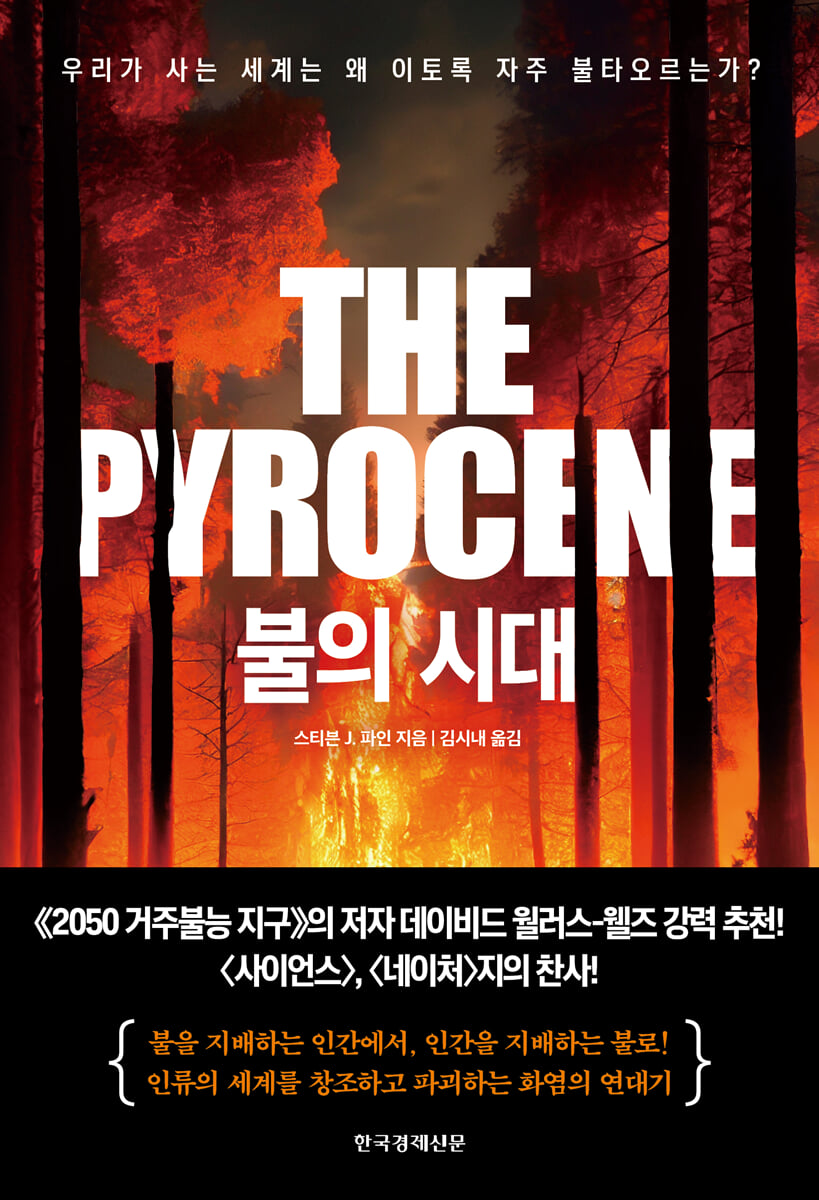
Why does the world we live in burn so often?
The Age of Fire, we are already in its midst!
From humans controlling fire to fire controlling humans
The Chronicle of Flames that Created and Destroyed the Human World, "The Age of Fire"
Highly recommended by David Wallace-Wells, author of "The Uninhabitable Earth of 2050"!
Praise from Science and Nature!
Today, with forest fires raging across the globe, we live in an era that goes beyond simple climate change.
It is the 'Age of Fire (Pyrocene)'.
This does not simply mean that there are more fires, but rather that the impact of fire has reached a global, geological scale, ushering in a new era comparable to the Ice Age.
The world's leading expert on fire, Stephen J.
Fine's book, "The Age of Fire," which is the culmination of a lifetime of knowledge, reexamines human civilization with fire at its center and delves into the multidimensional crisis that human-created fire has brought to Earth.
This book, which organically weaves together the humanities, science, and the environment to weave a world of fire, is a must-read for our times and a survival guide.
The Age of Fire, we are already in its midst!
From humans controlling fire to fire controlling humans
The Chronicle of Flames that Created and Destroyed the Human World, "The Age of Fire"
Highly recommended by David Wallace-Wells, author of "The Uninhabitable Earth of 2050"!
Praise from Science and Nature!
Today, with forest fires raging across the globe, we live in an era that goes beyond simple climate change.
It is the 'Age of Fire (Pyrocene)'.
This does not simply mean that there are more fires, but rather that the impact of fire has reached a global, geological scale, ushering in a new era comparable to the Ice Age.
The world's leading expert on fire, Stephen J.
Fine's book, "The Age of Fire," which is the culmination of a lifetime of knowledge, reexamines human civilization with fire at its center and delves into the multidimensional crisis that human-created fire has brought to Earth.
This book, which organically weaves together the humanities, science, and the environment to weave a world of fire, is a must-read for our times and a survival guide.
- You can preview some of the book's contents.
Preview
index
introduction
9 Between Three Fires
Chapter 1: The First Fire: The Fire of Nature
Fire Planet: Slow, Fast, and Long-Burning Fire 21
The History of Fire's Taken Root on Earth 22
Biological Properties of Fire 29
The Paleozoic History of Fire 42
Enlightenment: The Dark Age of Fire 51
Chapter 2: The Age of Ice 61
Why There Was So Much Ice During the Pleistocene 66
Megafauna, Mass Extinction 76
Pleistocene Stories 79
Guardian of the Flame 87
Chapter 3: The Second Fire: Fire Tamed by Man 93
Creations of Fire: Natural Landscapes 95
Second Fire 100
Crucible of Fire 102
Native Fires: Frequent, Gentle, Preemptive Fires 108
Farmer's Fire: Fire and Fallow 114
Flame Technique 125
Climate that influences and is influenced by 128
Chapter 4: The Third Fire: Fire After the Industrial Revolution 137
Rock Landscape 139
Combustion Mutations: A New Order in Combustion 1 43
Combustion Variation: Concept 150
Combustion Mutation: Act 154
The Third Natural Built Landscape 156
160 rural landscapes in the third nature
The Third Fire Reveals the Wilderness 164
Great Fire 173
Chapter 5: Flame Tax 181
Age of Fire 196
Living with Fire: Principle 206
Living with Fire: Practice 213
Practice Makes Perfect 229
Conclusion: The Sixth Sun 234
Author's Note 244
Reference 48
9 Between Three Fires
Chapter 1: The First Fire: The Fire of Nature
Fire Planet: Slow, Fast, and Long-Burning Fire 21
The History of Fire's Taken Root on Earth 22
Biological Properties of Fire 29
The Paleozoic History of Fire 42
Enlightenment: The Dark Age of Fire 51
Chapter 2: The Age of Ice 61
Why There Was So Much Ice During the Pleistocene 66
Megafauna, Mass Extinction 76
Pleistocene Stories 79
Guardian of the Flame 87
Chapter 3: The Second Fire: Fire Tamed by Man 93
Creations of Fire: Natural Landscapes 95
Second Fire 100
Crucible of Fire 102
Native Fires: Frequent, Gentle, Preemptive Fires 108
Farmer's Fire: Fire and Fallow 114
Flame Technique 125
Climate that influences and is influenced by 128
Chapter 4: The Third Fire: Fire After the Industrial Revolution 137
Rock Landscape 139
Combustion Mutations: A New Order in Combustion 1 43
Combustion Variation: Concept 150
Combustion Mutation: Act 154
The Third Natural Built Landscape 156
160 rural landscapes in the third nature
The Third Fire Reveals the Wilderness 164
Great Fire 173
Chapter 5: Flame Tax 181
Age of Fire 196
Living with Fire: Principle 206
Living with Fire: Practice 213
Practice Makes Perfect 229
Conclusion: The Sixth Sun 234
Author's Note 244
Reference 48
Detailed image
.jpg)
Into the book
Earth is the only planet with fire.
Let's take a moment to reflect on this surprising situation.
Fire is as rare among planets as life itself.
Because it is a product of the world in which living things live.
The Earth's oxygen-rich atmosphere emerged from marine life, and flammable hydrocarbons emerged from terrestrial life.
As soon as the plant took root on land, it was struck by lightning and burst into flames.
I've been riding it ever since.
Oxygen is also found on other planets, the most famous of which is Mars.
The rest is full of flammable materials.
Just look at Saturn's moon Titan, its atmosphere is full of methane.
Lightning strikes on gaseous planets.
However, no planet has all the essential elements or allows for the combination of elements.
We may discover an exoplanet that has life and fire, and intelligent life that can manipulate fire.
But for now, we know nothing, and even if we were to find something, it would be too far away to compare to Earth.
We live on the only livable fire planet.
--- p.21~22
What does fire do? It is precise and comprehensive.
Scatter everything and bake.
After dismantling the biome, a place is created to reassemble the materials that have been liberated during the burning process.
Biochemistry, species, and communities circulate around the flame, forming an ecological triangle.
Fire stirs molecules, organisms, and landscapes.
They take the breath away from plants, break down their ecological structures, and leave their molecules to drift, then mix with other species to find a suitable place and, for a while, reconnect the flow of energy and nutrients.
Gradually increase the speed, stir, break into pieces, shape again and breathe life into it.
Fire is both radical and conservative.
Because it promotes an environment that destroys the existing order while simultaneously restoring it.
In economic terms, it is the height of creative destruction.
--- p.37
Humans have used fire for over 2 million years and could not exist without fire.
They thrived in places where fire occurred, and struggled to survive in rocky deserts, humid rainforests, and shady forests where fire did not occur due to the lack of dry or rainy seasons.
Traditions rooted in social roles, norms, laws, rituals, and customs are only a part of it.
They lit fires in their homes, communities, fields, pastures, hunting grounds, fruit harvests, and on their roads, and also when they followed the paths of the Creator God.
Fire was used to wage war and celebrate peace.
And then, it came to coexist with fire.
We have made fire, cared for it, tamed it, incorporated it into our mythology, and told all sorts of stories about it.
--- p.51~52
Unlike other ancient elements, fire is still a wandering homeless being, sleeping roughly on the ground without a field of study, seeking refuge in various disciplines.
The biological properties of fire are fundamentally difficult to define and are dependent on physical models.
Think of it as mechanical engineering, where you confine fire in a machine and control combustion.
Even those who use fire do not acknowledge that the moment they set fire to the ground with a torch, fire ceases to be a physical device and transforms into an ecological process, treating fire as a mere tool like a candle or a turbine.
City dwellers living in today's industrial society have little personal contact with fire.
Fire exists only in a remote place outside their experience.
People are aware of virtual disasters through images of disasters and accidents or through smoke that threatens public health, as seen in various media.
Let's take a moment to reflect on this surprising situation.
Fire is as rare among planets as life itself.
Because it is a product of the world in which living things live.
The Earth's oxygen-rich atmosphere emerged from marine life, and flammable hydrocarbons emerged from terrestrial life.
As soon as the plant took root on land, it was struck by lightning and burst into flames.
I've been riding it ever since.
Oxygen is also found on other planets, the most famous of which is Mars.
The rest is full of flammable materials.
Just look at Saturn's moon Titan, its atmosphere is full of methane.
Lightning strikes on gaseous planets.
However, no planet has all the essential elements or allows for the combination of elements.
We may discover an exoplanet that has life and fire, and intelligent life that can manipulate fire.
But for now, we know nothing, and even if we were to find something, it would be too far away to compare to Earth.
We live on the only livable fire planet.
--- p.21~22
What does fire do? It is precise and comprehensive.
Scatter everything and bake.
After dismantling the biome, a place is created to reassemble the materials that have been liberated during the burning process.
Biochemistry, species, and communities circulate around the flame, forming an ecological triangle.
Fire stirs molecules, organisms, and landscapes.
They take the breath away from plants, break down their ecological structures, and leave their molecules to drift, then mix with other species to find a suitable place and, for a while, reconnect the flow of energy and nutrients.
Gradually increase the speed, stir, break into pieces, shape again and breathe life into it.
Fire is both radical and conservative.
Because it promotes an environment that destroys the existing order while simultaneously restoring it.
In economic terms, it is the height of creative destruction.
--- p.37
Humans have used fire for over 2 million years and could not exist without fire.
They thrived in places where fire occurred, and struggled to survive in rocky deserts, humid rainforests, and shady forests where fire did not occur due to the lack of dry or rainy seasons.
Traditions rooted in social roles, norms, laws, rituals, and customs are only a part of it.
They lit fires in their homes, communities, fields, pastures, hunting grounds, fruit harvests, and on their roads, and also when they followed the paths of the Creator God.
Fire was used to wage war and celebrate peace.
And then, it came to coexist with fire.
We have made fire, cared for it, tamed it, incorporated it into our mythology, and told all sorts of stories about it.
--- p.51~52
Unlike other ancient elements, fire is still a wandering homeless being, sleeping roughly on the ground without a field of study, seeking refuge in various disciplines.
The biological properties of fire are fundamentally difficult to define and are dependent on physical models.
Think of it as mechanical engineering, where you confine fire in a machine and control combustion.
Even those who use fire do not acknowledge that the moment they set fire to the ground with a torch, fire ceases to be a physical device and transforms into an ecological process, treating fire as a mere tool like a candle or a turbine.
City dwellers living in today's industrial society have little personal contact with fire.
Fire exists only in a remote place outside their experience.
People are aware of virtual disasters through images of disasters and accidents or through smoke that threatens public health, as seen in various media.
--- p.57
Publisher's Review
Earth is the only planet in the solar system where fire exists, and humans are the only species on Earth that uses fire.
Fire has evolved along with humans, and humans have shaped themselves through fire.
But fire, once humanity's most powerful tool, strength, and companion, now threatens humanity.
Wildfires are becoming increasingly powerful worldwide, with recent large-scale fires in Australia, the United States, and South Korea burning tens of millions of hectares of land and destroying countless people's homes.
In modern times, when humans boast of being able to control fire to a higher degree than ever before, the power of fire has actually become more intense and uncontrollable than ever before.
"The Age of Fire" traces the evolution of human civilization from the moment fire was domesticated to the present day, when fire has come to dominate the human world, through the insight that human civilization was built around fire.
Just as humans domesticated the buffalo into a dairy cow, they also domesticated wildfire into a torch, using this fire to clear grasslands and forests, creating an environment conducive to hunting and farming.
Fire was a tool that humans used to manipulate, reorganize, and dominate the ecosystem.
Human civilization has achieved remarkable progress by using fire in war, architecture, religion, chemistry, alchemy, and mechanical engineering.
For humans, fire is no longer just a tool; it has become the driving force that shapes the world.
Fire powered factories, powered railroads, provided electricity, and ushered in an era of mass production and consumption.
Fire allowed humans to build cities on previously unimaginable scales and travel thousands of kilometers in a single day.
But today, fire has reached a level beyond human control.
The massive wildfires observed around the world show that this 'age of fire' is not simply a natural phenomenon, but a product of human civilization.
The history of fire, as defined by Fine, is divided into three periods.
The first fires were natural fires that appeared as plants covered the continent.
Fires in this era, caused by natural phenomena such as lightning, existed as part of the ecosystem.
The second fire is the fire that humans have tamed.
Humans began to use fire as a tool for their survival and development, such as cooking, hunting, and farming, and fire in this era spread to all places where humans were present.
The third fire is qualitatively different.
The fire of this era is a fire with a destructive power that is not limited by ecological limitations such as season, sun, climate, or geography.
Since the Industrial Revolution, humans have been burning fossil fuels rather than organic matter like wood and grass, and the source of combustible materials is essentially infinite.
Fire is now not only hotter and longer-burning, but it is also a holistic force that is irreversibly changing the Earth's atmosphere and climate.
The dangers of the fire age are not only manifested in increased wildfires, but also in repeated warming, drying, increased carbon emissions, ocean acidification, changes in ocean currents, and loss of biodiversity.
Fire affects all places through the atmosphere, and even modern cities are becoming spaces organized around fire.
Today we stand at the zenith of this age of fire.
How we handle this fire now will determine our next era.
This book holds the key to understanding and responding to the crisis we face.
Recommended for these readers
- Anyone who is interested in and alert to the large-scale wildfires occurring around the world recently, such as the California wildfires, the Australian wildfires, and the 2025 Korean wildfires.
- People interested in environmental issues, climate crisis, and climate change
-People with anthropological curiosity about fire, which shaped human civilization
- A liberal arts readership based on humanities
Fire has evolved along with humans, and humans have shaped themselves through fire.
But fire, once humanity's most powerful tool, strength, and companion, now threatens humanity.
Wildfires are becoming increasingly powerful worldwide, with recent large-scale fires in Australia, the United States, and South Korea burning tens of millions of hectares of land and destroying countless people's homes.
In modern times, when humans boast of being able to control fire to a higher degree than ever before, the power of fire has actually become more intense and uncontrollable than ever before.
"The Age of Fire" traces the evolution of human civilization from the moment fire was domesticated to the present day, when fire has come to dominate the human world, through the insight that human civilization was built around fire.
Just as humans domesticated the buffalo into a dairy cow, they also domesticated wildfire into a torch, using this fire to clear grasslands and forests, creating an environment conducive to hunting and farming.
Fire was a tool that humans used to manipulate, reorganize, and dominate the ecosystem.
Human civilization has achieved remarkable progress by using fire in war, architecture, religion, chemistry, alchemy, and mechanical engineering.
For humans, fire is no longer just a tool; it has become the driving force that shapes the world.
Fire powered factories, powered railroads, provided electricity, and ushered in an era of mass production and consumption.
Fire allowed humans to build cities on previously unimaginable scales and travel thousands of kilometers in a single day.
But today, fire has reached a level beyond human control.
The massive wildfires observed around the world show that this 'age of fire' is not simply a natural phenomenon, but a product of human civilization.
The history of fire, as defined by Fine, is divided into three periods.
The first fires were natural fires that appeared as plants covered the continent.
Fires in this era, caused by natural phenomena such as lightning, existed as part of the ecosystem.
The second fire is the fire that humans have tamed.
Humans began to use fire as a tool for their survival and development, such as cooking, hunting, and farming, and fire in this era spread to all places where humans were present.
The third fire is qualitatively different.
The fire of this era is a fire with a destructive power that is not limited by ecological limitations such as season, sun, climate, or geography.
Since the Industrial Revolution, humans have been burning fossil fuels rather than organic matter like wood and grass, and the source of combustible materials is essentially infinite.
Fire is now not only hotter and longer-burning, but it is also a holistic force that is irreversibly changing the Earth's atmosphere and climate.
The dangers of the fire age are not only manifested in increased wildfires, but also in repeated warming, drying, increased carbon emissions, ocean acidification, changes in ocean currents, and loss of biodiversity.
Fire affects all places through the atmosphere, and even modern cities are becoming spaces organized around fire.
Today we stand at the zenith of this age of fire.
How we handle this fire now will determine our next era.
This book holds the key to understanding and responding to the crisis we face.
Recommended for these readers
- Anyone who is interested in and alert to the large-scale wildfires occurring around the world recently, such as the California wildfires, the Australian wildfires, and the 2025 Korean wildfires.
- People interested in environmental issues, climate crisis, and climate change
-People with anthropological curiosity about fire, which shaped human civilization
- A liberal arts readership based on humanities
GOODS SPECIFICS
- Date of issue: July 11, 2025
- Page count, weight, size: 260 pages | 140*205*20mm
- ISBN13: 9788947501774
- ISBN10: 8947501778
You may also like
카테고리
korean


korean

![GQ KOREA Mark (Monthly): December [2025]](http://librairie.coreenne.fr/cdn/shop/files/8ef265dbbfbf186523ed75ba7319009d.jpg?v=1765340328&width=3840)


