

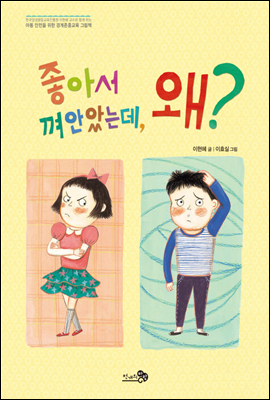
I hugged you because I liked you, but why?
 |
Description
Book Introduction
The line that must be maintained, the 'boundary'
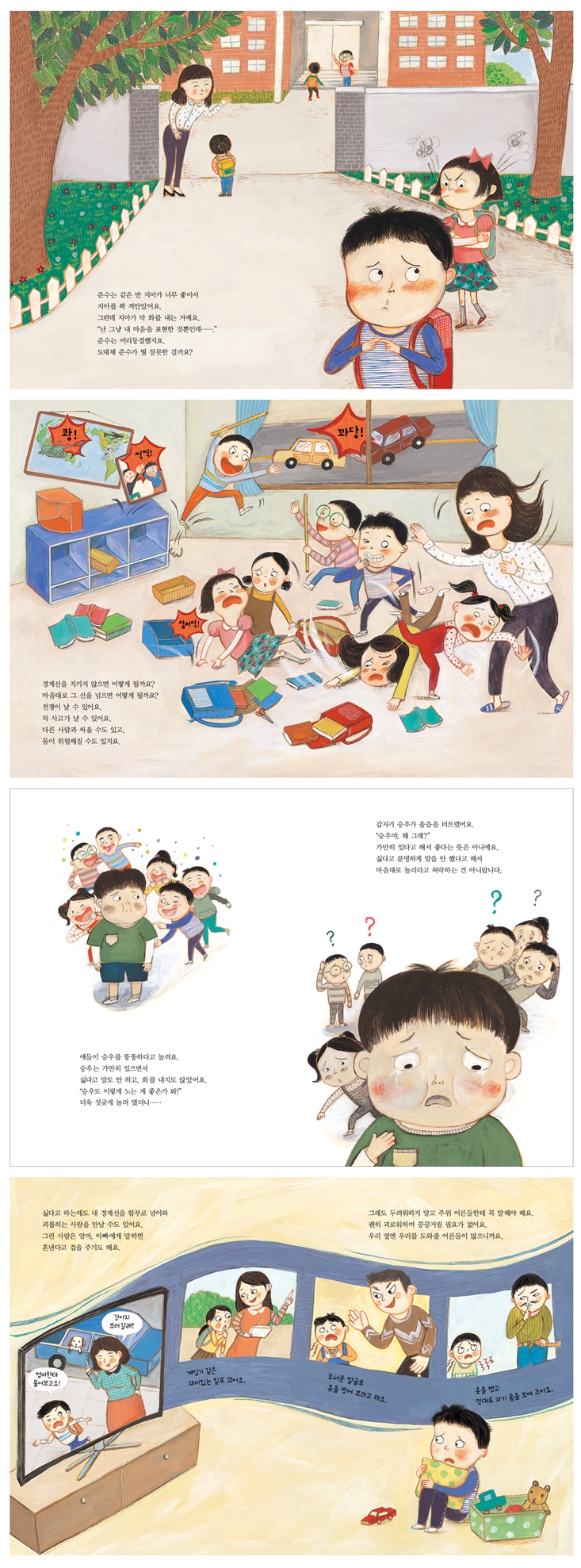
Junsu hugged his classmate, Jia, because he liked her.
But then Jia started getting angry.
What on earth did Jinsoo do wrong? Just as there are borders between countries and roads are divided into lanes and sidewalks, there are also boundaries between objects, distinguishing between what's mine and what's yours.
It's the same between people.
There are boundaries that separate each person's private sphere.
Areas divided by boundaries must not be crossed carelessly.
If you cross the border recklessly, war will break out, and if you cross the road or sidewalk recklessly, accidents will happen.
When boundaries between people are carelessly crossed, fights break out, people get hurt, or people feel bad.
So, we must always keep boundaries between people.
So, what should we do when crossing boundaries between people? We need to ask before we cross the line.
Ask the other person if you can use their stuff, play with them, or hug them.
You should only use objects, play with them, or hug them when they have given you permission to enter their boundaries.
So, do you see what Junsu did wrong? He crossed Jia's boundaries without permission, making her uncomfortable.
Junsu, who realized his mistake, writes an apology letter to Ji-ah and vows to keep his boundaries.
Junsu hugged his classmate, Jia, because he liked her.
But then Jia started getting angry.
What on earth did Jinsoo do wrong? Just as there are borders between countries and roads are divided into lanes and sidewalks, there are also boundaries between objects, distinguishing between what's mine and what's yours.
It's the same between people.
There are boundaries that separate each person's private sphere.
Areas divided by boundaries must not be crossed carelessly.
If you cross the border recklessly, war will break out, and if you cross the road or sidewalk recklessly, accidents will happen.
When boundaries between people are carelessly crossed, fights break out, people get hurt, or people feel bad.
So, we must always keep boundaries between people.
So, what should we do when crossing boundaries between people? We need to ask before we cross the line.
Ask the other person if you can use their stuff, play with them, or hug them.
You should only use objects, play with them, or hug them when they have given you permission to enter their boundaries.
So, do you see what Junsu did wrong? He crossed Jia's boundaries without permission, making her uncomfortable.
Junsu, who realized his mistake, writes an apology letter to Ji-ah and vows to keep his boundaries.
- You can preview some of the book's contents.
Preview
Detailed image
Publisher's Review
Why boundary respect education?
From minor arguments and fights between children to more serious sexual assault, violence of all kinds often occurs in kindergartens and schools.
In a group of diverse people, it is natural for conflicts to arise between individuals.
However, we cannot remain indifferent to violent incidents just because they are a natural phenomenon.
A more fundamental approach is needed to prevent these things from happening.
If we think carefully about why such conflict and violence arise between people, it stems from the desire to do things 'my way.'
I want to play with my friends' toys as I please, I want to monopolize my favorite friends as I please, I want to satisfy my desire to play as I please… … .
Conflicts arise when we act according to our own whims rather than considering the harm to others.
If I act as I please, I might end up invading the other person's private space where they should be making decisions and taking the lead.
Soon, it will be a reckless crossing of the 'boundary' between me and the other person.
To keep us safe and reduce conflict between people, it's important to acknowledge and respect each other's boundaries.
To respect boundaries, you must abandon the attitude of trying to manipulate the other person's belongings, body, emotions, feelings, and even language as you please.
When using the other person's belongings or attempting physical contact, you must first obtain the other person's consent.
Respect for boundaries is the education of proper values that do not harm others and are considerate of others first.
If everyone had these right values, children would be less exposed to danger and could live safer lives.
A picture book on social skills from a safety perspective
Child sexual abuse prevention education must prioritize child safety.
Preventing sexual violence from occurring is paramount, and a change in awareness among all members of society is necessary to create a safe environment for children.
However, we must not treat the issue of sexual violence as a ‘very special’ problem.
Just as it's good to be aware of the natural behavior of recognizing a "safety issue" as something to avoid, like telling someone not to touch something dangerous or that playing with fire is dangerous, it's good to have a natural attitude of recognizing it as something to avoid.
This is the first step in child sexual abuse prevention education.
This book, [I Hug You Because I Like You, But Why?] explains that it is important to keep your boundaries in order to stay safe.
By also showing situations where child abduction or sexual assault occurs as acts that cross boundaries, it instills the perception that the issue of sexual assault is an extension of child safety.
To keep your child safe, you need to not only respect other people's boundaries but also your own.
If someone crosses your boundaries even though you don't want them to, you need to clearly say, "No," or "No."
To express one's opinions clearly, one must train oneself to express oneself well from an early age.
It is the adult's responsibility to create an atmosphere where children can freely express their opinions.
If you listen to and respect your child's needs, he or she will grow up to be a child with high self-esteem.
[I hugged him because I liked him, but why?] follows Junsu's daily routine from going to school until he goes to bed, and contains tips on how to stay safe and maintain boundaries between people.
Because it follows the child's daily life in chronological order, it has the advantage of being easy for children to apply and practice in their own lives.
Additionally, it provides specific suggestions on how to deal with situations such as fights with friends, kidnapping, and sexual assault, making it suitable as a children's social skills picture book.
Planning and writing by gender equality experts
The author of this book, Professor Lee Hyeon-hye, has been working for the rights of children and women for a long time while working at the Korea Institute for Gender Equality Promotion and Education.
Especially when supporting and educating victims of violence such as sexual violence, I have always believed that 'prevention' is more important than responding to the situation at the time of the incident.
However, it is true that existing education focuses on how to behave in violent situations.
For example, child sexual violence prevention education also focused on how children would respond in sexual violence situations.
They taught active resistance methods, such as yelling loudly or saying “No, no.”
However, this method is not very effective for children with weak strength.
It just makes me feel more guilty for not being able to resist properly.
So, the educational concept that the author came up with after much thought is ‘boundary respect education.’
The author has trained numerous field leaders and teachers on boundary respect, and has discussed the frequent problem behaviors of children who cross others' boundaries in everyday life.
Teasing your friend recklessly, taking off your friend's pants as a joke, pulling your girlfriend's hair, taking your friend's toy by force, tripping your friend and making him fall, hitting your friend for no reason...
These types of behaviors that cross boundaries can easily escalate into major conflicts and violent incidents that threaten the safety of children.
Therefore, it is necessary to educate children that these careless actions are wrong and recklessly cross other people's boundaries.
The idea is to provide a fundamental solution to various violence problems by giving children the opportunity to reflect on their own actions and gain self-awareness and introspection.
[I hugged him because I liked him, but why?] is a book for children that combines the academic foundations I have pondered over for a long time as a researcher with practical methods in the field of child guidance.
From minor arguments and fights between children to more serious sexual assault, violence of all kinds often occurs in kindergartens and schools.
In a group of diverse people, it is natural for conflicts to arise between individuals.
However, we cannot remain indifferent to violent incidents just because they are a natural phenomenon.
A more fundamental approach is needed to prevent these things from happening.
If we think carefully about why such conflict and violence arise between people, it stems from the desire to do things 'my way.'
I want to play with my friends' toys as I please, I want to monopolize my favorite friends as I please, I want to satisfy my desire to play as I please… … .
Conflicts arise when we act according to our own whims rather than considering the harm to others.
If I act as I please, I might end up invading the other person's private space where they should be making decisions and taking the lead.
Soon, it will be a reckless crossing of the 'boundary' between me and the other person.
To keep us safe and reduce conflict between people, it's important to acknowledge and respect each other's boundaries.
To respect boundaries, you must abandon the attitude of trying to manipulate the other person's belongings, body, emotions, feelings, and even language as you please.
When using the other person's belongings or attempting physical contact, you must first obtain the other person's consent.
Respect for boundaries is the education of proper values that do not harm others and are considerate of others first.
If everyone had these right values, children would be less exposed to danger and could live safer lives.
A picture book on social skills from a safety perspective
Child sexual abuse prevention education must prioritize child safety.
Preventing sexual violence from occurring is paramount, and a change in awareness among all members of society is necessary to create a safe environment for children.
However, we must not treat the issue of sexual violence as a ‘very special’ problem.
Just as it's good to be aware of the natural behavior of recognizing a "safety issue" as something to avoid, like telling someone not to touch something dangerous or that playing with fire is dangerous, it's good to have a natural attitude of recognizing it as something to avoid.
This is the first step in child sexual abuse prevention education.
This book, [I Hug You Because I Like You, But Why?] explains that it is important to keep your boundaries in order to stay safe.
By also showing situations where child abduction or sexual assault occurs as acts that cross boundaries, it instills the perception that the issue of sexual assault is an extension of child safety.
To keep your child safe, you need to not only respect other people's boundaries but also your own.
If someone crosses your boundaries even though you don't want them to, you need to clearly say, "No," or "No."
To express one's opinions clearly, one must train oneself to express oneself well from an early age.
It is the adult's responsibility to create an atmosphere where children can freely express their opinions.
If you listen to and respect your child's needs, he or she will grow up to be a child with high self-esteem.
[I hugged him because I liked him, but why?] follows Junsu's daily routine from going to school until he goes to bed, and contains tips on how to stay safe and maintain boundaries between people.
Because it follows the child's daily life in chronological order, it has the advantage of being easy for children to apply and practice in their own lives.
Additionally, it provides specific suggestions on how to deal with situations such as fights with friends, kidnapping, and sexual assault, making it suitable as a children's social skills picture book.
Planning and writing by gender equality experts
The author of this book, Professor Lee Hyeon-hye, has been working for the rights of children and women for a long time while working at the Korea Institute for Gender Equality Promotion and Education.
Especially when supporting and educating victims of violence such as sexual violence, I have always believed that 'prevention' is more important than responding to the situation at the time of the incident.
However, it is true that existing education focuses on how to behave in violent situations.
For example, child sexual violence prevention education also focused on how children would respond in sexual violence situations.
They taught active resistance methods, such as yelling loudly or saying “No, no.”
However, this method is not very effective for children with weak strength.
It just makes me feel more guilty for not being able to resist properly.
So, the educational concept that the author came up with after much thought is ‘boundary respect education.’
The author has trained numerous field leaders and teachers on boundary respect, and has discussed the frequent problem behaviors of children who cross others' boundaries in everyday life.
Teasing your friend recklessly, taking off your friend's pants as a joke, pulling your girlfriend's hair, taking your friend's toy by force, tripping your friend and making him fall, hitting your friend for no reason...
These types of behaviors that cross boundaries can easily escalate into major conflicts and violent incidents that threaten the safety of children.
Therefore, it is necessary to educate children that these careless actions are wrong and recklessly cross other people's boundaries.
The idea is to provide a fundamental solution to various violence problems by giving children the opportunity to reflect on their own actions and gain self-awareness and introspection.
[I hugged him because I liked him, but why?] is a book for children that combines the academic foundations I have pondered over for a long time as a researcher with practical methods in the field of child guidance.
GOODS SPECIFICS
- Date of publication: November 25, 2015
- Format: Hardcover book binding method guide
- Page count, weight, size: 36 pages | 351g | 200*268*15mm
- ISBN13: 9788997984848
- ISBN10: 8997984845
You may also like
카테고리
korean


korean

![GQ KOREA Mark (Monthly): December [2025]](http://librairie.coreenne.fr/cdn/shop/files/8ef265dbbfbf186523ed75ba7319009d.jpg?v=1765340328&width=3840)


