

A world without fish
 |
Description
Book Introduction
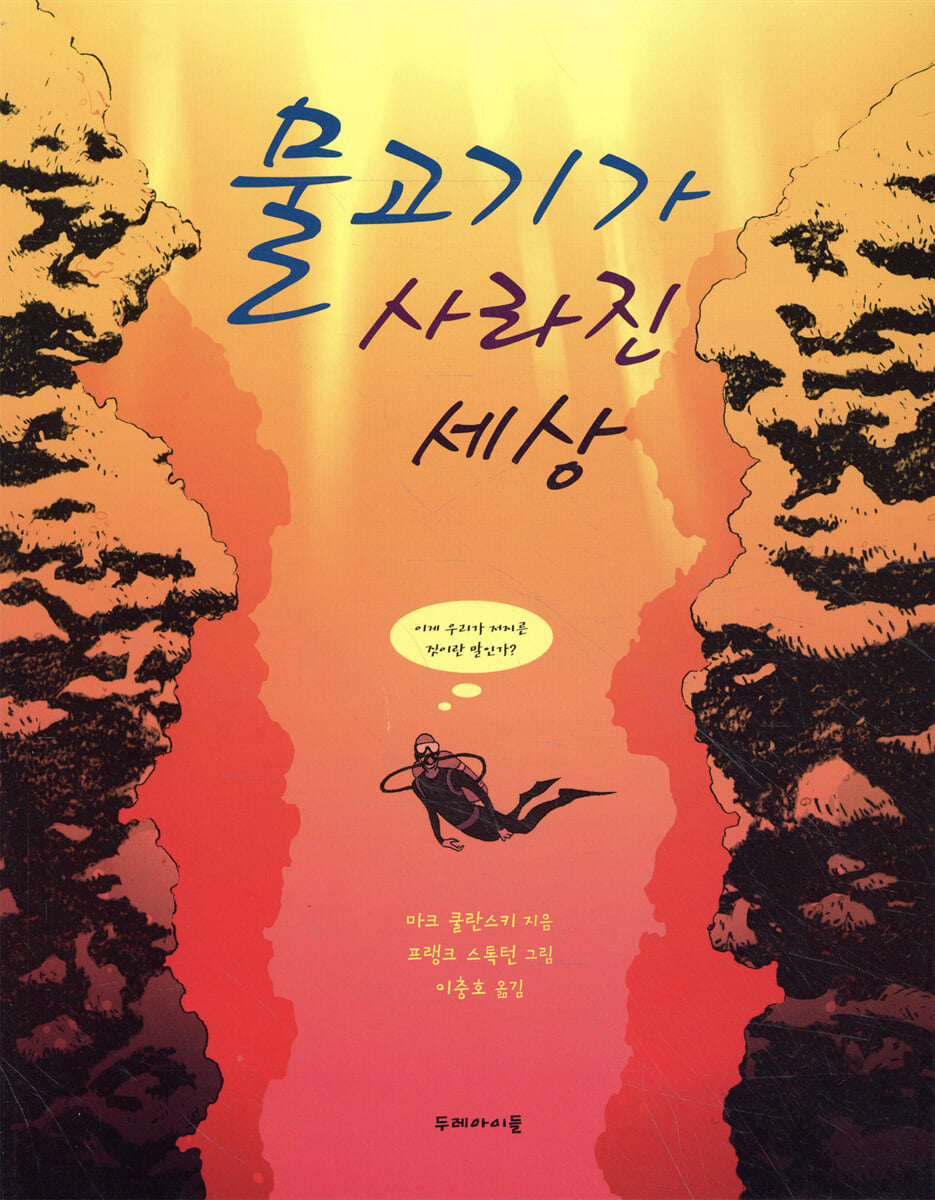
Food and history expert Mark Kurlansky meets Korean children with his book, "A World Without Fish," which addresses fish extinction and ocean issues.
With a special interest in fish, he presents both a warning about the extinction of fish and a hope for saving the ocean, based on his extensive knowledge and extensive data.
Nuclear power plant accidents, oil spills, and floating "plastic islands" in the Pacific Ocean continue to threaten our oceans.
However, in our country, which is surrounded by the sea on three sides, there are still no children's books that seriously deal with topics such as the destruction of the sea, the extinction of fish, and the problems of the fishing industry.
This book will give children a surprising insight into the ocean and fish like never before.
"The World Without Fish" shows how children can play a role in saving the oceans, fish, sea creatures, and the planet.
It also convincingly explains the consequences of overfishing, pollution, and global warming, and how the ocean floor is effectively turning into a desert.
We can't afford to sit idly by and allow a world without fish to become a reality. To do so, we must change our behavior, starting now!
With a special interest in fish, he presents both a warning about the extinction of fish and a hope for saving the ocean, based on his extensive knowledge and extensive data.
Nuclear power plant accidents, oil spills, and floating "plastic islands" in the Pacific Ocean continue to threaten our oceans.
However, in our country, which is surrounded by the sea on three sides, there are still no children's books that seriously deal with topics such as the destruction of the sea, the extinction of fish, and the problems of the fishing industry.
This book will give children a surprising insight into the ocean and fish like never before.
"The World Without Fish" shows how children can play a role in saving the oceans, fish, sea creatures, and the planet.
It also convincingly explains the consequences of overfishing, pollution, and global warming, and how the ocean floor is effectively turning into a desert.
We can't afford to sit idly by and allow a world without fish to become a reality. To do so, we must change our behavior, starting now!
- You can preview some of the book's contents.
Preview
index
Introduction: The Heart of the Matter
Chapter 1: What Could Happen Next
Chapter 2 How did people first start catching fish, and how did fishing grow into a large-scale industry?
Chapter 3: The Story of Orange Ruffy: A Sad Lesson
Chapter 4: The Myth of Nature's Abundance and Why Scientists Have Long Misunderstood It
Chapter 5: The Politics of Fish
Chapter 6: Why You Can't Just Stop Fishing
Chapter 7: Four Solutions, and Why They're Not Enough
Chapter 8: The Best Way to Stop Overfishing: Sustainable Fishing
Chapter 9 How Pollution Kills Fish
Chapter 10 How Will Global Warming Kill Fish?
Chapter 11: When to Wake Up and Take Action
References / Index / Acknowledgements
Chapter 1: What Could Happen Next
Chapter 2 How did people first start catching fish, and how did fishing grow into a large-scale industry?
Chapter 3: The Story of Orange Ruffy: A Sad Lesson
Chapter 4: The Myth of Nature's Abundance and Why Scientists Have Long Misunderstood It
Chapter 5: The Politics of Fish
Chapter 6: Why You Can't Just Stop Fishing
Chapter 7: Four Solutions, and Why They're Not Enough
Chapter 8: The Best Way to Stop Overfishing: Sustainable Fishing
Chapter 9 How Pollution Kills Fish
Chapter 10 How Will Global Warming Kill Fish?
Chapter 11: When to Wake Up and Take Action
References / Index / Acknowledgements
Detailed image
Publisher's Review
Mark Kurlansky, author of the bestselling books "Cod" and "Salt," tells us:
A sad and surprising story about fish and the sea!
“A book that sounds the alarm about the most surprising and unknown disaster of our time—the death of the oceans—and suggests ways to solve this crisis!”
The first children's book to address fish extinction and ocean problems!
Mark Kurlansky is a renowned food and history expert and nonfiction writer.
His books, "Cod," "Salt," and "The Giant Oyster," were New York Times bestsellers and received numerous awards, including the Beard Award and the New York Public Library's Best Book of the Year.
In particular, "Cod," which delved into the cruel history of fish, contributed greatly to raising people's interest in fish.
Kurlansky, who has always had a special interest in fish, has published a book titled "A World Without Fish," which presents both a warning about the extinction of fish and hope for saving the ocean, based on his extensive data and extensive knowledge.
In the East Sea, pollack almost disappeared about 10 years ago.
Even after the Fukushima Daiichi nuclear power plant accident in 2011, contaminated water continues to pollute the ocean, with “12 tons of highly radioactive contaminated water from the Fukushima Daiichi Nuclear Power Plant flowing into the ocean”.
Some claim that the floating "plastic island" of marine debris in the Pacific Ocean is twice the size of the United States.
In 2010, the Gulf of Mexico experienced the largest oil spill in history, covering 63 million square kilometers of the Gulf of Mexico in an oil slick.
However, in Korea, there are still no children's books that deal with topics such as ocean destruction, fish extinction, and fishing problems in earnest.
Even though we are surrounded by the sea on three sides, it is closely related to us.
In particular, there is almost no interest in fish.
This may be, as the author says, “because fish belong to a different class than us,” or it may be due to “the false myth about the abundance of nature that fish can never go extinct.”
That's why this book will bring children a surprising and unprecedented understanding of the ocean and fish.
Rachel Carson's "Silent Spring" and Mark Kurlansky's "The Silent Sea"
If we continue at our current rate, will fish disappear within the next 50 years? If the three major causes cited by the author—overfishing, ocean pollution, and global warming—continue at their current rates, fish extinction is not a distant future.
"A World Without Fish" tells the story of how and why common fish we eat, including tuna, salmon, and cod, could become extinct in the future, and what dangers all life, including seabirds, reptiles, and mammals, will face in their wake.
In her environmental classic "Silent Spring," which warned against the indiscriminate abuse of pesticides and chemicals and instilled a new awareness of the environment, Rachel Carson told a terrifying "fable for tomorrow" that the sounds of spring and birds could disappear if pesticides, insecticides, and herbicides continue to be indiscriminately used.
Mark Kurlansky also warns that if the oceans and fish continue to suffer this kind of damage, we will no longer hear the songs of dolphins or see the picturesque dances of flocks of birds in seas overrun with jellyfish and turned orange by red tide.
The protagonist of the tragedy is ultimately human!
The causes of the tragedies that are happening (and could happen) at sea now are mostly on land, and these tragedies will gradually spread there.
Who will be the protagonist and victim of this tragedy? It's none other than humans, at the very top of the food chain.
So, are the protagonists of this tragedy "villains plotting an evil scheme to lead the Earth to destruction"? No.
They are just ordinary, good people.
Kurlansky ultimately says that if things continue as they are, the next 50 years will bring about changes greater than the revolutionary changes experienced after the Industrial Revolution.
Myths about Nature's Abundance and Scientists' Misconceptions
It is not known when humans first began catching fish.
However, with the introduction of bottom trawl fishing in England in the 14th century, the development of beam trawl fishing vessels in the 18th century, and the subsequent development of tanks, the development of railways, the invention of steam-powered fishing vessels, and the development of nets, fishing has grown into a large-scale industry, and as fishing vessels roam the world's oceans, marine ecosystems are rapidly being destroyed.
However, people have long believed in the 'abundance of nature', that nature is inherently abundant and can never be exhausted no matter how much is wasted.
Fish are no exception.
Rather, fish were considered particularly difficult creatures to eliminate.
The biggest reason, he said, was because they 'lay a lot of eggs' (for example, cod lays 3 to 9 million eggs).
These myths? The people who questioned them were fishermen, not scientists.
Fishermen themselves have warned that mass overfishing could lead to fish extinction.
However, scientists who believe in the myth of 'nature's abundance' have turned a blind eye to this.
But recently, scientists have discovered that only one to six fish eggs survive.
The story of Orange Ruffy, a sad lesson
Also, as the fish in the coastal waters gradually dried up, people began to go further out to sea to catch fish.
And this soon brought disaster.
The representative fish species is orange roughy.
Orange Ruffy has a long lifespan.
However, as their lifespan is long, they also give birth late.
However, many orange roughies that appear fully grown on the outside have not yet experienced reproduction.
Ultimately, the orange roughy is now endangered, just a few decades after being discovered by humans.
This sad story of the orange roughy is a warning about what is happening in our oceans today.
How to avoid the worst-case scenario
According to the Food and Agriculture Organization of the United Nations, about two-thirds of all fish species are currently at risk of extinction due to overfishing.
The story is that the entire ocean is in a serious crisis.
If the number of fish species continues to decline at the current rate, the number of commercial fish species will be reduced to a level that is almost irreversible by 2048.
The ecosystem could literally collapse before our eyes.
That's why biodiversity is important.
But all of these are 'worst case scenarios' - what could happen if we do nothing.
"The World Without Fish" is a book that evokes images of apocalyptic destruction, but it is not a book that only shows such tragic images.
Rather, it is a book that urges us (especially children) to take action to prevent this dark future.
It highlights 'sustainable fishing' as the best way to prevent overfishing, and shows how children can play a role in changing the world by starting small and gradually expanding into bigger things.
And he emphasizes to children that they should wake up and take action.
"We absolutely cannot afford to sit idly by and allow a world without fish to become a reality. To do so, we must change our behavior starting now."
Small actions taken every day can change the world.
The book also delves into the history of the fishing industry, the fights between nations over fishing grounds, the creation of Iceland's 200-nautical-mile exclusive economic zone and its problems, the incompetence of government scientists, the loss of livelihoods due to fishing ground closures, pollution from pollutants like oil and chromium, and the serious problems caused by global warming.
But what this book should focus on is how we can stop what is happening in the ocean now.
In this regard, Kurlansky points out problems with several methods currently being discussed, such as fish farming, catch limits, fishing season restrictions, and fishery closures.
Ultimately, the 'best way' the author suggests is sustainable fishing.
In particular, it points out the harmful effects of bottom trawling, which depletes fish populations.
They also emphasize being suspicious of sudden increases in new fish availability, avoiding endangered fish (e.g., sharks, tuna), eating fish from sustainable fisheries and those lower down the food chain, and choosing stores that sell fish caught through sustainable fishing practices.
Ultimately, this book reminds us of the important truth that small actions can change our future, as Jane Goodall said, “Small actions taken every day can change the world.”
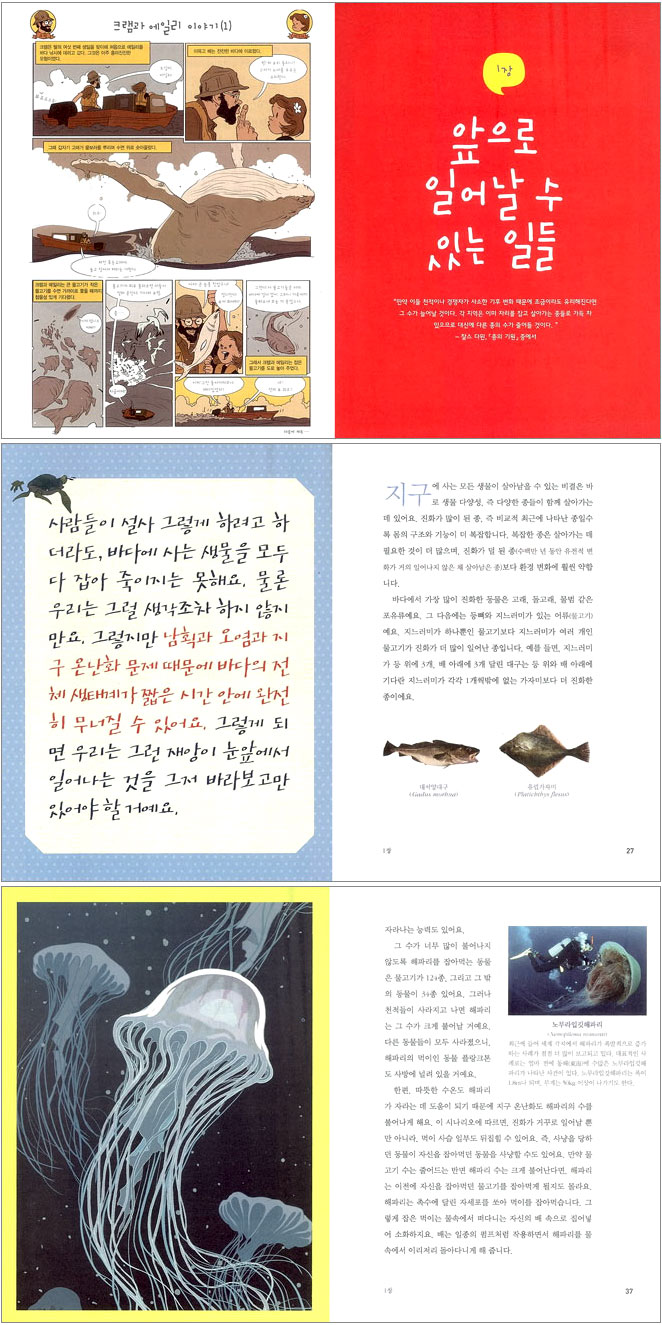
Unique editing and a comic for tomorrow: The Story of Cram and Ailee
"The World Without Fish" is designed with a unique text editing that will capture the attention of children.
The emphasis on the size and color of the text, along with Frank Stockton's splendid illustrations, soften the book's otherwise somewhat stiff content.
Additionally, each chapter ends with a cartoon by Stockton.
This serialized comic consists of 11 parts and condenses the theme of the book, 'Fish Extinction and the Destruction of the Ocean'.
In the cartoon, Cram and Ailee's efforts to protect the ocean and fish end in failure, ultimately leading to the extinction of fish. Through this cartoon, which is familiar to children these days, it raises awareness about our indifference and misguided beliefs.
This comic is a great work in itself.
A sad and surprising story about fish and the sea!
“A book that sounds the alarm about the most surprising and unknown disaster of our time—the death of the oceans—and suggests ways to solve this crisis!”
The first children's book to address fish extinction and ocean problems!
Mark Kurlansky is a renowned food and history expert and nonfiction writer.
His books, "Cod," "Salt," and "The Giant Oyster," were New York Times bestsellers and received numerous awards, including the Beard Award and the New York Public Library's Best Book of the Year.
In particular, "Cod," which delved into the cruel history of fish, contributed greatly to raising people's interest in fish.
Kurlansky, who has always had a special interest in fish, has published a book titled "A World Without Fish," which presents both a warning about the extinction of fish and hope for saving the ocean, based on his extensive data and extensive knowledge.
In the East Sea, pollack almost disappeared about 10 years ago.
Even after the Fukushima Daiichi nuclear power plant accident in 2011, contaminated water continues to pollute the ocean, with “12 tons of highly radioactive contaminated water from the Fukushima Daiichi Nuclear Power Plant flowing into the ocean”.
Some claim that the floating "plastic island" of marine debris in the Pacific Ocean is twice the size of the United States.
In 2010, the Gulf of Mexico experienced the largest oil spill in history, covering 63 million square kilometers of the Gulf of Mexico in an oil slick.
However, in Korea, there are still no children's books that deal with topics such as ocean destruction, fish extinction, and fishing problems in earnest.
Even though we are surrounded by the sea on three sides, it is closely related to us.
In particular, there is almost no interest in fish.
This may be, as the author says, “because fish belong to a different class than us,” or it may be due to “the false myth about the abundance of nature that fish can never go extinct.”
That's why this book will bring children a surprising and unprecedented understanding of the ocean and fish.
Rachel Carson's "Silent Spring" and Mark Kurlansky's "The Silent Sea"
If we continue at our current rate, will fish disappear within the next 50 years? If the three major causes cited by the author—overfishing, ocean pollution, and global warming—continue at their current rates, fish extinction is not a distant future.
"A World Without Fish" tells the story of how and why common fish we eat, including tuna, salmon, and cod, could become extinct in the future, and what dangers all life, including seabirds, reptiles, and mammals, will face in their wake.
In her environmental classic "Silent Spring," which warned against the indiscriminate abuse of pesticides and chemicals and instilled a new awareness of the environment, Rachel Carson told a terrifying "fable for tomorrow" that the sounds of spring and birds could disappear if pesticides, insecticides, and herbicides continue to be indiscriminately used.
Mark Kurlansky also warns that if the oceans and fish continue to suffer this kind of damage, we will no longer hear the songs of dolphins or see the picturesque dances of flocks of birds in seas overrun with jellyfish and turned orange by red tide.
The protagonist of the tragedy is ultimately human!
The causes of the tragedies that are happening (and could happen) at sea now are mostly on land, and these tragedies will gradually spread there.
Who will be the protagonist and victim of this tragedy? It's none other than humans, at the very top of the food chain.
So, are the protagonists of this tragedy "villains plotting an evil scheme to lead the Earth to destruction"? No.
They are just ordinary, good people.
Kurlansky ultimately says that if things continue as they are, the next 50 years will bring about changes greater than the revolutionary changes experienced after the Industrial Revolution.
Myths about Nature's Abundance and Scientists' Misconceptions
It is not known when humans first began catching fish.
However, with the introduction of bottom trawl fishing in England in the 14th century, the development of beam trawl fishing vessels in the 18th century, and the subsequent development of tanks, the development of railways, the invention of steam-powered fishing vessels, and the development of nets, fishing has grown into a large-scale industry, and as fishing vessels roam the world's oceans, marine ecosystems are rapidly being destroyed.
However, people have long believed in the 'abundance of nature', that nature is inherently abundant and can never be exhausted no matter how much is wasted.
Fish are no exception.
Rather, fish were considered particularly difficult creatures to eliminate.
The biggest reason, he said, was because they 'lay a lot of eggs' (for example, cod lays 3 to 9 million eggs).
These myths? The people who questioned them were fishermen, not scientists.
Fishermen themselves have warned that mass overfishing could lead to fish extinction.
However, scientists who believe in the myth of 'nature's abundance' have turned a blind eye to this.
But recently, scientists have discovered that only one to six fish eggs survive.
The story of Orange Ruffy, a sad lesson
Also, as the fish in the coastal waters gradually dried up, people began to go further out to sea to catch fish.
And this soon brought disaster.
The representative fish species is orange roughy.
Orange Ruffy has a long lifespan.
However, as their lifespan is long, they also give birth late.
However, many orange roughies that appear fully grown on the outside have not yet experienced reproduction.
Ultimately, the orange roughy is now endangered, just a few decades after being discovered by humans.
This sad story of the orange roughy is a warning about what is happening in our oceans today.
How to avoid the worst-case scenario
According to the Food and Agriculture Organization of the United Nations, about two-thirds of all fish species are currently at risk of extinction due to overfishing.
The story is that the entire ocean is in a serious crisis.
If the number of fish species continues to decline at the current rate, the number of commercial fish species will be reduced to a level that is almost irreversible by 2048.
The ecosystem could literally collapse before our eyes.
That's why biodiversity is important.
But all of these are 'worst case scenarios' - what could happen if we do nothing.
"The World Without Fish" is a book that evokes images of apocalyptic destruction, but it is not a book that only shows such tragic images.
Rather, it is a book that urges us (especially children) to take action to prevent this dark future.
It highlights 'sustainable fishing' as the best way to prevent overfishing, and shows how children can play a role in changing the world by starting small and gradually expanding into bigger things.
And he emphasizes to children that they should wake up and take action.
"We absolutely cannot afford to sit idly by and allow a world without fish to become a reality. To do so, we must change our behavior starting now."
Small actions taken every day can change the world.
The book also delves into the history of the fishing industry, the fights between nations over fishing grounds, the creation of Iceland's 200-nautical-mile exclusive economic zone and its problems, the incompetence of government scientists, the loss of livelihoods due to fishing ground closures, pollution from pollutants like oil and chromium, and the serious problems caused by global warming.
But what this book should focus on is how we can stop what is happening in the ocean now.
In this regard, Kurlansky points out problems with several methods currently being discussed, such as fish farming, catch limits, fishing season restrictions, and fishery closures.
Ultimately, the 'best way' the author suggests is sustainable fishing.
In particular, it points out the harmful effects of bottom trawling, which depletes fish populations.
They also emphasize being suspicious of sudden increases in new fish availability, avoiding endangered fish (e.g., sharks, tuna), eating fish from sustainable fisheries and those lower down the food chain, and choosing stores that sell fish caught through sustainable fishing practices.
Ultimately, this book reminds us of the important truth that small actions can change our future, as Jane Goodall said, “Small actions taken every day can change the world.”
Unique editing and a comic for tomorrow: The Story of Cram and Ailee
"The World Without Fish" is designed with a unique text editing that will capture the attention of children.
The emphasis on the size and color of the text, along with Frank Stockton's splendid illustrations, soften the book's otherwise somewhat stiff content.
Additionally, each chapter ends with a cartoon by Stockton.
This serialized comic consists of 11 parts and condenses the theme of the book, 'Fish Extinction and the Destruction of the Ocean'.
In the cartoon, Cram and Ailee's efforts to protect the ocean and fish end in failure, ultimately leading to the extinction of fish. Through this cartoon, which is familiar to children these days, it raises awareness about our indifference and misguided beliefs.
This comic is a great work in itself.
GOODS SPECIFICS
- Date of issue: April 15, 2012
- Page count, weight, size: 202 pages | 520g | 188*240*20mm
- ISBN13: 9788991550353
- ISBN10: 8991550355
You may also like
카테고리
korean


korean

![GQ KOREA Mark (Monthly): December [2025]](http://librairie.coreenne.fr/cdn/shop/files/8ef265dbbfbf186523ed75ba7319009d.jpg?v=1765340328&width=3840)


