

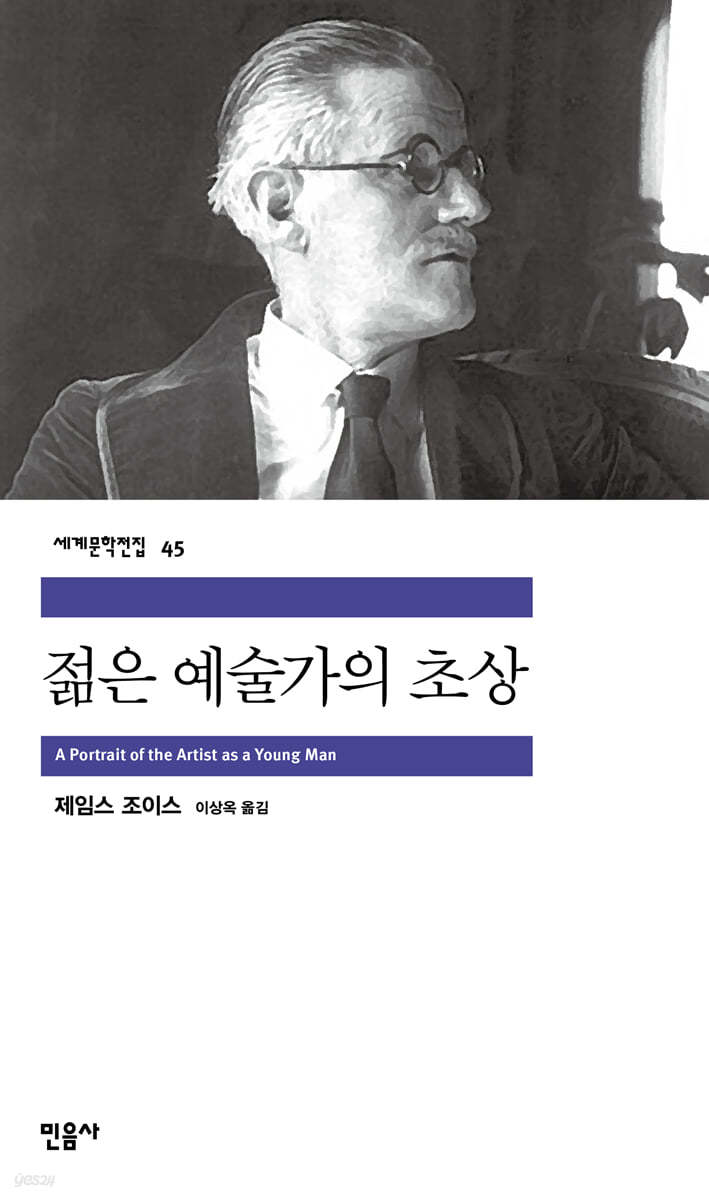
Portrait of a Young Artist
 |
Description
Book Introduction
A masterpiece by James Joyce, a leading writer of 20th-century modernist literature
An autobiographical novel depicting the growth of an artist who goes beyond purity and corruption to reach transcendence.
Experimental techniques and the "revolution of sensibility" that had a profound impact on the development of modern fiction.
“As freely as possible, as completely as possible.”
How Artists Are Born = How We Grow
A Portrait of the Artist as a Young Man is a Bildungsroman (coming-of-age novel) that depicts the growth of the protagonist, Stephen Dedalus, from infancy to adolescence.
In particular, as an artist's novel (Kunstlerroman) that depicts the process of an artist's growth, it belongs to the lineage of Goethe's 'Wilhelm Meister's Apprenticeship' and Stendhal's 'The Life of Henri Brûlard'.
This work is also an autobiographical novel, as Stephen is modeled after the author James Joyce himself.
The author's narrative focuses on the protagonist's exploration of self-image and spiritual growth, and here we get a glimpse into James Joyce's life as an artist.
Through Steven, who spends his formative years discovering himself for the future and contemplating the reality that binds him, we discover aspects of life that everyone can relate to.
An autobiographical novel depicting the growth of an artist who goes beyond purity and corruption to reach transcendence.
Experimental techniques and the "revolution of sensibility" that had a profound impact on the development of modern fiction.
“As freely as possible, as completely as possible.”
How Artists Are Born = How We Grow
A Portrait of the Artist as a Young Man is a Bildungsroman (coming-of-age novel) that depicts the growth of the protagonist, Stephen Dedalus, from infancy to adolescence.
In particular, as an artist's novel (Kunstlerroman) that depicts the process of an artist's growth, it belongs to the lineage of Goethe's 'Wilhelm Meister's Apprenticeship' and Stendhal's 'The Life of Henri Brûlard'.
This work is also an autobiographical novel, as Stephen is modeled after the author James Joyce himself.
The author's narrative focuses on the protagonist's exploration of self-image and spiritual growth, and here we get a glimpse into James Joyce's life as an artist.
Through Steven, who spends his formative years discovering himself for the future and contemplating the reality that binds him, we discover aspects of life that everyone can relate to.
- You can preview some of the book's contents.
Preview
Into the book
God, bless my father and mother so that they may live with me!
God, bless my younger siblings and let them live with me!
God, bless Danti and Uncle Charles, and let them live with me!
After making the sign of the cross, he quickly climbed into bed, tucked the ends of his pajamas under his feet, and lay shivering, curled up under the cold white sheets.
If you pray, you won't go to hell even if you die.
The shaking would stop, and a voice would be heard telling the boys in the dormitory to sleep well.
Looking out over the covering, he saw yellow curtains surrounding him in front of the bed and on all sides.
The gas lamp was quietly dimming.
The sound of the cadet's footsteps faded away.
Where was he going? Should he go down the stairs and follow the hallway? It was dark.
At night, a black dog, its eyes blazing like a carriage lantern, wanders through the darkness. Is this true? The dog is said to be the ghost of a murderer.
He trembled for a long time because of fear.
The castle's gloomy entrance came into view.
Old servants in old clothes were in the ironing room at the top of the stairs.
It was a long time ago.
The old servants were silent.
There was a light in the room, but the hallway was still dark.
Someone was coming up the stairs from the front door.
He was wearing a white coat, the uniform of a marshal, but his face was pale and strange-looking, and he was pressing one hand to his side.
He looked at the servants with a strange look.
The servants looked at him, and as they examined their master's face and coat, they saw that he was mortally wounded.
God, bless my younger siblings and let them live with me!
God, bless Danti and Uncle Charles, and let them live with me!
After making the sign of the cross, he quickly climbed into bed, tucked the ends of his pajamas under his feet, and lay shivering, curled up under the cold white sheets.
If you pray, you won't go to hell even if you die.
The shaking would stop, and a voice would be heard telling the boys in the dormitory to sleep well.
Looking out over the covering, he saw yellow curtains surrounding him in front of the bed and on all sides.
The gas lamp was quietly dimming.
The sound of the cadet's footsteps faded away.
Where was he going? Should he go down the stairs and follow the hallway? It was dark.
At night, a black dog, its eyes blazing like a carriage lantern, wanders through the darkness. Is this true? The dog is said to be the ghost of a murderer.
He trembled for a long time because of fear.
The castle's gloomy entrance came into view.
Old servants in old clothes were in the ironing room at the top of the stairs.
It was a long time ago.
The old servants were silent.
There was a light in the room, but the hallway was still dark.
Someone was coming up the stairs from the front door.
He was wearing a white coat, the uniform of a marshal, but his face was pale and strange-looking, and he was pressing one hand to his side.
He looked at the servants with a strange look.
The servants looked at him, and as they examined their master's face and coat, they saw that he was mortally wounded.
--- pp.30-31
Publisher's Review
A pioneering novel in 20th-century modernist literature
A Portrait of the Artist as a Young Man has also been evaluated as a work that represents Western modernist thought and pioneered the formal tradition of modern novels due to its use of experimental techniques and its sensual approach to reality.
What particularly catches our attention in this novel is the fact that the so-called stream of consciousness technique is attempted.
Although the novel takes the form of a perfect third-person novel, theoretically the stream-of-consciousness technique cannot be fully utilized, Stephen's conscious world is expressed throughout the novel in a way that is reminiscent of this modern technique.
This technique was used in earnest in Joyce's subsequent problematic work, Ulysses.
The work also chronicles the intellectual, religious, and artistic struggles the protagonist experiences from childhood through college, with the connections between each event appearing like thousands of scattered puzzle pieces.
Some are recalled through the 'flashback' technique, and in reality, it gives the impression that events and scenes over several days are being recorded in a complex manner.
Moreover, in this spotlight-style narrative method, the revelatory meaning of symbolic scenes, which Joyce himself called epiphanies, is revealed.
And what makes Joyce a modern writer, and what makes this novel a modern novel, is the way it perceives reality.
In Stephen's understanding of reality, we find a new method that is difficult to find in conventional novels: the sensory method of understanding reality.
The sound of a cricket bat making a peck, a peck, a puck, a pop, is an example of a feeling of auditory imagery of water drops from a fountain falling into a basin, or of pride, hope, and desire rising in one's heart like herbs, which can be called a revolution of sensibility in modern literature.
New translation, with friendly commentary notes
The translation of this work was done by Professor Lee Sang-ok of the Department of English Literature at Seoul National University.
He has demonstrated a natural Korean translation through 『Heart of Darkness』(Joseph Conrad), and in this book, in addition to the meticulous translation, he has placed 473 notes throughout the work.
This work was published in the English-speaking world in 1912, so readers who feel a temporal and cultural distance may find it easier to read.
A Portrait of the Artist as a Young Man has also been evaluated as a work that represents Western modernist thought and pioneered the formal tradition of modern novels due to its use of experimental techniques and its sensual approach to reality.
What particularly catches our attention in this novel is the fact that the so-called stream of consciousness technique is attempted.
Although the novel takes the form of a perfect third-person novel, theoretically the stream-of-consciousness technique cannot be fully utilized, Stephen's conscious world is expressed throughout the novel in a way that is reminiscent of this modern technique.
This technique was used in earnest in Joyce's subsequent problematic work, Ulysses.
The work also chronicles the intellectual, religious, and artistic struggles the protagonist experiences from childhood through college, with the connections between each event appearing like thousands of scattered puzzle pieces.
Some are recalled through the 'flashback' technique, and in reality, it gives the impression that events and scenes over several days are being recorded in a complex manner.
Moreover, in this spotlight-style narrative method, the revelatory meaning of symbolic scenes, which Joyce himself called epiphanies, is revealed.
And what makes Joyce a modern writer, and what makes this novel a modern novel, is the way it perceives reality.
In Stephen's understanding of reality, we find a new method that is difficult to find in conventional novels: the sensory method of understanding reality.
The sound of a cricket bat making a peck, a peck, a puck, a pop, is an example of a feeling of auditory imagery of water drops from a fountain falling into a basin, or of pride, hope, and desire rising in one's heart like herbs, which can be called a revolution of sensibility in modern literature.
New translation, with friendly commentary notes
The translation of this work was done by Professor Lee Sang-ok of the Department of English Literature at Seoul National University.
He has demonstrated a natural Korean translation through 『Heart of Darkness』(Joseph Conrad), and in this book, in addition to the meticulous translation, he has placed 473 notes throughout the work.
This work was published in the English-speaking world in 1912, so readers who feel a temporal and cultural distance may find it easier to read.
GOODS SPECIFICS
- Date of issue: March 31, 2001
- Page count, weight, size: 403 pages | 535g | 132*225*30mm
- ISBN13: 9788937460456
- ISBN10: 8937460459
You may also like
카테고리
korean


korean

![GQ KOREA Mark (Monthly): December [2025]](http://librairie.coreenne.fr/cdn/shop/files/8ef265dbbfbf186523ed75ba7319009d.jpg?v=1765340328&width=3840)


