

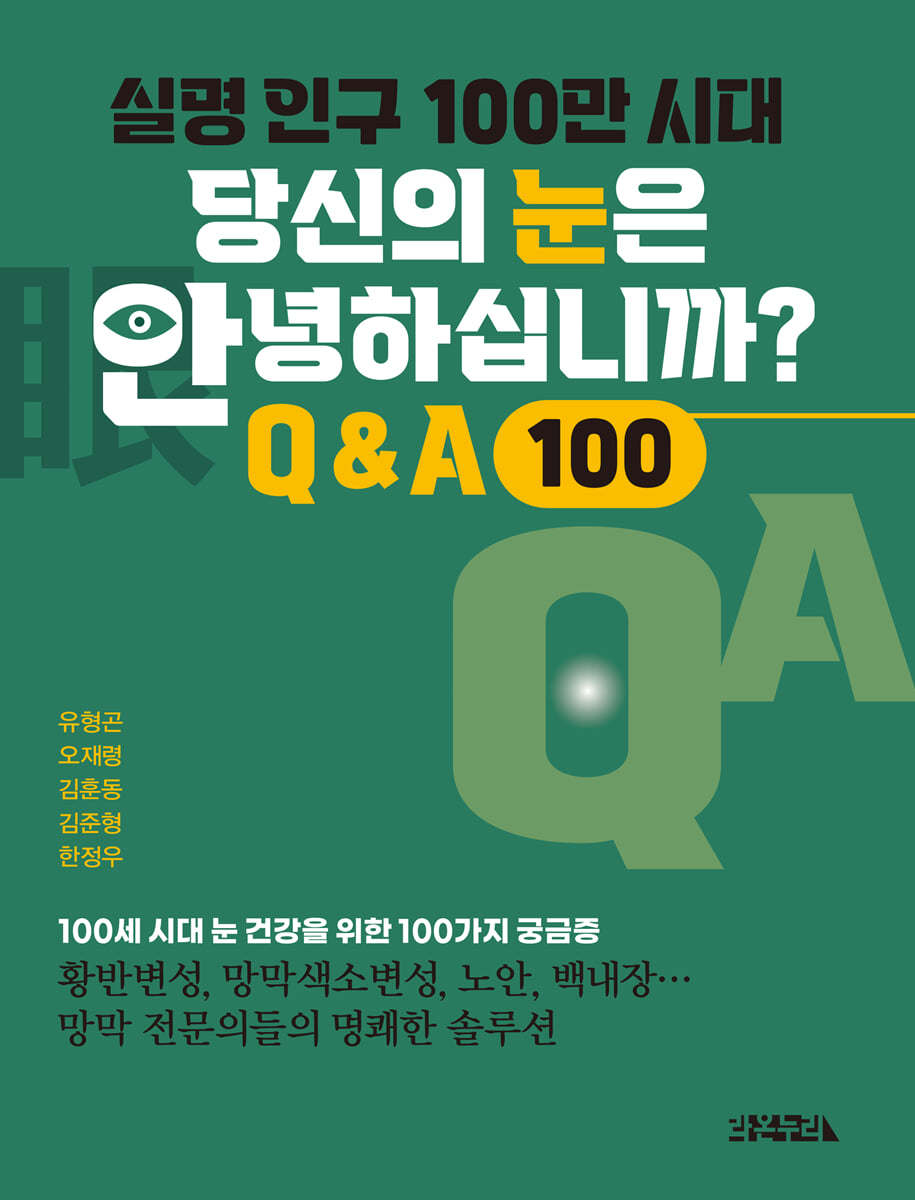
In an era with a population of 1 million, are your eyes healthy?
 |
Description
Book Introduction
A book that answers the questions of modern people amidst the real-name crisis.
According to a report by the World Health Organization (WHO), at least 2.2 billion people worldwide suffer from visual impairment, and of these, approximately 40 million are classified as "visually impaired" with vision impairment severe enough to interfere with daily life.
Eye-related diseases are often closely related to aging, and in Korea, where the population is rapidly aging, the number of people at risk of blindness is expected to exceed 800,000 to 1 million, and this number is expected to increase further in the future.
The fact that one million people have moderate to severe blindness is more than just a statistic.
Blindness is not simply a loss of sight; it is a profound loss that limits access to the world, autonomy, and even social relationships, making it a situation that demands the attention of everyone living in the information age.
This book is written by retina specialists who have seen patients in clinics and operating rooms, and provides easy-to-understand answers to 100 questions from patients and anyone concerned about their eye health.
According to a report by the World Health Organization (WHO), at least 2.2 billion people worldwide suffer from visual impairment, and of these, approximately 40 million are classified as "visually impaired" with vision impairment severe enough to interfere with daily life.
Eye-related diseases are often closely related to aging, and in Korea, where the population is rapidly aging, the number of people at risk of blindness is expected to exceed 800,000 to 1 million, and this number is expected to increase further in the future.
The fact that one million people have moderate to severe blindness is more than just a statistic.
Blindness is not simply a loss of sight; it is a profound loss that limits access to the world, autonomy, and even social relationships, making it a situation that demands the attention of everyone living in the information age.
This book is written by retina specialists who have seen patients in clinics and operating rooms, and provides easy-to-understand answers to 100 questions from patients and anyone concerned about their eye health.
- You can preview some of the book's contents.
Preview
index
● Introduction
● Recommendation 1
● Recommendation 2
PART 1 Frequently Asked Questions Before Visiting an Ophthalmologist
1.
If I have an eye problem, should I go to my local ophthalmologist? What's the first thing I should do?
2.
Can macular degeneration be cured after it has occurred?
3.
Can the blue light from smartphones and PC monitors be harmful to your eyes?
4.
I heard that even young people in their 30s and 40s are getting macular degeneration these days. Is that true?
5.
Do outdoor activities when fine dust and UV index are high affect macular degeneration?
6.
I had cataract surgery, but why can't I see well?
7.
Is retinitis pigmentosa similar to macular degeneration or a different disease?
8.
I have macular degeneration. Can I still drive?
9.
When you are blinded by the headlights of an oncoming car, you are told to look around. What function of the eye is this for?
PART 2 Common Sense About Eyes and Questions in Daily Life
10.
They say the real-name population is 1 million, but I'm curious about the criteria for real-name use and the basis and trends behind the statistical figures.
11.
How do I know if I have presbyopia?
12.
Do blackout glasses with small holes help improve vision, including eye muscle control?
13.
They say Mongolians have the best eyesight. Is this due to genetics or some other factor?
14.
Is it true that doing up-down-left-right eye movements or looking at the color green improves your eyesight?
15.
Wouldn't it be better to avoid wearing glasses if possible to prevent your eyesight from getting worse?
16.
After putting in eye drops, do I need to blink my eyes to help the medicine absorb better?
17.
Is it okay to refer to explanations from doctors on YouTube and blogs?
18.
Will reading a book in a dark place at night damage my eyes?
19.
Are short-term treatments like eye massage and eye exercise equipment credible?
PART 3 Curious Stories About Eyes and Vision
20.
What did eyes mean to ancient people?
21.
I want to know how the eye sees things.
22.
I am curious about the structure and function of the retina and macula.
23.
Please tell me how to measure visual acuity in patients with macular degeneration.
24.
What tests are needed to check the condition of the retina?
25.
Can you detect signs of other diseases with your eyes?
26.
What causes color blindness, which makes it difficult to distinguish colors?
PART 4 The development and progression of age-related macular degeneration
27.
What is the condition of the macula being 'degenerated'?
28.
How can we prevent and treat age-related macular degeneration?
29.
How do you know if you have macular degeneration?
30.
I am curious about the causes and progression of macular degeneration.
31.
What are the symptoms of late-stage macular degeneration?
32.
Are there different types of macular degeneration?
PART 5 Questions about retinal disease and presbyopia
33.
What is the difference between macular degeneration and presbyopia?
34.
Is there a connection between myopia (short-sightedness) and macular degeneration?
35.
What is the difference between macular degeneration and cataracts?
36.
Does macular degeneration start with aging of the macula?
37.
I'm curious about a macular disease called 'epiretinal membrane'.
38.
If a family member has been diagnosed with macular degeneration, should other family members be screened as well?
39.
My family is fine, so why did I get it? Is macular degeneration hereditary?
40.
What is central serous chorioretinopathy?
41.
What is retinal vein occlusion?
42.
Is presbyopia surgery safe enough to undergo?
43.
What causes objects to appear curved?
44.
Are presbyopia glasses that are sold off-the-shelf and of different prescriptions harmful to the eyes?
PART 6 Risk factors and prevention of macular degeneration
45.
How should I determine the timing of treatment for macular degeneration?
46.
Are there differences in the incidence of macular degeneration between men and women?
47.
I have diabetes, high blood pressure, and high cholesterol. Could this be related to macular degeneration?
48.
I am taking aspirin-based medication. Should I stop taking it when I am being treated for macular degeneration?
49.
How are cardiovascular and cerebrovascular diseases related to macular degeneration?
50.
How do drinking and smoking affect macular degeneration?
51.
How is macular degeneration related to other eye conditions, such as cataracts?
52.
What should I be aware of when self-diagnosing macular degeneration?
53.
What are the risks of exposing your eyes to UV rays?
PART 7 Treatment and Management of (Dry) Macular Degeneration
54.
What is dry macular degeneration?
55.
Please tell me how to self-examine for dry macular degeneration.
56.
Please tell me about the regular ophthalmological examination process for dry macular degeneration.
57.
Please tell me about screening for patients with advanced macular degeneration.
58.
Please tell me about retinal pigment epithelial cell transplantation using embryonic stem cells.
59.
I am curious about the lifestyle habits and management methods of patients with dry macular degeneration.
60.
Please tell me about the current treatment options for dry macular degeneration.
61.
What medications are available to help with dry macular degeneration?
62.
Is there any way to treat macular degeneration with medication?
63.
I am curious about the treatment process for low vision patients who have already suffered significant vision loss due to advanced macular degeneration.
64.
Please tell me how to effectively block UV rays.
65.
I have macular degeneration. Can I still get cataract surgery?
66.
I heard there is also artificial retina transplant surgery. Is it expensive?
PART 8 (Wet) Treatment and Management of Macular Degeneration
67.
Diagnosing Wet Age-Related ...
68.
What medications are used to treat wet macular degeneration?
69.
How many injections into the eye should I get?
70.
What treatments are available for wet macular degeneration?
71.
What is photodynamic therapy?
72.
I'm curious about the know-how to manage macular degeneration.
73.
What if you have already lost significant vision?
74.
Are there any complications or other problems after treatment for wet macular degeneration?
75.
They say my condition has improved on the test, but I don't feel it.
PART 9 Foods and Eating Habits Good for Macular Degeneration
76.
What is the relationship between macular degeneration and what we eat?
77.
What vegetables and fruits are good for eye health?
78.
I heard there are some beneficial foods that increase macular pigment?
79.
I usually enjoy tea and coffee. Is it okay for me to drink tea or coffee with macular degeneration?
80.
I'm taking omega-3s. Will this also help prevent macular degeneration?
81.
Beans are said to be good for your health, but are they also good for your eyes?
82.
When preparing food, are there any special cooking methods that are good for eye health?
PART 10 Questions about Retinitis Pigmentosa
83.
What is retinitis pigmentosa and why does it occur?
84.
How is retinal degeneration or macular degeneration different from retinitis pigmentosa?
85.
Does everyone with night blindness have retinitis pigmentosa?
86.
I am the only one in my family with retinitis pigmentosa. Can I still plan to get pregnant and have children?
87.
Is there any way to prevent retinitis pigmentosa from becoming hereditary?
88.
Are eye injection treatments for macular degeneration also applicable to retinitis pigmentosa?
89.
They say there is no fundamental treatment for retinitis pigmentosa, so should I still visit an ophthalmologist?
90.
What are the other ophthalmic complications of retinitis pigmentosa?
91.
Are antioxidants like vitamins effective for patients with retinitis pigmentosa?
92.
Are there any factors that cause retinitis pigmentosa to progress more quickly?
93.
Are there acute and chronic types of retinitis pigmentosa?
94.
Are floaters and flashes of light also caused by retinitis pigmentosa?
95.
Does looking at monitors, smartphones, books, etc. a lot affect the course of retinitis pigmentosa?
96.
I heard that if you have retinitis pigmentosa, your field of vision narrows. Does your eyesight also deteriorate at the same time?
97.
Are there cases where I have been diagnosed with retinitis pigmentosa but do not have symptoms or symptoms improve?
98.
How do patients with retinitis pigmentosa get prescribed vision aids?
99.
What lifestyle habits are helpful for people with retinitis pigmentosa?
100.
Please tell me about an organization or place of counseling that can help with vision and retinal diseases.
● Appendix: Amsler grid for self-diagnosis
● Recommendation 1
● Recommendation 2
PART 1 Frequently Asked Questions Before Visiting an Ophthalmologist
1.
If I have an eye problem, should I go to my local ophthalmologist? What's the first thing I should do?
2.
Can macular degeneration be cured after it has occurred?
3.
Can the blue light from smartphones and PC monitors be harmful to your eyes?
4.
I heard that even young people in their 30s and 40s are getting macular degeneration these days. Is that true?
5.
Do outdoor activities when fine dust and UV index are high affect macular degeneration?
6.
I had cataract surgery, but why can't I see well?
7.
Is retinitis pigmentosa similar to macular degeneration or a different disease?
8.
I have macular degeneration. Can I still drive?
9.
When you are blinded by the headlights of an oncoming car, you are told to look around. What function of the eye is this for?
PART 2 Common Sense About Eyes and Questions in Daily Life
10.
They say the real-name population is 1 million, but I'm curious about the criteria for real-name use and the basis and trends behind the statistical figures.
11.
How do I know if I have presbyopia?
12.
Do blackout glasses with small holes help improve vision, including eye muscle control?
13.
They say Mongolians have the best eyesight. Is this due to genetics or some other factor?
14.
Is it true that doing up-down-left-right eye movements or looking at the color green improves your eyesight?
15.
Wouldn't it be better to avoid wearing glasses if possible to prevent your eyesight from getting worse?
16.
After putting in eye drops, do I need to blink my eyes to help the medicine absorb better?
17.
Is it okay to refer to explanations from doctors on YouTube and blogs?
18.
Will reading a book in a dark place at night damage my eyes?
19.
Are short-term treatments like eye massage and eye exercise equipment credible?
PART 3 Curious Stories About Eyes and Vision
20.
What did eyes mean to ancient people?
21.
I want to know how the eye sees things.
22.
I am curious about the structure and function of the retina and macula.
23.
Please tell me how to measure visual acuity in patients with macular degeneration.
24.
What tests are needed to check the condition of the retina?
25.
Can you detect signs of other diseases with your eyes?
26.
What causes color blindness, which makes it difficult to distinguish colors?
PART 4 The development and progression of age-related macular degeneration
27.
What is the condition of the macula being 'degenerated'?
28.
How can we prevent and treat age-related macular degeneration?
29.
How do you know if you have macular degeneration?
30.
I am curious about the causes and progression of macular degeneration.
31.
What are the symptoms of late-stage macular degeneration?
32.
Are there different types of macular degeneration?
PART 5 Questions about retinal disease and presbyopia
33.
What is the difference between macular degeneration and presbyopia?
34.
Is there a connection between myopia (short-sightedness) and macular degeneration?
35.
What is the difference between macular degeneration and cataracts?
36.
Does macular degeneration start with aging of the macula?
37.
I'm curious about a macular disease called 'epiretinal membrane'.
38.
If a family member has been diagnosed with macular degeneration, should other family members be screened as well?
39.
My family is fine, so why did I get it? Is macular degeneration hereditary?
40.
What is central serous chorioretinopathy?
41.
What is retinal vein occlusion?
42.
Is presbyopia surgery safe enough to undergo?
43.
What causes objects to appear curved?
44.
Are presbyopia glasses that are sold off-the-shelf and of different prescriptions harmful to the eyes?
PART 6 Risk factors and prevention of macular degeneration
45.
How should I determine the timing of treatment for macular degeneration?
46.
Are there differences in the incidence of macular degeneration between men and women?
47.
I have diabetes, high blood pressure, and high cholesterol. Could this be related to macular degeneration?
48.
I am taking aspirin-based medication. Should I stop taking it when I am being treated for macular degeneration?
49.
How are cardiovascular and cerebrovascular diseases related to macular degeneration?
50.
How do drinking and smoking affect macular degeneration?
51.
How is macular degeneration related to other eye conditions, such as cataracts?
52.
What should I be aware of when self-diagnosing macular degeneration?
53.
What are the risks of exposing your eyes to UV rays?
PART 7 Treatment and Management of (Dry) Macular Degeneration
54.
What is dry macular degeneration?
55.
Please tell me how to self-examine for dry macular degeneration.
56.
Please tell me about the regular ophthalmological examination process for dry macular degeneration.
57.
Please tell me about screening for patients with advanced macular degeneration.
58.
Please tell me about retinal pigment epithelial cell transplantation using embryonic stem cells.
59.
I am curious about the lifestyle habits and management methods of patients with dry macular degeneration.
60.
Please tell me about the current treatment options for dry macular degeneration.
61.
What medications are available to help with dry macular degeneration?
62.
Is there any way to treat macular degeneration with medication?
63.
I am curious about the treatment process for low vision patients who have already suffered significant vision loss due to advanced macular degeneration.
64.
Please tell me how to effectively block UV rays.
65.
I have macular degeneration. Can I still get cataract surgery?
66.
I heard there is also artificial retina transplant surgery. Is it expensive?
PART 8 (Wet) Treatment and Management of Macular Degeneration
67.
Diagnosing Wet Age-Related ...
68.
What medications are used to treat wet macular degeneration?
69.
How many injections into the eye should I get?
70.
What treatments are available for wet macular degeneration?
71.
What is photodynamic therapy?
72.
I'm curious about the know-how to manage macular degeneration.
73.
What if you have already lost significant vision?
74.
Are there any complications or other problems after treatment for wet macular degeneration?
75.
They say my condition has improved on the test, but I don't feel it.
PART 9 Foods and Eating Habits Good for Macular Degeneration
76.
What is the relationship between macular degeneration and what we eat?
77.
What vegetables and fruits are good for eye health?
78.
I heard there are some beneficial foods that increase macular pigment?
79.
I usually enjoy tea and coffee. Is it okay for me to drink tea or coffee with macular degeneration?
80.
I'm taking omega-3s. Will this also help prevent macular degeneration?
81.
Beans are said to be good for your health, but are they also good for your eyes?
82.
When preparing food, are there any special cooking methods that are good for eye health?
PART 10 Questions about Retinitis Pigmentosa
83.
What is retinitis pigmentosa and why does it occur?
84.
How is retinal degeneration or macular degeneration different from retinitis pigmentosa?
85.
Does everyone with night blindness have retinitis pigmentosa?
86.
I am the only one in my family with retinitis pigmentosa. Can I still plan to get pregnant and have children?
87.
Is there any way to prevent retinitis pigmentosa from becoming hereditary?
88.
Are eye injection treatments for macular degeneration also applicable to retinitis pigmentosa?
89.
They say there is no fundamental treatment for retinitis pigmentosa, so should I still visit an ophthalmologist?
90.
What are the other ophthalmic complications of retinitis pigmentosa?
91.
Are antioxidants like vitamins effective for patients with retinitis pigmentosa?
92.
Are there any factors that cause retinitis pigmentosa to progress more quickly?
93.
Are there acute and chronic types of retinitis pigmentosa?
94.
Are floaters and flashes of light also caused by retinitis pigmentosa?
95.
Does looking at monitors, smartphones, books, etc. a lot affect the course of retinitis pigmentosa?
96.
I heard that if you have retinitis pigmentosa, your field of vision narrows. Does your eyesight also deteriorate at the same time?
97.
Are there cases where I have been diagnosed with retinitis pigmentosa but do not have symptoms or symptoms improve?
98.
How do patients with retinitis pigmentosa get prescribed vision aids?
99.
What lifestyle habits are helpful for people with retinitis pigmentosa?
100.
Please tell me about an organization or place of counseling that can help with vision and retinal diseases.
● Appendix: Amsler grid for self-diagnosis
Into the book
Facing the era of 1 million real-name population
According to a report by the World Health Organization (WHO), at least 2.2 billion people worldwide suffer from visual impairment, and of these, approximately 40 million are classified as "blind" with severe vision impairment.
This means that approximately one-quarter of the world's population experiences vision problems, and many of them have vision loss that interferes with their daily lives.
Visual impairment is more than just an inconvenience; it is a serious health issue that deeply affects quality of life and social independence.
In developing countries, uncorrected refractive errors and untreated cataracts are still the main causes, but in countries with advanced medical technology like ours, the situation is different.
Although the prevalence of refractive surgery and cataract surgery has significantly reduced the incidence of blindness due to these procedures, retinal diseases and glaucoma remain major causes of blindness.
These diseases are largely related to aging, and in Korea, where the population is rapidly aging, the number of people at risk of blindness is expected to exceed 800,000 to 1 million and increase further in the future (see page 30 for the current status of the blind population).
The fact that one million people have moderate to severe blindness is more than just a statistic.
Reality isn't just one person's problem.
Being blind is not just about losing sight, it's about a profound loss that limits our access to the world, our autonomy, and even our social relationships.
Many of the patients I've met in my practice have been living with the anxiety, fear, and sometimes frustration that changes in their vision bring.
Their stories, their silence, and their gazes were the greatest motivation and driving force that led me to start this book.
This book explores the causes of blindness and the direction we must all take, from the perspectives of retina specialists who have encountered patients in their clinics and operating rooms, and from the perspectives of educators who have contemplated the future of medicine.
I would like to express my deepest gratitude to Professor Oh Jae-ryeong of Korea University Anam Hospital, Professor Kim Hoon-dong of Soonchunhyang University Cheonan Hospital, Professor Kim Jun-hyeong of CHA University Bundang Hospital, and Professor Han Jeong-woo of Soonchunhyang University Bucheon Hospital for their hard work in helping to publish this book.
Above all, I would like to take this opportunity to express my sincere respect and gratitude to the patients who have taught me the most.
The era of visual impairment, the era of one million blind people.
We invite you on this journey to explore the countless stories and possibilities behind those numbers.
Yoo Hyeong-gon
Doctor of Medicine, President of the Korean Retinal Degeneration Association / Former Professor at Seoul National University Hospital, Sky Eye Clinic
According to a report by the World Health Organization (WHO), at least 2.2 billion people worldwide suffer from visual impairment, and of these, approximately 40 million are classified as "blind" with severe vision impairment.
This means that approximately one-quarter of the world's population experiences vision problems, and many of them have vision loss that interferes with their daily lives.
Visual impairment is more than just an inconvenience; it is a serious health issue that deeply affects quality of life and social independence.
In developing countries, uncorrected refractive errors and untreated cataracts are still the main causes, but in countries with advanced medical technology like ours, the situation is different.
Although the prevalence of refractive surgery and cataract surgery has significantly reduced the incidence of blindness due to these procedures, retinal diseases and glaucoma remain major causes of blindness.
These diseases are largely related to aging, and in Korea, where the population is rapidly aging, the number of people at risk of blindness is expected to exceed 800,000 to 1 million and increase further in the future (see page 30 for the current status of the blind population).
The fact that one million people have moderate to severe blindness is more than just a statistic.
Reality isn't just one person's problem.
Being blind is not just about losing sight, it's about a profound loss that limits our access to the world, our autonomy, and even our social relationships.
Many of the patients I've met in my practice have been living with the anxiety, fear, and sometimes frustration that changes in their vision bring.
Their stories, their silence, and their gazes were the greatest motivation and driving force that led me to start this book.
This book explores the causes of blindness and the direction we must all take, from the perspectives of retina specialists who have encountered patients in their clinics and operating rooms, and from the perspectives of educators who have contemplated the future of medicine.
I would like to express my deepest gratitude to Professor Oh Jae-ryeong of Korea University Anam Hospital, Professor Kim Hoon-dong of Soonchunhyang University Cheonan Hospital, Professor Kim Jun-hyeong of CHA University Bundang Hospital, and Professor Han Jeong-woo of Soonchunhyang University Bucheon Hospital for their hard work in helping to publish this book.
Above all, I would like to take this opportunity to express my sincere respect and gratitude to the patients who have taught me the most.
The era of visual impairment, the era of one million blind people.
We invite you on this journey to explore the countless stories and possibilities behind those numbers.
Yoo Hyeong-gon
Doctor of Medicine, President of the Korean Retinal Degeneration Association / Former Professor at Seoul National University Hospital, Sky Eye Clinic
--- From the preface
Publisher's Review
What if we lose our eye health in this smart age?
It is clear that the quality of life will likely decline significantly.
This is because these days, most of the communication is done on smart devices, such as working and making payments, in addition to enjoying entertainment like playing games or watching videos.
Even if it does not lead to complete blindness, the importance of eyesight is greater than ever because suffering from various retinal diseases, including macular degeneration, can cause extreme inconvenience in daily life.
However, compared to the importance of this issue, people's awareness is minimal and remains at the level of vague concern.
Even though I have many questions, I think that it will work out somehow and that I will solve it when I experience a certain illness.
But by then it may be too late to do anything.
However, it is also ambiguous to visit an ophthalmologist even if there is no major discomfort right away.
This book is for everyone, from those who have vague concerns about their eyes to those who already feel discomfort with their eyesight.
From the trivial question of whether turning off the lights at night and looking at your smartphone negatively affects your eyesight to specialized treatments for those already undergoing macular degeneration treatment, this book provides short, clear answers to 100 questions that even the average person can easily understand.
This book, in which the best ophthalmologists in each field working at the Korea Retinal Degeneration Association provide vivid answers based on medical knowledge and clinical results, will provide useful information to many readers due to the nature of ophthalmic diseases, which focus on prevention, status quo maintenance, and delaying symptoms rather than the concept of complete cure.
It is clear that the quality of life will likely decline significantly.
This is because these days, most of the communication is done on smart devices, such as working and making payments, in addition to enjoying entertainment like playing games or watching videos.
Even if it does not lead to complete blindness, the importance of eyesight is greater than ever because suffering from various retinal diseases, including macular degeneration, can cause extreme inconvenience in daily life.
However, compared to the importance of this issue, people's awareness is minimal and remains at the level of vague concern.
Even though I have many questions, I think that it will work out somehow and that I will solve it when I experience a certain illness.
But by then it may be too late to do anything.
However, it is also ambiguous to visit an ophthalmologist even if there is no major discomfort right away.
This book is for everyone, from those who have vague concerns about their eyes to those who already feel discomfort with their eyesight.
From the trivial question of whether turning off the lights at night and looking at your smartphone negatively affects your eyesight to specialized treatments for those already undergoing macular degeneration treatment, this book provides short, clear answers to 100 questions that even the average person can easily understand.
This book, in which the best ophthalmologists in each field working at the Korea Retinal Degeneration Association provide vivid answers based on medical knowledge and clinical results, will provide useful information to many readers due to the nature of ophthalmic diseases, which focus on prevention, status quo maintenance, and delaying symptoms rather than the concept of complete cure.
If you have any problems with your eyes, visit your local ophthalmologist.
Can you help me? What's the first thing I should do?
There is no need to necessarily go to a large hospital like a university hospital if you have any abnormal symptoms in your eyes.
First, visit an ophthalmology clinic near you, and depending on the type of disease, you can receive treatment at that clinic.
If your local ophthalmologist tells you that you need to see a university hospital ophthalmologist, you can see them accordingly.
And, among nearby ophthalmology clinics, we provide specialized treatment according to the director's specialty, so you can receive treatment with confidence.
If you experience vision loss that cannot be corrected with glasses or eye pain, you can visit a nearby ophthalmologist for treatment.
If you experience metamorphopsia, where objects appear distorted, or a central scotoma, there is a possibility of age-related macular degeneration, so it is recommended that you visit an ophthalmologist near you as soon as possible to get checked out.
Blue light from smartphones and PC monitors
Can it harm your eyes?
The light rays that reach Earth from the sun are a mixture of many wavelengths of light.
Light with wavelengths longer than visible light that can be distinguished by the human eye includes infrared rays, microwaves, and radio waves, while light with wavelengths shorter than visible light includes ultraviolet rays, X-rays, and gamma rays.
The rainbow colors of 'red, orange, yellow, green, blue, indigo, violet' are the visible light divided by wavelength.
Blue light literally means blue light among visible light.
It is light with a shorter wavelength than visible light, and a slightly longer wavelength than ultraviolet light.
It is already a known fact that ultraviolet rays can cause various skin diseases and have a negative effect on the eyes, especially the retina.
And it is said that short wavelength light contains more energy than long wavelength light.
There has been speculation that blue light, which has a short wavelength among visible light, can have a negative effect on the eyes.
And recently, as modern people's exposure time to LEDs (Light Emitting Diodes) in small electronic devices such as smartphones and tablets has increased, eye health problems caused by blue light emitted from LEDs have often become an issue.
Although there have been many studies on this, there is still no clear scientific evidence that blue light has a negative effect on the retina.
There are studies that show that blue light causes cataracts or increases the risk of macular degeneration, while there are also studies that show that it has no significant effect on the eyes.
Staring at the light from electronic devices for long periods of time can cause fatigue or worsen dry eye.
In children, there are also studies that show that the longer they spend looking at something close, the higher the risk of myopia progression.
And because blue light can affect the biological rhythm and induce a state of wakefulness, it is said that blue light can increase the risk of sleep disorders, and there are cases where sleep disorders are treated through the appropriate use of blue light.
In conclusion, there is still no clear evidence that blue light exposure alone directly causes macular degeneration.
However, symptoms such as eye fatigue and dry eyes can cause inconvenience in daily life, and research has shown that children can absorb more blue light than adults, so it is safer in many ways for children to refrain from using smart devices for long periods of time.
The real-name population is said to be 800,000, but what is the standard for real-name?
I am curious about the basis and trends of the statistical figures.
As of 2024, there are approximately 250,000 visually impaired people registered in Korea, accounting for approximately 9.4% of all registered disabled people.
However, this is only a number for the 'registered' population, and experts estimate that the actual population suffering from moderate to severe visual impairment may already exceed 1 million.
In other words, the blind population should be viewed as a population whose quality of life is significantly reduced due to visual impairment, even if they have not completely lost their sight.
According to a recent survey by the American Foundation for the Blind, approximately 50 million people in the United States experience vision loss.
Considering that the U.S. population is about six times that of Korea, it is estimated that more than 8 million people in Korea experience visual impairment, either temporary or permanent.
Of course, it would be a reasonable estimate to assume that this figure will increase rather than decrease in the future.
I am curious about the structure and function of the retina and macula.
While other structures of the eye described above serve only as light pathways, the retina, a collection of nerve cells including photoreceptors (photoreceptor cells), acts as a high-performance sensor that converts light into visual information.
The Chinese characters for retina (網膜), which are composed of a net (網) and a membrane (膜), mean 'a membrane tangled like a net', suggesting that its structure is very complex.
Although it is a very thin membrane, 0.2 to 0.3 mm thick, this thin membrane is actually a structure made up of many layers of various nerve cells.
Rather than a simple membrane, it would be more accurate to describe it as a sophisticated structure with complex circuits that continuously receive and transmit signals and various types of information processing devices.
Primarily, photoreceptor cells detect light, but the electrical signals converted here are sequentially transmitted and processed to the following layers, including the inner granular layer and the ganglion cell layer, where various nerve cells exist.
Although each cell layer is separate, it is organically connected to the other layers above and below it, so the processed information is connected to the next layer and ultimately transmitted to the brain.
The macula is the most important part of the retina, the nerve tissue at the very back of the eye.
It is the most rear part of the retina where light enters the eye and an image is formed, and is also the most central part of the entire retina.
The Chinese character for macula (黃斑) means yellow spot or yellow stain, because this area has more yellow-brown pigment distributed than other parts of the retina.
The darker part of the central part of the retina is the macula.
There is a slightly concave area in the center of the macula.
In that area, some of the upper layers of the retina are pushed aside, leaving only the lower layers containing photoreceptors, allowing more light to enter. This structure is unique to primates such as humans.
The photoreceptor cells in the retina can be divided into two types: cones and rods. Cone cells are important for clear vision in bright environments and are involved in distinguishing colors, while rod cells are important for vision in dark environments.
The macula is densely packed with cone cells, which primarily contribute to the formation of central vision.
This special shape and cellular composition of the macula can be said to be a highly functional arrangement for maximizing central vision.
Because the macula is such an important part of maintaining vision, if the macula becomes irreversibly scarred or severely atrophied (thinning) and photoreceptor cells disappear, central vision can drop significantly to 0.02 or less, even if other parts of the retina are intact.
When the macula is damaged, vision relies on the relatively normal area next to it, and other parts of the retina cannot take over the highly precise function of the macula, making normal daily life impossible in such a condition.
If you have any problems with your eyes, visit your local ophthalmologist.
Can you help me? What's the first thing I should do?
There is no need to necessarily go to a large hospital like a university hospital if you have any abnormal symptoms in your eyes.
First, visit an ophthalmology clinic near you, and depending on the type of disease, you can receive treatment at that clinic.
If your local ophthalmologist tells you that you need to see a university hospital ophthalmologist, you can see them accordingly.
And, among nearby ophthalmology clinics, we provide specialized treatment according to the director's specialty, so you can receive treatment with confidence.
If you experience vision loss that cannot be corrected with glasses or eye pain, you can visit a nearby ophthalmologist for treatment.
If you experience metamorphopsia or a central scotoma, which causes objects to appear distorted, there is a possibility of age-related macular degeneration, so it is recommended that you visit an ophthalmologist near you as soon as possible to get checked out.
Blue light from smartphones and PC monitors
Can it harm your eyes?
The light rays that reach Earth from the sun are a mixture of many wavelengths of light.
Light with wavelengths longer than visible light that can be distinguished by the human eye includes infrared rays, microwaves, and radio waves, while light with wavelengths shorter than visible light includes ultraviolet rays, X-rays, and gamma rays.
The rainbow colors of 'red, orange, yellow, green, blue, indigo, violet' are the visible light divided by wavelength.
Blue light literally means blue light among visible light.
It is light with a shorter wavelength than visible light, and a slightly longer wavelength than ultraviolet light.
It is already a known fact that ultraviolet rays can cause various skin diseases and have a negative effect on the eyes, especially the retina.
And it is said that short wavelength light contains more energy than long wavelength light.
There has been speculation that blue light, which has a shorter wavelength than visible light, can have a negative effect on the eyes.
And recently, as modern people's exposure time to LEDs (Light Emitting Diodes) in small electronic devices such as smartphones and tablets has increased, eye health problems caused by blue light emitted from LEDs have often become an issue.
Although there have been many studies on this, there is still no clear scientific evidence that blue light has a negative effect on the retina.
There are studies that show that blue light causes cataracts or increases the risk of macular degeneration, while there are also studies that show that it has no significant effect on the eyes.
Staring at the light from electronic devices for long periods of time can cause fatigue or worsen dry eye.
In children, there are also studies that show that the longer they spend looking at something close, the higher the risk of myopia progression.
And because blue light can affect the biological rhythm and induce a state of wakefulness, it is said that blue light can increase the risk of sleep disorders, and there are cases where sleep disorders are treated through the appropriate use of blue light.
In conclusion, there is still no clear evidence that blue light exposure alone directly causes macular degeneration.
However, symptoms such as eye fatigue and dry eyes can cause inconvenience in daily life, and research has shown that children can absorb more blue light than adults, so it is safer in many ways for children to refrain from using smart devices for long periods of time.
The real-name population is said to be 800,000, but what is the standard for real-name?
I am curious about the basis and trends of the statistical figures.
As of 2024, there are approximately 250,000 visually impaired people registered in Korea, accounting for approximately 9.4% of all registered disabled people.
However, this is only a number for the 'registered' population, and experts estimate that the actual population suffering from moderate to severe visual impairment may already exceed 1 million.
In other words, the blind population should be viewed as a population whose quality of life is significantly reduced due to visual impairment, even if they have not completely lost their sight.
According to a recent survey by the American Foundation for the Blind, approximately 50 million people in the United States experience vision loss.
Considering that the U.S. population is about six times that of Korea, it is estimated that more than 8 million people in Korea experience visual impairment, either temporary or permanent.
Of course, it would be a reasonable estimate to assume that this figure will increase rather than decrease in the future.
I am curious about the structure and function of the retina and macula.
While other structures of the eye described above serve only as light pathways, the retina, a collection of nerve cells including photoreceptors (photoreceptor cells), acts as a high-performance sensor that converts light into visual information.
The Chinese characters for retina (網膜), which are composed of a net (網) and a membrane (膜), mean 'a membrane tangled like a net', suggesting that its structure is very complex.
Although it is a very thin membrane, 0.2 to 0.3 mm thick, this thin membrane is actually a structure made up of many layers of various nerve cells.
Rather than a simple membrane, it would be more accurate to describe it as a sophisticated structure with complex circuits that continuously receive and transmit signals and various types of information processing devices.
Primarily, photoreceptor cells detect light, but the electrical signals converted here are sequentially transmitted and processed to the following layers, including the inner granular layer and the ganglion cell layer, where various nerve cells exist.
Although each cell layer is separate, it is organically connected to the other layers above and below it, so the processed information is connected to the next layer and ultimately transmitted to the brain.
The macula is the most important part of the retina, the nerve tissue at the very back of the eye.
It is the most rear part of the retina where light enters the eye and an image is formed, and is also the most central part of the entire retina.
The Chinese character for macula (黃斑) means yellow spot or yellow stain, because this area has more yellow-brown pigment distributed than other parts of the retina.
The darker part of the central part of the retina is the macula.
There is a slightly concave area in the center of the macula.
In that area, some of the upper layers of the retina are pushed aside, leaving only the lower layers containing photoreceptors, allowing more light to enter. This structure is unique to primates such as humans.
The photoreceptor cells in the retina can be divided into two types: cones and rods. Cone cells are important for clear vision in bright environments and are involved in distinguishing colors, while rod cells are important for vision in dark environments.
The macula is densely packed with cone cells, which primarily contribute to the formation of central vision.
This special shape and cellular composition of the macula can be said to be a highly functional arrangement for maximizing central vision.
Because the macula is such an important part of maintaining vision, if the macula becomes irreversibly scarred or severely atrophied (thinning) and photoreceptor cells disappear, central vision can drop significantly to 0.02 or less, even if other parts of the retina are intact.
When the macula is damaged, vision relies on the relatively normal area next to it, and other parts of the retina cannot take over the highly precise function of the macula, making normal daily life impossible in such a condition.
Can you help me? What's the first thing I should do?
There is no need to necessarily go to a large hospital like a university hospital if you have any abnormal symptoms in your eyes.
First, visit an ophthalmology clinic near you, and depending on the type of disease, you can receive treatment at that clinic.
If your local ophthalmologist tells you that you need to see a university hospital ophthalmologist, you can see them accordingly.
And, among nearby ophthalmology clinics, we provide specialized treatment according to the director's specialty, so you can receive treatment with confidence.
If you experience vision loss that cannot be corrected with glasses or eye pain, you can visit a nearby ophthalmologist for treatment.
If you experience metamorphopsia, where objects appear distorted, or a central scotoma, there is a possibility of age-related macular degeneration, so it is recommended that you visit an ophthalmologist near you as soon as possible to get checked out.
Blue light from smartphones and PC monitors
Can it harm your eyes?
The light rays that reach Earth from the sun are a mixture of many wavelengths of light.
Light with wavelengths longer than visible light that can be distinguished by the human eye includes infrared rays, microwaves, and radio waves, while light with wavelengths shorter than visible light includes ultraviolet rays, X-rays, and gamma rays.
The rainbow colors of 'red, orange, yellow, green, blue, indigo, violet' are the visible light divided by wavelength.
Blue light literally means blue light among visible light.
It is light with a shorter wavelength than visible light, and a slightly longer wavelength than ultraviolet light.
It is already a known fact that ultraviolet rays can cause various skin diseases and have a negative effect on the eyes, especially the retina.
And it is said that short wavelength light contains more energy than long wavelength light.
There has been speculation that blue light, which has a short wavelength among visible light, can have a negative effect on the eyes.
And recently, as modern people's exposure time to LEDs (Light Emitting Diodes) in small electronic devices such as smartphones and tablets has increased, eye health problems caused by blue light emitted from LEDs have often become an issue.
Although there have been many studies on this, there is still no clear scientific evidence that blue light has a negative effect on the retina.
There are studies that show that blue light causes cataracts or increases the risk of macular degeneration, while there are also studies that show that it has no significant effect on the eyes.
Staring at the light from electronic devices for long periods of time can cause fatigue or worsen dry eye.
In children, there are also studies that show that the longer they spend looking at something close, the higher the risk of myopia progression.
And because blue light can affect the biological rhythm and induce a state of wakefulness, it is said that blue light can increase the risk of sleep disorders, and there are cases where sleep disorders are treated through the appropriate use of blue light.
In conclusion, there is still no clear evidence that blue light exposure alone directly causes macular degeneration.
However, symptoms such as eye fatigue and dry eyes can cause inconvenience in daily life, and research has shown that children can absorb more blue light than adults, so it is safer in many ways for children to refrain from using smart devices for long periods of time.
The real-name population is said to be 800,000, but what is the standard for real-name?
I am curious about the basis and trends of the statistical figures.
As of 2024, there are approximately 250,000 visually impaired people registered in Korea, accounting for approximately 9.4% of all registered disabled people.
However, this is only a number for the 'registered' population, and experts estimate that the actual population suffering from moderate to severe visual impairment may already exceed 1 million.
In other words, the blind population should be viewed as a population whose quality of life is significantly reduced due to visual impairment, even if they have not completely lost their sight.
According to a recent survey by the American Foundation for the Blind, approximately 50 million people in the United States experience vision loss.
Considering that the U.S. population is about six times that of Korea, it is estimated that more than 8 million people in Korea experience visual impairment, either temporary or permanent.
Of course, it would be a reasonable estimate to assume that this figure will increase rather than decrease in the future.
I am curious about the structure and function of the retina and macula.
While other structures of the eye described above serve only as light pathways, the retina, a collection of nerve cells including photoreceptors (photoreceptor cells), acts as a high-performance sensor that converts light into visual information.
The Chinese characters for retina (網膜), which are composed of a net (網) and a membrane (膜), mean 'a membrane tangled like a net', suggesting that its structure is very complex.
Although it is a very thin membrane, 0.2 to 0.3 mm thick, this thin membrane is actually a structure made up of many layers of various nerve cells.
Rather than a simple membrane, it would be more accurate to describe it as a sophisticated structure with complex circuits that continuously receive and transmit signals and various types of information processing devices.
Primarily, photoreceptor cells detect light, but the electrical signals converted here are sequentially transmitted and processed to the following layers, including the inner granular layer and the ganglion cell layer, where various nerve cells exist.
Although each cell layer is separate, it is organically connected to the other layers above and below it, so the processed information is connected to the next layer and ultimately transmitted to the brain.
The macula is the most important part of the retina, the nerve tissue at the very back of the eye.
It is the most rear part of the retina where light enters the eye and an image is formed, and is also the most central part of the entire retina.
The Chinese character for macula (黃斑) means yellow spot or yellow stain, because this area has more yellow-brown pigment distributed than other parts of the retina.
The darker part of the central part of the retina is the macula.
There is a slightly concave area in the center of the macula.
In that area, some of the upper layers of the retina are pushed aside, leaving only the lower layers containing photoreceptors, allowing more light to enter. This structure is unique to primates such as humans.
The photoreceptor cells in the retina can be divided into two types: cones and rods. Cone cells are important for clear vision in bright environments and are involved in distinguishing colors, while rod cells are important for vision in dark environments.
The macula is densely packed with cone cells, which primarily contribute to the formation of central vision.
This special shape and cellular composition of the macula can be said to be a highly functional arrangement for maximizing central vision.
Because the macula is such an important part of maintaining vision, if the macula becomes irreversibly scarred or severely atrophied (thinning) and photoreceptor cells disappear, central vision can drop significantly to 0.02 or less, even if other parts of the retina are intact.
When the macula is damaged, vision relies on the relatively normal area next to it, and other parts of the retina cannot take over the highly precise function of the macula, making normal daily life impossible in such a condition.
If you have any problems with your eyes, visit your local ophthalmologist.
Can you help me? What's the first thing I should do?
There is no need to necessarily go to a large hospital like a university hospital if you have any abnormal symptoms in your eyes.
First, visit an ophthalmology clinic near you, and depending on the type of disease, you can receive treatment at that clinic.
If your local ophthalmologist tells you that you need to see a university hospital ophthalmologist, you can see them accordingly.
And, among nearby ophthalmology clinics, we provide specialized treatment according to the director's specialty, so you can receive treatment with confidence.
If you experience vision loss that cannot be corrected with glasses or eye pain, you can visit a nearby ophthalmologist for treatment.
If you experience metamorphopsia or a central scotoma, which causes objects to appear distorted, there is a possibility of age-related macular degeneration, so it is recommended that you visit an ophthalmologist near you as soon as possible to get checked out.
Blue light from smartphones and PC monitors
Can it harm your eyes?
The light rays that reach Earth from the sun are a mixture of many wavelengths of light.
Light with wavelengths longer than visible light that can be distinguished by the human eye includes infrared rays, microwaves, and radio waves, while light with wavelengths shorter than visible light includes ultraviolet rays, X-rays, and gamma rays.
The rainbow colors of 'red, orange, yellow, green, blue, indigo, violet' are the visible light divided by wavelength.
Blue light literally means blue light among visible light.
It is light with a shorter wavelength than visible light, and a slightly longer wavelength than ultraviolet light.
It is already a known fact that ultraviolet rays can cause various skin diseases and have a negative effect on the eyes, especially the retina.
And it is said that short wavelength light contains more energy than long wavelength light.
There has been speculation that blue light, which has a shorter wavelength than visible light, can have a negative effect on the eyes.
And recently, as modern people's exposure time to LEDs (Light Emitting Diodes) in small electronic devices such as smartphones and tablets has increased, eye health problems caused by blue light emitted from LEDs have often become an issue.
Although there have been many studies on this, there is still no clear scientific evidence that blue light has a negative effect on the retina.
There are studies that show that blue light causes cataracts or increases the risk of macular degeneration, while there are also studies that show that it has no significant effect on the eyes.
Staring at the light from electronic devices for long periods of time can cause fatigue or worsen dry eye.
In children, there are also studies that show that the longer they spend looking at something close, the higher the risk of myopia progression.
And because blue light can affect the biological rhythm and induce a state of wakefulness, it is said that blue light can increase the risk of sleep disorders, and there are cases where sleep disorders are treated through the appropriate use of blue light.
In conclusion, there is still no clear evidence that blue light exposure alone directly causes macular degeneration.
However, symptoms such as eye fatigue and dry eyes can cause inconvenience in daily life, and research has shown that children can absorb more blue light than adults, so it is safer in many ways for children to refrain from using smart devices for long periods of time.
The real-name population is said to be 800,000, but what is the standard for real-name?
I am curious about the basis and trends of the statistical figures.
As of 2024, there are approximately 250,000 visually impaired people registered in Korea, accounting for approximately 9.4% of all registered disabled people.
However, this is only a number for the 'registered' population, and experts estimate that the actual population suffering from moderate to severe visual impairment may already exceed 1 million.
In other words, the blind population should be viewed as a population whose quality of life is significantly reduced due to visual impairment, even if they have not completely lost their sight.
According to a recent survey by the American Foundation for the Blind, approximately 50 million people in the United States experience vision loss.
Considering that the U.S. population is about six times that of Korea, it is estimated that more than 8 million people in Korea experience visual impairment, either temporary or permanent.
Of course, it would be a reasonable estimate to assume that this figure will increase rather than decrease in the future.
I am curious about the structure and function of the retina and macula.
While other structures of the eye described above serve only as light pathways, the retina, a collection of nerve cells including photoreceptors (photoreceptor cells), acts as a high-performance sensor that converts light into visual information.
The Chinese characters for retina (網膜), which are composed of a net (網) and a membrane (膜), mean 'a membrane tangled like a net', suggesting that its structure is very complex.
Although it is a very thin membrane, 0.2 to 0.3 mm thick, this thin membrane is actually a structure made up of many layers of various nerve cells.
Rather than a simple membrane, it would be more accurate to describe it as a sophisticated structure with complex circuits that continuously receive and transmit signals and various types of information processing devices.
Primarily, photoreceptor cells detect light, but the electrical signals converted here are sequentially transmitted and processed to the following layers, including the inner granular layer and the ganglion cell layer, where various nerve cells exist.
Although each cell layer is separate, it is organically connected to the other layers above and below it, so the processed information is connected to the next layer and ultimately transmitted to the brain.
The macula is the most important part of the retina, the nerve tissue at the very back of the eye.
It is the most rear part of the retina where light enters the eye and an image is formed, and is also the most central part of the entire retina.
The Chinese character for macula (黃斑) means yellow spot or yellow stain, because this area has more yellow-brown pigment distributed than other parts of the retina.
The darker part of the central part of the retina is the macula.
There is a slightly concave area in the center of the macula.
In that area, some of the upper layers of the retina are pushed aside, leaving only the lower layers containing photoreceptors, allowing more light to enter. This structure is unique to primates such as humans.
The photoreceptor cells in the retina can be divided into two types: cones and rods. Cone cells are important for clear vision in bright environments and are involved in distinguishing colors, while rod cells are important for vision in dark environments.
The macula is densely packed with cone cells, which primarily contribute to the formation of central vision.
This special shape and cellular composition of the macula can be said to be a highly functional arrangement for maximizing central vision.
Because the macula is such an important part of maintaining vision, if the macula becomes irreversibly scarred or severely atrophied (thinning) and photoreceptor cells disappear, central vision can drop significantly to 0.02 or less, even if other parts of the retina are intact.
When the macula is damaged, vision relies on the relatively normal area next to it, and other parts of the retina cannot take over the highly precise function of the macula, making normal daily life impossible in such a condition.
GOODS SPECIFICS
- Date of issue: August 1, 2025
- Page count, weight, size: 180 pages | 188*252*20mm
- ISBN13: 9788986767650
- ISBN10: 8986767651
You may also like
카테고리
korean


korean

![GQ KOREA Mark (Monthly): December [2025]](http://librairie.coreenne.fr/cdn/shop/files/8ef265dbbfbf186523ed75ba7319009d.jpg?v=1765340328&width=3840)


