

Travel to Southern China
 |
Description
Book Introduction
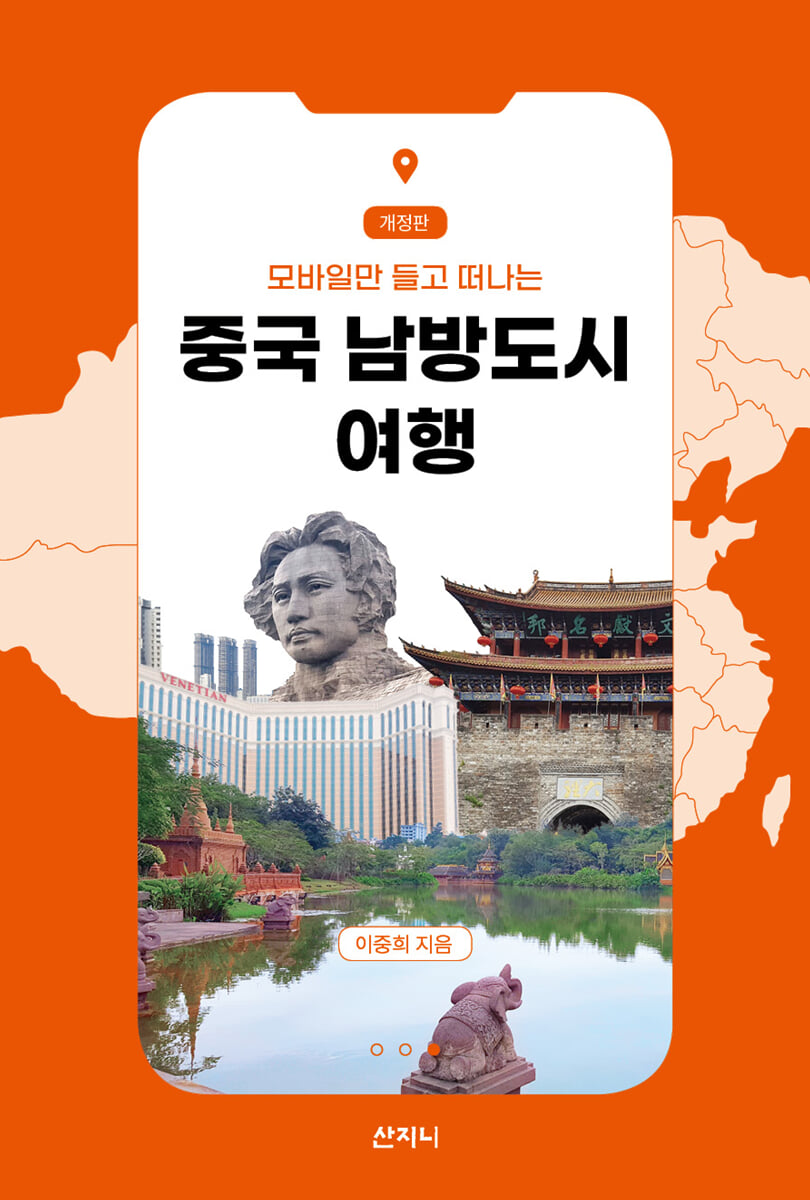
Travel to China's southern cities with just your mobile phone.
China is vast, ancient, and diverse.
And it boasts the world's largest population.
In modern times, it is called the 'factory of the world' and is a country leading the 4th industrial revolution, including AI, while also being a country with diverse ethnicities and cultures.
Therefore, depending on which city you visit in China, you can see different scenery.
Professor Lee Jung-hee, who teaches Chinese studies at a university, asked this question.
“How much do we know about today’s China?” Among China’s seven major regions, including Hubei, Shanghai, Fujian, and Chongqing, the southern cities corresponding to Central, South, and East China have been at the forefront of reform and opening up and the Fourth Industrial Revolution.
In particular, Shanghai is a city with a close connection to our country as it was the location of the Provisional Government of the Republic of Korea during the Japanese colonial period.
The author traveled freely for five months, armed only with a mobile phone, following his interests and showing the southern Chinese cities and the lives of modern Chinese people in this book.
China is vast, ancient, and diverse.
And it boasts the world's largest population.
In modern times, it is called the 'factory of the world' and is a country leading the 4th industrial revolution, including AI, while also being a country with diverse ethnicities and cultures.
Therefore, depending on which city you visit in China, you can see different scenery.
Professor Lee Jung-hee, who teaches Chinese studies at a university, asked this question.
“How much do we know about today’s China?” Among China’s seven major regions, including Hubei, Shanghai, Fujian, and Chongqing, the southern cities corresponding to Central, South, and East China have been at the forefront of reform and opening up and the Fourth Industrial Revolution.
In particular, Shanghai is a city with a close connection to our country as it was the location of the Provisional Government of the Republic of Korea during the Japanese colonial period.
The author traveled freely for five months, armed only with a mobile phone, following his interests and showing the southern Chinese cities and the lives of modern Chinese people in this book.
index
In publishing the revised edition
Introduction: How to Travel Southern China Today
Part 1 Before leaving on your trip
1.
Southern Range / 2.
Travel App / 3.
Mobile / 4.
Public transportation / 5.
Accommodation / 6.
banking services
Part 2 South China Region
Guangdong Guangzhou?
Sawangojin / Hongjuanchang Creative Park / Haitian Corridor / Local Restaurant / Tianjiachi
Guangdong Dongguan?莞
Shabapang / Ke Yuan
Guangdong Zhongshan
Sun Yat-sen Memorial Hall
Zhuhai, Guangdong
Gu Chun Tang / Yangming Square / Gongbei Customs and Hengqin Customs / Zhuhai Chimelong International Marine Resort
Guangdong Shenzhen?
Huanlehaian / Science and Technology Park / Shenzhen University / Unmanned Convenience Store
Hong Kong
Gangju-Ao Bridge / Golden Brand
Macau澳?
The Venetian Macao Resort Hotel / Chinese ID Card System
Guangxi Nanning?
ASEAN Business District / Guangxi National Museum / Confucius Temple
Wuzhou, Guangxi
Tourist attractions in the old city center
Guilin, Guangxi
Liu Sanje
Part 3 Hwadong region
Shanghai
Starbucks Coffee Roasting Workshop / Hema Xiansheng / Tian Zifang / Yidian
Save Ningbo?
Sanjiangkou / Laowaitan / Tianyige-Yuehu Tourist Area / Goryeo History Museum
Zhejiang Yuanzhou?
Umaga / Yuanzhou model
Hangzhou, Zhejiang
Alibaba City Complex / Alibaba Business School / Dream Town
Fujian Fuzhou
Sanfangchixiang / Minjiang Promenade
Fujian Xiamen
Gulangyu
Nanjing, Jiangsu
Confucius Temple - Qinhuaihe Tourist Area
Hefei, Anhui
Baojing Temple
Anhui Huangshan Mountain?
Huizhou Cultural Museum / Hongcun
Part 4 Southwest Region
Chongqing?
Chongqing Hot Pot / Liangjiang New District / Hongyadong
Chengdu, Sichuan
Chunshiro
Kunming, Yunnan
Kunming Luosiwan International Commercial District / Dianchi / Yunnan Nationalities Grand View Garden / Zhuxiang Tourist Attractions
Yunnan Dali Bai Autonomous Prefecture
Erhai / Darigo Castle
Yunnan Lijiang?
Yunnan-Guizhou Plateau / Lijiang Ancient Town / Yulong Snow Mountain / Baishui River
Yunnan Xishuangbanna Dai Autonomous Prefecture
Manting Park / Gaozhuang Xishuangbanna / Riverside Night Market / Red Tourism / Xishuangbanna Tropical Botanical Garden / Xishuangbanna Dai Village
Part 5, Central China Region
Hunan Changsha?
Juzizhou 276 / Liu Shaoqi Memorial Area
Shaoshan Mountain, Hunan
Mao Zedong Birthplace Memorial Area
Hubei Wuhan?
prestigious universities
References
Introduction: How to Travel Southern China Today
Part 1 Before leaving on your trip
1.
Southern Range / 2.
Travel App / 3.
Mobile / 4.
Public transportation / 5.
Accommodation / 6.
banking services
Part 2 South China Region
Guangdong Guangzhou?
Sawangojin / Hongjuanchang Creative Park / Haitian Corridor / Local Restaurant / Tianjiachi
Guangdong Dongguan?莞
Shabapang / Ke Yuan
Guangdong Zhongshan
Sun Yat-sen Memorial Hall
Zhuhai, Guangdong
Gu Chun Tang / Yangming Square / Gongbei Customs and Hengqin Customs / Zhuhai Chimelong International Marine Resort
Guangdong Shenzhen?
Huanlehaian / Science and Technology Park / Shenzhen University / Unmanned Convenience Store
Hong Kong
Gangju-Ao Bridge / Golden Brand
Macau澳?
The Venetian Macao Resort Hotel / Chinese ID Card System
Guangxi Nanning?
ASEAN Business District / Guangxi National Museum / Confucius Temple
Wuzhou, Guangxi
Tourist attractions in the old city center
Guilin, Guangxi
Liu Sanje
Part 3 Hwadong region
Shanghai
Starbucks Coffee Roasting Workshop / Hema Xiansheng / Tian Zifang / Yidian
Save Ningbo?
Sanjiangkou / Laowaitan / Tianyige-Yuehu Tourist Area / Goryeo History Museum
Zhejiang Yuanzhou?
Umaga / Yuanzhou model
Hangzhou, Zhejiang
Alibaba City Complex / Alibaba Business School / Dream Town
Fujian Fuzhou
Sanfangchixiang / Minjiang Promenade
Fujian Xiamen
Gulangyu
Nanjing, Jiangsu
Confucius Temple - Qinhuaihe Tourist Area
Hefei, Anhui
Baojing Temple
Anhui Huangshan Mountain?
Huizhou Cultural Museum / Hongcun
Part 4 Southwest Region
Chongqing?
Chongqing Hot Pot / Liangjiang New District / Hongyadong
Chengdu, Sichuan
Chunshiro
Kunming, Yunnan
Kunming Luosiwan International Commercial District / Dianchi / Yunnan Nationalities Grand View Garden / Zhuxiang Tourist Attractions
Yunnan Dali Bai Autonomous Prefecture
Erhai / Darigo Castle
Yunnan Lijiang?
Yunnan-Guizhou Plateau / Lijiang Ancient Town / Yulong Snow Mountain / Baishui River
Yunnan Xishuangbanna Dai Autonomous Prefecture
Manting Park / Gaozhuang Xishuangbanna / Riverside Night Market / Red Tourism / Xishuangbanna Tropical Botanical Garden / Xishuangbanna Dai Village
Part 5, Central China Region
Hunan Changsha?
Juzizhou 276 / Liu Shaoqi Memorial Area
Shaoshan Mountain, Hunan
Mao Zedong Birthplace Memorial Area
Hubei Wuhan?
prestigious universities
References
Into the book
As the Fourth Industrial Revolution changes the lifestyles of modern urbanites, the way we travel is also changing.
--- From the first sentence
When purchasing tickets for trains, long-distance buses, airplanes, etc., whether online or offline, you must enter your real name or present an ID.
It is a common sight everywhere to see ticket inspectors strictly rechecking your ID and ticket when boarding a bus after purchasing a ticket.
In fact, you can easily find the word “real-name system” everywhere in train stations and bus terminals.
--- p.35
If you travel around Guangdong, you can taste a lot of southern noodles.
Among them, the noodles that suited my taste were those from Yunnan, Guangxi, Chongqing, and Sichuan.
The noodles from Chongqing and Sichuan are very spicy.
Sichuan's representative noodle is Dandan Mian (??mian).
On the other hand, noodles from Guangxi and Yunnan are generally spicy and sour, which suits the Korean palate.
Because of this taste, I once heard a Shanghainese person say, “It’s not because it’s Yunnan or Guangxi food that it suits your taste, but because it’s Korean, it suits your taste.”
--- p.58
You can buy coffee, tea, ramen, etc. from the beverage vending machine.
It takes about 2 minutes to pay and purchase.
I tried ordering coffee in the order shown on the screens on the wall.
I paid for a 6 yuan coffee with my mobile phone, and it was 40% off, so it was only 3.6 yuan.
After five minutes, a door opens on another wall and a robot delivers coffee.
It feels like I've entered a world of science fiction.
You can purchase fresh food at the fresh food vending machine.
In the center of the store is a self-cleaning table.
This table has a function that automatically discards and washes food after eating.
--- p.98
Hotels in major southern cities such as Shanghai, Nanjing, and Ningbo have many Zhongdianfangs.
Since this type of discount is only for four hours, it is naturally cheaper than the rate for use from 12 noon to 12 noon the next day.
So, you should be careful not to make a reservation for Zhongdianfang.
In Shanghai, I also made the mistake of booking a Zhongdianfang.
I remember going to the hotel I had booked late in the evening and the staff laughingly saying, “This room is only available during the day.”
For a hotel facility, the price was surprisingly cheap.
--- p.190
Today, the revolutionary shrine is a tourist attraction that attracts huge numbers of tourists.
From the Chinese Communist Party's perspective, it could be said that it's killing it both ways.
First, revitalize the local economy.
Many revolutionary holy places are still underdeveloped or underdeveloped areas with low income levels.
Attracting tourists is a huge boost to the local economy.
It also serves to strengthen the system by reinforcing the red consciousness.
The red trend reveals the pragmatic thinking of the Chinese people.
In the Xi Jinping era, the red culture craze is evident throughout the southern regions.
--- p.271
Admission to the memorial area and various memorial halls within the area is almost free.
However, the shuttle buses, souvenir shops, photographers, hotels, restaurants, etc. are making huge profits.
A profitable merchant or business will be able to employ many people.
I think that the biggest industry in Shaoshan is Mao Zedong Industry.
It is no exaggeration to say that the local economy of Shaoshan is largely maintained through Mao Zedong Industries.
The power that attracts outsiders lies precisely in Mao Zedong.
Isn't this why the people of Hunan respect Mao Zedong more than any other region?
--- From the first sentence
When purchasing tickets for trains, long-distance buses, airplanes, etc., whether online or offline, you must enter your real name or present an ID.
It is a common sight everywhere to see ticket inspectors strictly rechecking your ID and ticket when boarding a bus after purchasing a ticket.
In fact, you can easily find the word “real-name system” everywhere in train stations and bus terminals.
--- p.35
If you travel around Guangdong, you can taste a lot of southern noodles.
Among them, the noodles that suited my taste were those from Yunnan, Guangxi, Chongqing, and Sichuan.
The noodles from Chongqing and Sichuan are very spicy.
Sichuan's representative noodle is Dandan Mian (??mian).
On the other hand, noodles from Guangxi and Yunnan are generally spicy and sour, which suits the Korean palate.
Because of this taste, I once heard a Shanghainese person say, “It’s not because it’s Yunnan or Guangxi food that it suits your taste, but because it’s Korean, it suits your taste.”
--- p.58
You can buy coffee, tea, ramen, etc. from the beverage vending machine.
It takes about 2 minutes to pay and purchase.
I tried ordering coffee in the order shown on the screens on the wall.
I paid for a 6 yuan coffee with my mobile phone, and it was 40% off, so it was only 3.6 yuan.
After five minutes, a door opens on another wall and a robot delivers coffee.
It feels like I've entered a world of science fiction.
You can purchase fresh food at the fresh food vending machine.
In the center of the store is a self-cleaning table.
This table has a function that automatically discards and washes food after eating.
--- p.98
Hotels in major southern cities such as Shanghai, Nanjing, and Ningbo have many Zhongdianfangs.
Since this type of discount is only for four hours, it is naturally cheaper than the rate for use from 12 noon to 12 noon the next day.
So, you should be careful not to make a reservation for Zhongdianfang.
In Shanghai, I also made the mistake of booking a Zhongdianfang.
I remember going to the hotel I had booked late in the evening and the staff laughingly saying, “This room is only available during the day.”
For a hotel facility, the price was surprisingly cheap.
--- p.190
Today, the revolutionary shrine is a tourist attraction that attracts huge numbers of tourists.
From the Chinese Communist Party's perspective, it could be said that it's killing it both ways.
First, revitalize the local economy.
Many revolutionary holy places are still underdeveloped or underdeveloped areas with low income levels.
Attracting tourists is a huge boost to the local economy.
It also serves to strengthen the system by reinforcing the red consciousness.
The red trend reveals the pragmatic thinking of the Chinese people.
In the Xi Jinping era, the red culture craze is evident throughout the southern regions.
--- p.271
Admission to the memorial area and various memorial halls within the area is almost free.
However, the shuttle buses, souvenir shops, photographers, hotels, restaurants, etc. are making huge profits.
A profitable merchant or business will be able to employ many people.
I think that the biggest industry in Shaoshan is Mao Zedong Industry.
It is no exaggeration to say that the local economy of Shaoshan is largely maintained through Mao Zedong Industries.
The power that attracts outsiders lies precisely in Mao Zedong.
Isn't this why the people of Hunan respect Mao Zedong more than any other region?
--- p.288
Publisher's Review
A journey that delves into China's history and culture.
Considering the vast size of China, there is a limit to how much space you can travel in five months.
The size of one province or one municipality directly under the central government in mainland China is comparable to the size and population of a country like ours.
To efficiently travel the vast area, the author occasionally runs a mobile app, keeps a journal on his mobile phone, and uploads his writings and photos whenever he has an internet connection.
And I searched and paid for things like choosing a travel destination, means of travel, and travel routes on my mobile phone.
As the author states in the preface, this book is not a travel guide.
It does not provide special information about the travel destination or present detailed reviews and eye-catching photos of tourist attractions, hotels, or restaurants.
However, by reading this book, you can understand the current progress of how China's southern cities are undergoing rapid changes and transforming into world-class tourist and economic cities.
The author's perspective, having studied modern Chinese society and economy for over 20 years, is clear.
In particular, it allows us to understand local government economic policies, fostering local brands, tourism policies that attract domestic and foreign tourists and revitalize the local economy, education policies that strengthen the characteristics of the Fourth Industrial Revolution, and the future vision of the country pursued by Chinese society.
How has China's southern cities changed today?
In this book, the author introduces readers to travel methods by showing them traveling through cities in southern China.
Anyone can travel freely according to their own interests and tastes, like the author.
The author says that mobile and the 4th industrial revolution make this possible.
And the rapid changes in modern Chinese society are perceived as a ‘revolution.’
During his travels, the author was struck by China's modern, capitalized landscape and the trends of the Fourth Industrial Revolution, and noted how changes in mobile devices and transportation are also influencing travel.
Reading this book, you will see the radical and massive changes in Chinese society and understand why the author chose the word "revolution."
Even though the motives, directions, and methods may be different, China can still be said to be a country in which a revolution is in progress.
Why can the red-flavored craze—red tourism, red restaurants—and the near-religious worship of ancient heroes, modern revolutionaries like Mao Zedong and Zhou Enlai, and contemporary capitalists like Jack Ma and Ma Huateng—coexist in a society leading the Fourth Industrial Revolution? Traveling through a southern Chinese city that preserves its historical significance, from ancient times to the modern era, with a sense of duty, the author explores these questions.
Admire the cityscape where various elements are harmoniously blended.
Southern Chinese cities have many museums and memorial halls.
Ancient cities such as Gojin and Gochon are so well preserved that there are ethnic minorities who still live in the old ways.
Along with it, modern high-rise buildings form the city's skyline.
These are cities with a strange charm, where a vast scale and diverse cultures coexist in a heterogeneous manner that cannot be described in a single word.
Shanghai and Xiamen are treasures of modern history and culture; Shenzhen and Zhuhai are special economic zones where capitalism has blossomed and show the landscape of modern Western cities; Hangzhou, which embraces the future of the 4th industrial revolution and is home to Alibaba's Xixi Industrial Complex; Guilin and Huangshan, which preserve mystical natural scenery; Lijiang and its bridges that seem to have returned to ancient cities; Wuhan, a lakeside city reminiscent of Chicago in the United States and home to many prestigious universities; and Xishuangbanna, where Southeast Asian nature and culture and various ethnic minorities live together, offer nightscapes and night markets that can only be experienced in Southeast Asian countries.
Following the popular ranking of 'Maphungwo'
When choosing a travel destination, the author prioritizes the popular tourist attractions ranked on the mobile app 'Mafengwo', which is widely used in China.
I carefully look at reviews and comments of places that Chinese people want to visit, and I visit them as if I were a Chinese person.
Chinese people get information from Baidu Encyclopedia, which is searched by Chinese people, or diligently read the information signs and descriptions installed at tourist sites.
So, the tourist destinations in this book that the author visited are places that have been verified to some extent.
In addition to the well-known tourist destinations such as Huangshan and Hongcun, there are also many world-famous attractions that are lesser known to us.
Additionally, it is fun to look around prestigious universities that are the author's area of interest and also popular in Mafengwo.
This is because there are several world-class universities, such as 985 Engineering College and 211 Engineering College.
It's an interesting place to see how the campus's scale, facilities, and government support policies are fostering future talent.
Considering the vast size of China, there is a limit to how much space you can travel in five months.
The size of one province or one municipality directly under the central government in mainland China is comparable to the size and population of a country like ours.
To efficiently travel the vast area, the author occasionally runs a mobile app, keeps a journal on his mobile phone, and uploads his writings and photos whenever he has an internet connection.
And I searched and paid for things like choosing a travel destination, means of travel, and travel routes on my mobile phone.
As the author states in the preface, this book is not a travel guide.
It does not provide special information about the travel destination or present detailed reviews and eye-catching photos of tourist attractions, hotels, or restaurants.
However, by reading this book, you can understand the current progress of how China's southern cities are undergoing rapid changes and transforming into world-class tourist and economic cities.
The author's perspective, having studied modern Chinese society and economy for over 20 years, is clear.
In particular, it allows us to understand local government economic policies, fostering local brands, tourism policies that attract domestic and foreign tourists and revitalize the local economy, education policies that strengthen the characteristics of the Fourth Industrial Revolution, and the future vision of the country pursued by Chinese society.
How has China's southern cities changed today?
In this book, the author introduces readers to travel methods by showing them traveling through cities in southern China.
Anyone can travel freely according to their own interests and tastes, like the author.
The author says that mobile and the 4th industrial revolution make this possible.
And the rapid changes in modern Chinese society are perceived as a ‘revolution.’
During his travels, the author was struck by China's modern, capitalized landscape and the trends of the Fourth Industrial Revolution, and noted how changes in mobile devices and transportation are also influencing travel.
Reading this book, you will see the radical and massive changes in Chinese society and understand why the author chose the word "revolution."
Even though the motives, directions, and methods may be different, China can still be said to be a country in which a revolution is in progress.
Why can the red-flavored craze—red tourism, red restaurants—and the near-religious worship of ancient heroes, modern revolutionaries like Mao Zedong and Zhou Enlai, and contemporary capitalists like Jack Ma and Ma Huateng—coexist in a society leading the Fourth Industrial Revolution? Traveling through a southern Chinese city that preserves its historical significance, from ancient times to the modern era, with a sense of duty, the author explores these questions.
Admire the cityscape where various elements are harmoniously blended.
Southern Chinese cities have many museums and memorial halls.
Ancient cities such as Gojin and Gochon are so well preserved that there are ethnic minorities who still live in the old ways.
Along with it, modern high-rise buildings form the city's skyline.
These are cities with a strange charm, where a vast scale and diverse cultures coexist in a heterogeneous manner that cannot be described in a single word.
Shanghai and Xiamen are treasures of modern history and culture; Shenzhen and Zhuhai are special economic zones where capitalism has blossomed and show the landscape of modern Western cities; Hangzhou, which embraces the future of the 4th industrial revolution and is home to Alibaba's Xixi Industrial Complex; Guilin and Huangshan, which preserve mystical natural scenery; Lijiang and its bridges that seem to have returned to ancient cities; Wuhan, a lakeside city reminiscent of Chicago in the United States and home to many prestigious universities; and Xishuangbanna, where Southeast Asian nature and culture and various ethnic minorities live together, offer nightscapes and night markets that can only be experienced in Southeast Asian countries.
Following the popular ranking of 'Maphungwo'
When choosing a travel destination, the author prioritizes the popular tourist attractions ranked on the mobile app 'Mafengwo', which is widely used in China.
I carefully look at reviews and comments of places that Chinese people want to visit, and I visit them as if I were a Chinese person.
Chinese people get information from Baidu Encyclopedia, which is searched by Chinese people, or diligently read the information signs and descriptions installed at tourist sites.
So, the tourist destinations in this book that the author visited are places that have been verified to some extent.
In addition to the well-known tourist destinations such as Huangshan and Hongcun, there are also many world-famous attractions that are lesser known to us.
Additionally, it is fun to look around prestigious universities that are the author's area of interest and also popular in Mafengwo.
This is because there are several world-class universities, such as 985 Engineering College and 211 Engineering College.
It's an interesting place to see how the campus's scale, facilities, and government support policies are fostering future talent.
GOODS SPECIFICS
- Date of issue: June 9, 2025
- Page count, weight, size: 296 pages | 564g | 153*226*22mm
- ISBN13: 9791168614659
- ISBN10: 1168614651
You may also like
카테고리
korean


korean

![GQ KOREA Mark (Monthly): December [2025]](http://librairie.coreenne.fr/cdn/shop/files/8ef265dbbfbf186523ed75ba7319009d.jpg?v=1765340328&width=3840)


