

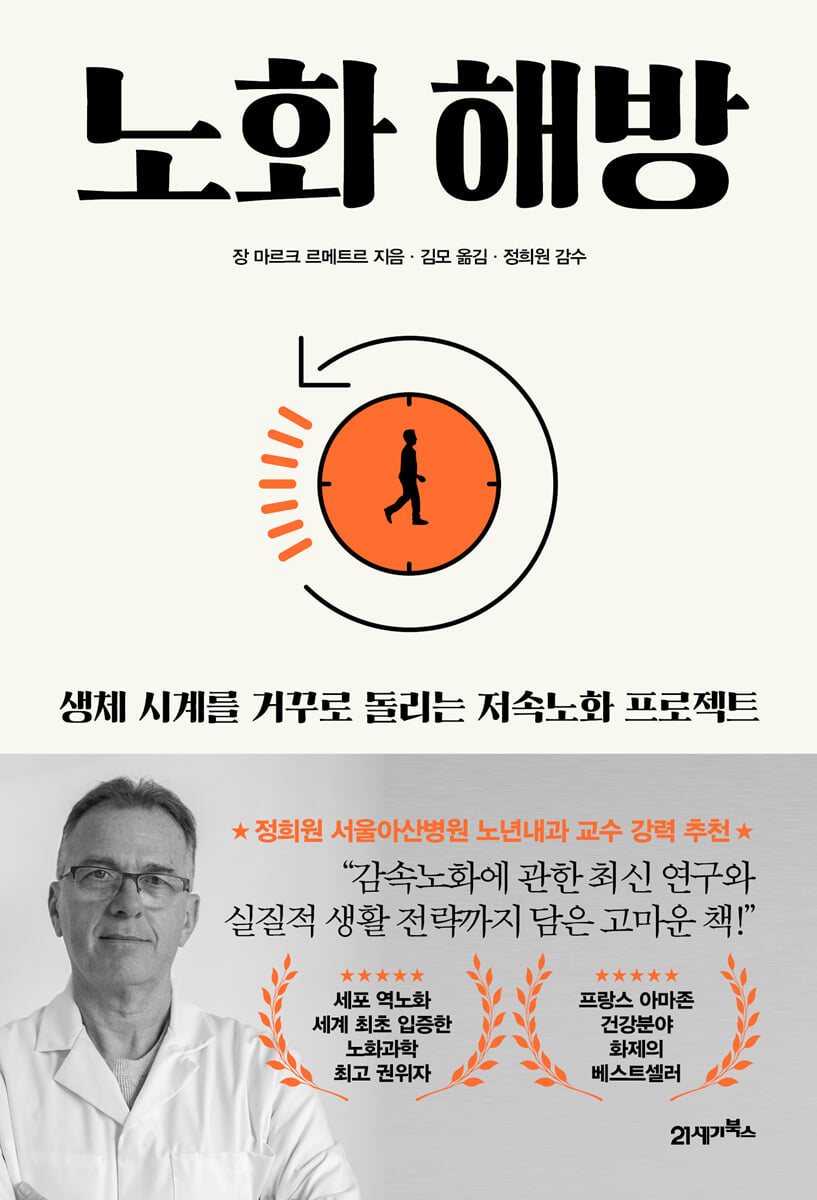
Aging liberation
 |
Description
Book Introduction
★ Highly recommended by Professor Jeong Hee-won of the Department of Geriatrics at Seoul Asan Medical Center!
★ The world's leading authority on aging science who first proved cellular reverse aging!
★ A hot topic bestseller in the health category on Amazon France!
“A wonderful book filled with cutting-edge research on slowing aging and practical lifestyle strategies!”
Your biological age can vary depending on your choices!
How to age slowly and healthily, according to the world's leading authority on aging and longevity!
A book by Jean-Marc Lemaître, the world's leading authority on aging science who first demonstrated the process of cellular aging, has been published by 21st Century Books.
This book analyzes the mechanisms of aging and presents a multifaceted approach to aging healthily.
From new facts about aging proven by the latest research, to the secrets of longevity discovered through the common characteristics of residents of longevity villages, to specific lifestyle habits that slow the aging process, this book contains everything anyone who wants to age slowly and healthily needs to know.
Professor Jeong Hee-won of the Department of Geriatrics at Seoul Asan Medical Center, who wrote the recommendation, described the book as “a valuable book that contains the latest research on slowed aging and practical lifestyle strategies.”
The author argues that the dream of immortality is no longer a far-fetched dream, and vividly demonstrates how far aging research has progressed.
Immortality is no longer a mad scientist's dream.
The author says that if we clearly understand the causes of aging, it is possible to prevent the hands of aging from moving too quickly, to slow them down, or even to reverse the direction of the needle.
What is particularly noteworthy in this book is that there is no such thing as a longevity gene, and that each person's genetic characteristics react differently depending on the environment.
This proves that genes don't determine everything, and that lifestyle can determine how quickly we age.
Diet, connection to nature, optimism, regular exercise and social connections.
Everything we choose and decide is connected to our aging.
The author presents a new landscape of aging science, researching not only lifestyle habits but also genomic and epigenetic mechanisms and life expectancy across generations based on the latest science, and includes practical lessons we can follow and put into practice.
Learn the latest theories and practices of slow aging through the author's research on aging science.
Now it's time to turn back your aging clock.
★ The world's leading authority on aging science who first proved cellular reverse aging!
★ A hot topic bestseller in the health category on Amazon France!
“A wonderful book filled with cutting-edge research on slowing aging and practical lifestyle strategies!”
Your biological age can vary depending on your choices!
How to age slowly and healthily, according to the world's leading authority on aging and longevity!
A book by Jean-Marc Lemaître, the world's leading authority on aging science who first demonstrated the process of cellular aging, has been published by 21st Century Books.
This book analyzes the mechanisms of aging and presents a multifaceted approach to aging healthily.
From new facts about aging proven by the latest research, to the secrets of longevity discovered through the common characteristics of residents of longevity villages, to specific lifestyle habits that slow the aging process, this book contains everything anyone who wants to age slowly and healthily needs to know.
Professor Jeong Hee-won of the Department of Geriatrics at Seoul Asan Medical Center, who wrote the recommendation, described the book as “a valuable book that contains the latest research on slowed aging and practical lifestyle strategies.”
The author argues that the dream of immortality is no longer a far-fetched dream, and vividly demonstrates how far aging research has progressed.
Immortality is no longer a mad scientist's dream.
The author says that if we clearly understand the causes of aging, it is possible to prevent the hands of aging from moving too quickly, to slow them down, or even to reverse the direction of the needle.
What is particularly noteworthy in this book is that there is no such thing as a longevity gene, and that each person's genetic characteristics react differently depending on the environment.
This proves that genes don't determine everything, and that lifestyle can determine how quickly we age.
Diet, connection to nature, optimism, regular exercise and social connections.
Everything we choose and decide is connected to our aging.
The author presents a new landscape of aging science, researching not only lifestyle habits but also genomic and epigenetic mechanisms and life expectancy across generations based on the latest science, and includes practical lessons we can follow and put into practice.
Learn the latest theories and practices of slow aging through the author's research on aging science.
Now it's time to turn back your aging clock.
- You can preview some of the book's contents.
Preview
index
A review of the article: For a life that is not simply long, but long and youthful.
Introduction In Search of Lost Time
Part 1: Actual Age and Physical Age
- How old are we?
: Perceived age | Actual age | Physical age
- How aging works
: Role of genes | Cell transformation | Decrease in cell regeneration | Epigenetic factors
- Can I become young again?
: Twins and Space Experiments | How Aging Works | The Ageless Body
- Calculate your real age
: Internal Medicine Examination | Physical Function Test | Is Aging a Disease? | Protein Age in the Blood
What Telomeres Tell Us | Epigenetic Age: The True Indicator of Aging
Part 2: A New Meaning of "Living Long"
- What life expectancy tells us
- As time passes, life expectancy increases
- Live a long and healthy life
- What is the limit of human lifespan?
: A special age that is becoming increasingly common
Part 3: The Secrets of People Who Slowed Down the Aging Process
- In search of the Blue Zone, a paradise for longevity
Sardinia Barbaza | Japan Okinawa | Greece Ikaria |
Nicoya, Costa Rica | Loma Linda, California | New Blue Zone
- The secret to longevity discovered in the Blue Zones
Diet | Physical activity | Sleep | Social bonds | Natural environment |
Stress and Optimism | The Secrets of the Blue Zones Revealed by Science
Part 4: The Aging Revolution: Turning Back the Biological Clock
What Happens to Your Body When You Restrict Calories
- Find beneficial bacteria
- The 'young' blood effect that revives stem cells
The Secret to Immortality: Telomerase
- Immune system that prevents aging
- How to reduce aging damage
conclusion
Aging is a treatable disease!
Acknowledgements
References
Introduction In Search of Lost Time
Part 1: Actual Age and Physical Age
- How old are we?
: Perceived age | Actual age | Physical age
- How aging works
: Role of genes | Cell transformation | Decrease in cell regeneration | Epigenetic factors
- Can I become young again?
: Twins and Space Experiments | How Aging Works | The Ageless Body
- Calculate your real age
: Internal Medicine Examination | Physical Function Test | Is Aging a Disease? | Protein Age in the Blood
What Telomeres Tell Us | Epigenetic Age: The True Indicator of Aging
Part 2: A New Meaning of "Living Long"
- What life expectancy tells us
- As time passes, life expectancy increases
- Live a long and healthy life
- What is the limit of human lifespan?
: A special age that is becoming increasingly common
Part 3: The Secrets of People Who Slowed Down the Aging Process
- In search of the Blue Zone, a paradise for longevity
Sardinia Barbaza | Japan Okinawa | Greece Ikaria |
Nicoya, Costa Rica | Loma Linda, California | New Blue Zone
- The secret to longevity discovered in the Blue Zones
Diet | Physical activity | Sleep | Social bonds | Natural environment |
Stress and Optimism | The Secrets of the Blue Zones Revealed by Science
Part 4: The Aging Revolution: Turning Back the Biological Clock
What Happens to Your Body When You Restrict Calories
- Find beneficial bacteria
- The 'young' blood effect that revives stem cells
The Secret to Immortality: Telomerase
- Immune system that prevents aging
- How to reduce aging damage
conclusion
Aging is a treatable disease!
Acknowledgements
References
Detailed image

Into the book
This book, "Liberation from Aging," is an excellent work that conveys the revolutionary spirit of the age science era to the general public in an easily understandable way, while also being deeply grounded in the latest research.
As a reviewer, I strongly recommend this book, and I hope that through it, many readers will join the era of “liberation from aging” and gain the opportunity to design their own biological age.
--- p.10, from “Editor’s Note | For a life that is not simply long, but a life that remains young and long”
In this book, we will take a closer look at the gears that make our 'biological clock' tick.
Once you understand how it works, you can adjust the watch hands.
As we await the day when many of the innovative technologies developed in our labs will be put to use as treatments, we want to share with you the first key to controlling the pace of the clock.
I sincerely hope that as many people as possible will remain young for longer, leave this world free from the attacks of physical and mental illness, and no longer regard aging and its accompanying diseases as an inevitable fate. With that, I conclude.
--- p.19, from "Introduction | In Search of Lost Time"
Time flows differently depending on each person's subjectivity.
Interestingly, scientific research has shown that there is a biological basis for this subjective perception of time.
Biological aging affects cognition.
Not only that, thinking positively and being optimistic about the future also has a huge impact on your health.
In particular, people who felt younger tended to live healthier lives over time.
They had lower symptoms of depression and risk of dementia, and were more likely to live longer and in better health.
--- p.30, from “Part 1 Actual Age and Physical Age”
Time flows differently depending on each person's subjectivity.
Interestingly, scientific research has shown that there is a biological basis for this subjective perception of time.
Biological aging affects cognition.
Not only that, thinking positively and being optimistic about the future also has a huge impact on your health.
In particular, people who felt younger tended to live healthier lives over time.
They had lower symptoms of depression and risk of dementia, and were more likely to live longer and in better health.
--- p.30, from “Part 1 Actual Age and Physical Age”
The leading cause of death today is diseases of old age.
Therefore, future life expectancy depends on how well we can overcome age-related diseases.
Thanks to incredible advances in science and medicine, we stand at the dawn of a new longevity revolution, one that could be as transformative as the first.
But this time, the core of the revolution will be the health and longevity of the elderly, not the health and mortality of infants and young children.
Since the mid-20th century, French people's life expectancy has increased by more than 15 years.
In 1950, life expectancy at birth was 63.4 years for men and 69.2 years for women, but in 2020, despite the COVID-19 pandemic, it was 79.1 years for men and 85.1 years for women.
Predicting the future is always difficult.
However, as a researcher, I am optimistic about the future, as I am well aware of the potential for innovative advancements in biomedicine, and I would like to share this outlook in this book.
--- p.96, from “Part 2: The New Meaning of ‘Living Long’”
Blue Zone cases show us what we can do in our daily lives to live long and healthy lives.
It's never too late to start managing your biological age, extending your healthy lifespan, and maintaining youthful vigor.
If you love life and are grateful for everyday life, you need to actively manage your health and aging.
Researchers, including myself, are currently developing technologies in our laboratories to achieve liberation from aging, and one day, we hope to make these technologies available to everyone.
--- p.134, from “The Secret of People Who Slowed Down the Aging Process”
So how can we scientifically explain the "rejuvenating" effect that occurs when young plasma is administered? The most credible hypothesis currently holds that certain molecules in young blood enhance the tissue regeneration capacity of stem cells.
Based on this hypothesis, they are also considering creating specific molecules in the lab and injecting them into older adults.
Advances in genetic engineering have made this technically possible, and injectables created this way could mimic the role of plasma.
The rejuvenating effects of this method have already been proven several times in animal studies.
That is, this method restored heart muscle that had lost elasticity due to aging, promoted the creation of new blood vessels, and increased the number of stem cells.
Additionally, plasma from young mice promoted muscle regeneration, restored olfactory memory, improved spatial memory, and stimulated nerve growth.
--- p.223, from “Part 4: The Aging Revolution That Turns Back the Biological Clock”
Age-related diseases continue to increase due to the aging population.
In this context, to avoid excessive burden on communities due to the aging population, paradoxically, we need to support more social investment to enable more people to live long, healthy lives.
The problem is not age, but aging.
People don't die simply because they grow old, they die because of aging and its consequences.
I can't waste any more time.
Now is the time for everyone to come together and seize the opportunity presented to ensure that aging does not become a source of despair.
As a reviewer, I strongly recommend this book, and I hope that through it, many readers will join the era of “liberation from aging” and gain the opportunity to design their own biological age.
--- p.10, from “Editor’s Note | For a life that is not simply long, but a life that remains young and long”
In this book, we will take a closer look at the gears that make our 'biological clock' tick.
Once you understand how it works, you can adjust the watch hands.
As we await the day when many of the innovative technologies developed in our labs will be put to use as treatments, we want to share with you the first key to controlling the pace of the clock.
I sincerely hope that as many people as possible will remain young for longer, leave this world free from the attacks of physical and mental illness, and no longer regard aging and its accompanying diseases as an inevitable fate. With that, I conclude.
--- p.19, from "Introduction | In Search of Lost Time"
Time flows differently depending on each person's subjectivity.
Interestingly, scientific research has shown that there is a biological basis for this subjective perception of time.
Biological aging affects cognition.
Not only that, thinking positively and being optimistic about the future also has a huge impact on your health.
In particular, people who felt younger tended to live healthier lives over time.
They had lower symptoms of depression and risk of dementia, and were more likely to live longer and in better health.
--- p.30, from “Part 1 Actual Age and Physical Age”
Time flows differently depending on each person's subjectivity.
Interestingly, scientific research has shown that there is a biological basis for this subjective perception of time.
Biological aging affects cognition.
Not only that, thinking positively and being optimistic about the future also has a huge impact on your health.
In particular, people who felt younger tended to live healthier lives over time.
They had lower symptoms of depression and risk of dementia, and were more likely to live longer and in better health.
--- p.30, from “Part 1 Actual Age and Physical Age”
The leading cause of death today is diseases of old age.
Therefore, future life expectancy depends on how well we can overcome age-related diseases.
Thanks to incredible advances in science and medicine, we stand at the dawn of a new longevity revolution, one that could be as transformative as the first.
But this time, the core of the revolution will be the health and longevity of the elderly, not the health and mortality of infants and young children.
Since the mid-20th century, French people's life expectancy has increased by more than 15 years.
In 1950, life expectancy at birth was 63.4 years for men and 69.2 years for women, but in 2020, despite the COVID-19 pandemic, it was 79.1 years for men and 85.1 years for women.
Predicting the future is always difficult.
However, as a researcher, I am optimistic about the future, as I am well aware of the potential for innovative advancements in biomedicine, and I would like to share this outlook in this book.
--- p.96, from “Part 2: The New Meaning of ‘Living Long’”
Blue Zone cases show us what we can do in our daily lives to live long and healthy lives.
It's never too late to start managing your biological age, extending your healthy lifespan, and maintaining youthful vigor.
If you love life and are grateful for everyday life, you need to actively manage your health and aging.
Researchers, including myself, are currently developing technologies in our laboratories to achieve liberation from aging, and one day, we hope to make these technologies available to everyone.
--- p.134, from “The Secret of People Who Slowed Down the Aging Process”
So how can we scientifically explain the "rejuvenating" effect that occurs when young plasma is administered? The most credible hypothesis currently holds that certain molecules in young blood enhance the tissue regeneration capacity of stem cells.
Based on this hypothesis, they are also considering creating specific molecules in the lab and injecting them into older adults.
Advances in genetic engineering have made this technically possible, and injectables created this way could mimic the role of plasma.
The rejuvenating effects of this method have already been proven several times in animal studies.
That is, this method restored heart muscle that had lost elasticity due to aging, promoted the creation of new blood vessels, and increased the number of stem cells.
Additionally, plasma from young mice promoted muscle regeneration, restored olfactory memory, improved spatial memory, and stimulated nerve growth.
--- p.223, from “Part 4: The Aging Revolution That Turns Back the Biological Clock”
Age-related diseases continue to increase due to the aging population.
In this context, to avoid excessive burden on communities due to the aging population, paradoxically, we need to support more social investment to enable more people to live long, healthy lives.
The problem is not age, but aging.
People don't die simply because they grow old, they die because of aging and its consequences.
I can't waste any more time.
Now is the time for everyone to come together and seize the opportunity presented to ensure that aging does not become a source of despair.
--- p.250, from “Conclusion | Aging is a treatable disease!”
Publisher's Review
“I hope that through this book, readers will be able to design their own biological age.”
A must-read for anyone who wants to slow down the aging process and live 10 years younger!
A 21st-century, tailored "aging liberation" project, packed with cutting-edge science and practical methods!
We can't completely avoid aging, but we can slow it down.
If Professor Jeong Hee-won of the Department of Geriatrics introduced the concept of 'slow aging' to Korean society, the author of this book, Jean-Marc Lemaître, deepens the concept of 'slow aging' and explains everything from the operating principles of aging and the latest scientific research to practical methods for slowing down the biological clock.
Gerontologists argue that we can no longer take aging for granted.
Most people don't distinguish between their chronological age and their biological age.
Even twins with identical genes can have different physical ages than their biological ages depending on their lifestyle, where they live, and their concerns about health.
This is a scientifically proven fact.
Of course, no scientist would ignore the importance of genes.
However, author Lemaître studies cellular transformation and aging damage and proves that acquired factors are the most crucial factors that determine our aging.
This book is divided into four parts.
Part 1 points out common misconceptions we have about aging and goes on to introduce the workings of aging, while Part 2 explores the new meaning of 'living long' in the 21st century, when life expectancy is increasing.
Part 3 observes and studies the lifestyle habits of residents of the longevity villages, the "Blue Zone," and analyzes their secrets. Part 4 introduces the latest scientific cases that can turn back the biological clock.
As time goes by and we grow older, we naturally think that our knees will ache, our physical strength will decline, and our skin will become flaky.
But aging is one area we can manage.
If you start paying attention to slow aging and change your lifestyle habits from now on, you will be able to live the next 20 years healthier than the previous 20 years.
The secrets of people who have slowed down the aging process, revealed by the Blue Zone, a long-life village!
Their secrets to longevity are drawing global attention: optimism, regular activity, and social connections!
Longevity villages, or 'Blue Zones', are scattered around the world and have no direct contact with each other, but they happen to have common characteristics.
From a healthy, balanced diet to regular physical activity, social connections, optimism in dealing with stress, and a positive attitude toward nature.
The author spent extensive time with residents of the Blue Zones, studying how they behave, what drives them to continue that behavior, and what genetic factors contribute to their longevity compared to other regions.
Longevity Village Blue Zones can be seen as offering a solution to modern society's aging population and increasing life expectancy.
Let's explore each longevity village's overall lifestyle and the wisdom of those who have naturally realized and practiced slow aging.
Okinawa, Japan: A characteristic of Okinawa's elderly population is their very active lifestyle.
Regular gatherings called 'Moai' allow residents to naturally mingle and maintain social bonds.
I also place great importance on the concept of purpose in life, called 'ikigai', which is what makes me wake up every morning.
The entire island is bustling with social activity, and physical activities like gardening and walking are part of everyday life.
Healthy foods such as fish, tofu, brown rice, green tea, and garlic form the center of the diet.
Ikaria, Greece: It is predicted that 30% of the population of Ikaria, a small island in the eastern Aegean Sea, will reach the age of 90 by 2050.
The island's 8,000 inhabitants enjoy sleeping in and live mostly without clocks.
Their days are filled with tending to their vegetable garden, meeting neighbors, and enjoying meals.
A leisurely life away from the stress of the big city is considered the secret to their longevity.
They place particular importance on the Mediterranean diet, occasionally including lamb in their meals.
Nicoya, Costa Rica: Nicoya's relative isolation for centuries has allowed it to avoid the negative impacts of modernization.
Nicoya residents reject foods such as carbonated drinks and fast food, and use black beans, pumpkin, and sweet potatoes as their main ingredients.
Nicoya's centenarians are also very physically active, have strong family ties and deep religious beliefs.
“By eliminating habits that accelerate aging, you can increase your lifespan by 14 years!”
Scientific habits based on lifestyle practices and the latest science
These days, even young people in their 20s and 30s are showing a keen interest in slow aging. Instead of sharing slow-aging diets on social media or drinking alcohol, they form running crews and engage in regular nightly exercise.
The same goes for 5060.
I go hiking every weekend and enjoy walking in my daily life.
He takes nutritional supplements and values his health more than anyone else.
We already unconsciously believe that we can take care of our own health.
Overcoming the comfortable and familiar instinct to accelerate aging could add 14 years to your lifespan, says Lemaître.
If you want to look younger as you age, turn back the clock and live a long and healthy life, join Lemaître's aging liberation project, a world-renowned authority on aging science.
A must-read for anyone who wants to slow down the aging process and live 10 years younger!
A 21st-century, tailored "aging liberation" project, packed with cutting-edge science and practical methods!
We can't completely avoid aging, but we can slow it down.
If Professor Jeong Hee-won of the Department of Geriatrics introduced the concept of 'slow aging' to Korean society, the author of this book, Jean-Marc Lemaître, deepens the concept of 'slow aging' and explains everything from the operating principles of aging and the latest scientific research to practical methods for slowing down the biological clock.
Gerontologists argue that we can no longer take aging for granted.
Most people don't distinguish between their chronological age and their biological age.
Even twins with identical genes can have different physical ages than their biological ages depending on their lifestyle, where they live, and their concerns about health.
This is a scientifically proven fact.
Of course, no scientist would ignore the importance of genes.
However, author Lemaître studies cellular transformation and aging damage and proves that acquired factors are the most crucial factors that determine our aging.
This book is divided into four parts.
Part 1 points out common misconceptions we have about aging and goes on to introduce the workings of aging, while Part 2 explores the new meaning of 'living long' in the 21st century, when life expectancy is increasing.
Part 3 observes and studies the lifestyle habits of residents of the longevity villages, the "Blue Zone," and analyzes their secrets. Part 4 introduces the latest scientific cases that can turn back the biological clock.
As time goes by and we grow older, we naturally think that our knees will ache, our physical strength will decline, and our skin will become flaky.
But aging is one area we can manage.
If you start paying attention to slow aging and change your lifestyle habits from now on, you will be able to live the next 20 years healthier than the previous 20 years.
The secrets of people who have slowed down the aging process, revealed by the Blue Zone, a long-life village!
Their secrets to longevity are drawing global attention: optimism, regular activity, and social connections!
Longevity villages, or 'Blue Zones', are scattered around the world and have no direct contact with each other, but they happen to have common characteristics.
From a healthy, balanced diet to regular physical activity, social connections, optimism in dealing with stress, and a positive attitude toward nature.
The author spent extensive time with residents of the Blue Zones, studying how they behave, what drives them to continue that behavior, and what genetic factors contribute to their longevity compared to other regions.
Longevity Village Blue Zones can be seen as offering a solution to modern society's aging population and increasing life expectancy.
Let's explore each longevity village's overall lifestyle and the wisdom of those who have naturally realized and practiced slow aging.
Okinawa, Japan: A characteristic of Okinawa's elderly population is their very active lifestyle.
Regular gatherings called 'Moai' allow residents to naturally mingle and maintain social bonds.
I also place great importance on the concept of purpose in life, called 'ikigai', which is what makes me wake up every morning.
The entire island is bustling with social activity, and physical activities like gardening and walking are part of everyday life.
Healthy foods such as fish, tofu, brown rice, green tea, and garlic form the center of the diet.
Ikaria, Greece: It is predicted that 30% of the population of Ikaria, a small island in the eastern Aegean Sea, will reach the age of 90 by 2050.
The island's 8,000 inhabitants enjoy sleeping in and live mostly without clocks.
Their days are filled with tending to their vegetable garden, meeting neighbors, and enjoying meals.
A leisurely life away from the stress of the big city is considered the secret to their longevity.
They place particular importance on the Mediterranean diet, occasionally including lamb in their meals.
Nicoya, Costa Rica: Nicoya's relative isolation for centuries has allowed it to avoid the negative impacts of modernization.
Nicoya residents reject foods such as carbonated drinks and fast food, and use black beans, pumpkin, and sweet potatoes as their main ingredients.
Nicoya's centenarians are also very physically active, have strong family ties and deep religious beliefs.
“By eliminating habits that accelerate aging, you can increase your lifespan by 14 years!”
Scientific habits based on lifestyle practices and the latest science
These days, even young people in their 20s and 30s are showing a keen interest in slow aging. Instead of sharing slow-aging diets on social media or drinking alcohol, they form running crews and engage in regular nightly exercise.
The same goes for 5060.
I go hiking every weekend and enjoy walking in my daily life.
He takes nutritional supplements and values his health more than anyone else.
We already unconsciously believe that we can take care of our own health.
Overcoming the comfortable and familiar instinct to accelerate aging could add 14 years to your lifespan, says Lemaître.
If you want to look younger as you age, turn back the clock and live a long and healthy life, join Lemaître's aging liberation project, a world-renowned authority on aging science.
GOODS SPECIFICS
- Date of issue: June 2, 2025
- Page count, weight, size: 284 pages | 128*188*20mm
- ISBN13: 9791173572890
- ISBN10: 1173572899
You may also like
카테고리
korean


korean

![ELLE 엘르 스페셜 에디션 A형 : 12월 [2025]](http://librairie.coreenne.fr/cdn/shop/files/b8e27a3de6c9538896439686c6b0e8fb.jpg?v=1766436872&width=3840)


