

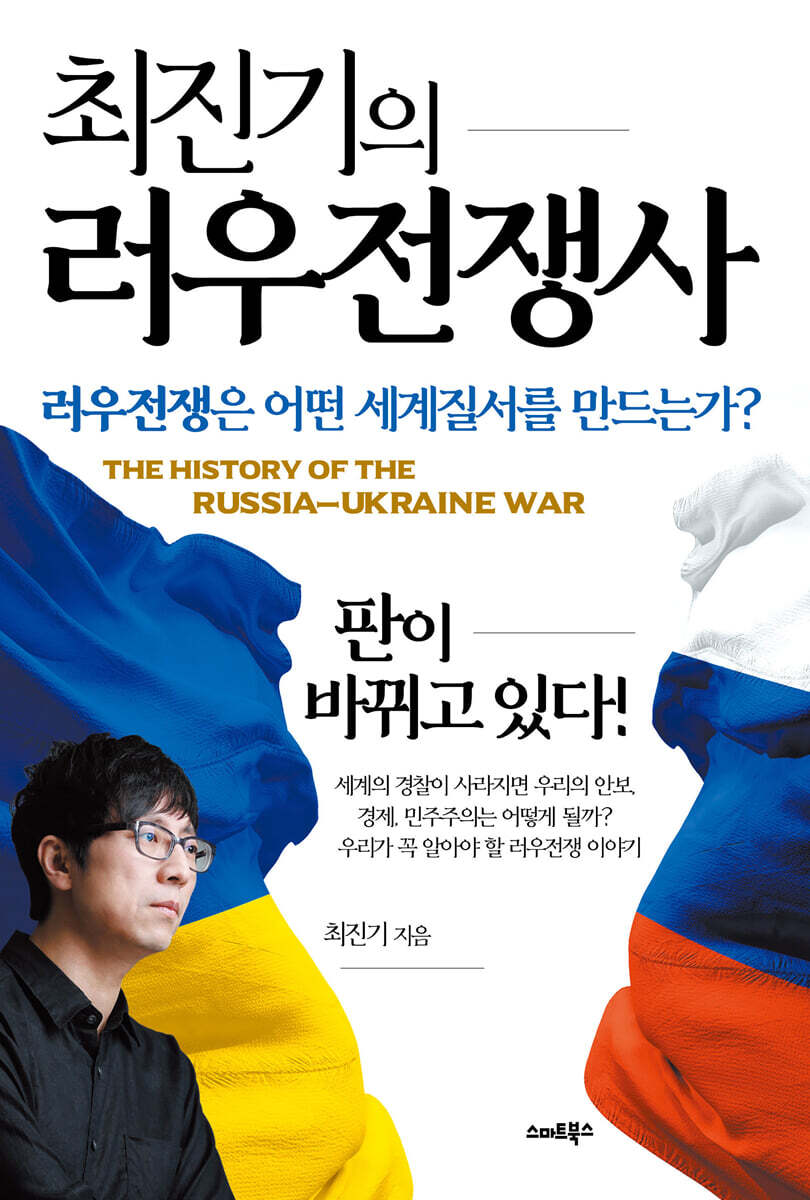
Choi Jin-gi's History of the Lou War
 |
Description
Book Introduction
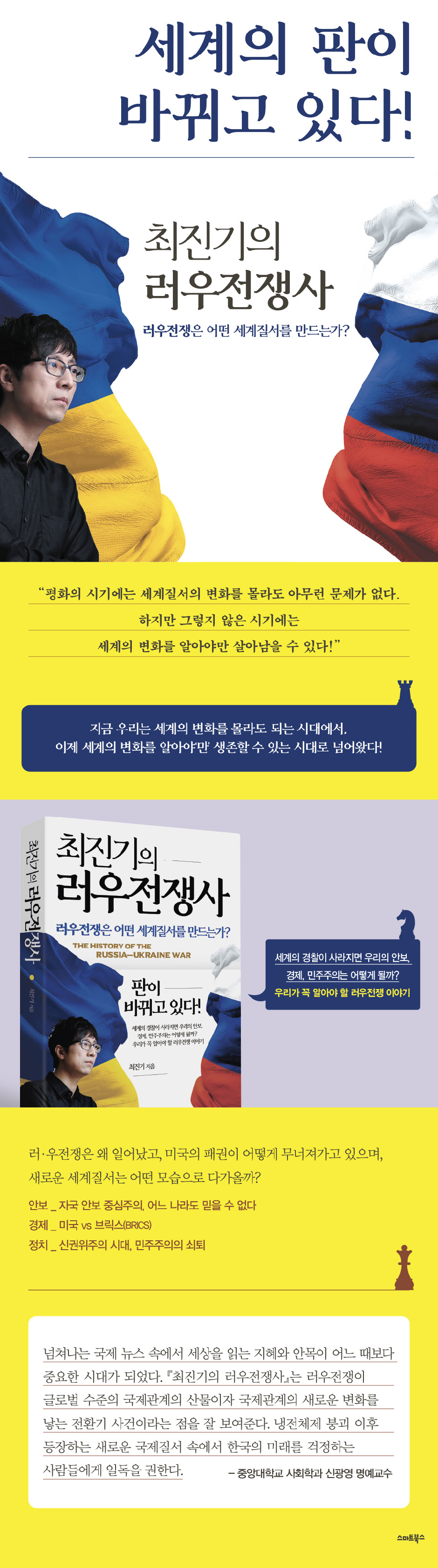
“The tables are turning!”
If the world's police disappear, our economy, security, and democracy will be
What will happen?
“During a period of economic development, you can survive without knowing the economy, but when the economy begins to decline, you cannot survive without knowing the economy.” It’s the same.
“In times of peace, there is no problem in not knowing about changes in the world order.
But in times like these, you 'must' know the changes in the world to survive." Now, we have moved from an era where we didn't need to know the changes in the world to an era where we 'must' know the changes in the world to survive.
Russia's full-scale invasion of Ukraine in February 2022 shocked the world, and contrary to initial expectations that the war would end quickly, it has now raged on for three years.
And the world is shifting! "Choi Jin-gi's History of the Russo-Russian War" examines the causes of the Russo-Russian War from a third-party perspective, exploring how American hegemony is crumbling, what a new world order will look like, and how it will impact our lives.
A must-read for those who want to understand and prepare for the changes in our economy, security, democracy, and the world!
If the world's police disappear, our economy, security, and democracy will be
What will happen?
“During a period of economic development, you can survive without knowing the economy, but when the economy begins to decline, you cannot survive without knowing the economy.” It’s the same.
“In times of peace, there is no problem in not knowing about changes in the world order.
But in times like these, you 'must' know the changes in the world to survive." Now, we have moved from an era where we didn't need to know the changes in the world to an era where we 'must' know the changes in the world to survive.
Russia's full-scale invasion of Ukraine in February 2022 shocked the world, and contrary to initial expectations that the war would end quickly, it has now raged on for three years.
And the world is shifting! "Choi Jin-gi's History of the Russo-Russian War" examines the causes of the Russo-Russian War from a third-party perspective, exploring how American hegemony is crumbling, what a new world order will look like, and how it will impact our lives.
A must-read for those who want to understand and prepare for the changes in our economy, security, democracy, and the world!
- You can preview some of the book's contents.
Preview
index
[Introduction] Why should we pay attention to the Russian-Russian War?
[Introduction] Which war is an important war?
Why the Russo-Japanese War was a world-historical war
Part 1: Why and how did the Russo-Japanese War occur?
[Introduction] How can we explain the cause of the outbreak of the Russo-Japanese War?
Preemptive Aggression Theory_The Western Position | Induced Aggression Theory_Russia's Position | Beyond the Two Positions
Chapter 1 [United States] Would war have broken out even if Trump had won the 2020 US presidential election?
Two Paths in Foreign Policy: Realism and Idealism
Pre-Cold War & Cold War _ Wilsonianism and Isolationism
Post-Cold War Liberal Hegemony
Trump's First Term: Aggressive Realism
Biden Administration: Neoliberal Hegemony
Why did the United States view Russia as something to be weakened first, rather than as a partner in containing China?
Chapter 2 [Ukraine] Ukraine, which chose Zelensky, lost everything.
Understanding Ukraine as an Eastern European Country
Pro-Western Europe or pro-Russia? That is the question.
How did comedian Zelensky ruin Ukraine?
Chapter 3 [Russia] Putin Decides on War
Putin shifts from pro-Western to anti-Western
Western Sanctions Transform Russia in 2014
Ukraine provides a pretext for war
Chapter 4 [Germany, the EU's Leader] Germany's Leadership Disappears with Merkel
How did Merkel lead the Minsk agreements?
Two Fallacies in Merkel's Criticism
Why did Germany go from being an EU leader to a subordinate to the US?
Scholz became the leader of the anti-Russian line
Chapter 5 [Russophobia] Eternal Keywords for Understanding the War between Russia and the West
Russophobia is not simply Russia-hatred.
Reading the Russo-Russian War through Russophobia
Part 2: Why and how did Russia win?
[Introduction] Diplomacy and War
Chapter 1 [Russia] 2014: A Year of Hope for a Decade
International sanctions in 2014 pushed Russia to the brink.
A Changed Russia, a Vaccinated Russia
Powerful Russia unleashes 10x more bombs
Chapter 2 [USA] The Illusion Shattered: No More World Police
We can no longer fight high-intensity ground wars.
The weapon that guaranteed American hegemony has lost its effectiveness.
Why should Europe melt down its own charcoal to make spears and swords?
The United States, the world's policeman, ended after 30 years
Chapter 3 [Ukraine] The Limits of Proxy War: Without Wind, the Pinwheel Stops
Decisions are made by others - results must be produced immediately.
Legitimacy and corruption are holding us back
Part 3: The World Changed by the Russo-Japanese War
[Introduction] Looking at a new era from a holistic perspective
Chapter 1: The New World Order Is Not a New Cold War
This is not the age of ideology.
We are not at war now
Politics no longer dominates the economy.
Chapter 2 [The End of the Westernization Era] The Illusion of the US-China Hegemony Competition
Is the West really that powerful?
Is the West really right?
Chapter 3 [New Order] The Era of National Security-Centricity, Bipolarity, and Neo-Authoritarianism
Self-centered security (military) - no country can be trusted
Bipolar System (Economy) - US vs. BRICS
The Era of Neo-Authoritarianism (Politics) _ The Crisis of Democracy
Closing the article
[Introduction] Which war is an important war?
Why the Russo-Japanese War was a world-historical war
Part 1: Why and how did the Russo-Japanese War occur?
[Introduction] How can we explain the cause of the outbreak of the Russo-Japanese War?
Preemptive Aggression Theory_The Western Position | Induced Aggression Theory_Russia's Position | Beyond the Two Positions
Chapter 1 [United States] Would war have broken out even if Trump had won the 2020 US presidential election?
Two Paths in Foreign Policy: Realism and Idealism
Pre-Cold War & Cold War _ Wilsonianism and Isolationism
Post-Cold War Liberal Hegemony
Trump's First Term: Aggressive Realism
Biden Administration: Neoliberal Hegemony
Why did the United States view Russia as something to be weakened first, rather than as a partner in containing China?
Chapter 2 [Ukraine] Ukraine, which chose Zelensky, lost everything.
Understanding Ukraine as an Eastern European Country
Pro-Western Europe or pro-Russia? That is the question.
How did comedian Zelensky ruin Ukraine?
Chapter 3 [Russia] Putin Decides on War
Putin shifts from pro-Western to anti-Western
Western Sanctions Transform Russia in 2014
Ukraine provides a pretext for war
Chapter 4 [Germany, the EU's Leader] Germany's Leadership Disappears with Merkel
How did Merkel lead the Minsk agreements?
Two Fallacies in Merkel's Criticism
Why did Germany go from being an EU leader to a subordinate to the US?
Scholz became the leader of the anti-Russian line
Chapter 5 [Russophobia] Eternal Keywords for Understanding the War between Russia and the West
Russophobia is not simply Russia-hatred.
Reading the Russo-Russian War through Russophobia
Part 2: Why and how did Russia win?
[Introduction] Diplomacy and War
Chapter 1 [Russia] 2014: A Year of Hope for a Decade
International sanctions in 2014 pushed Russia to the brink.
A Changed Russia, a Vaccinated Russia
Powerful Russia unleashes 10x more bombs
Chapter 2 [USA] The Illusion Shattered: No More World Police
We can no longer fight high-intensity ground wars.
The weapon that guaranteed American hegemony has lost its effectiveness.
Why should Europe melt down its own charcoal to make spears and swords?
The United States, the world's policeman, ended after 30 years
Chapter 3 [Ukraine] The Limits of Proxy War: Without Wind, the Pinwheel Stops
Decisions are made by others - results must be produced immediately.
Legitimacy and corruption are holding us back
Part 3: The World Changed by the Russo-Japanese War
[Introduction] Looking at a new era from a holistic perspective
Chapter 1: The New World Order Is Not a New Cold War
This is not the age of ideology.
We are not at war now
Politics no longer dominates the economy.
Chapter 2 [The End of the Westernization Era] The Illusion of the US-China Hegemony Competition
Is the West really that powerful?
Is the West really right?
Chapter 3 [New Order] The Era of National Security-Centricity, Bipolarity, and Neo-Authoritarianism
Self-centered security (military) - no country can be trusted
Bipolar System (Economy) - US vs. BRICS
The Era of Neo-Authoritarianism (Politics) _ The Crisis of Democracy
Closing the article
Detailed image
Publisher's Review
Which war is the most important? World War I and World War II both shared the commonality of being unprecedented in human history, yet World War I failed to change the existing imperialist order.
The victorious nation simply took away the colonies of the defeated nation.
However, World War II created a new world order called modified capitalism, with a bipolar system centered on the United States and the Soviet Union, based on ideological competition, breaking away from the imperialist ruling order.
Throughout human history, there have been wars that changed the world.
Representative examples include the wars between Greece and Persia in the 5th century BC that laid the foundation for Western civilization, the Crusades that opened the way for exchange between the East and the West in the late 11th and 13th centuries, and the Hundred Years' War, a long-term war over the succession to the thrones of England and France in the early 14th century that laid the foundation for modern nation-states.
And the Russian War is also a war that creates a new world order.
This is precisely why we must pay attention to the Russian War.
In 『Choi Jin-gi's History of the Russo-Russian War』, author Choi Jin-gi states that although the Russo-Russian War is not over yet, Russia has in fact already won.
The world has confirmed one fact through the Russian-Russian War.
The US-centered neoliberal hegemonic world order that has been maintained since the end of the Cold War in 1991 is no longer valid.
This change in perception is the starting point of transformation.
Why on earth did the Russo-Japanese War happen?
It is true that it is difficult to hear the truth about the war from the parties involved in the war.
So how can we objectively view the Russo-Russian War, moving beyond Western or Russian perspectives? Part 1 examines the dynamics between the parties and their leaders in a comprehensive manner, attempting to elucidate the causes of the war's outbreak.
The four parties involved in the Russo-Japanese War are the United States, Ukraine, Russia, and Germany, the leader of the EU.
As variables in the Russo-Russian War, four questions are asked about each country, and 'Russophobia' is dealt with as a constant.
1.
US _ If Trump had won the 2020 presidential election instead of Biden, would the Russian-Russian War have broken out?
2.
Ukraine: Would war have broken out if Zelensky's reforms had succeeded?
3.
Russia _ Would Putin have invaded if he had been in power at the beginning?
4.
Germany: If Merkel had been in power, would the Russo-American War have lasted this long?
5.
Russophobia: An Eternal Keyword for Understanding the War Between Russia and the West
It will be of great help in understanding the causes of the Russian-Russian War objectively and comprehensively from a third-party perspective.
Why did Russia win?
The author says that the Russo-Prussian War had essentially already ended in Russia's victory.
What did Russia, the victor of the Russo-Japanese War, gain, and what did Ukraine and the West, the losers, lose? Why did Russia win, and Ukraine and the West lose? "There is no war without an opponent." Finding the causes of victory in war is tantamount to finding the causes of defeat.
Tracing how Russia won is like examining how Ukraine and the West lost.
Part 2 compares and analyzes the war strategies and inherent capabilities of the participating nations in the Russo-Russian War to identify the reasons for Russia's victory.
1.
Russia _ 2014: A year that made us look forward to the next decade
2.
America: The Illusion Shattered, No Longer the World's Policeman
3.
Ukraine: The Limits of Proxy War: Without Wind, the Windmill Stops
Reading Part 2 will reveal the most important points that the Russo-Japanese War brought about in changing the world order.
What kind of new world order is the Russian War creating?
In Part 3, we will understand the new world order that has developed since the Russo-Japanese War through a 'multi-layered' and a 'holistic' approach.
Chapter 1 of Part 3 deals with 'Why the New World Order Cannot Be Called a New Cold War Order.'
Chapter 2 shows that this new world order emerged directly from the loss of the United States as the world's policeman, and more broadly, it opened the door to the decline of the West. Chapter 3 examines the shape of the new world order from a "multi-layered" perspective and a "holistic" analysis.
And the post-Russian War world is predicted to be an era centered on national security in terms of security, an era of confrontation between the West and the non-West in terms of economy, and an era in which authoritarianism overwhelms democracy in terms of politics.
1.
The new world order is not a new Cold War.
2.
The End of the Westernization Era: The Illusion of the "US-China Hegemony Competition"
3.
Self-centered security (military) - no country can be trusted
4.
Bipolar System (Economy) - US vs. BRICS
5.
The Era of Neo-Authoritarianism (Politics) _ The Crisis of Democracy
In the diplomacy of a powerful nation, one mistake can serve as a lesson, but in the diplomacy of a weak nation, one mistake can become irreversible.
Although we have achieved remarkable growth, we are still a weak country compared to the four major powers surrounding us.
"Choi Jin-gi's History of the Lou War" will be an intellectual journey for all those contemplating "the world we must know now" and the new post-war order.
It will be of great help to those who want to read about and prepare for changes in our economy, security, democracy, and the world.
The victorious nation simply took away the colonies of the defeated nation.
However, World War II created a new world order called modified capitalism, with a bipolar system centered on the United States and the Soviet Union, based on ideological competition, breaking away from the imperialist ruling order.
Throughout human history, there have been wars that changed the world.
Representative examples include the wars between Greece and Persia in the 5th century BC that laid the foundation for Western civilization, the Crusades that opened the way for exchange between the East and the West in the late 11th and 13th centuries, and the Hundred Years' War, a long-term war over the succession to the thrones of England and France in the early 14th century that laid the foundation for modern nation-states.
And the Russian War is also a war that creates a new world order.
This is precisely why we must pay attention to the Russian War.
In 『Choi Jin-gi's History of the Russo-Russian War』, author Choi Jin-gi states that although the Russo-Russian War is not over yet, Russia has in fact already won.
The world has confirmed one fact through the Russian-Russian War.
The US-centered neoliberal hegemonic world order that has been maintained since the end of the Cold War in 1991 is no longer valid.
This change in perception is the starting point of transformation.
Why on earth did the Russo-Japanese War happen?
It is true that it is difficult to hear the truth about the war from the parties involved in the war.
So how can we objectively view the Russo-Russian War, moving beyond Western or Russian perspectives? Part 1 examines the dynamics between the parties and their leaders in a comprehensive manner, attempting to elucidate the causes of the war's outbreak.
The four parties involved in the Russo-Japanese War are the United States, Ukraine, Russia, and Germany, the leader of the EU.
As variables in the Russo-Russian War, four questions are asked about each country, and 'Russophobia' is dealt with as a constant.
1.
US _ If Trump had won the 2020 presidential election instead of Biden, would the Russian-Russian War have broken out?
2.
Ukraine: Would war have broken out if Zelensky's reforms had succeeded?
3.
Russia _ Would Putin have invaded if he had been in power at the beginning?
4.
Germany: If Merkel had been in power, would the Russo-American War have lasted this long?
5.
Russophobia: An Eternal Keyword for Understanding the War Between Russia and the West
It will be of great help in understanding the causes of the Russian-Russian War objectively and comprehensively from a third-party perspective.
Why did Russia win?
The author says that the Russo-Prussian War had essentially already ended in Russia's victory.
What did Russia, the victor of the Russo-Japanese War, gain, and what did Ukraine and the West, the losers, lose? Why did Russia win, and Ukraine and the West lose? "There is no war without an opponent." Finding the causes of victory in war is tantamount to finding the causes of defeat.
Tracing how Russia won is like examining how Ukraine and the West lost.
Part 2 compares and analyzes the war strategies and inherent capabilities of the participating nations in the Russo-Russian War to identify the reasons for Russia's victory.
1.
Russia _ 2014: A year that made us look forward to the next decade
2.
America: The Illusion Shattered, No Longer the World's Policeman
3.
Ukraine: The Limits of Proxy War: Without Wind, the Windmill Stops
Reading Part 2 will reveal the most important points that the Russo-Japanese War brought about in changing the world order.
What kind of new world order is the Russian War creating?
In Part 3, we will understand the new world order that has developed since the Russo-Japanese War through a 'multi-layered' and a 'holistic' approach.
Chapter 1 of Part 3 deals with 'Why the New World Order Cannot Be Called a New Cold War Order.'
Chapter 2 shows that this new world order emerged directly from the loss of the United States as the world's policeman, and more broadly, it opened the door to the decline of the West. Chapter 3 examines the shape of the new world order from a "multi-layered" perspective and a "holistic" analysis.
And the post-Russian War world is predicted to be an era centered on national security in terms of security, an era of confrontation between the West and the non-West in terms of economy, and an era in which authoritarianism overwhelms democracy in terms of politics.
1.
The new world order is not a new Cold War.
2.
The End of the Westernization Era: The Illusion of the "US-China Hegemony Competition"
3.
Self-centered security (military) - no country can be trusted
4.
Bipolar System (Economy) - US vs. BRICS
5.
The Era of Neo-Authoritarianism (Politics) _ The Crisis of Democracy
In the diplomacy of a powerful nation, one mistake can serve as a lesson, but in the diplomacy of a weak nation, one mistake can become irreversible.
Although we have achieved remarkable growth, we are still a weak country compared to the four major powers surrounding us.
"Choi Jin-gi's History of the Lou War" will be an intellectual journey for all those contemplating "the world we must know now" and the new post-war order.
It will be of great help to those who want to read about and prepare for changes in our economy, security, democracy, and the world.
GOODS SPECIFICS
- Date of issue: May 30, 2025
- Page count, weight, size: 368 pages | 152*225*30mm
- ISBN13: 9791193674246
- ISBN10: 1193674247
You may also like
카테고리
korean


korean

![GQ KOREA Mark (Monthly): December [2025]](http://librairie.coreenne.fr/cdn/shop/files/8ef265dbbfbf186523ed75ba7319009d.jpg?v=1765340328&width=3840)


