

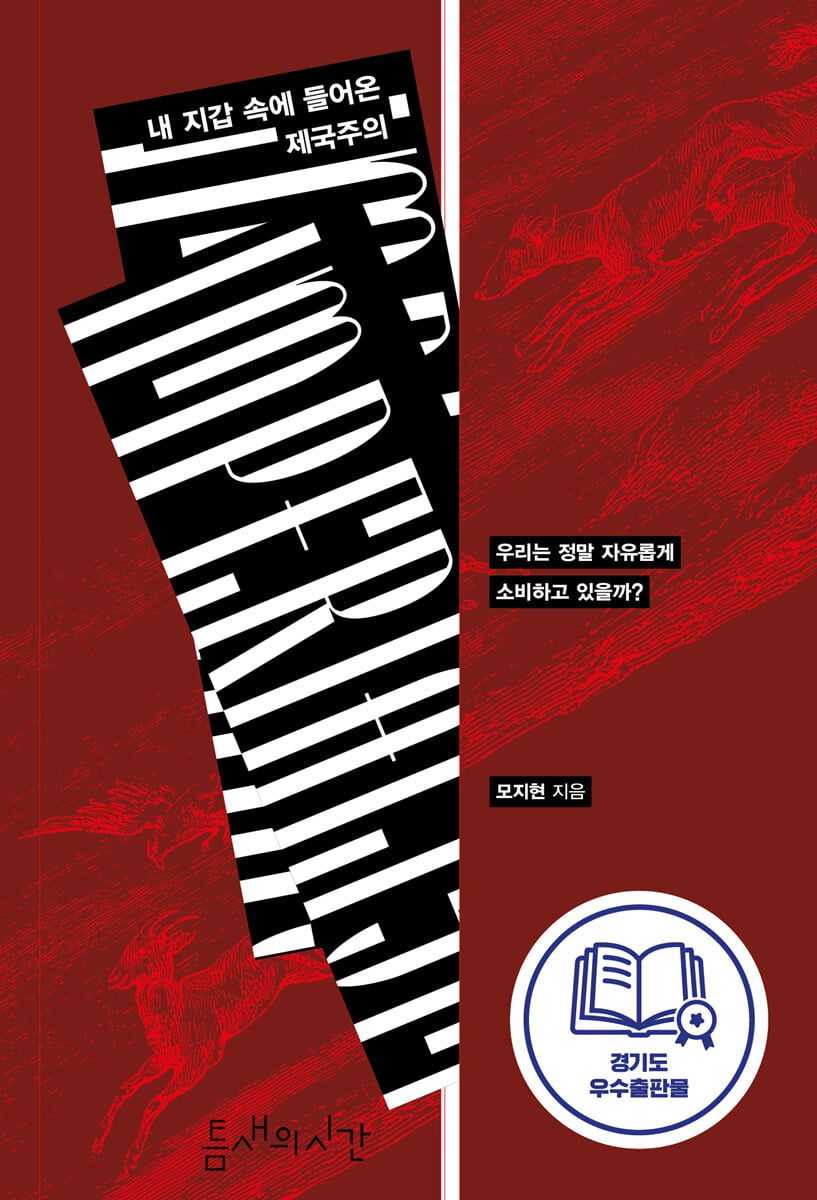
Imperialism in my wallet
 |
Description
Book Introduction
Paying for speed, eating, drinking, wearing brands… …your consumer life is intricately designed!
Coca-Cola, Starbucks, iPhone, Coupang, Kakao Taxi, Zara, and even 'easy payment' that is completed instantly with a single swipe of the screen.
Between the repetition of familiar names and familiar movements, we believe we are enjoying the 'freedom of choice'.
Is that really true? Are all my thoughts, decisions, imaginations, and consumptions today based on my own will? "Imperialism in My Wallet" asks this question.
"Is that freedom truly ours, or is it something we're forced to conform to some order designed by someone else?" This book is the result of the author's exploration of the "digital economy, data platforms, and narrative strategies of global brands" based on this critical awareness.
Author Mo Ji-hyun begins with scenes from the lives of ordinary Koreans in the prologue, meticulously connecting the global historical context with today's technological infrastructure to find an answer to the question, "Are we truly consuming freely?"
In the process, rather than unfolding academic theories, the argument is pushed forward with examples drawn from reality.
Why Starbucks' Chiquita bananas have a narrative that goes beyond just being a small fruit on the shelf; why the call center in "Slumdog Millionaire" is a scene that shows the inside of globalization; why "rocket delivery" and "one-click payment" can go beyond convenience and become textbooks for behavioral economic design (nudge, default, and reward lag), etc.
Furthermore, it goes beyond the cliché metaphor of "data is the new oil," and provides an interesting analysis of how the data collection-refining-cataloging-feedback loop solidifies into political and economic power, based on specific user journeys and platform revenue models (advertising, subscriptions, commissions, and entry fees).
Another unique feature of this book is the illustrations by artist Han Myeong-ji that appear in each chapter, which stimulate the reader's thinking by mixing historical facts with various real-life examples.
I confidently recommend to readers "Imperialism in My Wallet," which meticulously dissects today's consumer power through the common principles of standards, infrastructure, speed, and data, following the lineage of empires from Rome, Spain, and the Netherlands to Coca-Cola, Zara, GAFA, and BAT.
Coca-Cola, Starbucks, iPhone, Coupang, Kakao Taxi, Zara, and even 'easy payment' that is completed instantly with a single swipe of the screen.
Between the repetition of familiar names and familiar movements, we believe we are enjoying the 'freedom of choice'.
Is that really true? Are all my thoughts, decisions, imaginations, and consumptions today based on my own will? "Imperialism in My Wallet" asks this question.
"Is that freedom truly ours, or is it something we're forced to conform to some order designed by someone else?" This book is the result of the author's exploration of the "digital economy, data platforms, and narrative strategies of global brands" based on this critical awareness.
Author Mo Ji-hyun begins with scenes from the lives of ordinary Koreans in the prologue, meticulously connecting the global historical context with today's technological infrastructure to find an answer to the question, "Are we truly consuming freely?"
In the process, rather than unfolding academic theories, the argument is pushed forward with examples drawn from reality.
Why Starbucks' Chiquita bananas have a narrative that goes beyond just being a small fruit on the shelf; why the call center in "Slumdog Millionaire" is a scene that shows the inside of globalization; why "rocket delivery" and "one-click payment" can go beyond convenience and become textbooks for behavioral economic design (nudge, default, and reward lag), etc.
Furthermore, it goes beyond the cliché metaphor of "data is the new oil," and provides an interesting analysis of how the data collection-refining-cataloging-feedback loop solidifies into political and economic power, based on specific user journeys and platform revenue models (advertising, subscriptions, commissions, and entry fees).
Another unique feature of this book is the illustrations by artist Han Myeong-ji that appear in each chapter, which stimulate the reader's thinking by mixing historical facts with various real-life examples.
I confidently recommend to readers "Imperialism in My Wallet," which meticulously dissects today's consumer power through the common principles of standards, infrastructure, speed, and data, following the lineage of empires from Rome, Spain, and the Netherlands to Coca-Cola, Zara, GAFA, and BAT.
- You can preview some of the book's contents.
Preview
index
Author's Note
Prologue: An Unfamiliar View of Familiar Things_The Red Pill of The Matrix
1.
Coca-Cola and Hollywood's Sortie_Rediscovery of Imperialism (feat.
Roman Empire)
When did the terms empire and imperialism first come into use? / What is imperialism in its modern sense? / What is the significance of the creation of the brand 'Coca-Cola'? / How has the world changed since World War II? / Can the United States be compared to the Roman Empire? / What was the difference between the Roman Republic and the Empire? / What was the power that maintained the Roman Empire? / What is the meaning contained in Hollywood movies?
2.
Starbucks Bananas and Slumdog Millionaire_Globalization, a labyrinth of hundreds of years (feat.
British Empire)
What is globalization? / What impact did the first globalization have on people's lives? / What is the hidden story behind the Starbucks banana? / Why did the banana republic end up in that situation? / Is there any significance to the call center in Slumdog Millionaire? / What is the relationship between the second globalization and outsourcing? / India's rise as the outsourcing sector expanded? / What power allowed Britain to colonize India? / What is the hidden secret behind the British Empire's rule over India? / Is there a reason why India could not remain as a British Commonwealth?
3.
One Tier of Bubble World_And Then There Was the Dot-Com Bubble (feat.
Dutch Empire)
The dot-com bubble started because of the Internet? / Netscape had such a big impact? / How was the personal computer (PC) born? / Was there a catalyst for Microsoft's rise? / What is the significance of Windows 95 and Explorer 4.0? / What was the first bubble in history? / How did the Netherlands develop into an empire? / Was there a force that led the Dutch economy to growth? / What are the positive outcomes of the dot-com bubble that have left their mark on history? / Were there any other significant changes brought about by the dot-com bubble?
4.
From Zara to GAFA, Their Secret Stories_Data Mining and Platform Empires (feat.
Spanish Empire)
How are fashion and data connected? / Why is data considered important? / What is the relationship between digital platforms and data? / How does Amazon mine data for profit? / What has Google done? / What is the significance of Apple's smartphone revolution? / What impact has Facebook had on our times? / What caused Spain to fail as an empire? / What should be our attitude toward data?
5.
Empire of Advance, BAT_Fintech of a country you've never experienced (feat.
Jin Empire)
What motivated China to focus on information and communication technology? / What lessons can we learn from the actions of Baidu and ByteDance? / What hidden stories are there in the history of Alibaba? / What is the status of Tencent's 'app for everything'? / Why has QR code payment exploded in China? / What changes have mobile payments brought about in China? / What were the policies of the Qin Dynasty as an empire? / Where do China and the United States most sharply clash? / What do the digital empires of the United States and China have in common?
Epilogue: A world where all roads lead to artificial intelligence_Even if I become a two-eyed person in a one-eyed village
References
Prologue: An Unfamiliar View of Familiar Things_The Red Pill of The Matrix
1.
Coca-Cola and Hollywood's Sortie_Rediscovery of Imperialism (feat.
Roman Empire)
When did the terms empire and imperialism first come into use? / What is imperialism in its modern sense? / What is the significance of the creation of the brand 'Coca-Cola'? / How has the world changed since World War II? / Can the United States be compared to the Roman Empire? / What was the difference between the Roman Republic and the Empire? / What was the power that maintained the Roman Empire? / What is the meaning contained in Hollywood movies?
2.
Starbucks Bananas and Slumdog Millionaire_Globalization, a labyrinth of hundreds of years (feat.
British Empire)
What is globalization? / What impact did the first globalization have on people's lives? / What is the hidden story behind the Starbucks banana? / Why did the banana republic end up in that situation? / Is there any significance to the call center in Slumdog Millionaire? / What is the relationship between the second globalization and outsourcing? / India's rise as the outsourcing sector expanded? / What power allowed Britain to colonize India? / What is the hidden secret behind the British Empire's rule over India? / Is there a reason why India could not remain as a British Commonwealth?
3.
One Tier of Bubble World_And Then There Was the Dot-Com Bubble (feat.
Dutch Empire)
The dot-com bubble started because of the Internet? / Netscape had such a big impact? / How was the personal computer (PC) born? / Was there a catalyst for Microsoft's rise? / What is the significance of Windows 95 and Explorer 4.0? / What was the first bubble in history? / How did the Netherlands develop into an empire? / Was there a force that led the Dutch economy to growth? / What are the positive outcomes of the dot-com bubble that have left their mark on history? / Were there any other significant changes brought about by the dot-com bubble?
4.
From Zara to GAFA, Their Secret Stories_Data Mining and Platform Empires (feat.
Spanish Empire)
How are fashion and data connected? / Why is data considered important? / What is the relationship between digital platforms and data? / How does Amazon mine data for profit? / What has Google done? / What is the significance of Apple's smartphone revolution? / What impact has Facebook had on our times? / What caused Spain to fail as an empire? / What should be our attitude toward data?
5.
Empire of Advance, BAT_Fintech of a country you've never experienced (feat.
Jin Empire)
What motivated China to focus on information and communication technology? / What lessons can we learn from the actions of Baidu and ByteDance? / What hidden stories are there in the history of Alibaba? / What is the status of Tencent's 'app for everything'? / Why has QR code payment exploded in China? / What changes have mobile payments brought about in China? / What were the policies of the Qin Dynasty as an empire? / Where do China and the United States most sharply clash? / What do the digital empires of the United States and China have in common?
Epilogue: A world where all roads lead to artificial intelligence_Even if I become a two-eyed person in a one-eyed village
References
Into the book
You may find the word 'wallet' odd.
In fact, a large part of our day, made up of countless 'smart' choices, revolves around consumption.
In this book, the wallet is a symbol of consumption.
Not just the kind of long or half wallets made of leather with luxury logos on them, like the ones you see on the first floor of a department store, that store your cash.
You can imagine a variety of wallets, from card wallets to digital wallets that display the shape of a card on your smartphone screen to the balance numbers of your bank account.
If you look closely at a wallet like this, you can learn quite a bit.
A wallet says a lot about the kind of person its owner is.
Take a look at the wallets your family uses.
We've been so focused on money, not so much on the wallets we use to store it, right? Aren't wallets different across generations? There are wallets that use cash, cash and cards, cards and mobile devices, and those that use mobile devices exclusively as a means of payment.
Like this.
A person's wallet can be considered another face of a person, as it reveals the differences in their spending and payment patterns at a glance.
As a space that contains everything I plan to consume, including my intentions and choices.
So I guess wallets are considered extremely personal and private.
But is that really true? Am I the master of my own wallet?
--- From the "Prologue"
In fact, the 1960s were the golden age of American multinational corporations.
In 1950, American direct investment in Europe was $1.7 billion, but by 1970, it was on the rise. Employees of giant American multinational corporations like IBM, Ford, Kellogg, and Heinz were jet-setting from hotel to hotel, searching for new jobs.
The United States had already developed the technology to train its fleet while eliminating Japan's naval power and securing airfields built on Pacific islands, so the Pacific had become what is known as America's "lake."
Additionally, the Atlantic Ocean came to be called America's "pond" because of the multinational corporations who made the seven-hour crossing so commonplace.
But.
Nothing made Europeans more nervous than the fierce offensive of multinational corporations that started in the United States.
This is precisely the atmosphere in which the popular culture of the 1960s, which was ignited by the change in European culture amidst economic abundance and is recalled as “the most romantic in human history,” was being distorted into something synonymous with “Americanization of culture.”
Culture, such as a way of life and values, has no form, but in fact it is a huge power.
During this period, American lifestyles and culture, led by McDonald's and Hollywood movies, were infiltrating Europe, signaling the gradual but powerful beginning of America's "cultural dominance" over the world.
--- 「Coca-Cola and Hollywood's Sortie_Rediscovery of Imperialism (feat.
From "Roman Empire"
However, the Chiquita banana, which is consumed with the image of Starbucks, has a narrative behind its creation that is far from the neatness or warmth that would match its appearance.
Rather, it's a narrative closer to selfishness, discomfort, and cruelty. It's a story of tragedy, a tangled web of Cold War conflicts between the United States, Central and South America, multinational corporations, and developing countries.
The background is the great globalization of the 20th century.
It was 1870, when the first wave of globalization was in full swing.
Jamaican bananas are introduced to the United States.
Boston traders, seeing a high potential for commercialization, quickly jumped into importing it.
The company was founded to create the first brand for bananas and sell them, and to establish a truly huge empire, starting with Costa Rica and then Central and South America as a banana production base.
It was a company that grew its power by receiving land for free or at a low price in return for building infrastructure such as roads in countries and then growing bananas there.
The company was nicknamed the 'Octopus' because of its vast reach, which included Guatemala, Honduras, and Colombia.
In order to maintain their privileges, they did not hesitate to instigate a coup to oust the democratically elected Guatemalan president and support a dictatorship.
The Guatemalan Civil War that followed from here continued from the 1950s.
It is said that 200,000 people were killed and more than 1 million people were forced into exile.
A full 40 years, a long period of time in the history of the Republic of Korea, from the armistice of the Korean War until the IMF crisis.
It is said that he was also deeply involved in the Colombian 'Banana Massacre' that occurred in 1928.
In Siena, a densely populated banana plantation area, government forces machine-gunned farm workers, killing thousands.
At that time, workers were protesting and raising demands.
"Eight-hour work days, six-day work weeks, and cash pay!" The demands seem a bit odd, don't they? The working hours are understandable, but what was the issue with the pay? Apparently, the workers there were receiving their pay in coupons instead of wages.
With that, they could only buy American ham and agricultural products that the ships that went to America carrying bananas brought back with them in large quantities.
It's incredible.
--- "Starbucks' Bananas" and "Slumdog Millionaire"_Globalization, a labyrinth of hundreds of years (feat.
From "British Empire"
Netscape's catchphrase was “The Web for Everyone.”
It helped popularize it by providing a good direction in the sea of information on the Internet.
Thanks to this, the number of people accessing the Internet has increased rapidly.
Moreover, it was making a lot of money by taking over 90% of the web browser market at the time, so it was natural that young talent and investors would flock to it.
A number of Internet companies emerge and their stock prices begin to soar.
The excitement grew with the emergence of not only Netscape but also other prominent Internet companies such as Yahoo, Amazon, and eBay.
This boom accelerated after 1995, with the launch of a large number of new companies.
This phenomenon was the bubble itself.
Even if a company wasn't very profitable, simply adding "Internet" or ".com" to its articles of incorporation would cause its stock price to skyrocket, its value rising to inexplicable levels.
A phenomenon of overvaluation driven by psychology—a classic characteristic of a bubble, isn't it? Until 1999, a flood of people pursued MBA degrees to become instant riches, and dot-com companies could raise capital through stock issuance even without ever generating a profit.
Moreover, Wall Street analysts at the time fanned the flames by using all sorts of complex valuation techniques to justify the ridiculously high valuations of Internet stocks.
To give you an idea of the extent, the average size of venture capital quadrupled between 1996 and 2000, with over 50,000 companies emerging and over $256 billion invested.
The NASDAQ composite index rose 400% between 1995 and 2000, which was incredible.
But the bubble will eventually burst.
As the doomed merger of America Online and Time Warner came to fruition, confidence in the stock began to crumble.
As Dell and Cisco placed large sell orders, fear intensified, and eventually, as investment capital rapidly withdrew, the company headed towards collapse.
Companies worth millions of dollars were reduced to nothing in just a few months, wiping out over $1.7 trillion in market value.
During the dot-com boom, a significant number of 'startups' (a term that emerged in the 1990s, generally referring to IT-based new startups) went out of business.
It happened in an instant, just like it did at the beginning.
--- 「One Tier of the Bubble World_And Then There Was the Dot-Com Bubble (feat.
From the Dutch Empire)
So, would not turning over your data to the Empire solve this problem? Of course, if you're the only one creating and sharing your own data, you could choose not to disclose any potentially problematic information at all.
But we don't live in that kind of world.
Unless you go to a deserted island, cut off all human contact, and literally say, "I live alone," we live in a world where a significant portion of your personal data is outside of your control.
And when you realize that tens or even hundreds of billions of additional social data items are created every day, it becomes clear why our individual raw data is of little value.
Useful correlations and patterns only become apparent after aggregating and analyzing data from millions of people.
So even if one person decides not to provide data, the data refinery will still reach the same conclusions from the rest of the data.
Individuals may not be able to use the service if they refuse to provide their data, but the data refinery will only lose information on one in a billion people, so it won't be affected much.
Rather than that kind of resistance, I think we need a more fundamental change in thinking, starting with education from childhood.
To avoid being alienated from the natural resource of data, we need to break away from the passive "consumer" mindset of uncritically accepting what's presented to us.
As we become accustomed to a new way of thinking, where we are “co-producers” who actively create data.
This is why we need to learn 'data literacy'—the skills to understand how data works, its uncertainties, and the ripple effects of sharing social data.
It's also important to demand that data be available to all of us.
When, how, and why to share raw data, where the collected data will be used, and what you get as a result.
We also need to demand stronger means to control these matters from data refineries like platforms.
There is also a demand to be clear about what user data contributes to data products.
--- From Zara to GAFA, Their Secret Stories_Data Mining and Platform Empire (feat.
From the Spanish Empire)
Why has mobile payments via QR codes grown so explosively in China? It's because China was a backward country in terms of financial services.
In short, it's because credit card payments and internet banking aren't smooth.
It's a surprising reason, isn't it? Chinese finance has long been dominated by state-owned banks.
Large state-owned banks are said to make huge profits solely from lending and deposit interest rates, and their service quality is not high, with long waiting times at bank counters and inflexible systems.
Moreover, the number of bank branches was severely insufficient and the distribution of ATMs was uneven.
The credit card penetration rate was also very low.
As a result, online shopping payments became very difficult.
Consumers who chose to use bank transfers often struggled with the complicated authentication process of online banking.
It is because China, whose payment system was lagging behind that of advanced countries, was able to create a world-leading cashless society and digital economy.
Let's break this down into "fintech" and "techfin." Fintech is short for financial technology.
It means ‘financial innovation using technology.’
Examples of fintech include credit cards in the 1950s, ATMs in the 1960s, electronic stock trading in the 1970s, and computerized banking in the 1980s.
It developed particularly in the 1990s with the popularization of the Internet.
Access to non-face-to-face financial services via the Internet was a groundbreaking advancement.
Smartphones have further accelerated this development.
As a result, today's consumers have access to a wide range of fintech services, from internet banking and peer-to-peer lending and investing to robo-advisors and even crowdfunding.
“There are two major opportunities in the future financial industry.
One is online banking, where all financial institutions are online.
“The rest is internet finance led by completely different outsiders.” This is a surprising statement from Jack Ma, who first used the term “techfin” (a portmanteau of technology and finance) in 2016 and predicted that technology companies would lead financial innovation.
This statement illustrates the difference between fintech and techfin.
Both are financial innovations that utilize technology.
Differences are what drive innovation.
While fintech involves traditional financial companies collaborating with startups to digitize financial services, techfin involves internet companies leveraging digital platforms to provide financial services.
It is characterized by businesses with massive traffic (the amount of data or packets over a computer network) that have secured potential customers and utilize their own technology and non-financial data.
The country currently building the most advanced techfin ecosystem is China.
In fact, a large part of our day, made up of countless 'smart' choices, revolves around consumption.
In this book, the wallet is a symbol of consumption.
Not just the kind of long or half wallets made of leather with luxury logos on them, like the ones you see on the first floor of a department store, that store your cash.
You can imagine a variety of wallets, from card wallets to digital wallets that display the shape of a card on your smartphone screen to the balance numbers of your bank account.
If you look closely at a wallet like this, you can learn quite a bit.
A wallet says a lot about the kind of person its owner is.
Take a look at the wallets your family uses.
We've been so focused on money, not so much on the wallets we use to store it, right? Aren't wallets different across generations? There are wallets that use cash, cash and cards, cards and mobile devices, and those that use mobile devices exclusively as a means of payment.
Like this.
A person's wallet can be considered another face of a person, as it reveals the differences in their spending and payment patterns at a glance.
As a space that contains everything I plan to consume, including my intentions and choices.
So I guess wallets are considered extremely personal and private.
But is that really true? Am I the master of my own wallet?
--- From the "Prologue"
In fact, the 1960s were the golden age of American multinational corporations.
In 1950, American direct investment in Europe was $1.7 billion, but by 1970, it was on the rise. Employees of giant American multinational corporations like IBM, Ford, Kellogg, and Heinz were jet-setting from hotel to hotel, searching for new jobs.
The United States had already developed the technology to train its fleet while eliminating Japan's naval power and securing airfields built on Pacific islands, so the Pacific had become what is known as America's "lake."
Additionally, the Atlantic Ocean came to be called America's "pond" because of the multinational corporations who made the seven-hour crossing so commonplace.
But.
Nothing made Europeans more nervous than the fierce offensive of multinational corporations that started in the United States.
This is precisely the atmosphere in which the popular culture of the 1960s, which was ignited by the change in European culture amidst economic abundance and is recalled as “the most romantic in human history,” was being distorted into something synonymous with “Americanization of culture.”
Culture, such as a way of life and values, has no form, but in fact it is a huge power.
During this period, American lifestyles and culture, led by McDonald's and Hollywood movies, were infiltrating Europe, signaling the gradual but powerful beginning of America's "cultural dominance" over the world.
--- 「Coca-Cola and Hollywood's Sortie_Rediscovery of Imperialism (feat.
From "Roman Empire"
However, the Chiquita banana, which is consumed with the image of Starbucks, has a narrative behind its creation that is far from the neatness or warmth that would match its appearance.
Rather, it's a narrative closer to selfishness, discomfort, and cruelty. It's a story of tragedy, a tangled web of Cold War conflicts between the United States, Central and South America, multinational corporations, and developing countries.
The background is the great globalization of the 20th century.
It was 1870, when the first wave of globalization was in full swing.
Jamaican bananas are introduced to the United States.
Boston traders, seeing a high potential for commercialization, quickly jumped into importing it.
The company was founded to create the first brand for bananas and sell them, and to establish a truly huge empire, starting with Costa Rica and then Central and South America as a banana production base.
It was a company that grew its power by receiving land for free or at a low price in return for building infrastructure such as roads in countries and then growing bananas there.
The company was nicknamed the 'Octopus' because of its vast reach, which included Guatemala, Honduras, and Colombia.
In order to maintain their privileges, they did not hesitate to instigate a coup to oust the democratically elected Guatemalan president and support a dictatorship.
The Guatemalan Civil War that followed from here continued from the 1950s.
It is said that 200,000 people were killed and more than 1 million people were forced into exile.
A full 40 years, a long period of time in the history of the Republic of Korea, from the armistice of the Korean War until the IMF crisis.
It is said that he was also deeply involved in the Colombian 'Banana Massacre' that occurred in 1928.
In Siena, a densely populated banana plantation area, government forces machine-gunned farm workers, killing thousands.
At that time, workers were protesting and raising demands.
"Eight-hour work days, six-day work weeks, and cash pay!" The demands seem a bit odd, don't they? The working hours are understandable, but what was the issue with the pay? Apparently, the workers there were receiving their pay in coupons instead of wages.
With that, they could only buy American ham and agricultural products that the ships that went to America carrying bananas brought back with them in large quantities.
It's incredible.
--- "Starbucks' Bananas" and "Slumdog Millionaire"_Globalization, a labyrinth of hundreds of years (feat.
From "British Empire"
Netscape's catchphrase was “The Web for Everyone.”
It helped popularize it by providing a good direction in the sea of information on the Internet.
Thanks to this, the number of people accessing the Internet has increased rapidly.
Moreover, it was making a lot of money by taking over 90% of the web browser market at the time, so it was natural that young talent and investors would flock to it.
A number of Internet companies emerge and their stock prices begin to soar.
The excitement grew with the emergence of not only Netscape but also other prominent Internet companies such as Yahoo, Amazon, and eBay.
This boom accelerated after 1995, with the launch of a large number of new companies.
This phenomenon was the bubble itself.
Even if a company wasn't very profitable, simply adding "Internet" or ".com" to its articles of incorporation would cause its stock price to skyrocket, its value rising to inexplicable levels.
A phenomenon of overvaluation driven by psychology—a classic characteristic of a bubble, isn't it? Until 1999, a flood of people pursued MBA degrees to become instant riches, and dot-com companies could raise capital through stock issuance even without ever generating a profit.
Moreover, Wall Street analysts at the time fanned the flames by using all sorts of complex valuation techniques to justify the ridiculously high valuations of Internet stocks.
To give you an idea of the extent, the average size of venture capital quadrupled between 1996 and 2000, with over 50,000 companies emerging and over $256 billion invested.
The NASDAQ composite index rose 400% between 1995 and 2000, which was incredible.
But the bubble will eventually burst.
As the doomed merger of America Online and Time Warner came to fruition, confidence in the stock began to crumble.
As Dell and Cisco placed large sell orders, fear intensified, and eventually, as investment capital rapidly withdrew, the company headed towards collapse.
Companies worth millions of dollars were reduced to nothing in just a few months, wiping out over $1.7 trillion in market value.
During the dot-com boom, a significant number of 'startups' (a term that emerged in the 1990s, generally referring to IT-based new startups) went out of business.
It happened in an instant, just like it did at the beginning.
--- 「One Tier of the Bubble World_And Then There Was the Dot-Com Bubble (feat.
From the Dutch Empire)
So, would not turning over your data to the Empire solve this problem? Of course, if you're the only one creating and sharing your own data, you could choose not to disclose any potentially problematic information at all.
But we don't live in that kind of world.
Unless you go to a deserted island, cut off all human contact, and literally say, "I live alone," we live in a world where a significant portion of your personal data is outside of your control.
And when you realize that tens or even hundreds of billions of additional social data items are created every day, it becomes clear why our individual raw data is of little value.
Useful correlations and patterns only become apparent after aggregating and analyzing data from millions of people.
So even if one person decides not to provide data, the data refinery will still reach the same conclusions from the rest of the data.
Individuals may not be able to use the service if they refuse to provide their data, but the data refinery will only lose information on one in a billion people, so it won't be affected much.
Rather than that kind of resistance, I think we need a more fundamental change in thinking, starting with education from childhood.
To avoid being alienated from the natural resource of data, we need to break away from the passive "consumer" mindset of uncritically accepting what's presented to us.
As we become accustomed to a new way of thinking, where we are “co-producers” who actively create data.
This is why we need to learn 'data literacy'—the skills to understand how data works, its uncertainties, and the ripple effects of sharing social data.
It's also important to demand that data be available to all of us.
When, how, and why to share raw data, where the collected data will be used, and what you get as a result.
We also need to demand stronger means to control these matters from data refineries like platforms.
There is also a demand to be clear about what user data contributes to data products.
--- From Zara to GAFA, Their Secret Stories_Data Mining and Platform Empire (feat.
From the Spanish Empire)
Why has mobile payments via QR codes grown so explosively in China? It's because China was a backward country in terms of financial services.
In short, it's because credit card payments and internet banking aren't smooth.
It's a surprising reason, isn't it? Chinese finance has long been dominated by state-owned banks.
Large state-owned banks are said to make huge profits solely from lending and deposit interest rates, and their service quality is not high, with long waiting times at bank counters and inflexible systems.
Moreover, the number of bank branches was severely insufficient and the distribution of ATMs was uneven.
The credit card penetration rate was also very low.
As a result, online shopping payments became very difficult.
Consumers who chose to use bank transfers often struggled with the complicated authentication process of online banking.
It is because China, whose payment system was lagging behind that of advanced countries, was able to create a world-leading cashless society and digital economy.
Let's break this down into "fintech" and "techfin." Fintech is short for financial technology.
It means ‘financial innovation using technology.’
Examples of fintech include credit cards in the 1950s, ATMs in the 1960s, electronic stock trading in the 1970s, and computerized banking in the 1980s.
It developed particularly in the 1990s with the popularization of the Internet.
Access to non-face-to-face financial services via the Internet was a groundbreaking advancement.
Smartphones have further accelerated this development.
As a result, today's consumers have access to a wide range of fintech services, from internet banking and peer-to-peer lending and investing to robo-advisors and even crowdfunding.
“There are two major opportunities in the future financial industry.
One is online banking, where all financial institutions are online.
“The rest is internet finance led by completely different outsiders.” This is a surprising statement from Jack Ma, who first used the term “techfin” (a portmanteau of technology and finance) in 2016 and predicted that technology companies would lead financial innovation.
This statement illustrates the difference between fintech and techfin.
Both are financial innovations that utilize technology.
Differences are what drive innovation.
While fintech involves traditional financial companies collaborating with startups to digitize financial services, techfin involves internet companies leveraging digital platforms to provide financial services.
It is characterized by businesses with massive traffic (the amount of data or packets over a computer network) that have secured potential customers and utilize their own technology and non-financial data.
The country currently building the most advanced techfin ecosystem is China.
--- 「Attack on the Empire, BAT_Fintech in a country you've never experienced before (feat.
From the "Jin Empire"
From the "Jin Empire"
Publisher's Review
The Circuits of Imperialism Hidden Behind Everyday Algorithms
The author traces how we consume, rather than what we consume, in the midst of an ordinary day for a Korean college student in 2025—watching recommended shorts on the subway, using a gifted Starbucks card, impulsively buying a banana, selecting options at a kiosk, N-bread and real-time transfers in group chats, late-night deliveries and rocket delivery, and infinite scrolling on Netflix.
Furthermore, by presenting the 1922 Maeil Shinbo advertisement, “A Day in the Life of a Modern Gentleman,” he asks whether, just as the Japanese secretly changed the lifestyle of Joseon, today’s so-called “smart system” is also structurally transplanting our daily lives through the same mechanism.
This means that while the terms, names of goods, consumption processes, and payment systems have changed, the structure that moves consumers' thoughts and hearts to open their wallets remains the same as during the Japanese colonial period.
In this way, 『Imperialism in My Wallet』 is not a book that simply criticizes the consumer system.
Summoning the "lineage of empires" that stretches from Rome, Spain, the Netherlands, England, the United States, and China into the present tense, it dissects the workings of power in the 21st century, reorganized through culture, data, and fintech, after an era of war and conquest.
How is a "daily log" of alarms, rewards, one-click delivery, and reviews possible?
In a world where platforms and algorithms define order instead of guns and warships, and networks instead of borders, “empire” is no longer a national title, but an infrastructure.
A single app moves a city, a single payment standard moves a continent, and our clicks and movements function as "invisible assembly parts" within the value chain of massive capital.
This book dissects this very connection, at the intersection of history and technology, piece by piece, yet lovingly.
The author says, “Today’s consumption is a declaration.”
He emphasizes that the act of swiping a card, the small act of picking a banana, the desire for "faster" that comes to mind when thinking of Amazon Go, and the fingertips that send taxi fare through messenger while taking a Kakao Taxi—all of these are imbued with narratives of power, silence, and exploitation.
It also shows how the elements that shape our consumption decisions (convenience, reward, speed, network reputation) along the daily sequence, as presented in the prologue, replace our ‘freedom.’
And then, it captures the moment when the current consumption promotion system such as rewards, subscriptions, points, and coupons treats individuals as 'objects of indicators' rather than as objects of policy.
At this point, the question, "Am I the owner of my wallet?" expands into the question, "Who designs my time?"
We take a look at the true face of low-wage, shadow labor hidden behind the allure of convenience and cost-effectiveness!
Behind the sweetness of discount coupons and rewards, we can see the pressure on plantation unit prices and the problem of seasonal migrant labor. In the long chain of harvesting, sorting, packaging, and shipping, the risk of price fluctuations is easily transferred to farmers and day laborers.
In the fast fashion industry, the process of 'sample → small quantity test → bulk order' is repeated in an extremely short period of time to meet the 'two-week lead time'.
In this system where consumers smile at the cost-effectiveness, safety and wages are cut first to cut unit prices.
The same goes for quick commerce and delivery.
In an environment where single commissions, variable bonuses, and rating algorithms determine "today's income," workers are forced to shoulder the risks of insurance, industrial accident coverage, and inclement weather, and the platform's unilateral adjustments even increase income volatility.
And that's not all? The seemingly glamorous global service is maintained by labor that defies time differences.
When emotional labor and script compliance collide, burnout only accumulates for workers.
In addition, the essential labor required for maintaining the cloud system, such as electronic waste and reverse logistics at the end of the one-click system, as well as security and cleaning, as well as the overuse of electricity and water resources, often lead to conflicts with the local community.
By closely examining this map of hidden labor, the author examines the various layers operating behind consumption.
Let's read it like this
This book contrasts the successes and failures of five "imperial models" and identifies common principles that make empires work: standardization, infrastructure, narrative, accounting, and speed.
Chapter 1 traces how World War II gave birth to the world's first global brand through Coca-Cola and Hollywood, and how overseas bottling plants drove the global spread of the "American way of life."
Chapter 2 connects Starbucks' bananas with the film "Slumdog Millionaire" to unravel the history of banana republics and the global labor landscape created by call centers and outsourcing.
Chapter 3 examines the dot-com bubble through the lens of the Dutch East India Company and the tulip bubble, explaining that the explosion of the mass internet created by Netscape and Windows 95 left behind a bubble, but also long-term assets called "network standards" and an "ecosystem."
Chapter 4 guides you through specific flows, from Zara to GAFA—how the fast-moving fashion supply chain and data mining platforms combine to "produce" demand, and how search, stores, commerce, and social media each measure, segment, and attract individuals.
The final five chapters demonstrate why mobile wallets exploded in the Chinese market, which was not a "card-advanced" market, through BAT (Baidu, Alibaba, Tencent) and QR-based payment innovation, and how super apps transformed into everyday operating systems by linking payment, messenger, games, and content.
The author traces how we consume, rather than what we consume, in the midst of an ordinary day for a Korean college student in 2025—watching recommended shorts on the subway, using a gifted Starbucks card, impulsively buying a banana, selecting options at a kiosk, N-bread and real-time transfers in group chats, late-night deliveries and rocket delivery, and infinite scrolling on Netflix.
Furthermore, by presenting the 1922 Maeil Shinbo advertisement, “A Day in the Life of a Modern Gentleman,” he asks whether, just as the Japanese secretly changed the lifestyle of Joseon, today’s so-called “smart system” is also structurally transplanting our daily lives through the same mechanism.
This means that while the terms, names of goods, consumption processes, and payment systems have changed, the structure that moves consumers' thoughts and hearts to open their wallets remains the same as during the Japanese colonial period.
In this way, 『Imperialism in My Wallet』 is not a book that simply criticizes the consumer system.
Summoning the "lineage of empires" that stretches from Rome, Spain, the Netherlands, England, the United States, and China into the present tense, it dissects the workings of power in the 21st century, reorganized through culture, data, and fintech, after an era of war and conquest.
How is a "daily log" of alarms, rewards, one-click delivery, and reviews possible?
In a world where platforms and algorithms define order instead of guns and warships, and networks instead of borders, “empire” is no longer a national title, but an infrastructure.
A single app moves a city, a single payment standard moves a continent, and our clicks and movements function as "invisible assembly parts" within the value chain of massive capital.
This book dissects this very connection, at the intersection of history and technology, piece by piece, yet lovingly.
The author says, “Today’s consumption is a declaration.”
He emphasizes that the act of swiping a card, the small act of picking a banana, the desire for "faster" that comes to mind when thinking of Amazon Go, and the fingertips that send taxi fare through messenger while taking a Kakao Taxi—all of these are imbued with narratives of power, silence, and exploitation.
It also shows how the elements that shape our consumption decisions (convenience, reward, speed, network reputation) along the daily sequence, as presented in the prologue, replace our ‘freedom.’
And then, it captures the moment when the current consumption promotion system such as rewards, subscriptions, points, and coupons treats individuals as 'objects of indicators' rather than as objects of policy.
At this point, the question, "Am I the owner of my wallet?" expands into the question, "Who designs my time?"
We take a look at the true face of low-wage, shadow labor hidden behind the allure of convenience and cost-effectiveness!
Behind the sweetness of discount coupons and rewards, we can see the pressure on plantation unit prices and the problem of seasonal migrant labor. In the long chain of harvesting, sorting, packaging, and shipping, the risk of price fluctuations is easily transferred to farmers and day laborers.
In the fast fashion industry, the process of 'sample → small quantity test → bulk order' is repeated in an extremely short period of time to meet the 'two-week lead time'.
In this system where consumers smile at the cost-effectiveness, safety and wages are cut first to cut unit prices.
The same goes for quick commerce and delivery.
In an environment where single commissions, variable bonuses, and rating algorithms determine "today's income," workers are forced to shoulder the risks of insurance, industrial accident coverage, and inclement weather, and the platform's unilateral adjustments even increase income volatility.
And that's not all? The seemingly glamorous global service is maintained by labor that defies time differences.
When emotional labor and script compliance collide, burnout only accumulates for workers.
In addition, the essential labor required for maintaining the cloud system, such as electronic waste and reverse logistics at the end of the one-click system, as well as security and cleaning, as well as the overuse of electricity and water resources, often lead to conflicts with the local community.
By closely examining this map of hidden labor, the author examines the various layers operating behind consumption.
Let's read it like this
This book contrasts the successes and failures of five "imperial models" and identifies common principles that make empires work: standardization, infrastructure, narrative, accounting, and speed.
Chapter 1 traces how World War II gave birth to the world's first global brand through Coca-Cola and Hollywood, and how overseas bottling plants drove the global spread of the "American way of life."
Chapter 2 connects Starbucks' bananas with the film "Slumdog Millionaire" to unravel the history of banana republics and the global labor landscape created by call centers and outsourcing.
Chapter 3 examines the dot-com bubble through the lens of the Dutch East India Company and the tulip bubble, explaining that the explosion of the mass internet created by Netscape and Windows 95 left behind a bubble, but also long-term assets called "network standards" and an "ecosystem."
Chapter 4 guides you through specific flows, from Zara to GAFA—how the fast-moving fashion supply chain and data mining platforms combine to "produce" demand, and how search, stores, commerce, and social media each measure, segment, and attract individuals.
The final five chapters demonstrate why mobile wallets exploded in the Chinese market, which was not a "card-advanced" market, through BAT (Baidu, Alibaba, Tencent) and QR-based payment innovation, and how super apps transformed into everyday operating systems by linking payment, messenger, games, and content.
GOODS SPECIFICS
- Date of issue: September 5, 2025
- Page count, weight, size: 304 pages | 128*188*30mm
- ISBN13: 9791193933152
- ISBN10: 1193933153
You may also like
카테고리
korean


korean

![GQ KOREA Mark (Monthly): December [2025]](http://librairie.coreenne.fr/cdn/shop/files/8ef265dbbfbf186523ed75ba7319009d.jpg?v=1765340328&width=3840)


