

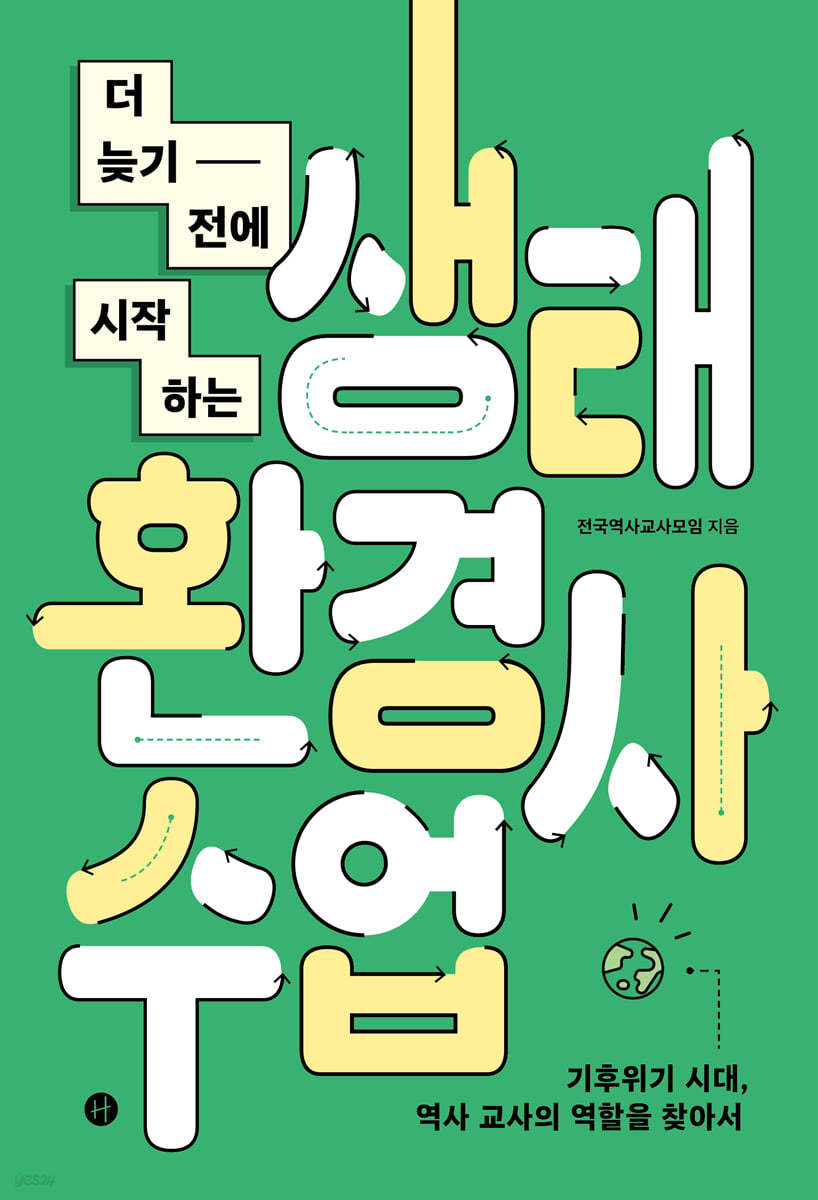
Ecology and Environmental History Classes to Start Before It's Too Late
 |
Description
Book Introduction
The contemporary demand for responding to the climate crisis
How much does history education reflect this?
Most history textbooks do not even include words like 'public hazard' or 'environmental pollution'.
History classes should provide an opportunity to reflect on the values that have been pursued throughout human history.
Middle school 3rd year students in 2024 will be 21 years old in 2030, 41 years old in 2050, and 91 years old in 2100.
Young people who will live into the 22nd century will have to live under the grave threat of the climate crisis, both now and in the future.
As concerns rise over the planet's uninhabitability, going beyond unsustainability, it's time for all sectors of education to consider and strive to foster ecological citizenship.
How well does our history education reflect these contemporary demands? Historically, history textbooks have linked industrialization to economic growth, imbuing development and progress with value and significance.
As a result, words like ‘public hazard’ or ‘environmental pollution’ did not even appear in most textbooks.
Although industrial accidents and health problems have emerged as social issues, there has been minimal effort to reflect these issues in historically reflective curricula or textbooks.
It cannot be denied that textbooks have been composed of narratives about the separation of humans and nature, civilization and progress, and development and nationalism.
Based on this awareness of the problem, the National History Teachers Association has been organizing an ecological environmental history study group since 2021.
We are developing classes by reconstructing the curriculum and textbooks from an ecological perspective, and have included our efforts and practices in “Ecological History Classes: Starting Before It’s Too Late.”
How much does history education reflect this?
Most history textbooks do not even include words like 'public hazard' or 'environmental pollution'.
History classes should provide an opportunity to reflect on the values that have been pursued throughout human history.
Middle school 3rd year students in 2024 will be 21 years old in 2030, 41 years old in 2050, and 91 years old in 2100.
Young people who will live into the 22nd century will have to live under the grave threat of the climate crisis, both now and in the future.
As concerns rise over the planet's uninhabitability, going beyond unsustainability, it's time for all sectors of education to consider and strive to foster ecological citizenship.
How well does our history education reflect these contemporary demands? Historically, history textbooks have linked industrialization to economic growth, imbuing development and progress with value and significance.
As a result, words like ‘public hazard’ or ‘environmental pollution’ did not even appear in most textbooks.
Although industrial accidents and health problems have emerged as social issues, there has been minimal effort to reflect these issues in historically reflective curricula or textbooks.
It cannot be denied that textbooks have been composed of narratives about the separation of humans and nature, civilization and progress, and development and nationalism.
Based on this awareness of the problem, the National History Teachers Association has been organizing an ecological environmental history study group since 2021.
We are developing classes by reconstructing the curriculum and textbooks from an ecological perspective, and have included our efforts and practices in “Ecological History Classes: Starting Before It’s Too Late.”
index
General
Studying and teaching ecological environmental history
Part 1: The Beginning of the Ecological History Class
1.
Teacher Preparation_In the era of climate crisis, finding things that history teachers can do well
2.
World History Class_A Time to Unfamiliarize Yourself with World History Textbooks
3.
East Asian History Class: Ecological and Environmental History Weaving Across East Asia
4.
Korean History Class_Drawing a Green Korean History Class
5.
Fusion Classes: Expanding the Possibilities of Ecological and Environmental Fusion Classes
Various practices in the second part of the ecological environmental history class
1.
Imagining Korean History with a Picture Book
2.
Tale_An ecological environmental history class using tales
3.
Field Trip: An ecological field trip that offers a fresh perspective on the region's history.
4.
Interview: A look back at the history of industrialization and pollution through oral interviews.
A New Narrative for Part 3 Ecological History Classes
1.
The Anthropocene: A Blueprint for a New World History
2.
Beyond the development narrative: Towards a shift in the framework for viewing history
3.
Teaching Theory: A Step-by-Step Approach to Organizing Ecological History Classes
symposium
To teachers who are just starting an ecological environmental history class
Americas
References and Recommended Reading
Studying and teaching ecological environmental history
Part 1: The Beginning of the Ecological History Class
1.
Teacher Preparation_In the era of climate crisis, finding things that history teachers can do well
2.
World History Class_A Time to Unfamiliarize Yourself with World History Textbooks
3.
East Asian History Class: Ecological and Environmental History Weaving Across East Asia
4.
Korean History Class_Drawing a Green Korean History Class
5.
Fusion Classes: Expanding the Possibilities of Ecological and Environmental Fusion Classes
Various practices in the second part of the ecological environmental history class
1.
Imagining Korean History with a Picture Book
2.
Tale_An ecological environmental history class using tales
3.
Field Trip: An ecological field trip that offers a fresh perspective on the region's history.
4.
Interview: A look back at the history of industrialization and pollution through oral interviews.
A New Narrative for Part 3 Ecological History Classes
1.
The Anthropocene: A Blueprint for a New World History
2.
Beyond the development narrative: Towards a shift in the framework for viewing history
3.
Teaching Theory: A Step-by-Step Approach to Organizing Ecological History Classes
symposium
To teachers who are just starting an ecological environmental history class
Americas
References and Recommended Reading
Detailed image
Publisher's Review
Rich class practice utilizing pictures, stories, field trips, and interviews
―An ecological environmental history class that weaves together Korean and world history.
A new narrative for history classes structured from an ecological perspective
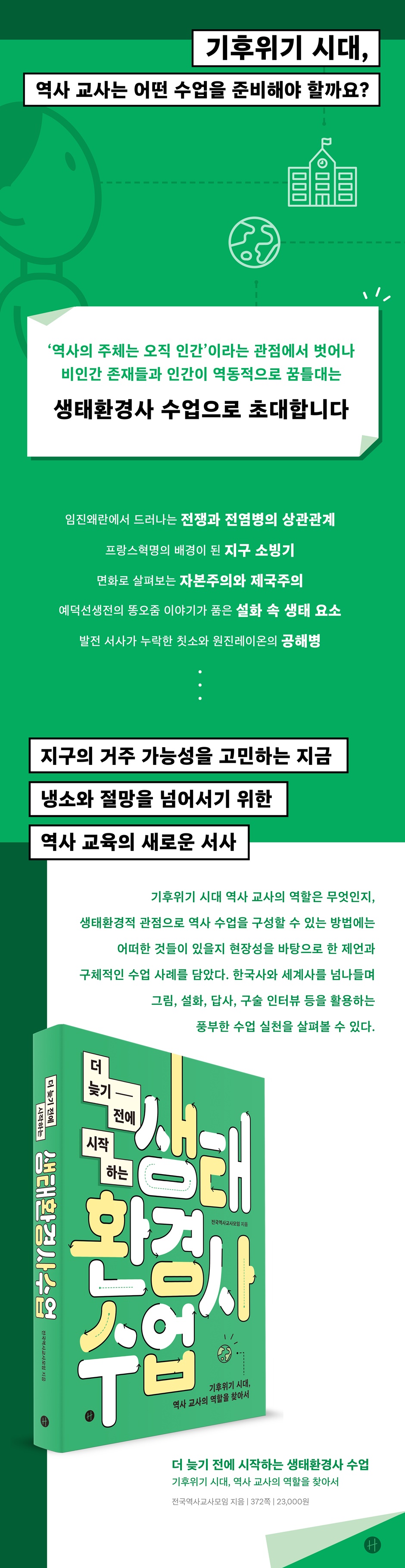
This book contains practical suggestions and concrete examples on what the responsibilities of history teachers are in the era of climate crisis and how to structure history classes from an ecological perspective.
You can see a wealth of classroom practices, from life guidance such as operating an environmental club to utilizing paintings, tales, field trips, and interviews across Korean and world history.
In the process of exploring the Annals of the Joseon Dynasty, history teachers infer a clear correlation between the weather and natural disasters, wars and epidemics, and famine surrounding the Imjin War. They also confirm that the 18th century, when the French Revolution occurred, was the Little Ice Age, when the average temperature of the Earth dropped significantly. They point out that crop failures due to reduced sunlight, exploitation by the ruling class, and the Black Death that overlapped these became the background for the resistance to the regime.
It is to move beyond the perspective of viewing history as being influenced by the rise and fall of dynasties or the decisions of the ruling class and to consider that historical events are hidden within diverse and complex contexts, including ecological factors such as climate and microorganisms.
From the commentary of the historian dated June 18th, year 27 of King Seonjo's reign, we can infer a clear correlation between war, epidemics, and famine by reading that during the Imjin War, relief for the people starving to death from famine was more urgent than the epidemic.
During the war, a huge amount of food was collected as military rations, leading to food shortages, and the famine that occurred along with the war drove the people into famine.
In a weakened immune system, infectious diseases are more powerful than before.
I believe that by asking questions and engaging in broad discussions about the role of government officials and the community's response in these disaster situations, students will be able to broaden their thinking.
―From “Ecological Environmental History Classes Using Tales” (p. 191)
The mid-to-late 14th century, when the Jacquerie and Wat-Tyler revolts occurred, and the late 18th century, when the French Revolution occurred, were periods when the average global temperature dropped significantly.
This period of cold that lasted for about 300 to 400 years is also called the Little Ice Age.
As temperatures dropped and sunlight decreased, crop failures continued, and when famine and the Black Death were added to this, the foundations of society began to crumble.
In this situation, the heavy taxation and exploitation of the ruling class placed a great burden on the peasants, which soon became the background for the growth of forces resisting the system.
―From "A Time to Unfamiliarize Yourself with World History Textbooks" (p. 51)
Meanwhile, from an ecological perspective, it is possible to create a new narrative centered on specific plants, animals, or objects that have had a significant impact on historical change through thematic history classes.
Additionally, by using pictures as a source material, we can understand the existence and location of animals and nature, and the relationships and interactions between humans and non-human beings.
Through folktales, which are texts that vividly reveal stories that were not included or excluded from written sources that are full of institutional history, we can examine the perception of nature of the people of the time and tell the story that humans also live in an ecological network.
I thought that covering the efforts to expand cotton cultivation around the world, which had negative impacts on the environment and human life, would also help us examine various aspects surrounding the Industrial Revolution and imperialism.
… First, I decided on the class topic, “Ecological Environmental History through Cotton,” and created learning materials by extracting four content elements from different units: “New Sea Route Development and the Slave Trade, the Industrial Revolution, the American Civil War, and the Indian National Movement.”
―From "A Time to Unfamiliarize Yourself with World History Textbooks" (p. 64)
As time passed and more people wanted to eat beef, more people started stealing cattle or slaughtering and selling them without a permit.
The government strictly enforced a law called the "Cow Ban" to punish the indiscriminate killing, selling, and eating of cows.
However, demand for beef gradually increased, with the number of cattle slaughtered per day reaching 500 to 1,000.
The government's ban didn't do much good.
As shown in the picture above, the fact that the main class that ate beef was the yangban or the powerful may have been a factor.
On the one hand, it can be interpreted that the number of cattle was so large that many cattle were slaughtered every day, and that agricultural productivity was sufficient to feed those cattle.
―From “Imagining a Korean History with a Place for Cows” (p. 164)
Let's go back to the example from "Yedeok Seonsaengjeon" and pay attention to the last sentence.
The above mentions show that dung and urine fertilizer played an essential role in the cultivation of all kinds of crops in Hanyang.
… 'Humans excrete a certain amount of feces and urine every day, but why was it that East Asia was the only region that utilized it as an agricultural resource? When did East Asian countries start using feces and urine as fertilizer? ... What is the difference between recognizing the daily excrement as a valuable resource and as waste, and what does this question mean in the current ecological crisis?' and so on. You can ask students various questions like this.
The idea is to think about the ecological awareness of people in the past and the cycle of the ecosystem, focusing on feces.
―From “Ecological Environmental History Classes Using Tales” (p. 185)
The curriculum and textbooks must change
Active ecological environmental history classes are possible.
―For a new narrative in ecological environmental history classes
Examining history carefully from an ecological perspective also allows us to reflect soberly on the current situation facing humanity.
This is a process through which students grow into ecological citizens who understand the concept and phenomenon of the climate crisis, the inevitable limitations of individual efforts, and the direction of changes in laws and systems. This is also why various subjects must be taught together.
Accordingly, 『Ecological Environment History Class: Starting Before It's Too Late』 introduces examples of ecological and environmental fusion classes through collaboration among various subjects and suggests active participation from each subject.
This project class, which attempted to read modern Korean history through oral interviews with victims of the Wonjin Rayon industrial accident, reminds us that the history and existence of spaces that seemed to have been erased in the "victory narrative" of industrialization, but must not be forgotten, still breathe alongside us.
The Galileo trial is usually mentioned briefly in world history classes.
In contrast, in the integrated class, this case allowed us to discuss specifically how innovative the Renaissance's human-centered thinking was.
By incorporating knowledge from 'Earth Science' and 'Life and Ethics' into the spatiotemporal scales presented in history classes, I was able to gain a much richer understanding.
In that sense, wouldn't history, a subject that at first glance seems far removed from ecological citizenship education, offer an opportunity for a "Copernican" shift in thinking? If we could turn human history, which has been steeped in the "humanity that overcame hardship" to achieve civilization and progress, upside down, that is.
―From "Expanding the Possibilities of Ecological and Environmental Convergence Classes" (p. 129)
What is surprising is that there were students who recognized the connection between the Wonjin Rayon industrial accident and the present, even though the teacher did not suggest it.
Students pointed out the problems of the management style that runs the company at the expense of workers, as well as the ongoing industrial accidents, including the SPC incident.
After recognizing the real-world problem, it naturally led to discussions about methods and countermeasures to prevent industrial accidents.
As I worked on the project, I was able to feel the historical presence of the past and present meeting.
―From "Reviewing the History of Industrialization and Pollution through Oral Interviews" (p. 227)
The 2022 revised curriculum integrates ecological transition education across all subject areas and also creates a new high school elective course for ecological transition education.
But this is not enough.
Going forward, ecological and environmental perspectives should be incorporated more into history curricula and textbooks.
The framework of modern historiography and the history education based on it, which emerged from the needs of the 19th-century nation-state, cannot cope with the current crisis.
When ecological environmental education becomes established as a curriculum rather than an individual endeavor, we can expect a comprehensive change in the educational field.
To relieve teachers of their burden and inspire them, we need to provide justification for teaching what the curriculum emphasizes, review and organize ecological research results in textbooks, and provide meaningful inquiry activities.
The ecological environmental history class is the result of an educational reconstruction based on the achievements and issues of historical studies.
Therefore, an important role of ecological history classes is to place students at the center of history classes and provide a new historical imagination to young people living in the era of climate crisis.
Ecological and environmental education in Korea has only just taken its first steps, and further study, practice, and discussion are needed.
"Starting Ecological History Classes Before It's Too Late" will serve as a catalyst for finding the right direction for ecological history classes by providing opportunities for teachers and students to ask questions and share ideas that transcend the limitations of existing textbooks.
―An ecological environmental history class that weaves together Korean and world history.
A new narrative for history classes structured from an ecological perspective
This book contains practical suggestions and concrete examples on what the responsibilities of history teachers are in the era of climate crisis and how to structure history classes from an ecological perspective.
You can see a wealth of classroom practices, from life guidance such as operating an environmental club to utilizing paintings, tales, field trips, and interviews across Korean and world history.
In the process of exploring the Annals of the Joseon Dynasty, history teachers infer a clear correlation between the weather and natural disasters, wars and epidemics, and famine surrounding the Imjin War. They also confirm that the 18th century, when the French Revolution occurred, was the Little Ice Age, when the average temperature of the Earth dropped significantly. They point out that crop failures due to reduced sunlight, exploitation by the ruling class, and the Black Death that overlapped these became the background for the resistance to the regime.
It is to move beyond the perspective of viewing history as being influenced by the rise and fall of dynasties or the decisions of the ruling class and to consider that historical events are hidden within diverse and complex contexts, including ecological factors such as climate and microorganisms.
From the commentary of the historian dated June 18th, year 27 of King Seonjo's reign, we can infer a clear correlation between war, epidemics, and famine by reading that during the Imjin War, relief for the people starving to death from famine was more urgent than the epidemic.
During the war, a huge amount of food was collected as military rations, leading to food shortages, and the famine that occurred along with the war drove the people into famine.
In a weakened immune system, infectious diseases are more powerful than before.
I believe that by asking questions and engaging in broad discussions about the role of government officials and the community's response in these disaster situations, students will be able to broaden their thinking.
―From “Ecological Environmental History Classes Using Tales” (p. 191)
The mid-to-late 14th century, when the Jacquerie and Wat-Tyler revolts occurred, and the late 18th century, when the French Revolution occurred, were periods when the average global temperature dropped significantly.
This period of cold that lasted for about 300 to 400 years is also called the Little Ice Age.
As temperatures dropped and sunlight decreased, crop failures continued, and when famine and the Black Death were added to this, the foundations of society began to crumble.
In this situation, the heavy taxation and exploitation of the ruling class placed a great burden on the peasants, which soon became the background for the growth of forces resisting the system.
―From "A Time to Unfamiliarize Yourself with World History Textbooks" (p. 51)
Meanwhile, from an ecological perspective, it is possible to create a new narrative centered on specific plants, animals, or objects that have had a significant impact on historical change through thematic history classes.
Additionally, by using pictures as a source material, we can understand the existence and location of animals and nature, and the relationships and interactions between humans and non-human beings.
Through folktales, which are texts that vividly reveal stories that were not included or excluded from written sources that are full of institutional history, we can examine the perception of nature of the people of the time and tell the story that humans also live in an ecological network.
I thought that covering the efforts to expand cotton cultivation around the world, which had negative impacts on the environment and human life, would also help us examine various aspects surrounding the Industrial Revolution and imperialism.
… First, I decided on the class topic, “Ecological Environmental History through Cotton,” and created learning materials by extracting four content elements from different units: “New Sea Route Development and the Slave Trade, the Industrial Revolution, the American Civil War, and the Indian National Movement.”
―From "A Time to Unfamiliarize Yourself with World History Textbooks" (p. 64)
As time passed and more people wanted to eat beef, more people started stealing cattle or slaughtering and selling them without a permit.
The government strictly enforced a law called the "Cow Ban" to punish the indiscriminate killing, selling, and eating of cows.
However, demand for beef gradually increased, with the number of cattle slaughtered per day reaching 500 to 1,000.
The government's ban didn't do much good.
As shown in the picture above, the fact that the main class that ate beef was the yangban or the powerful may have been a factor.
On the one hand, it can be interpreted that the number of cattle was so large that many cattle were slaughtered every day, and that agricultural productivity was sufficient to feed those cattle.
―From “Imagining a Korean History with a Place for Cows” (p. 164)
Let's go back to the example from "Yedeok Seonsaengjeon" and pay attention to the last sentence.
The above mentions show that dung and urine fertilizer played an essential role in the cultivation of all kinds of crops in Hanyang.
… 'Humans excrete a certain amount of feces and urine every day, but why was it that East Asia was the only region that utilized it as an agricultural resource? When did East Asian countries start using feces and urine as fertilizer? ... What is the difference between recognizing the daily excrement as a valuable resource and as waste, and what does this question mean in the current ecological crisis?' and so on. You can ask students various questions like this.
The idea is to think about the ecological awareness of people in the past and the cycle of the ecosystem, focusing on feces.
―From “Ecological Environmental History Classes Using Tales” (p. 185)
The curriculum and textbooks must change
Active ecological environmental history classes are possible.
―For a new narrative in ecological environmental history classes
Examining history carefully from an ecological perspective also allows us to reflect soberly on the current situation facing humanity.
This is a process through which students grow into ecological citizens who understand the concept and phenomenon of the climate crisis, the inevitable limitations of individual efforts, and the direction of changes in laws and systems. This is also why various subjects must be taught together.
Accordingly, 『Ecological Environment History Class: Starting Before It's Too Late』 introduces examples of ecological and environmental fusion classes through collaboration among various subjects and suggests active participation from each subject.
This project class, which attempted to read modern Korean history through oral interviews with victims of the Wonjin Rayon industrial accident, reminds us that the history and existence of spaces that seemed to have been erased in the "victory narrative" of industrialization, but must not be forgotten, still breathe alongside us.
The Galileo trial is usually mentioned briefly in world history classes.
In contrast, in the integrated class, this case allowed us to discuss specifically how innovative the Renaissance's human-centered thinking was.
By incorporating knowledge from 'Earth Science' and 'Life and Ethics' into the spatiotemporal scales presented in history classes, I was able to gain a much richer understanding.
In that sense, wouldn't history, a subject that at first glance seems far removed from ecological citizenship education, offer an opportunity for a "Copernican" shift in thinking? If we could turn human history, which has been steeped in the "humanity that overcame hardship" to achieve civilization and progress, upside down, that is.
―From "Expanding the Possibilities of Ecological and Environmental Convergence Classes" (p. 129)
What is surprising is that there were students who recognized the connection between the Wonjin Rayon industrial accident and the present, even though the teacher did not suggest it.
Students pointed out the problems of the management style that runs the company at the expense of workers, as well as the ongoing industrial accidents, including the SPC incident.
After recognizing the real-world problem, it naturally led to discussions about methods and countermeasures to prevent industrial accidents.
As I worked on the project, I was able to feel the historical presence of the past and present meeting.
―From "Reviewing the History of Industrialization and Pollution through Oral Interviews" (p. 227)
The 2022 revised curriculum integrates ecological transition education across all subject areas and also creates a new high school elective course for ecological transition education.
But this is not enough.
Going forward, ecological and environmental perspectives should be incorporated more into history curricula and textbooks.
The framework of modern historiography and the history education based on it, which emerged from the needs of the 19th-century nation-state, cannot cope with the current crisis.
When ecological environmental education becomes established as a curriculum rather than an individual endeavor, we can expect a comprehensive change in the educational field.
To relieve teachers of their burden and inspire them, we need to provide justification for teaching what the curriculum emphasizes, review and organize ecological research results in textbooks, and provide meaningful inquiry activities.
The ecological environmental history class is the result of an educational reconstruction based on the achievements and issues of historical studies.
Therefore, an important role of ecological history classes is to place students at the center of history classes and provide a new historical imagination to young people living in the era of climate crisis.
Ecological and environmental education in Korea has only just taken its first steps, and further study, practice, and discussion are needed.
"Starting Ecological History Classes Before It's Too Late" will serve as a catalyst for finding the right direction for ecological history classes by providing opportunities for teachers and students to ask questions and share ideas that transcend the limitations of existing textbooks.
GOODS SPECIFICS
- Date of issue: October 28, 2024
- Page count, weight, size: 372 pages | 536g | 150*220*22mm
- ISBN13: 9791170872542
You may also like
카테고리
korean


korean

![GQ KOREA Mark (Monthly): December [2025]](http://librairie.coreenne.fr/cdn/shop/files/8ef265dbbfbf186523ed75ba7319009d.jpg?v=1765340328&width=3840)


