

Lines
 |
Description
Book Introduction
It has no beginning or end and exists everywhere in the world.
Anthropological Exploration of Line
A journey of goodness that opens beyond the dead end toward a "further place"
A vast book that transcends boundaries of discipline, culture, and time.
The beginnings of Zen anthropology, offering profound and creative perspectives
What do walking, observing, talking, drawing, and writing have in common? They all involve following lines.
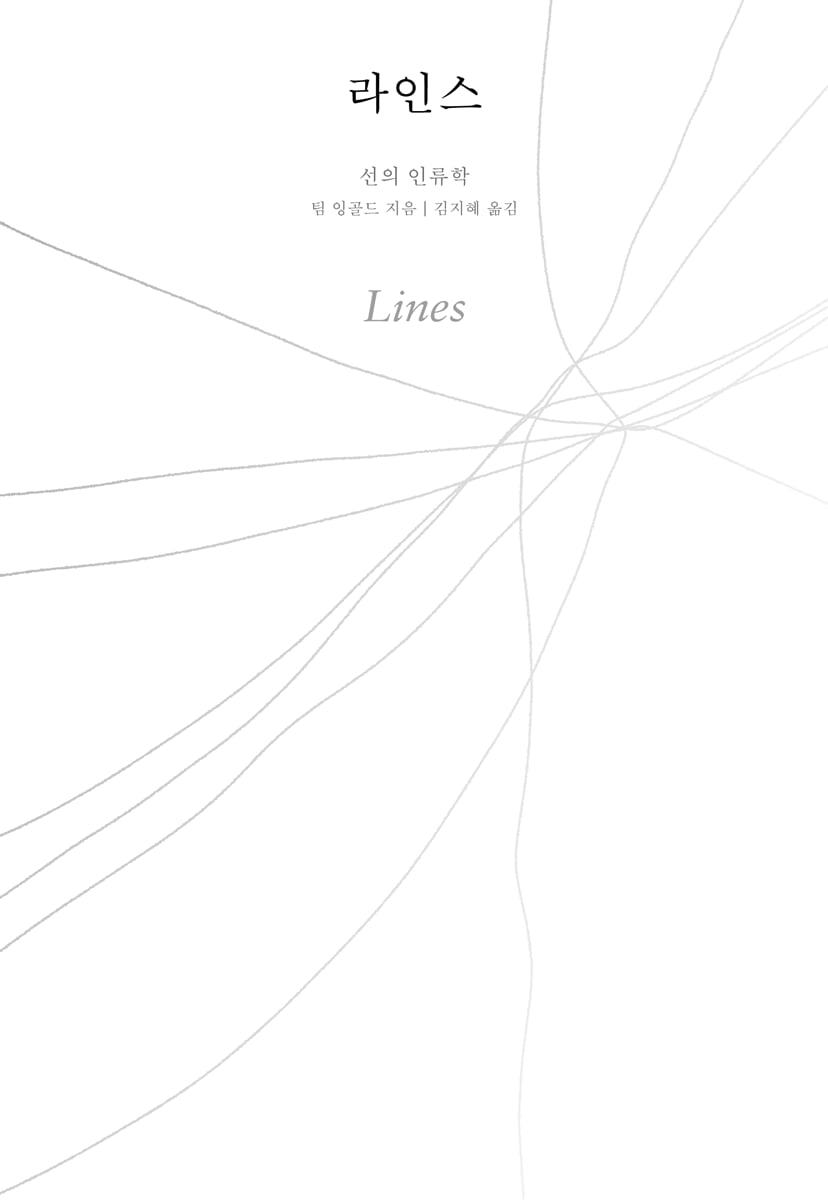
"Lines" explores the lines that exist everywhere: in everyday life, in history, and in the world.
Tim Ingold, who boldly thinks through profound and creative perspectives, begins this book by developing a 'zen anthropology.'
He presents a fascinating way of wayfaring, following the open road and growing in movement.
This book will serve as a knot that weaves new paths and a link that opens yet another path for not only researchers immersed in the academic world, but also musicians, painters, calligraphers, artisans, and all those living their daily lives.
A world unfolds as a story that continues along a line, without beginning or end.
Anthropological Exploration of Line
A journey of goodness that opens beyond the dead end toward a "further place"
A vast book that transcends boundaries of discipline, culture, and time.
The beginnings of Zen anthropology, offering profound and creative perspectives
What do walking, observing, talking, drawing, and writing have in common? They all involve following lines.
"Lines" explores the lines that exist everywhere: in everyday life, in history, and in the world.
Tim Ingold, who boldly thinks through profound and creative perspectives, begins this book by developing a 'zen anthropology.'
He presents a fascinating way of wayfaring, following the open road and growing in movement.
This book will serve as a knot that weaves new paths and a link that opens yet another path for not only researchers immersed in the academic world, but also musicians, painters, calligraphers, artisans, and all those living their daily lives.
A world unfolds as a story that continues along a line, without beginning or end.
- You can preview some of the book's contents.
Preview
index
Acknowledgements
Preface to the Routledge Classic Edition
Entering
Chapter 1 Language, Music, and Notation
Chapter 2: Traces, Reality, and Surface
Chapter 3 Up, Across, Accordingly
Chapter 4: The Line of Genealogy
Chapter 5: Drawing, Writing, and Calligraphy
Chapter 6 How to Make a Line a Straight Line
Translator's Note
References
Search
Preface to the Routledge Classic Edition
Entering
Chapter 1 Language, Music, and Notation
Chapter 2: Traces, Reality, and Surface
Chapter 3 Up, Across, Accordingly
Chapter 4: The Line of Genealogy
Chapter 5: Drawing, Writing, and Calligraphy
Chapter 6 How to Make a Line a Straight Line
Translator's Note
References
Search
Detailed image

Into the book
This discipline [anthropology] is a comparative discipline that recognizes that existence can always be in other ways, and it is a critical discipline in the sense that existence as it is can never be content.
--- p.22
What do walking, weaving, observing, telling stories, singing, drawing, and writing have in common? The answer is that they all proceed along one line or another.
The purpose of this book is to lay the foundations for what might be called a comparative anthropology of good.
As far as I know, nothing of this kind has ever been attempted.
--- p.23
The wayfarer is constantly moving around.
More strictly speaking, he is his movement.
As in the example above, the Inuit people's journey is exemplified by the line of travel within the world.
--- p.159
I believe that the path is the most fundamental aspect of the way living beings, both human and non-human, inhabit the earth.
--- p.170
A resident is someone who participates in the birth of the world from within, in the very process of its continuous birth, and who leaves traces of life and contributes to the pattern and texture of the world.
--- p.170
The traveler on the road is always somewhere, but all that 'somewhere' is on the way to somewhere else.
The world we inhabit is a tangled web of these paths, continually woven together as life moves along them.
--- p.174
In a word, the knowledge of the residents is integrated as they go along.
--- p.183
Things that are told in stories happen rather than exist, so to speak.
That is, each is a moment of ongoing activity.
In short, these are not objects, but stories.
--- p.185
I argue that when the writer ceases to perform the equivalent of walking, words are reduced to fragments and consequently fragmented.
--- p.191~192
The settlers occupy the place.
On the other hand, the nomads fail to occupy.
But the traveler is not a failed or hesitant occupier, but a successful occupier.
They actually move from place to place, sometimes traveling extensively over considerable distances, and through this movement they contribute to the ongoing formation of each place they pass through.
In short, the path is neither placeless nor tied to a place, but rather creates a place.
--- p.205
Life is not confined, but rather moves forward, weaving its way through the world along countless lines of relationships.
--- p.209
In short, the ecology of life is an ecology of threads and traces, not an ecology of nodes and connectors.
And its subject of inquiry must consist not of the relationships between organisms and their external environment, but of the relationships that follow the way of life in which each of them is caught.
In short, ecology is the study of life as a good.
--- p.209
Life is not confined to a point.
Life moves along the line.
--- p.213
The line of the path is topian, achieved through the practice of dwelling and the circuitous movements it entails.
On the other hand, the straight line of modernity, driven by the grand narrative of progressive progress, is utopian, and the fragmented line of postmodernity is distopian.
--- p.330
Indeed, good, like life, has no end.
As in life, what matters is not the final destination, but all the interesting things that happen along the way.
Because wherever you are, there's always a farther place you can go.
--- p.22
What do walking, weaving, observing, telling stories, singing, drawing, and writing have in common? The answer is that they all proceed along one line or another.
The purpose of this book is to lay the foundations for what might be called a comparative anthropology of good.
As far as I know, nothing of this kind has ever been attempted.
--- p.23
The wayfarer is constantly moving around.
More strictly speaking, he is his movement.
As in the example above, the Inuit people's journey is exemplified by the line of travel within the world.
--- p.159
I believe that the path is the most fundamental aspect of the way living beings, both human and non-human, inhabit the earth.
--- p.170
A resident is someone who participates in the birth of the world from within, in the very process of its continuous birth, and who leaves traces of life and contributes to the pattern and texture of the world.
--- p.170
The traveler on the road is always somewhere, but all that 'somewhere' is on the way to somewhere else.
The world we inhabit is a tangled web of these paths, continually woven together as life moves along them.
--- p.174
In a word, the knowledge of the residents is integrated as they go along.
--- p.183
Things that are told in stories happen rather than exist, so to speak.
That is, each is a moment of ongoing activity.
In short, these are not objects, but stories.
--- p.185
I argue that when the writer ceases to perform the equivalent of walking, words are reduced to fragments and consequently fragmented.
--- p.191~192
The settlers occupy the place.
On the other hand, the nomads fail to occupy.
But the traveler is not a failed or hesitant occupier, but a successful occupier.
They actually move from place to place, sometimes traveling extensively over considerable distances, and through this movement they contribute to the ongoing formation of each place they pass through.
In short, the path is neither placeless nor tied to a place, but rather creates a place.
--- p.205
Life is not confined, but rather moves forward, weaving its way through the world along countless lines of relationships.
--- p.209
In short, the ecology of life is an ecology of threads and traces, not an ecology of nodes and connectors.
And its subject of inquiry must consist not of the relationships between organisms and their external environment, but of the relationships that follow the way of life in which each of them is caught.
In short, ecology is the study of life as a good.
--- p.209
Life is not confined to a point.
Life moves along the line.
--- p.213
The line of the path is topian, achieved through the practice of dwelling and the circuitous movements it entails.
On the other hand, the straight line of modernity, driven by the grand narrative of progressive progress, is utopian, and the fragmented line of postmodernity is distopian.
--- p.330
Indeed, good, like life, has no end.
As in life, what matters is not the final destination, but all the interesting things that happen along the way.
Because wherever you are, there's always a farther place you can go.
--- p.333
Publisher's Review
What do walking, observing, talking, drawing, and writing have in common?
The point is that everyone follows the line.
Lines is the masterpiece of British anthropologist Tim Ingold, published in 2007.
Tim Ingold, born in 1948, has been conducting research since the 1970s. In 2007, at the age of 60, he published "Lines," which summarized his research topics and his own thoughts, and finally announced the beginning of "pre-anthropology."
Ingold asks himself whether he is "breaking away from anthropology" through the publication of "Lines," and says that from this point on, he has become a lineologist, a person who studies lines.
After the publication of Lines, Ingold published Being Alive (2011), Making (2013), The Life of Lines (2015), and Correspondences (2020). In fact, all of his discussions after the publication of Lines unfold within the context of his reflections on lines.
"Lines" is a commemorative book marking the beginning of a creative movement called "Zen Anthropology," offering a profound perspective on life and living beings, and offering rich reflections on diverse fields such as history, culture, art, technology, ecology, and evolution.
Exploring the real 'good', not a metaphor or an object of theory.
“After reading this book, you will never see the world the same way again.”
The line explored in 『Lines』 is not a line expressed metaphorically, nor is it a line as an object of theory.
Ingold explores the real 'good' that exists everywhere and at all times in our daily lives.
So, the unfamiliar topic of lines initially raises doubts.
Could this truly be the subject of anthropological inquiry? Can the exploration of goodness truly tell us something about people and things, about historical time and everyday life?
Ingold sees the world as a dynamic process of becoming.
Therefore, I believe that the study of people and things should not be done by understanding them as independent entities, but rather by following the lines that compose them.
Furthermore, I believe that anthropology itself is the practice of growth, which begins from within people's lives, follows an open path, and develops through interaction within relationships.
In 『Lines』, the practice of following the line and moving forward is presented as an important way of life, and for Ingold, this is also an anthropological practice.
"Lines" is a work that is like a knot created by Ingold's thoughts and practices.
Anthropologist Mark Ebert, in his review of Lines, said, “After reading this book, you will never see the world the same way again.”
As he says, after reading Lines, we gain a completely new understanding of the meaning of even everyday activities we perform, such as walking, observing, and talking.
Furthermore, “life is not confined to a point.
We open our eyes to the way of existence in which the 'end leads to the beginning', expressed in the saying, "Life moves along the line."
The experience of noticing and following the good in the world changes your perspective on 'living'.
Ingold emphasizes this without hesitation.
“Goodness truly has the power to change the world.”
Like the winding lines of a path
Six stories with endings and beginnings
Chapter 1 Language, Music, and Notation
In Chapter 1, Ingold begins his discussion by explaining why he came to study lines.
In fact, this was the question that first struck Ingold, regardless of the line.
The question, “How did we come to distinguish between words and songs?”
In the past, music was, above all, the 'resonance of lyrics' and language was understood as 'speech sounds', but today, lyrics are no longer essential to music, and language has now become a kind of 'system of meaning' given regardless of speech sounds, Ingold points out.
So, this change is expressed as follows.
“Music became silent, and language became silent.” Why did this change occur?
In his search for answers to the question of why the 'silence of language' occurred, Ingold examines the changes that occurred during the transition from oral to written culture.
In this case, Ingold notes that the silence of language is related to a change in the way writing is understood, namely, a change from the understanding of writing as a handwritten inscription to the understanding of writing as a technique for constructing spoken language.
In order to accurately grasp this point, in the process of examining the 'history of writing', we confirm that the history of writing is more broadly included in the 'history of notation'.
And when you start studying notation, you realize that notation is nothing but made up of lines.
It is at this point that Ingold begins his study of the production and meaning of lines.
Chapter 2: Traces, Reality, and Surface
Chapter 2 examines the relationship between lines and the surfaces on which they are drawn.
This is because it is clear that what is important in the exploration of lines is not simply the lines themselves, but their relationship to the surface on which they are engraved.
To examine the history of lines, we must examine the changing relationship between lines and surfaces.
Therefore, in Chapter 2, the surface becomes the object of exploration.
Before exploring the surface, Ingold asks a fundamental question.
What is good? Here, we present two main categories of good.
They are ‘thread’ and ‘trace.’
Threads and traces create lines of movement and growth, sometimes creating surfaces and sometimes destroying them.
Chapter 3 Up, Across, Accordingly
Chapter 3 examines the results of changes in the relationship between lines and surfaces.
Chapter 3 contains a critical discussion.
What is the criticism about?
This is a critique of the movement of 'up' and 'across'.
Here, Ingold first presents an example of the distinction between 'walking' and 'assembly'.
A walk is a trace of a gesture, while an assembly is an artifact made of point-to-point connections.
The point-to-point connection method transforms our understanding of space, making us perceive the environment as something we occupy rather than something we inhabit.
What Ingold considers “the most fundamental mode of terrestrial inhabitation for living beings, human and non-human” is a mode of movement that he calls “wayfaring.”
In Chapter 3, Ingold criticizes the network method and transportation method that connects intersections with straight lines, and talks about the way of living by following lines in the entangled area called the net.
According to Ingold, beings inhabit the world by practicing a way of life that integrates movement and growth.
Chapter 4: The Line of Genealogy
What we will look at in Chapter 4 is the ‘line of genealogy.’
An example that immediately comes to mind when thinking about genealogical lines is the diagram in Charles Darwin's Origin of Species, a genealogical diagram depicting the evolution of life.
Ingold says that when Charles Darwin drew this diagram, he was drawing "life within each dot" rather than "life along a line."
This is because the ‘dotted lines’ that make up the genealogy are just like that.
As this dotted line makes clear, this line of genealogy is neither a lifeline nor even a story about humanity.
Ingold examines how the concept of 'evolution' has been dealt with throughout history through the lens of goodness.
Chapter 5: Drawing, Writing, and Calligraphy
Chapter 5 returns to the topic of 'writing'.
Ingold asks what the difference is between gesture in drawing and writing.
There can be no strict distinction between drawing and writing, as long as writing is understood in its original sense as the practice of inscription.
So why do we understand drawing and writing as different things today?
In considering the reasons for this, Ingold points out the dichotomy that drives this 'modern divide' (including the division between speech and song discussed earlier): the dichotomy between technology and art.
Chapter 6 How to Make a Line a Straight Line
Chapter 6 examines the 'eerie ghost of the line', that is, the straight line.
The line does not necessarily have to be straight.
Yet, why and how did it come to be that in our perception, a line must be a straight line?
Ingold argues that the straight line has become an icon of modernity, and traces its historical origins.
Ingold describes the straight line as a puzzle.
Straight lines dominate the surface but do not connect anything.
It also does not embody any kind of movement or gesture.
Moreover, when the certainty of modernity is questioned, the straight line that once connected the dots becomes fragmented.
"A gesture that weaves the world together again in a world filled with lines."
At the end of the book, there is a translator's note that provides a detailed explanation of the context and meaning of Lines and Zen anthropology.
In this 'invitation'-like text, the translator says:
“What I want to talk about with my readers in particular is ‘growth.’
In a world dominated by developmentalism and capitalism, the meaning of 'growth' has become inseparable from advanced technoscience, capitalization, and scale.
Many who resist this catastrophic situation seek an escape route called 'degrowth'.
The concept leaves some very useful implications, but I think Ingold's attempt is much bolder.
Ingold rethinks what we mean by 'growth' and reveals that deterministic growth is not growth at all.
As we affirm and reclaim the desire and drive for growth, we also discover the potential for disruption that reweaves life and the world.
[…] The line will only open up a new world when it is found and followed again.
The important thing is that through this line we move forward on a new path, and that this 'new' path is achieved through 'following'.
It is not a gesture that begins from an empty space, but rather a gesture that weaves the world again within a world already filled with lines.
These attempts are quite different from the modern trend of pursuing worldly comfort.
“The journey of the path is meaningful because the future is not set in stone.”
The point is that everyone follows the line.
Lines is the masterpiece of British anthropologist Tim Ingold, published in 2007.
Tim Ingold, born in 1948, has been conducting research since the 1970s. In 2007, at the age of 60, he published "Lines," which summarized his research topics and his own thoughts, and finally announced the beginning of "pre-anthropology."
Ingold asks himself whether he is "breaking away from anthropology" through the publication of "Lines," and says that from this point on, he has become a lineologist, a person who studies lines.
After the publication of Lines, Ingold published Being Alive (2011), Making (2013), The Life of Lines (2015), and Correspondences (2020). In fact, all of his discussions after the publication of Lines unfold within the context of his reflections on lines.
"Lines" is a commemorative book marking the beginning of a creative movement called "Zen Anthropology," offering a profound perspective on life and living beings, and offering rich reflections on diverse fields such as history, culture, art, technology, ecology, and evolution.
Exploring the real 'good', not a metaphor or an object of theory.
“After reading this book, you will never see the world the same way again.”
The line explored in 『Lines』 is not a line expressed metaphorically, nor is it a line as an object of theory.
Ingold explores the real 'good' that exists everywhere and at all times in our daily lives.
So, the unfamiliar topic of lines initially raises doubts.
Could this truly be the subject of anthropological inquiry? Can the exploration of goodness truly tell us something about people and things, about historical time and everyday life?
Ingold sees the world as a dynamic process of becoming.
Therefore, I believe that the study of people and things should not be done by understanding them as independent entities, but rather by following the lines that compose them.
Furthermore, I believe that anthropology itself is the practice of growth, which begins from within people's lives, follows an open path, and develops through interaction within relationships.
In 『Lines』, the practice of following the line and moving forward is presented as an important way of life, and for Ingold, this is also an anthropological practice.
"Lines" is a work that is like a knot created by Ingold's thoughts and practices.
Anthropologist Mark Ebert, in his review of Lines, said, “After reading this book, you will never see the world the same way again.”
As he says, after reading Lines, we gain a completely new understanding of the meaning of even everyday activities we perform, such as walking, observing, and talking.
Furthermore, “life is not confined to a point.
We open our eyes to the way of existence in which the 'end leads to the beginning', expressed in the saying, "Life moves along the line."
The experience of noticing and following the good in the world changes your perspective on 'living'.
Ingold emphasizes this without hesitation.
“Goodness truly has the power to change the world.”
Like the winding lines of a path
Six stories with endings and beginnings
Chapter 1 Language, Music, and Notation
In Chapter 1, Ingold begins his discussion by explaining why he came to study lines.
In fact, this was the question that first struck Ingold, regardless of the line.
The question, “How did we come to distinguish between words and songs?”
In the past, music was, above all, the 'resonance of lyrics' and language was understood as 'speech sounds', but today, lyrics are no longer essential to music, and language has now become a kind of 'system of meaning' given regardless of speech sounds, Ingold points out.
So, this change is expressed as follows.
“Music became silent, and language became silent.” Why did this change occur?
In his search for answers to the question of why the 'silence of language' occurred, Ingold examines the changes that occurred during the transition from oral to written culture.
In this case, Ingold notes that the silence of language is related to a change in the way writing is understood, namely, a change from the understanding of writing as a handwritten inscription to the understanding of writing as a technique for constructing spoken language.
In order to accurately grasp this point, in the process of examining the 'history of writing', we confirm that the history of writing is more broadly included in the 'history of notation'.
And when you start studying notation, you realize that notation is nothing but made up of lines.
It is at this point that Ingold begins his study of the production and meaning of lines.
Chapter 2: Traces, Reality, and Surface
Chapter 2 examines the relationship between lines and the surfaces on which they are drawn.
This is because it is clear that what is important in the exploration of lines is not simply the lines themselves, but their relationship to the surface on which they are engraved.
To examine the history of lines, we must examine the changing relationship between lines and surfaces.
Therefore, in Chapter 2, the surface becomes the object of exploration.
Before exploring the surface, Ingold asks a fundamental question.
What is good? Here, we present two main categories of good.
They are ‘thread’ and ‘trace.’
Threads and traces create lines of movement and growth, sometimes creating surfaces and sometimes destroying them.
Chapter 3 Up, Across, Accordingly
Chapter 3 examines the results of changes in the relationship between lines and surfaces.
Chapter 3 contains a critical discussion.
What is the criticism about?
This is a critique of the movement of 'up' and 'across'.
Here, Ingold first presents an example of the distinction between 'walking' and 'assembly'.
A walk is a trace of a gesture, while an assembly is an artifact made of point-to-point connections.
The point-to-point connection method transforms our understanding of space, making us perceive the environment as something we occupy rather than something we inhabit.
What Ingold considers “the most fundamental mode of terrestrial inhabitation for living beings, human and non-human” is a mode of movement that he calls “wayfaring.”
In Chapter 3, Ingold criticizes the network method and transportation method that connects intersections with straight lines, and talks about the way of living by following lines in the entangled area called the net.
According to Ingold, beings inhabit the world by practicing a way of life that integrates movement and growth.
Chapter 4: The Line of Genealogy
What we will look at in Chapter 4 is the ‘line of genealogy.’
An example that immediately comes to mind when thinking about genealogical lines is the diagram in Charles Darwin's Origin of Species, a genealogical diagram depicting the evolution of life.
Ingold says that when Charles Darwin drew this diagram, he was drawing "life within each dot" rather than "life along a line."
This is because the ‘dotted lines’ that make up the genealogy are just like that.
As this dotted line makes clear, this line of genealogy is neither a lifeline nor even a story about humanity.
Ingold examines how the concept of 'evolution' has been dealt with throughout history through the lens of goodness.
Chapter 5: Drawing, Writing, and Calligraphy
Chapter 5 returns to the topic of 'writing'.
Ingold asks what the difference is between gesture in drawing and writing.
There can be no strict distinction between drawing and writing, as long as writing is understood in its original sense as the practice of inscription.
So why do we understand drawing and writing as different things today?
In considering the reasons for this, Ingold points out the dichotomy that drives this 'modern divide' (including the division between speech and song discussed earlier): the dichotomy between technology and art.
Chapter 6 How to Make a Line a Straight Line
Chapter 6 examines the 'eerie ghost of the line', that is, the straight line.
The line does not necessarily have to be straight.
Yet, why and how did it come to be that in our perception, a line must be a straight line?
Ingold argues that the straight line has become an icon of modernity, and traces its historical origins.
Ingold describes the straight line as a puzzle.
Straight lines dominate the surface but do not connect anything.
It also does not embody any kind of movement or gesture.
Moreover, when the certainty of modernity is questioned, the straight line that once connected the dots becomes fragmented.
"A gesture that weaves the world together again in a world filled with lines."
At the end of the book, there is a translator's note that provides a detailed explanation of the context and meaning of Lines and Zen anthropology.
In this 'invitation'-like text, the translator says:
“What I want to talk about with my readers in particular is ‘growth.’
In a world dominated by developmentalism and capitalism, the meaning of 'growth' has become inseparable from advanced technoscience, capitalization, and scale.
Many who resist this catastrophic situation seek an escape route called 'degrowth'.
The concept leaves some very useful implications, but I think Ingold's attempt is much bolder.
Ingold rethinks what we mean by 'growth' and reveals that deterministic growth is not growth at all.
As we affirm and reclaim the desire and drive for growth, we also discover the potential for disruption that reweaves life and the world.
[…] The line will only open up a new world when it is found and followed again.
The important thing is that through this line we move forward on a new path, and that this 'new' path is achieved through 'following'.
It is not a gesture that begins from an empty space, but rather a gesture that weaves the world again within a world already filled with lines.
These attempts are quite different from the modern trend of pursuing worldly comfort.
“The journey of the path is meaningful because the future is not set in stone.”
GOODS SPECIFICS
- Date of issue: March 14, 2024
- Page count, weight, size: 368 pages | 496g | 145*210*22mm
- ISBN13: 9791188501380
You may also like
카테고리
korean


korean

![GQ KOREA Mark (Monthly): December [2025]](http://librairie.coreenne.fr/cdn/shop/files/8ef265dbbfbf186523ed75ba7319009d.jpg?v=1765340328&width=3840)


