

History of the Huns
 |
Description
Book Introduction
The original text of this paper is 『Хунну: Срединная Азия в древние времена (Hunnu: Ancient Central Asia)』(1960), and its setting is not only present-day Mongolia but also several countries in Central Asia.
The title of the translated book reflects this, as it covers the period from 2000 BC, before the formation of the Xiongnu, to the 1st century BC, after the fall of the Xiongnu.
This paper is a work that reflects the author's anti-European Eurasian worldview, natural determinism, and 'passinarnost', the background of national formation.
He rejected the biased view that portrayed the Huns as "uncivilized barbarians," and emphasized that the Huns formed an independent culture and state that interacted in various ways not only with the Han but also with other nomadic peoples.
The history of the Huns was understood within the historical context of Central Asia and the entire Eurasian continent, and the relationship between nomads and settled peoples was analyzed as a dynamic interaction.
Among Gumilyov's works on the steppe, the history of the Mongol Empire was translated from English and published in Korea as 『In Search of an Imaginary Kingdom』(Поиски вымышленного царства)(1970).
This book is the second translation of Gumilyov's work in Korea.
However, it is the first history book written by Gumilyov about the Xiongnu people, who continued to the Mongol Empire, and it is the book that led to the creation of the theory of national formation.
It can be said that the meaning is different in that it was translated from Russian and was done by an archaeologist who understood the archaeological data that became the background knowledge for the theory of ethnogenesis.
The title of the translated book reflects this, as it covers the period from 2000 BC, before the formation of the Xiongnu, to the 1st century BC, after the fall of the Xiongnu.
This paper is a work that reflects the author's anti-European Eurasian worldview, natural determinism, and 'passinarnost', the background of national formation.
He rejected the biased view that portrayed the Huns as "uncivilized barbarians," and emphasized that the Huns formed an independent culture and state that interacted in various ways not only with the Han but also with other nomadic peoples.
The history of the Huns was understood within the historical context of Central Asia and the entire Eurasian continent, and the relationship between nomads and settled peoples was analyzed as a dynamic interaction.
Among Gumilyov's works on the steppe, the history of the Mongol Empire was translated from English and published in Korea as 『In Search of an Imaginary Kingdom』(Поиски вымышленного царства)(1970).
This book is the second translation of Gumilyov's work in Korea.
However, it is the first history book written by Gumilyov about the Xiongnu people, who continued to the Mongol Empire, and it is the book that led to the creation of the theory of national formation.
It can be said that the meaning is different in that it was translated from Russian and was done by an archaeologist who understood the archaeological data that became the background knowledge for the theory of ethnogenesis.
index
Translator's Preface
introduction
Chapter I.
In the fog of time
1.
In ancient China
2.
The birth of the Huns
3.
Geographic environment of the eastern steppe
4.
The Rong and the Huns
5.
The Zhou Dynasty's victory and its consequences
Chapter II.
Exiles of the Prairie
1.
Xiongnu Prehistory and Siberian Archaeology
2.
Formation of the Huns
3.
The Discovery and Cultural Mixture of Siberia
4.
To the north, the Xiongnu advance
5.
The Huns' ancient neighbors
Chapter III.
On the shores of the “Sand Sea”
1.
The first Xiongnu invasion of China
2.
The struggle between the Chinese and the Feng people
3.
Stone slab tomb culture
4.
Views on the Xiongnu language
Chapter IV.
prairie
1.
War between Zhao and the Xiongnu
2.
Construction of the Great Wall
3.
The war between the Qin and the Xiongnu
4.
The Fall of Jin
5.
On the method of writing history in ancient China
Chapter V.
Whistling Arrow: Myeongjeok (鳴鏑)
1.
Modun (冒頓) Chanyu and the rise of the Huns
2.
The first war between the Huns and the Han
3.
nomadic Tibetans
4.
Oson (烏孫)
5.
Xiongnu state structure
6.
Seonwoo (單于)
7.
noble families of the Xiongnu
8.
The Xiongnu's rank system
9.
Xiongnu legal system
10.
Xiongnu warriors
11.
The Xiongnu army
12.
The Huns' source of income
13.
Structure of Xiongnu society
Chapter VI.
Rule over the people
1.
Western border issue
2.
Internal policy
3.
The War for Free Trade with China
4.
eastern border
5.
Northern border
6.
Life in an economic community within the Xiongnu state
7.
Huns' religion
Chapter VII.
Rise of the Dragon
1.
Resumption of war between the Xiongnu and China
2.
Defeat of the Huns
3.
Battle between the Wei Qing and the Xiongnu
4.
The success of Chinese weapons
5.
The Discovery of Europe
6.
the western edge
7.
Han Muje and his achievements
Chapter VIII.
Cheonma (Heavenly Horse)
1.
China's westward expansion
2.
The reign of Ah Seon-u
3.
The first Dayuan expedition
4.
The second Dayan expedition
5.
Besiege Kushan
6.
The result of a hard war
Chapter IX.
Fight until you die
1.
failed conspiracy
2.
Surrender of Yi Ling
3.
The Huns' succession to the throne was distorted
4.
Battle of Yanyan Mountain
Chapter X.
The crisis of the Xiongnu Empire
1.
Fight to the death
2.
Xiongnu society on the verge of decline
3.
Old Xiongnu group
4.
War with China
5.
Triangular diplomacy between Wusun, China, and the Xiongnu
6.
Defeat of the Huns
Chapter XI.
Brother to brother
1.
The coup d'état of Jeon Geo-yeonji
2.
war of slaughter
3.
The division of Wusun and the war of Ganggeo
4.
Submission to China
5.
The Huns of Central Asia
6.
Battle of Talas
7.
The formation of the late Dingling and Yenisei Kyrgyz people
Chapter XII.
Freedom Returns
1.
The status of an empire as seen through the eyes of its contemporaries
2.
The Huns under Chinese protection
3.
Wang Mang's accession to the throne and idealistic reforms
4.
Separation of the Huns from China
5.
Noyong-ol (Ноён-Уул)
6.
Change of dynasty
7.
The resurrection of the enemy and the death of Wang Mang
8.
Reconstruction of Han
Chapter XIII.
split
1.
The success of the Huns
2.
Internal strife within the Xiongnu power
3.
separation of the state
4.
Weakening of the Huns
5.
River rebellion
6.
Events in the Western Regions
7.
The evolution of the Southern Xiongnu
8.
The Formation of Orda - Organizational Democracy
Chapter XIV.
broken ring
1.
Before I die
2.
Defeat of the Northern Xiongnu
3.
Bancho's victory
4.
The upheaval of the Southern Xiongnu
5.
Conquest of the Qiang
6.
The revival of the Northern Xiongnu
7.
River rebellion
8.
China's loss of the Western Regions
Chapter XV.
Final attack
1.
Sandstone
2.
The four tribes of the Huns
3.
Huns and Huns
Ethnicity
Chronological Table (16th century BC - 2nd century AD)
Xiongnu genealogy
Translator's Note: References
clear
introduction
Chapter I.
In the fog of time
1.
In ancient China
2.
The birth of the Huns
3.
Geographic environment of the eastern steppe
4.
The Rong and the Huns
5.
The Zhou Dynasty's victory and its consequences
Chapter II.
Exiles of the Prairie
1.
Xiongnu Prehistory and Siberian Archaeology
2.
Formation of the Huns
3.
The Discovery and Cultural Mixture of Siberia
4.
To the north, the Xiongnu advance
5.
The Huns' ancient neighbors
Chapter III.
On the shores of the “Sand Sea”
1.
The first Xiongnu invasion of China
2.
The struggle between the Chinese and the Feng people
3.
Stone slab tomb culture
4.
Views on the Xiongnu language
Chapter IV.
prairie
1.
War between Zhao and the Xiongnu
2.
Construction of the Great Wall
3.
The war between the Qin and the Xiongnu
4.
The Fall of Jin
5.
On the method of writing history in ancient China
Chapter V.
Whistling Arrow: Myeongjeok (鳴鏑)
1.
Modun (冒頓) Chanyu and the rise of the Huns
2.
The first war between the Huns and the Han
3.
nomadic Tibetans
4.
Oson (烏孫)
5.
Xiongnu state structure
6.
Seonwoo (單于)
7.
noble families of the Xiongnu
8.
The Xiongnu's rank system
9.
Xiongnu legal system
10.
Xiongnu warriors
11.
The Xiongnu army
12.
The Huns' source of income
13.
Structure of Xiongnu society
Chapter VI.
Rule over the people
1.
Western border issue
2.
Internal policy
3.
The War for Free Trade with China
4.
eastern border
5.
Northern border
6.
Life in an economic community within the Xiongnu state
7.
Huns' religion
Chapter VII.
Rise of the Dragon
1.
Resumption of war between the Xiongnu and China
2.
Defeat of the Huns
3.
Battle between the Wei Qing and the Xiongnu
4.
The success of Chinese weapons
5.
The Discovery of Europe
6.
the western edge
7.
Han Muje and his achievements
Chapter VIII.
Cheonma (Heavenly Horse)
1.
China's westward expansion
2.
The reign of Ah Seon-u
3.
The first Dayuan expedition
4.
The second Dayan expedition
5.
Besiege Kushan
6.
The result of a hard war
Chapter IX.
Fight until you die
1.
failed conspiracy
2.
Surrender of Yi Ling
3.
The Huns' succession to the throne was distorted
4.
Battle of Yanyan Mountain
Chapter X.
The crisis of the Xiongnu Empire
1.
Fight to the death
2.
Xiongnu society on the verge of decline
3.
Old Xiongnu group
4.
War with China
5.
Triangular diplomacy between Wusun, China, and the Xiongnu
6.
Defeat of the Huns
Chapter XI.
Brother to brother
1.
The coup d'état of Jeon Geo-yeonji
2.
war of slaughter
3.
The division of Wusun and the war of Ganggeo
4.
Submission to China
5.
The Huns of Central Asia
6.
Battle of Talas
7.
The formation of the late Dingling and Yenisei Kyrgyz people
Chapter XII.
Freedom Returns
1.
The status of an empire as seen through the eyes of its contemporaries
2.
The Huns under Chinese protection
3.
Wang Mang's accession to the throne and idealistic reforms
4.
Separation of the Huns from China
5.
Noyong-ol (Ноён-Уул)
6.
Change of dynasty
7.
The resurrection of the enemy and the death of Wang Mang
8.
Reconstruction of Han
Chapter XIII.
split
1.
The success of the Huns
2.
Internal strife within the Xiongnu power
3.
separation of the state
4.
Weakening of the Huns
5.
River rebellion
6.
Events in the Western Regions
7.
The evolution of the Southern Xiongnu
8.
The Formation of Orda - Organizational Democracy
Chapter XIV.
broken ring
1.
Before I die
2.
Defeat of the Northern Xiongnu
3.
Bancho's victory
4.
The upheaval of the Southern Xiongnu
5.
Conquest of the Qiang
6.
The revival of the Northern Xiongnu
7.
River rebellion
8.
China's loss of the Western Regions
Chapter XV.
Final attack
1.
Sandstone
2.
The four tribes of the Huns
3.
Huns and Huns
Ethnicity
Chronological Table (16th century BC - 2nd century AD)
Xiongnu genealogy
Translator's Note: References
clear
Publisher's Review
The original text of this paper, 『Хунну: Срединная Азия в древние времена (Hyunnu: Ancient Central Asia)』, is the first book in Gumilyov's trilogy on the steppe, which deals with the Huns, Turks, and Mongols, and is Gumilyov's second work to be introduced in Korea.
A book on the history of the Mongol Empire translated into English has already been published in Korea (In Search of an Imaginary Kingdom).
As the translator specializes in and studies Eurasian prehistoric archaeology, he has included the latest, although insufficient, information in the commentary to help readers understand the archaeological culture that formed the background for the formation of the Huns covered in the original work.
In 『In Search of an Imaginary Kingdom』 (Russian original), which deals with the history of the Mongol Empire, there were evaluations that it surpassed history books due to its artistic expression, but it also received harsh criticism.
The translation also faced many challenges due to Gumilyov's unique writing style and the inclusion of references that transcend East and West, but we worked to make it as readable as possible.
There are differences between this paper and studies on the Xiongnu based on Chinese historical texts and a Sino-centric perspective.
However, the translator aimed to convey Gumilyov's ideas and historical research perspectives and tried to remain faithful to the content.
The original book was published in 1960 and has been reprinted several times since Gumilyov's death, with some of its contents revised.
The translator decided to translate and annotate the first edition, judging that it best reflects Gumilyov's historical perspective.
Gumilyov's historiography is anti-European and incorporates a Eurasian worldview, environmental determinism, and theories of national formation.
His historical writing was not simply a historical writing from the perspective of a historian, as is often found in history books, but he sought to grasp the whole picture.
So, the background of all the books he wrote is large in terms of time and space.
The same perspective was also used in the ancient Turkic history 『древних тюрок』(1967) and the history of the Mongol Empire 『In Search of an Imaginary Kingdom』(Поиски вымышленного царства)(1970).
He believed that the formation of a nation was influenced not only by geographical environment, socioeconomic development level, and technological equipment, but also by the passion and tension of the nation.
Passionate tension is expressed by the number of enthusiasts within an ethnic group, the ratio of enthusiasts to non-enthusiasts, and the moment of ethnic formation is said to occur when enthusiasts and quasi-enthusiasts suddenly appear.
At this time, 'passion' was defined as the activity that appears when an individual strives for a goal and makes extreme efforts and sacrifices for this goal.
So, it was seen that the rise and fall of a nation follows the decline and increase in the number of enthusiasts within the nation.
He attempted to explain the birth, rise, and decline of a specific nation through the theory of national formation.
For that reason, archaeological data was actively utilized to find out what the Huns looked like before they appeared in historical records.
The Siberian Bronze Age cultures include the Glaskovo culture, Andronovo culture, Karasuk culture, and stone slab tomb culture, which are mainly from the 2nd millennium BC, and the Pazyryk culture and Tagar culture, which are from the Scytho-Siberian culture from the 1st millennium BC.
Because it is based on data researched by Kiselev, Okladnikov, and Rudenko, there are some differences from the current facts made possible by the latest mechanical equipment, but many of the characteristics of the archaeological culture have continued to this day.
The translator has added explanations based on the latest research findings in the annotation regarding the archaeological culture used in the text.
The Xiongnu reached their peak around the 3rd century BC, with the emergence of the Chanyu of Modun.
The process of integration into a powerful nomadic empire was developed in detail, and the process of the Xiongnu establishing themselves as a major political force in East Asia was analyzed, focusing on the policy of reconciliation with China.
After the Modun and Luoshang Chanyu periods, during the period of the Junshen Chanyu and the Yijishi Chanyu, China rose to power in the 2nd century BC, and engaged in diplomacy with several Central Asian countries that were neighbors of the Xiongnu, competing with them.
Gumilyov viewed the competition between the Huns and the Han Chinese as a competition for trade, that is, a trade war.
According to this, both the Huns and the Han became sources of great prosperity through their competitive relationship for free trade, which is interesting because it resembles the present day when the preface is being written.
The fact that the Huns, unlike other Central Asian peoples, formed an organization based on a socio-military democratic alliance called 'Orda' rather than a clan-tribe or blood-based one was pointed out as the reason for the rise and fall of the empire.
In 'Orda', a leader is elected and approved at a meeting of all members. The person elected at this time was Seonwoo, and there was a clear difference in light and dark when a strong leader was elected and when he was not, which made for instability.
However, it was an organization that could not be seen in neighboring Central Asian peoples.
The decline of the Xiongnu began in the 1st century BC, when the Xiongnu split into the North and South due to internal strife.
After that, the southern and northern Huns went their separate ways, with the northern Huns moving to Europe and becoming the Huns.
The trigger for the decline of the Xiongnu was the intervention of Jeon Geo-yeon-ji (wife of the previous Chanyu) to succeed the Chanyu of Yeo-ryeo-gwon-geo, thereby destroying the order of succession to the Chanyu.
In other words, as the Orda, which was a democratic organization among the Xiongnu clans, became powerless, the authority of the Chanyu also fell to the ground, leading to the proliferation of Chanyu.
However, although not mentioned in the original text, there were several instances of Jeon Geo-yeonji intervening in the Seonwoo genealogy included in the appendix.
Gumilyov called it a coup d'état in the former Soviet Union.
The translator believes that the authority and ability of the Sunwoo, who was elected by the democratic political body called 'Orda', would have been a great driving force in forming a great empire.
The fact that Chanyu became numerous after the Chanyu of Haeryeo Gwongeo and the Chanyu of Hohanya can be explained in reverse.
It is not known who the Chanyu before Duman Chanyu were, but they were likely people who practiced the Bronze Age and Early Iron Age cultures of southern Siberia.
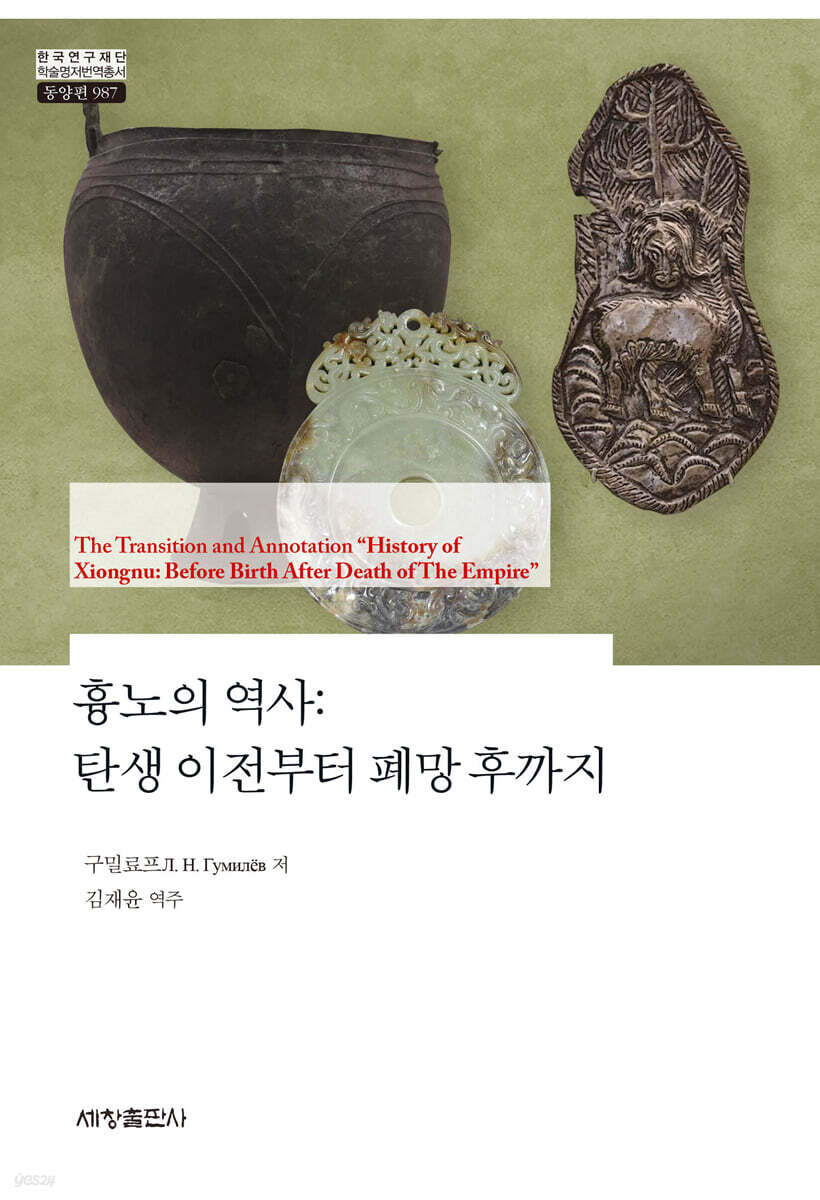
Among the Xiongnu relics, there is the 'Jade Wall' (center of the cover photo) made of milky-white jade.
These relics have been found since the Late Paleolithic period in the Baikal region, and were particularly abundant in the tombs of the Glaskovo culture mentioned in this paper.
Jade walls reappeared among the Xiongnu during the Bronze Age.
Also, the artifact called a bronze cauldron or bronze bowl (left side of the cover photo) is from the Scytho-Siberian culture that began in the 9th century BC.
The oldest remains date back to the 7th century BC and are also found at the Arzhan II site in Tuva and the Kelermes site in the Kuban region.
Also, after the Huns, bronze cauldrons were used by many ethnic groups in Northeast Asia, including the Buyeo and Xianbei.
In addition to this, it is a relic that has spread widely to the west, even to Hungary.
Of course, the size and material may change, but the shape and handle of the pot remain, maintaining its originality.
Archaeological sites contain many relics and remains, among which there are relics or specific remains whose essence has been preserved for a very long time, and which can be said to reveal the uniqueness of a people.
Some relics may appear continuously, but there are also relics that have an invisible period of time.
It's like a meme phenomenon.
Just as vintage culture is popular among the MZ generation in their 20s and 30s today, there are items that reappear and become popular even after a period of discontinuity.
I don't know exactly where the decline of the Xiongnu people began, but I dream of a moment when enthusiasts like Modun Chanyu, Mukkhagan, and Genghis Khan will emerge again, triggering the unification of the Eurasian continent.
A book on the history of the Mongol Empire translated into English has already been published in Korea (In Search of an Imaginary Kingdom).
As the translator specializes in and studies Eurasian prehistoric archaeology, he has included the latest, although insufficient, information in the commentary to help readers understand the archaeological culture that formed the background for the formation of the Huns covered in the original work.
In 『In Search of an Imaginary Kingdom』 (Russian original), which deals with the history of the Mongol Empire, there were evaluations that it surpassed history books due to its artistic expression, but it also received harsh criticism.
The translation also faced many challenges due to Gumilyov's unique writing style and the inclusion of references that transcend East and West, but we worked to make it as readable as possible.
There are differences between this paper and studies on the Xiongnu based on Chinese historical texts and a Sino-centric perspective.
However, the translator aimed to convey Gumilyov's ideas and historical research perspectives and tried to remain faithful to the content.
The original book was published in 1960 and has been reprinted several times since Gumilyov's death, with some of its contents revised.
The translator decided to translate and annotate the first edition, judging that it best reflects Gumilyov's historical perspective.
Gumilyov's historiography is anti-European and incorporates a Eurasian worldview, environmental determinism, and theories of national formation.
His historical writing was not simply a historical writing from the perspective of a historian, as is often found in history books, but he sought to grasp the whole picture.
So, the background of all the books he wrote is large in terms of time and space.
The same perspective was also used in the ancient Turkic history 『древних тюрок』(1967) and the history of the Mongol Empire 『In Search of an Imaginary Kingdom』(Поиски вымышленного царства)(1970).
He believed that the formation of a nation was influenced not only by geographical environment, socioeconomic development level, and technological equipment, but also by the passion and tension of the nation.
Passionate tension is expressed by the number of enthusiasts within an ethnic group, the ratio of enthusiasts to non-enthusiasts, and the moment of ethnic formation is said to occur when enthusiasts and quasi-enthusiasts suddenly appear.
At this time, 'passion' was defined as the activity that appears when an individual strives for a goal and makes extreme efforts and sacrifices for this goal.
So, it was seen that the rise and fall of a nation follows the decline and increase in the number of enthusiasts within the nation.
He attempted to explain the birth, rise, and decline of a specific nation through the theory of national formation.
For that reason, archaeological data was actively utilized to find out what the Huns looked like before they appeared in historical records.
The Siberian Bronze Age cultures include the Glaskovo culture, Andronovo culture, Karasuk culture, and stone slab tomb culture, which are mainly from the 2nd millennium BC, and the Pazyryk culture and Tagar culture, which are from the Scytho-Siberian culture from the 1st millennium BC.
Because it is based on data researched by Kiselev, Okladnikov, and Rudenko, there are some differences from the current facts made possible by the latest mechanical equipment, but many of the characteristics of the archaeological culture have continued to this day.
The translator has added explanations based on the latest research findings in the annotation regarding the archaeological culture used in the text.
The Xiongnu reached their peak around the 3rd century BC, with the emergence of the Chanyu of Modun.
The process of integration into a powerful nomadic empire was developed in detail, and the process of the Xiongnu establishing themselves as a major political force in East Asia was analyzed, focusing on the policy of reconciliation with China.
After the Modun and Luoshang Chanyu periods, during the period of the Junshen Chanyu and the Yijishi Chanyu, China rose to power in the 2nd century BC, and engaged in diplomacy with several Central Asian countries that were neighbors of the Xiongnu, competing with them.
Gumilyov viewed the competition between the Huns and the Han Chinese as a competition for trade, that is, a trade war.
According to this, both the Huns and the Han became sources of great prosperity through their competitive relationship for free trade, which is interesting because it resembles the present day when the preface is being written.
The fact that the Huns, unlike other Central Asian peoples, formed an organization based on a socio-military democratic alliance called 'Orda' rather than a clan-tribe or blood-based one was pointed out as the reason for the rise and fall of the empire.
In 'Orda', a leader is elected and approved at a meeting of all members. The person elected at this time was Seonwoo, and there was a clear difference in light and dark when a strong leader was elected and when he was not, which made for instability.
However, it was an organization that could not be seen in neighboring Central Asian peoples.
The decline of the Xiongnu began in the 1st century BC, when the Xiongnu split into the North and South due to internal strife.
After that, the southern and northern Huns went their separate ways, with the northern Huns moving to Europe and becoming the Huns.
The trigger for the decline of the Xiongnu was the intervention of Jeon Geo-yeon-ji (wife of the previous Chanyu) to succeed the Chanyu of Yeo-ryeo-gwon-geo, thereby destroying the order of succession to the Chanyu.
In other words, as the Orda, which was a democratic organization among the Xiongnu clans, became powerless, the authority of the Chanyu also fell to the ground, leading to the proliferation of Chanyu.
However, although not mentioned in the original text, there were several instances of Jeon Geo-yeonji intervening in the Seonwoo genealogy included in the appendix.
Gumilyov called it a coup d'état in the former Soviet Union.
The translator believes that the authority and ability of the Sunwoo, who was elected by the democratic political body called 'Orda', would have been a great driving force in forming a great empire.
The fact that Chanyu became numerous after the Chanyu of Haeryeo Gwongeo and the Chanyu of Hohanya can be explained in reverse.
It is not known who the Chanyu before Duman Chanyu were, but they were likely people who practiced the Bronze Age and Early Iron Age cultures of southern Siberia.
Among the Xiongnu relics, there is the 'Jade Wall' (center of the cover photo) made of milky-white jade.
These relics have been found since the Late Paleolithic period in the Baikal region, and were particularly abundant in the tombs of the Glaskovo culture mentioned in this paper.
Jade walls reappeared among the Xiongnu during the Bronze Age.
Also, the artifact called a bronze cauldron or bronze bowl (left side of the cover photo) is from the Scytho-Siberian culture that began in the 9th century BC.
The oldest remains date back to the 7th century BC and are also found at the Arzhan II site in Tuva and the Kelermes site in the Kuban region.
Also, after the Huns, bronze cauldrons were used by many ethnic groups in Northeast Asia, including the Buyeo and Xianbei.
In addition to this, it is a relic that has spread widely to the west, even to Hungary.
Of course, the size and material may change, but the shape and handle of the pot remain, maintaining its originality.
Archaeological sites contain many relics and remains, among which there are relics or specific remains whose essence has been preserved for a very long time, and which can be said to reveal the uniqueness of a people.
Some relics may appear continuously, but there are also relics that have an invisible period of time.
It's like a meme phenomenon.
Just as vintage culture is popular among the MZ generation in their 20s and 30s today, there are items that reappear and become popular even after a period of discontinuity.
I don't know exactly where the decline of the Xiongnu people began, but I dream of a moment when enthusiasts like Modun Chanyu, Mukkhagan, and Genghis Khan will emerge again, triggering the unification of the Eurasian continent.
GOODS SPECIFICS
- Date of issue: November 17, 2025
- Page count, weight, size: 460 pages | 152*225*30mm
- ISBN13: 9791166844577
- ISBN10: 1166844579
You may also like
카테고리
korean


korean

![GQ KOREA Mark (Monthly): December [2025]](http://librairie.coreenne.fr/cdn/shop/files/8ef265dbbfbf186523ed75ba7319009d.jpg?v=1765340328&width=3840)


