

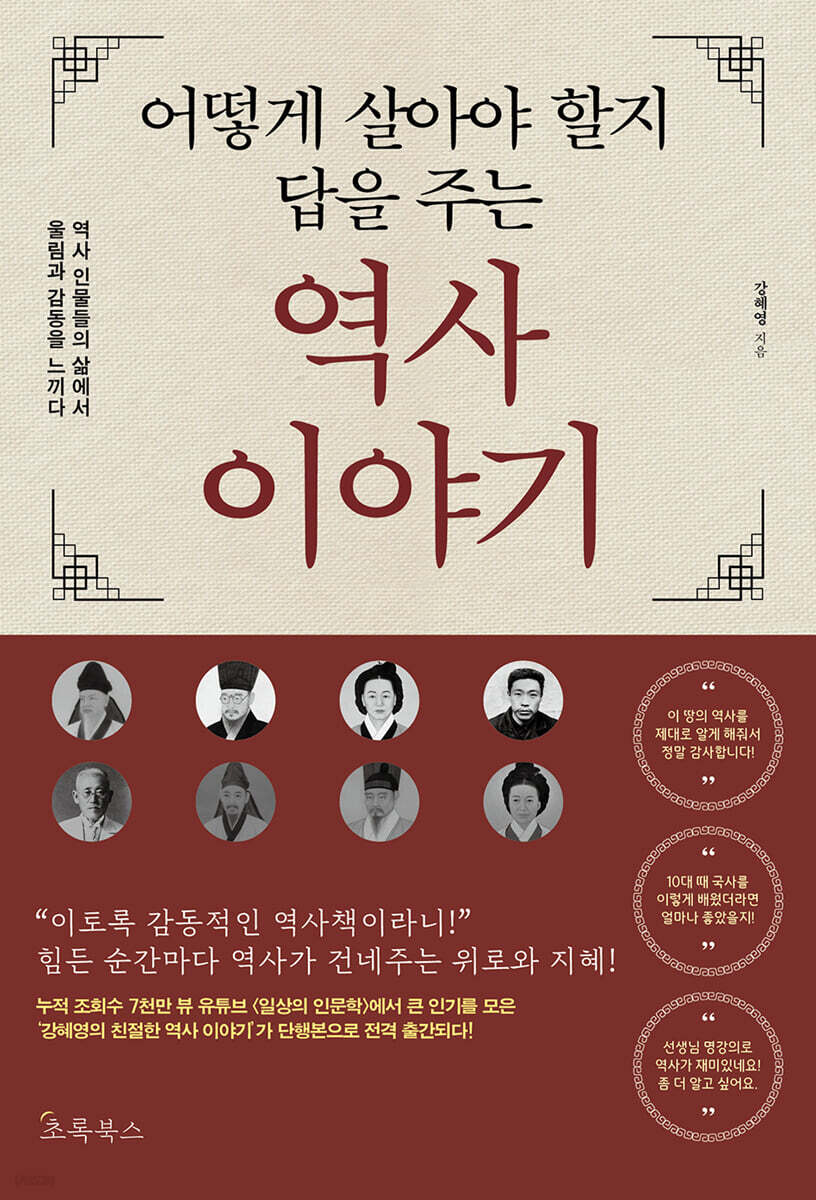
A historical story that gives answers on how to live
 |
Description
Book Introduction
In the lives of historical figures
Gain the courage and strength to live today!
There is a saying that “history is an unending dialogue between the past and the present.”
Although we live in different times and spaces, the concerns of historical figures resemble our own, and we, living today, can learn the wisdom of life through their thoughts and actions.
Historical figures provide vivid lessons to modern people.
As we go through life, we all look back and think about how we should live and what values are important in our lives.
The values and beliefs by which one lives are of great significance to each individual.
This is because it gives us the strength to sustain life.
The author says that this kind of power and meaning can be found through the lives of historical figures.
As a historical storyteller who has conveyed historical facts in a useful way and widely shared its message, the author presents the lives of past figures in an engaging storytelling format.
The anecdotes of our ancestors who left behind special traces of their lives serve as guides for us on how to cultivate our lives.
Unlike existing history books that unfold based on the flow of time or era, this book unfolds based on characters.
Through this, we can glimpse the thoughts and attitudes toward life of our ancestors representing subjects such as political leaders, successful second-in-commands, those who have benefited the world, thinkers and artists, independence activists, and border people.
The lives, values, dreams, trials, challenges, failures, and deaths of historical figures can be applied to us today.
They went through the same trials, struggled, and failed, but the difference was that they wisely overcame and resolved those difficulties.
In this way, history leaves us with advice and gives us the strength to rise up even in the face of setbacks.
The purpose of this book is to help us learn lessons by looking back on and reflecting on our own lives through the lives of our ancestors.
The text highlights quotes from each character, allowing us to experience their thoughts more directly and deeply, and presents questions we can ask ourselves within each character's narrative.
These questions serve as a compass that can help us find our own direction in life by finding our own answers, and the anecdotes of these characters will become the driving force in our lives.
The anecdotal format allows even those who find history difficult to read with immersion.
The appendix includes biographies and achievements of the historical figures in this book, along with their photos, to help you understand their characteristics in detail.
Through this book, you will experience a change in your thinking about life and gain wisdom, courage, insight, and comfort.
Gain the courage and strength to live today!
There is a saying that “history is an unending dialogue between the past and the present.”
Although we live in different times and spaces, the concerns of historical figures resemble our own, and we, living today, can learn the wisdom of life through their thoughts and actions.
Historical figures provide vivid lessons to modern people.
As we go through life, we all look back and think about how we should live and what values are important in our lives.
The values and beliefs by which one lives are of great significance to each individual.
This is because it gives us the strength to sustain life.
The author says that this kind of power and meaning can be found through the lives of historical figures.
As a historical storyteller who has conveyed historical facts in a useful way and widely shared its message, the author presents the lives of past figures in an engaging storytelling format.
The anecdotes of our ancestors who left behind special traces of their lives serve as guides for us on how to cultivate our lives.
Unlike existing history books that unfold based on the flow of time or era, this book unfolds based on characters.
Through this, we can glimpse the thoughts and attitudes toward life of our ancestors representing subjects such as political leaders, successful second-in-commands, those who have benefited the world, thinkers and artists, independence activists, and border people.
The lives, values, dreams, trials, challenges, failures, and deaths of historical figures can be applied to us today.
They went through the same trials, struggled, and failed, but the difference was that they wisely overcame and resolved those difficulties.
In this way, history leaves us with advice and gives us the strength to rise up even in the face of setbacks.
The purpose of this book is to help us learn lessons by looking back on and reflecting on our own lives through the lives of our ancestors.
The text highlights quotes from each character, allowing us to experience their thoughts more directly and deeply, and presents questions we can ask ourselves within each character's narrative.
These questions serve as a compass that can help us find our own direction in life by finding our own answers, and the anecdotes of these characters will become the driving force in our lives.
The anecdotal format allows even those who find history difficult to read with immersion.
The appendix includes biographies and achievements of the historical figures in this book, along with their photos, to help you understand their characteristics in detail.
Through this book, you will experience a change in your thinking about life and gain wisdom, courage, insight, and comfort.
- You can preview some of the book's contents.
Preview
index
Author's Note: A narrative of historical figures that resonates deeply.
First Yard┃Righteous People Who Sacrificed Their Lives for Independence
Ahn Jung-geun, Lee Hoe-yeong, and Kim Won-bong, who dedicated themselves to the independence movement.
Yun Hee-soon and Jeong Jeong-hwa, female independence activists who must be remembered
Homer Hulbert and Fuse Tatsuji, who fought for Korean independence
Second Yard┃Icons of Sharing That Benefit the World
Lee Ji-ham and Jang Gye-hyang, who were sincere in their efforts to help the people
Kim Man-deok and Lim Sang-ok, who practiced noblesse oblige
Lee Seung-hoon and Choi Jae-hyung, who went from being rejectors to independence activists
Third Yard┃Great Leaders Who Changed History
The secret to success of Wang Geon, the key figure in the unification of the Later Three Kingdoms
King Hyeonjong of Goryeo, who overcame dark history and ushered in an era of peace
King Jeongjo, the reformist monarch of Joseon who dreamed of becoming the lord of the bright moon
Fourth Yard┃Successful Second-in-Commands Who Created First-In-Commands
Jeong Do-jeon, Jo Jun, Yi I, and Yi Won-ik, who led Joseon's reforms
Joseon's kingmakers: Jeong Do-jeon, Ha Ryun, and Han Myeong-hoe
Park Mun-su and Jeong Yak-yong, who showed perfect chemistry with the king
Fifth Yard: Great Leaders of Thought and Art
Wonhyo and Uisang, practical thinkers who lived with the people
Kim Si-seup and Heo Gyun, wandering thinkers who dreamed of freedom
Shin Saimdang and Heo Nanseolheon, representative female artists of Joseon
Sixth Yard: The Borderlines of History We Never Knew
Goguryeo refugees Go Seonji and Lee Jeong-gi, who shook China
Jang Bogo and Choi Chi-won, who broke through the wall of the bone rank system
Countless naturalized citizens who have become part of our history
Appendix_Character biographies and achievements
First Yard┃Righteous People Who Sacrificed Their Lives for Independence
Ahn Jung-geun, Lee Hoe-yeong, and Kim Won-bong, who dedicated themselves to the independence movement.
Yun Hee-soon and Jeong Jeong-hwa, female independence activists who must be remembered
Homer Hulbert and Fuse Tatsuji, who fought for Korean independence
Second Yard┃Icons of Sharing That Benefit the World
Lee Ji-ham and Jang Gye-hyang, who were sincere in their efforts to help the people
Kim Man-deok and Lim Sang-ok, who practiced noblesse oblige
Lee Seung-hoon and Choi Jae-hyung, who went from being rejectors to independence activists
Third Yard┃Great Leaders Who Changed History
The secret to success of Wang Geon, the key figure in the unification of the Later Three Kingdoms
King Hyeonjong of Goryeo, who overcame dark history and ushered in an era of peace
King Jeongjo, the reformist monarch of Joseon who dreamed of becoming the lord of the bright moon
Fourth Yard┃Successful Second-in-Commands Who Created First-In-Commands
Jeong Do-jeon, Jo Jun, Yi I, and Yi Won-ik, who led Joseon's reforms
Joseon's kingmakers: Jeong Do-jeon, Ha Ryun, and Han Myeong-hoe
Park Mun-su and Jeong Yak-yong, who showed perfect chemistry with the king
Fifth Yard: Great Leaders of Thought and Art
Wonhyo and Uisang, practical thinkers who lived with the people
Kim Si-seup and Heo Gyun, wandering thinkers who dreamed of freedom
Shin Saimdang and Heo Nanseolheon, representative female artists of Joseon
Sixth Yard: The Borderlines of History We Never Knew
Goguryeo refugees Go Seonji and Lee Jeong-gi, who shook China
Jang Bogo and Choi Chi-won, who broke through the wall of the bone rank system
Countless naturalized citizens who have become part of our history
Appendix_Character biographies and achievements
Detailed image

Into the book
Everyone sometimes loses direction in life and wanders.
There are no right answers in life, but if we seek answers in history about how to live, wouldn't we find them in the people who lived through the Japanese colonial period, the most difficult period in our history? How did those who lived during that era persevere through such a difficult time? What is the strength that sustains our lives? Everyone will have different answers, but one thing is clear: we must live our lives with greater value.
It's an obvious question, but I want you to seriously ask yourself this.
People who ask themselves, 'How should I live?' do not just live today.
---From "The Righteous Who Sacrificed Their Lives for the Independence of the First Yard"
Yun Hee-soon moved to Musun with her son, established a new base, and organized the 'Joseon Independence Corps'.
The Joseon Independence Corps was a joint Korean-Chinese organization.
In order to form a joint Korean-Chinese army, Yun Hee-soon personally stepped forward and persuaded the Chinese to fight together.
“I will risk my life and fight the Japanese on Chinese soil.
I have nothing to fear in the world.
If I fall a thousand times, I will get up ten thousand times.
“We will fight now, risking our lives, to avenge the Korean people, to avenge our families, and to restore Korea’s sovereignty.” Many Chinese people agreed with her persuasion.
They also rescued people who had been taken to China by Japan and had them join the independence army.
Afterwards, the 'Joseon Independence Corps School' was established here as well, and Yun Hee-soon was at the center of all these activities.
Her activities transcended the barriers imposed on women at the time.
The Korean-Chinese Joint Korean Independence Corps she created played a significant role in fighting against Japan, and even carried out joint operations with General Yang Se-bong, who led the Korean Revolutionary Army.
---From "The Righteous Who Sacrificed Their Lives for the Independence of the First Yard"
Lee Ji-ham was a reformer ahead of his time.
Thanks to the active recommendation of Nammyeong Josik and Yulgok Yi I, who were aware of Lee Ji-ham's abilities and character, Lee Ji-ham became the magistrate of Pocheon in 1573 at the age of 57.
At that time, the situation in Pocheon was severe and many people were starving to death due to a severe famine.
Lee Ji-ham, who was appointed as the magistrate of Pocheon, submitted a petition.
“There is an island in Mangyong-hyeon, Jeolla-do where you can fish, and an island in Pungcheon-bu, Hwanghae-do where you can roast salt.
If you lend me these islands for a while, I will catch fish and make salt. In two or three years, I will be able to prepare several thousand sacks of grain.
(…) The land and the sea are a storehouse of a hundred resources, and there has never been a country that was governed without using them as resources.
If we open this storehouse of resources, the benefits to the people will be limitless.” Although both Hwanghae-do and Jeolla-do were far from Pocheon, he knew where to get salt and where to catch fish.
Because I traveled around the eight provinces and experienced the lives of the people.
He proposed to use resources to create national wealth and return that wealth to the people, but the yangban officials in the government at the time did not accept his groundbreaking proposal.
---From "The Second Yard: Icons of Sharing That Benefited the World"
Kim Man-deok used all her wealth to buy rice from the mainland.
Of the 500 seok of rice she brought from the mainland, Kim Man-deok distributed 10% to her followers and family, and gave 90% to the Jeju government office.
As a profit-driven merchant, it wasn't an easy decision.
Perhaps it was her memories of her difficult childhood that gave her the heart to empathize with the plight of the Jeju people.
The Jeju pastor reported Kim Man-deok's good deeds to the court.
When King Jeongjo was very pleased and announced that he would award Kim Man-deok, Kim Man-deok said that her wish was to go to the mainland, see Hanyang, and tour Geumgangsan Mountain.
However, at that time, there was a law prohibiting Jeju women from crossing the sea.
However, King Jeongjo allowed Kim Man-deok to come to the mainland without being subject to the Wolhaegeum Law and invited her to the palace.
Kim Man-deok met King Jeongjo, toured Hanyang, and went on a tour of Geumgangsan Mountain the following year.
---From "The Second Yard: Icons of Sharing That Benefited the World"
Wang Geon's success formula can be said to be a political success formula that permeates every era, a leader's success formula.
In that respect, studying Wang Geon's laws of success will be of great help in solving the problems we face today.
If I were to describe Wang Geon's leadership in one word, I would say it would be the 'us' mindset.
He always had us in his heart, and he made choices for us.
Thanks to that, he was able to write a reversal drama called The Unification of the Three Kingdoms.
Doesn't the turnaround in our lives depend on the choices we make?
---From "Great Leaders Who Changed History in the Third Yard"
Hyeonjong reigned for 22 years and died at the age of 38.
He is a king with a dark history who has experienced trials and tribulations since birth and had to go on a difficult journey of refuge during the Khitan invasion.
However, when he gave rewards, he was generous and genuinely grateful, and when he punished, he tried to give only the bare minimum necessary.
Lee Je-hyeon, a Confucian scholar from the late Goryeo Dynasty, evaluated King Hyeonjong as follows:
“I cannot find any fault in King Hyeonjong.” King Hyeonjong’s life has a dark history that is unprecedented in history.
Nevertheless, King Hyeonjong became a virtuous king who brought about an era of peace in Goryeo.
Has there ever been another king in our history who lived such a turbulent life, overcame such dark times, and created an era of peace?
---From "Great Leaders Who Changed History in the Third Yard"
In the rear garden of Changdeokgung Palace, there is a signboard that reads, “Mancheonmyeongwoljuinong (萬川明月主人翁).”
The meaning of this text is well expressed in 『Hongjaejeonseo (弘齋全書)』 written by King Jeongjo, and it expresses King Jeongjo's desire to become a monarch like the moon that illuminates 10,000 rivers.
And this was the Joseon that Jeongjo dreamed of.
How different would Joseon have been if such a king had lived longer? His death is truly a sad one.
I believe that Jeongjo is the most attractive leader our society needs today.
Because his political and governance philosophy is the leadership competency we need in the 21st century.
In addition, his life, which was a series of hardships and adversities, and his unexpected human side sometimes touch our hearts, make us laugh, and give us great courage.
---From "Great Leaders Who Changed History in the Third Yard"
The most radical reform of Jeong Do-jeon, a representative reformer of Joseon, was the 'Gyemin Sujeon (計民授田)'.
The Gyeminsujeon is a system in which the country collects land, distributes it to the people according to their number, and collects taxes.
Jeong Do-jeon thought that the most serious issue was the land issue.
Because I looked at it from the people's perspective.
He argued that agriculture was the foundation of the people, and that to encourage agriculture, the state should take back all land and distribute it equally to the people.
His view of land is well recorded in 『Joseon Gyeonggukjeon』.
“In the old days, the government owned the land and gave it to the people, so all the land that the people farmed was given by the government.
“There was no one among the people of the world who did not receive land and there was no one who did not cultivate it.” However, Jeong Do-jeon’s land reform was an ideal ahead of its time.
The Gyeminsujeon project was ultimately not realized due to strong opposition and criticism from the powerful families.
His radical reforms were so radical that even those who advocated for reform along with him opposed them.
The reason Jeong Do-jeon's land reform failed was because he took reality into account but could not give up his ideals.
---From "The Successful Second-in-Commands Who Made the Fourth Yard First-in-Command"
Jeong Do-jeon's political philosophy is clearly revealed in 『Sambongjip』.
“A country and a king are valuable only when they exist for the people.” Jeong Do-jeon further emphasizes the people’s hearts in his 『Joseon Gyeongguk Jeon』.
“If you win the hearts of the people, they will obey, but if you do not win their hearts, they will abandon you.” Jeong Do-jeon and Jeong Mong-ju fell out of favor with the powerful families and were exiled, but Jeong Do-jeon was unable to rise to a government position even after his exile.
Because my maternal grandmother was a slave.
However, Jeong Do-jeon, who came to truly understand the people while in exile, was deeply moved by the idea in Mencius that both the country and the king exist for the people.
Jeong Do-jeon, who wanted to change the world, went to Hamheung to meet Yi Seong-gye.
I wanted to personally confirm what kind of person Lee Seong-gye, who is praised by people as the hero of the Battle of Hwangsan, was.
Jeong Do-jeon was shocked when he saw Lee Seong-gye's army.
“Excellent.
“What can’t we do with an army this large?” Yi Seong-gye must have guessed what Jeong Do-jeon meant and why he had come to see him.
Although he was famous for suppressing the Jurchen, Red Turban, and Japanese pirates, Yi Seong-gye was also from Hamheung and was not part of the mainstream of Goryeo.
It was a historic moment of meeting between two people who had nothing to boast about.
---From "The Successful Second-in-Commands Who Made the Fourth Yard First-in-Command"
Yeongjo and Park Mun-su, and Jeongjo and Jeong Yak-yong were kings and subjects of Joseon who showed special chemistry.
They were a positive influence on each other, indispensable to each other, and truly shared their hearts.
Don't we all have people like this? There are people who positively influence each other and create greater synergy.
I want you to think of someone who makes you shine brighter, someone who helps you grow, who gives you encouragement and comfort, and who makes you feel happy every time you meet him or her.
As I think about each person, I also have this thought.
'How can I meet someone like that?' And this question came to me.
'Who can I make shine brighter?'
---From "The Successful Second-in-Commands Who Made the Fourth Yard First-in-Command"
In the 『Haedong Jeondo-rok (海東傳道錄)』, which records the history of Taoism, Kim Si-seup is referred to as the ‘ancestor of Korean Taoism.’
Kim Si-seup embraced both Confucianism, Buddhism, and Taoism, and tried to put the ideas he had discovered into practice in his life.
Seo Geo-jeong said this about him:
“He was free to enter the mountains and give birth as he pleased, and he was not restricted by Confucianism or Buddhism.
He was Confucius, Buddhist, and Taoist, and at the same time, he was neither Confucius, Buddhist, or Taoist.” Kim Si-seup argued that the fundamental theories of Confucianism, Buddhism, and Taoism were all the same.
But at the root of all his thoughts were the people.
This can be seen in the article titled ‘Aeminui (愛民義)’ written by Kim Si-seup.
“When a king ascends the throne, all he can command are the people.
If the people's hearts turn and follow him, he can be a monarch for all eternity, but if the people's hearts turn away and scatter, he cannot even wait for one evening and becomes a commoner.
“The gap between a ruler and a commoner is as narrow as a hair’s breadth, so how can one not be careful? (…) Therefore, when a ruler receives food, he should consider whether the people eat the same food as he does, and when he wears clothes, he should consider whether the people wear the same clothes as he does.”
---From "The Fifth Yard: Great Leaders of Thought and Art"
Homin refers to people who stand up and face the world when the time comes. When Homin stands up, Wonmin and Hangmin also rise up to follow him.
Hong Gildong in The Story of Hong Gildong is Homin.
Heo Gyun, like Hong Gil-dong, wanted to talk about a world without discrimination.
In 『The Story of Hong Gildong』, the nobles who created the illegitimate children and the laws discriminating against them are criticized.
In 『The Story of Hong Gildong』, Heo Gyun included the ideal world he dreamed of, a world where people are at the center and talents are hired without discrimination.
Heo Gyun was an outsider who was ignored by Joseon, but he was a reformer who was ahead of his time.
Heo Gyun lived his life as Heo Gyun, without being bound by the world.
What about us now? We live in a time of change, yet we still feel the absurdity of the world.
So what do we need? Isn't what we need most right now to find our own identity? What is your "true self"?
---From "The Fifth Yard: Great Leaders of Thought and Art"
There is a famous anecdote about Shin Saimdang's paintings.
It is said that when a woman who came to a banquet wearing a borrowed silk dress ended up throwing it away and crying, Shin Saimdang drew a picture of grapes on the skirt, and the skirt was sold for a high price, which was enough to pay for the borrowed dress.
Men of the time praised the paintings of artist Shin Saimdang, saying they were second only to An Gyeon.
There is a record related to this in Eosukkwon's 『Paegwanjabgi』.
“Saimdang’s grapes and landscapes were so exquisite that people said they were second only to An Gyeon.”
Ah! How can we neglect a woman's handwriting, and how can we criticize her for something that is not her proper duty?" Shin Saimdang's outstanding handwriting is also known, including six folding screens written in cursive script and one in seal script.
The cursive script and powerful script written in soft curves seem to show Shin Saimdang's personality.
It was not easy for women in the Joseon Dynasty to leave their names behind.
Arts such as poetry, calligraphy, and painting were the exclusive domain of men.
How was Shin Saimdang able to showcase her artistic talents during such a time? It was thanks to the strong support of her family, especially her parents.
---From "The Fifth Yard: Great Leaders of Thought and Art"
Although Goguryeo has disappeared from history, there were Goguryeo refugees, Go Seon-ji and Lee Jeong-gi, who gained fame in China enough to shake China.
Although both men met unfortunate deaths, Gao Xianzhi expanded the Tang Dynasty's territory to its maximum by advancing into the Western Regions, and although he was defeated in the Battle of Talas, he changed world history with the papermaking techniques passed down by the prisoners.
Lee Jeong-gi is a person who dreamed of the revival of Goguryeo by forming an independent force that could shake up the party.
How did these refugees from a fallen nation wield such incredible power, and where did it come from? It came from the spirit of the Goguryeo people.
And the DNA of the Goguryeo people is still with us today.
---From "The Sixth Yard: The Borderlines of History We Never Knew"
There are more naturalized citizens in our history than you might think.
It is said that 136 of the 275 surnames in our country originated from naturalized people.
We already have a lot of immigrant blood mixed in with us.
According to the Ulsan National Institute of Science and Technology (UNIST), genetic analysis using modern science has shown that the current Korean population was created through fusion with many Asians over thousands of years, and that Korea, China, and Japan have a high degree of internal identity to the point where they can be considered one ethnic group.
In our history, naturalized people did not live as marginalized people.
It is a history of inclusion that we have shown early on.
But what about now? The number of foreigners living in Korea increases every year, but our perception of them, which is often viewed with a discriminatory eye, remains stubbornly stubborn.
There are no right answers in life, but if we seek answers in history about how to live, wouldn't we find them in the people who lived through the Japanese colonial period, the most difficult period in our history? How did those who lived during that era persevere through such a difficult time? What is the strength that sustains our lives? Everyone will have different answers, but one thing is clear: we must live our lives with greater value.
It's an obvious question, but I want you to seriously ask yourself this.
People who ask themselves, 'How should I live?' do not just live today.
---From "The Righteous Who Sacrificed Their Lives for the Independence of the First Yard"
Yun Hee-soon moved to Musun with her son, established a new base, and organized the 'Joseon Independence Corps'.
The Joseon Independence Corps was a joint Korean-Chinese organization.
In order to form a joint Korean-Chinese army, Yun Hee-soon personally stepped forward and persuaded the Chinese to fight together.
“I will risk my life and fight the Japanese on Chinese soil.
I have nothing to fear in the world.
If I fall a thousand times, I will get up ten thousand times.
“We will fight now, risking our lives, to avenge the Korean people, to avenge our families, and to restore Korea’s sovereignty.” Many Chinese people agreed with her persuasion.
They also rescued people who had been taken to China by Japan and had them join the independence army.
Afterwards, the 'Joseon Independence Corps School' was established here as well, and Yun Hee-soon was at the center of all these activities.
Her activities transcended the barriers imposed on women at the time.
The Korean-Chinese Joint Korean Independence Corps she created played a significant role in fighting against Japan, and even carried out joint operations with General Yang Se-bong, who led the Korean Revolutionary Army.
---From "The Righteous Who Sacrificed Their Lives for the Independence of the First Yard"
Lee Ji-ham was a reformer ahead of his time.
Thanks to the active recommendation of Nammyeong Josik and Yulgok Yi I, who were aware of Lee Ji-ham's abilities and character, Lee Ji-ham became the magistrate of Pocheon in 1573 at the age of 57.
At that time, the situation in Pocheon was severe and many people were starving to death due to a severe famine.
Lee Ji-ham, who was appointed as the magistrate of Pocheon, submitted a petition.
“There is an island in Mangyong-hyeon, Jeolla-do where you can fish, and an island in Pungcheon-bu, Hwanghae-do where you can roast salt.
If you lend me these islands for a while, I will catch fish and make salt. In two or three years, I will be able to prepare several thousand sacks of grain.
(…) The land and the sea are a storehouse of a hundred resources, and there has never been a country that was governed without using them as resources.
If we open this storehouse of resources, the benefits to the people will be limitless.” Although both Hwanghae-do and Jeolla-do were far from Pocheon, he knew where to get salt and where to catch fish.
Because I traveled around the eight provinces and experienced the lives of the people.
He proposed to use resources to create national wealth and return that wealth to the people, but the yangban officials in the government at the time did not accept his groundbreaking proposal.
---From "The Second Yard: Icons of Sharing That Benefited the World"
Kim Man-deok used all her wealth to buy rice from the mainland.
Of the 500 seok of rice she brought from the mainland, Kim Man-deok distributed 10% to her followers and family, and gave 90% to the Jeju government office.
As a profit-driven merchant, it wasn't an easy decision.
Perhaps it was her memories of her difficult childhood that gave her the heart to empathize with the plight of the Jeju people.
The Jeju pastor reported Kim Man-deok's good deeds to the court.
When King Jeongjo was very pleased and announced that he would award Kim Man-deok, Kim Man-deok said that her wish was to go to the mainland, see Hanyang, and tour Geumgangsan Mountain.
However, at that time, there was a law prohibiting Jeju women from crossing the sea.
However, King Jeongjo allowed Kim Man-deok to come to the mainland without being subject to the Wolhaegeum Law and invited her to the palace.
Kim Man-deok met King Jeongjo, toured Hanyang, and went on a tour of Geumgangsan Mountain the following year.
---From "The Second Yard: Icons of Sharing That Benefited the World"
Wang Geon's success formula can be said to be a political success formula that permeates every era, a leader's success formula.
In that respect, studying Wang Geon's laws of success will be of great help in solving the problems we face today.
If I were to describe Wang Geon's leadership in one word, I would say it would be the 'us' mindset.
He always had us in his heart, and he made choices for us.
Thanks to that, he was able to write a reversal drama called The Unification of the Three Kingdoms.
Doesn't the turnaround in our lives depend on the choices we make?
---From "Great Leaders Who Changed History in the Third Yard"
Hyeonjong reigned for 22 years and died at the age of 38.
He is a king with a dark history who has experienced trials and tribulations since birth and had to go on a difficult journey of refuge during the Khitan invasion.
However, when he gave rewards, he was generous and genuinely grateful, and when he punished, he tried to give only the bare minimum necessary.
Lee Je-hyeon, a Confucian scholar from the late Goryeo Dynasty, evaluated King Hyeonjong as follows:
“I cannot find any fault in King Hyeonjong.” King Hyeonjong’s life has a dark history that is unprecedented in history.
Nevertheless, King Hyeonjong became a virtuous king who brought about an era of peace in Goryeo.
Has there ever been another king in our history who lived such a turbulent life, overcame such dark times, and created an era of peace?
---From "Great Leaders Who Changed History in the Third Yard"
In the rear garden of Changdeokgung Palace, there is a signboard that reads, “Mancheonmyeongwoljuinong (萬川明月主人翁).”
The meaning of this text is well expressed in 『Hongjaejeonseo (弘齋全書)』 written by King Jeongjo, and it expresses King Jeongjo's desire to become a monarch like the moon that illuminates 10,000 rivers.
And this was the Joseon that Jeongjo dreamed of.
How different would Joseon have been if such a king had lived longer? His death is truly a sad one.
I believe that Jeongjo is the most attractive leader our society needs today.
Because his political and governance philosophy is the leadership competency we need in the 21st century.
In addition, his life, which was a series of hardships and adversities, and his unexpected human side sometimes touch our hearts, make us laugh, and give us great courage.
---From "Great Leaders Who Changed History in the Third Yard"
The most radical reform of Jeong Do-jeon, a representative reformer of Joseon, was the 'Gyemin Sujeon (計民授田)'.
The Gyeminsujeon is a system in which the country collects land, distributes it to the people according to their number, and collects taxes.
Jeong Do-jeon thought that the most serious issue was the land issue.
Because I looked at it from the people's perspective.
He argued that agriculture was the foundation of the people, and that to encourage agriculture, the state should take back all land and distribute it equally to the people.
His view of land is well recorded in 『Joseon Gyeonggukjeon』.
“In the old days, the government owned the land and gave it to the people, so all the land that the people farmed was given by the government.
“There was no one among the people of the world who did not receive land and there was no one who did not cultivate it.” However, Jeong Do-jeon’s land reform was an ideal ahead of its time.
The Gyeminsujeon project was ultimately not realized due to strong opposition and criticism from the powerful families.
His radical reforms were so radical that even those who advocated for reform along with him opposed them.
The reason Jeong Do-jeon's land reform failed was because he took reality into account but could not give up his ideals.
---From "The Successful Second-in-Commands Who Made the Fourth Yard First-in-Command"
Jeong Do-jeon's political philosophy is clearly revealed in 『Sambongjip』.
“A country and a king are valuable only when they exist for the people.” Jeong Do-jeon further emphasizes the people’s hearts in his 『Joseon Gyeongguk Jeon』.
“If you win the hearts of the people, they will obey, but if you do not win their hearts, they will abandon you.” Jeong Do-jeon and Jeong Mong-ju fell out of favor with the powerful families and were exiled, but Jeong Do-jeon was unable to rise to a government position even after his exile.
Because my maternal grandmother was a slave.
However, Jeong Do-jeon, who came to truly understand the people while in exile, was deeply moved by the idea in Mencius that both the country and the king exist for the people.
Jeong Do-jeon, who wanted to change the world, went to Hamheung to meet Yi Seong-gye.
I wanted to personally confirm what kind of person Lee Seong-gye, who is praised by people as the hero of the Battle of Hwangsan, was.
Jeong Do-jeon was shocked when he saw Lee Seong-gye's army.
“Excellent.
“What can’t we do with an army this large?” Yi Seong-gye must have guessed what Jeong Do-jeon meant and why he had come to see him.
Although he was famous for suppressing the Jurchen, Red Turban, and Japanese pirates, Yi Seong-gye was also from Hamheung and was not part of the mainstream of Goryeo.
It was a historic moment of meeting between two people who had nothing to boast about.
---From "The Successful Second-in-Commands Who Made the Fourth Yard First-in-Command"
Yeongjo and Park Mun-su, and Jeongjo and Jeong Yak-yong were kings and subjects of Joseon who showed special chemistry.
They were a positive influence on each other, indispensable to each other, and truly shared their hearts.
Don't we all have people like this? There are people who positively influence each other and create greater synergy.
I want you to think of someone who makes you shine brighter, someone who helps you grow, who gives you encouragement and comfort, and who makes you feel happy every time you meet him or her.
As I think about each person, I also have this thought.
'How can I meet someone like that?' And this question came to me.
'Who can I make shine brighter?'
---From "The Successful Second-in-Commands Who Made the Fourth Yard First-in-Command"
In the 『Haedong Jeondo-rok (海東傳道錄)』, which records the history of Taoism, Kim Si-seup is referred to as the ‘ancestor of Korean Taoism.’
Kim Si-seup embraced both Confucianism, Buddhism, and Taoism, and tried to put the ideas he had discovered into practice in his life.
Seo Geo-jeong said this about him:
“He was free to enter the mountains and give birth as he pleased, and he was not restricted by Confucianism or Buddhism.
He was Confucius, Buddhist, and Taoist, and at the same time, he was neither Confucius, Buddhist, or Taoist.” Kim Si-seup argued that the fundamental theories of Confucianism, Buddhism, and Taoism were all the same.
But at the root of all his thoughts were the people.
This can be seen in the article titled ‘Aeminui (愛民義)’ written by Kim Si-seup.
“When a king ascends the throne, all he can command are the people.
If the people's hearts turn and follow him, he can be a monarch for all eternity, but if the people's hearts turn away and scatter, he cannot even wait for one evening and becomes a commoner.
“The gap between a ruler and a commoner is as narrow as a hair’s breadth, so how can one not be careful? (…) Therefore, when a ruler receives food, he should consider whether the people eat the same food as he does, and when he wears clothes, he should consider whether the people wear the same clothes as he does.”
---From "The Fifth Yard: Great Leaders of Thought and Art"
Homin refers to people who stand up and face the world when the time comes. When Homin stands up, Wonmin and Hangmin also rise up to follow him.
Hong Gildong in The Story of Hong Gildong is Homin.
Heo Gyun, like Hong Gil-dong, wanted to talk about a world without discrimination.
In 『The Story of Hong Gildong』, the nobles who created the illegitimate children and the laws discriminating against them are criticized.
In 『The Story of Hong Gildong』, Heo Gyun included the ideal world he dreamed of, a world where people are at the center and talents are hired without discrimination.
Heo Gyun was an outsider who was ignored by Joseon, but he was a reformer who was ahead of his time.
Heo Gyun lived his life as Heo Gyun, without being bound by the world.
What about us now? We live in a time of change, yet we still feel the absurdity of the world.
So what do we need? Isn't what we need most right now to find our own identity? What is your "true self"?
---From "The Fifth Yard: Great Leaders of Thought and Art"
There is a famous anecdote about Shin Saimdang's paintings.
It is said that when a woman who came to a banquet wearing a borrowed silk dress ended up throwing it away and crying, Shin Saimdang drew a picture of grapes on the skirt, and the skirt was sold for a high price, which was enough to pay for the borrowed dress.
Men of the time praised the paintings of artist Shin Saimdang, saying they were second only to An Gyeon.
There is a record related to this in Eosukkwon's 『Paegwanjabgi』.
“Saimdang’s grapes and landscapes were so exquisite that people said they were second only to An Gyeon.”
Ah! How can we neglect a woman's handwriting, and how can we criticize her for something that is not her proper duty?" Shin Saimdang's outstanding handwriting is also known, including six folding screens written in cursive script and one in seal script.
The cursive script and powerful script written in soft curves seem to show Shin Saimdang's personality.
It was not easy for women in the Joseon Dynasty to leave their names behind.
Arts such as poetry, calligraphy, and painting were the exclusive domain of men.
How was Shin Saimdang able to showcase her artistic talents during such a time? It was thanks to the strong support of her family, especially her parents.
---From "The Fifth Yard: Great Leaders of Thought and Art"
Although Goguryeo has disappeared from history, there were Goguryeo refugees, Go Seon-ji and Lee Jeong-gi, who gained fame in China enough to shake China.
Although both men met unfortunate deaths, Gao Xianzhi expanded the Tang Dynasty's territory to its maximum by advancing into the Western Regions, and although he was defeated in the Battle of Talas, he changed world history with the papermaking techniques passed down by the prisoners.
Lee Jeong-gi is a person who dreamed of the revival of Goguryeo by forming an independent force that could shake up the party.
How did these refugees from a fallen nation wield such incredible power, and where did it come from? It came from the spirit of the Goguryeo people.
And the DNA of the Goguryeo people is still with us today.
---From "The Sixth Yard: The Borderlines of History We Never Knew"
There are more naturalized citizens in our history than you might think.
It is said that 136 of the 275 surnames in our country originated from naturalized people.
We already have a lot of immigrant blood mixed in with us.
According to the Ulsan National Institute of Science and Technology (UNIST), genetic analysis using modern science has shown that the current Korean population was created through fusion with many Asians over thousands of years, and that Korea, China, and Japan have a high degree of internal identity to the point where they can be considered one ethnic group.
In our history, naturalized people did not live as marginalized people.
It is a history of inclusion that we have shown early on.
But what about now? The number of foreigners living in Korea increases every year, but our perception of them, which is often viewed with a discriminatory eye, remains stubbornly stubborn.
---From "The Sixth Yard: The Borderlines of History We Never Knew"
Publisher's Review
In every difficult moment, history
Comfort and wisdom given!
This book consists of six chapters and an appendix.
The first section, “Righteous People Who Sacrificed Their Lives for Independence,” introduces Korean and foreign independence activists such as Ahn Jung-geun, Lee Hoe-young, Kim Won-bong, Yun Hee-soon, Jeong Jeong-hwa, Homer Hulbert, and Fuse Tatsuji, emphasizing names that should not be forgotten as Koreans.
It shows the justice, perseverance, and courage of those who sacrificed their lives to protect their country.
In the second section, ‘Icons of Sharing that Benefited the World,’ the values regarding the use of money are shown through Lee Ji-ham and Jang Gye-hyang, who helped the people with their love for the people, Kim Man-deok and Lim Sang-ok, who made a lot of money as merchants and used it to help the people, and Lee Seung-hoon and Choi Jae-hyung, who led the anti-Japanese independence movement and protected the people.
Through these, we reflect on true noblesse oblige and convey the philosophy of wealth.
The third section, “Great Leaders Who Changed History,” reveals the secrets to success as leaders through Wang Geon, King Hyeonjong of Goryeo, and King Jeongjo of Joseon, who were all renowned political figures.
Through anecdotes about values and governance that lead to victory, and how failure becomes a stepping stone to growth and success, it makes us think about the kind of leader our society needs.
In the fourth section, ‘Successful Second-in-Commands Who Made the Number One’, we will learn about Jeong Do-jeon, Jo Jun, Yi I, Yi Won-ik, Ha Ryun, Han Myeong-hoe, Park Mun-su, and Jeong Yak-yong, who were able to achieve success and authority despite not being the number one.
Through this, we will explore the characteristics that lead to success and who has synergy with us.
The fifth section, “Great Leaders of Thought and Art,” tells the stories of Wonhyo and Uisang, who, as thinkers, used Buddhist teachings to comfort the people, and Shin Saimdang and Heo Nanseolheon, who, even in an era when it was difficult for women to make a name for themselves, did not give up and continued to display their talents as artists.
Rather than chasing societal stereotypes or material possessions, we examine the value of living a life that upholds one's own beliefs.
The sixth section, "People on the Boundaries of History We Never Knew," tells the stories of Go Seon-ji, Lee Jeong-gi, Jang Bo-go, Choi Chi-won, and countless other naturalized citizens who persevered with passion even in difficult situations, and preaches that their efforts ultimately pay off.
Through their stories, we too can gain the strength to move forward without giving up.
The appendix contains photos, biographies, and achievements of all characters.
Comfort and wisdom given!
This book consists of six chapters and an appendix.
The first section, “Righteous People Who Sacrificed Their Lives for Independence,” introduces Korean and foreign independence activists such as Ahn Jung-geun, Lee Hoe-young, Kim Won-bong, Yun Hee-soon, Jeong Jeong-hwa, Homer Hulbert, and Fuse Tatsuji, emphasizing names that should not be forgotten as Koreans.
It shows the justice, perseverance, and courage of those who sacrificed their lives to protect their country.
In the second section, ‘Icons of Sharing that Benefited the World,’ the values regarding the use of money are shown through Lee Ji-ham and Jang Gye-hyang, who helped the people with their love for the people, Kim Man-deok and Lim Sang-ok, who made a lot of money as merchants and used it to help the people, and Lee Seung-hoon and Choi Jae-hyung, who led the anti-Japanese independence movement and protected the people.
Through these, we reflect on true noblesse oblige and convey the philosophy of wealth.
The third section, “Great Leaders Who Changed History,” reveals the secrets to success as leaders through Wang Geon, King Hyeonjong of Goryeo, and King Jeongjo of Joseon, who were all renowned political figures.
Through anecdotes about values and governance that lead to victory, and how failure becomes a stepping stone to growth and success, it makes us think about the kind of leader our society needs.
In the fourth section, ‘Successful Second-in-Commands Who Made the Number One’, we will learn about Jeong Do-jeon, Jo Jun, Yi I, Yi Won-ik, Ha Ryun, Han Myeong-hoe, Park Mun-su, and Jeong Yak-yong, who were able to achieve success and authority despite not being the number one.
Through this, we will explore the characteristics that lead to success and who has synergy with us.
The fifth section, “Great Leaders of Thought and Art,” tells the stories of Wonhyo and Uisang, who, as thinkers, used Buddhist teachings to comfort the people, and Shin Saimdang and Heo Nanseolheon, who, even in an era when it was difficult for women to make a name for themselves, did not give up and continued to display their talents as artists.
Rather than chasing societal stereotypes or material possessions, we examine the value of living a life that upholds one's own beliefs.
The sixth section, "People on the Boundaries of History We Never Knew," tells the stories of Go Seon-ji, Lee Jeong-gi, Jang Bo-go, Choi Chi-won, and countless other naturalized citizens who persevered with passion even in difficult situations, and preaches that their efforts ultimately pay off.
Through their stories, we too can gain the strength to move forward without giving up.
The appendix contains photos, biographies, and achievements of all characters.
GOODS SPECIFICS
- Date of issue: January 20, 2025
- Page count, weight, size: 320 pages | 508g | 155*225*21mm
- ISBN13: 9791160029215
- ISBN10: 1160029210
You may also like
카테고리
korean


korean

![GQ KOREA Mark (Monthly): December [2025]](http://librairie.coreenne.fr/cdn/shop/files/8ef265dbbfbf186523ed75ba7319009d.jpg?v=1765340328&width=3840)


