

Egyptian History Digest 100
 |
Description
Book Introduction
Based on the Nile civilization, where human civilization began
A mysterious country with a magnificent history of 7,000 years
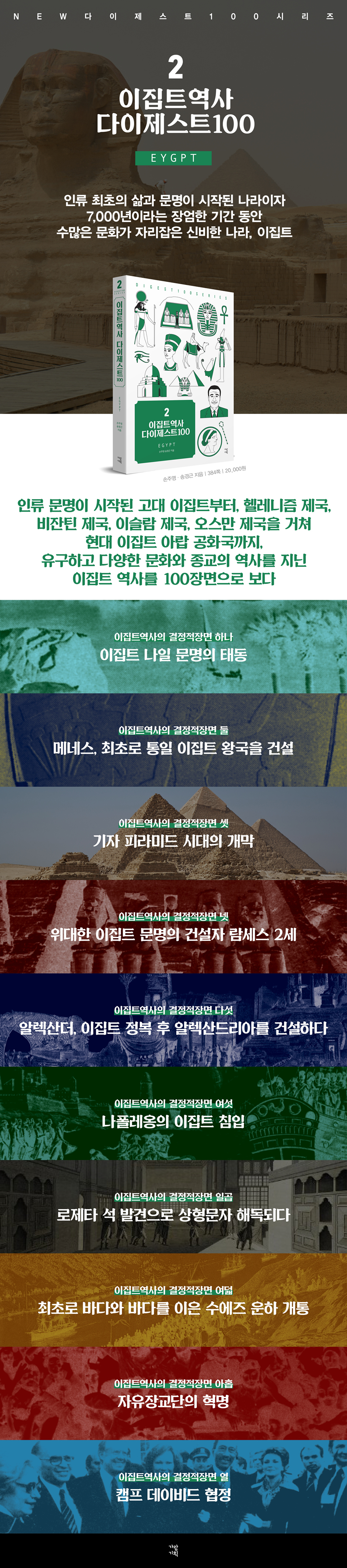
A look at Egyptian history in 100 scenes
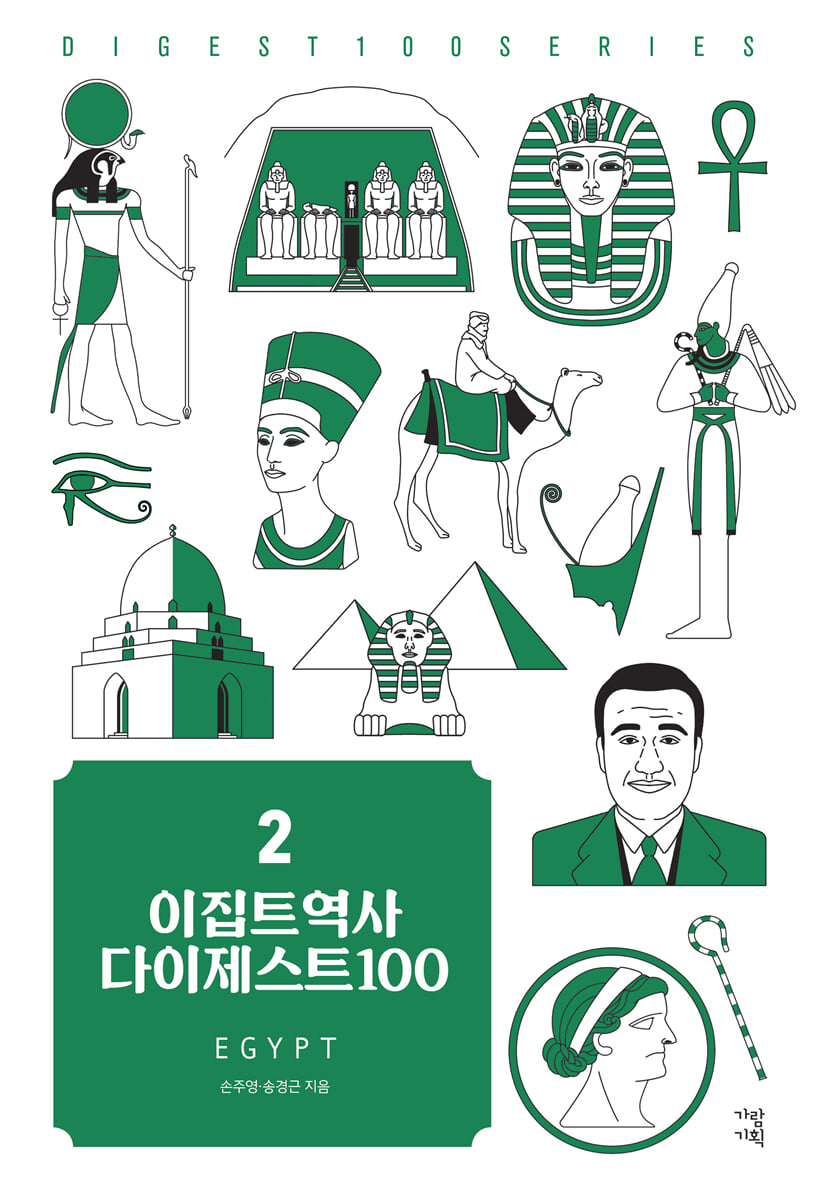
『Egyptian History Digest 100』 is the second book in Garam Planning's 'NEW Digest 100' series, which selects important scenes from Egypt, the oldest land and the land where various empires rose and fell.
This book selects the crucial moments that occurred in Egypt, allowing readers to examine the history and ups and downs of Egypt and its surrounding countries throughout its magnificent 7,000-year history.
From the ancient Egyptian era when the Pharaohs reigned with power, to the era of various empires such as the Roman, Byzantine, Islamic, and Ottoman empires.
It contains the history of Napoleon's invasion of Egypt, the process of gaining independence from Britain, and the conflict with Israel.
During this process, various figures such as Thutmose III, Ramses II, Cleopatra VII, Muhammad Ali, Gamal Abdul Nasser, and Anwar Sadat appeared.
Unlike the natural order of things in the human world, where many regions throughout human history were once battlegrounds or prosperous lands, but quickly fell out of favor, Egypt was always the object of interest for powerful nations and a bridgehead for their advancement into the international arena.
Thanks to this, Egypt was able to preserve its own unique civilization while having a mixture of various civilizations.
Through 『Egyptian History Digest 100』, you will be able to see the various aspects of Egypt, with its magnificent 7,000-year history.
A mysterious country with a magnificent history of 7,000 years
A look at Egyptian history in 100 scenes
『Egyptian History Digest 100』 is the second book in Garam Planning's 'NEW Digest 100' series, which selects important scenes from Egypt, the oldest land and the land where various empires rose and fell.
This book selects the crucial moments that occurred in Egypt, allowing readers to examine the history and ups and downs of Egypt and its surrounding countries throughout its magnificent 7,000-year history.
From the ancient Egyptian era when the Pharaohs reigned with power, to the era of various empires such as the Roman, Byzantine, Islamic, and Ottoman empires.
It contains the history of Napoleon's invasion of Egypt, the process of gaining independence from Britain, and the conflict with Israel.
During this process, various figures such as Thutmose III, Ramses II, Cleopatra VII, Muhammad Ali, Gamal Abdul Nasser, and Anwar Sadat appeared.
Unlike the natural order of things in the human world, where many regions throughout human history were once battlegrounds or prosperous lands, but quickly fell out of favor, Egypt was always the object of interest for powerful nations and a bridgehead for their advancement into the international arena.
Thanks to this, Egypt was able to preserve its own unique civilization while having a mixture of various civilizations.
Through 『Egyptian History Digest 100』, you will be able to see the various aspects of Egypt, with its magnificent 7,000-year history.
- You can preview some of the book's contents.
Preview
index
preface
Chapter 1.
Ancient Egyptian period (3000 BC - 341 BC)
1.
The birth of the Egyptian Nile civilization
2.
Ancient Egyptian time and calendar
3.
Death and the Underworld of Ancient Egyptians
4.
Ancient Egyptian hieroglyphs
5.
Menes, the first to establish a unified Egyptian kingdom
6.
Djoser builds the Step Pyramid
7.
The dawn of the Giza pyramid era
8.
The Mysterious Sphinx
9.
The temples of Heliopolis and the cult of the sun god Ra
10.
The life of farmers in the Old Kingdom
11.
The nation's elite, the clerks and nobles
12.
The Tilting Power of the Pharaoh
13.
The end of the Old Kingdom
14.
The ideas of freedom and equality sprouting in the harsh world of the First Intermediate Period
15.
Pessimistic secular literature born during a time of chaos
16.
The Age of the Senusret Kings of the Middle Kingdom
17.
The Hyksos invasion and conquest of Egypt
18.
Theban resistance to Hyksos rule
19.
The achievements of Ahmose I, who defeated the Hyksos
20.
Thutmose I builds the Valley of the Kings
21.
Hatshepsut, the cross-dressing queen who ruled Egypt with a beard
22.
Thutmose III, the great conqueror who undertook 17 expeditions
23.
Armies and soldiers of ancient Egypt
24.
Akhenaten, a religious reformer who worshipped the god Aton
25.
A sample of ancient Egyptian diplomatic documents, the Amarna Documents
26.
The owner of the golden mask, the boy king Tutankhamun
27.
Battle of Kadesh, the great battle between Ramses II and the Hittites
28.
Ramses II, the founder of the great Egyptian civilization
29.
The Life of Ancient Egyptian Women·123
30.
The Exodus of the Jews led by Moses
31.
Invasion of the maritime peoples
32.
Libyan monarch, Sosenk I
33.
Production of papyrus paper
34.
Black Pharaoh Piye and Shabako
35.
Assyrian invasion and Egyptian domination
36.
Merchant Dynasty, Sais Dynasty
37.
Cambyses II of Persia conquers Egypt
38.
Love and Relationships among Ancient Egyptians
Chapter 2.
Greco-Roman era (332 BC - AD 641)
39.
Alexander the Great founded Alexandria after conquering Egypt.
40.
The beginning of the Ptolemaic dynasty
41.
The Pharos Lighthouse, a wonder of ancient civilization
42.
Priest Manethon compiles the Egyptian History
43.
The Library of Alexandria, once the largest library in the world
44.
The love of the great heroine Cleopatra and Antony
45.
The Battle of Actium and Cleopatra's End
46.
Egypt, which became a province of the Roman Empire
47.
The Flight of Baby Jesus
48.
Mark's Gospel and Martyrdom
49.
Hero, who invented the hydraulic crane
50.
Riots in Alexandria
51.
Persecution of Christians in Rome
52.
The Alexandrian school of theology that led the way in the divinity of Jesus
53.
Hyphetia, a female philosopher from Alexandria
54.
Egypt becomes part of the Byzantine Empire
55.
Ship of the Desert, Camel
Chapter 3.
Islamic era (641–1798)
56.
Amur ibn al-As's Arab-Muslim forces conquer Egypt.
57.
Construction of Egypt's new capital, Fustat
58.
Egypt became a province of the Islamic Empire
59.
Arab settlement in Egypt and the Arabization and Islamization of Egypt
60.
Copts in the Islamic State of Egypt
61.
The establishment of the independent dynasty, the Tulun Dynasty
62.
Ibn Tulun Mosque boasts magnificent architectural beauty
63.
The Fatimid dynasty conquered Egypt and founded a new capital, Cairo.
64.
The construction of the Al-Azhar Mosque and the opening of Al-Azhar University
65.
The Gin Khalifa Al Hakim
66.
The prosperity of the Fatimid dynasty as seen by the poet Khusrau
67.
Saladin, the hero of the Muslim world who defeated the Crusaders
68.
Peace Treaty between Al-Kamil and Frederick II
69.
The captive French king Louis IX and the first Muslim queen, Shajar al-Durr
70.
The rise of the Mamluk state, ruled by sultans of slave origin
71.
Arab revolt against Mamluk rule
72.
Battle of Ain Jalut
73.
Mamluk Sultan Establishes Puppet Caliph
74.
Cairo became the center of Islamic culture with the rise of Al-Azhar.
75.
Mamluk forces drive the Crusader forces out of Syria
76.
The confrontation between Ghazan Khan of Mongolia and the Mamluk Sultan Nasser
77.
Timur Ren's invasion
78.
Portugal defeats the Mamluk navy and dominates the Indian Ocean.
79.
Ottoman conquest of Egypt
80.
Alibey's Rebellion
Chapter 4.
Modern Egypt (1798? present)
81.
Napoleon's invasion of Egypt
82.
The Sheikhs of Al-Azhar who resisted Napoleon
83.
Hieroglyphics deciphered with the discovery of the Rosetta Stone
84.
The emergence of Muhammad Ali, the father of modern Egypt
85.
Muhammad Ali's reforms and achievements
86.
Ibrahim Pasha, a war hero of modern Egypt
87.
The opening of the Suez Canal, the first sea-to-sea connection
88.
The Brother Rebellion and the Rise of Nationalist Forces
89.
Sudan jointly ruled by Egypt and Britain
90.
Dinshawai village incident
91.
Britain declares independence for Egypt
92.
Battle of El Alamein
93.
Palestine War: First Arab-Israeli War
94.
Revolution of the Free Officers' Corps
95.
Suez War: The Second Arab-Israeli War
96.
Six-Day War: The Third Arab-Israeli War
97.
Cairo's Opera House burned down
98.
October War: The Fourth Arab-Israeli War
99.
Camp David Accords
100.
Sadat's assassination and Mubarak's inauguration
Egyptian History Chronology
Chapter 1.
Ancient Egyptian period (3000 BC - 341 BC)
1.
The birth of the Egyptian Nile civilization
2.
Ancient Egyptian time and calendar
3.
Death and the Underworld of Ancient Egyptians
4.
Ancient Egyptian hieroglyphs
5.
Menes, the first to establish a unified Egyptian kingdom
6.
Djoser builds the Step Pyramid
7.
The dawn of the Giza pyramid era
8.
The Mysterious Sphinx
9.
The temples of Heliopolis and the cult of the sun god Ra
10.
The life of farmers in the Old Kingdom
11.
The nation's elite, the clerks and nobles
12.
The Tilting Power of the Pharaoh
13.
The end of the Old Kingdom
14.
The ideas of freedom and equality sprouting in the harsh world of the First Intermediate Period
15.
Pessimistic secular literature born during a time of chaos
16.
The Age of the Senusret Kings of the Middle Kingdom
17.
The Hyksos invasion and conquest of Egypt
18.
Theban resistance to Hyksos rule
19.
The achievements of Ahmose I, who defeated the Hyksos
20.
Thutmose I builds the Valley of the Kings
21.
Hatshepsut, the cross-dressing queen who ruled Egypt with a beard
22.
Thutmose III, the great conqueror who undertook 17 expeditions
23.
Armies and soldiers of ancient Egypt
24.
Akhenaten, a religious reformer who worshipped the god Aton
25.
A sample of ancient Egyptian diplomatic documents, the Amarna Documents
26.
The owner of the golden mask, the boy king Tutankhamun
27.
Battle of Kadesh, the great battle between Ramses II and the Hittites
28.
Ramses II, the founder of the great Egyptian civilization
29.
The Life of Ancient Egyptian Women·123
30.
The Exodus of the Jews led by Moses
31.
Invasion of the maritime peoples
32.
Libyan monarch, Sosenk I
33.
Production of papyrus paper
34.
Black Pharaoh Piye and Shabako
35.
Assyrian invasion and Egyptian domination
36.
Merchant Dynasty, Sais Dynasty
37.
Cambyses II of Persia conquers Egypt
38.
Love and Relationships among Ancient Egyptians
Chapter 2.
Greco-Roman era (332 BC - AD 641)
39.
Alexander the Great founded Alexandria after conquering Egypt.
40.
The beginning of the Ptolemaic dynasty
41.
The Pharos Lighthouse, a wonder of ancient civilization
42.
Priest Manethon compiles the Egyptian History
43.
The Library of Alexandria, once the largest library in the world
44.
The love of the great heroine Cleopatra and Antony
45.
The Battle of Actium and Cleopatra's End
46.
Egypt, which became a province of the Roman Empire
47.
The Flight of Baby Jesus
48.
Mark's Gospel and Martyrdom
49.
Hero, who invented the hydraulic crane
50.
Riots in Alexandria
51.
Persecution of Christians in Rome
52.
The Alexandrian school of theology that led the way in the divinity of Jesus
53.
Hyphetia, a female philosopher from Alexandria
54.
Egypt becomes part of the Byzantine Empire
55.
Ship of the Desert, Camel
Chapter 3.
Islamic era (641–1798)
56.
Amur ibn al-As's Arab-Muslim forces conquer Egypt.
57.
Construction of Egypt's new capital, Fustat
58.
Egypt became a province of the Islamic Empire
59.
Arab settlement in Egypt and the Arabization and Islamization of Egypt
60.
Copts in the Islamic State of Egypt
61.
The establishment of the independent dynasty, the Tulun Dynasty
62.
Ibn Tulun Mosque boasts magnificent architectural beauty
63.
The Fatimid dynasty conquered Egypt and founded a new capital, Cairo.
64.
The construction of the Al-Azhar Mosque and the opening of Al-Azhar University
65.
The Gin Khalifa Al Hakim
66.
The prosperity of the Fatimid dynasty as seen by the poet Khusrau
67.
Saladin, the hero of the Muslim world who defeated the Crusaders
68.
Peace Treaty between Al-Kamil and Frederick II
69.
The captive French king Louis IX and the first Muslim queen, Shajar al-Durr
70.
The rise of the Mamluk state, ruled by sultans of slave origin
71.
Arab revolt against Mamluk rule
72.
Battle of Ain Jalut
73.
Mamluk Sultan Establishes Puppet Caliph
74.
Cairo became the center of Islamic culture with the rise of Al-Azhar.
75.
Mamluk forces drive the Crusader forces out of Syria
76.
The confrontation between Ghazan Khan of Mongolia and the Mamluk Sultan Nasser
77.
Timur Ren's invasion
78.
Portugal defeats the Mamluk navy and dominates the Indian Ocean.
79.
Ottoman conquest of Egypt
80.
Alibey's Rebellion
Chapter 4.
Modern Egypt (1798? present)
81.
Napoleon's invasion of Egypt
82.
The Sheikhs of Al-Azhar who resisted Napoleon
83.
Hieroglyphics deciphered with the discovery of the Rosetta Stone
84.
The emergence of Muhammad Ali, the father of modern Egypt
85.
Muhammad Ali's reforms and achievements
86.
Ibrahim Pasha, a war hero of modern Egypt
87.
The opening of the Suez Canal, the first sea-to-sea connection
88.
The Brother Rebellion and the Rise of Nationalist Forces
89.
Sudan jointly ruled by Egypt and Britain
90.
Dinshawai village incident
91.
Britain declares independence for Egypt
92.
Battle of El Alamein
93.
Palestine War: First Arab-Israeli War
94.
Revolution of the Free Officers' Corps
95.
Suez War: The Second Arab-Israeli War
96.
Six-Day War: The Third Arab-Israeli War
97.
Cairo's Opera House burned down
98.
October War: The Fourth Arab-Israeli War
99.
Camp David Accords
100.
Sadat's assassination and Mubarak's inauguration
Egyptian History Chronology
Detailed image
Into the book
In fact, countless protagonists in human history have set foot on this land, and many of them conquered it and established great empires.
The ancient Egyptian Pharaonic Empire, founded by the Pharaohs who were the masters of this land, was of course the same, as was the Greek Empire founded by Alexander the Great, who invaded from outside, and the Roman Empire, the Byzantine Empire, the Islamic Empire, and the Ottoman Empire that followed.
---From the "Preface"
All animals eat to survive, and to survive, they seek out places where food is plentiful.
Humans could not be an exception to such conditions.
Paleolithic Egyptians, like other African people, lived a nomadic life with very simple tools, traveling to places with abundant food.
Then, as the Earth's ice age ended and North Africa began to dry out, turning most of the region into desert, people flocked to the Nile Valley.
The Nile Valley was rich in water and, above all, food.
---From "The Birth of the Egyptian Nile Civilization"
Egyptian tombs were truly perfect living spaces, so much so that they could be called the homes of the dead.
Inside the tomb were statues of cooks, bakers, barbers, and other figures who would serve the deceased, as well as all sorts of utensils and instruments to help pass the time.
The wealthier the deceased, the more valuable jewels they were buried with, and in some cases, even toilets were provided for the dead.
---From "Death and the Underworld of the Ancient Egyptians"
Ramses II was a tireless and passionate builder.
He built the temple himself, encouraging the architects.
Among them, the most complete masterpiece among masterpieces was the Abu Simbel Temple.
This temple is one of the most precious cultural heritages left to mankind today.
The two structures standing side by side represent the origins of creation: male and female, each imbued with its own unique genius.
---From "Ramses II, the Builder of the Great Egyptian Civilization"
After Alexander the Great of Greece defeated King Darius of Persia and established the Greek Empire, Egypt became part of the Hellenistic world.
For over 2,000 years thereafter, Egypt was ruled by outside powers until Nasser's successful military revolution in 1952.
---From "Cambyses II of Persia Conquers Egypt"
It is virtually a miracle that such a historic mosque of outstanding architectural skill has survived to this day.
Although the mosque has been repaired and rebuilt many times, it has retained its majesty and beauty for nearly 1,200 years.
In other words, the Ibn Tulun Mosque is one of the most proud of the numerous Egyptian cultural heritages remaining in Cairo.
It is a representative example of medieval Egyptian architecture left in Cairo by the Tulun Dynasty, which established the first independent dynasty after the death of Cleopatra.
---From "Ibn Tulun Mosque, Boasting Magnificent Architectural Beauty"
Qutuz lured the Mongol army to Ain Jalut.
The decoy operation was carried out by the Mamluk cavalry led by Baybars.
The two armies clashed at Ain Jalut, and the battle ended with the Mamluks' victory and the Mongols' crushing defeat, as Qutuz had planned, and this battle is recorded in the history of world wars.
Victory in this battle saved the Islamic world from Mongol destruction and conquest.
After that, the Ilkhanate established by Hulagu attempted to expand the Mongol territory toward Egypt several times, but without much success.
---From "The Battle of Ain Jalut"
Meanwhile, political tensions between the Christian and Islamic worlds continued after the Crusades, and trade between the Mediterranean and Indian Oceans was virtually halted.
Egypt alone monopolized international trade and enjoyed economic prosperity, and as a result, Cairo naturally became firmly established as the center of politics, economy, and culture.
Among them, Al-Azhar became the center of Islamic learning as a temple of learning and religion.
As the Mamluks' authority grew and Cairo flourished, Al-Azhar once again enjoyed a golden age.
Other Islamic religious schools were established in Egypt, but none could match the fame of Al-Azhar.
---From "The Rise of Al-Azhar and Cairo, the Center of Islamic Culture"
Sadat's visit to Israel was dramatic, and he became a star in the West.
Yet, outside observers worried that he might be killed for his anti-Arab actions.
Most Arab countries were outraged, and they considered Sadat a traitor who had turned his back on the Arabs.
Palestinians in particular were extremely indignant and cursed him for visiting Israel.
But the mood among the Egyptian people was quite different.
Although somewhat uneasy, they were positive that their president had visited Israel to seek peace and avoid further war.
The ancient Egyptian Pharaonic Empire, founded by the Pharaohs who were the masters of this land, was of course the same, as was the Greek Empire founded by Alexander the Great, who invaded from outside, and the Roman Empire, the Byzantine Empire, the Islamic Empire, and the Ottoman Empire that followed.
---From the "Preface"
All animals eat to survive, and to survive, they seek out places where food is plentiful.
Humans could not be an exception to such conditions.
Paleolithic Egyptians, like other African people, lived a nomadic life with very simple tools, traveling to places with abundant food.
Then, as the Earth's ice age ended and North Africa began to dry out, turning most of the region into desert, people flocked to the Nile Valley.
The Nile Valley was rich in water and, above all, food.
---From "The Birth of the Egyptian Nile Civilization"
Egyptian tombs were truly perfect living spaces, so much so that they could be called the homes of the dead.
Inside the tomb were statues of cooks, bakers, barbers, and other figures who would serve the deceased, as well as all sorts of utensils and instruments to help pass the time.
The wealthier the deceased, the more valuable jewels they were buried with, and in some cases, even toilets were provided for the dead.
---From "Death and the Underworld of the Ancient Egyptians"
Ramses II was a tireless and passionate builder.
He built the temple himself, encouraging the architects.
Among them, the most complete masterpiece among masterpieces was the Abu Simbel Temple.
This temple is one of the most precious cultural heritages left to mankind today.
The two structures standing side by side represent the origins of creation: male and female, each imbued with its own unique genius.
---From "Ramses II, the Builder of the Great Egyptian Civilization"
After Alexander the Great of Greece defeated King Darius of Persia and established the Greek Empire, Egypt became part of the Hellenistic world.
For over 2,000 years thereafter, Egypt was ruled by outside powers until Nasser's successful military revolution in 1952.
---From "Cambyses II of Persia Conquers Egypt"
It is virtually a miracle that such a historic mosque of outstanding architectural skill has survived to this day.
Although the mosque has been repaired and rebuilt many times, it has retained its majesty and beauty for nearly 1,200 years.
In other words, the Ibn Tulun Mosque is one of the most proud of the numerous Egyptian cultural heritages remaining in Cairo.
It is a representative example of medieval Egyptian architecture left in Cairo by the Tulun Dynasty, which established the first independent dynasty after the death of Cleopatra.
---From "Ibn Tulun Mosque, Boasting Magnificent Architectural Beauty"
Qutuz lured the Mongol army to Ain Jalut.
The decoy operation was carried out by the Mamluk cavalry led by Baybars.
The two armies clashed at Ain Jalut, and the battle ended with the Mamluks' victory and the Mongols' crushing defeat, as Qutuz had planned, and this battle is recorded in the history of world wars.
Victory in this battle saved the Islamic world from Mongol destruction and conquest.
After that, the Ilkhanate established by Hulagu attempted to expand the Mongol territory toward Egypt several times, but without much success.
---From "The Battle of Ain Jalut"
Meanwhile, political tensions between the Christian and Islamic worlds continued after the Crusades, and trade between the Mediterranean and Indian Oceans was virtually halted.
Egypt alone monopolized international trade and enjoyed economic prosperity, and as a result, Cairo naturally became firmly established as the center of politics, economy, and culture.
Among them, Al-Azhar became the center of Islamic learning as a temple of learning and religion.
As the Mamluks' authority grew and Cairo flourished, Al-Azhar once again enjoyed a golden age.
Other Islamic religious schools were established in Egypt, but none could match the fame of Al-Azhar.
---From "The Rise of Al-Azhar and Cairo, the Center of Islamic Culture"
Sadat's visit to Israel was dramatic, and he became a star in the West.
Yet, outside observers worried that he might be killed for his anti-Arab actions.
Most Arab countries were outraged, and they considered Sadat a traitor who had turned his back on the Arabs.
Palestinians in particular were extremely indignant and cursed him for visiting Israel.
But the mood among the Egyptian people was quite different.
Although somewhat uneasy, they were positive that their president had visited Israel to seek peace and avoid further war.
---From the Camp David Accords
Publisher's Review
How did the Nile civilization begin in Egypt, the birthplace of civilization?
How much time has passed?
The beginning of Egyptian civilization began on the Nile River.
People flocked to the Nile River's abundant resources and settled around it, using the Nile River to cultivate vast arable land.
In the process of irrigation work to develop farmland, they acquired knowledge of geometry, astronomy, and calendar, and by taking surplus produce, they made not only daily necessities but also decorative items.
And people created elements of civilization by questioning natural phenomena that were not understood and thinking about various things such as death, the afterlife, and happiness.
Also, due to the surplus production, social classes emerged.
Those in power led society through their command and developed it into an organizational society that developed through cooperation with one another.
The ancient Egyptians also divided night and day into 12-hour periods.
Because time and the month were important factors to the Egyptians who were farming.
They expressed their ideas about life and death through religion, worshipping and serving various gods, including Osiris, and their leader, the Pharaoh, as the god's representative, protected Egypt and performed sacrifices.
Also, to show off his authority, he built a pyramid as his own tomb, buried numerous gold and silver treasures in the tomb, and painted murals on it.
Even the seemingly eternal era of the Pharaohs had its moments of chaos.
It was ruled by the Hyksos, its national power declined due to invasions by groups called the Sea Peoples, and it was also ruled by countries such as Assyria and Persia.
Eventually, the ancient Egyptian dynasty that had lasted for over 3,000 years ended with Cleopatra VII, and the country became the host of the Roman Empire.
The splendid civilization of ancient Egypt, which spanned over 3,000 years, still remains.
Including the pyramids, various murals and steles, the Abu Simbel Temple, and the Valley of the Kings, various cultural heritages remain and provide us with much inspiration and respect.
Reading the history of Egypt
It is reading world history.
The following phrase appears in the text of 『Egyptian History Digest 100』.
“When Alexander the Great of Greece defeated King Darius of Persia and established the great Greek Empire, Egypt became part of the Hellenistic world.
For over 2,000 years after that, Egypt was ruled by outside powers until Nasser's successful military revolution.”
Although Egypt lived through a period of splendid civilization and culture, it later became a province of various empires or was reduced to a small part of them, depending on the flow of the world.
The book picks up these moments one by one and covers the history of Egypt's suffering.
After becoming a province of the Roman Empire, Egypt was ruled by various empires.
It was also the territory of the Byzantine Empire, which succeeded the Roman Empire after its division and fall, and also became a province of the Islamic Empire.
During this process, many Arabs came into Egypt, and from this time on, Egypt began to become Arabized and Islamized.
Afterwards, Egypt went through various dynasties and was inhabited by various religions, cultures, and ethnicities. Islamic-style buildings such as the Idun Tulun Mosque were built, and Cairo, the current capital of Egypt, was also built.
The Mamluk dynasty, with its strong naval power, won victories over various external peoples, including the Mongols, but was ultimately defeated by the Ottoman Empire, and Egypt became a vassal state of the Ottoman Empire. Egypt remained under the rule of the Ottoman Empire until the emergence of Muhammad Ali, the father of modern Egypt.
Afterwards, Egypt became a British protectorate and was subject to economic and political interference, until the Kingdom of Egypt officially achieved independence in 1922.
However, since Muhammad Ali was also from the Ottoman Empire, not Egypt, Egypt was under foreign rule for a long period of 2,000 years until Nasser established the Egyptian Republic through the Free Officers' Revolution in 1952.
However, behind these historical hardships, it also means that Egypt has a very important position and abundant resources.
European and Arab empires seeking hegemony have always targeted Egypt as a bridgehead for expanding their empires.
After the Roman Empire made Egypt its province, it grew its empire based on Egypt's abundant crops, and Egypt also played a central role in the Islamic Empire.
It also became the site of a decisive battle between European and Arab forces during the Crusades.
Moreover, in modern times, it is Egypt that claims to be the leading power in the confrontation between Israel and the Arab world.
Although Egypt fought a fierce war with Israel and established friendly relations with President Sadat, it is still difficult to ignore Egypt's status in the Arab world.
Reading Egyptian history is simultaneously a history of clashes between world powers, and it will also provide an opportunity to learn about Arab history, which is still unfamiliar to us.
How much time has passed?
The beginning of Egyptian civilization began on the Nile River.
People flocked to the Nile River's abundant resources and settled around it, using the Nile River to cultivate vast arable land.
In the process of irrigation work to develop farmland, they acquired knowledge of geometry, astronomy, and calendar, and by taking surplus produce, they made not only daily necessities but also decorative items.
And people created elements of civilization by questioning natural phenomena that were not understood and thinking about various things such as death, the afterlife, and happiness.
Also, due to the surplus production, social classes emerged.
Those in power led society through their command and developed it into an organizational society that developed through cooperation with one another.
The ancient Egyptians also divided night and day into 12-hour periods.
Because time and the month were important factors to the Egyptians who were farming.
They expressed their ideas about life and death through religion, worshipping and serving various gods, including Osiris, and their leader, the Pharaoh, as the god's representative, protected Egypt and performed sacrifices.
Also, to show off his authority, he built a pyramid as his own tomb, buried numerous gold and silver treasures in the tomb, and painted murals on it.
Even the seemingly eternal era of the Pharaohs had its moments of chaos.
It was ruled by the Hyksos, its national power declined due to invasions by groups called the Sea Peoples, and it was also ruled by countries such as Assyria and Persia.
Eventually, the ancient Egyptian dynasty that had lasted for over 3,000 years ended with Cleopatra VII, and the country became the host of the Roman Empire.
The splendid civilization of ancient Egypt, which spanned over 3,000 years, still remains.
Including the pyramids, various murals and steles, the Abu Simbel Temple, and the Valley of the Kings, various cultural heritages remain and provide us with much inspiration and respect.
Reading the history of Egypt
It is reading world history.
The following phrase appears in the text of 『Egyptian History Digest 100』.
“When Alexander the Great of Greece defeated King Darius of Persia and established the great Greek Empire, Egypt became part of the Hellenistic world.
For over 2,000 years after that, Egypt was ruled by outside powers until Nasser's successful military revolution.”
Although Egypt lived through a period of splendid civilization and culture, it later became a province of various empires or was reduced to a small part of them, depending on the flow of the world.
The book picks up these moments one by one and covers the history of Egypt's suffering.
After becoming a province of the Roman Empire, Egypt was ruled by various empires.
It was also the territory of the Byzantine Empire, which succeeded the Roman Empire after its division and fall, and also became a province of the Islamic Empire.
During this process, many Arabs came into Egypt, and from this time on, Egypt began to become Arabized and Islamized.
Afterwards, Egypt went through various dynasties and was inhabited by various religions, cultures, and ethnicities. Islamic-style buildings such as the Idun Tulun Mosque were built, and Cairo, the current capital of Egypt, was also built.
The Mamluk dynasty, with its strong naval power, won victories over various external peoples, including the Mongols, but was ultimately defeated by the Ottoman Empire, and Egypt became a vassal state of the Ottoman Empire. Egypt remained under the rule of the Ottoman Empire until the emergence of Muhammad Ali, the father of modern Egypt.
Afterwards, Egypt became a British protectorate and was subject to economic and political interference, until the Kingdom of Egypt officially achieved independence in 1922.
However, since Muhammad Ali was also from the Ottoman Empire, not Egypt, Egypt was under foreign rule for a long period of 2,000 years until Nasser established the Egyptian Republic through the Free Officers' Revolution in 1952.
However, behind these historical hardships, it also means that Egypt has a very important position and abundant resources.
European and Arab empires seeking hegemony have always targeted Egypt as a bridgehead for expanding their empires.
After the Roman Empire made Egypt its province, it grew its empire based on Egypt's abundant crops, and Egypt also played a central role in the Islamic Empire.
It also became the site of a decisive battle between European and Arab forces during the Crusades.
Moreover, in modern times, it is Egypt that claims to be the leading power in the confrontation between Israel and the Arab world.
Although Egypt fought a fierce war with Israel and established friendly relations with President Sadat, it is still difficult to ignore Egypt's status in the Arab world.
Reading Egyptian history is simultaneously a history of clashes between world powers, and it will also provide an opportunity to learn about Arab history, which is still unfamiliar to us.
GOODS SPECIFICS
- Date of issue: April 28, 2023
- Page count, weight, size: 384 pages | 564g | 153*225*18mm
- ISBN13: 9788984355798
- ISBN10: 8984355798
You may also like
카테고리
korean


korean

![GQ KOREA Mark (Monthly): December [2025]](http://librairie.coreenne.fr/cdn/shop/files/8ef265dbbfbf186523ed75ba7319009d.jpg?v=1765340328&width=3840)


