

Central Asian history
 |
Description
Book Introduction
The “center of history” where numerous civilizations have passed through and diverse cultures have merged.
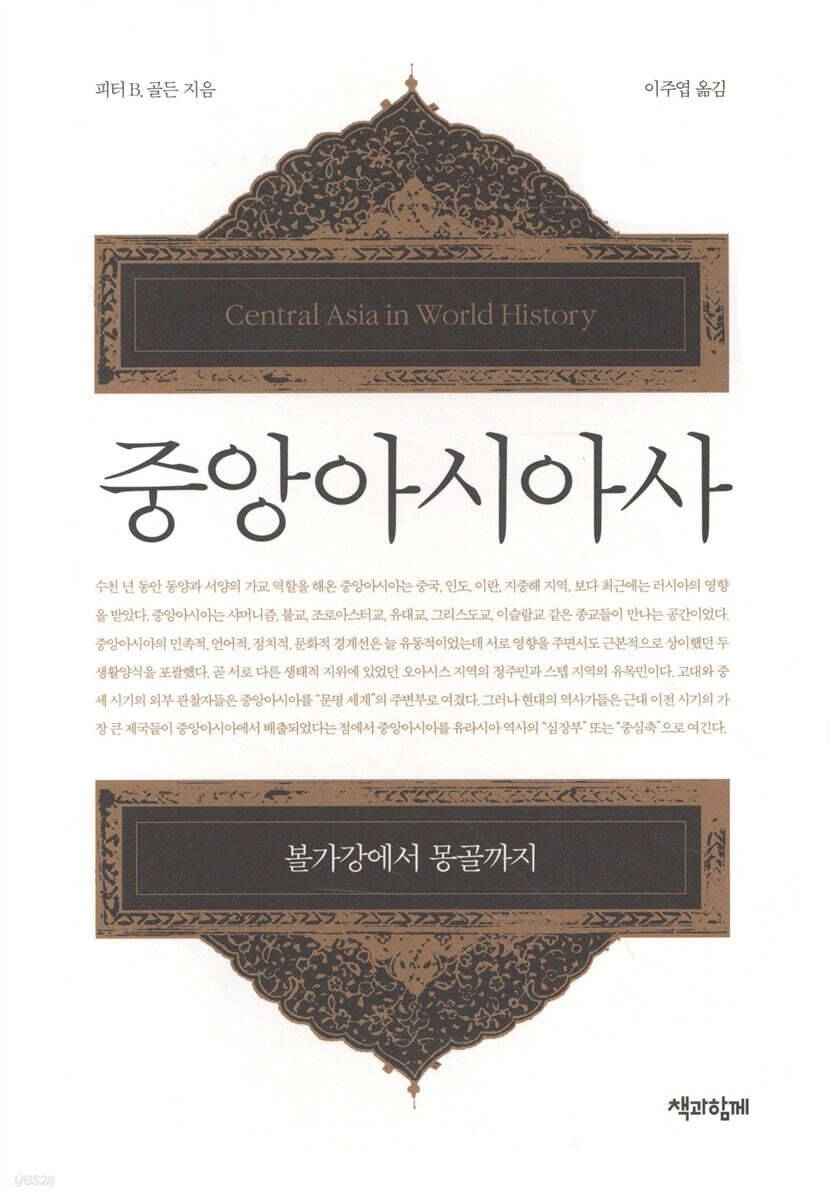
The definitive edition of Central Asian history written by world-renowned scholar Peter Golden
To 'complete knowledge of world history', one must know Central Asian history.
A cutting-edge, academically rigorous, and comprehensive introduction to the history of Central Asia, which fostered Genghis Khan, laid the Silk Road, and gave birth to the Mongol Empire.
Peter Golden, who is considered the most comprehensive scholar on Central Asian history, wrote this book concisely and with a balanced perspective, and Lee Ju-yeop, author of “Descendants of the Mongol Empire,” translated it into Korean meticulously after extensive consultation with the author.
The book treats Central Asia as a region that has served as a bridge between East and West, and as a space where diverse cultures and religions have met.
It focuses particularly on the unique fusion of cultures created by different ethnicities, lifestyles, religions, languages, and migrations.
From the emergence of nomadic life and oasis city-states, to nomads and settled peoples, Islam and Turkic peoples, the Silk Road and oasis city-states, the Mongol Empire of the “Mongol Whirlwind,” the Timurid Empire and the later Genghis Khan Dynasty, Central Asia surrounded by great powers such as the Russian Empire and the Qing Empire from the 16th century onward, and the dissolution of the Soviet Union in 1991 and the subsequent independence of Central Asian countries, it covers a wide range of topics, in depth and clarity.
The definitive edition of Central Asian history written by world-renowned scholar Peter Golden
To 'complete knowledge of world history', one must know Central Asian history.
A cutting-edge, academically rigorous, and comprehensive introduction to the history of Central Asia, which fostered Genghis Khan, laid the Silk Road, and gave birth to the Mongol Empire.
Peter Golden, who is considered the most comprehensive scholar on Central Asian history, wrote this book concisely and with a balanced perspective, and Lee Ju-yeop, author of “Descendants of the Mongol Empire,” translated it into Korean meticulously after extensive consultation with the author.
The book treats Central Asia as a region that has served as a bridge between East and West, and as a space where diverse cultures and religions have met.
It focuses particularly on the unique fusion of cultures created by different ethnicities, lifestyles, religions, languages, and migrations.
From the emergence of nomadic life and oasis city-states, to nomads and settled peoples, Islam and Turkic peoples, the Silk Road and oasis city-states, the Mongol Empire of the “Mongol Whirlwind,” the Timurid Empire and the later Genghis Khan Dynasty, Central Asia surrounded by great powers such as the Russian Empire and the Qing Empire from the 16th century onward, and the dissolution of the Soviet Union in 1991 and the subsequent independence of Central Asian countries, it covers a wide range of topics, in depth and clarity.
- You can preview some of the book's contents.
Preview
index
Preface to the Korean edition
Introduction: Crossroads of Nations
Chapter 1: Nomadic Life and the Emergence of Oasis City-States
Chapter 2: The Early Nomads: "War is Their Profession"
Chapter 3: The Heavenly Khagans: The Turkic Empire and Its Successor States
Chapter 4: Cities of the Silk Road and the Advent of Islam
Chapter 5: The Crescent Moon Rising Over the Steppes: Islam and the Turkic Peoples
Chapter 6: Mongolian Whirlwind
Chapter 7: The Later Genghis Dynasties, Timur the Conqueror, and the Timurid Renaissance
Chapter 8: The Age of Gunpowder and the Rise of Empires
Chapter 9: Problems of Modern Central Asia
Timeline
main
Further Reading
Acknowledgements
Translator's Note: Why Central Asian History?
Search
Introduction: Crossroads of Nations
Chapter 1: Nomadic Life and the Emergence of Oasis City-States
Chapter 2: The Early Nomads: "War is Their Profession"
Chapter 3: The Heavenly Khagans: The Turkic Empire and Its Successor States
Chapter 4: Cities of the Silk Road and the Advent of Islam
Chapter 5: The Crescent Moon Rising Over the Steppes: Islam and the Turkic Peoples
Chapter 6: Mongolian Whirlwind
Chapter 7: The Later Genghis Dynasties, Timur the Conqueror, and the Timurid Renaissance
Chapter 8: The Age of Gunpowder and the Rise of Empires
Chapter 9: Problems of Modern Central Asia
Timeline
main
Further Reading
Acknowledgements
Translator's Note: Why Central Asian History?
Search
Into the book
Central Asia, which has served as a bridge between East and West for thousands of years, has been influenced by China, India, Iran, the Mediterranean region, and more recently Russia.
Central Asia was a meeting place for religions such as Shamanism, Buddhism, Zoroastrianism, Judaism, Christianity, and Islam.
Central Asia's ethnic, linguistic, political, and cultural boundaries have always been fluid, encompassing two fundamentally different ways of life while influencing each other.
Soon, there were settled people in the oasis region and nomads in the steppe region, who were in different ecological niches.
---From the "Preface"
In the urban and agricultural areas of Central Asia, social classes were divided into nobles and commoners.
However, from the 3rd to 4th centuries AD, as Turkic-speaking nomads drove out the previous Iranian nomads and became the new ruling class, linguistic divisions also occurred.
But cities have adapted well.
City dwellers needed nomads to encourage trade and protect them from other nomads.
This kind of relationship of influence between sedentary and nomadic peoples, which occurred in all aspects of political, economic, social, and cultural life, is a phenomenon that has continued to appear in the history of Central Asia.
---From "Chapter 1: Nomadic Life and the Emergence of Oasis City-States"
The nomads were most famous for their fighting prowess, being able to fire arrows from horseback or chariot.
In ancient Iranian, the word 'rathaeshtar', meaning nobleman and warrior, literally meant "one who stands in a chariot."
---From "Chapter 2: Early Nomads: "War is Their Profession"
Byzantine envoys traveled across Central Asia (probably as far as present-day Kyrgyzstan) to meet with the Turkic Khagans.
Zemarchus, who led the first Byzantine embassy in 568, was deeply impressed by Ishtemi.
Ishtemi lived in tents made of silk and sat alternately on a gold throne set on two wheels (to be pulled by horses) and on various golden thrones.
One of these was supported by four peacocks made of gold.
---From "Chapter 3: The Khagans of Heaven: The Turkic Empire and Its Successor States"
To the east of Sogdiana, Xinjiang was home to a series of oasis city-states or kingdoms, including the Tarim Basin and Turpan regions in the north and the Khotan region in the south.
These city-states, caught between the nomadic powers of the steppe and China, had enjoyed a state of uneasy independence or autonomy since the Han Dynasty.
In the 7th century, China and Tibet competed for control of the region.
---From "Chapter 4: Cities on the Silk Road and the Advent of Islam"
In the Mongolian steppe, migration was triggered by the fall of the Turkic Empire and the rise of the Uyghur Empire.
As a result, Turkic tribes migrated to the border areas of Iran-Islamic Transoxiana, and some reached the Black Sea steppes.
These tribes had direct and continuous relations with the Islamic and Byzantine empires and later developed into the modern Central Asian Turkic peoples.
---From "Chapter 5: The Crescent Moon Rising Over the Steppes: Islam and the Turkic Peoples"
Now the whirlwind of the Mongol Empire was to sweep through Western Turkestan.
While the Khwarezm Empire and the Mongol Empire were secretly gathering information about each other and exchanging envoys, Genghis Khan decided to attack Guchuluq.
He attacked the Merkits again and invaded Kara-Khitai territory between 1216 and 1218.
The rescuers were killed and the Merkit refugees fled to the Kipchak steppe.
The Merkits and Naimans no longer posed a military threat to Mongolia.
---From "Chapter 6: Mongolian Whirlwind"
Unlike the empire's founder, Timur, his descendants were literate.
The Timurid clan patronized scholars, poets, architects, and artists.
Some historians argue that the Timurid dynasty, which promoted culture and meritocracy, resembled the European dynasties of the Renaissance, which considered cultural displays an essential element of governance.
---From "Chapter 7: The Genghis Dynasty, Timur the Conqueror, and the Timurid Renaissance"
Nomads were largely left behind in the gunpowder age and were left at a disadvantage.
They were not prepared to embrace rapid technological advancement and innovation.
These problems were occurring throughout the Turkic-Muslim world.
The Ottoman, Safavid, and Mughal empires, which had all experienced the transition from conquering dynasties to bureaucratic states, were all struggling to cope with European onslaughts and changing economic, political, and military environments.
European outposts and colonies were now spreading across Asia and the Americas.
In Central Asia, the immediate threat came from Russia and the Qing.
---From "Chapter 8: The Age of Gunpowder and the Emergence of Empires"
Most of the current leaders of Central Asian states have practiced varying degrees of political repression, a practice common to the Soviet system in which they grew up.
Saparmurat Niyazov, who ruled Turkmenistan from 1990 until his death in 2006, declared himself Turkmenbashi, meaning “leader of the Turkmen.”
His outrageous personality cult was accompanied by oppressive rule.
Less daring than Niyazov, Uzbek President Islam Karimov (in office 1991–2016) also showed little tolerance for political opponents.
Nursultan Nazarbayev, who became president of Kazakhstan in 1991 (serving 1991–2019), was more successful in growing the economy without overt political repression.
Central Asia was a meeting place for religions such as Shamanism, Buddhism, Zoroastrianism, Judaism, Christianity, and Islam.
Central Asia's ethnic, linguistic, political, and cultural boundaries have always been fluid, encompassing two fundamentally different ways of life while influencing each other.
Soon, there were settled people in the oasis region and nomads in the steppe region, who were in different ecological niches.
---From the "Preface"
In the urban and agricultural areas of Central Asia, social classes were divided into nobles and commoners.
However, from the 3rd to 4th centuries AD, as Turkic-speaking nomads drove out the previous Iranian nomads and became the new ruling class, linguistic divisions also occurred.
But cities have adapted well.
City dwellers needed nomads to encourage trade and protect them from other nomads.
This kind of relationship of influence between sedentary and nomadic peoples, which occurred in all aspects of political, economic, social, and cultural life, is a phenomenon that has continued to appear in the history of Central Asia.
---From "Chapter 1: Nomadic Life and the Emergence of Oasis City-States"
The nomads were most famous for their fighting prowess, being able to fire arrows from horseback or chariot.
In ancient Iranian, the word 'rathaeshtar', meaning nobleman and warrior, literally meant "one who stands in a chariot."
---From "Chapter 2: Early Nomads: "War is Their Profession"
Byzantine envoys traveled across Central Asia (probably as far as present-day Kyrgyzstan) to meet with the Turkic Khagans.
Zemarchus, who led the first Byzantine embassy in 568, was deeply impressed by Ishtemi.
Ishtemi lived in tents made of silk and sat alternately on a gold throne set on two wheels (to be pulled by horses) and on various golden thrones.
One of these was supported by four peacocks made of gold.
---From "Chapter 3: The Khagans of Heaven: The Turkic Empire and Its Successor States"
To the east of Sogdiana, Xinjiang was home to a series of oasis city-states or kingdoms, including the Tarim Basin and Turpan regions in the north and the Khotan region in the south.
These city-states, caught between the nomadic powers of the steppe and China, had enjoyed a state of uneasy independence or autonomy since the Han Dynasty.
In the 7th century, China and Tibet competed for control of the region.
---From "Chapter 4: Cities on the Silk Road and the Advent of Islam"
In the Mongolian steppe, migration was triggered by the fall of the Turkic Empire and the rise of the Uyghur Empire.
As a result, Turkic tribes migrated to the border areas of Iran-Islamic Transoxiana, and some reached the Black Sea steppes.
These tribes had direct and continuous relations with the Islamic and Byzantine empires and later developed into the modern Central Asian Turkic peoples.
---From "Chapter 5: The Crescent Moon Rising Over the Steppes: Islam and the Turkic Peoples"
Now the whirlwind of the Mongol Empire was to sweep through Western Turkestan.
While the Khwarezm Empire and the Mongol Empire were secretly gathering information about each other and exchanging envoys, Genghis Khan decided to attack Guchuluq.
He attacked the Merkits again and invaded Kara-Khitai territory between 1216 and 1218.
The rescuers were killed and the Merkit refugees fled to the Kipchak steppe.
The Merkits and Naimans no longer posed a military threat to Mongolia.
---From "Chapter 6: Mongolian Whirlwind"
Unlike the empire's founder, Timur, his descendants were literate.
The Timurid clan patronized scholars, poets, architects, and artists.
Some historians argue that the Timurid dynasty, which promoted culture and meritocracy, resembled the European dynasties of the Renaissance, which considered cultural displays an essential element of governance.
---From "Chapter 7: The Genghis Dynasty, Timur the Conqueror, and the Timurid Renaissance"
Nomads were largely left behind in the gunpowder age and were left at a disadvantage.
They were not prepared to embrace rapid technological advancement and innovation.
These problems were occurring throughout the Turkic-Muslim world.
The Ottoman, Safavid, and Mughal empires, which had all experienced the transition from conquering dynasties to bureaucratic states, were all struggling to cope with European onslaughts and changing economic, political, and military environments.
European outposts and colonies were now spreading across Asia and the Americas.
In Central Asia, the immediate threat came from Russia and the Qing.
---From "Chapter 8: The Age of Gunpowder and the Emergence of Empires"
Most of the current leaders of Central Asian states have practiced varying degrees of political repression, a practice common to the Soviet system in which they grew up.
Saparmurat Niyazov, who ruled Turkmenistan from 1990 until his death in 2006, declared himself Turkmenbashi, meaning “leader of the Turkmen.”
His outrageous personality cult was accompanied by oppressive rule.
Less daring than Niyazov, Uzbek President Islam Karimov (in office 1991–2016) also showed little tolerance for political opponents.
Nursultan Nazarbayev, who became president of Kazakhstan in 1991 (serving 1991–2019), was more successful in growing the economy without overt political repression.
---From "Chapter 9: Problems of Modern Central Asia"
Publisher's Review
“If I were asked to choose a book among the comprehensive histories of Central Asia published domestically and internationally that synthesizes the most recent research findings, is the most academically reliable, is accessible to the general reader, and offers a balanced perspective, I would choose ‘Central Asian History’ without hesitation.
“I highly recommend this book as a must-read for readers and beginners who are interested in history, including Central Asian history.” - Lee Ju-yeop, from the Translator’s Note
Written by Peter Golden, a world-renowned scholar of Central Asian history
Translated by Lee Ju-yeop, author of "Descendants of the Mongol Empire"
‘Genghis Khan,’ ‘Silk Road,’ and ‘Mongol Empire’ have recently been hot topics in the domestic and international history and publishing world.
The following are being shed light on and re-examined: 'Genghis Khan', who allows for a variety of storytelling, from a barbaric invader to the founder of a great empire and brilliant manager; the 'Silk Road', which was a road that crossed all borders in the world and a global network, a route for trade and cultural transmission between the East and the West; and the 'Mongol Empire', a nomadic nation that conquered the Eurasian continent and the most extensive world empire.
"Central Asia: From the Volga to Mongolia" is a cutting-edge, academically rigorous, and comprehensive introduction to the world that fostered Genghis Khan, paved the Silk Road, and gave birth to the Mongol Empire.
From prehistoric times to the late 20th century, the vast history of Central Asia from the Volga River to Mongolia is examined within the context of world history.
Author Peter B.
Golden is a world-renowned scholar in the field of Central Asian history, recognized as the most comprehensive scholar of Central Asian history, capable of comprehensively studying original sources in numerous languages, including Turkic languages, Persian, Arabic, Russian, German, French, and Chinese.
Translator Lee Ju-yeop is a Korean scholar who teaches the history of nomadic empires and the Mongol Empire at the University of Toronto. He won the CESS Book Award, the most prestigious writing award in the international Central Eurasian studies field (2017), and is the author of Descendants of the Mongol Empire (2020), the first domestic research book that traces the legacy of the Mongol Empire in modern Eurasia.
Lee Ju-yeop, who has had a long-standing academic relationship with the author, not only planned the translation of this book, but also consulted deeply with the author on many aspects to ensure a rigorous translation. He also translated it with even greater care and detail than his own books, including adding footnotes and subheadings that did not appear in the original for Korean readers.
To complete your knowledge of world history, you must know the history of Central Asia.
- “The central axis of history” where numerous civilizations have passed through and diverse cultures have merged.
Central Asia has served as a conduit and midwife of trade and human and cultural exchange between East and West for thousands of years, influenced by China, India, Iran, the Mediterranean region, and more recently Russia.
Central Asia was also a meeting place for religions such as Shamanism, Buddhism, Zoroastrianism, Judaism, Christianity, and Islam, which arose as a result of the migration of peoples.
Central Asia's ethnic, linguistic, political, and cultural boundaries have always been fluid, encompassing two fundamentally different ways of life while influencing each other.
Soon, there were settled people in the oasis region and nomads in the steppe region, who were in different ecological niches.
Central Asian nomadic conquerors and Silk Road traders shaped the course of history in a broader world encompassing pre-modern China, India, the Middle East, and Europe, yet outside observers in ancient and medieval times regarded Central Asia as peripheral to the “civilized world.”
However, modern historians consider Central Asia to be the "heartland of history" or "pivotal axis of history" in Eurasia, as it produced some of the greatest empires of the pre-modern period, including the Xiongnu, Turkic, and Mongol empires, which exerted significant military, political, cultural, and commercial influence on China, India, the Middle East, and Europe.
Therefore, in order to ‘complete knowledge of world history,’ one must know the history of Central Asia.
"Central Asian History" treats Central Asia as a region that has served as a bridge between the East and the West, and as a space where diverse cultures and religions have met.
It focuses particularly on the unique fusion of cultures created by different ethnicities, lifestyles, religions, languages, and migrations.
It covers a wide range of topics, from the emergence of nomadic life and oasis city-states, to nomads and settled peoples, Islam and Turkic peoples, the Silk Road and oasis city-states, the Mongol Empire of the “Mongol Whirlwind,” the Timurid Empire and the later Genghis Khan Dynasty, Central Asia surrounded by great powers such as the Russian Empire and the Qing Empire from the 16th century onward, and the dissolution of the Soviet Union in 1991 and the subsequent independence of Central Asian countries.
There are few books, domestically or internationally, that comprehensively examine the time, space, and themes of Central Asia as deeply as "Central Asian History."
Deep and rigorous, yet readable and balanced.
The definitive edition of Central Asian history
The greatest virtue of "A History of Central Asia," and what sets it apart from other books, is that it is written in a way that is both academically rigorous and accessible to the general reader, meeting the standards of the "New Oxford World History" series published by Oxford University Press.
The author synthesizes research findings from not only Western academia to date, but also from the former Soviet Union, Russia, and local Central Asian academia, while minimizing specialized explanations and focusing on essential information in a concise and clear manner.
This book also covers Central Asian history from a balanced perspective.
Existing books usually examine the history of Central Asia from the perspective of nomadic empires and nomads.
However, this book covers the history and heritage of nomads and oasis settlers without bias.
The history of nomadic empires such as the Mongol Empire and the Turkic Empire is also described without bias or exaggeration.
It is also free from the Eurocentric perspective, the historical view of the former Soviet academic world, the pan-Turkic perspective, and the nationalistic perspectives of the present-day Central Asian countries.
This is an essential condition for an objective description of Central Asian history.
In short, this book can be said to be the definitive edition of Central Asian history.
“I highly recommend this book as a must-read for readers and beginners who are interested in history, including Central Asian history.” - Lee Ju-yeop, from the Translator’s Note
Written by Peter Golden, a world-renowned scholar of Central Asian history
Translated by Lee Ju-yeop, author of "Descendants of the Mongol Empire"
‘Genghis Khan,’ ‘Silk Road,’ and ‘Mongol Empire’ have recently been hot topics in the domestic and international history and publishing world.
The following are being shed light on and re-examined: 'Genghis Khan', who allows for a variety of storytelling, from a barbaric invader to the founder of a great empire and brilliant manager; the 'Silk Road', which was a road that crossed all borders in the world and a global network, a route for trade and cultural transmission between the East and the West; and the 'Mongol Empire', a nomadic nation that conquered the Eurasian continent and the most extensive world empire.
"Central Asia: From the Volga to Mongolia" is a cutting-edge, academically rigorous, and comprehensive introduction to the world that fostered Genghis Khan, paved the Silk Road, and gave birth to the Mongol Empire.
From prehistoric times to the late 20th century, the vast history of Central Asia from the Volga River to Mongolia is examined within the context of world history.
Author Peter B.
Golden is a world-renowned scholar in the field of Central Asian history, recognized as the most comprehensive scholar of Central Asian history, capable of comprehensively studying original sources in numerous languages, including Turkic languages, Persian, Arabic, Russian, German, French, and Chinese.
Translator Lee Ju-yeop is a Korean scholar who teaches the history of nomadic empires and the Mongol Empire at the University of Toronto. He won the CESS Book Award, the most prestigious writing award in the international Central Eurasian studies field (2017), and is the author of Descendants of the Mongol Empire (2020), the first domestic research book that traces the legacy of the Mongol Empire in modern Eurasia.
Lee Ju-yeop, who has had a long-standing academic relationship with the author, not only planned the translation of this book, but also consulted deeply with the author on many aspects to ensure a rigorous translation. He also translated it with even greater care and detail than his own books, including adding footnotes and subheadings that did not appear in the original for Korean readers.
To complete your knowledge of world history, you must know the history of Central Asia.
- “The central axis of history” where numerous civilizations have passed through and diverse cultures have merged.
Central Asia has served as a conduit and midwife of trade and human and cultural exchange between East and West for thousands of years, influenced by China, India, Iran, the Mediterranean region, and more recently Russia.
Central Asia was also a meeting place for religions such as Shamanism, Buddhism, Zoroastrianism, Judaism, Christianity, and Islam, which arose as a result of the migration of peoples.
Central Asia's ethnic, linguistic, political, and cultural boundaries have always been fluid, encompassing two fundamentally different ways of life while influencing each other.
Soon, there were settled people in the oasis region and nomads in the steppe region, who were in different ecological niches.
Central Asian nomadic conquerors and Silk Road traders shaped the course of history in a broader world encompassing pre-modern China, India, the Middle East, and Europe, yet outside observers in ancient and medieval times regarded Central Asia as peripheral to the “civilized world.”
However, modern historians consider Central Asia to be the "heartland of history" or "pivotal axis of history" in Eurasia, as it produced some of the greatest empires of the pre-modern period, including the Xiongnu, Turkic, and Mongol empires, which exerted significant military, political, cultural, and commercial influence on China, India, the Middle East, and Europe.
Therefore, in order to ‘complete knowledge of world history,’ one must know the history of Central Asia.
"Central Asian History" treats Central Asia as a region that has served as a bridge between the East and the West, and as a space where diverse cultures and religions have met.
It focuses particularly on the unique fusion of cultures created by different ethnicities, lifestyles, religions, languages, and migrations.
It covers a wide range of topics, from the emergence of nomadic life and oasis city-states, to nomads and settled peoples, Islam and Turkic peoples, the Silk Road and oasis city-states, the Mongol Empire of the “Mongol Whirlwind,” the Timurid Empire and the later Genghis Khan Dynasty, Central Asia surrounded by great powers such as the Russian Empire and the Qing Empire from the 16th century onward, and the dissolution of the Soviet Union in 1991 and the subsequent independence of Central Asian countries.
There are few books, domestically or internationally, that comprehensively examine the time, space, and themes of Central Asia as deeply as "Central Asian History."
Deep and rigorous, yet readable and balanced.
The definitive edition of Central Asian history
The greatest virtue of "A History of Central Asia," and what sets it apart from other books, is that it is written in a way that is both academically rigorous and accessible to the general reader, meeting the standards of the "New Oxford World History" series published by Oxford University Press.
The author synthesizes research findings from not only Western academia to date, but also from the former Soviet Union, Russia, and local Central Asian academia, while minimizing specialized explanations and focusing on essential information in a concise and clear manner.
This book also covers Central Asian history from a balanced perspective.
Existing books usually examine the history of Central Asia from the perspective of nomadic empires and nomads.
However, this book covers the history and heritage of nomads and oasis settlers without bias.
The history of nomadic empires such as the Mongol Empire and the Turkic Empire is also described without bias or exaggeration.
It is also free from the Eurocentric perspective, the historical view of the former Soviet academic world, the pan-Turkic perspective, and the nationalistic perspectives of the present-day Central Asian countries.
This is an essential condition for an objective description of Central Asian history.
In short, this book can be said to be the definitive edition of Central Asian history.
GOODS SPECIFICS
- Date of issue: January 29, 2021
- Page count, weight, size: 372 pages | 488g | 145*210*30mm
- ISBN13: 9791188990597
- ISBN10: 1188990594
You may also like
카테고리
korean


korean

![GQ KOREA Mark (Monthly): December [2025]](http://librairie.coreenne.fr/cdn/shop/files/8ef265dbbfbf186523ed75ba7319009d.jpg?v=1765340328&width=3840)


