

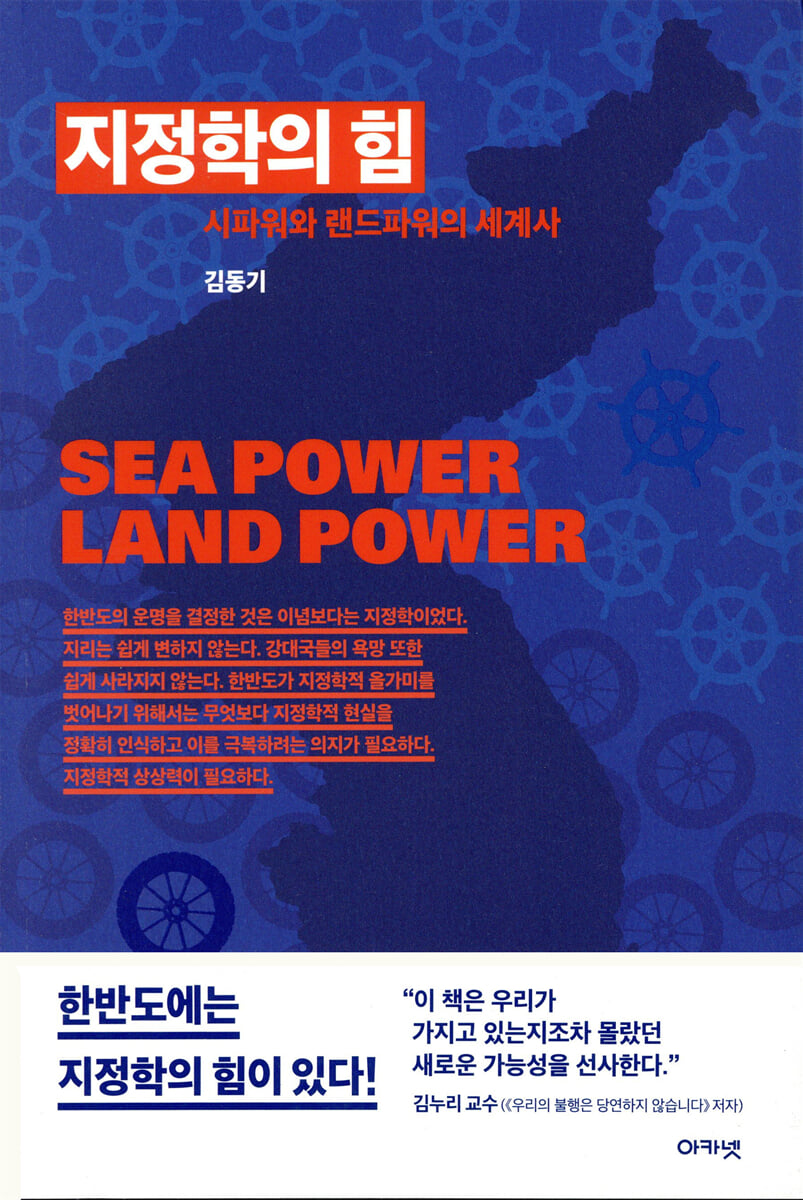
The power of geopolitics
 |
Description
Book Introduction
The Korean Peninsula has geopolitical power!
Will we be trapped in the trap of geopolitics, or will we overcome it?
We need 'geopolitics of the Korean Peninsula' now.
It was geopolitics, not ideology, that determined the fate of the Korean Peninsula.
Geography doesn't disappear easily.
The desires of the great powers also do not easily disappear.
For the Korean Peninsula to escape its geopolitical trap, it needs, above all, an accurate understanding of geopolitical realities and the will to overcome them.
Now, rather than passively being trapped in the geopolitical shackles of major powers, we must seek a better geopolitical structure for the Korean Peninsula.
Above all, we need the geopolitical imagination to make the geopolitical power of the Korean Peninsula our own.
This book presents a map of new possibilities we didn't even know we had.
Will we be trapped in the trap of geopolitics, or will we overcome it?
We need 'geopolitics of the Korean Peninsula' now.
It was geopolitics, not ideology, that determined the fate of the Korean Peninsula.
Geography doesn't disappear easily.
The desires of the great powers also do not easily disappear.
For the Korean Peninsula to escape its geopolitical trap, it needs, above all, an accurate understanding of geopolitical realities and the will to overcome them.
Now, rather than passively being trapped in the geopolitical shackles of major powers, we must seek a better geopolitical structure for the Korean Peninsula.
Above all, we need the geopolitical imagination to make the geopolitical power of the Korean Peninsula our own.
This book presents a map of new possibilities we didn't even know we had.
- You can preview some of the book's contents.
Preview
index
Introduction
1.
Mahan Sea Power
2.
Mackinder Land Power
3.
Haushofer_Lebensraum
4.
Spikeman Rimland
5.
Kissinger: The Resurgence of Geopolitics
6.
Brzezinski_From unipolar to multipolar
7.
Memories of the Russian Empire
8.
Geopolitics of Japanese Reception
9.
Chinese Dream_One Belt One Road
10.
The world is also a battleground
11.
The Korean Peninsula: The Geopolitical Trap
Reviews
References
Source of the illustration
Search
1.
Mahan Sea Power
2.
Mackinder Land Power
3.
Haushofer_Lebensraum
4.
Spikeman Rimland
5.
Kissinger: The Resurgence of Geopolitics
6.
Brzezinski_From unipolar to multipolar
7.
Memories of the Russian Empire
8.
Geopolitics of Japanese Reception
9.
Chinese Dream_One Belt One Road
10.
The world is also a battleground
11.
The Korean Peninsula: The Geopolitical Trap
Reviews
References
Source of the illustration
Search
Into the book
‘Korean Peninsula geopolitics’ does not exist alone, separate from ‘global geopolitics.’
Because ‘Korean Peninsula geopolitics’ is located within ‘global geopolitics,’ it is difficult to understand and utilize ‘Korean Peninsula geopolitics’ without understanding the basics of geopolitics.
What is important to us is a strategic response for the future of the Korean Peninsula.
To achieve this, we must systematically understand geopolitics, starting from its inception.
Only by understanding the sophisticated geopolitical strategies employed by global players such as the United Kingdom, the United States, Germany, Russia, Japan, and China can we truly understand the past and present of the Korean Peninsula and envision its future.
Readers of this book may be impatient and want to know the conclusion right away, but for the reasons mentioned above, I will explain it step by step from the basics.
--- p.13, from “Introduction”
In his historical research, Mahan placed great importance on the influence of the sea on the nation.
He believed that in order to become a great power, one must dominate the sea and become a maritime power.
As the history of Carthage, Rome, Italy, Spain, and Britain shows, control of the seas has always been crucial to global hegemony.
Why were sea routes more important than land routes? Mahan noted that, unlike land, the ocean served as a vast, unobstructed highway, providing a trade route that could travel in any direction.
Historically, overland transportation has been inefficient due to the lack of roads and the high cost of building and maintaining them.
Moreover, it was not safe in case of war or chaos.
On the other hand, maritime transport was much faster and safer.
In order to utilize these oceans, we must strengthen our naval power and secure control of the seas.
For domestic and international trade at sea to proceed smoothly, it is essential to strengthen naval power to ensure peaceful navigation, as well as facilities such as ports.
Afterwards, the foundation for securing overseas colonies and bases and entering overseas markets to increase national wealth is sea power.
Mahan believed that the importance of this power had not received sufficient attention in history.
--- p.20~21, from “Chapter 1 Mahan_Shipower”
The main battlefield of World War I was the peninsular nation of France, but it was a war between land power and sea power.
The Allied Powers were the sea powers of Britain, Canada, the United States, Brazil, Australia, Japan, and New Zealand, and the peninsular nations of France and Italy.
India and China joined in.
China was the vanguard of the sea powers of Britain, the United States, and Japan.
Because the achievements of British sea power have been so remarkable, the British tend to ignore the warnings of history.
It is believed that sea power is superior to land power.
But if Land Power Germany had won World War I, it would have been able to build the largest sea power base in history.
What would happen if a vast continent, the world, or even most of it, were to become a single, unified sea power base in the future? An invincible sea power could be built.
Although Germany ultimately lost World War I, Mackinder remained wary of Germany.
It was thought that most of the great continents might one day be unified by a single power, creating an invincible power.
Mackinder said this was the greatest threat to freedom in the world.
--- p.56~57, from “Chapter 2 Mackinder_Land Power”
Haushofer considered Britain and Japan to be the two major sea power bases, and later included the United States in the list of sea powers.
South America, Africa with its black population, and Australia and New Zealand were viewed as 'continental islands' located in the outer crescent within the geopolitical structure.
If a Heartland Power with sufficient sea power were to one day subdue the Inner Crescent, it could also control the continental islands under its control.
Haushofer believed that by adding Japan to Germany and Russia, they could first subdue British sea power in the Inner Crescent and eventually also dominate the continental islands of the Outer Crescent.
For Haushofer, the ideal was a great power capable of both land and sea.
He believed that only after conquering the continent could he dominate the seas.
--- p.324, from “Chapter 3 Haushofer_Lebensraum”
It is particularly noteworthy that Spykman proposes the concept of the 'Asiatic Mediterranean' and emphasizes its strategic significance.
The Asian Mediterranean Sea refers to the sea within the triangle connecting Taiwan, Singapore, and Cape York in Australia.
Within the Asian Mediterranean Sea, located between Asia and Australia and between the Pacific and Indian Oceans, lies China's access to the Pacific Ocean and a passage connecting the Indian and Pacific Oceans.
And the Strait of Malacca, a key chokepoint, is also located there.
Spykman points out that the Asian Mediterranean will become the most important source of strategic raw materials for the United States after the war.
However, he emphasized that it would be very disadvantageous for the United States for this place to be ruled by a single country.
(…) Spikeman predicted the development of the post-war Asian region.
However, after the end of World War II, there were concerns that the region would become awash with independent states, and that it would be more difficult for them to achieve balance by becoming nations of equal national power than in Europe.
For that reason, he recommended restoring the postwar US-Japan alliance to maintain a balance of power in East Asia so that the US could check a rising China in the future.
It should be remembered that at the time he wrote this, the United States and Japan were pointing their guns at each other in the Pacific.
From his perspective in 1942, Spykman predicted with chilling accuracy not only that Japan would lose the war, but that China, now an economic powerhouse, would become a military power and pose a threat to the United States.
--- p.128~129, from “Chapter 4: Spikeman_Rimland”
Shortly after Wang Jishi's westward advance strategy was announced, the Belt and Road Initiative was revealed.
On September 7, 2013, in a lecture at Nazarbayev University in Kazakhstan, President Xi Jinping proposed that China and Eurasian countries build a "Silk Road Economic Belt" to expand economic cooperation and development space.
In his speech, President Xi Jinping called for gradually expanding regional cooperation by drawing lines from points and gradually expanding lines to areas.
In a speech to the Indonesian National Assembly in October of the same year, President Xi Jinping emphasized that China would deepen cooperation with ASEAN and build a closer community with a shared future, and proposed jointly building the "21st Century Maritime Silk Road."
The concept developed by integrating the joint construction of the 'Silk Road Economic Belt' and the 'Maritime Silk Road' is China's 'One Belt, One Road' initiative.
The Belt and Road Initiative begins in China and extends through Central Asia, East Asia, South Asia, West Asia, and parts of Europe.
It could build the world's largest and longest economic corridor, involving at least 65 countries and covering 4.4 billion people, or 64 percent of the world's population, by leading the Asia-Pacific economic bloc to the east and linking it with the European economic bloc to the west.
31 percent of the world's GDP is involved here.
--- p.250, from “Chapter 9 China_One Belt One Road”
The Korean Peninsula's Military Demarcation Line still remains the boundary between land power and sea power.
The divided South Korea has become a single island geopolitically.
Because it was not connected to the continent.
Korea was under the influence of the US Sea Power.
North Korea was part of the land power bloc of the Soviet Union and China, and its access to the sea was blocked, making it the easternmost corner of Eurasia.
As Mackinder and Brzezinski have already observed, the strategic importance of the Korean Peninsula is the reason why the strongest land and sea powers clash here.
The Korean Peninsula has suffered historically and remains divided because it has been unable to check and control land and sea power on its own.
In the future, China, which is emerging as the strongest land power, and the United States, the strongest sea power, could clash on or around the Korean Peninsula, embroiling the Korean Peninsula in an unwanted conflict.
To avoid being drawn into unwanted geopolitical games, the Korean Peninsula must clarify its strategic objectives.
Because ‘Korean Peninsula geopolitics’ is located within ‘global geopolitics,’ it is difficult to understand and utilize ‘Korean Peninsula geopolitics’ without understanding the basics of geopolitics.
What is important to us is a strategic response for the future of the Korean Peninsula.
To achieve this, we must systematically understand geopolitics, starting from its inception.
Only by understanding the sophisticated geopolitical strategies employed by global players such as the United Kingdom, the United States, Germany, Russia, Japan, and China can we truly understand the past and present of the Korean Peninsula and envision its future.
Readers of this book may be impatient and want to know the conclusion right away, but for the reasons mentioned above, I will explain it step by step from the basics.
--- p.13, from “Introduction”
In his historical research, Mahan placed great importance on the influence of the sea on the nation.
He believed that in order to become a great power, one must dominate the sea and become a maritime power.
As the history of Carthage, Rome, Italy, Spain, and Britain shows, control of the seas has always been crucial to global hegemony.
Why were sea routes more important than land routes? Mahan noted that, unlike land, the ocean served as a vast, unobstructed highway, providing a trade route that could travel in any direction.
Historically, overland transportation has been inefficient due to the lack of roads and the high cost of building and maintaining them.
Moreover, it was not safe in case of war or chaos.
On the other hand, maritime transport was much faster and safer.
In order to utilize these oceans, we must strengthen our naval power and secure control of the seas.
For domestic and international trade at sea to proceed smoothly, it is essential to strengthen naval power to ensure peaceful navigation, as well as facilities such as ports.
Afterwards, the foundation for securing overseas colonies and bases and entering overseas markets to increase national wealth is sea power.
Mahan believed that the importance of this power had not received sufficient attention in history.
--- p.20~21, from “Chapter 1 Mahan_Shipower”
The main battlefield of World War I was the peninsular nation of France, but it was a war between land power and sea power.
The Allied Powers were the sea powers of Britain, Canada, the United States, Brazil, Australia, Japan, and New Zealand, and the peninsular nations of France and Italy.
India and China joined in.
China was the vanguard of the sea powers of Britain, the United States, and Japan.
Because the achievements of British sea power have been so remarkable, the British tend to ignore the warnings of history.
It is believed that sea power is superior to land power.
But if Land Power Germany had won World War I, it would have been able to build the largest sea power base in history.
What would happen if a vast continent, the world, or even most of it, were to become a single, unified sea power base in the future? An invincible sea power could be built.
Although Germany ultimately lost World War I, Mackinder remained wary of Germany.
It was thought that most of the great continents might one day be unified by a single power, creating an invincible power.
Mackinder said this was the greatest threat to freedom in the world.
--- p.56~57, from “Chapter 2 Mackinder_Land Power”
Haushofer considered Britain and Japan to be the two major sea power bases, and later included the United States in the list of sea powers.
South America, Africa with its black population, and Australia and New Zealand were viewed as 'continental islands' located in the outer crescent within the geopolitical structure.
If a Heartland Power with sufficient sea power were to one day subdue the Inner Crescent, it could also control the continental islands under its control.
Haushofer believed that by adding Japan to Germany and Russia, they could first subdue British sea power in the Inner Crescent and eventually also dominate the continental islands of the Outer Crescent.
For Haushofer, the ideal was a great power capable of both land and sea.
He believed that only after conquering the continent could he dominate the seas.
--- p.324, from “Chapter 3 Haushofer_Lebensraum”
It is particularly noteworthy that Spykman proposes the concept of the 'Asiatic Mediterranean' and emphasizes its strategic significance.
The Asian Mediterranean Sea refers to the sea within the triangle connecting Taiwan, Singapore, and Cape York in Australia.
Within the Asian Mediterranean Sea, located between Asia and Australia and between the Pacific and Indian Oceans, lies China's access to the Pacific Ocean and a passage connecting the Indian and Pacific Oceans.
And the Strait of Malacca, a key chokepoint, is also located there.
Spykman points out that the Asian Mediterranean will become the most important source of strategic raw materials for the United States after the war.
However, he emphasized that it would be very disadvantageous for the United States for this place to be ruled by a single country.
(…) Spikeman predicted the development of the post-war Asian region.
However, after the end of World War II, there were concerns that the region would become awash with independent states, and that it would be more difficult for them to achieve balance by becoming nations of equal national power than in Europe.
For that reason, he recommended restoring the postwar US-Japan alliance to maintain a balance of power in East Asia so that the US could check a rising China in the future.
It should be remembered that at the time he wrote this, the United States and Japan were pointing their guns at each other in the Pacific.
From his perspective in 1942, Spykman predicted with chilling accuracy not only that Japan would lose the war, but that China, now an economic powerhouse, would become a military power and pose a threat to the United States.
--- p.128~129, from “Chapter 4: Spikeman_Rimland”
Shortly after Wang Jishi's westward advance strategy was announced, the Belt and Road Initiative was revealed.
On September 7, 2013, in a lecture at Nazarbayev University in Kazakhstan, President Xi Jinping proposed that China and Eurasian countries build a "Silk Road Economic Belt" to expand economic cooperation and development space.
In his speech, President Xi Jinping called for gradually expanding regional cooperation by drawing lines from points and gradually expanding lines to areas.
In a speech to the Indonesian National Assembly in October of the same year, President Xi Jinping emphasized that China would deepen cooperation with ASEAN and build a closer community with a shared future, and proposed jointly building the "21st Century Maritime Silk Road."
The concept developed by integrating the joint construction of the 'Silk Road Economic Belt' and the 'Maritime Silk Road' is China's 'One Belt, One Road' initiative.
The Belt and Road Initiative begins in China and extends through Central Asia, East Asia, South Asia, West Asia, and parts of Europe.
It could build the world's largest and longest economic corridor, involving at least 65 countries and covering 4.4 billion people, or 64 percent of the world's population, by leading the Asia-Pacific economic bloc to the east and linking it with the European economic bloc to the west.
31 percent of the world's GDP is involved here.
--- p.250, from “Chapter 9 China_One Belt One Road”
The Korean Peninsula's Military Demarcation Line still remains the boundary between land power and sea power.
The divided South Korea has become a single island geopolitically.
Because it was not connected to the continent.
Korea was under the influence of the US Sea Power.
North Korea was part of the land power bloc of the Soviet Union and China, and its access to the sea was blocked, making it the easternmost corner of Eurasia.
As Mackinder and Brzezinski have already observed, the strategic importance of the Korean Peninsula is the reason why the strongest land and sea powers clash here.
The Korean Peninsula has suffered historically and remains divided because it has been unable to check and control land and sea power on its own.
In the future, China, which is emerging as the strongest land power, and the United States, the strongest sea power, could clash on or around the Korean Peninsula, embroiling the Korean Peninsula in an unwanted conflict.
To avoid being drawn into unwanted geopolitical games, the Korean Peninsula must clarify its strategic objectives.
--- p.324, from “Chapter 11: The Korean Peninsula: The Geopolitical Trap”
Publisher's Review
What differences do North Korea and Vietnam have for the United States?
In 1972, US President Nixon made a surprise visit to China, an enemy country.
And relations between the two countries were normalized.
In the Korean War that broke out in 1950, the death toll of the Chinese People's Volunteer Army reached 148,000.
The number of American casualties was also around 58,000.
The United States and China fought a war as enemies just over 20 years ago, and although they have different ideologies and systems, they have reconciled without any hesitation.
The Cold War ended in 1972.
The United States escalated its war with North Vietnam into an all-out war on August 7, 1964, triggered by the Gulf of Tonkin Incident.
The United States then deployed 550,000 ground troops to Vietnam.
North Vietnam lost 850,000 men, while South Vietnam lost 300,000 men.
The number of American casualties also reached 58,000.
In April 1975, Vietnam became communist and relations between the two countries were severed.
And 20 years after the end of the war, relations between the two countries were normalized.
Vietnam's communist-dominated political system presented no obstacle to normalizing diplomatic relations with the United States, the leader of the liberal democratic camp.
If ideology and regime are not primary considerations in US foreign policy, as the cases of China and Vietnam demonstrate, why doesn't the US establish normal relations with North Korea? Is it because North Korea is attempting to develop nuclear weapons? North Korea declared its possession of nuclear weapons in 2005.
Why was normalization impossible before? Couldn't normalization have been possible with North Korea around 1972, when it was with China, or around 1995, when it was with Vietnam? Why do we remain hostile with North Korea 67 years after the armistice? The second summit between US President Trump and North Korean Chairman Kim Jong-un took place in Hanoi, Vietnam, on February 28, 2019, but the two leaders parted ways without reaching any agreement.
What difference does North Korea and Vietnam make to the United States?
The geopolitics of the Korean Peninsula do not exist in isolation.
‘Korean Peninsula geopolitics’ does not exist alone, separate from ‘global geopolitics.’
Because ‘Korean Peninsula geopolitics’ is located within ‘global geopolitics,’ it is impossible to understand and utilize ‘Korean Peninsula geopolitics’ without understanding the basics of geopolitics.
What is important to us is a strategic response for the future of the Korean Peninsula.
To achieve this, we must systematically understand geopolitics, starting from its inception.
Only by understanding the sophisticated geopolitical strategies employed by global players such as the United Kingdom, the United States, Germany, Russia, Japan, and China can we truly understand the past and present of the Korean Peninsula and envision its future.
This book begins from the point in time when the concepts and theories of classical geopolitics were established.
This book introduces the theories of Alfred Mahan, who played a decisive role in the growth of the United States as a seapower (naval military power), Halford Mackinder, who was the first to systematically study seapower and landpower (military power), Karl Haushofer, who was called Hitler's brain and supported Nazi expansion, and Nicholas Spykman, who presented the direction of America's foreign strategy after World War II, and the international political history related to them, and examines how geopolitics worked during the Cold War.
It also provides an interesting account of how Henry Kissinger, a Jew who immigrated to the United States to escape Nazi persecution and served as Secretary of State under President Nixon, revived geopolitics, and how geopolitical ideas were concretized through Zbigniew Brzezinski, a leading American foreign policy and security strategist.
And it introduces, in order, Russia's geopolitics after the collapse of the Soviet Union, Japan's geopolitics that justified Japanese fascism, and China's geopolitics that seeks to realize the 'Chinese Dream'.
Finally, this book examines the confrontation between the United States and China, the biggest issue in the international community today, from a geopolitical perspective, examines the geopolitical situation on the Korean Peninsula, and considers the existential problems we face.
The geopolitics of the Korean Peninsula must become a geopolitics that goes beyond geopolitics.
Author Kim Dong-gi acquired historical awareness and critical thinking while struggling on campus during the turbulent times of the 1980s.
It was only after I passed the bar exam, worked as a lawyer, and then went to study abroad in the United States that I began to face the existential limitations that were shackling us.
Born in a divided nation, I discovered myself with a deeply ingrained anti-communist mentality, and realized that the era of ideology had long since ended.
The Korean Peninsula has lagged behind the global trend to that extent, and the author has been intensely contemplating and researching what we need to overcome the limitations of this 'delay.'
This book is the first result.
The author concluded that the Korean Peninsula must first dismantle the Cold War worldview, and that geopolitics could provide us with an alternative imagination at that very point.
“The author, a voracious reader, has clearly penetrated the complex world of ‘geopolitics.’
From Mahan, Mackinder, and Spykman to Kissinger and Brzezinski, Anglo-American maritime geopolitics, German and Japanese fascist geopolitics, Russian and Chinese continental geopolitics, and finally Korea's peninsular geopolitics.
“The ‘geopolitics of the Korean Peninsula’ that the author has concluded is ‘geopolitics beyond geopolitics’ to escape the geopolitical trap set by the great powers.” ─ From the recommendation by Professor Kim Sang-jun
Geopolitics has been a strategic tool for major powers to expand their own interests.
What mattered to them was only realistic national interests.
This is the lesson we must learn from geopolitics.
Great powers employ strategies for practical gain, but why is the Korean Peninsula trapped in ideological strife and historical entanglements rather than practical interests? If we are to avoid being oppressed by the geopolitics of great powers and assert a confident voice in the world map (a concept that views Eurasia and Africa as a single, vast cape), we must accurately understand the concept of geopolitics and actively utilize it.
We must secure our voice in the power games surrounding the Korean Peninsula, including North Korea's nuclear program and the trade war between the US and China, and implement a national strategy grounded in geopolitical realities.
In particular, we must choose a new national leader in 2022.
Will we ever meet a global leader who can properly develop the geopolitics of the Korean Peninsula without being oppressed by the geopolitics of major powers?
The author suggests:
Now is the time for the Korean Peninsula to calmly recognize what is in its best interest, and to achieve that, South and North Korea must build a peace regime and further establish relations with other nations. We must understand the geopolitical strategies and dynamics of the major powers and find gaps to expand the Korean Peninsula's strategic space. Therefore, I boldly suggest that now is the time to seriously consider and seize the "geopolitical power" that the Korean Peninsula possesses.
This book presents a 'map of new possibilities'.
In 1972, US President Nixon made a surprise visit to China, an enemy country.
And relations between the two countries were normalized.
In the Korean War that broke out in 1950, the death toll of the Chinese People's Volunteer Army reached 148,000.
The number of American casualties was also around 58,000.
The United States and China fought a war as enemies just over 20 years ago, and although they have different ideologies and systems, they have reconciled without any hesitation.
The Cold War ended in 1972.
The United States escalated its war with North Vietnam into an all-out war on August 7, 1964, triggered by the Gulf of Tonkin Incident.
The United States then deployed 550,000 ground troops to Vietnam.
North Vietnam lost 850,000 men, while South Vietnam lost 300,000 men.
The number of American casualties also reached 58,000.
In April 1975, Vietnam became communist and relations between the two countries were severed.
And 20 years after the end of the war, relations between the two countries were normalized.
Vietnam's communist-dominated political system presented no obstacle to normalizing diplomatic relations with the United States, the leader of the liberal democratic camp.
If ideology and regime are not primary considerations in US foreign policy, as the cases of China and Vietnam demonstrate, why doesn't the US establish normal relations with North Korea? Is it because North Korea is attempting to develop nuclear weapons? North Korea declared its possession of nuclear weapons in 2005.
Why was normalization impossible before? Couldn't normalization have been possible with North Korea around 1972, when it was with China, or around 1995, when it was with Vietnam? Why do we remain hostile with North Korea 67 years after the armistice? The second summit between US President Trump and North Korean Chairman Kim Jong-un took place in Hanoi, Vietnam, on February 28, 2019, but the two leaders parted ways without reaching any agreement.
What difference does North Korea and Vietnam make to the United States?
The geopolitics of the Korean Peninsula do not exist in isolation.
‘Korean Peninsula geopolitics’ does not exist alone, separate from ‘global geopolitics.’
Because ‘Korean Peninsula geopolitics’ is located within ‘global geopolitics,’ it is impossible to understand and utilize ‘Korean Peninsula geopolitics’ without understanding the basics of geopolitics.
What is important to us is a strategic response for the future of the Korean Peninsula.
To achieve this, we must systematically understand geopolitics, starting from its inception.
Only by understanding the sophisticated geopolitical strategies employed by global players such as the United Kingdom, the United States, Germany, Russia, Japan, and China can we truly understand the past and present of the Korean Peninsula and envision its future.
This book begins from the point in time when the concepts and theories of classical geopolitics were established.
This book introduces the theories of Alfred Mahan, who played a decisive role in the growth of the United States as a seapower (naval military power), Halford Mackinder, who was the first to systematically study seapower and landpower (military power), Karl Haushofer, who was called Hitler's brain and supported Nazi expansion, and Nicholas Spykman, who presented the direction of America's foreign strategy after World War II, and the international political history related to them, and examines how geopolitics worked during the Cold War.
It also provides an interesting account of how Henry Kissinger, a Jew who immigrated to the United States to escape Nazi persecution and served as Secretary of State under President Nixon, revived geopolitics, and how geopolitical ideas were concretized through Zbigniew Brzezinski, a leading American foreign policy and security strategist.
And it introduces, in order, Russia's geopolitics after the collapse of the Soviet Union, Japan's geopolitics that justified Japanese fascism, and China's geopolitics that seeks to realize the 'Chinese Dream'.
Finally, this book examines the confrontation between the United States and China, the biggest issue in the international community today, from a geopolitical perspective, examines the geopolitical situation on the Korean Peninsula, and considers the existential problems we face.
The geopolitics of the Korean Peninsula must become a geopolitics that goes beyond geopolitics.
Author Kim Dong-gi acquired historical awareness and critical thinking while struggling on campus during the turbulent times of the 1980s.
It was only after I passed the bar exam, worked as a lawyer, and then went to study abroad in the United States that I began to face the existential limitations that were shackling us.
Born in a divided nation, I discovered myself with a deeply ingrained anti-communist mentality, and realized that the era of ideology had long since ended.
The Korean Peninsula has lagged behind the global trend to that extent, and the author has been intensely contemplating and researching what we need to overcome the limitations of this 'delay.'
This book is the first result.
The author concluded that the Korean Peninsula must first dismantle the Cold War worldview, and that geopolitics could provide us with an alternative imagination at that very point.
“The author, a voracious reader, has clearly penetrated the complex world of ‘geopolitics.’
From Mahan, Mackinder, and Spykman to Kissinger and Brzezinski, Anglo-American maritime geopolitics, German and Japanese fascist geopolitics, Russian and Chinese continental geopolitics, and finally Korea's peninsular geopolitics.
“The ‘geopolitics of the Korean Peninsula’ that the author has concluded is ‘geopolitics beyond geopolitics’ to escape the geopolitical trap set by the great powers.” ─ From the recommendation by Professor Kim Sang-jun
Geopolitics has been a strategic tool for major powers to expand their own interests.
What mattered to them was only realistic national interests.
This is the lesson we must learn from geopolitics.
Great powers employ strategies for practical gain, but why is the Korean Peninsula trapped in ideological strife and historical entanglements rather than practical interests? If we are to avoid being oppressed by the geopolitics of great powers and assert a confident voice in the world map (a concept that views Eurasia and Africa as a single, vast cape), we must accurately understand the concept of geopolitics and actively utilize it.
We must secure our voice in the power games surrounding the Korean Peninsula, including North Korea's nuclear program and the trade war between the US and China, and implement a national strategy grounded in geopolitical realities.
In particular, we must choose a new national leader in 2022.
Will we ever meet a global leader who can properly develop the geopolitics of the Korean Peninsula without being oppressed by the geopolitics of major powers?
The author suggests:
Now is the time for the Korean Peninsula to calmly recognize what is in its best interest, and to achieve that, South and North Korea must build a peace regime and further establish relations with other nations. We must understand the geopolitical strategies and dynamics of the major powers and find gaps to expand the Korean Peninsula's strategic space. Therefore, I boldly suggest that now is the time to seriously consider and seize the "geopolitical power" that the Korean Peninsula possesses.
This book presents a 'map of new possibilities'.
GOODS SPECIFICS
- Publication date: November 18, 2020
- Page count, weight, size: 360 pages | 632g | 152*225*20mm
- ISBN13: 9788957337103
- ISBN10: 8957337105
You may also like
카테고리
korean


korean

![GQ KOREA Mark (Monthly): December [2025]](http://librairie.coreenne.fr/cdn/shop/files/8ef265dbbfbf186523ed75ba7319009d.jpg?v=1765340328&width=3840)


