

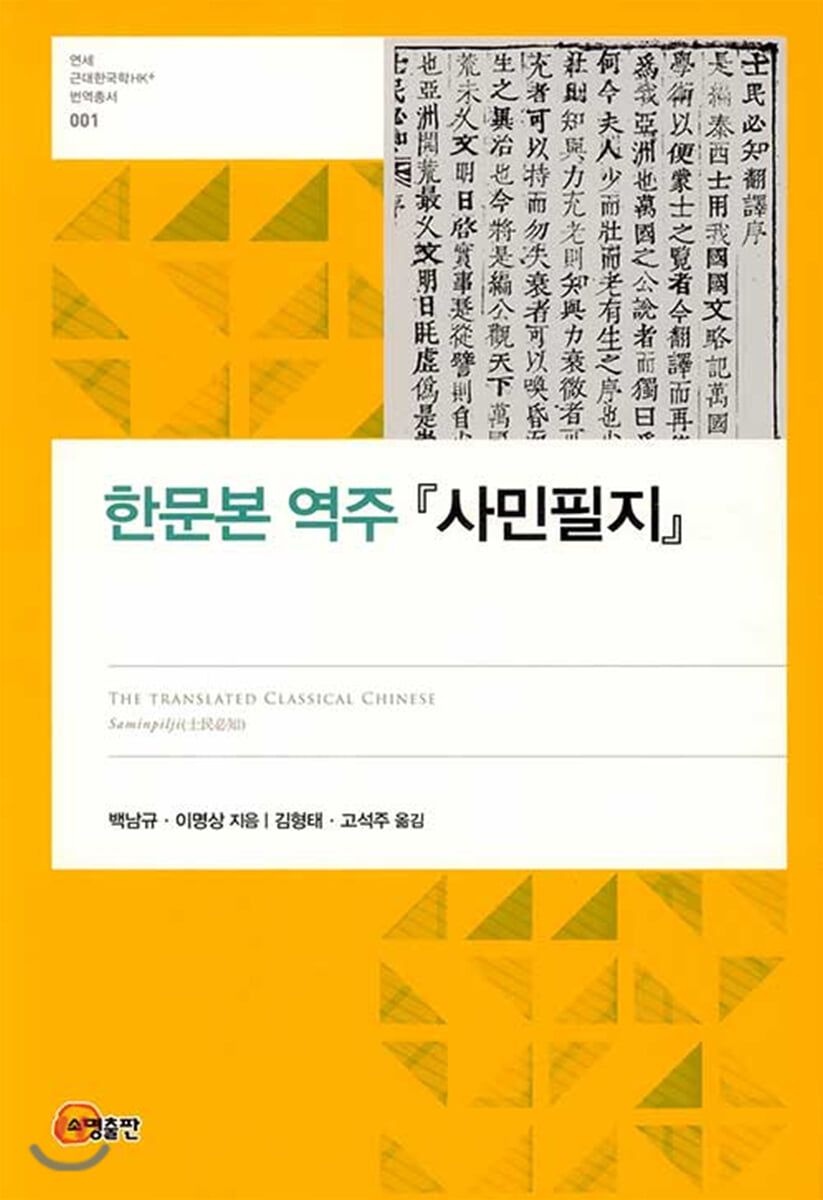
Annotated translation of the Chinese version of 『Saminpilji』
 |
Description
Book Introduction
『Saminpilji』 is known as the world geography book and the first geography textbook written by Homer Bezaleel Hulbert, 紇法 (1863-1949), an American missionary who was active in Korea in the late 19th century.
In 1886, Hulbert took up a position as a teacher at Yukyeong Public School and wrote “Minpilji,” a textbook introducing world geography and culture.
The first Korean edition of this book was published between 1889 and 1893, a revised edition was published in 1906, and the third edition was published in 1909.
The main contents of the 『Saminpilji』 described in each country have a slight difference in order.
In general, the contents include the history of the founding of the country, location (latitude and longitude), area, number of cities, natural landforms and borders, climate, products, population, race, language, capital city, description of major cities, industry and special products, import and export items and amounts, political system, criminal penalties, national social classes, education, religion, tax system, military system and military power, national infrastructure (roads and railways), customs, etc.
What is unique is that in 1895, Baek Nam-gyu and Lee Myeong-sang, the Joseon State Councilors, translated the Korean version into Chinese, and Kim Taek-yeong edited it, and the Joseon State Councilors' Office published a Chinese translation.
Although traces of Chinese translations can often be found in works such as Akbusi, the fact that a Korean text was translated into Chinese and published as a Chinese version is a very unique and rare case in the history of Korean translation.
Herein lies the important modern literary value of 『Saminpilji』.
The purpose of these translations is to allow readers to directly compare and verify aspects of modern translation, such as additions and deletions, through the Korean and Chinese versions.
In 1886, Hulbert took up a position as a teacher at Yukyeong Public School and wrote “Minpilji,” a textbook introducing world geography and culture.
The first Korean edition of this book was published between 1889 and 1893, a revised edition was published in 1906, and the third edition was published in 1909.
The main contents of the 『Saminpilji』 described in each country have a slight difference in order.
In general, the contents include the history of the founding of the country, location (latitude and longitude), area, number of cities, natural landforms and borders, climate, products, population, race, language, capital city, description of major cities, industry and special products, import and export items and amounts, political system, criminal penalties, national social classes, education, religion, tax system, military system and military power, national infrastructure (roads and railways), customs, etc.
What is unique is that in 1895, Baek Nam-gyu and Lee Myeong-sang, the Joseon State Councilors, translated the Korean version into Chinese, and Kim Taek-yeong edited it, and the Joseon State Councilors' Office published a Chinese translation.
Although traces of Chinese translations can often be found in works such as Akbusi, the fact that a Korean text was translated into Chinese and published as a Chinese version is a very unique and rare case in the history of Korean translation.
Herein lies the important modern literary value of 『Saminpilji』.
The purpose of these translations is to allow readers to directly compare and verify aspects of modern translation, such as additions and deletions, through the Korean and Chinese versions.
- You can preview some of the book's contents.
Preview
index
clear
Translation of 『Saminpilji』
『Saminpilji』 Kwon Ji-il
earth
General theory of Earth
General theory of race
European General Theory
『Saminpilji』 Kwon Ji-i
Asia General Theory
General Introduction to America
General Introduction to Africa
Australian continent
Pacific Islands
several small islands in the Pacific Ocean
『Saminpilji』 reprint
Publisher
Translation of 『Saminpilji』
『Saminpilji』 Kwon Ji-il
earth
General theory of Earth
General theory of race
European General Theory
『Saminpilji』 Kwon Ji-i
Asia General Theory
General Introduction to America
General Introduction to Africa
Australian continent
Pacific Islands
several small islands in the Pacific Ocean
『Saminpilji』 reprint
Publisher
Publisher's Review
The Chinese version of 『Saminpilji』
The original text used for the translation of the Chinese text is Volume 2, Book 1 of 『士民必知』 (Call number: Han古朝60-1) held by the National Library of Korea.
This text is a movable type version (ancient movable type, printed type, wooden type), and consists of 71 pages, 10 lines per page, and 20 characters per line.
In addition, there is a two-volume, one-book, woodblock print text (call number: L175074) in the Ogura Library of the University of Tokyo, Japan.
The Chinese version is included to facilitate comparison between the translation and the original text, and the original text is included at the end for convenient comparison.
The characteristics of the Chinese version of 『Saminpilji』 are as follows.
First, it has the characteristics of a Confucian encyclopedia of the East.
This can be said to be an attempt to complete the Chinese character version of the historical text by supplementing the Korean version with historical events and figures from each country and describing the rise and fall of that country.
Additionally, the fact that the author's commentary, which can be found in the will, is included at the end of the description of each country, and the listing of the names of each country's special products and import/export items is very detailed, is also an important part that is in line with the listing of the names of products in the will.
Second, it follows a thorough item-by-item classification system.
『Saminpilji』 follows the traditional classification system of Eastern classics.
For example, from ‘Earth’ to ‘Astronomy’, major and minor items that were omitted in the Korean version are included in the Chinese version.
Therefore, it can be said that the Chinese version was the result of an attempt to follow the traditional classification system of East Asia's classics by supplementing its items and system in the order of heaven, earth, and man, like the Samjaedohoe, one of the representative classics of Northeast Asia.
Third, it maintains a consistent, concise narrative format for each item.
The Chinese version of 『Saminpilji』 can be seen as a greatly abridged version of the excessively long Korean version, in accordance with the unique character of Chinese characters that allows for abbreviation.
That is, rather than dividing each item into paragraphs by subtopic, the description of one country is organized into a single paragraph. This type of item-by-item description is a characteristic of traditional Chinese writing, and is also a characteristic of its form.
In addition, since the Chinese version was translated and written by two people, the writing style and vocabulary are sometimes different, and many of the vernacular vocabulary that was popular at the time was used. It also has a unique characteristic of starting from Russia, unlike contemporary Chinese geography books that start from Greece or Rome (Italy).
When we consider all these points, we can say that the fundamental reason for translating the Korean version into Chinese characters and publishing it was to expand and disseminate knowledge.
In other words, the Chinese version of 『Saminpilji』 can be said to be a work that re-invented the tradition of compiling books, which was a good example of conveying more sophisticated knowledge, by using Chinese characters, the universal writing system of East Asia, which still maintained its status.
This can be said to have important cultural and historical significance in that it represents a return to good traditions during the modern enlightenment period when the influence of new civilization was great.
Therefore, the Chinese version of 『Saminpilji』 can be said to be a unique text that incorporates historical elements into the new content of modern geographical knowledge and presents it in a traditional Eastern format.
The original text used for the translation of the Chinese text is Volume 2, Book 1 of 『士民必知』 (Call number: Han古朝60-1) held by the National Library of Korea.
This text is a movable type version (ancient movable type, printed type, wooden type), and consists of 71 pages, 10 lines per page, and 20 characters per line.
In addition, there is a two-volume, one-book, woodblock print text (call number: L175074) in the Ogura Library of the University of Tokyo, Japan.
The Chinese version is included to facilitate comparison between the translation and the original text, and the original text is included at the end for convenient comparison.
The characteristics of the Chinese version of 『Saminpilji』 are as follows.
First, it has the characteristics of a Confucian encyclopedia of the East.
This can be said to be an attempt to complete the Chinese character version of the historical text by supplementing the Korean version with historical events and figures from each country and describing the rise and fall of that country.
Additionally, the fact that the author's commentary, which can be found in the will, is included at the end of the description of each country, and the listing of the names of each country's special products and import/export items is very detailed, is also an important part that is in line with the listing of the names of products in the will.
Second, it follows a thorough item-by-item classification system.
『Saminpilji』 follows the traditional classification system of Eastern classics.
For example, from ‘Earth’ to ‘Astronomy’, major and minor items that were omitted in the Korean version are included in the Chinese version.
Therefore, it can be said that the Chinese version was the result of an attempt to follow the traditional classification system of East Asia's classics by supplementing its items and system in the order of heaven, earth, and man, like the Samjaedohoe, one of the representative classics of Northeast Asia.
Third, it maintains a consistent, concise narrative format for each item.
The Chinese version of 『Saminpilji』 can be seen as a greatly abridged version of the excessively long Korean version, in accordance with the unique character of Chinese characters that allows for abbreviation.
That is, rather than dividing each item into paragraphs by subtopic, the description of one country is organized into a single paragraph. This type of item-by-item description is a characteristic of traditional Chinese writing, and is also a characteristic of its form.
In addition, since the Chinese version was translated and written by two people, the writing style and vocabulary are sometimes different, and many of the vernacular vocabulary that was popular at the time was used. It also has a unique characteristic of starting from Russia, unlike contemporary Chinese geography books that start from Greece or Rome (Italy).
When we consider all these points, we can say that the fundamental reason for translating the Korean version into Chinese characters and publishing it was to expand and disseminate knowledge.
In other words, the Chinese version of 『Saminpilji』 can be said to be a work that re-invented the tradition of compiling books, which was a good example of conveying more sophisticated knowledge, by using Chinese characters, the universal writing system of East Asia, which still maintained its status.
This can be said to have important cultural and historical significance in that it represents a return to good traditions during the modern enlightenment period when the influence of new civilization was great.
Therefore, the Chinese version of 『Saminpilji』 can be said to be a unique text that incorporates historical elements into the new content of modern geographical knowledge and presents it in a traditional Eastern format.
GOODS SPECIFICS
- Date of issue: February 10, 2020
- Format: Hardcover book binding method guide
- Pages, weight, size: 331 pages | 734g | 160*230*30mm
- ISBN13: 9791159054655
- ISBN10: 1159054657
You may also like
카테고리
korean


korean

![GQ KOREA Mark (Monthly): December [2025]](http://librairie.coreenne.fr/cdn/shop/files/8ef265dbbfbf186523ed75ba7319009d.jpg?v=1765340328&width=3840)


