

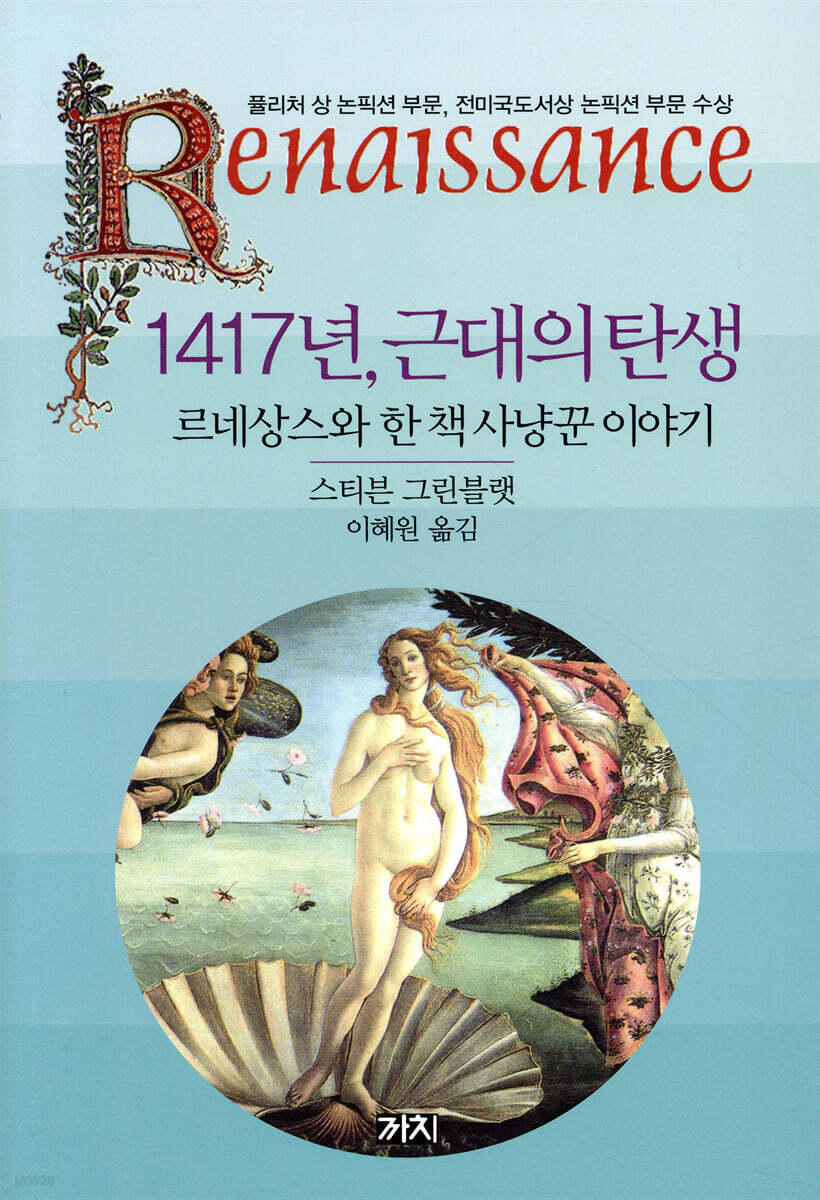
1417, the birth of the modern era
 |
Description
Book Introduction
The Renaissance, depicting its splendid yet decadent debauchery.
In the winter of 1417, a man in his late thirties discovers an ancient manuscript in a dusty library in a monastery in southern Germany.
He was Poggio Bracciolini, a brilliant scribe of the Renaissance, a discoverer of ancient texts, a collector of ancient artifacts, and an outstanding humanist.
At a turning point in history when the papal authority was collapsing, Pozzo went on a book hunt in search of lost ancient texts, and the book he discovered was an ancient manuscript of On the Nature of Things.
Author Greenblatt attempted to elucidate the birth and development of the Renaissance by tracing the events surrounding the discovery of the “book hunter” Pozzo.
And it was a great journey to discover the fingerprints that confirmed the “birth of modernity” in the deep abyss of history.
On the Nature of Things was a long poem containing the most dangerous ideas of its time.
The poem was filled with disturbing ideas: that the universe operates without divine assistance, that religious fears about the afterlife are the enemy of human life, and that pleasure and virtue are not opposites but intertwined.
He also argued that matter is formed as a result of the "deviation" of countless atoms that cannot be divided any further, continually colliding and combining with each other in the infinite space of space.
The discovery of this book marked the end of the “dark” Middle Ages, when human thought and freedom were restricted by Christian doctrine, and the exploitation of the people by the church and feudal rule, and the beginning of the Renaissance, a period of “rebirth.”
In particular, while proving that the Renaissance became the foundation of the modern era, the author does not unilaterally praise the Renaissance, but rather criticizes the decadence and pollution of the time, particularly religion, the ruling class, and society, thereby demonstrating that he is not a simple modernist.
Greenblatt's compelling, panoramic depiction of the Renaissance's splendid yet decadent underbelly is another enticing gift this book offers readers.
In the deep abyss of history, you will be able to witness the “birth of modernity.”
In the winter of 1417, a man in his late thirties discovers an ancient manuscript in a dusty library in a monastery in southern Germany.
He was Poggio Bracciolini, a brilliant scribe of the Renaissance, a discoverer of ancient texts, a collector of ancient artifacts, and an outstanding humanist.
At a turning point in history when the papal authority was collapsing, Pozzo went on a book hunt in search of lost ancient texts, and the book he discovered was an ancient manuscript of On the Nature of Things.
Author Greenblatt attempted to elucidate the birth and development of the Renaissance by tracing the events surrounding the discovery of the “book hunter” Pozzo.
And it was a great journey to discover the fingerprints that confirmed the “birth of modernity” in the deep abyss of history.
On the Nature of Things was a long poem containing the most dangerous ideas of its time.
The poem was filled with disturbing ideas: that the universe operates without divine assistance, that religious fears about the afterlife are the enemy of human life, and that pleasure and virtue are not opposites but intertwined.
He also argued that matter is formed as a result of the "deviation" of countless atoms that cannot be divided any further, continually colliding and combining with each other in the infinite space of space.
The discovery of this book marked the end of the “dark” Middle Ages, when human thought and freedom were restricted by Christian doctrine, and the exploitation of the people by the church and feudal rule, and the beginning of the Renaissance, a period of “rebirth.”
In particular, while proving that the Renaissance became the foundation of the modern era, the author does not unilaterally praise the Renaissance, but rather criticizes the decadence and pollution of the time, particularly religion, the ruling class, and society, thereby demonstrating that he is not a simple modernist.
Greenblatt's compelling, panoramic depiction of the Renaissance's splendid yet decadent underbelly is another enticing gift this book offers readers.
In the deep abyss of history, you will be able to witness the “birth of modernity.”
- You can preview some of the book's contents.
Preview
index
introduction
1 Book Hunter
2 Moment of Discovery
3 In Search of Lucretius
4 hour teeth
5 Birth and Rebirth
6 In the Lie Factory
7 Fox Trap
8 The Way of Things
9 Return
10 Deviations
11 Afterlife
Acknowledgements
main
References
Translator's Note and Author Interview with the Translator
Biographical Index
1 Book Hunter
2 Moment of Discovery
3 In Search of Lucretius
4 hour teeth
5 Birth and Rebirth
6 In the Lie Factory
7 Fox Trap
8 The Way of Things
9 Return
10 Deviations
11 Afterlife
Acknowledgements
main
References
Translator's Note and Author Interview with the Translator
Biographical Index
Publisher's Review
A masterpiece worthy of being a model for humanities books
Winner of the Pulitzer Prize for Nonfiction and the National Book Award for Nonfiction
A story about the great cultural “deviation” called the “Renaissance”
In the winter of 1417, the great humanist Poggio Bracciolini, in his late thirties, discovered an ancient manuscript of On the Nature of Things in the library of a monastery in southern Germany.
On the Nature of Things was a long and beautiful poem containing the most dangerous ideas of its time, such as negative skepticism about the relationship between God and man and Epicurus's "atomism."
This discovery changed the course of world history thereafter.
Greenblatt dynamically illuminates the birth and development of the Renaissance by tracing the events surrounding the discovery of the "book hunter" Pozzo.
It was a great journey to discover the fingerprints that confirmed the “birth of modernity” in the deep abyss of history.
In the winter of 1417, a man in his late thirties discovers an ancient manuscript in a dusty library in a monastery in southern Germany.
Poggio Bracciolini was a brilliant scribe of the Renaissance, a discoverer of ancient texts, a Latin translator of classics, a writer of dialogues and epistles, and a collector of ancient artifacts, all of whom were outstanding humanists.
At that time, Pope John XXIII, whom Pozzo served, was deposed at the Council of Constance and was under arrest.
At a turning point in history when the papal authority was collapsing, Pozzo went on a book hunt in search of lost ancient texts.
The manuscript captured by Pozzo, history's most famous book-hunter, was the philosophical epic "On the Nature of Things" by the ancient Roman poet Lucretius, which had been forgotten for over a thousand years.
On the Nature of Things was a long poem containing the most dangerous ideas of its time.
The poem was filled with disturbing ideas: that the universe operates without divine assistance, that religious fears about the afterlife are the enemy of human life, and that pleasure and virtue are not opposites but intertwined.
And according to the atomism of Epicurus, an ancient Greek philosopher who formed the background of Lucretius's thoughts, countless atoms that can no longer be divided are constantly colliding and combining with each other in the infinite space of space, forming matter as a result of their "deviation."
“Swerve” is the source of free will.
Atomism, which had such a logical background, was a heretical idea that had been suppressed for a thousand years in the Middle Ages, and has now been “resurrected” and liberated from the compulsion of oblivion.
Pozzo's work, which was circulated and disseminated throughout the world by having his work partner, Nicolli, who was 16 years older than him, transcribe 『On the Nature of Things』, changed the course of world history thereafter.
The Catholic Church was able to silence Jan Hus and Giordano Bruno by executing them as heretics, but it was unable to silence the rediscovered De Rerum Natura.
The worldview of that poem first permeated art, inspiring Botticelli and da Vinci.
It was revealed that the manuscript of On the Nature of Things, housed in the Vatican, was handwritten by Machiavelli himself.
Montaigne proved his fascination with this poem by writing his thoughts in the margins of the book.
Moreover, this poem had a great influence on Galileo, Freud, Darwin, and Einstein, and its traces can even be found in Thomas Jefferson's American Declaration of Independence.
According to author Greenblatt, the discovery of this book marked the end of the “dark” Middle Ages, when human thought and freedom were restricted by Christian doctrine, and the people were exploited by the church and feudal rule, and the beginning of the Renaissance, a period of “rebirth.”
Greenblatt traces Pozzo's life as a book hunter who undertook perilous expeditions to foreign lands, as a calligrapher and scribe who created beautiful letters and transcribed them, and as a papal official.
As Greenblatt traces the life of the great humanist Pozzo, he is moved by the friendship Pozzo shared with the talented scribe Niccolò Niccoli, and witnesses the hypocrisy, corruption, and political strife of the Vatican as a vast bureaucracy.
In particular, while proving that the Renaissance became the foundation of the modern era, the author does not unilaterally praise the Renaissance, but rather criticizes the decadence and pollution of the time, particularly religion, the ruling class, and society, thereby demonstrating that he is not a simple modernist.
Greenblatt's compelling, panoramic depiction of the Renaissance's splendid yet decadent underbelly is another enticing gift this book offers readers.
In this book, Greenblatt, a 21st-century authority on Shakespeare studies, dynamically illuminates the birth and development of the Renaissance by delicately tracing the enigmatic encounters between Epicurus in the 4th century BC, Lucretius in the 1st century BC, and Poggio Bracciolini in the 15th century.
It was a great journey to discover the fingerprints that confirmed the “birth of modernity” in the deep abyss of history.
This book, which successfully accomplished meaningful work in history and literature, won the 2012 Pulitzer Prize for Nonfiction and the 2011 National Book Award for Nonfiction.
It also achieved commercial success, being listed as a bestseller in publications such as the New York Times.
Winner of the Pulitzer Prize for Nonfiction and the National Book Award for Nonfiction
A story about the great cultural “deviation” called the “Renaissance”
In the winter of 1417, the great humanist Poggio Bracciolini, in his late thirties, discovered an ancient manuscript of On the Nature of Things in the library of a monastery in southern Germany.
On the Nature of Things was a long and beautiful poem containing the most dangerous ideas of its time, such as negative skepticism about the relationship between God and man and Epicurus's "atomism."
This discovery changed the course of world history thereafter.
Greenblatt dynamically illuminates the birth and development of the Renaissance by tracing the events surrounding the discovery of the "book hunter" Pozzo.
It was a great journey to discover the fingerprints that confirmed the “birth of modernity” in the deep abyss of history.
In the winter of 1417, a man in his late thirties discovers an ancient manuscript in a dusty library in a monastery in southern Germany.
Poggio Bracciolini was a brilliant scribe of the Renaissance, a discoverer of ancient texts, a Latin translator of classics, a writer of dialogues and epistles, and a collector of ancient artifacts, all of whom were outstanding humanists.
At that time, Pope John XXIII, whom Pozzo served, was deposed at the Council of Constance and was under arrest.
At a turning point in history when the papal authority was collapsing, Pozzo went on a book hunt in search of lost ancient texts.
The manuscript captured by Pozzo, history's most famous book-hunter, was the philosophical epic "On the Nature of Things" by the ancient Roman poet Lucretius, which had been forgotten for over a thousand years.
On the Nature of Things was a long poem containing the most dangerous ideas of its time.
The poem was filled with disturbing ideas: that the universe operates without divine assistance, that religious fears about the afterlife are the enemy of human life, and that pleasure and virtue are not opposites but intertwined.
And according to the atomism of Epicurus, an ancient Greek philosopher who formed the background of Lucretius's thoughts, countless atoms that can no longer be divided are constantly colliding and combining with each other in the infinite space of space, forming matter as a result of their "deviation."
“Swerve” is the source of free will.
Atomism, which had such a logical background, was a heretical idea that had been suppressed for a thousand years in the Middle Ages, and has now been “resurrected” and liberated from the compulsion of oblivion.
Pozzo's work, which was circulated and disseminated throughout the world by having his work partner, Nicolli, who was 16 years older than him, transcribe 『On the Nature of Things』, changed the course of world history thereafter.
The Catholic Church was able to silence Jan Hus and Giordano Bruno by executing them as heretics, but it was unable to silence the rediscovered De Rerum Natura.
The worldview of that poem first permeated art, inspiring Botticelli and da Vinci.
It was revealed that the manuscript of On the Nature of Things, housed in the Vatican, was handwritten by Machiavelli himself.
Montaigne proved his fascination with this poem by writing his thoughts in the margins of the book.
Moreover, this poem had a great influence on Galileo, Freud, Darwin, and Einstein, and its traces can even be found in Thomas Jefferson's American Declaration of Independence.
According to author Greenblatt, the discovery of this book marked the end of the “dark” Middle Ages, when human thought and freedom were restricted by Christian doctrine, and the people were exploited by the church and feudal rule, and the beginning of the Renaissance, a period of “rebirth.”
Greenblatt traces Pozzo's life as a book hunter who undertook perilous expeditions to foreign lands, as a calligrapher and scribe who created beautiful letters and transcribed them, and as a papal official.
As Greenblatt traces the life of the great humanist Pozzo, he is moved by the friendship Pozzo shared with the talented scribe Niccolò Niccoli, and witnesses the hypocrisy, corruption, and political strife of the Vatican as a vast bureaucracy.
In particular, while proving that the Renaissance became the foundation of the modern era, the author does not unilaterally praise the Renaissance, but rather criticizes the decadence and pollution of the time, particularly religion, the ruling class, and society, thereby demonstrating that he is not a simple modernist.
Greenblatt's compelling, panoramic depiction of the Renaissance's splendid yet decadent underbelly is another enticing gift this book offers readers.
In this book, Greenblatt, a 21st-century authority on Shakespeare studies, dynamically illuminates the birth and development of the Renaissance by delicately tracing the enigmatic encounters between Epicurus in the 4th century BC, Lucretius in the 1st century BC, and Poggio Bracciolini in the 15th century.
It was a great journey to discover the fingerprints that confirmed the “birth of modernity” in the deep abyss of history.
This book, which successfully accomplished meaningful work in history and literature, won the 2012 Pulitzer Prize for Nonfiction and the 2011 National Book Award for Nonfiction.
It also achieved commercial success, being listed as a bestseller in publications such as the New York Times.
GOODS SPECIFICS
- Date of issue: May 15, 2013
- Page count, weight, size: 400 pages | 732g | 155*225*30mm
- ISBN13: 9788972915416
- ISBN10: 8972915416
You may also like
카테고리
korean


korean

![GQ KOREA Mark (Monthly): December [2025]](http://librairie.coreenne.fr/cdn/shop/files/8ef265dbbfbf186523ed75ba7319009d.jpg?v=1765340328&width=3840)


