

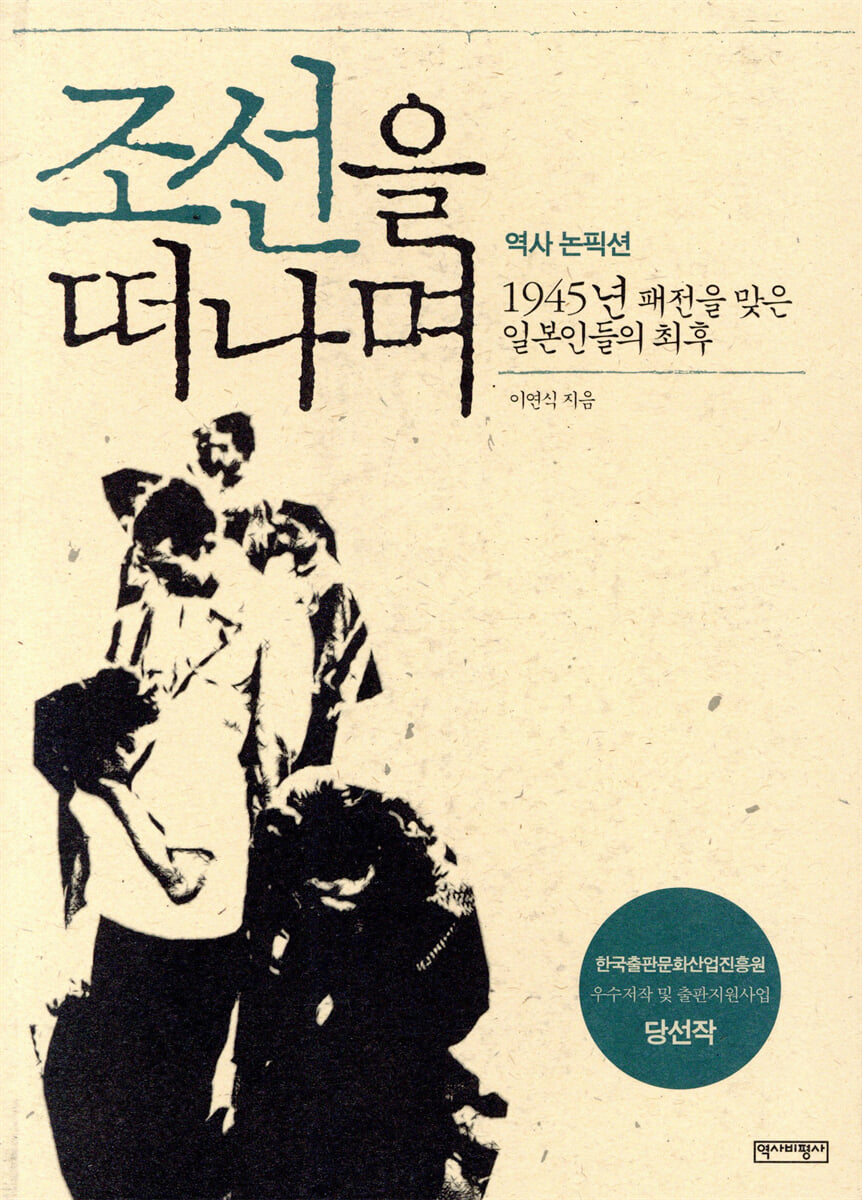
Leaving Joseon
 |
Description
Book Introduction
At that time in 1945,
Tracing the backs of the Japanese who suffered defeat in Joseon!
This is a historical non-fiction work that traces the back of the Japanese who suffered defeat in Korea in 1945.
The story, woven into episodes through the memoirs of Japanese people, vividly depicts how the highest-ranking officials of the Japanese Government-General of Korea, the police who tortured independence activists, wealthy Japanese, Japanese born in Korea, and teachers faced defeat in Korea in 1945, what harm they left behind in Korea, how they returned to Japan, and how they were treated in Japan upon their return.
In the long history of Korea-Japan relations, what kind of group were the Japanese who returned to Japan from colonial Korea? What impact did the traces they left behind on the Korean Peninsula have on both Korea and Japan? These are the questions this book poses.
Tracing the backs of the Japanese who suffered defeat in Joseon!
This is a historical non-fiction work that traces the back of the Japanese who suffered defeat in Korea in 1945.
The story, woven into episodes through the memoirs of Japanese people, vividly depicts how the highest-ranking officials of the Japanese Government-General of Korea, the police who tortured independence activists, wealthy Japanese, Japanese born in Korea, and teachers faced defeat in Korea in 1945, what harm they left behind in Korea, how they returned to Japan, and how they were treated in Japan upon their return.
In the long history of Korea-Japan relations, what kind of group were the Japanese who returned to Japan from colonial Korea? What impact did the traces they left behind on the Korean Peninsula have on both Korea and Japan? These are the questions this book poses.
- You can preview some of the book's contents.
Preview
index
Preface: Variations on "Detention and Escape," "Repatriation and Smuggling"
1.
Unexpected disaster, defeat
The Return of the Governor-General's Wife / The Unfamiliar Reality of Fear / Rushing to the Bank Window / Overflowing Goods on the Streets / A Self-Portrait of a Defeated Nation
2.
The Government-General of Korea, in a desperate situation
The Japanese Government's Incompetence / The Government-General of Korea's Incompetence / The Leadership's Conflict / A Clever Strategy / The Kim Gye-jo Incident and the Japanese Hostess / The Government-General of Korea's Transformation and the Japanese Humanization Society / Retaliation for Original Sin
3.
Japanese people at the crossroads of remaining and returning
Untimely Korean language classes open / The battle between the remaining and returning factions / The fishing industry's leader captured at the port / What to board: a thief ship or a repatriation ship / Koreans calling for the eradication of Japanese slaves / The unbelievable occupation force
4.
The extreme experience of detention, deportation, and escape
Tattooed Roske / Local Procurement of People / The Troublemakers of the Soviet Army and Their Henchmen / Those Taken Away and Those Left Behind / Manchurian Refugees Even the Japanese Feared
5.
I resent the upside-down world
A Reversed Fate / Unfamiliar Group Life / A Life's Divergence That Cuts to the Bone / Those Who Sell Ajinomoto / The Appearance of "Madame Roske" / Kamchatka Fishing and the Labor Aristocracy / "Madame Dabai" Play and the Great Escape
6.
Betrayal of Mother Japan
The sorrow of being betrayed by one's own countrymen / Social stigma, hikiagesha / 200,000 letters sent to the Prime Minister's Office / The strange logic of "war victims" / The gap between experience and memory
7.
Meetings, Partings, and Other Memories
The Full Story of the "Waeno" Uproar / Moribae, the Continuing Lineage of Pro-Japanese Collaborators / Another Vicious Cycle of Retaliation / The Last Appearance of the Japanese / Joseon, a Place of Regret and Longing
In conclusion: Beyond the memories of harm and victimization
Americas
1.
Unexpected disaster, defeat
The Return of the Governor-General's Wife / The Unfamiliar Reality of Fear / Rushing to the Bank Window / Overflowing Goods on the Streets / A Self-Portrait of a Defeated Nation
2.
The Government-General of Korea, in a desperate situation
The Japanese Government's Incompetence / The Government-General of Korea's Incompetence / The Leadership's Conflict / A Clever Strategy / The Kim Gye-jo Incident and the Japanese Hostess / The Government-General of Korea's Transformation and the Japanese Humanization Society / Retaliation for Original Sin
3.
Japanese people at the crossroads of remaining and returning
Untimely Korean language classes open / The battle between the remaining and returning factions / The fishing industry's leader captured at the port / What to board: a thief ship or a repatriation ship / Koreans calling for the eradication of Japanese slaves / The unbelievable occupation force
4.
The extreme experience of detention, deportation, and escape
Tattooed Roske / Local Procurement of People / The Troublemakers of the Soviet Army and Their Henchmen / Those Taken Away and Those Left Behind / Manchurian Refugees Even the Japanese Feared
5.
I resent the upside-down world
A Reversed Fate / Unfamiliar Group Life / A Life's Divergence That Cuts to the Bone / Those Who Sell Ajinomoto / The Appearance of "Madame Roske" / Kamchatka Fishing and the Labor Aristocracy / "Madame Dabai" Play and the Great Escape
6.
Betrayal of Mother Japan
The sorrow of being betrayed by one's own countrymen / Social stigma, hikiagesha / 200,000 letters sent to the Prime Minister's Office / The strange logic of "war victims" / The gap between experience and memory
7.
Meetings, Partings, and Other Memories
The Full Story of the "Waeno" Uproar / Moribae, the Continuing Lineage of Pro-Japanese Collaborators / Another Vicious Cycle of Retaliation / The Last Appearance of the Japanese / Joseon, a Place of Regret and Longing
In conclusion: Beyond the memories of harm and victimization
Americas
Publisher's Review
Tracing the backs of the Japanese who were defeated in Korea in 1945.
A selection of excellent works by the Publication Industry Promotion Agency of Korea, and historical nonfiction published by History Criticism Publishers.
Colonization, political subjugation, economic invasion and exploitation…
These are the key words that characterize the 35 years of Japanese colonial rule that began with the Japan-Korea annexation in 1910.
We know the truth to some extent about the uncomfortable encounter that began with the ruling and ruled relationship between the two peoples of Korea and Japan, and the subsequent colonial period, through many books and documentaries.
Also (quite obviously) I am well aware of the various expressions of liberated Joseon and the efforts of the Joseon people to build a new nation.
However, it is difficult to find a book that focuses on the process and appearance of Japanese people leaving the Korean Peninsula following the liberation of Korea in 1945 (Japan's 'defeat').
What happened to the Japanese who suffered defeat in Korea? Having come to Korea as colonists, did they simply return to their homeland without incident after the war?
This book is a historical non-fiction that traces the aftermath of the Japanese defeat in Korea in 1945.
The story, woven into episodes through the memoirs of Japanese people, vividly depicts how the highest-ranking officials of the Japanese Government-General of Korea, the police who tortured independence activists, wealthy Japanese, Japanese born in Korea, and teachers faced defeat in Korea in 1945, what harm they left behind in Korea, how they returned to Japan, and how they were treated in Japan upon their return.
In the long history of Korea-Japan relations, what kind of group were the Japanese who returned to Japan from colonial Korea? What impact did the traces they left behind on the Korean Peninsula have on both Korea and Japan? These are the questions this book poses.
Korea was liberated in 1945, but
For the Japanese, it was an unprecedented horror and a terrible disaster.
From August 16 to 23, 1945, a total of 913 'unusual incidents' were reported to the central government from all over Korea over a period of about a week.
Looking at the details of the incident, the places where Koreans attacked in groups were mainly police stations, local administrative offices, and shrines.
Additionally, approximately 267 incidents of murder and assault against individuals were reported, with the primary targets being police officers, school teachers, government officials, and their families.
(…) The Government-General, embarrassed by the situation that arose after the defeat, ordered on August 18 to burn the pictures of the Emperor hanging in each institution, and quickly contacted each local shrine to perform a ceremony to enshrine the spirits, burning the ancestral tablets to prevent any disrespect to the spirits.
Not to mention the Emperor's portrait, a symbol of Japanese colonial rule, the shrine, which was a daily space that provided emotional stability to the residents as a warding off all kinds of disasters and was the embodiment of Japanese culture, was destroyed by the Koreans who were so "disrespectful" that they could not bear to watch it with their hands down.
Regardless of the severity or scale of the incident, the Japanese people suffered from collective fear as they experienced this unprecedented situation.
-Pages 25-26 of the text
Immediately after the Emperor's declaration of surrender, collective action by Koreans erupted throughout Korea.
After suffering and groaning under Japanese colonial rule, liberation brought out old emotions that had been sealed away.
The Japanese, who were in a state of collective fear and panic, were busy trying to find their own way to survive.
They rushed to the bank window with their bankbooks and seals, and were busy selling their household goods before returning.
In an emergency situation where it was difficult to see even an inch ahead, the Government-General of Korea was incompetent, and they felt that the government, which had no power whatsoever, could not protect them, so they had no choice but to trust in 'money' more.
At the time, the Japanese government did not want a sudden influx of Japanese from the colonies to the mainland, which would cause social unrest, so they instructed the Governor-General to keep the Japanese in Korea in the country as much as possible.
The Government-General of Korea was in a desperate situation: it had no power to maintain public order in Korea, could not disobey the Japanese government's orders, had to negotiate with the occupying forces to guarantee the safety of Japanese citizens, and could not continue to ignore the Japanese people's requests for return as soon as possible.
Japanese people in the South and North in different situations
Mass repatriation, smuggling, and detention, deportation, and escape
Japanese people who were born and raised in Korea or who had lived there for a long time considered Korea their "homeland," so some did not understand why they had to return to the "unfamiliar" land of Japan due to defeat.
They could not even imagine leaving Joseon.
Because of this, the conflict between the remaining faction and the returning faction became very serious.
However, due to the strong pressure from Koreans to expel them and the repatriation policy of the US military government, even Japanese who wanted to remain in Korea were eventually forced to return to mainland Japan.
Now their concern was how to bring more wealth to Japan.
In December 1945, an incident occurred that shook Busan.
One of the Japanese influential figures who had been called the 'Big Three' or 'Big Four' in Busan for decades was caught by the Coast Guard while trying to smuggle into Japan by hiding stocks, bonds, and insurance policies in a bicycle tube.
-Pages 88-89
The US military government that occupied the area south of the 38th parallel initially failed to properly manage the repatriation administration, and then, while reflecting the increasing demands of Koreans in a limited way, limited the money of the repatriated Japanese to 1,000 yen per person and the cargo to the amount that could be carried in both hands.
Japanese people who wanted to take even a penny more with them used all means possible to board smuggling ships, also known as thief ships, rather than official repatriation ships, and engaged in various lobbying activities with the US military government.
In the process, various evils arose in collusion with Korean brokers.
Meanwhile, Japanese people in North Korea, under Soviet occupation, were not immediately repatriated.
Especially in the case of men directly connected to colonial rule, they were imprisoned, deported, and detained by the occupying forces or the newly established local government.
Moreover, the communal living conditions resulting from various requisitions and the subsequent confiscation of property resulted in a much worse living and return environment than that of Japanese people in South Korea.
As men were taken away or deported to Siberia and other places, the women and elderly left behind had to flee and escape, separated from their families, and thus had to feel the 'absence of the state' and the 'absence of the head of the household' even more keenly.
A returnee unwelcome even in his home country, but finally recognized as a victim of war.
The political rhetoric in "Victims of War"
Author Lee Yeon-sik does not raise his own thoughts or voice in this book.
It describes how the Japanese people in Korea viewed and responded to defeat in 1945, and the expressions and final appearances of the Japanese people before their return to the mainland, through their own words.
It is woven with descriptions that seem to show the scene at the time as it was and a narrative that is like a reportage.
It also meticulously examines the contents of newspaper articles from that time to provide an unfiltered look at the complexities of society.
Rather than the politicians who occupy the top ranks of the colonial apparatus, the film vividly portrays the fear of defeat faced by ordinary Japanese men and women and their struggles to protect their property at all costs.
Moreover, the administrative systems of the US military government and the Soviet military government in the South and North, respectively, prioritizing their own convenience and interests, as well as the image of Korean brokers who colluded with returning Japanese to commit all sorts of corruption, are also vivid.
Because of this, the book's characteristics as a non-fiction work are even more evident.
That doesn't mean the author completely hides his views.
For example, “The strange anxiety and fear that the Japanese experienced after their defeat was the price they paid for the privilege of being able to go about their daily lives without having to pay any attention to Koreans.
“Forgetfulness and ignorance of past history were the causes of anxiety and fear,” or “The last image of the Japanese to the Koreans was filled with killing and destruction, just as it was when they first set foot on this land.” While portraying the appearance of the Japanese during the period of defeat and return through their memoirs, the author does not overdo the analysis and evaluation.
This is because the author wants readers to read about the social conditions of the time and think about and evaluate the complex social conditions and the two faces of the colonists who left Joseon.
Where this author reveals his thoughts most significantly is in the section describing the attitudes of the postwar Japanese government and society in the process of returning to Japan and being transformed into 'war victims'.
After many twists and turns, the overseas returnees were finally recognized as war victims by the Japanese government.
However, this was not a concept of compensation for the objective damage they had actually suffered, but rather had a strong discursive character that incorporated the various 'needs and aspirations' of the post-war Japanese government.
From the Japanese government's perspective, given the financial situation at the time, it was difficult to provide relief through public funds, so they needed a justification to appease these people and elicit help from the general public.
And to quell the demands of the various groups, each claiming different damages and compensation, while at the same time uniting them as citizens of a new nation-state, some common topic was needed.
The concept of 'war victim' emerged against this backdrop and spread throughout society.
This was the essence of the political rhetoric of 'war victims'.
-Page 211
The repatriates who returned to Japan immediately after the war were criticized by their own compatriots as the "vanguard of continental invasion" who exploited the colonists and enjoyed luxury, and were regarded as a "nuisance group" who threatened jobs and wasted food in postwar Japanese society, which was already difficult to live in due to the air raids and defeat.
They were ultimately a group of 'illegitimate children of the Japanese Empire' who were not welcomed even in their home country, let alone in Joseon, the country they had left behind.
However, they continued to petition to secure their rights and were finally recognized as 'war victims' by the government.
The author raises the question calmly.
Before they were Japanese 'overseas returnees', they were 'colonizers' who supported the Japanese Empire.
If we look at them only in the context of their damage, we can overlook the problem of the harm they inflicted as colonizers.
We need to examine what impact the traces they left behind as they left the Korean Peninsula had on both Korea and Japan.
And in order for both Korea and Japan to move beyond the memories of harm and harm, they must seriously consider and examine these issues.
A selection of excellent works by the Publication Industry Promotion Agency of Korea, and historical nonfiction published by History Criticism Publishers.
Colonization, political subjugation, economic invasion and exploitation…
These are the key words that characterize the 35 years of Japanese colonial rule that began with the Japan-Korea annexation in 1910.
We know the truth to some extent about the uncomfortable encounter that began with the ruling and ruled relationship between the two peoples of Korea and Japan, and the subsequent colonial period, through many books and documentaries.
Also (quite obviously) I am well aware of the various expressions of liberated Joseon and the efforts of the Joseon people to build a new nation.
However, it is difficult to find a book that focuses on the process and appearance of Japanese people leaving the Korean Peninsula following the liberation of Korea in 1945 (Japan's 'defeat').
What happened to the Japanese who suffered defeat in Korea? Having come to Korea as colonists, did they simply return to their homeland without incident after the war?
This book is a historical non-fiction that traces the aftermath of the Japanese defeat in Korea in 1945.
The story, woven into episodes through the memoirs of Japanese people, vividly depicts how the highest-ranking officials of the Japanese Government-General of Korea, the police who tortured independence activists, wealthy Japanese, Japanese born in Korea, and teachers faced defeat in Korea in 1945, what harm they left behind in Korea, how they returned to Japan, and how they were treated in Japan upon their return.
In the long history of Korea-Japan relations, what kind of group were the Japanese who returned to Japan from colonial Korea? What impact did the traces they left behind on the Korean Peninsula have on both Korea and Japan? These are the questions this book poses.
Korea was liberated in 1945, but
For the Japanese, it was an unprecedented horror and a terrible disaster.
From August 16 to 23, 1945, a total of 913 'unusual incidents' were reported to the central government from all over Korea over a period of about a week.
Looking at the details of the incident, the places where Koreans attacked in groups were mainly police stations, local administrative offices, and shrines.
Additionally, approximately 267 incidents of murder and assault against individuals were reported, with the primary targets being police officers, school teachers, government officials, and their families.
(…) The Government-General, embarrassed by the situation that arose after the defeat, ordered on August 18 to burn the pictures of the Emperor hanging in each institution, and quickly contacted each local shrine to perform a ceremony to enshrine the spirits, burning the ancestral tablets to prevent any disrespect to the spirits.
Not to mention the Emperor's portrait, a symbol of Japanese colonial rule, the shrine, which was a daily space that provided emotional stability to the residents as a warding off all kinds of disasters and was the embodiment of Japanese culture, was destroyed by the Koreans who were so "disrespectful" that they could not bear to watch it with their hands down.
Regardless of the severity or scale of the incident, the Japanese people suffered from collective fear as they experienced this unprecedented situation.
-Pages 25-26 of the text
Immediately after the Emperor's declaration of surrender, collective action by Koreans erupted throughout Korea.
After suffering and groaning under Japanese colonial rule, liberation brought out old emotions that had been sealed away.
The Japanese, who were in a state of collective fear and panic, were busy trying to find their own way to survive.
They rushed to the bank window with their bankbooks and seals, and were busy selling their household goods before returning.
In an emergency situation where it was difficult to see even an inch ahead, the Government-General of Korea was incompetent, and they felt that the government, which had no power whatsoever, could not protect them, so they had no choice but to trust in 'money' more.
At the time, the Japanese government did not want a sudden influx of Japanese from the colonies to the mainland, which would cause social unrest, so they instructed the Governor-General to keep the Japanese in Korea in the country as much as possible.
The Government-General of Korea was in a desperate situation: it had no power to maintain public order in Korea, could not disobey the Japanese government's orders, had to negotiate with the occupying forces to guarantee the safety of Japanese citizens, and could not continue to ignore the Japanese people's requests for return as soon as possible.
Japanese people in the South and North in different situations
Mass repatriation, smuggling, and detention, deportation, and escape
Japanese people who were born and raised in Korea or who had lived there for a long time considered Korea their "homeland," so some did not understand why they had to return to the "unfamiliar" land of Japan due to defeat.
They could not even imagine leaving Joseon.
Because of this, the conflict between the remaining faction and the returning faction became very serious.
However, due to the strong pressure from Koreans to expel them and the repatriation policy of the US military government, even Japanese who wanted to remain in Korea were eventually forced to return to mainland Japan.
Now their concern was how to bring more wealth to Japan.
In December 1945, an incident occurred that shook Busan.
One of the Japanese influential figures who had been called the 'Big Three' or 'Big Four' in Busan for decades was caught by the Coast Guard while trying to smuggle into Japan by hiding stocks, bonds, and insurance policies in a bicycle tube.
-Pages 88-89
The US military government that occupied the area south of the 38th parallel initially failed to properly manage the repatriation administration, and then, while reflecting the increasing demands of Koreans in a limited way, limited the money of the repatriated Japanese to 1,000 yen per person and the cargo to the amount that could be carried in both hands.
Japanese people who wanted to take even a penny more with them used all means possible to board smuggling ships, also known as thief ships, rather than official repatriation ships, and engaged in various lobbying activities with the US military government.
In the process, various evils arose in collusion with Korean brokers.
Meanwhile, Japanese people in North Korea, under Soviet occupation, were not immediately repatriated.
Especially in the case of men directly connected to colonial rule, they were imprisoned, deported, and detained by the occupying forces or the newly established local government.
Moreover, the communal living conditions resulting from various requisitions and the subsequent confiscation of property resulted in a much worse living and return environment than that of Japanese people in South Korea.
As men were taken away or deported to Siberia and other places, the women and elderly left behind had to flee and escape, separated from their families, and thus had to feel the 'absence of the state' and the 'absence of the head of the household' even more keenly.
A returnee unwelcome even in his home country, but finally recognized as a victim of war.
The political rhetoric in "Victims of War"
Author Lee Yeon-sik does not raise his own thoughts or voice in this book.
It describes how the Japanese people in Korea viewed and responded to defeat in 1945, and the expressions and final appearances of the Japanese people before their return to the mainland, through their own words.
It is woven with descriptions that seem to show the scene at the time as it was and a narrative that is like a reportage.
It also meticulously examines the contents of newspaper articles from that time to provide an unfiltered look at the complexities of society.
Rather than the politicians who occupy the top ranks of the colonial apparatus, the film vividly portrays the fear of defeat faced by ordinary Japanese men and women and their struggles to protect their property at all costs.
Moreover, the administrative systems of the US military government and the Soviet military government in the South and North, respectively, prioritizing their own convenience and interests, as well as the image of Korean brokers who colluded with returning Japanese to commit all sorts of corruption, are also vivid.
Because of this, the book's characteristics as a non-fiction work are even more evident.
That doesn't mean the author completely hides his views.
For example, “The strange anxiety and fear that the Japanese experienced after their defeat was the price they paid for the privilege of being able to go about their daily lives without having to pay any attention to Koreans.
“Forgetfulness and ignorance of past history were the causes of anxiety and fear,” or “The last image of the Japanese to the Koreans was filled with killing and destruction, just as it was when they first set foot on this land.” While portraying the appearance of the Japanese during the period of defeat and return through their memoirs, the author does not overdo the analysis and evaluation.
This is because the author wants readers to read about the social conditions of the time and think about and evaluate the complex social conditions and the two faces of the colonists who left Joseon.
Where this author reveals his thoughts most significantly is in the section describing the attitudes of the postwar Japanese government and society in the process of returning to Japan and being transformed into 'war victims'.
After many twists and turns, the overseas returnees were finally recognized as war victims by the Japanese government.
However, this was not a concept of compensation for the objective damage they had actually suffered, but rather had a strong discursive character that incorporated the various 'needs and aspirations' of the post-war Japanese government.
From the Japanese government's perspective, given the financial situation at the time, it was difficult to provide relief through public funds, so they needed a justification to appease these people and elicit help from the general public.
And to quell the demands of the various groups, each claiming different damages and compensation, while at the same time uniting them as citizens of a new nation-state, some common topic was needed.
The concept of 'war victim' emerged against this backdrop and spread throughout society.
This was the essence of the political rhetoric of 'war victims'.
-Page 211
The repatriates who returned to Japan immediately after the war were criticized by their own compatriots as the "vanguard of continental invasion" who exploited the colonists and enjoyed luxury, and were regarded as a "nuisance group" who threatened jobs and wasted food in postwar Japanese society, which was already difficult to live in due to the air raids and defeat.
They were ultimately a group of 'illegitimate children of the Japanese Empire' who were not welcomed even in their home country, let alone in Joseon, the country they had left behind.
However, they continued to petition to secure their rights and were finally recognized as 'war victims' by the government.
The author raises the question calmly.
Before they were Japanese 'overseas returnees', they were 'colonizers' who supported the Japanese Empire.
If we look at them only in the context of their damage, we can overlook the problem of the harm they inflicted as colonizers.
We need to examine what impact the traces they left behind as they left the Korean Peninsula had on both Korea and Japan.
And in order for both Korea and Japan to move beyond the memories of harm and harm, they must seriously consider and examine these issues.
GOODS SPECIFICS
- Publication date: November 28, 2012
- Page count, weight, size: 296 pages | 418g | 152*210*20mm
- ISBN13: 9788976962836
- ISBN10: 8976962834
You may also like
카테고리
korean


korean

![GQ KOREA Mark (Monthly): December [2025]](http://librairie.coreenne.fr/cdn/shop/files/8ef265dbbfbf186523ed75ba7319009d.jpg?v=1765340328&width=3840)


