

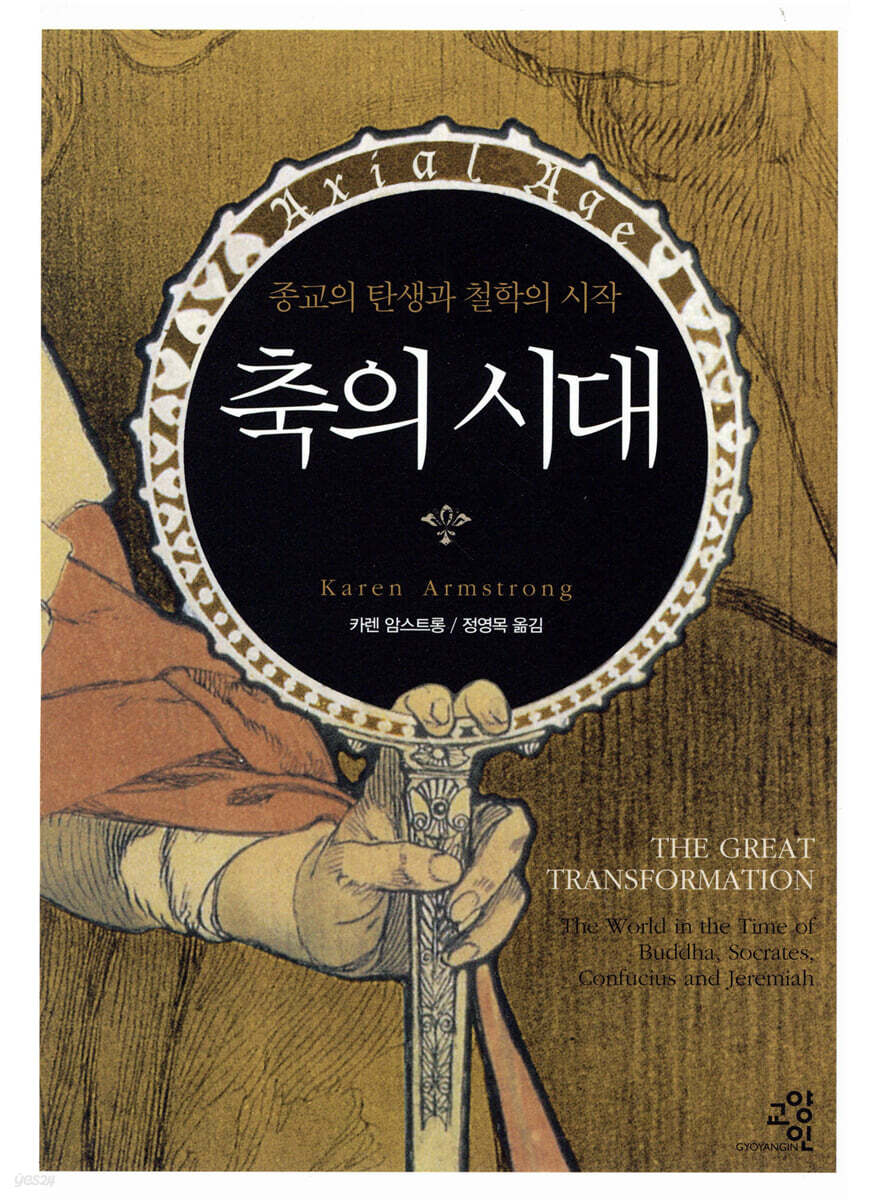
Axial Age
 |
Description
Book Introduction
The Axial Age, when human creativity exploded at its most fervent.
A feast of humanistic insights into a defining moment in the evolution of civilization.
The Axial Age is a historical book that covers the most wondrous period in human history, from approximately 900 BC to 200 BC, when the world's major religions and philosophies were born.
During this period, Confucius, Mozi, and Laozi were active in China; the Upanishads, Jainism, and Siddhartha Gautama appeared in India; Elijah, Jeremiah, and Isaiah appeared in Israel; and Sophocles, Socrates, and Plato were born in Greece.
The author of this book believes that this period is a pivotal point in the spiritual development of humanity.
In this book, the author explores how the four nations of the "Axial Age" (India, Israel, China, and Greece) underwent remarkable revolutions in thought at similar times despite having no interaction with one another.
In particular, it presents the spiritual transformations of the four peoples side by side and traverses them, creating an exciting narrative of each civilization passing through its 'axial age'.
This book reexamines this remarkable cultural parallel, a riddle of human history, as it traverses the belt of civilization during the Axial Age.
Why the Axial Age
A look at the historical record of the "Axial Age" discussed in this book reveals that it was a time of the most productive intellectual, psychological, philosophical, and religious changes to date.
Because we have never yet surpassed the insights of the Axial Age, we have always looked back to it in moments of spiritual and social crisis to find our way.
In a present rife with violence, hatred, and intolerance, the fundamental shift in human perception and enlightenment achieved during the "Axial Age" will allow us to overcome the challenges of our time and find a vision that illuminates the future.
A feast of humanistic insights into a defining moment in the evolution of civilization.
The Axial Age is a historical book that covers the most wondrous period in human history, from approximately 900 BC to 200 BC, when the world's major religions and philosophies were born.
During this period, Confucius, Mozi, and Laozi were active in China; the Upanishads, Jainism, and Siddhartha Gautama appeared in India; Elijah, Jeremiah, and Isaiah appeared in Israel; and Sophocles, Socrates, and Plato were born in Greece.
The author of this book believes that this period is a pivotal point in the spiritual development of humanity.
In this book, the author explores how the four nations of the "Axial Age" (India, Israel, China, and Greece) underwent remarkable revolutions in thought at similar times despite having no interaction with one another.
In particular, it presents the spiritual transformations of the four peoples side by side and traverses them, creating an exciting narrative of each civilization passing through its 'axial age'.
This book reexamines this remarkable cultural parallel, a riddle of human history, as it traverses the belt of civilization during the Axial Age.
Why the Axial Age
A look at the historical record of the "Axial Age" discussed in this book reveals that it was a time of the most productive intellectual, psychological, philosophical, and religious changes to date.
Because we have never yet surpassed the insights of the Axial Age, we have always looked back to it in moments of spiritual and social crisis to find our way.
In a present rife with violence, hatred, and intolerance, the fundamental shift in human perception and enlightenment achieved during the "Axial Age" will allow us to overcome the challenges of our time and find a vision that illuminates the future.
- You can preview some of the book's contents.
Preview
index
Preface - We have never gone beyond the insights of the Axial Age.
Chapter 1: The Axial Age Civilization Belt (c. 1600–900 BC)
Zoroaster, the battle between good and evil
Aryan conquerors who settled in India
Yao, Shun, and Yu: The Age of Righteous Rulers
Yahweh, the holy war god
Chapter 2: The Age of Anxiety and Fear (c. 900–800 BCE)
Athens, which endured 400 years of darkness
Elijah, the first monotheist
Life on earth that follows the way of heaven
Atman, the true self within me
Chapter 3: The Discovery of the Self (c. 800–700 BC)
Isaiah, the angry representative of Yahweh
Odysseus and Achilles: The Heroes' Egocentrism
The Spring and Autumn Period: The Emergence of a New Sensibility
The Sage Who Went to the Forest, Pioneers of Spiritual Quest
Chapter 4: The Long Journey to Knowledge (c. 700–600 BCE)
Conquering the Human Inner Self, The Upanishads
Logos Ends the Greek Heroic Age
A model for life in chaotic times: the gentleman
The Birth of Judaism, the "Religion of the Book"
Chapter 5: The Age of Trouble (c. 600–530 BC)
The trauma of the exiled
Solon of Athens, Inventing Politics
Sankhya, humanity's first atheist
The shaky etiquette and the collapsing Tao
Chapter 6: The Discovery of Empathy (c. 530–450 BC)
Confucius sets out in search of a land of benevolence.
Monotheism born on the path of suffering
The power of reason that opened up Greek democracy
Jainism, the extreme of nonviolence and non-killing
Chapter 7: The Revolution in Thought (c. 450–398 BC)
Ezra's Closed Road, Jonah's Open Road
A philosophy brought to earth, a tragedy that purifies life
Socrates, the teacher of knowledge who taught the wisdom of ignorance
Mohism, the thought of radical empathy
Siddhartha Gautama, Discoverer of Anatta, Revolutionary of the Mind
Chapter 8: Adventures in Philosophy (c. 400–300 BC)
Hyeja's paradox, Zhuangzi's inaction, Mencius's benevolence
The Mahabharata, an epic poem of fearful warriors
Plato, the seeker of ideas from the cave
Aristotle, the architect of logos
Chapter 9: The Age of Empires (c. 300–220 BC)
The moral monarchies of Han Feizi, Xun Zi, and Lao Zi
Hellenism, the first clash of civilizations that created civilization
Bhagavad Gita, the last great song of the Axial Age
Chapter 10: The Return of the Axial Age (2nd century BC - )
Unification of the world and integration of ideas
The new Buddhist hero, Bodhisattva
The Torah principle: "Love your neighbor as yourself."
In these perilous times, we need a new vision.
Chapter 1: The Axial Age Civilization Belt (c. 1600–900 BC)
Zoroaster, the battle between good and evil
Aryan conquerors who settled in India
Yao, Shun, and Yu: The Age of Righteous Rulers
Yahweh, the holy war god
Chapter 2: The Age of Anxiety and Fear (c. 900–800 BCE)
Athens, which endured 400 years of darkness
Elijah, the first monotheist
Life on earth that follows the way of heaven
Atman, the true self within me
Chapter 3: The Discovery of the Self (c. 800–700 BC)
Isaiah, the angry representative of Yahweh
Odysseus and Achilles: The Heroes' Egocentrism
The Spring and Autumn Period: The Emergence of a New Sensibility
The Sage Who Went to the Forest, Pioneers of Spiritual Quest
Chapter 4: The Long Journey to Knowledge (c. 700–600 BCE)
Conquering the Human Inner Self, The Upanishads
Logos Ends the Greek Heroic Age
A model for life in chaotic times: the gentleman
The Birth of Judaism, the "Religion of the Book"
Chapter 5: The Age of Trouble (c. 600–530 BC)
The trauma of the exiled
Solon of Athens, Inventing Politics
Sankhya, humanity's first atheist
The shaky etiquette and the collapsing Tao
Chapter 6: The Discovery of Empathy (c. 530–450 BC)
Confucius sets out in search of a land of benevolence.
Monotheism born on the path of suffering
The power of reason that opened up Greek democracy
Jainism, the extreme of nonviolence and non-killing
Chapter 7: The Revolution in Thought (c. 450–398 BC)
Ezra's Closed Road, Jonah's Open Road
A philosophy brought to earth, a tragedy that purifies life
Socrates, the teacher of knowledge who taught the wisdom of ignorance
Mohism, the thought of radical empathy
Siddhartha Gautama, Discoverer of Anatta, Revolutionary of the Mind
Chapter 8: Adventures in Philosophy (c. 400–300 BC)
Hyeja's paradox, Zhuangzi's inaction, Mencius's benevolence
The Mahabharata, an epic poem of fearful warriors
Plato, the seeker of ideas from the cave
Aristotle, the architect of logos
Chapter 9: The Age of Empires (c. 300–220 BC)
The moral monarchies of Han Feizi, Xun Zi, and Lao Zi
Hellenism, the first clash of civilizations that created civilization
Bhagavad Gita, the last great song of the Axial Age
Chapter 10: The Return of the Axial Age (2nd century BC - )
Unification of the world and integration of ideas
The new Buddhist hero, Bodhisattva
The Torah principle: "Love your neighbor as yourself."
In these perilous times, we need a new vision.
Publisher's Review
“We have never gone beyond the insights of the Axial Age.”
The Axial Age was a time when humans looked up to the sky and worshipped the power of nature.
Turning your gaze inward, you begin to discover yourself and explore your inner God.
It was the first Copernican shift in human intellectual civilization.
The first Copernican shift in human intellectual civilization
A wondrous era when human creativity exploded at its hottest.
Humanistic Insights into the Crucial Moment of Civilization's Leap Forward
The Axial Age is a history book that covers the most wondrous period in human history, from 900 BC to 200 BC, when the world's major religions and philosophies were born.
The Axial Age was the first Copernican shift in human spiritual civilization, when humans, who had looked up to the heavens and worshipped the forces of nature, turned their gaze inward to discover themselves and begin to explore the god within.
The era of the greatest geniuses of thought in history!
During this period, Confucius, Mozi, and Laozi were active in China; the Upanishads, Jainism, and Siddhartha Gautama appeared in India; Elijah, Jeremiah, and Isaiah appeared in Israel; and Sophocles, Socrates, and Plato were born in Greece.
Their appearance was the second most decisive event for mankind after the discovery of the art of controlling fire.
How could such a remarkable revolution in thought take place in four regions with no interaction at such a similar time? Why did they reach the same conclusions about the universe, humanity, and life?
World-renowned religious scholar Karen Armstrong's book, The Axial Age, sheds new light on this remarkable cultural parallel, a riddle of human history, by traversing the Axial Age civilization belt from China to India, the Near East, and Greece.
We encounter a humanistic exploration of the Axial Age, a time when the fundamental question of "What is man?" arose, the struggle of reason against mythical cognition took its first steps, and human ethical awakening and philosophical reflection exploded, marking a great turning point in the history of the human mind.
The Axial Age, faced with unprecedented violence, fear, and the emptiness of life, speaks to us.
The Axial Age combines Karen Armstrong's knowledge of comparative religion with her spiritual insight.
Armstrong reimagined the "Axial Age," a concept of civilizational history created by German philosopher Karl Jaspers, not as a vague idea stuck in papyrus or parchment, but as a story of living people who walked through an age of suffering and anxiety.
In the Axial Age, people discovered the spirit of empathy and compassion, feeling the pain of others and mourning the misery of humanity.
The answers discovered by history's greatest intellectual geniuses remain fundamental to humanity's philosophical and religious reflections, even after two thousand years.
Today, when the scientism and progressivism that gave birth to the modern world are the subject of intense reflection and questioning, Armstrong finds a vision that will transcend the challenges of our time and illuminate the future in the people of the "Axial Age," who faced the same violence, fear, and emptiness of life as we do.
“We have never gone beyond the insights of the Axial Age.”
The Axial Age, the starting point of human spiritual civilization
The 'Axial Age' is a concept of civilizational history proposed by German philosopher Karl Jaspers in his book 'The Origin and Goal of History' (1949).
Jaspers established an era that all humanity, regardless of East or West, could recognize as the origin of the spirit, an era that would become the common axis of humanity, and named that era the 'Axial Age'.
In The Axial Age, Karen Armstrong defines the "Axial Age" as roughly the period from 900 BC to 200 BC.
During this period, great philosophical and religious traditions were born that would later nourish the human spirit.
These include Confucianism and Taoism in China, Hinduism and Buddhism in India, monotheism in Israel, and philosophical rationalism in Greece.
This period was also the hottest 'age of creation' in history, with the emergence of geniuses of thought such as Buddha, Socrates, Confucius, Jeremiah, Mencius, Euripides, and Plato.
The Axial Age, born of political turmoil and violence
Not all Axial Age peoples evolved uniformly.
Indians have always been at the forefront of progress during the Axial Age.
Israel experienced a brief but intense period of extraordinary creativity in the 6th century BC, brought about by the exiles to Babylonia.
The Axial Age insights achieved by the Israelites were reborn in Rabbinic Judaism, Christianity, and Islam.
In China, Confucius first developed the spirit of the Axial Age in its entirety in the late 6th century BC, and it was further developed in various forms by the Hundred Schools of Thought.
While these three regions moved from the beginning in the direction of inner exploration and the pursuit of spirituality, Greece moved in the direction of logos and rationalism.
However, there was a common historical background to the development of the 'Axial Age' in these four regions.
Although the times were slightly different, most of them had to go through difficult times such as rapid urbanization, socioeconomic changes due to population growth, and continuous war.
Traditional customs and sacrifices to the gods were not very effective in dealing with the violence and disorder that arose when many people gathered and lived together in cities.
Now humans have moved away from the world of myths and are beginning to focus on themselves.
Questions of human psychology, individual self, morality and ethics were raised.
The 'Axial Age' was born amidst these enormous changes.
The spiritual revolution of the Axial Age took place against a backdrop of chaos, migration, and conquest.
It often happened between the fall of one empire and the rise of another.
In China, the Axial Age finally began with the collapse of the Zhou Dynasty and ended with the unification of the Warring States period by the Qin Dynasty.
The Axial Age in India began after the dissolution of the Harappan civilization (Indus civilization) and ended with the Mauryan Empire.
The changes in Greece took place between the Mycenaean Kingdom and the Macedonian Empire.
The sages of the Axial Age lived in a wandering society, away from their anchorages.
… … Even the Jews, who had suffered terribly because of the imperial adventures in the Middle East, were thrust into the Axial Age, forced by the trauma of the collapse of their homeland and subsequent exile to break with the past and start anew, with the terrible freedom they had gained.
- Page 623, Chapter 10: The Return of the Axial Age
In this book, the author traces the history of the four nations of the 'Axial Age': India, Israel, China, and Greece.
In particular, by arranging the spiritual transformations of the four peoples side by side by time period, it shows the process of each people passing through the 'Axial Age' at their own pace, making it even more exciting.
For example, in India around the 8th century BC, both priests and warriors were slowly moving towards the axial ideal of 'ahimsa' (non-violence).
But at the same time, the Greeks celebrated the heroic ethos of the self-centered warrior.
Other axial age peoples practiced ahimsa and 'kenosis' ('self-emptying').
The pursuit of (egocentrism) was motivated by an aversion to violence, but the Greeks, at around the same time, emphasized the effort to sacrifice selfishness and dedicate oneself to others for the sake of a strong military.
In this way, the author compares and sometimes foreshadows events taking place in the Axial Age civilization belt, making the reader eagerly move on to the next chapter, filled with anticipation and curiosity, as if reading a well-written mystery novel.
Why the 'Axial Age'?
But why is this the "Axial Age"? Could there be any other reason to examine this past era than to satisfy historical curiosity? Armstrong believes that in the fundamental shift in human perception and enlightenment achieved during the "Axial Age," we can find a breakthrough to overcome the crises of our time, marked by violence, hatred, and intolerance.
In the 20th century, we witnessed an eruption of violence on an unprecedented scale.
Unfortunately, the ability of humans to harm and injure one another has evolved alongside the extraordinary economic and scientific advances of human civilization.
The author asserts that without a spiritual revolution, this planet cannot be saved.
As we seek to escape this predicament, I believe we can draw inspiration from what the German philosopher Karl Jaspers called the "Axial Age."
… … How could the sages of the Axial Age, who lived in a completely different environment from our own, speak to our current situation? Why should we turn to Confucius or Buddha for help? Of course, studying this distant era may be merely a step in the archaeology of the mind.
Because what we need is to create innovative beliefs that reflect the realities of this world today.
But in reality, we have never gone beyond the insights of the Axial Age.
In times of mental and social crisis, people have always looked back to the Axial Age to find their way.
- Pages 5-7, from the “Preface”
Turn your eyes from the sky to look into the human mind
- Discovery of the self and internalization of religion
Karen Armstrong notes that during the Axial Age, four regions that had previously had no interaction with each other experienced a nearly identical mental leap.
Among them, the greatest legacy that the 'Axial Age' left to humanity was the discovery of the human mind.
At this time, humans first turned their eyes from heaven to look within themselves.
And I realized that the universe, the immortal truth, was not in that distant sky, but right within me.
Now, the path to salvation and liberation from a life of suffering could be found not in an external god or transcendent being, but within oneself.
For the first time in human history, a 'great shift' in Copernican thinking has occurred.
Rather than worshipping external gods such as the sky, natural objects, and ancestors according to established doctrines and rituals, people of the Axial Age sought fundamental changes in the 'inner' side of humanity.
They believed that transcendence could be experienced within oneself not through animal sacrifice but through special mental training methods such as yoga or meditation.
The exploration of the human mind first began in India around the 9th century BC, and was explored most deeply and far by Indian sages.
The Axial Age began in India.
In the modern world, rituals are often seen as encouraging slavish compliance.
But the Brahmins used their learning to create a completely new sense of self, an independent and autonomous self, free from external rituals and gods.
Priestly reformers looked inward by meditating on the inner dynamics of the ritual.
Now they began to explore the inner world with great enthusiasm, like Aryan warriors delving into the unknown jungles of India.
In the Axial Age, accumulating knowledge is also emphasized as important.
The experts in the field of offerings urged everyone to think deeply about their offerings and understand the meaning of what they were doing.
A new self-consciousness was born.
From then on, Indian spiritual quests focused not on external gods, but on the eternal self.
- Page 150, Chapter 2: The Age of Anxiety and Fear
In China during the Spring and Autumn Period and the Warring States Period in the 5th century BC, there were people who argued that if a ruler could find the center within himself, he could set the world right.
It was said that one can find peace and stability of mind through meditation without withdrawing from reality, and that only when one discovers the depths of one's inner self can one truly become human.
The author of this article (『Simsul心術』) argued that benevolence is not a distortion of human nature, but its completion.
In fact, the word 'in' itself is synonymous with humanity.
If a monarch truly wants to have a 'human heart', he must discover the depths of his own being.
Instead of running away to the forest to find peace and tranquility, we should cultivate inner calm through meditation.
An enlightened monarch will control his passions, quiet his desires, empty his mind of distracting thoughts, and discover his true and authentic self.
Then, you will clearly organize your mental strength, your physical health will improve, and you will realize that you have 'naturally' become a person of benevolence without having to make any more effort.
… … In ancient times, kings established the Tao by determining the exact direction of the body.
Now, according to "Simsul," the monarch could set the world right by discovering the true center within himself.
- Pages 497 and 498, Chapter 8: The Adventures of Philosophy
“Face the unavoidable truth of life: suffering!”
One of the most important insights from the sages of the Axial Age is that “we must face the unavoidable truth of life: suffering.”
The religious traditions created in the four regions during the Axial Age were all rooted in fear and suffering.
They all argue that it is essential not to deny these hardships.
Fully acknowledging suffering was a prerequisite for enlightenment.
Jeremiah hated being a prophet.
But against his will, he was forced to go around shouting “Doom and destruction!” all day long.
When I tried to close my mouth, my heart and bones felt like they were on fire, so I had no choice but to prophesy again.
Jeremiah, like Amos and Hosea, felt that God had taken control of him.
The pain of twisting one's own limbs was Yahweh's pain.
God too felt humiliated, exiled, and abandoned.
Instead of denying his suffering, Jeremiah appeared before the people as a man of sorrow.
He opened his heart to the fears, anger, and sorrows of his time, allowing them to invade every corner of his being.
I couldn't deny it.
Because it only hinders enlightenment.
- Pages 289-290, Chapter 5: The Age of Suffering
Sankhya made two important contributions to Indian spirituality.
The first was the recognition that all life is 'dukkha'.
This word is often translated as 'suffering', but has a broader meaning of 'dissatisfied, distorted'.
… … Nothing lasts long.
Our chaotic inner world can change from one state to another in an instant.
Friends die.
People get sick, grow old, and lose their beauty and vitality.
To deny this universal duka (as many do) is a delusion.
Because Duka is the law of life.
However, Sankhya argues that this imperfect nature is also our friend.
The more I suffer and become one with this fleeting world, the more I long for the absolute and unconditional reality called Purusha.
- Page 332, Chapter 5, The Age of Suffering
Armstrong says that only when we acknowledge our own suffering can we truly "empathize" with the suffering of others, and from that point on, can we begin to take action to bring about change.
In the 5th century BC, the Greeks were able to develop the ability to "feel with others" through tragedy.
This point is particularly evident in Aeschylus's The Persians, which appeared at the Dionysian festival in 472 BC.
The Athenians who saw this work wept as they felt the suffering of the Persians who had ravaged Athens just a few years earlier.
Just a few years before, the Persians had destroyed their cities and desecrated their sanctuaries, and now they could weep for the Persian dead.
Xerxes, his wife Atossa, and the ghost of Darius all speak movingly of the heart-rending grief felt when blood relatives are lost, the veneer of security is ripped away, and the horrors of life are revealed.
There was no attitude of being haughty or self-righteous.
There was no atmosphere of resentment.
Aeschylus portrayed the Persians not as enemies but as mourners.
He also praised the courage of the Persians.
… … The Persian was a brilliant example of empathy extended to a past enemy at a time when memories of life-threatening battles were still fresh.
- Pages 387-388, Chapter 6: The Discovery of Empathy
Kenosis, or self-abandonment
If life is inherently suffering, where does that suffering come from? The sages and philosophers of the Axial Age realized that the root cause of both individual suffering and social conflict stems from "egocentrism."
The desire to protect oneself, the selfishness that prioritizes one's own instincts and desires, is what brings about greed, conflict, and hatred among people.
Finding a way to abandon the 'self' was a common goal of the sages of the Axial Age.
In ancient China, Emperor Yao and Emperor Shun, who brought about a period of peace, were revered as wise men who practiced 'self-renunciation.'
Even in the early stages, some of the ritual experts of the state of No understood the importance of 'self-renunciation'.
They worshipped the ancient sage kings Yao and Shun, and may have written the "Yao Chronicles" and "Shun Chronicles," which are among the earliest chronicles in the Book of Documents.
… …Yo and Sun became adults.
They were good and compassionate people who established a golden age of peace.
Their legends in the Book of Documents are clearly an implicit critique of the reality in which dynasties are passed down through generations and rule is based on force and coercion.
Yao and Shun were not obsessed with their own status and dignity, but put the people's interests ahead of their own instinctive preferences.
They were archetypal examples of the temperance, humility, self-control, and reverence that the example sought to cultivate.
As Chinese political life became increasingly selfish and ruthless, the legend of Yao and Shun continued to be a source of inspiration.
The sages of the Axial Age claimed that all humans have the potential to become such great people.
- Pages 206 and 208, Chapter 3: Discovery of the Self
In Israel, the prophets experienced the spirituality of 'self-emptying' through the experience of being completely overwhelmed by God.
At the same time, they took on the role of hollowing out the arrogant egos of the Israelites.
Amos dealt a tremendous blow to Israel's self-esteem.
He wanted to poke a hole in the nation's ego.
This is what lies at the heart of the spirituality of 'self-renunciation' in Israel - the Axial Age and beyond.
- is one of the first expressions for .
Instead of using religion to bolster their self-esteem, the Israelites were to transcend personal interests and prioritize justice and fairness.
The prophet was a walking example of what the Greeks called kenosis, or 'emptiness.'
Amos felt that God had taken over his subjectivity.
He spoke not his own words, but the words of Yahweh.
The prophet, in the process of passionately empathizing with God, abandoned himself.
God viewed the injustices committed by Israel as a personal insult.
This was a pivotal moment.
The Axial Age religion is based on the empathy people feel for others.
Amos did not experience anger himself, but felt Yahweh's anger.
- Page 160, Chapter 3: Discovery of the Self
Finally finding empathy and compassion
For the sages and philosophers of the 'Axial Age', the most important thing was not what to believe, but how to act.
The wise men of the Axial Age all called for the Golden Rule, compromise, empathy, and a compassionate life.
They stressed that people should abandon egocentrism, greed, violence and rudeness.
Killing each other is not the only thing wrong.
You must not use hostile language or act in an impatient manner.
Furthermore, almost all the wise men of the Axial Age realized that mercy could not be limited to one's own people.
We must somehow expand our interest to the whole world.
Each tradition has its own way of formulating the Golden Rule – “Do not do to others what you would not want done to you.”
Confucius called it 'shu' (恕, comparing oneself to oneself), Mozi expressed it as 'jian-ai' (兼愛, 'concern for all'), and Buddha said, "He who loves himself should not harm others."
Rabbi Hillel said, “Do not do to others what is abominable to yourself.
“That is all there is to the Torah, the rest is just commentary,” he said.
Respect for the sacred rights of all beings in the world is the basis of mercy.
We must constantly remind ourselves that the sages of the Axial Age developed an ethics of mercy in horrific and dire circumstances.
They did not meditate in an ivory tower, but lived in a horrific society torn apart by war, a society where old values were fading away.
They, like us, were conscious of emptiness and abyss.
These wise men were not utopian dreamers, but practical people.
Many were engrossed in politics and government.
They were convinced that empathy wasn't just a nice-sounding thing to say; it actually worked.
Compassion and concern for all were the best policies.
We must take their insights seriously.
Because they were experts.
- Page 670, Chapter 10: The Return of the Axial Age
The age of the greatest sages and philosophical geniuses in history!
The Axial Age brought together some of the most extraordinary figures in human history.
In China, Confucius and Mencius appeared, and all schools of Chinese philosophy, including Mohism, Taoism, and Legalism, were born.
In India, Siddhartha Gautama and Mahavira of Jainism were born, and in Iran, Zoroaster appeared a little earlier and heralded the 'Axial Age'.
In the Palestinian region, the prophets of Israel, such as Amos, Ezekiel, Isaiah, and Jeremiah, appeared.
In Greece, Homer appeared, and philosophers such as Parmenides, Socrates, and Aristotle, and tragedians such as Sophocles and Euripides were active.
The author resurrects the lives and thoughts of the sages and philosophers who shaped this remarkable era not as flawless, noble "great men," but as stories of people who, just like us, felt joy, sorrow, and anger and pondered the question of "humanity."
Zoroaster, the cosmic struggle between good and evil
From around 1500 BC, the slow and peaceful life of the Aryans living in the southern Russian steppes changed violently.
With the discovery of bronze weapons and new methods of transportation using oxen and horses, the Aryans became warriors.
They could now travel long distances at high speeds.
Using superior weapons, they raided neighboring settlements and stole livestock and crops.
I had to learn military skills, even if only for defense.
The age of heroes has begun.
Power is justice.
At this time, a young priest, deeply troubled by the violence sweeping the grasslands, had a new realization.
His name was Zoroaster.
Zoroaster was shocked by the suffering and despair that had befallen his people, and he was consumed by conflict and torn apart by despair.
In the old peaceful world, life seemed to follow a cycle.
The seasons changed, day gave way to night, and harvest gave way to sowing.
But Zoroaster could no longer believe in this rhythm of nature.
The world was rushing towards upheaval.
Zoroaster and his followers lived in a 'time of liminal' when cosmic conflict was about to erupt, but they would soon witness the final triumph of good and the annihilation of the forces of darkness.
After the terrible battle, Ahura Mazda and the immortals will descend to the world of men and women to offer sacrifices.
Then the great judgment takes place.
The wicked will be swept from the earth, and a burning river will flow into hell, burning the 'hostile souls' to ashes.
Then the universe will be restored to its original perfect state.
… … We are familiar with these apocalyptic visions.
But in the ancient world before Zoroaster, there was no such prospect.
This outlook stemmed from Zoroaster's anger and yearning for justice as he watched his people suffer.
Zoroaster hoped that the wicked would be punished for the suffering they inflicted on good and innocent people.
- Page 35, Chapter 1: Axial Age Civilization Belt
Centuries later, when the Axial Age began, philosophers, prophets, and mystics all sought to counter the brutality and aggression of their time by promoting a spirituality based on nonviolence.
But the wounded Zoroaster's outlook was one of vengeance, and it contained images of arson, tyranny, and annihilation.
A look at Zoroaster's life reveals that political upheaval, atrocities, and suffering do not always produce Axial Age-style faith.
A militant belief may emerge that polarizes complex reality into overly simplistic categories of good and evil.
But Zoroaster looked forward to the Axial Age with a fervent ethical outlook.
He tried to inject morality into the new warrior's ethos.
A true hero does not oppress his fellow countrymen, but stands up to violence.
The holy warrior is dedicated to peace.
Ironically, the people who created the first religion of the 'Axial Age' were the very Indian Aryan cattle thieves whom Zoroaster had condemned.
The Sage of the Upanishads Conquer the Human Inner Self
India's ancient Vedic religion was inspired by constant migration and conquest of new territories.
It emerged from a world of violent conflict.
However, the Upanishads, which contain the essence of Vedic religion, set out to peacefully conquer the inner space.
This marks a very important development in the history of religion, where external rituals are replaced by rigorous self-reflection.
The wise men penetrated the uncharted spiritual world and became pioneers.
The two most famous figures in the early Upanishads were Yajinavalkya of the kingdom of Videha and Uddalaka Aruni of the Kuru-Panchala region.
Yajinavalkya was a philosopher under King Janaka of Videha who was at the forefront of advocating a new spirituality.
Like all the sages of the Upanishads, Yajinavalkya was convinced that deep within the human being there was, so to speak, an immortal spark.
The immortal flame participates in and is of the same essence as the immortal Brahman, which sustains the entire universe and gives life to it.
This was a tremendously important discovery, and it became a central insight in all major religious traditions.
Ultimate reality exists within each and every human being.
Therefore, it could be found deep within the self, the Atman.
- Pages 225-226, Chapter 4: A Long Journey to Knowledge
For the first time, humans began to systematically perceive the deeper layers of human consciousness.
The sages of the Axial Age, through disciplined self-reflection, opened their eyes to the vast realms of the self that lie beneath the surface of the mind.
It was becoming completely 'self-conscious'.
Yajinavalkya did not discuss the external rituals of religion.
Instead, in the process of trying to uncover the true self, the 'inner man' that controls and keeps alive the 'me' within worldly experience, I began to explore the psychological structure of human existence.
This attempt to experience the sacred within oneself rather than through external rituals was one of the characteristics of the Axial Age that appeared in all regions.
Long before Sigmund Freud explored the human unconscious in the 19th century, there were already pioneers in India who explored and reflected on the depths of the human mind.
The Trauma of the Exiled: Israel's Axial Age
In the 6th century BC, Israel entered its Axial Age in earnest.
This time, too, the catalyst for change was an experience of uncontrollable, shocking violence.
Following Assyria, the Babylonian Empire took control of the Canaan region.
Following the northern kingdom of Israel, which was conquered by Assyria in 722 BC, the southern kingdom of Judah was now conquered by a foreign power, Babylonia.
In 597 BC, Jehoiachin, the young king of Judah, surrendered to the Babylonians and was exiled from his land along with 8,000 of his people.
The people who created the new axial age perspective were those who were taken to Babylon at this time.
The prophet Ezekiel was one of those taken away.
Ezekiel later learns in a vision that Yahweh had driven the remaining Judeans out of their city because of their idolatry and immorality.
But the exiles also had to realize that they had some responsibility for the disaster.
Ezekiel's mission was to make the exiled people aware of this fact in 597 BC.
I shouldn't have entertained the illusion that I would ever be able to return.
All they had to do was repent and somehow establish a properly ordered life in Babylonia.
But I couldn't do that until I fully experienced the weight of grief.
- Pages 295-296, Chapter 5: The Age of Suffering
Babylonia's ruthless display of imperial power undermined the national unity of the exiled people.
However, in this situation, the exiled priests and prophets achieved great things by avoiding beliefs based on resentment and revenge and creating a spirituality that recognized the sacredness of all life.
The wise men of the Axial Age realized that violence only leads to more violence.
Before blaming others, we must first look back at ourselves and recognize the preciousness of all life.
Empathizing with the suffering of others was the core insight of the Axial Age.
Confucius sets out in search of a land of benevolence.
As the Zhou Dynasty, ruled by an emperor who received the mandate from heaven, lost power, China entered a period of great chaos.
The so-called Spring and Autumn Period and Warring States Period began.
Wars between the principalities intensified, and the Central Plains was engulfed in violence.
The old political and social structures were disintegrating, and China seemed to be plunging into anarchy.
Contempt for ancestral rites spread, and the spirit of moderation according to etiquette weakened.
The number of nouveau riche increased significantly, and some of the lowest-ranking members of the ruling class were reduced to commoners.
Many people worried that if the way of heaven was ignored in this way, the entire universe could be put in danger.
Around this time, someone appeared in the state of Lu who believed that if the profound meaning of rites was properly interpreted, the Chinese people could return to the capital.
His name was Gonggu, and we often call him Confucius.
With Confucius, the Axial Age of China finally began.
Confucius's Forgiveness asks us to look into our own hearts 'all day long, every day', to discover what causes us pain, and to refrain from causing that pain to others no matter what.
It requires us not to place ourselves in a special, separate category, but to always connect our experiences with those of others.
Confucius was the first person to promulgate the Golden Rule.
To Confucius, it was a transcendent value.
If you master the example perfectly, you can move on to the path of obtaining what he called benevolence.
The word 'in' originally meant 'noble' or 'excellent', but in Confucius's time it simply meant human being.
Confucius gave this saying a whole new meaning, but did not try to define it.
Later, some philosophers equated benevolence with 'universal love,' but for Confucius this was too narrow a definition of the word.
- Page 357, Chapter 6: The Discovery of Empathy
Confucius was not a timid conservative who clung to the minutiae of traditional customs and precedents.
His outlook was revolutionary.
He gave a new interpretation to the customary offering (yes).
This was not designed to elevate the dignity of the nobility, but to transform oneself by making the practice of self-forgetting a habit.
Confucius pushed away egocentrism in ritual and brought out its profound spiritual and moral potential.
Confucius also introduced a new egalitarianism.
In the past, only nobles performed the ritual.
Now Confucius argued that anyone, even those of humble origins, could become a gentleman if they practiced the rites.
Other philosophers of Axial Age China offered more realistic solutions to many of China's problems, but they were not always as ambitious as Confucius.
Confucius aimed for something more than law and order.
He desired human dignity, nobility, and holiness, and he knew that this could be achieved only by striving daily for the virtue of forgiveness.
It was a truly bold plan.
Euripides: The Power of Greek Tragedy to Purify Life
While in other regions religious priests and philosophers pioneered the Axial Age, in Greece it was the tragic writers who took up the task.
In 5th century BC Athens, tragedy became a valuable institution.
The plays performed each year during the Dionysian festival reflected the self-reflection of the Axial Age.
These plays showed famous mythological figures such as Agamemnon, Oedipus, Ajax, and Hercules embarking on inner journeys, struggling with complex choices and facing the consequences of those choices.
These plays reveal a new self-consciousness in the Axial Age.
The audience watched as the protagonist's mind turned inward, meditated on alternatives, and painfully reached a conclusion.
Tragedians, like philosophers, questioned everything: the nature of God, the values of Greek civilization, the meaning of life.
Tragedy also taught the Athenians to see themselves in the light of the 'other' and to include within their circle of empathy those whose premises clearly differed from their own.
Above all, tragedy puts suffering on the stage.
The tragedy did not allow the audience to forget that life is dukkha, painful, dissatisfying, and twisted.
Tragedians of the fifth century BC, such as Aeschylus, Sophocles, and Euripides, reached the heart of Axial Age spirituality by placing the suffering individual ahead of the polis, analyzing his suffering, and helping the audience empathize with him.
The Greeks firmly believed that sharing sorrow and tears created precious bonds between people.
So even enemies find a common humanity, as Achilles and Priam do at the end of the Iliad.
Their tears became catharsis, purifying the sorrow filled with poisonous hatred.
The Athenians wept loudly and shamelessly at the Dionysus festival.
This not only strengthened bonds between citizens, but also reminded individuals that they were not alone in their grief.
They realized in a whole new way that all humans suffer.
Catharsis (purification) could be obtained from experiencing empathy and compassion.
Because the ability to feel with others is central to the tragic experience.
- Pages 386-387, Chapter 6: The Discovery of Empathy
Euripides continued the tragic tradition of reaching out emotionally to the 'other', even to people like Medea, who logically persuaded herself to kill her children for revenge, or Hercules, who killed his wife and children in a madness inspired by the goddess Hera.
At the end of Hercules, Theseus tries to empathize with the defiled and broken man.
Theseus takes Hercules backstage and links arms with him as a sign of 'friendship'.
The chorus laments 'with mourning and tears'.
“Because today we lost our most precious friend.” The audience also wept at these words.
It was a 'going out' (ecstasis) of our deeply ingrained prejudices and preconceptions, and an act of mercy that we had thought impossible before seeing the play.
Socrates, the teacher of knowledge who taught the wisdom of ignorance
In the 420s BC, as the Peloponnesian War dragged on and atrocities continued to occur, a new philosopher became a celebrity in Athens.
Unlike the stylish sophists, he was rather shabby.
He had no interest in making money and was appalled by the idea of taking money from students.
Although Socrates was of humble origins, several young men from the best families in Athens came to him to become his disciples.
They were fascinated by Socrates and worshipped him as a philosophical hero.
Socrates understood how little he knew, and he was not ashamed to repeatedly encounter the limitations of his own thinking.
If I ever felt that I had any advantage over others, it was only because I realized that I would never find the answers to the questions I posed myself.
While the Sophists took refuge from this ignorance in practical action, Socrates experienced it as ecstasis, revealing the deep mystery of life.
People were forced to question their most fundamental assumptions.
Only then can we think and act correctly, see things as they truly are, and come a little closer to that perfect intuition that enables us to transcend false opinions and always act correctly.
Those who do not do this are forced to live superficial lives according to convenience.
This point is explained in a memorable saying attributed to Socrates:
“The unexamined life is not worth living.” - pp. 444-445, Chapter 4, Revolution of Thought
However, the Athenians viewed Socrates as a dangerous person.
At the trial, Socrates was accused of not recognizing the gods of the state, introducing new gods, and corrupting the youth.
Eventually, in 399 BC, Socrates drank poison and died in prison.
According to Plato, Socrates washed himself before drinking the poison.
It was to relieve women of the burden of what they had to do after he died.
I politely thanked the guard for his kindness.
He even made a mild joke about his predicament.
Socrates was able to face death calmly, telling his friends not to mourn, and quietly and affectionately accepting their friendship that stood by his side.
Instead of destructive and consuming sorrow, there was a quiet and accepting peace.
Throughout the Axial Age, wise men were preoccupied with death.
Socrates showed that even in the midst of pain and suffering, humans can achieve a peace that transcends their circumstances.
Siddhartha Gautama, Discoverer of Anatta, Revolutionary of the Mind
Towards the end of the 5th century BC, a Kshatriya living in the Shakya Republic at the foot of the Himalayas cut his hair and beard, put on the bright yellow robe of a monk, and set out on the road to Magadha.
His name was Siddhartha Gautama, and he was 29 years old.
After becoming a monk, Gautama studied with the greatest yoga practitioners of his time and achieved remarkable results.
The teachers were delighted, but Gautama was not satisfied.
Because I couldn't find true change within myself.
Then Gautama asked the ascetics to teach him.
Gautama practiced extreme asceticism until his spine was so emaciated that it protruded like a spindle, almost to the point of death.
But no matter how much I practiced asceticism, my desires and longings did not subside, and peace and liberation of the self did not come.
Gautama began to develop his own special yoga training method.
Through his daily yoga practice, he entered new realms of consciousness and was gradually able to free himself from the influence of selfish cravings and desires.
After seven years of constant self-cultivation, Gautama finally attained enlightenment, liberation from all suffering.
Now Gautama became the 'awakened one' or 'enlightened one' (Buddha).
Gautama claimed to have discovered the path to nirvana, freedom from suffering and pain.
Traditionally called the 'Eightfold Path' (Paljeongdo), this path is a course of action based on morality, meditation, and wisdom.
Based on this, practitioners can 'directly' understand Gautama's teachings through yoga practice and integrate them into their daily lives.
… … What is nirvana? As we have already seen, it means that Gautama 'gone out' when he attained enlightenment.
After his enlightenment, Gautama was often called 'tathagata' ('disappeared').
It means 'he' is no longer there.
But this does not mean personal extinction.
What went out was not his personality, but the fire of greed, hatred, and deceit.
The Buddha (or rather, Gautama as we should now call him) achieved the peace that comes from a state of selflessness by suppressing and eliminating 'unwholesome' states of mind.
- Page 479, Chapter 7: Revolution of Thought
The Buddha served as a peaceful refuge for many people of his time who lived in a violent and sad world.
Although he achieved his goal by finding Nirvana, he did not consider that to be the end of his mission.
The Buddha tried to spread his enlightenment to a world of sorrow with a heart of empathy and compassion.
For 45 years, he tirelessly traveled through the cities of the Gangetic plain, teaching gods, animals, and people.
People were not offended by his coolness, nor were they irritated by his attitude of not showing any particular preference for any object or person.
The Buddha was not a humorless, strict, or inhumane person.
On the contrary, it seems that he evoked special feelings in everyone who met him.
His constant and persistent generosity, calmness, and fairness seemed to strike a chord and resonate with people's deepest longings.
Buddha, like Socrates and Confucius, became what Karl Jaspers called a “model of character.”
He became a person who exemplified the goals that humans can and should achieve.
The pioneers of this axial age became archetypal models.
Because by imitating them, others could also go a little further along the path to achieving the elevated humanity they embodied.
- Pages 490-491, Chapter 7: Revolution of Thought
The Axial Age was a time when humans looked up to the sky and worshipped the power of nature.
Turning your gaze inward, you begin to discover yourself and explore your inner God.
It was the first Copernican shift in human intellectual civilization.
The first Copernican shift in human intellectual civilization
A wondrous era when human creativity exploded at its hottest.
Humanistic Insights into the Crucial Moment of Civilization's Leap Forward
The Axial Age is a history book that covers the most wondrous period in human history, from 900 BC to 200 BC, when the world's major religions and philosophies were born.
The Axial Age was the first Copernican shift in human spiritual civilization, when humans, who had looked up to the heavens and worshipped the forces of nature, turned their gaze inward to discover themselves and begin to explore the god within.
The era of the greatest geniuses of thought in history!
During this period, Confucius, Mozi, and Laozi were active in China; the Upanishads, Jainism, and Siddhartha Gautama appeared in India; Elijah, Jeremiah, and Isaiah appeared in Israel; and Sophocles, Socrates, and Plato were born in Greece.
Their appearance was the second most decisive event for mankind after the discovery of the art of controlling fire.
How could such a remarkable revolution in thought take place in four regions with no interaction at such a similar time? Why did they reach the same conclusions about the universe, humanity, and life?
World-renowned religious scholar Karen Armstrong's book, The Axial Age, sheds new light on this remarkable cultural parallel, a riddle of human history, by traversing the Axial Age civilization belt from China to India, the Near East, and Greece.
We encounter a humanistic exploration of the Axial Age, a time when the fundamental question of "What is man?" arose, the struggle of reason against mythical cognition took its first steps, and human ethical awakening and philosophical reflection exploded, marking a great turning point in the history of the human mind.
The Axial Age, faced with unprecedented violence, fear, and the emptiness of life, speaks to us.
The Axial Age combines Karen Armstrong's knowledge of comparative religion with her spiritual insight.
Armstrong reimagined the "Axial Age," a concept of civilizational history created by German philosopher Karl Jaspers, not as a vague idea stuck in papyrus or parchment, but as a story of living people who walked through an age of suffering and anxiety.
In the Axial Age, people discovered the spirit of empathy and compassion, feeling the pain of others and mourning the misery of humanity.
The answers discovered by history's greatest intellectual geniuses remain fundamental to humanity's philosophical and religious reflections, even after two thousand years.
Today, when the scientism and progressivism that gave birth to the modern world are the subject of intense reflection and questioning, Armstrong finds a vision that will transcend the challenges of our time and illuminate the future in the people of the "Axial Age," who faced the same violence, fear, and emptiness of life as we do.
“We have never gone beyond the insights of the Axial Age.”
The Axial Age, the starting point of human spiritual civilization
The 'Axial Age' is a concept of civilizational history proposed by German philosopher Karl Jaspers in his book 'The Origin and Goal of History' (1949).
Jaspers established an era that all humanity, regardless of East or West, could recognize as the origin of the spirit, an era that would become the common axis of humanity, and named that era the 'Axial Age'.
In The Axial Age, Karen Armstrong defines the "Axial Age" as roughly the period from 900 BC to 200 BC.
During this period, great philosophical and religious traditions were born that would later nourish the human spirit.
These include Confucianism and Taoism in China, Hinduism and Buddhism in India, monotheism in Israel, and philosophical rationalism in Greece.
This period was also the hottest 'age of creation' in history, with the emergence of geniuses of thought such as Buddha, Socrates, Confucius, Jeremiah, Mencius, Euripides, and Plato.
The Axial Age, born of political turmoil and violence
Not all Axial Age peoples evolved uniformly.
Indians have always been at the forefront of progress during the Axial Age.
Israel experienced a brief but intense period of extraordinary creativity in the 6th century BC, brought about by the exiles to Babylonia.
The Axial Age insights achieved by the Israelites were reborn in Rabbinic Judaism, Christianity, and Islam.
In China, Confucius first developed the spirit of the Axial Age in its entirety in the late 6th century BC, and it was further developed in various forms by the Hundred Schools of Thought.
While these three regions moved from the beginning in the direction of inner exploration and the pursuit of spirituality, Greece moved in the direction of logos and rationalism.
However, there was a common historical background to the development of the 'Axial Age' in these four regions.
Although the times were slightly different, most of them had to go through difficult times such as rapid urbanization, socioeconomic changes due to population growth, and continuous war.
Traditional customs and sacrifices to the gods were not very effective in dealing with the violence and disorder that arose when many people gathered and lived together in cities.
Now humans have moved away from the world of myths and are beginning to focus on themselves.
Questions of human psychology, individual self, morality and ethics were raised.
The 'Axial Age' was born amidst these enormous changes.
The spiritual revolution of the Axial Age took place against a backdrop of chaos, migration, and conquest.
It often happened between the fall of one empire and the rise of another.
In China, the Axial Age finally began with the collapse of the Zhou Dynasty and ended with the unification of the Warring States period by the Qin Dynasty.
The Axial Age in India began after the dissolution of the Harappan civilization (Indus civilization) and ended with the Mauryan Empire.
The changes in Greece took place between the Mycenaean Kingdom and the Macedonian Empire.
The sages of the Axial Age lived in a wandering society, away from their anchorages.
… … Even the Jews, who had suffered terribly because of the imperial adventures in the Middle East, were thrust into the Axial Age, forced by the trauma of the collapse of their homeland and subsequent exile to break with the past and start anew, with the terrible freedom they had gained.
- Page 623, Chapter 10: The Return of the Axial Age
In this book, the author traces the history of the four nations of the 'Axial Age': India, Israel, China, and Greece.
In particular, by arranging the spiritual transformations of the four peoples side by side by time period, it shows the process of each people passing through the 'Axial Age' at their own pace, making it even more exciting.
For example, in India around the 8th century BC, both priests and warriors were slowly moving towards the axial ideal of 'ahimsa' (non-violence).
But at the same time, the Greeks celebrated the heroic ethos of the self-centered warrior.
Other axial age peoples practiced ahimsa and 'kenosis' ('self-emptying').
The pursuit of (egocentrism) was motivated by an aversion to violence, but the Greeks, at around the same time, emphasized the effort to sacrifice selfishness and dedicate oneself to others for the sake of a strong military.
In this way, the author compares and sometimes foreshadows events taking place in the Axial Age civilization belt, making the reader eagerly move on to the next chapter, filled with anticipation and curiosity, as if reading a well-written mystery novel.
Why the 'Axial Age'?
But why is this the "Axial Age"? Could there be any other reason to examine this past era than to satisfy historical curiosity? Armstrong believes that in the fundamental shift in human perception and enlightenment achieved during the "Axial Age," we can find a breakthrough to overcome the crises of our time, marked by violence, hatred, and intolerance.
In the 20th century, we witnessed an eruption of violence on an unprecedented scale.
Unfortunately, the ability of humans to harm and injure one another has evolved alongside the extraordinary economic and scientific advances of human civilization.
The author asserts that without a spiritual revolution, this planet cannot be saved.
As we seek to escape this predicament, I believe we can draw inspiration from what the German philosopher Karl Jaspers called the "Axial Age."
… … How could the sages of the Axial Age, who lived in a completely different environment from our own, speak to our current situation? Why should we turn to Confucius or Buddha for help? Of course, studying this distant era may be merely a step in the archaeology of the mind.
Because what we need is to create innovative beliefs that reflect the realities of this world today.
But in reality, we have never gone beyond the insights of the Axial Age.
In times of mental and social crisis, people have always looked back to the Axial Age to find their way.
- Pages 5-7, from the “Preface”
Turn your eyes from the sky to look into the human mind
- Discovery of the self and internalization of religion
Karen Armstrong notes that during the Axial Age, four regions that had previously had no interaction with each other experienced a nearly identical mental leap.
Among them, the greatest legacy that the 'Axial Age' left to humanity was the discovery of the human mind.
At this time, humans first turned their eyes from heaven to look within themselves.
And I realized that the universe, the immortal truth, was not in that distant sky, but right within me.
Now, the path to salvation and liberation from a life of suffering could be found not in an external god or transcendent being, but within oneself.
For the first time in human history, a 'great shift' in Copernican thinking has occurred.
Rather than worshipping external gods such as the sky, natural objects, and ancestors according to established doctrines and rituals, people of the Axial Age sought fundamental changes in the 'inner' side of humanity.
They believed that transcendence could be experienced within oneself not through animal sacrifice but through special mental training methods such as yoga or meditation.
The exploration of the human mind first began in India around the 9th century BC, and was explored most deeply and far by Indian sages.
The Axial Age began in India.
In the modern world, rituals are often seen as encouraging slavish compliance.
But the Brahmins used their learning to create a completely new sense of self, an independent and autonomous self, free from external rituals and gods.
Priestly reformers looked inward by meditating on the inner dynamics of the ritual.
Now they began to explore the inner world with great enthusiasm, like Aryan warriors delving into the unknown jungles of India.
In the Axial Age, accumulating knowledge is also emphasized as important.
The experts in the field of offerings urged everyone to think deeply about their offerings and understand the meaning of what they were doing.
A new self-consciousness was born.
From then on, Indian spiritual quests focused not on external gods, but on the eternal self.
- Page 150, Chapter 2: The Age of Anxiety and Fear
In China during the Spring and Autumn Period and the Warring States Period in the 5th century BC, there were people who argued that if a ruler could find the center within himself, he could set the world right.
It was said that one can find peace and stability of mind through meditation without withdrawing from reality, and that only when one discovers the depths of one's inner self can one truly become human.
The author of this article (『Simsul心術』) argued that benevolence is not a distortion of human nature, but its completion.
In fact, the word 'in' itself is synonymous with humanity.
If a monarch truly wants to have a 'human heart', he must discover the depths of his own being.
Instead of running away to the forest to find peace and tranquility, we should cultivate inner calm through meditation.
An enlightened monarch will control his passions, quiet his desires, empty his mind of distracting thoughts, and discover his true and authentic self.
Then, you will clearly organize your mental strength, your physical health will improve, and you will realize that you have 'naturally' become a person of benevolence without having to make any more effort.
… … In ancient times, kings established the Tao by determining the exact direction of the body.
Now, according to "Simsul," the monarch could set the world right by discovering the true center within himself.
- Pages 497 and 498, Chapter 8: The Adventures of Philosophy
“Face the unavoidable truth of life: suffering!”
One of the most important insights from the sages of the Axial Age is that “we must face the unavoidable truth of life: suffering.”
The religious traditions created in the four regions during the Axial Age were all rooted in fear and suffering.
They all argue that it is essential not to deny these hardships.
Fully acknowledging suffering was a prerequisite for enlightenment.
Jeremiah hated being a prophet.
But against his will, he was forced to go around shouting “Doom and destruction!” all day long.
When I tried to close my mouth, my heart and bones felt like they were on fire, so I had no choice but to prophesy again.
Jeremiah, like Amos and Hosea, felt that God had taken control of him.
The pain of twisting one's own limbs was Yahweh's pain.
God too felt humiliated, exiled, and abandoned.
Instead of denying his suffering, Jeremiah appeared before the people as a man of sorrow.
He opened his heart to the fears, anger, and sorrows of his time, allowing them to invade every corner of his being.
I couldn't deny it.
Because it only hinders enlightenment.
- Pages 289-290, Chapter 5: The Age of Suffering
Sankhya made two important contributions to Indian spirituality.
The first was the recognition that all life is 'dukkha'.
This word is often translated as 'suffering', but has a broader meaning of 'dissatisfied, distorted'.
… … Nothing lasts long.
Our chaotic inner world can change from one state to another in an instant.
Friends die.
People get sick, grow old, and lose their beauty and vitality.
To deny this universal duka (as many do) is a delusion.
Because Duka is the law of life.
However, Sankhya argues that this imperfect nature is also our friend.
The more I suffer and become one with this fleeting world, the more I long for the absolute and unconditional reality called Purusha.
- Page 332, Chapter 5, The Age of Suffering
Armstrong says that only when we acknowledge our own suffering can we truly "empathize" with the suffering of others, and from that point on, can we begin to take action to bring about change.
In the 5th century BC, the Greeks were able to develop the ability to "feel with others" through tragedy.
This point is particularly evident in Aeschylus's The Persians, which appeared at the Dionysian festival in 472 BC.
The Athenians who saw this work wept as they felt the suffering of the Persians who had ravaged Athens just a few years earlier.
Just a few years before, the Persians had destroyed their cities and desecrated their sanctuaries, and now they could weep for the Persian dead.
Xerxes, his wife Atossa, and the ghost of Darius all speak movingly of the heart-rending grief felt when blood relatives are lost, the veneer of security is ripped away, and the horrors of life are revealed.
There was no attitude of being haughty or self-righteous.
There was no atmosphere of resentment.
Aeschylus portrayed the Persians not as enemies but as mourners.
He also praised the courage of the Persians.
… … The Persian was a brilliant example of empathy extended to a past enemy at a time when memories of life-threatening battles were still fresh.
- Pages 387-388, Chapter 6: The Discovery of Empathy
Kenosis, or self-abandonment
If life is inherently suffering, where does that suffering come from? The sages and philosophers of the Axial Age realized that the root cause of both individual suffering and social conflict stems from "egocentrism."
The desire to protect oneself, the selfishness that prioritizes one's own instincts and desires, is what brings about greed, conflict, and hatred among people.
Finding a way to abandon the 'self' was a common goal of the sages of the Axial Age.
In ancient China, Emperor Yao and Emperor Shun, who brought about a period of peace, were revered as wise men who practiced 'self-renunciation.'
Even in the early stages, some of the ritual experts of the state of No understood the importance of 'self-renunciation'.
They worshipped the ancient sage kings Yao and Shun, and may have written the "Yao Chronicles" and "Shun Chronicles," which are among the earliest chronicles in the Book of Documents.
… …Yo and Sun became adults.
They were good and compassionate people who established a golden age of peace.
Their legends in the Book of Documents are clearly an implicit critique of the reality in which dynasties are passed down through generations and rule is based on force and coercion.
Yao and Shun were not obsessed with their own status and dignity, but put the people's interests ahead of their own instinctive preferences.
They were archetypal examples of the temperance, humility, self-control, and reverence that the example sought to cultivate.
As Chinese political life became increasingly selfish and ruthless, the legend of Yao and Shun continued to be a source of inspiration.
The sages of the Axial Age claimed that all humans have the potential to become such great people.
- Pages 206 and 208, Chapter 3: Discovery of the Self
In Israel, the prophets experienced the spirituality of 'self-emptying' through the experience of being completely overwhelmed by God.
At the same time, they took on the role of hollowing out the arrogant egos of the Israelites.
Amos dealt a tremendous blow to Israel's self-esteem.
He wanted to poke a hole in the nation's ego.
This is what lies at the heart of the spirituality of 'self-renunciation' in Israel - the Axial Age and beyond.
- is one of the first expressions for .
Instead of using religion to bolster their self-esteem, the Israelites were to transcend personal interests and prioritize justice and fairness.
The prophet was a walking example of what the Greeks called kenosis, or 'emptiness.'
Amos felt that God had taken over his subjectivity.
He spoke not his own words, but the words of Yahweh.
The prophet, in the process of passionately empathizing with God, abandoned himself.
God viewed the injustices committed by Israel as a personal insult.
This was a pivotal moment.
The Axial Age religion is based on the empathy people feel for others.
Amos did not experience anger himself, but felt Yahweh's anger.
- Page 160, Chapter 3: Discovery of the Self
Finally finding empathy and compassion
For the sages and philosophers of the 'Axial Age', the most important thing was not what to believe, but how to act.
The wise men of the Axial Age all called for the Golden Rule, compromise, empathy, and a compassionate life.
They stressed that people should abandon egocentrism, greed, violence and rudeness.
Killing each other is not the only thing wrong.
You must not use hostile language or act in an impatient manner.
Furthermore, almost all the wise men of the Axial Age realized that mercy could not be limited to one's own people.
We must somehow expand our interest to the whole world.
Each tradition has its own way of formulating the Golden Rule – “Do not do to others what you would not want done to you.”
Confucius called it 'shu' (恕, comparing oneself to oneself), Mozi expressed it as 'jian-ai' (兼愛, 'concern for all'), and Buddha said, "He who loves himself should not harm others."
Rabbi Hillel said, “Do not do to others what is abominable to yourself.
“That is all there is to the Torah, the rest is just commentary,” he said.
Respect for the sacred rights of all beings in the world is the basis of mercy.
We must constantly remind ourselves that the sages of the Axial Age developed an ethics of mercy in horrific and dire circumstances.
They did not meditate in an ivory tower, but lived in a horrific society torn apart by war, a society where old values were fading away.
They, like us, were conscious of emptiness and abyss.
These wise men were not utopian dreamers, but practical people.
Many were engrossed in politics and government.
They were convinced that empathy wasn't just a nice-sounding thing to say; it actually worked.
Compassion and concern for all were the best policies.
We must take their insights seriously.
Because they were experts.
- Page 670, Chapter 10: The Return of the Axial Age
The age of the greatest sages and philosophical geniuses in history!
The Axial Age brought together some of the most extraordinary figures in human history.
In China, Confucius and Mencius appeared, and all schools of Chinese philosophy, including Mohism, Taoism, and Legalism, were born.
In India, Siddhartha Gautama and Mahavira of Jainism were born, and in Iran, Zoroaster appeared a little earlier and heralded the 'Axial Age'.
In the Palestinian region, the prophets of Israel, such as Amos, Ezekiel, Isaiah, and Jeremiah, appeared.
In Greece, Homer appeared, and philosophers such as Parmenides, Socrates, and Aristotle, and tragedians such as Sophocles and Euripides were active.
The author resurrects the lives and thoughts of the sages and philosophers who shaped this remarkable era not as flawless, noble "great men," but as stories of people who, just like us, felt joy, sorrow, and anger and pondered the question of "humanity."
Zoroaster, the cosmic struggle between good and evil
From around 1500 BC, the slow and peaceful life of the Aryans living in the southern Russian steppes changed violently.
With the discovery of bronze weapons and new methods of transportation using oxen and horses, the Aryans became warriors.
They could now travel long distances at high speeds.
Using superior weapons, they raided neighboring settlements and stole livestock and crops.
I had to learn military skills, even if only for defense.
The age of heroes has begun.
Power is justice.
At this time, a young priest, deeply troubled by the violence sweeping the grasslands, had a new realization.
His name was Zoroaster.
Zoroaster was shocked by the suffering and despair that had befallen his people, and he was consumed by conflict and torn apart by despair.
In the old peaceful world, life seemed to follow a cycle.
The seasons changed, day gave way to night, and harvest gave way to sowing.
But Zoroaster could no longer believe in this rhythm of nature.
The world was rushing towards upheaval.
Zoroaster and his followers lived in a 'time of liminal' when cosmic conflict was about to erupt, but they would soon witness the final triumph of good and the annihilation of the forces of darkness.
After the terrible battle, Ahura Mazda and the immortals will descend to the world of men and women to offer sacrifices.
Then the great judgment takes place.
The wicked will be swept from the earth, and a burning river will flow into hell, burning the 'hostile souls' to ashes.
Then the universe will be restored to its original perfect state.
… … We are familiar with these apocalyptic visions.
But in the ancient world before Zoroaster, there was no such prospect.
This outlook stemmed from Zoroaster's anger and yearning for justice as he watched his people suffer.
Zoroaster hoped that the wicked would be punished for the suffering they inflicted on good and innocent people.
- Page 35, Chapter 1: Axial Age Civilization Belt
Centuries later, when the Axial Age began, philosophers, prophets, and mystics all sought to counter the brutality and aggression of their time by promoting a spirituality based on nonviolence.
But the wounded Zoroaster's outlook was one of vengeance, and it contained images of arson, tyranny, and annihilation.
A look at Zoroaster's life reveals that political upheaval, atrocities, and suffering do not always produce Axial Age-style faith.
A militant belief may emerge that polarizes complex reality into overly simplistic categories of good and evil.
But Zoroaster looked forward to the Axial Age with a fervent ethical outlook.
He tried to inject morality into the new warrior's ethos.
A true hero does not oppress his fellow countrymen, but stands up to violence.
The holy warrior is dedicated to peace.
Ironically, the people who created the first religion of the 'Axial Age' were the very Indian Aryan cattle thieves whom Zoroaster had condemned.
The Sage of the Upanishads Conquer the Human Inner Self
India's ancient Vedic religion was inspired by constant migration and conquest of new territories.
It emerged from a world of violent conflict.
However, the Upanishads, which contain the essence of Vedic religion, set out to peacefully conquer the inner space.
This marks a very important development in the history of religion, where external rituals are replaced by rigorous self-reflection.
The wise men penetrated the uncharted spiritual world and became pioneers.
The two most famous figures in the early Upanishads were Yajinavalkya of the kingdom of Videha and Uddalaka Aruni of the Kuru-Panchala region.
Yajinavalkya was a philosopher under King Janaka of Videha who was at the forefront of advocating a new spirituality.
Like all the sages of the Upanishads, Yajinavalkya was convinced that deep within the human being there was, so to speak, an immortal spark.
The immortal flame participates in and is of the same essence as the immortal Brahman, which sustains the entire universe and gives life to it.
This was a tremendously important discovery, and it became a central insight in all major religious traditions.
Ultimate reality exists within each and every human being.
Therefore, it could be found deep within the self, the Atman.
- Pages 225-226, Chapter 4: A Long Journey to Knowledge
For the first time, humans began to systematically perceive the deeper layers of human consciousness.
The sages of the Axial Age, through disciplined self-reflection, opened their eyes to the vast realms of the self that lie beneath the surface of the mind.
It was becoming completely 'self-conscious'.
Yajinavalkya did not discuss the external rituals of religion.
Instead, in the process of trying to uncover the true self, the 'inner man' that controls and keeps alive the 'me' within worldly experience, I began to explore the psychological structure of human existence.
This attempt to experience the sacred within oneself rather than through external rituals was one of the characteristics of the Axial Age that appeared in all regions.
Long before Sigmund Freud explored the human unconscious in the 19th century, there were already pioneers in India who explored and reflected on the depths of the human mind.
The Trauma of the Exiled: Israel's Axial Age
In the 6th century BC, Israel entered its Axial Age in earnest.
This time, too, the catalyst for change was an experience of uncontrollable, shocking violence.
Following Assyria, the Babylonian Empire took control of the Canaan region.
Following the northern kingdom of Israel, which was conquered by Assyria in 722 BC, the southern kingdom of Judah was now conquered by a foreign power, Babylonia.
In 597 BC, Jehoiachin, the young king of Judah, surrendered to the Babylonians and was exiled from his land along with 8,000 of his people.
The people who created the new axial age perspective were those who were taken to Babylon at this time.
The prophet Ezekiel was one of those taken away.
Ezekiel later learns in a vision that Yahweh had driven the remaining Judeans out of their city because of their idolatry and immorality.
But the exiles also had to realize that they had some responsibility for the disaster.
Ezekiel's mission was to make the exiled people aware of this fact in 597 BC.
I shouldn't have entertained the illusion that I would ever be able to return.
All they had to do was repent and somehow establish a properly ordered life in Babylonia.
But I couldn't do that until I fully experienced the weight of grief.
- Pages 295-296, Chapter 5: The Age of Suffering
Babylonia's ruthless display of imperial power undermined the national unity of the exiled people.
However, in this situation, the exiled priests and prophets achieved great things by avoiding beliefs based on resentment and revenge and creating a spirituality that recognized the sacredness of all life.
The wise men of the Axial Age realized that violence only leads to more violence.
Before blaming others, we must first look back at ourselves and recognize the preciousness of all life.
Empathizing with the suffering of others was the core insight of the Axial Age.
Confucius sets out in search of a land of benevolence.
As the Zhou Dynasty, ruled by an emperor who received the mandate from heaven, lost power, China entered a period of great chaos.
The so-called Spring and Autumn Period and Warring States Period began.
Wars between the principalities intensified, and the Central Plains was engulfed in violence.
The old political and social structures were disintegrating, and China seemed to be plunging into anarchy.
Contempt for ancestral rites spread, and the spirit of moderation according to etiquette weakened.
The number of nouveau riche increased significantly, and some of the lowest-ranking members of the ruling class were reduced to commoners.
Many people worried that if the way of heaven was ignored in this way, the entire universe could be put in danger.
Around this time, someone appeared in the state of Lu who believed that if the profound meaning of rites was properly interpreted, the Chinese people could return to the capital.
His name was Gonggu, and we often call him Confucius.
With Confucius, the Axial Age of China finally began.
Confucius's Forgiveness asks us to look into our own hearts 'all day long, every day', to discover what causes us pain, and to refrain from causing that pain to others no matter what.
It requires us not to place ourselves in a special, separate category, but to always connect our experiences with those of others.
Confucius was the first person to promulgate the Golden Rule.
To Confucius, it was a transcendent value.
If you master the example perfectly, you can move on to the path of obtaining what he called benevolence.
The word 'in' originally meant 'noble' or 'excellent', but in Confucius's time it simply meant human being.
Confucius gave this saying a whole new meaning, but did not try to define it.
Later, some philosophers equated benevolence with 'universal love,' but for Confucius this was too narrow a definition of the word.
- Page 357, Chapter 6: The Discovery of Empathy
Confucius was not a timid conservative who clung to the minutiae of traditional customs and precedents.
His outlook was revolutionary.
He gave a new interpretation to the customary offering (yes).
This was not designed to elevate the dignity of the nobility, but to transform oneself by making the practice of self-forgetting a habit.
Confucius pushed away egocentrism in ritual and brought out its profound spiritual and moral potential.
Confucius also introduced a new egalitarianism.
In the past, only nobles performed the ritual.
Now Confucius argued that anyone, even those of humble origins, could become a gentleman if they practiced the rites.
Other philosophers of Axial Age China offered more realistic solutions to many of China's problems, but they were not always as ambitious as Confucius.
Confucius aimed for something more than law and order.
He desired human dignity, nobility, and holiness, and he knew that this could be achieved only by striving daily for the virtue of forgiveness.
It was a truly bold plan.
Euripides: The Power of Greek Tragedy to Purify Life
While in other regions religious priests and philosophers pioneered the Axial Age, in Greece it was the tragic writers who took up the task.
In 5th century BC Athens, tragedy became a valuable institution.
The plays performed each year during the Dionysian festival reflected the self-reflection of the Axial Age.
These plays showed famous mythological figures such as Agamemnon, Oedipus, Ajax, and Hercules embarking on inner journeys, struggling with complex choices and facing the consequences of those choices.
These plays reveal a new self-consciousness in the Axial Age.
The audience watched as the protagonist's mind turned inward, meditated on alternatives, and painfully reached a conclusion.
Tragedians, like philosophers, questioned everything: the nature of God, the values of Greek civilization, the meaning of life.
Tragedy also taught the Athenians to see themselves in the light of the 'other' and to include within their circle of empathy those whose premises clearly differed from their own.
Above all, tragedy puts suffering on the stage.
The tragedy did not allow the audience to forget that life is dukkha, painful, dissatisfying, and twisted.
Tragedians of the fifth century BC, such as Aeschylus, Sophocles, and Euripides, reached the heart of Axial Age spirituality by placing the suffering individual ahead of the polis, analyzing his suffering, and helping the audience empathize with him.
The Greeks firmly believed that sharing sorrow and tears created precious bonds between people.
So even enemies find a common humanity, as Achilles and Priam do at the end of the Iliad.
Their tears became catharsis, purifying the sorrow filled with poisonous hatred.
The Athenians wept loudly and shamelessly at the Dionysus festival.
This not only strengthened bonds between citizens, but also reminded individuals that they were not alone in their grief.
They realized in a whole new way that all humans suffer.
Catharsis (purification) could be obtained from experiencing empathy and compassion.
Because the ability to feel with others is central to the tragic experience.
- Pages 386-387, Chapter 6: The Discovery of Empathy
Euripides continued the tragic tradition of reaching out emotionally to the 'other', even to people like Medea, who logically persuaded herself to kill her children for revenge, or Hercules, who killed his wife and children in a madness inspired by the goddess Hera.
At the end of Hercules, Theseus tries to empathize with the defiled and broken man.
Theseus takes Hercules backstage and links arms with him as a sign of 'friendship'.
The chorus laments 'with mourning and tears'.
“Because today we lost our most precious friend.” The audience also wept at these words.
It was a 'going out' (ecstasis) of our deeply ingrained prejudices and preconceptions, and an act of mercy that we had thought impossible before seeing the play.
Socrates, the teacher of knowledge who taught the wisdom of ignorance
In the 420s BC, as the Peloponnesian War dragged on and atrocities continued to occur, a new philosopher became a celebrity in Athens.
Unlike the stylish sophists, he was rather shabby.
He had no interest in making money and was appalled by the idea of taking money from students.
Although Socrates was of humble origins, several young men from the best families in Athens came to him to become his disciples.
They were fascinated by Socrates and worshipped him as a philosophical hero.
Socrates understood how little he knew, and he was not ashamed to repeatedly encounter the limitations of his own thinking.
If I ever felt that I had any advantage over others, it was only because I realized that I would never find the answers to the questions I posed myself.
While the Sophists took refuge from this ignorance in practical action, Socrates experienced it as ecstasis, revealing the deep mystery of life.
People were forced to question their most fundamental assumptions.
Only then can we think and act correctly, see things as they truly are, and come a little closer to that perfect intuition that enables us to transcend false opinions and always act correctly.
Those who do not do this are forced to live superficial lives according to convenience.
This point is explained in a memorable saying attributed to Socrates:
“The unexamined life is not worth living.” - pp. 444-445, Chapter 4, Revolution of Thought
However, the Athenians viewed Socrates as a dangerous person.
At the trial, Socrates was accused of not recognizing the gods of the state, introducing new gods, and corrupting the youth.
Eventually, in 399 BC, Socrates drank poison and died in prison.
According to Plato, Socrates washed himself before drinking the poison.
It was to relieve women of the burden of what they had to do after he died.
I politely thanked the guard for his kindness.
He even made a mild joke about his predicament.
Socrates was able to face death calmly, telling his friends not to mourn, and quietly and affectionately accepting their friendship that stood by his side.
Instead of destructive and consuming sorrow, there was a quiet and accepting peace.
Throughout the Axial Age, wise men were preoccupied with death.
Socrates showed that even in the midst of pain and suffering, humans can achieve a peace that transcends their circumstances.
Siddhartha Gautama, Discoverer of Anatta, Revolutionary of the Mind
Towards the end of the 5th century BC, a Kshatriya living in the Shakya Republic at the foot of the Himalayas cut his hair and beard, put on the bright yellow robe of a monk, and set out on the road to Magadha.
His name was Siddhartha Gautama, and he was 29 years old.
After becoming a monk, Gautama studied with the greatest yoga practitioners of his time and achieved remarkable results.
The teachers were delighted, but Gautama was not satisfied.
Because I couldn't find true change within myself.
Then Gautama asked the ascetics to teach him.
Gautama practiced extreme asceticism until his spine was so emaciated that it protruded like a spindle, almost to the point of death.
But no matter how much I practiced asceticism, my desires and longings did not subside, and peace and liberation of the self did not come.
Gautama began to develop his own special yoga training method.
Through his daily yoga practice, he entered new realms of consciousness and was gradually able to free himself from the influence of selfish cravings and desires.
After seven years of constant self-cultivation, Gautama finally attained enlightenment, liberation from all suffering.
Now Gautama became the 'awakened one' or 'enlightened one' (Buddha).
Gautama claimed to have discovered the path to nirvana, freedom from suffering and pain.
Traditionally called the 'Eightfold Path' (Paljeongdo), this path is a course of action based on morality, meditation, and wisdom.
Based on this, practitioners can 'directly' understand Gautama's teachings through yoga practice and integrate them into their daily lives.
… … What is nirvana? As we have already seen, it means that Gautama 'gone out' when he attained enlightenment.
After his enlightenment, Gautama was often called 'tathagata' ('disappeared').
It means 'he' is no longer there.
But this does not mean personal extinction.
What went out was not his personality, but the fire of greed, hatred, and deceit.
The Buddha (or rather, Gautama as we should now call him) achieved the peace that comes from a state of selflessness by suppressing and eliminating 'unwholesome' states of mind.
- Page 479, Chapter 7: Revolution of Thought
The Buddha served as a peaceful refuge for many people of his time who lived in a violent and sad world.
Although he achieved his goal by finding Nirvana, he did not consider that to be the end of his mission.
The Buddha tried to spread his enlightenment to a world of sorrow with a heart of empathy and compassion.
For 45 years, he tirelessly traveled through the cities of the Gangetic plain, teaching gods, animals, and people.
People were not offended by his coolness, nor were they irritated by his attitude of not showing any particular preference for any object or person.
The Buddha was not a humorless, strict, or inhumane person.
On the contrary, it seems that he evoked special feelings in everyone who met him.
His constant and persistent generosity, calmness, and fairness seemed to strike a chord and resonate with people's deepest longings.
Buddha, like Socrates and Confucius, became what Karl Jaspers called a “model of character.”
He became a person who exemplified the goals that humans can and should achieve.
The pioneers of this axial age became archetypal models.
Because by imitating them, others could also go a little further along the path to achieving the elevated humanity they embodied.
- Pages 490-491, Chapter 7: Revolution of Thought
GOODS SPECIFICS
- Date of publication: December 14, 2010
- Format: Hardcover book binding method guide
- Page count, weight, size: 740 pages | 1,130g | 160*224*40mm
- ISBN13: 9788991799561
- ISBN10: 8991799566
You may also like
카테고리
korean


korean

![GQ KOREA Mark (Monthly): December [2025]](http://librairie.coreenne.fr/cdn/shop/files/8ef265dbbfbf186523ed75ba7319009d.jpg?v=1765340328&width=3840)


