

Europe's Golden Age
 |
Description
Book Introduction
We examine how Germany and the Netherlands, which used religious conflicts to escape Spanish rule in the 16th and 17th centuries, achieved complete autonomy.
In particular, you can see the changes in European thought and politics, such as the life and achievements of Luther, who triggered the Reformation, Philip, who ruled the Netherlands with force and eventually provoked the wrath of Calvinists, and William of Orange, Duke of Orange, who was assassinated by Philip's scheme.
Here, 17th-century Amsterdam, a time when art and science flourished, is revealed through Rembrandt, who was at the heart of the Dutch Golden Age.
In particular, you can see the changes in European thought and politics, such as the life and achievements of Luther, who triggered the Reformation, Philip, who ruled the Netherlands with force and eventually provoked the wrath of Calvinists, and William of Orange, Duke of Orange, who was assassinated by Philip's scheme.
Here, 17th-century Amsterdam, a time when art and science flourished, is revealed through Rembrandt, who was at the heart of the Dutch Golden Age.
index
_The Reformation - Overview and Chronology of Rebellion and Wealth
1.
The Birth of the Reformation
2.
The fight between peasants and monarchs for freedom
3.
Golden Marsh, Amsterdam
ESSAY 1.
Dürer's Gate
ESSAY 2.
world market
ESSAY 3.
The much-loved Dutch children
1.
The Birth of the Reformation
2.
The fight between peasants and monarchs for freedom
3.
Golden Marsh, Amsterdam
ESSAY 1.
Dürer's Gate
ESSAY 2.
world market
ESSAY 3.
The much-loved Dutch children
Publisher's Review
On October 7, 1518, exhausted, sick, and frightened, Martin Luther entered the Bavarian city of Augsburg.
He was on his way to be summoned to answer questions about the Catholic Church's accusation of heresy (a crime punishable by death).
This Augustinian monk had walked 520 km over 12 days from Wittenberg, Saxony, where he lived.
The journey was very rough and arduous.
Not only did Luther have to strain to reach Augsburg by the church's appointed time, but he also had to endure the constant worry of anxious supporters in every small town he stopped in the German countryside.… “They will burn you at the stake,” Luther's fellow monks warned him as he approached Augsburg.
“Go back.”
A group of giggling art students are pushing and shoving each other through a narrow gap between the partitions that fill a large Amsterdam warehouse, trying to see something.
While the teacher was away for a moment, one of the young students decided to become part of the painting, rather than focusing on the actual model.
The student took off his clothes and began posing with a female nude model.
When the teacher suddenly appeared, the surprised student was momentarily speechless.
After a while, breaking the silence, the young student shouted.
“Now we are naked like Adam and Eve in heaven!” The Master replied, tapping the wall with a stick.
“You are naked and must leave heaven!” Rembrandt picked up his stick again and drove them out of the studio and into the street.
It tells the fascinating stories of various men and women in Germany and the Netherlands in the 16th and 17th centuries, and covers the Protestant Reformation, the greatest religious reformation movement in world history, and the social, economic, and cultural prosperity of the Golden Age of the Dutch Republic.
This book offers a close-up look at the lives of various people: printers printing books, farmers working in the fields or celebrating holidays in the town square, businessmen chatting at the stock exchange, workers unwinding in a tavern, and children playing.
The eloquent illustrations, including many portraits and mystical subjects, are by the greatest masters of their time.
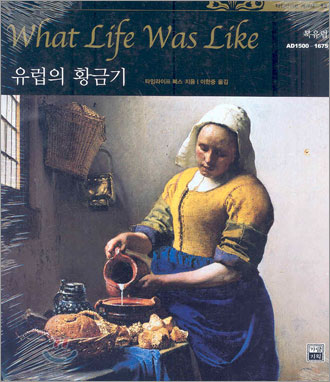
Among them are painters such as Dürer, Titian, Bruegel, Bosch, and Vermeer.
Additionally, beggar's bowls, which were symbols of resistance against Spain, and fantastic crafts vividly portray the atmosphere of the time.
He was on his way to be summoned to answer questions about the Catholic Church's accusation of heresy (a crime punishable by death).
This Augustinian monk had walked 520 km over 12 days from Wittenberg, Saxony, where he lived.
The journey was very rough and arduous.
Not only did Luther have to strain to reach Augsburg by the church's appointed time, but he also had to endure the constant worry of anxious supporters in every small town he stopped in the German countryside.… “They will burn you at the stake,” Luther's fellow monks warned him as he approached Augsburg.
“Go back.”
A group of giggling art students are pushing and shoving each other through a narrow gap between the partitions that fill a large Amsterdam warehouse, trying to see something.
While the teacher was away for a moment, one of the young students decided to become part of the painting, rather than focusing on the actual model.
The student took off his clothes and began posing with a female nude model.
When the teacher suddenly appeared, the surprised student was momentarily speechless.
After a while, breaking the silence, the young student shouted.
“Now we are naked like Adam and Eve in heaven!” The Master replied, tapping the wall with a stick.
“You are naked and must leave heaven!” Rembrandt picked up his stick again and drove them out of the studio and into the street.
It tells the fascinating stories of various men and women in Germany and the Netherlands in the 16th and 17th centuries, and covers the Protestant Reformation, the greatest religious reformation movement in world history, and the social, economic, and cultural prosperity of the Golden Age of the Dutch Republic.
This book offers a close-up look at the lives of various people: printers printing books, farmers working in the fields or celebrating holidays in the town square, businessmen chatting at the stock exchange, workers unwinding in a tavern, and children playing.
The eloquent illustrations, including many portraits and mystical subjects, are by the greatest masters of their time.
Among them are painters such as Dürer, Titian, Bruegel, Bosch, and Vermeer.
Additionally, beggar's bowls, which were symbols of resistance against Spain, and fantastic crafts vividly portray the atmosphere of the time.
GOODS SPECIFICS
- Date of issue: April 20, 2005
- Format: Hardcover book binding method guide
- Page count, weight, size: 209 pages | 1,008g | 222*250*20mm
- ISBN13: 9788984351851
- ISBN10: 8984351857
You may also like
카테고리
korean


korean

![GQ KOREA Mark (Monthly): December [2025]](http://librairie.coreenne.fr/cdn/shop/files/8ef265dbbfbf186523ed75ba7319009d.jpg?v=1765340328&width=3840)


