

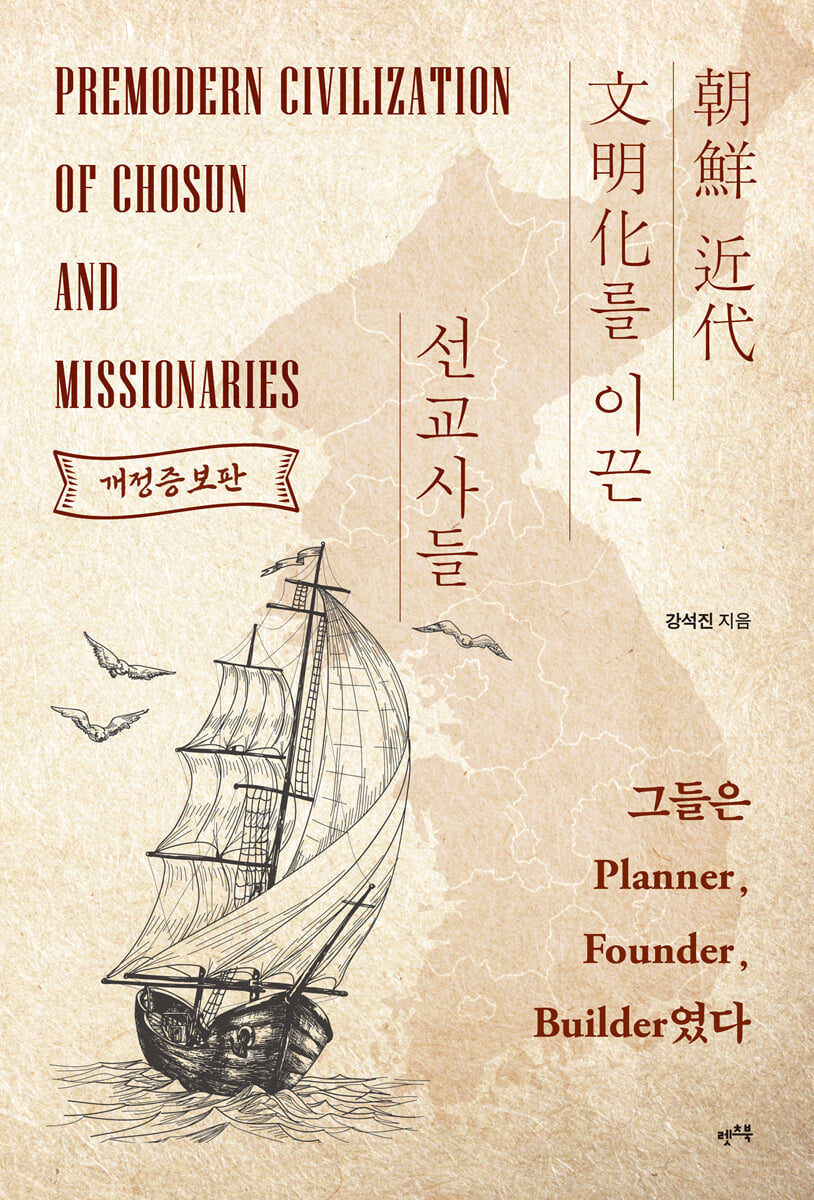
Missionaries who led Joseon's modern civilization
 |
Description
Book Introduction
Princeton University, UC Berkeley, Columbia University, University of Michigan, etc.
History books officially housed in the libraries of six prestigious American universities
This author has recently confirmed that among the historical materials on the modern civilization of Korea, the contributions and influence of missionaries are very weakly evaluated and even denigrated and distorted.
In particular, we have discovered that the content of elementary and middle school textbooks and history museums lacks fairness and objectivity.
Accordingly, I felt the need for a new understanding of history based on the facts of our modern and contemporary history, and I could not help but feel a deep sense of urgency to correct this.
The three elements of history are ‘events’, ‘time’, and ‘people’.
Even in Korea's modern and contemporary history, there was a period of dedicated, civilization-building missionary work, where missionaries who served in that era crossed the Pacific Ocean, settled in the dark land of Joseon, and dedicated themselves and their families to their mission.
They were the main characters of that era who fulfilled all three elements of history.
It is a self-evident fact that they played a leading role in the modern civilization of the Republic of Korea and stood at its center.
Because of this, we are now reaping the fruits and multiplying them.
These are the roots of today's advanced Republic of Korea.
As a missionary, I have been engaged in missionary work for over 30 years, and have naturally become convinced that Christian providence has been at work in the modern and contemporary history of our people, and I have reflected this in this book.
From that perspective, historical facts should be given top priority, and equally important, the evaluation and interpretation of history should be reviewed objectively.
However, if we interpret history through an ideological framework and exclusive stereotypes, we will not be able to learn the painful lessons contained in that history, and such history will repeat itself in the future.
Therefore, in order to objectify history and conduct a balanced evaluation and interpretation, we must examine it not only with our own historical records but also with historical materials from around the world. Only then can we empathize with the universality and truth of history and utilize it as a resource for our people's civilization.
History books officially housed in the libraries of six prestigious American universities
This author has recently confirmed that among the historical materials on the modern civilization of Korea, the contributions and influence of missionaries are very weakly evaluated and even denigrated and distorted.
In particular, we have discovered that the content of elementary and middle school textbooks and history museums lacks fairness and objectivity.
Accordingly, I felt the need for a new understanding of history based on the facts of our modern and contemporary history, and I could not help but feel a deep sense of urgency to correct this.
The three elements of history are ‘events’, ‘time’, and ‘people’.
Even in Korea's modern and contemporary history, there was a period of dedicated, civilization-building missionary work, where missionaries who served in that era crossed the Pacific Ocean, settled in the dark land of Joseon, and dedicated themselves and their families to their mission.
They were the main characters of that era who fulfilled all three elements of history.
It is a self-evident fact that they played a leading role in the modern civilization of the Republic of Korea and stood at its center.
Because of this, we are now reaping the fruits and multiplying them.
These are the roots of today's advanced Republic of Korea.
As a missionary, I have been engaged in missionary work for over 30 years, and have naturally become convinced that Christian providence has been at work in the modern and contemporary history of our people, and I have reflected this in this book.
From that perspective, historical facts should be given top priority, and equally important, the evaluation and interpretation of history should be reviewed objectively.
However, if we interpret history through an ideological framework and exclusive stereotypes, we will not be able to learn the painful lessons contained in that history, and such history will repeat itself in the future.
Therefore, in order to objectify history and conduct a balanced evaluation and interpretation, we must examine it not only with our own historical records but also with historical materials from around the world. Only then can we empathize with the universality and truth of history and utilize it as a resource for our people's civilization.
- You can preview some of the book's contents.
Preview
index
Preface 004
Recommendation 010
Introduction 015
Chapter 1: Joseon in Chaos and Darkness
The Tragedy of Joseon Witnessed by Missionaries 030
1.
The Collapse of Joseon's Economy and Society 030
2.
Corruption in the Court and the People's Groans 032
3.
Primitive Housing Environment 035
4.
Koreans 036 unable to receive treatment due to underdeveloped medical conditions
5.
Koreans Obsessed with Superstition and Idolatry 039
6.
Gender Discrimination and the Culture of Degradation of Women 042
7.
Internal and External Factors in Joseon's Corruption and Downfall 045
Chapter 2: The General Sherman Incident during the Isolation Period and the Dawn of Diplomatic Relations between North Korea and the United States
Meeting in Beijing with Missionary Thomas and Fellow Fellow Park Gyu-su 052
Park Gyu-su, who sank the Sherman, and missionary Thomas, who was martyred 058
ㆍArmed conflict between Joseon and the United States triggered by the Sherman (Shinmiyangyo) 060
ㆍThe 'Joseon-US Amity and Trade' that ushered in Joseon's modern civilization 063
Chapter 3: The Work That Laid the Foundation for Modern Education in Joseon
Establishment of Christian Educational Institutions 073
1.
Kindergarten 073
2.
Elementary School 074
3.
Secondary School 074
4.
University 076, the highest educational institution
The Influence of Christian Schools on Education in Joseon 079
1.
Whole Person Education 079
2.
Equal Public Education 079
3.
Universal Women's Education 080
4.
Shamanism and Breaking Old Traditions Education 083
Chapter 4: Pioneers of Modern Civilization in Joseon
Allen 088, the comprehensive architect of Joseon's modern civilization
1.
Allen, the first Western medical professional to enter Korea, and the Gapsin Coup 088
2.
Allen 097, who founded Gwanghyewon, the first modern Western hospital
3.
Allen 107, who defended Joseon's diplomatic sovereignty
4.
The first water supply project for epidemic prevention 118
5.
Gyeongin Railroad Proposal and Construction 120
6.
Tram Installation and Operation 123
7.
Will-o'-the-wisps enter the royal palace 126
8.
Underwood and Appenzeller, who succeeded Allen's ministry 127
Underwood's Ministry 134
1.
Korean Bible Translation and Literacy Eradication 140
2.
Enlightenment through the publication of the first newspaper 144
3.
Korean Love and Devotion Passed Down Through Generations 147
Appenzeller's Ministry 149
1.
Baejae School, Joseon's first modern educational institution, 149
2.
Enlightenment through the First Publishing Culture Ministry 155
3.
First International School Operation 156
4.
Popularizing the Korean Language through Bible Translation 158
5.
Appenzeller and Syngman Rhee 161
6.
The son of the successor, Dodge Appenzeller 163
Avison, who laid the foundation for Western medicine, 165
1.
Avison's Decision to Go to Joseon Through Underwood 165
2.
The First Jejungwon Mission in Joseon and Its Problems 167
3.
Avison's View of the Sanitary Conditions and Lives of Koreans 169
4.
Eradicating the Cholera Outbreak 174
5.
Jejungwon evolved into Severance Hospital 175
6.
Joseon's first seven doctors were produced in 176
7.
Eradicating Superstitions and Breaking Down Class Discrimination through Medicine 179
8.
The educator who raised a low-born butcher to become the first doctor.
9.
Avison 181, the one that short-circuited Syngman Rhee
Baird 184: Making Pyongyang a Center for Modern Education
1.
Mission's Education Policy 184
2.
Sungsil Academy of Modern Education 190
3.
Transition from academy to university through the operation of a joint school 194
4.
Contribution to the development of national leaders and the promotion of national consciousness 199
The Four Eugene Bell and Linton Families Who Modernized Honam with Education 203
1.
1st Generation: Eugene Bell 204
2.
2nd generation: William Linton, founder of Hannam University (206)
3.
3rd Generation: Hugh McIntyre Linton and Dwight Linton 209
4.
4th generation: Stephen Linton, David Linton, John Linton 211
5.
Missionary Drew 213, who pioneered the first medical mission to an isolated island in Honam.
6.
Dr. Wilson, who transformed Honam through medical missions 214
ㆍThe Hall Family's Medical Ministry: 217
1.
1st Generation: William James Hall and his wife's ministry in Pyongyang 217
2.
2nd Generation: Sherwood Hall and his wife, who dedicated themselves to the fight against tuberculosis. 236
ㆍSheping 259, the Nightingale of Joseon and the Mother of Gwangju
1.
Pioneer of Korean Nursing Education 260
2.
Pedestrian Relief Service 262
3.
Shepping 265, who loved lepers as if they were his own body.
4.
Pioneers in Social Welfare Ministry 267
5.
After all the hard work in the world, 270
Hulbert, who dedicated himself to the independence movement and opened a modern royal school, 272
1.
Officially dispatched teachers from the U.S. government 272
2.
Dedication to the enlightenment movement and independence movement through publishing and the press 274
ㆍGreat House's Establishment and Contribution to the Modern Judicial System 278
Missionaries who participated in the March 1st Independence Movement: Becker, Schofield, Mowry, McCune, Thomas, Moffett, Noble 283
ㆍScranton, mother and son, the first Korean women to be educated and provided medical care, 285
1.
Mary Scranton's Ewha Girls' School 285
2.
Baehwa Hakdang 287: A School That Fostered Women's Potential and National Consciousness
3.
William Scranton's Medical Ministry 290
Missionary Moore, the Liberator of the Baekjeong (294)
Missionary Arthur Becker, who produced 300 modern scientists
Missionary Gillette, founder of the YMCA in Joseon 303
1.
Dedication to Joseon Youth 303
2. Japanese colonial rule 307 that suppressed the YMCA
3.
Contributing to the civilization of rural areas 308
4.
The father of modern Korean sports, who introduced Western sports such as baseball and basketball.
Education and Medical Workers for Koreans in North Gando: Barker, Mansfield, Foote, Martin, Scott 310
1.
Gando Yongjeong Mission 314, which provided a base for the independence movement
2.
Myeongdong, Myeongsin Girls' School, and Eunjin Middle School 314 in Bukgando, the cradle of national leaders
The Shaw family, which founded the Korean military chaplaincy and dedicated itself to the cause for four generations.
1.
Contributed to the introduction of the military chaplain system in the Korean Armed Forces 317
2.
Four generations of missionaries' love for Korea, their participation in the Korean War, and the 318 soldiers who died in battle.
Missionaries Who Accompany Joseon's Rise and Fall 321
1.
321 Missionaries Who Became Emperor Gojong's Bodyguards
2.
Muppet 324, representing the suffering of Pyongyang residents due to the construction of the Gyeongui Line.
Professor Herbert Miller, who supported Korea's independence and helped establish a government, 327
Missionaries and churches who contributed to the protection of liberal democracy after the founding of the nation 332
Chapter 5: Missionaries Who Transmitted Modern Western Music and Literature
Introduction and Popularization of Western Music through Hymns 338
Missionaries who introduced symphony orchestras and choirs and trained musicians 342
1.
Marlsbury: Founding of the Symphony Orchestra and Brass Band 342
2.
Mourie: Organizing a Choir and Developing Ahn Ik-tae's Musical Talent 344
ㆍGale 348, the popularization of Western literature and the rise of Syngman Rhee
1.
The first Korean translation and publication of Pilgrim's Progress in 350
2.
Translating Korean literature into English and introducing it to the world 352
3.
353. Sent Syngman Rhee to study in the United States to establish him as a national leader.
Chapter 6: Conclusion - Seven Legacies of Modern Civilization Passed Down by Missionaries
Liberation from Shamanism and Idolatry 360
ㆍAbolition of the Caste System and the Movement for Gender Equality 361
Awakening and Universalization of National Consciousness 364
ㆍTraining Nation-building Leaders 366
ㆍFreedom from Disease and Training of Medical Professionals 369
ㆍThe Enlightenment Movement from Illiteracy to Civilization 374
ㆍStopping Communism and Awakening Liberal Democracy 378
Outgoing Words 382
Recommendation 010
Introduction 015
Chapter 1: Joseon in Chaos and Darkness
The Tragedy of Joseon Witnessed by Missionaries 030
1.
The Collapse of Joseon's Economy and Society 030
2.
Corruption in the Court and the People's Groans 032
3.
Primitive Housing Environment 035
4.
Koreans 036 unable to receive treatment due to underdeveloped medical conditions
5.
Koreans Obsessed with Superstition and Idolatry 039
6.
Gender Discrimination and the Culture of Degradation of Women 042
7.
Internal and External Factors in Joseon's Corruption and Downfall 045
Chapter 2: The General Sherman Incident during the Isolation Period and the Dawn of Diplomatic Relations between North Korea and the United States
Meeting in Beijing with Missionary Thomas and Fellow Fellow Park Gyu-su 052
Park Gyu-su, who sank the Sherman, and missionary Thomas, who was martyred 058
ㆍArmed conflict between Joseon and the United States triggered by the Sherman (Shinmiyangyo) 060
ㆍThe 'Joseon-US Amity and Trade' that ushered in Joseon's modern civilization 063
Chapter 3: The Work That Laid the Foundation for Modern Education in Joseon
Establishment of Christian Educational Institutions 073
1.
Kindergarten 073
2.
Elementary School 074
3.
Secondary School 074
4.
University 076, the highest educational institution
The Influence of Christian Schools on Education in Joseon 079
1.
Whole Person Education 079
2.
Equal Public Education 079
3.
Universal Women's Education 080
4.
Shamanism and Breaking Old Traditions Education 083
Chapter 4: Pioneers of Modern Civilization in Joseon
Allen 088, the comprehensive architect of Joseon's modern civilization
1.
Allen, the first Western medical professional to enter Korea, and the Gapsin Coup 088
2.
Allen 097, who founded Gwanghyewon, the first modern Western hospital
3.
Allen 107, who defended Joseon's diplomatic sovereignty
4.
The first water supply project for epidemic prevention 118
5.
Gyeongin Railroad Proposal and Construction 120
6.
Tram Installation and Operation 123
7.
Will-o'-the-wisps enter the royal palace 126
8.
Underwood and Appenzeller, who succeeded Allen's ministry 127
Underwood's Ministry 134
1.
Korean Bible Translation and Literacy Eradication 140
2.
Enlightenment through the publication of the first newspaper 144
3.
Korean Love and Devotion Passed Down Through Generations 147
Appenzeller's Ministry 149
1.
Baejae School, Joseon's first modern educational institution, 149
2.
Enlightenment through the First Publishing Culture Ministry 155
3.
First International School Operation 156
4.
Popularizing the Korean Language through Bible Translation 158
5.
Appenzeller and Syngman Rhee 161
6.
The son of the successor, Dodge Appenzeller 163
Avison, who laid the foundation for Western medicine, 165
1.
Avison's Decision to Go to Joseon Through Underwood 165
2.
The First Jejungwon Mission in Joseon and Its Problems 167
3.
Avison's View of the Sanitary Conditions and Lives of Koreans 169
4.
Eradicating the Cholera Outbreak 174
5.
Jejungwon evolved into Severance Hospital 175
6.
Joseon's first seven doctors were produced in 176
7.
Eradicating Superstitions and Breaking Down Class Discrimination through Medicine 179
8.
The educator who raised a low-born butcher to become the first doctor.
9.
Avison 181, the one that short-circuited Syngman Rhee
Baird 184: Making Pyongyang a Center for Modern Education
1.
Mission's Education Policy 184
2.
Sungsil Academy of Modern Education 190
3.
Transition from academy to university through the operation of a joint school 194
4.
Contribution to the development of national leaders and the promotion of national consciousness 199
The Four Eugene Bell and Linton Families Who Modernized Honam with Education 203
1.
1st Generation: Eugene Bell 204
2.
2nd generation: William Linton, founder of Hannam University (206)
3.
3rd Generation: Hugh McIntyre Linton and Dwight Linton 209
4.
4th generation: Stephen Linton, David Linton, John Linton 211
5.
Missionary Drew 213, who pioneered the first medical mission to an isolated island in Honam.
6.
Dr. Wilson, who transformed Honam through medical missions 214
ㆍThe Hall Family's Medical Ministry: 217
1.
1st Generation: William James Hall and his wife's ministry in Pyongyang 217
2.
2nd Generation: Sherwood Hall and his wife, who dedicated themselves to the fight against tuberculosis. 236
ㆍSheping 259, the Nightingale of Joseon and the Mother of Gwangju
1.
Pioneer of Korean Nursing Education 260
2.
Pedestrian Relief Service 262
3.
Shepping 265, who loved lepers as if they were his own body.
4.
Pioneers in Social Welfare Ministry 267
5.
After all the hard work in the world, 270
Hulbert, who dedicated himself to the independence movement and opened a modern royal school, 272
1.
Officially dispatched teachers from the U.S. government 272
2.
Dedication to the enlightenment movement and independence movement through publishing and the press 274
ㆍGreat House's Establishment and Contribution to the Modern Judicial System 278
Missionaries who participated in the March 1st Independence Movement: Becker, Schofield, Mowry, McCune, Thomas, Moffett, Noble 283
ㆍScranton, mother and son, the first Korean women to be educated and provided medical care, 285
1.
Mary Scranton's Ewha Girls' School 285
2.
Baehwa Hakdang 287: A School That Fostered Women's Potential and National Consciousness
3.
William Scranton's Medical Ministry 290
Missionary Moore, the Liberator of the Baekjeong (294)
Missionary Arthur Becker, who produced 300 modern scientists
Missionary Gillette, founder of the YMCA in Joseon 303
1.
Dedication to Joseon Youth 303
2. Japanese colonial rule 307 that suppressed the YMCA
3.
Contributing to the civilization of rural areas 308
4.
The father of modern Korean sports, who introduced Western sports such as baseball and basketball.
Education and Medical Workers for Koreans in North Gando: Barker, Mansfield, Foote, Martin, Scott 310
1.
Gando Yongjeong Mission 314, which provided a base for the independence movement
2.
Myeongdong, Myeongsin Girls' School, and Eunjin Middle School 314 in Bukgando, the cradle of national leaders
The Shaw family, which founded the Korean military chaplaincy and dedicated itself to the cause for four generations.
1.
Contributed to the introduction of the military chaplain system in the Korean Armed Forces 317
2.
Four generations of missionaries' love for Korea, their participation in the Korean War, and the 318 soldiers who died in battle.
Missionaries Who Accompany Joseon's Rise and Fall 321
1.
321 Missionaries Who Became Emperor Gojong's Bodyguards
2.
Muppet 324, representing the suffering of Pyongyang residents due to the construction of the Gyeongui Line.
Professor Herbert Miller, who supported Korea's independence and helped establish a government, 327
Missionaries and churches who contributed to the protection of liberal democracy after the founding of the nation 332
Chapter 5: Missionaries Who Transmitted Modern Western Music and Literature
Introduction and Popularization of Western Music through Hymns 338
Missionaries who introduced symphony orchestras and choirs and trained musicians 342
1.
Marlsbury: Founding of the Symphony Orchestra and Brass Band 342
2.
Mourie: Organizing a Choir and Developing Ahn Ik-tae's Musical Talent 344
ㆍGale 348, the popularization of Western literature and the rise of Syngman Rhee
1.
The first Korean translation and publication of Pilgrim's Progress in 350
2.
Translating Korean literature into English and introducing it to the world 352
3.
353. Sent Syngman Rhee to study in the United States to establish him as a national leader.
Chapter 6: Conclusion - Seven Legacies of Modern Civilization Passed Down by Missionaries
Liberation from Shamanism and Idolatry 360
ㆍAbolition of the Caste System and the Movement for Gender Equality 361
Awakening and Universalization of National Consciousness 364
ㆍTraining Nation-building Leaders 366
ㆍFreedom from Disease and Training of Medical Professionals 369
ㆍThe Enlightenment Movement from Illiteracy to Civilization 374
ㆍStopping Communism and Awakening Liberal Democracy 378
Outgoing Words 382
GOODS SPECIFICS
- Date of issue: July 21, 2025
- Page count, weight, size: 388 pages | 152*224*30mm
- ISBN13: 9791160547672
- ISBN10: 116054767X
You may also like
카테고리
korean


korean

![GQ KOREA Mark (Monthly): December [2025]](http://librairie.coreenne.fr/cdn/shop/files/8ef265dbbfbf186523ed75ba7319009d.jpg?v=1765340328&width=3840)


