

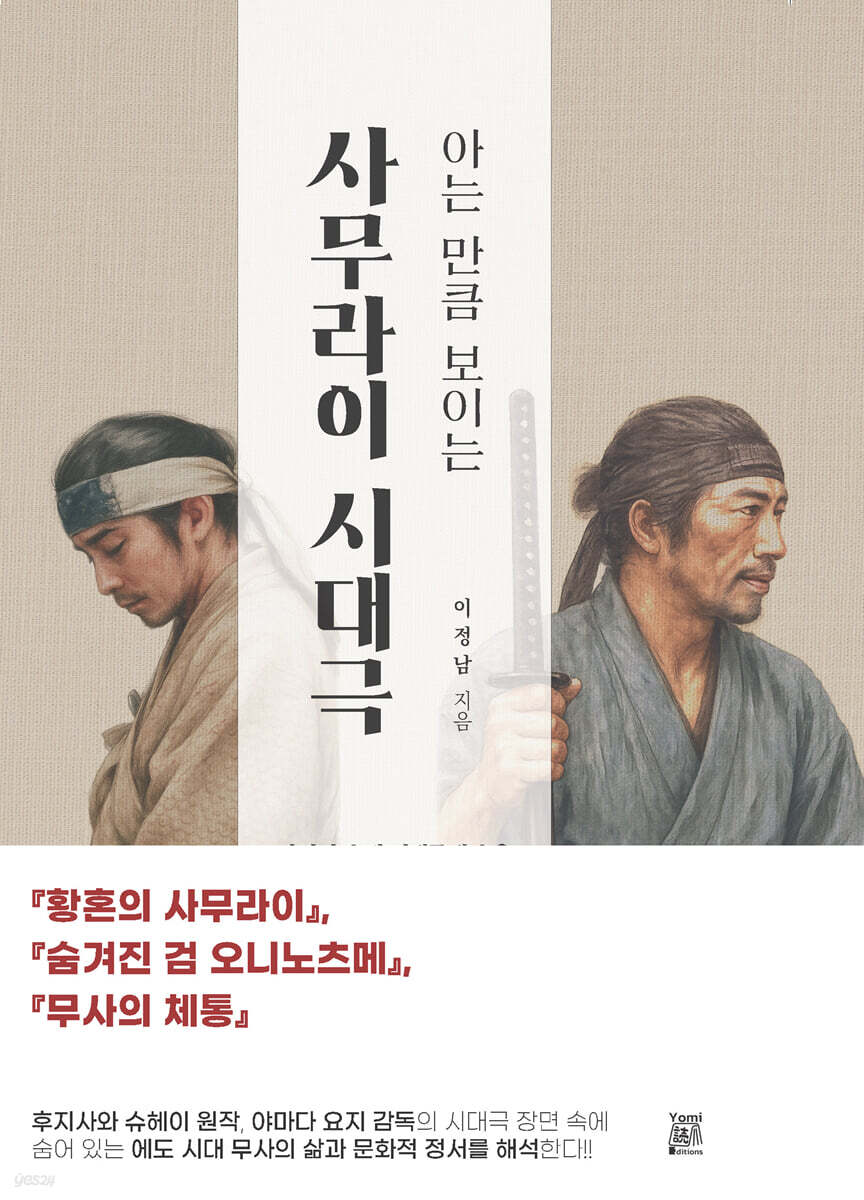
A samurai period drama that shows as much as you know
 |
Description
Book Introduction
Japanese period dramas: A deeper understanding when viewed this way.
Publication of "Samurai Period Drama: The More You Know, the More You See"
- A new attempt to interpret the historical context and emotional layers contained in period drama scenes.
The Japanese period drama genre has long been a cinematic form that captures the aesthetics of tradition, bushido, and justice.
However, few people have looked deeply into the fact that these scenes do not simply reproduce the past, but rather elaborately reflect the emotions, ethics, and social structure of the people of the Edo period.
『Samurai Period Dramas That You See as Much as You Know』(written by Lee Jeong-nam, Yomi Editions) is a book that points out exactly that point.
This book focuses on director Yoji Yamada's period drama trilogy - "The Twilight Samurai," "The Hidden Sword: Oninotsume," and "The Warrior's Disposition" - and interprets the cultural codes and historical meanings hidden in each scene in the films.
Through rich commentary, it is revealed that even seemingly simple directing, such as the characters' appearances, speech patterns, actions, dialogue, and conflict structures, actually elaborately reflects the customs and mindset of the Edo period.
Based on his extensive understanding of Edo-period Japanese history and his experience interpreting video footage, the author guides viewers through scenes from period dramas in a way that allows them to be "read" rather than simply "appreciated."
This is not a simple film commentary, but rather a cultural book that explores history and human emotions through symbols in the film.
The text minimizes the use of Japanese expressions and Chinese characters, and provides necessary terminology explanations through footnotes, thereby providing readability for general readers and depth of information for specialist readers.
It is notable that it is structured so that even readers unfamiliar with Japanese history or video content can access it without much difficulty.
In particular, the author stands out for his vivid portrayal of the historical context contained in the space in the film, based on footage he personally visited and filmed in **Tsuruoka City, Yamagata Prefecture (former Shonai Domain region),** which serves as the main setting for the trilogy of period dramas.
Certain episodes include QR codes for YouTube videos that match the book's themes. These videos were all filmed and edited by the author, allowing readers to understand the period drama and its historical background in a more three-dimensional way by going back and forth between text and video.
"The More You Know, the More You See: Samurai Period Drama" is a new attempt to highlight the contemporary nature and aesthetics contained within the period drama genre, and will be a meaningful reading experience for both general readers and creators seeking a deeper understanding of video content.
Publication of "Samurai Period Drama: The More You Know, the More You See"
- A new attempt to interpret the historical context and emotional layers contained in period drama scenes.
The Japanese period drama genre has long been a cinematic form that captures the aesthetics of tradition, bushido, and justice.
However, few people have looked deeply into the fact that these scenes do not simply reproduce the past, but rather elaborately reflect the emotions, ethics, and social structure of the people of the Edo period.
『Samurai Period Dramas That You See as Much as You Know』(written by Lee Jeong-nam, Yomi Editions) is a book that points out exactly that point.
This book focuses on director Yoji Yamada's period drama trilogy - "The Twilight Samurai," "The Hidden Sword: Oninotsume," and "The Warrior's Disposition" - and interprets the cultural codes and historical meanings hidden in each scene in the films.
Through rich commentary, it is revealed that even seemingly simple directing, such as the characters' appearances, speech patterns, actions, dialogue, and conflict structures, actually elaborately reflects the customs and mindset of the Edo period.
Based on his extensive understanding of Edo-period Japanese history and his experience interpreting video footage, the author guides viewers through scenes from period dramas in a way that allows them to be "read" rather than simply "appreciated."
This is not a simple film commentary, but rather a cultural book that explores history and human emotions through symbols in the film.
The text minimizes the use of Japanese expressions and Chinese characters, and provides necessary terminology explanations through footnotes, thereby providing readability for general readers and depth of information for specialist readers.
It is notable that it is structured so that even readers unfamiliar with Japanese history or video content can access it without much difficulty.
In particular, the author stands out for his vivid portrayal of the historical context contained in the space in the film, based on footage he personally visited and filmed in **Tsuruoka City, Yamagata Prefecture (former Shonai Domain region),** which serves as the main setting for the trilogy of period dramas.
Certain episodes include QR codes for YouTube videos that match the book's themes. These videos were all filmed and edited by the author, allowing readers to understand the period drama and its historical background in a more three-dimensional way by going back and forth between text and video.
"The More You Know, the More You See: Samurai Period Drama" is a new attempt to highlight the contemporary nature and aesthetics contained within the period drama genre, and will be a meaningful reading experience for both general readers and creators seeking a deeper understanding of video content.
- You can preview some of the book's contents.
Preview
index
Episode.
1 What are the hidden symbols in the movie scenes?
Episode.
2 Hidden symbols in the background of the movie
Episode.
3. A Study on the Salary Levels of Poor Samurai
Episode.
4 The Messy Hairstyle of a Poor Samurai
Episode.
5 'Twilight Samurai' and Part-time Job
Episode.
6 Servants in the Period Drama Trilogy: Why Do They Carry Swords?
Episode.
7 Were samurai allowed to kill people at will?
Episode.
The highlight of the eight-part period drama trilogy: a showdown between samurai with honor on the line.
Episode.
9 The identity of the cylindrical barrel seen in the funeral scene
Episode.
10. Did the cannons that appear in the military training scenes actually exist?
Episode.
11 During the ceremonial training march, the reason the samurai laughed
Episode.
12 Cultural Codes Hidden in Fishing Scenes - Shonai Domain Fishing Culture -
Episode.
13 Hidden Symbols in Dining Scenes - Shonai Domain's Local Cuisine -
Episode.
14 Is it true that the girl said she saw a samurai for the first time?
Episode.
15 The Center of Shonai Domain Education, the Domain School Chidokan and the Samurai at Twilight
Episode.
16 Samurai Marriage and Divorce: Whose Permission Was Required?
Episode.
17. What is the paper in the samurai's bosom used for?
Episode.
18 Don't overlook the small props that appear in the movie.
1 What are the hidden symbols in the movie scenes?
Episode.
2 Hidden symbols in the background of the movie
Episode.
3. A Study on the Salary Levels of Poor Samurai
Episode.
4 The Messy Hairstyle of a Poor Samurai
Episode.
5 'Twilight Samurai' and Part-time Job
Episode.
6 Servants in the Period Drama Trilogy: Why Do They Carry Swords?
Episode.
7 Were samurai allowed to kill people at will?
Episode.
The highlight of the eight-part period drama trilogy: a showdown between samurai with honor on the line.
Episode.
9 The identity of the cylindrical barrel seen in the funeral scene
Episode.
10. Did the cannons that appear in the military training scenes actually exist?
Episode.
11 During the ceremonial training march, the reason the samurai laughed
Episode.
12 Cultural Codes Hidden in Fishing Scenes - Shonai Domain Fishing Culture -
Episode.
13 Hidden Symbols in Dining Scenes - Shonai Domain's Local Cuisine -
Episode.
14 Is it true that the girl said she saw a samurai for the first time?
Episode.
15 The Center of Shonai Domain Education, the Domain School Chidokan and the Samurai at Twilight
Episode.
16 Samurai Marriage and Divorce: Whose Permission Was Required?
Episode.
17. What is the paper in the samurai's bosom used for?
Episode.
18 Don't overlook the small props that appear in the movie.
Into the book
For example, let's say there's a scene in a Korean drama where a child wearing a hanbok bows to an adult and eats tteokguk with them.
If you are Korean, this scene will naturally remind you of Seollal, but foreigners who are not familiar with Korean culture may not understand the implied meaning of this scene.
To them, it would just be a scene of a child in traditional attire greeting an adult and eating together.
A short scene featuring a traditional food called tteokguk contains specific information about the season, winter, and the first day of the first lunar month.
However, this is a visual symbol that only Koreans or foreigners familiar with Korean culture can easily understand.
--- From "The Meaning of Semiotics and Signs in Media"
The duel scenes in these two works are not simply private revenge, but rather have the character of a 'public execution' in that they are executions carried out on orders from a superior.
This 'execution by superior order' is not just a fictional device, but a concept that actually existed in Japanese history.
A representative example is the 'Teradaya Incident' that occurred on May 21, 1862, at Teradaya, a Satsuma clan inn located in the Fushimi area of Kyoto.
--- From "The Highlight of the Period Drama Trilogy: A Samurai Showdown for Honor"
The film features a scene where the main character, Munezo Katagiri, and his colleagues demonstrate firing a sagen-san gun in front of the lord.
However, immediately after firing, the cannon suddenly moved backwards due to strong recoil, and the samurai fell over, which was comically portrayed.
Although it may be seen as a simple humor scene, it is also a direction that is historically true.
--- From "Did the representative appearing in the ceremonial training scene actually exist?"
That is, the most familiar way is to swing your left arm along with your right leg moving forward.
However, in the film, there is a scene where an instructor teaching British-style martial arts looks frustrated as he teaches this technique to samurai.
Conversely, the Unasaka clan samurai are depicted as having difficulty mastering this technique and struggling with it.
If you are Korean, this scene will naturally remind you of Seollal, but foreigners who are not familiar with Korean culture may not understand the implied meaning of this scene.
To them, it would just be a scene of a child in traditional attire greeting an adult and eating together.
A short scene featuring a traditional food called tteokguk contains specific information about the season, winter, and the first day of the first lunar month.
However, this is a visual symbol that only Koreans or foreigners familiar with Korean culture can easily understand.
--- From "The Meaning of Semiotics and Signs in Media"
The duel scenes in these two works are not simply private revenge, but rather have the character of a 'public execution' in that they are executions carried out on orders from a superior.
This 'execution by superior order' is not just a fictional device, but a concept that actually existed in Japanese history.
A representative example is the 'Teradaya Incident' that occurred on May 21, 1862, at Teradaya, a Satsuma clan inn located in the Fushimi area of Kyoto.
--- From "The Highlight of the Period Drama Trilogy: A Samurai Showdown for Honor"
The film features a scene where the main character, Munezo Katagiri, and his colleagues demonstrate firing a sagen-san gun in front of the lord.
However, immediately after firing, the cannon suddenly moved backwards due to strong recoil, and the samurai fell over, which was comically portrayed.
Although it may be seen as a simple humor scene, it is also a direction that is historically true.
--- From "Did the representative appearing in the ceremonial training scene actually exist?"
That is, the most familiar way is to swing your left arm along with your right leg moving forward.
However, in the film, there is a scene where an instructor teaching British-style martial arts looks frustrated as he teaches this technique to samurai.
Conversely, the Unasaka clan samurai are depicted as having difficulty mastering this technique and struggling with it.
--- From "Why did the samurai laugh during the ceremonial training march?"
Publisher's Review
『Samurai period drama that shows the more you know』
- A new educational book that reads the Edo period through Japanese period dramas.
Japanese period dramas are not simply recreations of the past; they are cultural products that reflect the mindset, emotions, and social structure of the people who lived in that era.
『Samurai Period Dramas: The More You Know, the More You See』 is a book that seeks to deeply interpret the lives and cultural context of samurai in the late Edo period through these period dramas.
The author explores the ethics and aesthetics of Japanese society at the time, focusing on director Yoji Yamada's trilogy of period dramas - "The Twilight Samurai," "The Hidden Sword: Oninotsume," and "The Style of the Samurai" - using the characters' appearances, lines, gestures, and spatial compositions as clues.
Class structure, family institutions, ways of expressing emotions, and the status of women are cultural symbols that are not intuitively conveyed to today's audiences, but this book unravels these scenes within the grammar of history and culture, revealing "unseen meanings."
This book goes beyond a simple appreciation of Japanese period dramas, analyzing the historical realities and aesthetic layers inherent in the genre through a semiotic perspective.
Combining visual language and historical interpretation to systematically examine the symbols and directorial intentions contained in the film provides useful insights not only to general readers seeking a deeper understanding of period dramas, but also to content creators.
In the main text, the use of Japanese expressions and Chinese characters, except for names of people and places, has been minimized to reduce the burden on readers. Instead, footnotes have been used to faithfully provide explanations and background information on key terms, so that even readers unfamiliar with Japanese history will not miss the context.
This is the author's strategy to balance popularity and expertise, and is also a device to increase the practical usability of interpreting scenes from period dramas.
Based on the author's personal visit to Tsuruoka City, Yamagata Prefecture, the setting of the trilogy of period dramas that form the background of the book—the former Shonai Domain region—the book vividly conveys how the scenes in the film connect with the actual space.
In particular, QR codes for YouTube videos related to specific topics are included, and these videos are all composed of materials shot and edited on-site by the author, allowing readers to experience the aesthetics of period dramas in a more three-dimensional way by moving between text commentary and video content.
"The More You Know, the More You See" is a trilogy of period dramas by director Yoji Yamada that transcends stereotypes about traditional Japanese culture and the samurai class, illuminating how period dramas embrace both historical truth and contemporary ideals.
Although it's been over 20 years since its release, the world you discover within it changes as you change the depth of your perspective when watching a film.
This book will serve as a starting point for that new perspective.
- A new educational book that reads the Edo period through Japanese period dramas.
Japanese period dramas are not simply recreations of the past; they are cultural products that reflect the mindset, emotions, and social structure of the people who lived in that era.
『Samurai Period Dramas: The More You Know, the More You See』 is a book that seeks to deeply interpret the lives and cultural context of samurai in the late Edo period through these period dramas.
The author explores the ethics and aesthetics of Japanese society at the time, focusing on director Yoji Yamada's trilogy of period dramas - "The Twilight Samurai," "The Hidden Sword: Oninotsume," and "The Style of the Samurai" - using the characters' appearances, lines, gestures, and spatial compositions as clues.
Class structure, family institutions, ways of expressing emotions, and the status of women are cultural symbols that are not intuitively conveyed to today's audiences, but this book unravels these scenes within the grammar of history and culture, revealing "unseen meanings."
This book goes beyond a simple appreciation of Japanese period dramas, analyzing the historical realities and aesthetic layers inherent in the genre through a semiotic perspective.
Combining visual language and historical interpretation to systematically examine the symbols and directorial intentions contained in the film provides useful insights not only to general readers seeking a deeper understanding of period dramas, but also to content creators.
In the main text, the use of Japanese expressions and Chinese characters, except for names of people and places, has been minimized to reduce the burden on readers. Instead, footnotes have been used to faithfully provide explanations and background information on key terms, so that even readers unfamiliar with Japanese history will not miss the context.
This is the author's strategy to balance popularity and expertise, and is also a device to increase the practical usability of interpreting scenes from period dramas.
Based on the author's personal visit to Tsuruoka City, Yamagata Prefecture, the setting of the trilogy of period dramas that form the background of the book—the former Shonai Domain region—the book vividly conveys how the scenes in the film connect with the actual space.
In particular, QR codes for YouTube videos related to specific topics are included, and these videos are all composed of materials shot and edited on-site by the author, allowing readers to experience the aesthetics of period dramas in a more three-dimensional way by moving between text commentary and video content.
"The More You Know, the More You See" is a trilogy of period dramas by director Yoji Yamada that transcends stereotypes about traditional Japanese culture and the samurai class, illuminating how period dramas embrace both historical truth and contemporary ideals.
Although it's been over 20 years since its release, the world you discover within it changes as you change the depth of your perspective when watching a film.
This book will serve as a starting point for that new perspective.
GOODS SPECIFICS
- Date of issue: July 11, 2025
- Page count, weight, size: 267 pages | 450g | 128*188*16mm
- ISBN13: 9791197564192
- ISBN10: 1197564195
You may also like
카테고리
korean


korean

![GQ KOREA Mark (Monthly): December [2025]](http://librairie.coreenne.fr/cdn/shop/files/8ef265dbbfbf186523ed75ba7319009d.jpg?v=1765340328&width=3840)


