

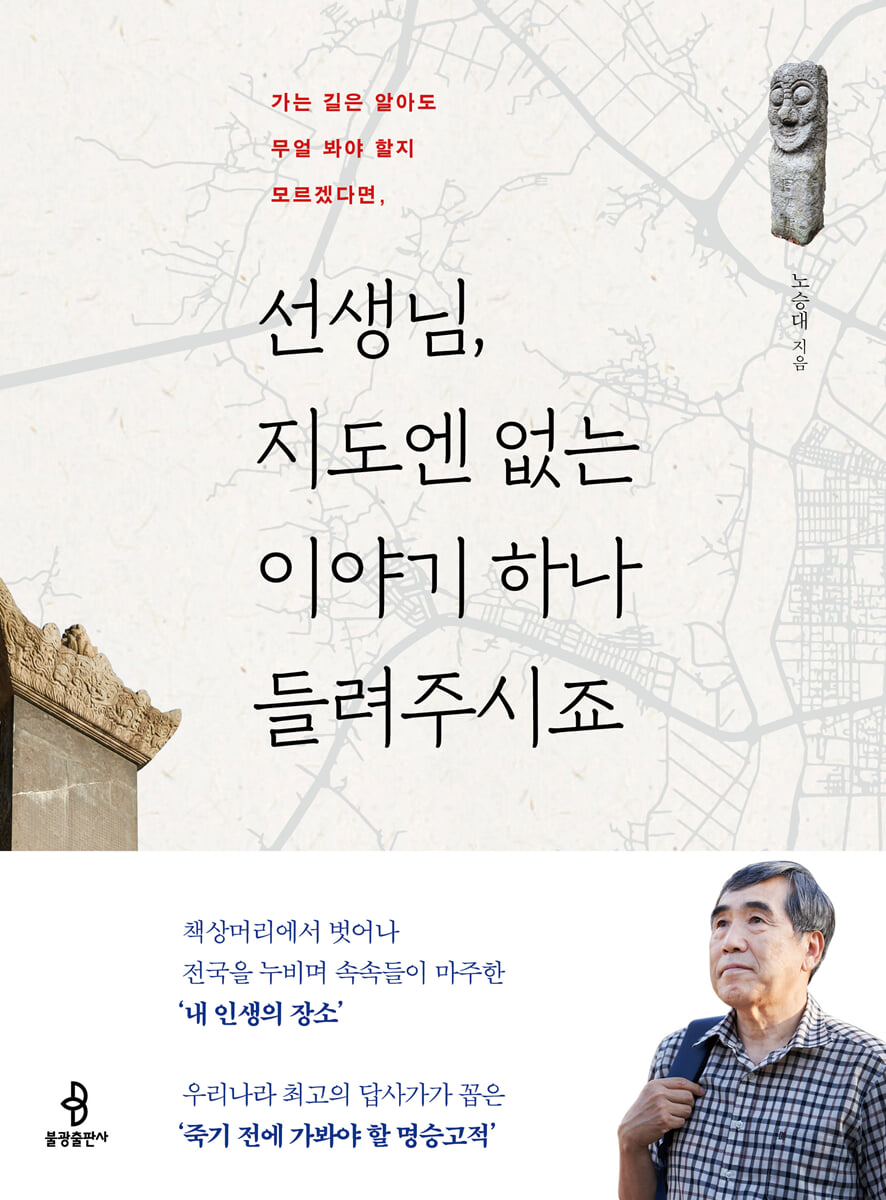
Teacher, please tell me a story that isn't on the map.
 |
Description
Book Introduction
“There is a story at every stop along the way.”
"The Places of My Life," a journey I took from my desk to the rest of the country, encountering them head-on.
"Scenic Sites You Must See Before You Die," Chosen by Korea's Top Traveler
A new book by Noh Seung-dae, known as "Korea's greatest traveler," has been published, introducing the mysterious beings that have existed in our temples as paintings and sculptures, as well as the cultural heritage of temples whose uses and meanings were unknown, and has been loved by many readers.
This book is a humanities travel essay about the "places of my life" selected by the author while looking back on the past 42 years of traveling all over the country, and it contains the history of famous places, historic sites, and cultural heritages in 16 regions including Samcheok, Andong, and Namwon, as well as the time, memories, and emotions they hold.
The author organized this book around the special stories of each space, rather than the fame of the place.
In particular, I wanted to talk about the 'living history' that is not well known beyond the schematic information such as internet searches and cultural heritage guides.
Furthermore, it becomes even warmer and more exciting as you encounter old memories with the robbers you encounter at the field trip site, reminisce about the lost forest path, and reminisce about the mountaineers you meet at the mountain lodge.
A record of the place where your feet stayed the longest while walking and walking as guided by the reverse horse.
This book encourages a slow journey, listening to the memories of a stone statue located in a corner of a small village, rather than the noise of the city, and exploring the hidden stories of a temple site overgrown with grass, unvisited by people.
Through this book, readers will rediscover the charm of in-depth cultural travel, rather than superficial tourism.
"The Places of My Life," a journey I took from my desk to the rest of the country, encountering them head-on.
"Scenic Sites You Must See Before You Die," Chosen by Korea's Top Traveler
A new book by Noh Seung-dae, known as "Korea's greatest traveler," has been published, introducing the mysterious beings that have existed in our temples as paintings and sculptures, as well as the cultural heritage of temples whose uses and meanings were unknown, and has been loved by many readers.
This book is a humanities travel essay about the "places of my life" selected by the author while looking back on the past 42 years of traveling all over the country, and it contains the history of famous places, historic sites, and cultural heritages in 16 regions including Samcheok, Andong, and Namwon, as well as the time, memories, and emotions they hold.
The author organized this book around the special stories of each space, rather than the fame of the place.
In particular, I wanted to talk about the 'living history' that is not well known beyond the schematic information such as internet searches and cultural heritage guides.
Furthermore, it becomes even warmer and more exciting as you encounter old memories with the robbers you encounter at the field trip site, reminisce about the lost forest path, and reminisce about the mountaineers you meet at the mountain lodge.
A record of the place where your feet stayed the longest while walking and walking as guided by the reverse horse.
This book encourages a slow journey, listening to the memories of a stone statue located in a corner of a small village, rather than the noise of the city, and exploring the hidden stories of a temple site overgrown with grass, unvisited by people.
Through this book, readers will rediscover the charm of in-depth cultural travel, rather than superficial tourism.
- You can preview some of the book's contents.
Preview
index
Entering
A coastal town where fishing and mountain villages coexist | Samcheok, Gangwon-do
Pilgrimage to Three Temples Along the Spring Lake Trail | Wanju, Jeollabuk-do
Beyond Chupungnyeong Pass, a vibrant home for practitioners | Gimcheon, Gyeongsangbuk-do
A large town at the foot of Jirisan, blossoming with loyalty and integrity | Namwon, Jeollabuk-do
Ancient temples and shrines that stand firm like pine trees that withstand the elements | Andong, Gyeongsangbuk-do
The sound of shouts at Samnyeonsanseong Fortress has died down because of the illegality that dwells on Songnisan Mountain | Boeun, Chungcheongbuk-do
Arirang envelops Yeongnamnu, and righteousness flows like a river | Miryang, Gyeongsangnam-do
Famous mountains are adorned with temples, and shrines stand throughout the towns | Buan, Jeollabuk-do
A refuge for upright practitioners, a home for lost scholars | Seoraksan
The Wishes of a Thousand Buddhas and Thousand Pagodas and the Beauty of a Millennium-Old Town | Hwasun and Naju, Jeollanam-do
The Breath of Baekje on Old Roads | Seosan, South Chungcheong Province
Ancient temple sites along the Namhan River | Yeoju, Gyeonggi Province and Wonju, Gangwon Province
A coastal town where fishing and mountain villages coexist | Samcheok, Gangwon-do
Pilgrimage to Three Temples Along the Spring Lake Trail | Wanju, Jeollabuk-do
Beyond Chupungnyeong Pass, a vibrant home for practitioners | Gimcheon, Gyeongsangbuk-do
A large town at the foot of Jirisan, blossoming with loyalty and integrity | Namwon, Jeollabuk-do
Ancient temples and shrines that stand firm like pine trees that withstand the elements | Andong, Gyeongsangbuk-do
The sound of shouts at Samnyeonsanseong Fortress has died down because of the illegality that dwells on Songnisan Mountain | Boeun, Chungcheongbuk-do
Arirang envelops Yeongnamnu, and righteousness flows like a river | Miryang, Gyeongsangnam-do
Famous mountains are adorned with temples, and shrines stand throughout the towns | Buan, Jeollabuk-do
A refuge for upright practitioners, a home for lost scholars | Seoraksan
The Wishes of a Thousand Buddhas and Thousand Pagodas and the Beauty of a Millennium-Old Town | Hwasun and Naju, Jeollanam-do
The Breath of Baekje on Old Roads | Seosan, South Chungcheong Province
Ancient temple sites along the Namhan River | Yeoju, Gyeonggi Province and Wonju, Gangwon Province
Detailed image

Into the book
Our ancestors believed that the earth was alive, just as all living things were alive.
Just as the body has blood vessels that maintain life and health, the earth also has veins and energy that flow through it.
Therefore, the entire Korean Peninsula was viewed as a living organism, and the bloodline of Mt. Baekdu, the ancestor of all mountains, was seen to spread like a spider web throughout the mountains and fields of the country.
--- p.15
He was looking for a good place to sleep when he fell asleep for a moment while resting.
In a dream, a monk passing by with a Taoist monk muttered, "If I build a tomb here, a king will be born in five generations."
The monk who was walking ahead immediately scolded him.
“You rascal! They say that birds hear what is said during the day, and rats hear what is said at night. How dare you divulge the secrets of heaven so carelessly!”
--- p.20
As we approached the Shindan of Mt. Sinum, the scenery changed completely.
To the left was a dense pine forest, to the right was a high rock wall, and the small path between them seemed to herald the coming of a sanctuary.
As we leave this place, we see a row of stone towers that someone has piled up on both sides of the road.
How many people must have climbed the mountain and poured so much time and effort into building these sacred towers? The fervor of prayer permeates these countless sacred towers, so how could they not be sacred?
--- p.24
The narrow forest path leading to the eastern forest was deserted, with only the chirping of birds breaking the silence.
A breeze occasionally passes by, shaking the branches and sending birds chirping.
The valley is getting deeper and deeper, but the temple is not casting a shadow.
'Am I really on the right path to the temple?'
--- p.50
During the Joseon Dynasty, scholars going up to Hanyang to take the civil service examination did not pass through Chupungnyeong Pass.
This is because there was a popular belief that if you pass Chupungnyeong Pass, you will fall like autumn leaves during the civil service examination.
In the same context, Jukryeong Pass was not even passed.
It is because of the superstition that 'it is slippery and slippery'.
--- p.85
If you look closely at the main hall, which sits elegantly against the backdrop of a forest, you can see a row of white porcelain tiles in the shape of lotus buds on the eaves and the top.
In temple buildings, when it rains heavily or snows pile up, the roof tiles may fall off.
To prevent this, long nails are driven in to secure it, to prevent damage to the roof and any accidents that may occur.
However, to prevent the iron nails from being exposed and to adorn the temple, white porcelain lotus buds are inserted into the iron nails.
That much care was put into decorating the temple.
--- p.95
After Queen Inhyeon was restored to her throne and returned to the palace, she sent a letter of thanks in Chinese characters to Cheongamsa Temple.
The letter is now in the Seongbo Museum in Jikjisa Temple.
Queen Inhyeon wrote in a letter, "I have just heard that Monks Un and Jeok have built a new pavilion where they earnestly pray and bless me day and night," expressing her deep affection and sending a hairpin, a cup, and shoes as gifts.
Queen Inhyeon also designated the forests around Cheongamsa Temple as a nationally protected forest and granted them rice fields.
--- p.107
In 1582 (the 15th year of King Seonjo's reign), Jeong Cheol, who was appointed as the governor of Jeolla Province, created three islands symbolizing Samsinsan (Three Sacred Mountains) in the pond.
The three sacred mountains are Yeongjusan, Bangjangsan, and Bongraesan, which are legendary mountains where the immortals of the eastern sea live.
On each island, a pavilion was built and banyan trees were planted.
Jeong Cheol, a famous writer who wrote “Gwandongbyeolgok” and “Samiingok,” was a man of taste and style, so he must have come up with this idea.
--- p.127
It is said that after Jeong Cheol built an island modeled after Samsinsan Mountain in Gwanghalluwon, natural disasters continued to occur in Namwon.
Originally, it was said that the East Sea's Samshin Mountain was carried on its back by a giant sea turtle, and that because there was only Samshin Mountain, disasters kept occurring.
It is said that this stone was made and placed on the water's edge, and the disaster disappeared. The local description also called it 'Oseok (鼇石, 鼇石, 鼇石)'.
--- p.131
The people of that time considered this epidemic to be a trick of a female ghost.
It was believed that the souls of those who died violently in disasters such as war, punishment, floods, and epidemics, had no descendants to perform ancestral rites for, and thus became female ghosts. These ghosts roamed the earth, spreading disasters and epidemics.
To ward off this evil spirit, people began to erect fierce-looking jangseung statues at village entrances and mountain peaks, and this became a nationwide trend.
As jangseung were erected using stones or wood, the wooden jangseung could not survive the passage of time and all disappeared, leaving only the stone jangseung concentrated in the Jeolla-do region.
--- p.144
If you are going to Silsangsa Temple anyway, it would be a good idea to consider making a pilgrimage to the seven hermitages of Silsangsa Temple, even if it means extending your stay by one day.
I also walked this path, which has a special name called the '7 Hermitage Pilgrimage Route', in 2021, and the aftertaste still lingers deep in my heart.
The 7 Hermitage Pilgrimage Route is a pilgrimage route that visits three temples (Yeongwonsa, Sambulsa, and Silsangsa) and four hermitages (Dosolam, Sangmujuam, Munsooam, and Yaksuam) around Samjeongsan (1,225m), a foothill of Jirisan. Silsangsa and Yaksuam are also included in this pilgrimage route.
--- p.154
The first time I visited Jijoam Chilseongjeon was in the fall of 1985.
I stopped by Bongjeongsa Temple and Yeongsanam Temple and heard about Jijoam Temple, so I went up to see it. It was my first time seeing a temple called Chilseongjeon Temple instead of Chilseonggak Temple, and I was surprised to see the gorgeous constellation murals inside.
This is because the inside walls were filled with constellations in the shape of Taoist figures that I had never seen before.
It was also unusual that the names of the people corresponding to the constellations were written in red letters.
Just as the body has blood vessels that maintain life and health, the earth also has veins and energy that flow through it.
Therefore, the entire Korean Peninsula was viewed as a living organism, and the bloodline of Mt. Baekdu, the ancestor of all mountains, was seen to spread like a spider web throughout the mountains and fields of the country.
--- p.15
He was looking for a good place to sleep when he fell asleep for a moment while resting.
In a dream, a monk passing by with a Taoist monk muttered, "If I build a tomb here, a king will be born in five generations."
The monk who was walking ahead immediately scolded him.
“You rascal! They say that birds hear what is said during the day, and rats hear what is said at night. How dare you divulge the secrets of heaven so carelessly!”
--- p.20
As we approached the Shindan of Mt. Sinum, the scenery changed completely.
To the left was a dense pine forest, to the right was a high rock wall, and the small path between them seemed to herald the coming of a sanctuary.
As we leave this place, we see a row of stone towers that someone has piled up on both sides of the road.
How many people must have climbed the mountain and poured so much time and effort into building these sacred towers? The fervor of prayer permeates these countless sacred towers, so how could they not be sacred?
--- p.24
The narrow forest path leading to the eastern forest was deserted, with only the chirping of birds breaking the silence.
A breeze occasionally passes by, shaking the branches and sending birds chirping.
The valley is getting deeper and deeper, but the temple is not casting a shadow.
'Am I really on the right path to the temple?'
--- p.50
During the Joseon Dynasty, scholars going up to Hanyang to take the civil service examination did not pass through Chupungnyeong Pass.
This is because there was a popular belief that if you pass Chupungnyeong Pass, you will fall like autumn leaves during the civil service examination.
In the same context, Jukryeong Pass was not even passed.
It is because of the superstition that 'it is slippery and slippery'.
--- p.85
If you look closely at the main hall, which sits elegantly against the backdrop of a forest, you can see a row of white porcelain tiles in the shape of lotus buds on the eaves and the top.
In temple buildings, when it rains heavily or snows pile up, the roof tiles may fall off.
To prevent this, long nails are driven in to secure it, to prevent damage to the roof and any accidents that may occur.
However, to prevent the iron nails from being exposed and to adorn the temple, white porcelain lotus buds are inserted into the iron nails.
That much care was put into decorating the temple.
--- p.95
After Queen Inhyeon was restored to her throne and returned to the palace, she sent a letter of thanks in Chinese characters to Cheongamsa Temple.
The letter is now in the Seongbo Museum in Jikjisa Temple.
Queen Inhyeon wrote in a letter, "I have just heard that Monks Un and Jeok have built a new pavilion where they earnestly pray and bless me day and night," expressing her deep affection and sending a hairpin, a cup, and shoes as gifts.
Queen Inhyeon also designated the forests around Cheongamsa Temple as a nationally protected forest and granted them rice fields.
--- p.107
In 1582 (the 15th year of King Seonjo's reign), Jeong Cheol, who was appointed as the governor of Jeolla Province, created three islands symbolizing Samsinsan (Three Sacred Mountains) in the pond.
The three sacred mountains are Yeongjusan, Bangjangsan, and Bongraesan, which are legendary mountains where the immortals of the eastern sea live.
On each island, a pavilion was built and banyan trees were planted.
Jeong Cheol, a famous writer who wrote “Gwandongbyeolgok” and “Samiingok,” was a man of taste and style, so he must have come up with this idea.
--- p.127
It is said that after Jeong Cheol built an island modeled after Samsinsan Mountain in Gwanghalluwon, natural disasters continued to occur in Namwon.
Originally, it was said that the East Sea's Samshin Mountain was carried on its back by a giant sea turtle, and that because there was only Samshin Mountain, disasters kept occurring.
It is said that this stone was made and placed on the water's edge, and the disaster disappeared. The local description also called it 'Oseok (鼇石, 鼇石, 鼇石)'.
--- p.131
The people of that time considered this epidemic to be a trick of a female ghost.
It was believed that the souls of those who died violently in disasters such as war, punishment, floods, and epidemics, had no descendants to perform ancestral rites for, and thus became female ghosts. These ghosts roamed the earth, spreading disasters and epidemics.
To ward off this evil spirit, people began to erect fierce-looking jangseung statues at village entrances and mountain peaks, and this became a nationwide trend.
As jangseung were erected using stones or wood, the wooden jangseung could not survive the passage of time and all disappeared, leaving only the stone jangseung concentrated in the Jeolla-do region.
--- p.144
If you are going to Silsangsa Temple anyway, it would be a good idea to consider making a pilgrimage to the seven hermitages of Silsangsa Temple, even if it means extending your stay by one day.
I also walked this path, which has a special name called the '7 Hermitage Pilgrimage Route', in 2021, and the aftertaste still lingers deep in my heart.
The 7 Hermitage Pilgrimage Route is a pilgrimage route that visits three temples (Yeongwonsa, Sambulsa, and Silsangsa) and four hermitages (Dosolam, Sangmujuam, Munsooam, and Yaksuam) around Samjeongsan (1,225m), a foothill of Jirisan. Silsangsa and Yaksuam are also included in this pilgrimage route.
--- p.154
The first time I visited Jijoam Chilseongjeon was in the fall of 1985.
I stopped by Bongjeongsa Temple and Yeongsanam Temple and heard about Jijoam Temple, so I went up to see it. It was my first time seeing a temple called Chilseongjeon Temple instead of Chilseonggak Temple, and I was surprised to see the gorgeous constellation murals inside.
This is because the inside walls were filled with constellations in the shape of Taoist figures that I had never seen before.
It was also unusual that the names of the people corresponding to the constellations were written in red letters.
--- p.195~197
Publisher's Review
“There is a story at every stop along the way.”
"The Places of My Life," a journey I took from my desk to the rest of the country, encountering them head-on.
"Scenic Sites You Must See Before You Die," Chosen by Korea's Top Traveler
A new book by Noh Seung-dae, the author of "Korea's Best Traveler," has been published, introducing the mysterious beings that have existed in our temples through paintings and sculptures, as well as the cultural heritage of temples that have been neglected due to lack of understanding of their purpose or meaning.
The author, who has shed light on another aspect of our temple culture in books such as 『Goblins and Samshin Halmi Live in Temples』, 『Hidden Supporting Characters in Temples』, and 『Things You Suddenly See When You Go to Temples』, writes about the ‘places of my life’ he discovered while traveling around the country in this book 『Teacher, Please Tell Me a Story That Isn’t on the Map』.
"Don't write at your desk" - A life of reckless abandon
The author's mentor, the late Dr. Jo Ja-yong (founder of the Emile Museum), advised him as follows:
“Don’t write at your desk.” The author’s life of exploration began with his teacher’s advice to always go on foot and see the vivid cultural heritage sites.
42 years have passed since then, and the author is still on the road.
Still looking at each piece of our cultural heritage with affectionate eyes, he discovers "living history" beyond the schematic information of an age overflowing with internet searches, cultural heritage guides, and tourist guides.
This book was created to convey the historical insights discovered in this way.
The story that contains the warmth and vitality of the scene is one that can only be discovered by those who have walked for a long time and looked for a long time.
The author believes that exploring and studying cultural heritage is a duty in this life.
This book is a 'humanities travel essay' that records the places where the feet stayed the longest while walking and walking as the reverse horse led.
The 'real' story not in the guide
The author talks about famous places, historic sites, and cultural heritage sites in 16 regions across the country, including Samcheok, Wanju, Gimcheon, Namwon, Andong, and Boeun, and captures the time, memories, and emotions they hold.
These stories are all so touching and exciting that the author sometimes feels like a grandfather telling old tales, and sometimes like an old friend suggesting an interesting field trip.
Among the stories, there are also contents that were not covered in existing travelogues.
For example, we explored 'How did Goryeo architecture survive the harsh times?', 'Why are there Confucian scholars' tombstones in temple grounds?', and 'How did a national treasure-level pagoda that was once on a temple site end up in the National Museum of Korea?', and we tried to organize the points where explanations were lacking in an easy-to-understand manner.
Meanwhile, this book is alive with the breath of people and time, from reminiscences about forest paths that have now disappeared, to special nights with hikers met at a mountain lodge in Seoraksan, to memories of begging with Doban during his monastic days.
So warm.
The first step in a humanities journey through our land that will remain in your heart for a long time.
In the end, field trips are about walking for a long time and looking deeply.
In that sense, this book does not just list places in passing.
Also, rather than chasing the fame of a place, it was composed around the special story of a certain space.
Thus, it attracts readers with a lingering feeling and excitement that lingers longer in the mind than famous tourist attractions.
This book is the first step toward viewing our land with fresh eyes and a companion that will enrich everyone's journey. For students, it offers a vivid and immersive account of our history beyond the textbook, and for those planning field trips, it serves as an in-depth guide that allows them to delve deeper into the depths of our cultural heritage.
In an era where shopping and leisure-oriented travel are popular, this book reminds us of the true joy of cultural travel: "The more you know, the more you see, and the more you see, the more deeply you are moved."
The author speaks indirectly.
What we need now is a slow journey away from the noise of the city, listening to the memories of the stone statues nestled in a corner of a small village, and tracing the stories beyond the unvisited, grassy temple site.
Rather than a superficial, consumer-oriented trip, isn't a leisurely, exploratory journey, one that delves into the layers of our cultural heritage and the stories of its people, a journey more necessary than ever in our times? This book is a solid guide to that journey, one that leaves behind a fleeting memory rather than a single photograph.
"The Places of My Life," a journey I took from my desk to the rest of the country, encountering them head-on.
"Scenic Sites You Must See Before You Die," Chosen by Korea's Top Traveler
A new book by Noh Seung-dae, the author of "Korea's Best Traveler," has been published, introducing the mysterious beings that have existed in our temples through paintings and sculptures, as well as the cultural heritage of temples that have been neglected due to lack of understanding of their purpose or meaning.
The author, who has shed light on another aspect of our temple culture in books such as 『Goblins and Samshin Halmi Live in Temples』, 『Hidden Supporting Characters in Temples』, and 『Things You Suddenly See When You Go to Temples』, writes about the ‘places of my life’ he discovered while traveling around the country in this book 『Teacher, Please Tell Me a Story That Isn’t on the Map』.
"Don't write at your desk" - A life of reckless abandon
The author's mentor, the late Dr. Jo Ja-yong (founder of the Emile Museum), advised him as follows:
“Don’t write at your desk.” The author’s life of exploration began with his teacher’s advice to always go on foot and see the vivid cultural heritage sites.
42 years have passed since then, and the author is still on the road.
Still looking at each piece of our cultural heritage with affectionate eyes, he discovers "living history" beyond the schematic information of an age overflowing with internet searches, cultural heritage guides, and tourist guides.
This book was created to convey the historical insights discovered in this way.
The story that contains the warmth and vitality of the scene is one that can only be discovered by those who have walked for a long time and looked for a long time.
The author believes that exploring and studying cultural heritage is a duty in this life.
This book is a 'humanities travel essay' that records the places where the feet stayed the longest while walking and walking as the reverse horse led.
The 'real' story not in the guide
The author talks about famous places, historic sites, and cultural heritage sites in 16 regions across the country, including Samcheok, Wanju, Gimcheon, Namwon, Andong, and Boeun, and captures the time, memories, and emotions they hold.
These stories are all so touching and exciting that the author sometimes feels like a grandfather telling old tales, and sometimes like an old friend suggesting an interesting field trip.
Among the stories, there are also contents that were not covered in existing travelogues.
For example, we explored 'How did Goryeo architecture survive the harsh times?', 'Why are there Confucian scholars' tombstones in temple grounds?', and 'How did a national treasure-level pagoda that was once on a temple site end up in the National Museum of Korea?', and we tried to organize the points where explanations were lacking in an easy-to-understand manner.
Meanwhile, this book is alive with the breath of people and time, from reminiscences about forest paths that have now disappeared, to special nights with hikers met at a mountain lodge in Seoraksan, to memories of begging with Doban during his monastic days.
So warm.
The first step in a humanities journey through our land that will remain in your heart for a long time.
In the end, field trips are about walking for a long time and looking deeply.
In that sense, this book does not just list places in passing.
Also, rather than chasing the fame of a place, it was composed around the special story of a certain space.
Thus, it attracts readers with a lingering feeling and excitement that lingers longer in the mind than famous tourist attractions.
This book is the first step toward viewing our land with fresh eyes and a companion that will enrich everyone's journey. For students, it offers a vivid and immersive account of our history beyond the textbook, and for those planning field trips, it serves as an in-depth guide that allows them to delve deeper into the depths of our cultural heritage.
In an era where shopping and leisure-oriented travel are popular, this book reminds us of the true joy of cultural travel: "The more you know, the more you see, and the more you see, the more deeply you are moved."
The author speaks indirectly.
What we need now is a slow journey away from the noise of the city, listening to the memories of the stone statues nestled in a corner of a small village, and tracing the stories beyond the unvisited, grassy temple site.
Rather than a superficial, consumer-oriented trip, isn't a leisurely, exploratory journey, one that delves into the layers of our cultural heritage and the stories of its people, a journey more necessary than ever in our times? This book is a solid guide to that journey, one that leaves behind a fleeting memory rather than a single photograph.
GOODS SPECIFICS
- Date of issue: June 13, 2025
- Page count, weight, size: 520 pages | 1,032g | 172*230*27mm
- ISBN13: 9791172611729
- ISBN10: 1172611726
You may also like
카테고리
korean


korean

![GQ KOREA Mark (Monthly): December [2025]](http://librairie.coreenne.fr/cdn/shop/files/8ef265dbbfbf186523ed75ba7319009d.jpg?v=1765340328&width=3840)


