

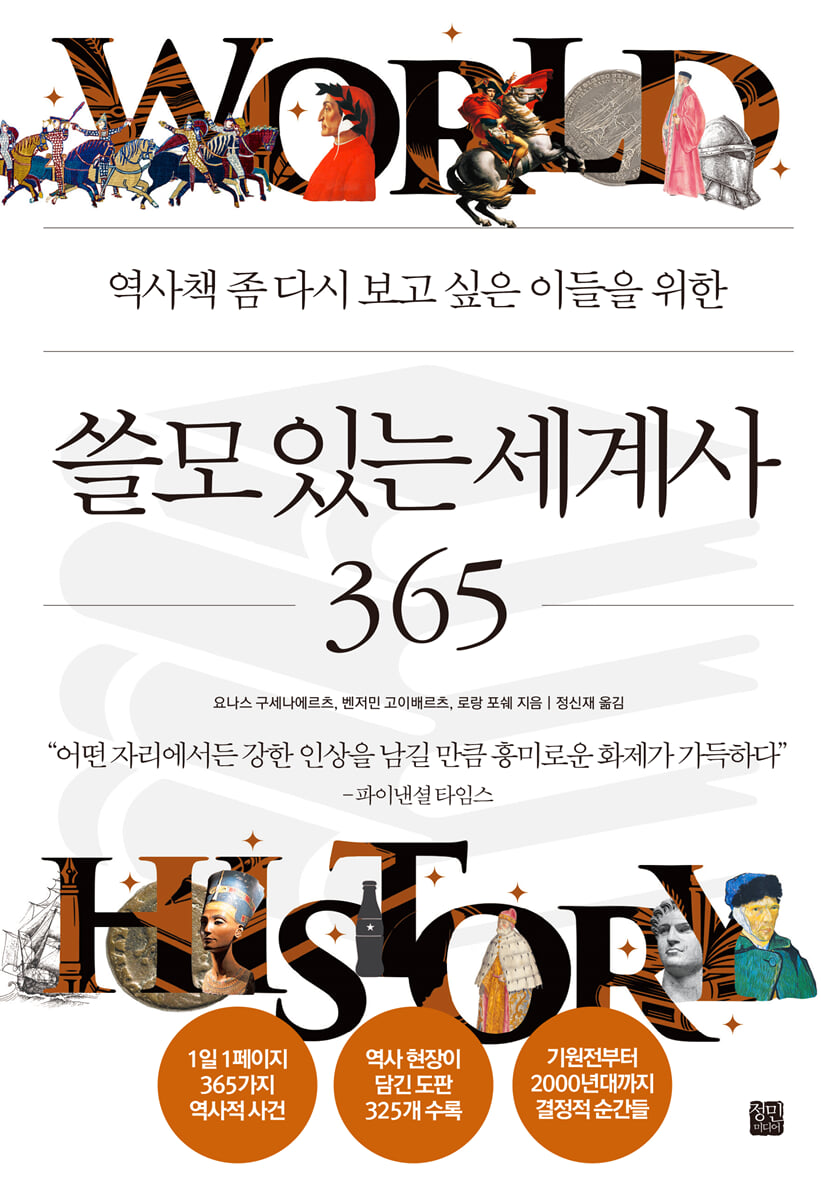
Useful World History 365
 |
Description
Book Introduction
A historical event that shook the fate of humanity
365 Amazing One-Minute World History Stories
“A fascinating world history you've never heard of before.”
- BBC Radio 1, UK
***1 page per day, 365 historical events
***Includes 325 illustrations of historical sites
***Decisive moments from BC to 2000
Two history teachers, facing difficulties finding work due to the COVID-19 pandemic lockdown, have teamed up to take on a new challenge.
For all those who are not yet interested in human history, or who are but have not found an interesting book suitable for their level, this project was to compile the major and sometimes minor events of today's world history into a single book.
Their goal was to present a fascinating account of colorful moments in world history, from the beginning of the Mayan calendar (August 11, 3114 BC) to the collapse of Lehman Brothers (September 15, 2008), the introduction of the euro (January 1, 2002), and the handover of the Panama Canal (December 31, 1999).
This book is structured so that readers can read it in their own way.
You can read one story a day, or you can read several stories at once, as you like.
One way to do this is to skip parts on special days like Friday the 13th, or read two stories together on important days like birthdays.
Designed to allow for free and flexible reading, this book goes beyond simply listing historical facts; it also fascinatingly unravels the meaning and stories behind everyday historical events.
It's perfect for those who want to revisit history books.
365 Amazing One-Minute World History Stories
“A fascinating world history you've never heard of before.”
- BBC Radio 1, UK
***1 page per day, 365 historical events
***Includes 325 illustrations of historical sites
***Decisive moments from BC to 2000
Two history teachers, facing difficulties finding work due to the COVID-19 pandemic lockdown, have teamed up to take on a new challenge.
For all those who are not yet interested in human history, or who are but have not found an interesting book suitable for their level, this project was to compile the major and sometimes minor events of today's world history into a single book.
Their goal was to present a fascinating account of colorful moments in world history, from the beginning of the Mayan calendar (August 11, 3114 BC) to the collapse of Lehman Brothers (September 15, 2008), the introduction of the euro (January 1, 2002), and the handover of the Panama Canal (December 31, 1999).
This book is structured so that readers can read it in their own way.
You can read one story a day, or you can read several stories at once, as you like.
One way to do this is to skip parts on special days like Friday the 13th, or read two stories together on important days like birthdays.
Designed to allow for free and flexible reading, this book goes beyond simply listing historical facts; it also fascinatingly unravels the meaning and stories behind everyday historical events.
It's perfect for those who want to revisit history books.
- You can preview some of the book's contents.
Preview
index
prolog
january
february
March
april
May
June
July
August
September
october
November
december
january
february
March
april
May
June
July
August
September
october
November
december
Detailed image

Into the book
Use this book as you see fit.
You can read one a day, or if you're impatient, you can read it all in one day.
You can skip it on days you don't feel like reading, and read the parts you didn't know twice.
You can be surprised by even the most trivial bits of history, or enjoy the thrill of finally learning about already well-known history.
If it's an important day, like a loved one's birthday, write their name on the calendar and share historical facts about that day.
Well, shall we go and enjoy a year of history?
--- p.7
For balloonist Jean-Pierre Blanchard, this was not his first flight.
Eight years earlier, he had already successfully crossed the English Channel in a hot air balloon.
This flight was Blanchard's 45th hot air balloon flight.
For weeks now, he has been advertising his upcoming hydrogen-fueled hot air balloon flights.
Tickets sell for $5 each.
Almost everyone in Pennsylvania's capital city gathered to witness this extraordinary sight.
At about 9:45, a carriage arrives and 15 guns fire loudly in salute.
The man in the carriage was U.S. President George Washington (1732-1799), who had come to see the hot air balloon launch.
--- p.21
Delft blue, a unique Dutch porcelain, perfectly matches the color of Chinese Ming Dynasty porcelain.
In fact, the term Dutch porcelain also refers to counterfeit Ming Dynasty porcelain.
--- p.35
Shortly after liftoff, one of the booster engines fails, causing the shuttle to disintegrate.
Seven astronauts lost their lives, including teacher Christina McAuliffe (1948–1986).
Christina, who was assigned to fly to rekindle public interest in the space shuttle program, was on the verge of becoming the first astronaut teacher.
However, 73 seconds after launch, it exploded 14,020 meters above the ground with a loud explosion.
--- p.40
On January 31, 1990, McDonald's opened its first store in Russia.
Thousands of Muscovites stand in line for hours, willing to pay the equivalent of several days' salary, just to get their first Big Mac.
At that time, Russia was still a republic of the communist Soviet Union.
The opening of a hamburger joint, a symbol of capitalism, in the heart of a communist country was a clear sign that times were changing.
--- p.43
There were four burial chambers inside the tomb.
It was filled with over 5,000 royal statues, jewels, vases, chariots, musical instruments, furniture, and other objects symbolizing power buried with the Pharaoh for use in the afterlife.
And on February 16th, Tutankhamun's golden sarcophagus was finally opened.
A few weeks later, the Earl of Carnavon and his dog meet with unexpected death.
Their deaths gave rise to the belief that anyone who entered the Pharaoh's tomb would soon be punished.
This is how the 'Curse of Tutankhamun', which has now become a boring old story, was born.
--- p.62
When Bell applied for a patent in 1876, Antonio Meucci filed a lawsuit.
Mooch submits technical drawings and original sketches to the Western Union lab, but they suddenly disappear.
It is presumed that Western Union sold it to Bell on the condition that they would share the profits.
Muchi died while pursuing a lawsuit against Bell, and thus Bell went down in history as the 'Father of the Telephone'.
Later, in 2002, the U.S. House of Representatives passed a bill recognizing Antonio Meucci's rights.
--- p.85
It's very common these days to see April Fool's jokes or pranks on TV.
One of the greatest April Fool's jokes in history was broadcast on the BBC in 1957.
On April 1, 1957, 'Auntie Beeb' (as the BBC nicknamed her) convinced viewers that real spaghetti grows on trees.
--- p.113
On April 23, 1516, Duke Wilhelm IV of Bavaria (1493–1550) issued the Beer Purity Law.
It specifically specifies what ingredients are needed to make beer.
According to the Purity Law, the essential ingredients for making beer are water, malt, and hops, and no other herbs, fruits, or spices may be used.
You can read one a day, or if you're impatient, you can read it all in one day.
You can skip it on days you don't feel like reading, and read the parts you didn't know twice.
You can be surprised by even the most trivial bits of history, or enjoy the thrill of finally learning about already well-known history.
If it's an important day, like a loved one's birthday, write their name on the calendar and share historical facts about that day.
Well, shall we go and enjoy a year of history?
--- p.7
For balloonist Jean-Pierre Blanchard, this was not his first flight.
Eight years earlier, he had already successfully crossed the English Channel in a hot air balloon.
This flight was Blanchard's 45th hot air balloon flight.
For weeks now, he has been advertising his upcoming hydrogen-fueled hot air balloon flights.
Tickets sell for $5 each.
Almost everyone in Pennsylvania's capital city gathered to witness this extraordinary sight.
At about 9:45, a carriage arrives and 15 guns fire loudly in salute.
The man in the carriage was U.S. President George Washington (1732-1799), who had come to see the hot air balloon launch.
--- p.21
Delft blue, a unique Dutch porcelain, perfectly matches the color of Chinese Ming Dynasty porcelain.
In fact, the term Dutch porcelain also refers to counterfeit Ming Dynasty porcelain.
--- p.35
Shortly after liftoff, one of the booster engines fails, causing the shuttle to disintegrate.
Seven astronauts lost their lives, including teacher Christina McAuliffe (1948–1986).
Christina, who was assigned to fly to rekindle public interest in the space shuttle program, was on the verge of becoming the first astronaut teacher.
However, 73 seconds after launch, it exploded 14,020 meters above the ground with a loud explosion.
--- p.40
On January 31, 1990, McDonald's opened its first store in Russia.
Thousands of Muscovites stand in line for hours, willing to pay the equivalent of several days' salary, just to get their first Big Mac.
At that time, Russia was still a republic of the communist Soviet Union.
The opening of a hamburger joint, a symbol of capitalism, in the heart of a communist country was a clear sign that times were changing.
--- p.43
There were four burial chambers inside the tomb.
It was filled with over 5,000 royal statues, jewels, vases, chariots, musical instruments, furniture, and other objects symbolizing power buried with the Pharaoh for use in the afterlife.
And on February 16th, Tutankhamun's golden sarcophagus was finally opened.
A few weeks later, the Earl of Carnavon and his dog meet with unexpected death.
Their deaths gave rise to the belief that anyone who entered the Pharaoh's tomb would soon be punished.
This is how the 'Curse of Tutankhamun', which has now become a boring old story, was born.
--- p.62
When Bell applied for a patent in 1876, Antonio Meucci filed a lawsuit.
Mooch submits technical drawings and original sketches to the Western Union lab, but they suddenly disappear.
It is presumed that Western Union sold it to Bell on the condition that they would share the profits.
Muchi died while pursuing a lawsuit against Bell, and thus Bell went down in history as the 'Father of the Telephone'.
Later, in 2002, the U.S. House of Representatives passed a bill recognizing Antonio Meucci's rights.
--- p.85
It's very common these days to see April Fool's jokes or pranks on TV.
One of the greatest April Fool's jokes in history was broadcast on the BBC in 1957.
On April 1, 1957, 'Auntie Beeb' (as the BBC nicknamed her) convinced viewers that real spaghetti grows on trees.
--- p.113
On April 23, 1516, Duke Wilhelm IV of Bavaria (1493–1550) issued the Beer Purity Law.
It specifically specifies what ingredients are needed to make beer.
According to the Purity Law, the essential ingredients for making beer are water, malt, and hops, and no other herbs, fruits, or spices may be used.
--- p.135
Publisher's Review
"When you open the door to history, every day becomes special."
My knowledge deepens and broadens with each minute of history every day.
This book covers significant events in history that are not well known.
For example, you can rediscover the backstories of events you've heard about but didn't know about, such as the story of how mangoes were worshipped in place of Mao Zedong in China, or how Anne Frank's diary moved the world so deeply.
Additionally, you can explore the diverse aspects of history through a variety of topics and spectrums, from humorous history like April Fool's jokes to innovative events like the invention of the contraceptive pill.
This book is not a simple list of history, but rather helps us look at the various moments connected to everyday life in a new way.
History does not happen only on a specific day, but takes on new meaning as it accumulates and is recorded every day.
Even a small incident can change the world, and countless stories are hidden behind those changes.
Additionally, 325 illustrations depicting historical scenes for each event are included, allowing you to experience a vividness that is quite different from simply reading about it.
Through this book, readers will rediscover stories often overlooked in the flow of history and encounter surprising truths hidden behind famous events.
Rather than simply learning history, it provides a journey to find stories connected to everyday life within it.
The moment we realize how historical events are connected to our daily lives, we will feel closer to history.
If you are curious about our present and future in a rapidly changing society, look back at the past.
What happened today?
World History 365, One Page a Day
January 20 - Six million lives lost after an hour-and-a-half meeting.
March 11 - Over 80,000 people face life-threatening situations without even realizing it.
June 11 - A monk who remained seated cross-legged while engulfed in flames
· August 4 - People worship mangoes, a fruit bestowed by their leader.
October 30 - The War of the Worlds that terrified countless people
December 6 - The face of the oldest beauty in human history
The author captures interesting and surprising historical moments we were unaware of and vividly conveys their background and meaning.
This book goes beyond simply listing historical facts; it piques the reader's curiosity by delving into dramatic events from humanity's past.
Even those who have never been particularly interested in history will find themselves drawn into this book the moment they open it.
For example, on January 20, 1942, just 15 people gathered, discussed for 90 minutes, and decided to kill 11 million people.
This tragic event, in which 6 million people actually died, reveals the cruelty of humanity and the dark side of history.
Also, on March 11, 1958, a nuclear warhead was dropped on South Carolina, USA, but fortunately it ended in a misfire.
It vividly conveys the moment of historical crisis through the fact that it was a bomb twice as powerful as the atomic bomb dropped on Hiroshima, and that 80,000 people were likely killed at the time.
Moreover, the incident in which a monk self-immolated to resist the oppression of the dictatorship shocked the world.
It is said that he did not waver even an inch from his cross-legged posture during the 10 minutes his body was burning, which shows how strong his convictions were.
That photo still resonates deeply to this day.
There are even more interesting incidents.
The absurdity of the 20th century, when a nation's citizens worshipped a mango gifted by their national leader, wrote a poem about it, and even built a golden model, illustrates the humor and irony of history.
On October 30, 1938, when a radio news report was broadcast that Martians were invading Earth, countless people took to the streets in fear. It was later revealed that it was a radio drama, conveying the chaotic atmosphere of the time.
In addition, the discovery of a beautiful bust of a queen from 3,300 years ago makes us marvel at the long history of mankind.
The queen's mystical beauty has captivated hearts across the globe for thousands of years, demonstrating that the standards and meaning of beauty remain unchanged throughout history.
This book captures not only well-known events but also historical moments we were unaware of, offering readers a fresh perspective.
Through 365 world history chapters, one page a day, you will come to realize that history is not simply a record of the past, but a living story that can provide lessons and insights even in the present.
My knowledge deepens and broadens with each minute of history every day.
This book covers significant events in history that are not well known.
For example, you can rediscover the backstories of events you've heard about but didn't know about, such as the story of how mangoes were worshipped in place of Mao Zedong in China, or how Anne Frank's diary moved the world so deeply.
Additionally, you can explore the diverse aspects of history through a variety of topics and spectrums, from humorous history like April Fool's jokes to innovative events like the invention of the contraceptive pill.
This book is not a simple list of history, but rather helps us look at the various moments connected to everyday life in a new way.
History does not happen only on a specific day, but takes on new meaning as it accumulates and is recorded every day.
Even a small incident can change the world, and countless stories are hidden behind those changes.
Additionally, 325 illustrations depicting historical scenes for each event are included, allowing you to experience a vividness that is quite different from simply reading about it.
Through this book, readers will rediscover stories often overlooked in the flow of history and encounter surprising truths hidden behind famous events.
Rather than simply learning history, it provides a journey to find stories connected to everyday life within it.
The moment we realize how historical events are connected to our daily lives, we will feel closer to history.
If you are curious about our present and future in a rapidly changing society, look back at the past.
What happened today?
World History 365, One Page a Day
January 20 - Six million lives lost after an hour-and-a-half meeting.
March 11 - Over 80,000 people face life-threatening situations without even realizing it.
June 11 - A monk who remained seated cross-legged while engulfed in flames
· August 4 - People worship mangoes, a fruit bestowed by their leader.
October 30 - The War of the Worlds that terrified countless people
December 6 - The face of the oldest beauty in human history
The author captures interesting and surprising historical moments we were unaware of and vividly conveys their background and meaning.
This book goes beyond simply listing historical facts; it piques the reader's curiosity by delving into dramatic events from humanity's past.
Even those who have never been particularly interested in history will find themselves drawn into this book the moment they open it.
For example, on January 20, 1942, just 15 people gathered, discussed for 90 minutes, and decided to kill 11 million people.
This tragic event, in which 6 million people actually died, reveals the cruelty of humanity and the dark side of history.
Also, on March 11, 1958, a nuclear warhead was dropped on South Carolina, USA, but fortunately it ended in a misfire.
It vividly conveys the moment of historical crisis through the fact that it was a bomb twice as powerful as the atomic bomb dropped on Hiroshima, and that 80,000 people were likely killed at the time.
Moreover, the incident in which a monk self-immolated to resist the oppression of the dictatorship shocked the world.
It is said that he did not waver even an inch from his cross-legged posture during the 10 minutes his body was burning, which shows how strong his convictions were.
That photo still resonates deeply to this day.
There are even more interesting incidents.
The absurdity of the 20th century, when a nation's citizens worshipped a mango gifted by their national leader, wrote a poem about it, and even built a golden model, illustrates the humor and irony of history.
On October 30, 1938, when a radio news report was broadcast that Martians were invading Earth, countless people took to the streets in fear. It was later revealed that it was a radio drama, conveying the chaotic atmosphere of the time.
In addition, the discovery of a beautiful bust of a queen from 3,300 years ago makes us marvel at the long history of mankind.
The queen's mystical beauty has captivated hearts across the globe for thousands of years, demonstrating that the standards and meaning of beauty remain unchanged throughout history.
This book captures not only well-known events but also historical moments we were unaware of, offering readers a fresh perspective.
Through 365 world history chapters, one page a day, you will come to realize that history is not simply a record of the past, but a living story that can provide lessons and insights even in the present.
GOODS SPECIFICS
- Date of issue: December 5, 2024
- Page count, weight, size: 408 pages | 702g | 152*225*25mm
- ISBN13: 9791191669848
- ISBN10: 119166984X
You may also like
카테고리
korean


korean

![GQ KOREA Mark (Monthly): December [2025]](http://librairie.coreenne.fr/cdn/shop/files/8ef265dbbfbf186523ed75ba7319009d.jpg?v=1765340328&width=3840)


