

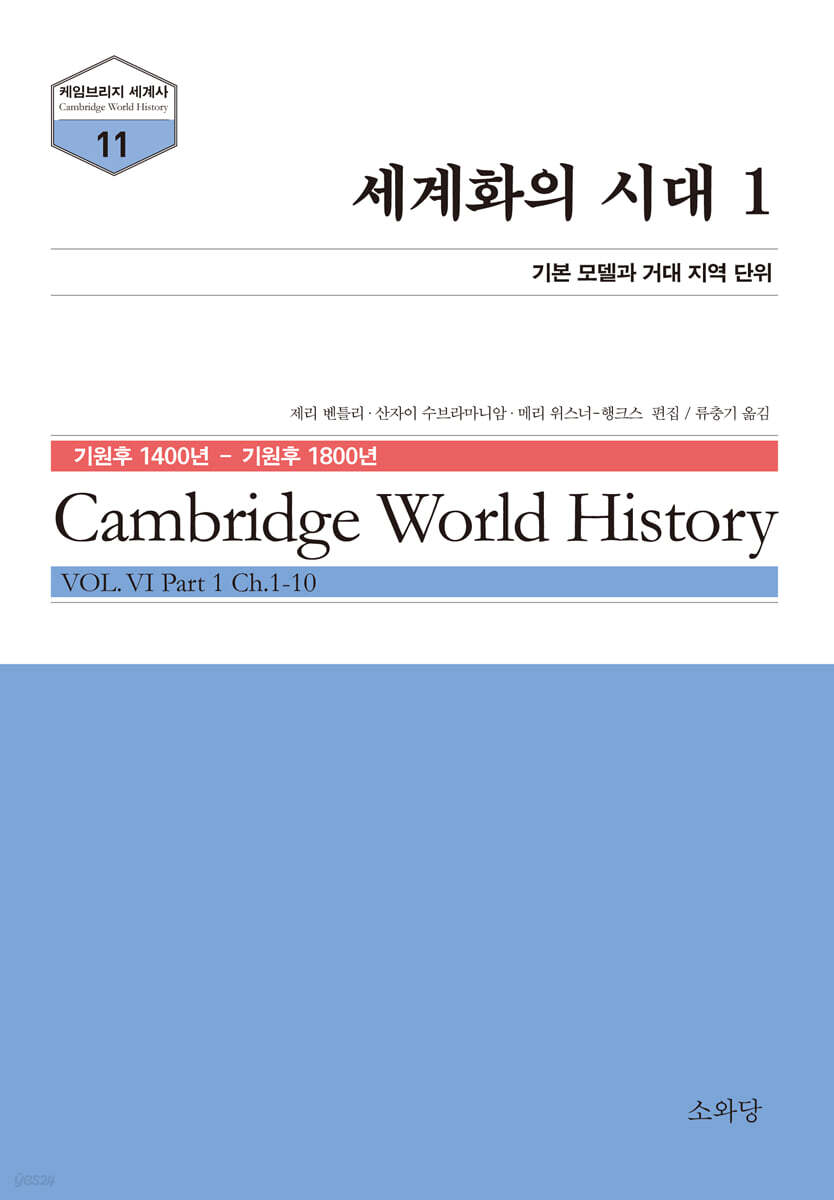
The Age of Globalization 1
 |
Description
Book Introduction
The period from 1400 to 1800 was a period of active biological, commercial, and cultural exchange.
As a result, the world at that time became more closely connected than ever before.
This book (Korean edition, volumes 11-14) examines the important changes of this period.
Volumes 11 and 12 of the Korean edition examine issues of the environment, disease, technology, and cities from a global perspective.
We also looked specifically at empires in the Eastern and Western Hemispheres, the crossroads of the Indian Ocean, Central Asia, and the Caribbean, and areas of competition and conflict such as Southeast Asia, Asia, Africa, and the Mediterranean.
Volumes 13 and 14 of the Korean edition focus on patterns of change.
It analyzes events that occurred on a global scale, including the expansion of Christianity and Islam, migration, and war.
It also examines in detail issues such as the Columbian Exchange, slavery, silver, trade, corporations, Asian religions, legal conflicts, plantation economies, early industrialization, and historiography.
As a result, the world at that time became more closely connected than ever before.
This book (Korean edition, volumes 11-14) examines the important changes of this period.
Volumes 11 and 12 of the Korean edition examine issues of the environment, disease, technology, and cities from a global perspective.
We also looked specifically at empires in the Eastern and Western Hemispheres, the crossroads of the Indian Ocean, Central Asia, and the Caribbean, and areas of competition and conflict such as Southeast Asia, Asia, Africa, and the Mediterranean.
Volumes 13 and 14 of the Korean edition focus on patterns of change.
It analyzes events that occurred on a global scale, including the expansion of Christianity and Islam, migration, and war.
It also examines in detail issues such as the Columbian Exchange, slavery, silver, trade, corporations, Asian religions, legal conflicts, plantation economies, early industrialization, and historiography.
- You can preview some of the book's contents.
Preview
index
CHAPTER 01 Introduction
PART 1 The World's Environment
CHAPTER 02 Depleting the Earth: Environment and History in the Early Modern World
CHAPTER 03 The Globalization of Disease, 1300–1900
CHAPTER 04 Technological Changes in Transitional Periods
CHAPTER 05 Patterns of Urbanization, 1400–1800
CHAPTER 06 Gender and Sexuality
PART 2 Large Regional Units
CHAPTER 07 Eurasia after Mongolia
CHAPTER 08 Change and Continuity of the Indian Ocean Coast
CHAPTER 09 The Age of Native American Empires
CHAPTER 10 Africa in World History, 1400–1800
(Continued in Volume 12)
PART 1 The World's Environment
CHAPTER 02 Depleting the Earth: Environment and History in the Early Modern World
CHAPTER 03 The Globalization of Disease, 1300–1900
CHAPTER 04 Technological Changes in Transitional Periods
CHAPTER 05 Patterns of Urbanization, 1400–1800
CHAPTER 06 Gender and Sexuality
PART 2 Large Regional Units
CHAPTER 07 Eurasia after Mongolia
CHAPTER 08 Change and Continuity of the Indian Ocean Coast
CHAPTER 09 The Age of Native American Empires
CHAPTER 10 Africa in World History, 1400–1800
(Continued in Volume 12)
Publisher's Review
The 11th book in the Cambridge World History series (18 volumes)
The Cambridge World History Series is a vast world history series in which over 200 scholars from around the world have participated.
The Korean version is scheduled to be published in 18 volumes.
This book, the eleventh in a series, shows how the era of globalization began and how large regional units went through a process of integration before full-scale globalization began.
Part 1: The World's Environment
Fundamentally, it examines issues such as the relationship between the environment and history, disease, technology and change, and urbanization patterns on a global scale, and addresses issues of gender and sexuality within the context of social history.
Each chapter covers a fairly wide range of topics, setting the stage for what will be discussed later.
The chapters that follow have a narrower geographical scope.
The issues raised in the preceding chapters are largely material, but they are not entirely devoid of cultural questions.
It shows how the dimensions of comparison and connection are related in the narrative of world history.
It is also interesting that the authors' generations are very widely distributed.
Part 2 Large Regional Units
The various regions of the world have been divided into different categories according to their meaning, and these distinctions themselves have been the subject of recent historical geography research.
The first chapter examines the legacy of the 13th-century Mongol “world conquest.”
As is well known, several major dynasties of the early modern period bore the imprint of Mongol heritage.
Some were direct Mongol descendants (such as the Timurid and Mughal empires in India), while others were indirectly related.
In subsequent articles, we will cover the Indian Ocean, the Americas before European conquest, and Africa, which have brought about a true renaissance of historical scholarship in recent generations.
One of the purposes of this section is to establish certain spatial blocks for a more balanced world history.
The Cambridge World History Series is a vast world history series in which over 200 scholars from around the world have participated.
The Korean version is scheduled to be published in 18 volumes.
This book, the eleventh in a series, shows how the era of globalization began and how large regional units went through a process of integration before full-scale globalization began.
Part 1: The World's Environment
Fundamentally, it examines issues such as the relationship between the environment and history, disease, technology and change, and urbanization patterns on a global scale, and addresses issues of gender and sexuality within the context of social history.
Each chapter covers a fairly wide range of topics, setting the stage for what will be discussed later.
The chapters that follow have a narrower geographical scope.
The issues raised in the preceding chapters are largely material, but they are not entirely devoid of cultural questions.
It shows how the dimensions of comparison and connection are related in the narrative of world history.
It is also interesting that the authors' generations are very widely distributed.
Part 2 Large Regional Units
The various regions of the world have been divided into different categories according to their meaning, and these distinctions themselves have been the subject of recent historical geography research.
The first chapter examines the legacy of the 13th-century Mongol “world conquest.”
As is well known, several major dynasties of the early modern period bore the imprint of Mongol heritage.
Some were direct Mongol descendants (such as the Timurid and Mughal empires in India), while others were indirectly related.
In subsequent articles, we will cover the Indian Ocean, the Americas before European conquest, and Africa, which have brought about a true renaissance of historical scholarship in recent generations.
One of the purposes of this section is to establish certain spatial blocks for a more balanced world history.
GOODS SPECIFICS
- Date of issue: November 25, 2024
- Page count, weight, size: 468 pages | 150*215*30mm
- ISBN13: 9788967220396
- ISBN10: 8967220391
You may also like
카테고리
korean


korean

![GQ KOREA Mark (Monthly): December [2025]](http://librairie.coreenne.fr/cdn/shop/files/8ef265dbbfbf186523ed75ba7319009d.jpg?v=1765340328&width=3840)


