

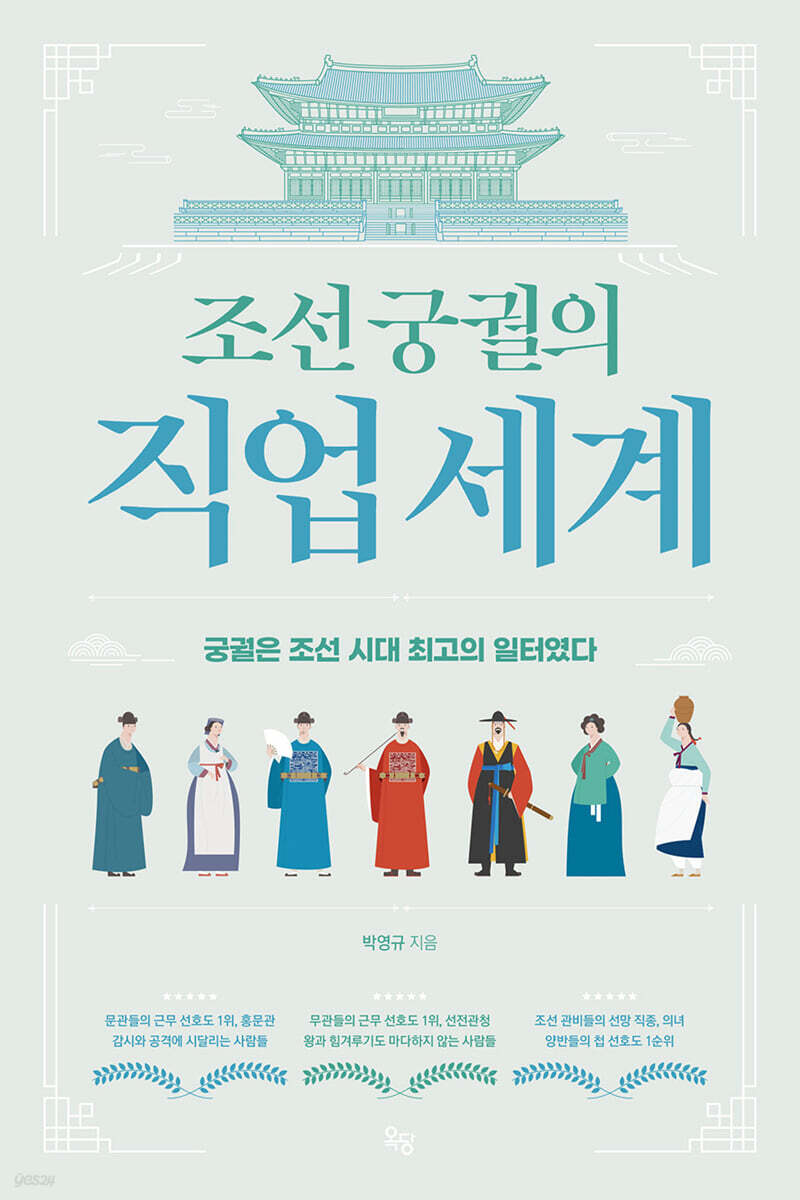
The world of occupations in the Joseon palace
 |
Description
Book Introduction
The palace was the best workplace during the Joseon Dynasty.
There were about 20 government offices within the Joseon palace.
Here, people from all walks of life, from the nobility to slaves, commuted to work every day.
Regardless of their status, they felt great pride in the mere fact that they were working in the palace.
Even if it was a contract job or there was no salary, they greatly preferred to work in the palace.
To that extent, the palace was a dream job for Joseon people.
In this book, the author introduces the various occupations and working environments of those working in the palace.
You can examine by occupation what jobs Koreans most wanted, what they did, how much they earned, and what their work culture was like.
There were about 20 government offices within the Joseon palace.
Here, people from all walks of life, from the nobility to slaves, commuted to work every day.
Regardless of their status, they felt great pride in the mere fact that they were working in the palace.
Even if it was a contract job or there was no salary, they greatly preferred to work in the palace.
To that extent, the palace was a dream job for Joseon people.
In this book, the author introduces the various occupations and working environments of those working in the palace.
You can examine by occupation what jobs Koreans most wanted, what they did, how much they earned, and what their work culture was like.
- You can preview some of the book's contents.
Preview
index
Seomun_ The palace was the best workplace during the Joseon Dynasty.
Chapter 0: The Hottest Job in Joseon Palace
The palace is the best workplace in Joseon
The five palaces representing Joseon
What is the best job in the palace?
A place where contract workers and unpaid workers abound
A person who earns more in retirement than in salary
Joseon workers suffering from painful initiation ceremonies
Chapter 1: Hongmungwan Civil Servants' Most Preferred Job
A field for nurturing talent that began at Jiphyeonjeon
Bookkeeper, political advisor to the king
Officials suffering from surveillance, strife, and attacks
The most honorable scholar in Joseon, Daejehak
Chapter 2: The Example Hall: A place where people risk their lives to record history.
A poetry book written by following the king like a shadow
A civilian who was exiled for being faithful to his duty as an officer
An officer must drink well and write poetry well.
The most common cause of the bloody storm
Chapter 3: The Stepping Stones to the Position of Prime Minister and Minister of the Royal Secretariat
The Joseon king's secretariat and a place of advancement
The eyes, ears, hands, and feet of the king, the servants and servants
Chapter 4 Direct Remarks and Direct Remarks of the Inspector General
The most upright group among bureaucrats
King Taejong used the conflict between the Office of the Inspector General and the Office of the Censor-General to resolve personnel issues.
Chapter 5: The Front Line of Diplomacy
Diplomatic documents come out of our hands.
A place where not even a single letter or word is tolerated
Chapter 6: Printing and Calligraphy at the Library
Joseon's publishing and seal management
Did a monk work at the library?
Chapter 7: The Crown Prince's Secretariat and the Crown Prince's Assistants
The birthplace of future power
Hong Guk-yeong, a powerful man from Sejasi Gangwon
Chapter 8: The Seal of the Royal Secretariat and the Officials of the Ministry of War
The most important seal in Joseon, the royal seal
The logistical resources needed to move the army
There are 670 mapae across the country?
Chapter 9: The Royal Hospital in the Palace
Those who treat the illnesses of the king and queen
Royal physicians who dominated the Joseon Dynasty
- Noh Jung-rye, the best physician of the early Joseon Dynasty, trusted by King Sejong
- Heo Jun, the compiler of Donguibogam, known as the Joseon Dynasty's compilation
- Baek Gwang-hyeon, a dark-eyed man who was promoted from a mere magician to a royal physician
Chapter 10: Female Doctors of Joseon
The most coveted job among Joseon government officials
Medical women mobilized for all kinds of work
The most preferred concubine among noblemen, the female servant
Female doctors who left their mark on history
- Dae Jang Geum, the personal physician to whom King Jungjong entrusted his life until the end
- Jang Deok and Gwi Geum, masters of cavity removal
- Aejong, a renowned doctor of addiction treatment and dedicated to the education of women in the royal family
Chapter 11: The Royal Court Lady's Life Secretarial Secretary
Professional female civil servants in Joseon
Categories and titles of court ladies
The hotel organization consists of seven departments
Key positions of court ladies
The working methods and salaries of palace maids
What did the maids do with their salaries?
Chapter 12: Eunuchs, the royal family's closest secretaries
When did eunuchs, a unique occupation during the dynasty, begin?
Yi Seong-gye, who showed extraordinary passion for organizing eunuchs
Joseon's eunuch department, which possesses both practicality and rationality
How did Joseon kings treat eunuchs?
- Taejong, who treated eunuchs like a tiger
- Sejong, who controlled eunuchs with strict principles
- King Seonjo and King Gwanghaegun, who appointed many eunuchs as their subjects
- King Yeongjo was particularly strict with eunuchs.
- King Jeongjo tried to prevent the tyranny of eunuchs.
Eunuchs who left their mark on history
- Kim Sa-haeng, who established the eunuch system in Joseon
- Eom Ja-chi, the last bastion of the Danjong Dynasty
- Kim Cheo-seon was brutally murdered while criticizing King Yeonsangun's tyranny.
Chapter 13: A Political School for the King of Gyeongyeoncheong
A political forum for kings and their subjects
Taejong, who was kicked out by the queen and had to sleep in the royal palace
Chapter 14: The Most Preferred Job for Propaganda Officials
Those who protect the king's life from the closest
A shortcut to high-ranking positions
A propaganda official who doesn't hesitate to compete with the king
Park Seom, who was unfairly dismissed from his position due to a propaganda officer recommendation issue
Chapter 15: The King's Guard, composed of the finest members of the Royal Guard
700 warriors protecting the king
Various incidents that occurred in my palace
Two people who were convicted of the crime of belittling a commoner of low birth
Chapter 16: The Five Guards Command and the Joint Chiefs of Staff of Joseon
The officers of the Commandery who reigned as tigers over the soldiers
'Gwannaehaengha', a bad habit that has become a custom
Chapter 17: Astronomy and Feng Shui at the Gwan Sang Gam
A gathering of Joseon's natural science experts
Yi Sun-ji, a master of Joseon astronomy, and Jegayeoksangjip
The Legacy of Joseon Astronomical Science Left Behind by the Gwansanggam
Joseon's "Great Hand" Jang Yeong-sil and King Sejong's Scientific Revolution
Chapter 18: Horse and Ranch Management in Saboksi
The place with the most manpower in the palace
Jeomma Byeolgam corruption case
Chapter 19: The Legendary Curtain and Awning
Their fate depends on the weather
Officials who instantly became criminals because of evil deeds
Chapter 20: Management of Royal Property
If you look closely, it is the highest power organization
The tyranny of the Naesusa Byeoljwa reached its peak during the reign of King Yeonsangun.
The evils brought about by the usury business of the internal investigation
Chapter 21: Saongwon: The Workplace of Joseon's Best Chefs
The place in charge of palace food
The popularization of royal cuisine and royal banquets during the Joseon Dynasty
The ordeal of the court officials in charge of royal dining
Chapter 22: The House of Representatives: Leading Joseon Fashion
600 artisans in charge of royal clothing and jewelry
The clothing artisans of the upper house who always live with a heavy heart
The stray dog called 'Sangbang Gisaeng'
Chapter 0: The Hottest Job in Joseon Palace
The palace is the best workplace in Joseon
The five palaces representing Joseon
What is the best job in the palace?
A place where contract workers and unpaid workers abound
A person who earns more in retirement than in salary
Joseon workers suffering from painful initiation ceremonies
Chapter 1: Hongmungwan Civil Servants' Most Preferred Job
A field for nurturing talent that began at Jiphyeonjeon
Bookkeeper, political advisor to the king
Officials suffering from surveillance, strife, and attacks
The most honorable scholar in Joseon, Daejehak
Chapter 2: The Example Hall: A place where people risk their lives to record history.
A poetry book written by following the king like a shadow
A civilian who was exiled for being faithful to his duty as an officer
An officer must drink well and write poetry well.
The most common cause of the bloody storm
Chapter 3: The Stepping Stones to the Position of Prime Minister and Minister of the Royal Secretariat
The Joseon king's secretariat and a place of advancement
The eyes, ears, hands, and feet of the king, the servants and servants
Chapter 4 Direct Remarks and Direct Remarks of the Inspector General
The most upright group among bureaucrats
King Taejong used the conflict between the Office of the Inspector General and the Office of the Censor-General to resolve personnel issues.
Chapter 5: The Front Line of Diplomacy
Diplomatic documents come out of our hands.
A place where not even a single letter or word is tolerated
Chapter 6: Printing and Calligraphy at the Library
Joseon's publishing and seal management
Did a monk work at the library?
Chapter 7: The Crown Prince's Secretariat and the Crown Prince's Assistants
The birthplace of future power
Hong Guk-yeong, a powerful man from Sejasi Gangwon
Chapter 8: The Seal of the Royal Secretariat and the Officials of the Ministry of War
The most important seal in Joseon, the royal seal
The logistical resources needed to move the army
There are 670 mapae across the country?
Chapter 9: The Royal Hospital in the Palace
Those who treat the illnesses of the king and queen
Royal physicians who dominated the Joseon Dynasty
- Noh Jung-rye, the best physician of the early Joseon Dynasty, trusted by King Sejong
- Heo Jun, the compiler of Donguibogam, known as the Joseon Dynasty's compilation
- Baek Gwang-hyeon, a dark-eyed man who was promoted from a mere magician to a royal physician
Chapter 10: Female Doctors of Joseon
The most coveted job among Joseon government officials
Medical women mobilized for all kinds of work
The most preferred concubine among noblemen, the female servant
Female doctors who left their mark on history
- Dae Jang Geum, the personal physician to whom King Jungjong entrusted his life until the end
- Jang Deok and Gwi Geum, masters of cavity removal
- Aejong, a renowned doctor of addiction treatment and dedicated to the education of women in the royal family
Chapter 11: The Royal Court Lady's Life Secretarial Secretary
Professional female civil servants in Joseon
Categories and titles of court ladies
The hotel organization consists of seven departments
Key positions of court ladies
The working methods and salaries of palace maids
What did the maids do with their salaries?
Chapter 12: Eunuchs, the royal family's closest secretaries
When did eunuchs, a unique occupation during the dynasty, begin?
Yi Seong-gye, who showed extraordinary passion for organizing eunuchs
Joseon's eunuch department, which possesses both practicality and rationality
How did Joseon kings treat eunuchs?
- Taejong, who treated eunuchs like a tiger
- Sejong, who controlled eunuchs with strict principles
- King Seonjo and King Gwanghaegun, who appointed many eunuchs as their subjects
- King Yeongjo was particularly strict with eunuchs.
- King Jeongjo tried to prevent the tyranny of eunuchs.
Eunuchs who left their mark on history
- Kim Sa-haeng, who established the eunuch system in Joseon
- Eom Ja-chi, the last bastion of the Danjong Dynasty
- Kim Cheo-seon was brutally murdered while criticizing King Yeonsangun's tyranny.
Chapter 13: A Political School for the King of Gyeongyeoncheong
A political forum for kings and their subjects
Taejong, who was kicked out by the queen and had to sleep in the royal palace
Chapter 14: The Most Preferred Job for Propaganda Officials
Those who protect the king's life from the closest
A shortcut to high-ranking positions
A propaganda official who doesn't hesitate to compete with the king
Park Seom, who was unfairly dismissed from his position due to a propaganda officer recommendation issue
Chapter 15: The King's Guard, composed of the finest members of the Royal Guard
700 warriors protecting the king
Various incidents that occurred in my palace
Two people who were convicted of the crime of belittling a commoner of low birth
Chapter 16: The Five Guards Command and the Joint Chiefs of Staff of Joseon
The officers of the Commandery who reigned as tigers over the soldiers
'Gwannaehaengha', a bad habit that has become a custom
Chapter 17: Astronomy and Feng Shui at the Gwan Sang Gam
A gathering of Joseon's natural science experts
Yi Sun-ji, a master of Joseon astronomy, and Jegayeoksangjip
The Legacy of Joseon Astronomical Science Left Behind by the Gwansanggam
Joseon's "Great Hand" Jang Yeong-sil and King Sejong's Scientific Revolution
Chapter 18: Horse and Ranch Management in Saboksi
The place with the most manpower in the palace
Jeomma Byeolgam corruption case
Chapter 19: The Legendary Curtain and Awning
Their fate depends on the weather
Officials who instantly became criminals because of evil deeds
Chapter 20: Management of Royal Property
If you look closely, it is the highest power organization
The tyranny of the Naesusa Byeoljwa reached its peak during the reign of King Yeonsangun.
The evils brought about by the usury business of the internal investigation
Chapter 21: Saongwon: The Workplace of Joseon's Best Chefs
The place in charge of palace food
The popularization of royal cuisine and royal banquets during the Joseon Dynasty
The ordeal of the court officials in charge of royal dining
Chapter 22: The House of Representatives: Leading Joseon Fashion
600 artisans in charge of royal clothing and jewelry
The clothing artisans of the upper house who always live with a heavy heart
The stray dog called 'Sangbang Gisaeng'
Detailed image

Publisher's Review
The best workplace in Joseon? The palace!
Where is the Joseon version of 'Nekarakubaedangto'?
Why did they prefer the palace even without a salary?
The best work life story in Joseon that we didn't know about
What was the hottest job in Joseon? It was the palace.
The palace was not only a residential space for the king and royal family, but also a place where the most desired jobs of Joseon people were gathered together.
In today's terms, it was a place where all the major corporations, public corporations, and 'Nekarakubundangto (Naver, Kakao, Line, Coupang, Baedal Minjok, Carrot, Toss) that college students most want to work for were gathered together.
The new book, “The World of Occupations in the Joseon Palace,” introduces the various occupations and working environments of those working in the palace.
You can examine by occupation what jobs Koreans most wanted, what they did, how much they earned, and what their work culture was like.
It is different from the previous focus and interest on the king and royal family living in the palace.
Author Park Young-gyu is a best-selling author who has published over 50 books on history, literature, philosophy, and religion.
Beginning with “Reading the Annals of the Joseon Dynasty in One Volume” in 1996, the “Reading History in One Volume” series has been published, ranging from the Annals of the Goryeo Dynasty to the Annals of the Presidents of the Republic of Korea.
This time, he delved into the various occupations within the palace through “The World of Occupations in the Joseon Palace.”
The palace is an opportunity to take a deep look into the lives of working people.
What is the most preferred job among civil and military officials?
There were about 20 government offices within the Joseon palace.
Here, people from all walks of life, from the nobility to slaves, commuted to work every day.
Regardless of their status, they felt great pride in the mere fact that they were working in the palace.
Even if it was a contract job or there was no salary, they greatly preferred to work in the palace.
To that extent, the palace was a dream job for Joseon people.
In particular, Hongmungwan was the most preferred workplace for civil servants.
The main duties were to manage the royal books and historical records and to process documents.
But there was a more important role.
It was to answer the king's questions about various real-world issues.
It was truly a political advisory body for the king.
It was also called the Three Offices of the Press, along with the Office of the Inspector General and the Office of the Censor-General.
Because the importance of the job guaranteed advancement, it was bound to be the most desirable job for civil servants.
So where was the most preferred location for military officers? The Propaganda Office.
Since its mission was to convey the king's orders and protect his safety, it was composed of the king's most trusted people.
The competition was so fierce that anyone with a military background wanted to become a propaganda officer.
It was recognized as a cradle of success that one must pass through to become a high-ranking military officer.
A court lady, the king's woman?
Female civil servants of the dynasty era!
Women also preferred the palace as a workplace.
We often think of court ladies only as the 'king's women'.
However, if we look at it from an occupational perspective, a palace maid is a ‘female civil servant of the dynasty.’
Typically, they enter the palace between the ages of 4 and 16, receive about 15 years of education, and undergo a long process of becoming a formal court lady around the age of 20.
It can be seen as a fairly skilled female professional.
The same goes for eunuchs.
Although they are often portrayed as light and humorous, they are actually special positions created during the dynasty era.
They were indispensable for ensuring the chastity of the palace women and protecting them.
The power of the eunuchs was also considerable.
The eunuch who served the king, 'Seungjeonsaek', was not something even a high-ranking minister could do carelessly.
Even the ministers invited Seungjeonsaek to a banquet to celebrate his victory.
The Real Story of Joseon Palace People
Which palace workplace offered the best work-life balance? Which offered the most privileges? How did unpaid officials make a living? Where did the palace maids spend their money? "The World of Work in the Joseon Palace" is a book that easily answers your questions about the working people of that era.
You can also get a glimpse of the hardships and sorrows they had to endure in the palace.
Just like us today, they had to watch their superiors' faces and sometimes had to go through harsh initiation ceremonies.
Because some jobs paid little or no wages, corruption was rampant.
This book will serve as a mirror for readers to reflect on the lives of the people of the Joseon Dynasty palace.
Where is the Joseon version of 'Nekarakubaedangto'?
Why did they prefer the palace even without a salary?
The best work life story in Joseon that we didn't know about
What was the hottest job in Joseon? It was the palace.
The palace was not only a residential space for the king and royal family, but also a place where the most desired jobs of Joseon people were gathered together.
In today's terms, it was a place where all the major corporations, public corporations, and 'Nekarakubundangto (Naver, Kakao, Line, Coupang, Baedal Minjok, Carrot, Toss) that college students most want to work for were gathered together.
The new book, “The World of Occupations in the Joseon Palace,” introduces the various occupations and working environments of those working in the palace.
You can examine by occupation what jobs Koreans most wanted, what they did, how much they earned, and what their work culture was like.
It is different from the previous focus and interest on the king and royal family living in the palace.
Author Park Young-gyu is a best-selling author who has published over 50 books on history, literature, philosophy, and religion.
Beginning with “Reading the Annals of the Joseon Dynasty in One Volume” in 1996, the “Reading History in One Volume” series has been published, ranging from the Annals of the Goryeo Dynasty to the Annals of the Presidents of the Republic of Korea.
This time, he delved into the various occupations within the palace through “The World of Occupations in the Joseon Palace.”
The palace is an opportunity to take a deep look into the lives of working people.
What is the most preferred job among civil and military officials?
There were about 20 government offices within the Joseon palace.
Here, people from all walks of life, from the nobility to slaves, commuted to work every day.
Regardless of their status, they felt great pride in the mere fact that they were working in the palace.
Even if it was a contract job or there was no salary, they greatly preferred to work in the palace.
To that extent, the palace was a dream job for Joseon people.
In particular, Hongmungwan was the most preferred workplace for civil servants.
The main duties were to manage the royal books and historical records and to process documents.
But there was a more important role.
It was to answer the king's questions about various real-world issues.
It was truly a political advisory body for the king.
It was also called the Three Offices of the Press, along with the Office of the Inspector General and the Office of the Censor-General.
Because the importance of the job guaranteed advancement, it was bound to be the most desirable job for civil servants.
So where was the most preferred location for military officers? The Propaganda Office.
Since its mission was to convey the king's orders and protect his safety, it was composed of the king's most trusted people.
The competition was so fierce that anyone with a military background wanted to become a propaganda officer.
It was recognized as a cradle of success that one must pass through to become a high-ranking military officer.
A court lady, the king's woman?
Female civil servants of the dynasty era!
Women also preferred the palace as a workplace.
We often think of court ladies only as the 'king's women'.
However, if we look at it from an occupational perspective, a palace maid is a ‘female civil servant of the dynasty.’
Typically, they enter the palace between the ages of 4 and 16, receive about 15 years of education, and undergo a long process of becoming a formal court lady around the age of 20.
It can be seen as a fairly skilled female professional.
The same goes for eunuchs.
Although they are often portrayed as light and humorous, they are actually special positions created during the dynasty era.
They were indispensable for ensuring the chastity of the palace women and protecting them.
The power of the eunuchs was also considerable.
The eunuch who served the king, 'Seungjeonsaek', was not something even a high-ranking minister could do carelessly.
Even the ministers invited Seungjeonsaek to a banquet to celebrate his victory.
The Real Story of Joseon Palace People
Which palace workplace offered the best work-life balance? Which offered the most privileges? How did unpaid officials make a living? Where did the palace maids spend their money? "The World of Work in the Joseon Palace" is a book that easily answers your questions about the working people of that era.
You can also get a glimpse of the hardships and sorrows they had to endure in the palace.
Just like us today, they had to watch their superiors' faces and sometimes had to go through harsh initiation ceremonies.
Because some jobs paid little or no wages, corruption was rampant.
This book will serve as a mirror for readers to reflect on the lives of the people of the Joseon Dynasty palace.
GOODS SPECIFICS
- Date of issue: October 7, 2024
- Page count, weight, size: 410 pages | 140*210*30mm
- ISBN13: 9791189936495
- ISBN10: 1189936496
You may also like
카테고리
korean


korean

![GQ KOREA Mark (Monthly): December [2025]](http://librairie.coreenne.fr/cdn/shop/files/8ef265dbbfbf186523ed75ba7319009d.jpg?v=1765340328&width=3840)


