

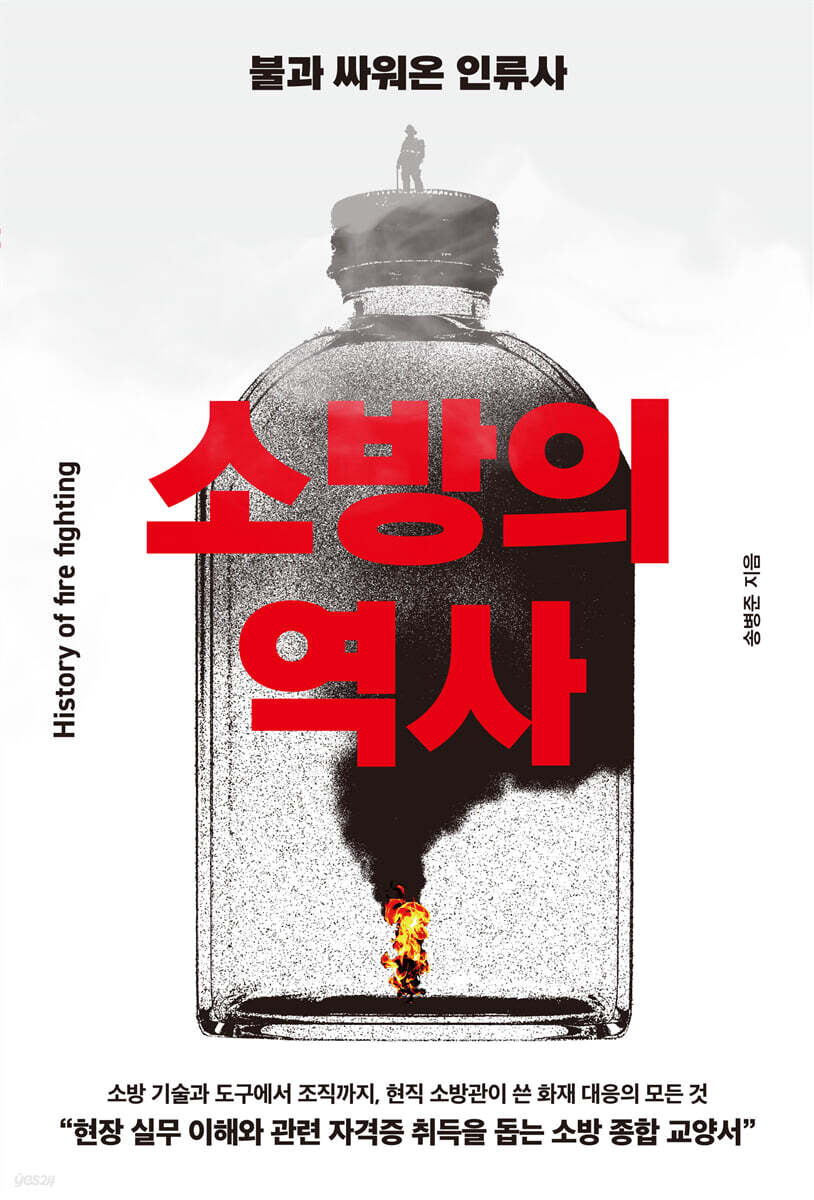
History of Firefighting
 |
Description
Book Introduction
Written with dedication by a current firefighter
A History of Almost Everything About Firefighting
A fascinating micro-history of fire and firefighting, as well as the history of human civilization.
At the same time, for those working in firefighting or preparing for related work, this practical and field-oriented firefighting textbook provides a wealth of background knowledge, common sense, principles, and simulations not found in multiple-choice, short-answer exam books.
From the time when the three elements for fire on Earth were in place 13.4 billion years after the Big Bang and Homo erectus began using fire 1.42 million years ago, to the present day, it is packed with the experiences and knowledge of mankind fighting fire, from extinguishing agents, firefighting tools and techniques, fire trucks, alarms and evacuation facilities, experiences and lessons from great fires, to firefighting organizations and the lives of firefighters.
A History of Almost Everything About Firefighting
A fascinating micro-history of fire and firefighting, as well as the history of human civilization.
At the same time, for those working in firefighting or preparing for related work, this practical and field-oriented firefighting textbook provides a wealth of background knowledge, common sense, principles, and simulations not found in multiple-choice, short-answer exam books.
From the time when the three elements for fire on Earth were in place 13.4 billion years after the Big Bang and Homo erectus began using fire 1.42 million years ago, to the present day, it is packed with the experiences and knowledge of mankind fighting fire, from extinguishing agents, firefighting tools and techniques, fire trucks, alarms and evacuation facilities, experiences and lessons from great fires, to firefighting organizations and the lives of firefighters.
- You can preview some of the book's contents.
Preview
index
Introduction: A History of Humanity and Fire 023
Part 1: A History of Fire Extinguishing Agents - Fire-Suppressing Substances
Chapter 1: Water, the Most Basic Digestive Substance 043
Chapter 2 Carbon Dioxide, a Fire-Extinguishing Gas 054
Chapter 3 Powdered Fire Extinguishing Agent 062
Chapter 4 Foaming Extinguishing Agent 075
Chapter 5 Halon Fire Extinguishing Agent 089
Chapter 6 Halogen Compounds and Inert Gas Extinguishing Agents 107
Chapter 7: Fire Extinguishing Systems 110
Chapter 8: What Will Be the Digestive Agents of the Future? 116
Part 2: History of Fire Extinguishers - Small Fire Trucks
Chapter 1: The Use of Fire and the Need for Extinguishing It 125
Chapter 2: The First Device for Extinguishing Fires 132
Chapter 3: From Bucket to Fire Pump 134
Chapter 4: The Emergence of Modern Digestive Devices 151
Chapter 5 Soda Acid Fire Extinguishers 162
Chapter 6 Glass Bottle Fire Extinguisher 169
Chapter 7: Evolution of Fire Extinguishers According to Combustible Materials 178
Chapter 8 Powder Fire Extinguishers 189
Chapter 9 Halon Fire Extinguishers 196
Chapter 10: The Significance of Digestive Disease and the Need for Education 200
Part 3: Pumps, Fluid Mechanics, and Power Engines - Principles of Firefighting
Chapter 1: The Inevitable Invention: The Pump 213
Chapter 2: Suction and Fluid Mechanics of Fire Pumps 243
Chapter 3: Steam Pumps and Steam Engines 259
Chapter 4: A Groundbreaking Mode of Transportation: Steam Engine Vehicles 275
Chapter 5: Internal Combustion Engine Vehicles Using Liquid Fossil Fuels 281
Part 4: The History of Fire Trucks - A Symbol of Modern Firefighting
Chapter 1: The Evolution of Digestive Organs 301
Chapter 2 British Manual Fire Pumps 310
Chapter 3: American Manual Fire Pumps 333
Chapter 4: The Expanding Role of Firefighters and the End of the Hand Pump Era 344
Chapter 5: Steam Engine Fire Pumps 357
Chapter 6 Internal Combustion Engine Fire Truck 370
Chapter 7 Ladder Trucks, Special-Purpose Fire Trucks 386
Chapter 8: The History of Fire Trucks in Korea 404
Chapter 9: The Significance of Fire Trucks in Modern Society 408
Part 5: The History of Sprinklers - The Guardians of Building Fires
Chapter 1: The Sprinkler Circular 419
Chapter 2: Industrial Changes and Perforated Pipe Irrigation Systems 429
Chapter 3 Sprinkler Heads 437
Chapter 4 Modern Sprinkler Systems 444
Chapter 5: Improving Sprinkler Functionality and Reliability 467
Chapter 6: Sprinkler Fire Extinguishing Systems for Warehouses 481
Chapter 7 Residential Sprinkler Fire Extinguishing Systems 495
Chapter 8: The Future of Sprinklers 500
Part 6: The History of Alarm Systems - The Guardians of Building Fires
Chapter 1: The Golden Hour for Fire Detection 509
Chapter 2 City Fire Alarm 514
Chapter 3: Reporting a Fire 528
Chapter 4 Fire Alarms Inside Buildings 560
Chapter 5 Fire Detection Devices 574
Chapter 6: Fire Alarm Systems in Korea and Japan 592
Chapter 7: The Lifeblood of Alarm Systems: Speed and Accuracy 595
Part 7: History of Evacuation Facilities - Emergency Exits and Exit Lights
Chapter 1: The Evolution of Urban Fire Prevention 607
Chapter 2 Emergency Evacuation Route, Exit 614
Chapter 3 Major Accidents That Revealed the Need for Emergency Exits 621
Chapter 4: Exit Lights, Exit, Exit 649
Part 8: The History of Firefighters - The People Who Put Out Fires
Chapter 1: Firefighter Personal Safety Equipment 667
Chapter 2: The History of Firefighting in Korea 677
Chapter 3: The Work of Firefighters in Korea 692
Part 1: A History of Fire Extinguishing Agents - Fire-Suppressing Substances
Chapter 1: Water, the Most Basic Digestive Substance 043
Chapter 2 Carbon Dioxide, a Fire-Extinguishing Gas 054
Chapter 3 Powdered Fire Extinguishing Agent 062
Chapter 4 Foaming Extinguishing Agent 075
Chapter 5 Halon Fire Extinguishing Agent 089
Chapter 6 Halogen Compounds and Inert Gas Extinguishing Agents 107
Chapter 7: Fire Extinguishing Systems 110
Chapter 8: What Will Be the Digestive Agents of the Future? 116
Part 2: History of Fire Extinguishers - Small Fire Trucks
Chapter 1: The Use of Fire and the Need for Extinguishing It 125
Chapter 2: The First Device for Extinguishing Fires 132
Chapter 3: From Bucket to Fire Pump 134
Chapter 4: The Emergence of Modern Digestive Devices 151
Chapter 5 Soda Acid Fire Extinguishers 162
Chapter 6 Glass Bottle Fire Extinguisher 169
Chapter 7: Evolution of Fire Extinguishers According to Combustible Materials 178
Chapter 8 Powder Fire Extinguishers 189
Chapter 9 Halon Fire Extinguishers 196
Chapter 10: The Significance of Digestive Disease and the Need for Education 200
Part 3: Pumps, Fluid Mechanics, and Power Engines - Principles of Firefighting
Chapter 1: The Inevitable Invention: The Pump 213
Chapter 2: Suction and Fluid Mechanics of Fire Pumps 243
Chapter 3: Steam Pumps and Steam Engines 259
Chapter 4: A Groundbreaking Mode of Transportation: Steam Engine Vehicles 275
Chapter 5: Internal Combustion Engine Vehicles Using Liquid Fossil Fuels 281
Part 4: The History of Fire Trucks - A Symbol of Modern Firefighting
Chapter 1: The Evolution of Digestive Organs 301
Chapter 2 British Manual Fire Pumps 310
Chapter 3: American Manual Fire Pumps 333
Chapter 4: The Expanding Role of Firefighters and the End of the Hand Pump Era 344
Chapter 5: Steam Engine Fire Pumps 357
Chapter 6 Internal Combustion Engine Fire Truck 370
Chapter 7 Ladder Trucks, Special-Purpose Fire Trucks 386
Chapter 8: The History of Fire Trucks in Korea 404
Chapter 9: The Significance of Fire Trucks in Modern Society 408
Part 5: The History of Sprinklers - The Guardians of Building Fires
Chapter 1: The Sprinkler Circular 419
Chapter 2: Industrial Changes and Perforated Pipe Irrigation Systems 429
Chapter 3 Sprinkler Heads 437
Chapter 4 Modern Sprinkler Systems 444
Chapter 5: Improving Sprinkler Functionality and Reliability 467
Chapter 6: Sprinkler Fire Extinguishing Systems for Warehouses 481
Chapter 7 Residential Sprinkler Fire Extinguishing Systems 495
Chapter 8: The Future of Sprinklers 500
Part 6: The History of Alarm Systems - The Guardians of Building Fires
Chapter 1: The Golden Hour for Fire Detection 509
Chapter 2 City Fire Alarm 514
Chapter 3: Reporting a Fire 528
Chapter 4 Fire Alarms Inside Buildings 560
Chapter 5 Fire Detection Devices 574
Chapter 6: Fire Alarm Systems in Korea and Japan 592
Chapter 7: The Lifeblood of Alarm Systems: Speed and Accuracy 595
Part 7: History of Evacuation Facilities - Emergency Exits and Exit Lights
Chapter 1: The Evolution of Urban Fire Prevention 607
Chapter 2 Emergency Evacuation Route, Exit 614
Chapter 3 Major Accidents That Revealed the Need for Emergency Exits 621
Chapter 4: Exit Lights, Exit, Exit 649
Part 8: The History of Firefighters - The People Who Put Out Fires
Chapter 1: Firefighter Personal Safety Equipment 667
Chapter 2: The History of Firefighting in Korea 677
Chapter 3: The Work of Firefighters in Korea 692
Detailed image

Into the book
Looking at the trajectory of the development of fire extinguishing agents, we can see that behind the use of new technologies that could change society, new fires occurred, and that fire extinguishing agents were developed only after numerous fires caused significant damage.
I'm still in that situation.
As we move into the era of electric vehicles, a new type of fire has emerged as a problem, caused by lithium batteries, the power source.
--- p.42
The fire hydrant, a representative facility among the fire fighting water facilities stipulated in our country's law, was also installed in 1908 when the water supply system was installed in Seoul.
From the perspective that water could be useful as a fire extinguishing agent only after the water supply network was built and made readily available as an urban infrastructure, it can be said that active fire suppression became possible in cities from this point on.
--- p.50
There is no extinguishing agent that can be used for all types of combustibles and in all situations.
There is no environmentally friendly fire extinguishing agent that causes less pollution after suppression.
Also, no fire extinguishing agent has ever been developed ahead of the changes in industry.
This is because when new industrial technologies emerge, profit incentives take precedence over safety.
Until now, the development and regulation of digestive medicines have only been implemented when victims have occurred.
However, as industries change and new types of fires arise, fire extinguishing agents are also adapting to these challenges.
The reason why this cannot be helped is because the value of protecting human life is more important than the purpose of an industry that pursues profit.
--- p.118
A year after the fire, the British king commissioned Barbon to devise a solution to repair the royal treasury that had been depleted by the fire, and Barbon devised a home loan product and fire insurance as a means of raising funds for real estate development to rebuild the city.
In 1667, Barbon founded The Fire Office, a fire insurance company, and in 1690, he founded England's first land bank, the National Land Bank, which sold mortgage loans.
--- p.139
Sodium bicarbonate, better known as baking soda or baking powder, was the first substance in powder form used to extinguish fire.
Baking soda, or sodium bicarbonate, which was superior to yeast in terms of efficiency, quickly spread among bakers, and bakers in the kitchen knew from experience that sodium bicarbonate had fire-extinguishing properties.
--- p.189
Due to these quantitative and qualitative changes in firefighting demands, the firefighting field has also developed.
Firefighting has evolved not as a field in itself, but rather in response to the development of other industries. Key among these developments are pump and power engine technologies, and academic achievements in fluid mechanics.
--- p.208
In general, the firefighting field appears to have evolved passively, accepting the maturing achievements of society and industry through innovative research, invention, and technological advancements, rather than developing on its own at the forefront of society and industry.
Because the concept of safety, including fire prevention, is a word that is far from efficiency.
The advancements and developments in the field of firefighting may have been shaped by the enormous property damage and casualties that occurred in the past.
--- p.293
Benjamin Franklin, one of the founding fathers of the United States, is also famous for inventing the lightning rod.
He became alarmed by fire in 1730 when he witnessed a fire on a ship in Philadelphia's Fishbone Harbor, which spread to the docks and nearby warehouses and houses, destroying everything.
Moreover, the horrific sight of people looting during this chaos made me seriously consider the danger that fire poses to the local community.
After purchasing the Pennsylvania Gazette newspaper, Benjamin Franklin often wrote to it from 1733 onward, arguing that "for the efficient and effective protection of a community from fire, some organization for preventing and suppressing it is necessary."
--- p.337
As power generation shifted to internal combustion engine technology that suddenly appeared in the late 19th and early 20th centuries, Merriweather & Sons, a pioneer in steam-powered fire engines, also began producing internal combustion engine fire engines that adapted to the changing times.
Initially, they were built to protect large mansions such as the Rothschilds' to protect themselves from fires, as ordered by wealthy private clients who could afford the high cost of fire trucks.
However, as sales were low and profitability was poor, internal combustion engine fire trucks were soon produced for public fire departments for mass sales.
Early internal combustion engine pump cars usually had a tank of soda extinguishing agent instead of a water-injecting pump.
--- p.372
The history of fire trucks in Korea began in 1723, the third year of King Gyeongjong's reign, with a suggestion from the Office of the Inspector General.
The Gwansanggam imported a water gun, a hand pump that was available in China at the time. However, since no actual object or picture of this Western-imported device remains, its exact nature is unclear.
Initially, it was planned to deploy firearms imported from China to each military base across the country, but this plan was canceled due to successive crop failures.
--- p.404
If a fire breaks out in a large building and grows, all human activities will become meaningless and uncontrollable.
The most direct reason we can live in large buildings without worrying about fire is not because of fire prevention measures, but because of sprinkler systems that automatically operate in the early stages of a fire to prevent fire.
--- p.414
The standard sprinkler regulations, which were created for the benefit of both private entities, capitalists and fire insurance companies, were not mandatory in themselves, but they became generally mandatory due to the voluntary motivation of the two entities.
This can be said to be an example of an event that started out as a private interest but ended up achieving the public interest goal of providing fire protection to all factories in the country.
--- p.466
Lyndon Johnson, the 36th President of the United States, took office after President Kennedy was assassinated and was re-elected.
Johnson first coined the slogan "Great Society" in his 1964 commencement address at the University of Michigan.
The goal of the Great Society was to overcome poverty and racism, and during his term, Johnson proposed and actively promoted policies on education, health care, and welfare for overcrowded cities and rural areas.
Johnson also declared the creation of a comprehensive fire research and safety program in 1967, which led Congress to enact the Fire Research and Safety Act of 1968.
In addition, to ensure the effectiveness of the law, the technical details were delegated to the National Commission on Fire Prevention and Control.
After two years of research, the commission submitted a report to the president in 1973 titled "America Burning."
The report presented concrete statistics showing that while fire damage in the United States is perceived as a low-probability misfortune that occurs to individuals, fires kill 12,000 people and cause $11 billion in property damage each year.
The report also argued that fires, a costly disaster for the nation, should be managed at the federal level.
--- p.495~496
Therefore, the most important thing in an alarm system is reliability, which means that it works reliably in an actual fire and does not work in non-fire situations.
Because it is not easy to implement this reliability with mechanical devices, the current automatic fire detection equipment system went through a long and arduous process.
--- p.507
These five minutes are referred to by the media, including firefighters, as the 'golden time' for firefighting.
As evidence in this regard, we can cite the report titled “Improvement of Firefighting Force Operation to Strengthen Response to Fire Accidents in Seoul” published by the Seoul Institute in 2017.
This report, which analyzed 28,032 fires that occurred from 2010 to 2014, found that the average damage was 2.92 million won when firefighters arrived within 5 minutes, compared to 10.61 million won when they arrived after 5 minutes, showing a difference of more than three times in the amount of damage.
In terms of casualties, the number of deaths was confirmed to be more than double in the 751 fires (2.7 percent) where firefighters arrived within 5 minutes, with 38 deaths, compared to 16 deaths in the 27,281 fires (97.3 percent) where firefighters arrived within 5 minutes.
--- p.510~511
The sound of a bell to warn of disasters such as fire has evolved one step further with the invention of the siren.
Early sirens produced sounds similar to those produced by a spinning top, a type of toy.
A spinning top is a toy with a button threaded through two layers of string. When you pull and release the string held with both hands, the string twists and untwists, causing the button to spin.
This button acts as a flywheel, causing the thread to twist further in the opposite direction, creating a continuous motion.
When a button rotates at high speed, it makes a 'boo-boo-boo' sound. This sound is caused by the vibration of air flowing in and out of the buttonhole as it rotates at high speed.
--- p.519
During the Joseon Dynasty, when a fire was discovered while watching from a bell tower, the bell was rung to summon the fire brigade.
Beginning with the installation of the first motor siren in Korea at Namdaemun Fire Station (the predecessor of Gyeongseong Fire Station) in 1924 during the Japanese colonial period, it spread nationwide.
In the 1930s, siren towers (also serving as fire watchtowers) were installed in most township fire departments across the country.
--- p.525
For similar reasons, Japan also adopted '119' as its emergency number.
Japan considered opening an emergency telephone line by introducing an automatic switching system instead of the manual switching system where operators connect calls, following the Great Kanto Earthquake.
During the process of reviewing the emergency number, we initially decided on '112', which has a short dial time, but there were many cases of mistaken connections due to the location of dial 2 adjacent to 1.
Eventually, the number 9, which had not been used as an area code since 1927, was added to the number, resulting in the current 119.
In Korea, on October 1, 1935, the telephone exchange system at the Gyeongseong Central Telephone Office headquarters was automatically changed, and new numbers for various services provided by telephone were established.
At this time, a total of 10 service numbers were set, including 114, which calls for an exchange, and Japan's 119 number was used as the number to report a fire.
--- p.557
For humans, who are homeothermic animals, maintaining a constant appropriate temperature was very important.
Especially in heating, which began its history at the same time as the use of fire, it has long been difficult to maintain an indoor temperature that is neither too hot nor too cold.
The invention of the smoke detector was greatly influenced by the development of thermostats that automatically maintain indoor temperature.
--- p.577
In Korea, the Enforcement Decree of the Fire Service Act, which was a copy of the Enforcement Decree of the Fire Service Act revised in 1961 in Japan, was applied simultaneously to all modern buildings built after the war on January 15, 1968.
Regardless of our cultural context, social status, and the unique architectural environment that comes with it, standards for installing fire protection facilities in buildings were indiscriminately established and mandated based solely on purpose and size, which resulted in various adverse effects.
--- p.594
Herein lies the core difficulty.
The purpose of an alarm system is to be fulfilled only when the person who hears the sound takes action.
(Omitted) In a fire at Incheon's Saeil Electronics in 2018 that killed nine people and seriously injured six others, it was revealed that the security guard at the time had left the power turned off to the alarm system that frequently malfunctioned.
In the same year, a fire broke out at Sejong Hospital in Miryang, Gyeongsangnam-do, killing 37 people.
One survivor at the time testified that the emergency bell continued to sound for 10 minutes, but the hospital staff, including the caregivers, perceived it as a 'malfunction' and took no action during those crucial 10 minutes that could determine life or death.
--- p.596~597
In firefighting organizations, a false alarm is referred to as a "false fire alarm" when the alarm malfunctions in a situation other than an actual fire.
According to a report on false fire reports submitted by Seoul Metropolitan Council Urban Safety and Construction Committee member Kim Chun-gon in the 2022 administrative audit, out of the approximately 56,000 fire dispatches by Seoul Fire Department from 2019 to September 30, 2022, approximately 14,000 cases, or 24 percent of the total, were false fire reports, and the number is said to be increasing every year.
The report also pointed out the waste of budget due to false alarms, which cost 430,000 won per dispatch.
--- p.598
However, until the late 19th century, urban firefighting was carried out outside the outer walls of buildings.
Most of the ordinary buildings that made up the city had only one entrance, and the safety of the people inside in the event of a fire was not a fire safety consideration.
Each person was responsible for their own life.
--- p.613
The expensive theater had about 1,700 seats and had a high ceiling and marble steps.
The advertising flyer promoting the theater's opening proudly proclaimed, "Absolutely Fireproof."
The content included phrases reassuring people about the dangers of fire, such as “the theater has 27 exits, allowing 1,700 audience members to evacuate within 5 minutes,” “no smoking for audience members,” and “the theater is equipped with the latest alarm systems and fire-fighting equipment.”
However, the reality revealed by the fire was completely different from the content of the text.
--- p.627
Unlike the 'EXIT sign' in the US or the '出口志' in China, in Korea and Japan, the equipment leading to the exit, which is the destination for evacuation, is called 'guide lights'.
This equipment is a lighting device installed along an evacuation route that emits light to indicate the location of the exit.
Just looking at the name, "guide light," it seems to differentiate itself from those in other countries and gives rise to expectations that it will actively guide people inside the building to the exit.
But in fact, there is not much difference in equipment, components, operating principles, and functions from other countries.
--- p.657
Although the Samguk Sagi (History of the Three Kingdoms) records fires that caused large-scale damage and the king's subsequent measures, there is a lack of records on fire management methods.
However, it is believed that when a fire broke out, it was put out in a timely manner through cooperation between local residents and mobilized military forces.
--- p.677
In 1948, when the South Korean government began its activities, the fire department was absorbed into the police.
In 1949, the National Civil Service Act based on a rank system was enacted, and firefighters and police officers were classified as general civil servants.
--- p.683
The number of firefighters, which was 25,008 in 1995, was reduced in July 1998 due to the IMF economic crisis, when the organization of the Ministry of Government Administration and Home Affairs and its affiliated organizations was revised.
The number of firefighters nationwide has continued to increase, exceeding 31,990 in 2006, 40,406 in 2014, 57,122 in 2018, and 67,680 in 2020, excluding the case where 1,431 people were reduced at that time.
The policy of increasing the number of firefighters by 20,000, which began in 2017, has accelerated the increase in the number of firefighters.
--- p.686
Based on my personal experience, it is clear that almost all working conditions have improved since I first joined in 2006.
The two-shift system, where personnel were mobilized for fire fighting water investigations, training, and various events on their off-duty days, has been changed to a three-shift system and a system that guarantees rest time.
Personal equipment has improved and quality has improved, from the days when people had to take turns wearing waterproof raincoats that reached up to their thighs to now having two sets of fire-fighting suits.
Many improvements have been made, including a reduction in the frequency of fires as the outdated city hall building has been improved and the downtown environment has improved through redevelopment.
I'm still in that situation.
As we move into the era of electric vehicles, a new type of fire has emerged as a problem, caused by lithium batteries, the power source.
--- p.42
The fire hydrant, a representative facility among the fire fighting water facilities stipulated in our country's law, was also installed in 1908 when the water supply system was installed in Seoul.
From the perspective that water could be useful as a fire extinguishing agent only after the water supply network was built and made readily available as an urban infrastructure, it can be said that active fire suppression became possible in cities from this point on.
--- p.50
There is no extinguishing agent that can be used for all types of combustibles and in all situations.
There is no environmentally friendly fire extinguishing agent that causes less pollution after suppression.
Also, no fire extinguishing agent has ever been developed ahead of the changes in industry.
This is because when new industrial technologies emerge, profit incentives take precedence over safety.
Until now, the development and regulation of digestive medicines have only been implemented when victims have occurred.
However, as industries change and new types of fires arise, fire extinguishing agents are also adapting to these challenges.
The reason why this cannot be helped is because the value of protecting human life is more important than the purpose of an industry that pursues profit.
--- p.118
A year after the fire, the British king commissioned Barbon to devise a solution to repair the royal treasury that had been depleted by the fire, and Barbon devised a home loan product and fire insurance as a means of raising funds for real estate development to rebuild the city.
In 1667, Barbon founded The Fire Office, a fire insurance company, and in 1690, he founded England's first land bank, the National Land Bank, which sold mortgage loans.
--- p.139
Sodium bicarbonate, better known as baking soda or baking powder, was the first substance in powder form used to extinguish fire.
Baking soda, or sodium bicarbonate, which was superior to yeast in terms of efficiency, quickly spread among bakers, and bakers in the kitchen knew from experience that sodium bicarbonate had fire-extinguishing properties.
--- p.189
Due to these quantitative and qualitative changes in firefighting demands, the firefighting field has also developed.
Firefighting has evolved not as a field in itself, but rather in response to the development of other industries. Key among these developments are pump and power engine technologies, and academic achievements in fluid mechanics.
--- p.208
In general, the firefighting field appears to have evolved passively, accepting the maturing achievements of society and industry through innovative research, invention, and technological advancements, rather than developing on its own at the forefront of society and industry.
Because the concept of safety, including fire prevention, is a word that is far from efficiency.
The advancements and developments in the field of firefighting may have been shaped by the enormous property damage and casualties that occurred in the past.
--- p.293
Benjamin Franklin, one of the founding fathers of the United States, is also famous for inventing the lightning rod.
He became alarmed by fire in 1730 when he witnessed a fire on a ship in Philadelphia's Fishbone Harbor, which spread to the docks and nearby warehouses and houses, destroying everything.
Moreover, the horrific sight of people looting during this chaos made me seriously consider the danger that fire poses to the local community.
After purchasing the Pennsylvania Gazette newspaper, Benjamin Franklin often wrote to it from 1733 onward, arguing that "for the efficient and effective protection of a community from fire, some organization for preventing and suppressing it is necessary."
--- p.337
As power generation shifted to internal combustion engine technology that suddenly appeared in the late 19th and early 20th centuries, Merriweather & Sons, a pioneer in steam-powered fire engines, also began producing internal combustion engine fire engines that adapted to the changing times.
Initially, they were built to protect large mansions such as the Rothschilds' to protect themselves from fires, as ordered by wealthy private clients who could afford the high cost of fire trucks.
However, as sales were low and profitability was poor, internal combustion engine fire trucks were soon produced for public fire departments for mass sales.
Early internal combustion engine pump cars usually had a tank of soda extinguishing agent instead of a water-injecting pump.
--- p.372
The history of fire trucks in Korea began in 1723, the third year of King Gyeongjong's reign, with a suggestion from the Office of the Inspector General.
The Gwansanggam imported a water gun, a hand pump that was available in China at the time. However, since no actual object or picture of this Western-imported device remains, its exact nature is unclear.
Initially, it was planned to deploy firearms imported from China to each military base across the country, but this plan was canceled due to successive crop failures.
--- p.404
If a fire breaks out in a large building and grows, all human activities will become meaningless and uncontrollable.
The most direct reason we can live in large buildings without worrying about fire is not because of fire prevention measures, but because of sprinkler systems that automatically operate in the early stages of a fire to prevent fire.
--- p.414
The standard sprinkler regulations, which were created for the benefit of both private entities, capitalists and fire insurance companies, were not mandatory in themselves, but they became generally mandatory due to the voluntary motivation of the two entities.
This can be said to be an example of an event that started out as a private interest but ended up achieving the public interest goal of providing fire protection to all factories in the country.
--- p.466
Lyndon Johnson, the 36th President of the United States, took office after President Kennedy was assassinated and was re-elected.
Johnson first coined the slogan "Great Society" in his 1964 commencement address at the University of Michigan.
The goal of the Great Society was to overcome poverty and racism, and during his term, Johnson proposed and actively promoted policies on education, health care, and welfare for overcrowded cities and rural areas.
Johnson also declared the creation of a comprehensive fire research and safety program in 1967, which led Congress to enact the Fire Research and Safety Act of 1968.
In addition, to ensure the effectiveness of the law, the technical details were delegated to the National Commission on Fire Prevention and Control.
After two years of research, the commission submitted a report to the president in 1973 titled "America Burning."
The report presented concrete statistics showing that while fire damage in the United States is perceived as a low-probability misfortune that occurs to individuals, fires kill 12,000 people and cause $11 billion in property damage each year.
The report also argued that fires, a costly disaster for the nation, should be managed at the federal level.
--- p.495~496
Therefore, the most important thing in an alarm system is reliability, which means that it works reliably in an actual fire and does not work in non-fire situations.
Because it is not easy to implement this reliability with mechanical devices, the current automatic fire detection equipment system went through a long and arduous process.
--- p.507
These five minutes are referred to by the media, including firefighters, as the 'golden time' for firefighting.
As evidence in this regard, we can cite the report titled “Improvement of Firefighting Force Operation to Strengthen Response to Fire Accidents in Seoul” published by the Seoul Institute in 2017.
This report, which analyzed 28,032 fires that occurred from 2010 to 2014, found that the average damage was 2.92 million won when firefighters arrived within 5 minutes, compared to 10.61 million won when they arrived after 5 minutes, showing a difference of more than three times in the amount of damage.
In terms of casualties, the number of deaths was confirmed to be more than double in the 751 fires (2.7 percent) where firefighters arrived within 5 minutes, with 38 deaths, compared to 16 deaths in the 27,281 fires (97.3 percent) where firefighters arrived within 5 minutes.
--- p.510~511
The sound of a bell to warn of disasters such as fire has evolved one step further with the invention of the siren.
Early sirens produced sounds similar to those produced by a spinning top, a type of toy.
A spinning top is a toy with a button threaded through two layers of string. When you pull and release the string held with both hands, the string twists and untwists, causing the button to spin.
This button acts as a flywheel, causing the thread to twist further in the opposite direction, creating a continuous motion.
When a button rotates at high speed, it makes a 'boo-boo-boo' sound. This sound is caused by the vibration of air flowing in and out of the buttonhole as it rotates at high speed.
--- p.519
During the Joseon Dynasty, when a fire was discovered while watching from a bell tower, the bell was rung to summon the fire brigade.
Beginning with the installation of the first motor siren in Korea at Namdaemun Fire Station (the predecessor of Gyeongseong Fire Station) in 1924 during the Japanese colonial period, it spread nationwide.
In the 1930s, siren towers (also serving as fire watchtowers) were installed in most township fire departments across the country.
--- p.525
For similar reasons, Japan also adopted '119' as its emergency number.
Japan considered opening an emergency telephone line by introducing an automatic switching system instead of the manual switching system where operators connect calls, following the Great Kanto Earthquake.
During the process of reviewing the emergency number, we initially decided on '112', which has a short dial time, but there were many cases of mistaken connections due to the location of dial 2 adjacent to 1.
Eventually, the number 9, which had not been used as an area code since 1927, was added to the number, resulting in the current 119.
In Korea, on October 1, 1935, the telephone exchange system at the Gyeongseong Central Telephone Office headquarters was automatically changed, and new numbers for various services provided by telephone were established.
At this time, a total of 10 service numbers were set, including 114, which calls for an exchange, and Japan's 119 number was used as the number to report a fire.
--- p.557
For humans, who are homeothermic animals, maintaining a constant appropriate temperature was very important.
Especially in heating, which began its history at the same time as the use of fire, it has long been difficult to maintain an indoor temperature that is neither too hot nor too cold.
The invention of the smoke detector was greatly influenced by the development of thermostats that automatically maintain indoor temperature.
--- p.577
In Korea, the Enforcement Decree of the Fire Service Act, which was a copy of the Enforcement Decree of the Fire Service Act revised in 1961 in Japan, was applied simultaneously to all modern buildings built after the war on January 15, 1968.
Regardless of our cultural context, social status, and the unique architectural environment that comes with it, standards for installing fire protection facilities in buildings were indiscriminately established and mandated based solely on purpose and size, which resulted in various adverse effects.
--- p.594
Herein lies the core difficulty.
The purpose of an alarm system is to be fulfilled only when the person who hears the sound takes action.
(Omitted) In a fire at Incheon's Saeil Electronics in 2018 that killed nine people and seriously injured six others, it was revealed that the security guard at the time had left the power turned off to the alarm system that frequently malfunctioned.
In the same year, a fire broke out at Sejong Hospital in Miryang, Gyeongsangnam-do, killing 37 people.
One survivor at the time testified that the emergency bell continued to sound for 10 minutes, but the hospital staff, including the caregivers, perceived it as a 'malfunction' and took no action during those crucial 10 minutes that could determine life or death.
--- p.596~597
In firefighting organizations, a false alarm is referred to as a "false fire alarm" when the alarm malfunctions in a situation other than an actual fire.
According to a report on false fire reports submitted by Seoul Metropolitan Council Urban Safety and Construction Committee member Kim Chun-gon in the 2022 administrative audit, out of the approximately 56,000 fire dispatches by Seoul Fire Department from 2019 to September 30, 2022, approximately 14,000 cases, or 24 percent of the total, were false fire reports, and the number is said to be increasing every year.
The report also pointed out the waste of budget due to false alarms, which cost 430,000 won per dispatch.
--- p.598
However, until the late 19th century, urban firefighting was carried out outside the outer walls of buildings.
Most of the ordinary buildings that made up the city had only one entrance, and the safety of the people inside in the event of a fire was not a fire safety consideration.
Each person was responsible for their own life.
--- p.613
The expensive theater had about 1,700 seats and had a high ceiling and marble steps.
The advertising flyer promoting the theater's opening proudly proclaimed, "Absolutely Fireproof."
The content included phrases reassuring people about the dangers of fire, such as “the theater has 27 exits, allowing 1,700 audience members to evacuate within 5 minutes,” “no smoking for audience members,” and “the theater is equipped with the latest alarm systems and fire-fighting equipment.”
However, the reality revealed by the fire was completely different from the content of the text.
--- p.627
Unlike the 'EXIT sign' in the US or the '出口志' in China, in Korea and Japan, the equipment leading to the exit, which is the destination for evacuation, is called 'guide lights'.
This equipment is a lighting device installed along an evacuation route that emits light to indicate the location of the exit.
Just looking at the name, "guide light," it seems to differentiate itself from those in other countries and gives rise to expectations that it will actively guide people inside the building to the exit.
But in fact, there is not much difference in equipment, components, operating principles, and functions from other countries.
--- p.657
Although the Samguk Sagi (History of the Three Kingdoms) records fires that caused large-scale damage and the king's subsequent measures, there is a lack of records on fire management methods.
However, it is believed that when a fire broke out, it was put out in a timely manner through cooperation between local residents and mobilized military forces.
--- p.677
In 1948, when the South Korean government began its activities, the fire department was absorbed into the police.
In 1949, the National Civil Service Act based on a rank system was enacted, and firefighters and police officers were classified as general civil servants.
--- p.683
The number of firefighters, which was 25,008 in 1995, was reduced in July 1998 due to the IMF economic crisis, when the organization of the Ministry of Government Administration and Home Affairs and its affiliated organizations was revised.
The number of firefighters nationwide has continued to increase, exceeding 31,990 in 2006, 40,406 in 2014, 57,122 in 2018, and 67,680 in 2020, excluding the case where 1,431 people were reduced at that time.
The policy of increasing the number of firefighters by 20,000, which began in 2017, has accelerated the increase in the number of firefighters.
--- p.686
Based on my personal experience, it is clear that almost all working conditions have improved since I first joined in 2006.
The two-shift system, where personnel were mobilized for fire fighting water investigations, training, and various events on their off-duty days, has been changed to a three-shift system and a system that guarantees rest time.
Personal equipment has improved and quality has improved, from the days when people had to take turns wearing waterproof raincoats that reached up to their thighs to now having two sets of fire-fighting suits.
Many improvements have been made, including a reduction in the frequency of fires as the outdated city hall building has been improved and the downtown environment has improved through redevelopment.
--- p.701
Publisher's Review
A micro-history of firefighting written by a current firefighter
Contains the footsteps of mankind that developed while fighting against fire
A firefighter who works in a fire scene covered in flames and smoke has compiled a book about the progress of mankind while fighting fire.
By discovering, controlling, and fighting fire, mankind improved the quality of life and formed large cities, leading to the civilization we have today.
From the perspective of fire, the history of mankind is also the history of developing fire-fighting capabilities, technologies, and firefighting organizations.
《The History of Firefighting》 is a book that explores the microhistory of firefighting, an important part of human history.
This is the first time in Korea, and it would be difficult to find a similar case worldwide where a current firefighter has written a history book on the subject.
In a situation where domestic books and materials on firefighting are extremely scarce, the author spent a long time studying science and technology, anthropology and paleontology, and urban history on his own. During the three years he began writing in earnest, he dedicated his time after work and off to searching for and organizing materials by searching through overseas patent documents, articles, theses, and blogs.
Author Song Byeong-jun was appointed as a firefighter in 2006 and worked at the Industrial Complex Fire Station, Nambu (Michuhol) Fire Station, and Incheon Fire Academy under the Incheon Fire Department. He also served as a professor and fire instructor at the National Fire Agency's Central Fire Academy and is currently a firefighter at the Incheon Fire Department, working at fire scenes.
300 million years ago, fire became possible on Earth.
Fire has been used since Homo erectus 1.42 million years ago.
Before the firefighting operation, there was a fire first.
But when did fire first exist on Earth?
In fire science, the three elements of fire are said to be 'combustible material', 'oxygen', and 'heat'.
All three of these elements must be present for fire to occur, and based on this, the environment in which fire can occur on this Earth where we live was created around 300 million years ago when a certain concentration of oxygen was created in the atmosphere and combustible organic matter was abundant on land.
Fire is not a common phenomenon in space, such as on planets without atmospheres or with different atmospheric compositions.
This can only happen if there is an Earth-like environment where a constant oxygen concentration is maintained in the atmosphere and the surface is rich in organic matter, i.e. carbon compounds that can burn.
It is a very special phenomenon that may only occur on Earth, and could only occur if there was a chance event where heat energy was concentrated in a space containing combustible materials, based on the current atmospheric oxygen concentration of 21 percent.
-Page 27
So when did humans first recognize and utilize fire?
The oldest evidence of fire use comes from pieces of burnt clay found with chipped stone tools called Oldowan tools in Tsesowanza, Kenya.
Based on this, the author introduces the paleontological view that fire began to be used 1.42 million years ago when Homo erectus was active.
Jill D. Fruetz, an anthropologist at the University of Iowa, discovered this fact.
Pruetz and Nicole M. Herzog of the University of Utah.
Herzog conducted research with this group of chimpanzees to explore the connection between early humans and fire.
The two anthropologists developed a model in which humans acquired the ability to control fire through three stages of cognitive evolution.
The first step was to understand the concept of fire enough to understand and anticipate its movements and be able to get close to it; the second step was to have the control to make the fire grow or shrink by adding or removing fuel; and the third step was to have the ability to start a fire where there was no fire.
It was predicted that each stage's ability would be acquired sequentially, and that only at the final stage would humans be able to eat meat.
-Page 128
The acquisition of the ability to use fire freely brought about qualitative and dramatic changes in all aspects of human life.
There is no doubt that fire was essential and useful to life, as it enabled the start of civilized life, but on the other hand, it also carried the risk of destroying not only the surrounding environment but also human life.
Therefore, the ability to prevent or suppress fire-related disasters has emerged as an essential element.
This is followed by the author's extensive exploration of how the book's subjects—firefighting technology, extinguishing agents, firefighting tools, and organizations—were conceived, changed, and developed.
A configuration that meets the needs of end users
A comprehensive firefighting textbook combining intellectual inquiry and field orientation.
Although it begins by exploring the relationship between humanity and fire, "A History of Firefighting" is not structured chronologically.
This book has an unusual structure that at first glance resembles a practical manual: Part 1: History of fire extinguishing agents (materials that put out fires); Part 2: History of fire extinguishing equipment; Part 3: Pumps, fluid mechanics, and power engines; Part 4: History of fire engines; Part 5: History of sprinklers; Part 6: History of alarm systems; Part 7: History of evacuation systems; and Part 8: History of firefighters.
But a little closer examination reveals that this is an approach aimed purely at practicality in the field.
The author has designed this book with the needs of actual users in mind, such as firefighters and those preparing for certification, so that it can be utilized not only for exploration to satisfy intellectual curiosity but also in fire scenes or practical training settings.
While working at fire sites and in related educational institutions, the author realized how difficult it is to easily convey to users the origins, uses, operating principles, utility, and limitations of currently used fire extinguishing agents, fire extinguishing devices, fire trucks, and firefighting equipment.
Even in laws and regulations, there were many questions about the reality in which terms and facts that do not match actual use were continuously reproduced within certain boundaries.
Even if we increase firefighting equipment and organizations, about 40,000 fires occur in our country every year, causing over 2,000 casualties and over 1 trillion won in property damage.
As civilization develops, the machines and items used by humans change, and the methods of digestion also change with each change.
The main motivation for writing this book is to deeply recognize this dynamic interrelationship and to amplify interest and diverse imagination in the conditions, methods, and countermeasures of fire, thereby educating people to prevent fires in advance or minimize damage.
This configuration, designed with practicality in mind, also has the advantage of clearly showing how the primary goal of firefighting has changed to reducing casualties.
The development of all firefighting tools, equipment, and organizations has been consistent because, while in the early history, activities focused on protecting property such as buildings have shifted to prioritizing the value of human life in modern times.
In the 1820s in England, Abraham Wivell, a hairdresser, painter, and writer, took issue with the fact that the firefighting activities of the British private fire brigades at the time were primarily focused on protecting property, namely buildings, rather than protecting people.
This prompted Webel to create a wheeled evacuation device attached to a folding ladder to allow people who were unable to escape from the upper floors of a burning building to the ground floor and had no escape route to escape through windows.
This ladder could reach the second floor when folded, and could reach the fourth floor when an additional ladder with a hook was extended.
On the opposite side of the ladder from where people climb up and down, a long cloth handle with open top and bottom was hung so that several people could slide down to the ground.
In 1836, Wiebel founded the Royal Society for the Protection of Life from Fire and distributed 85 ladder trucks throughout London.
-Pages 349-350
The reason there were so many casualties in the Daeyeongak Hotel fire was largely because, in an era where economic development was the top priority, safety awareness, which prioritizes human life, was pushed to the back burner.
As evidence, we can cite the fire at the Dae-A Tourist Hotel in Busan in 1984.
Although improved fire prevention measures were implemented based on lessons learned from the Daeyeon-gak fire, there were still many casualties from similar causes.
In this fire, the sprinklers did not work at all, the hotel's interior was made of flammable materials that were not flame retardant, and the alarm systems and exit lights did not function properly.
Additionally, many of the emergency exit doors inside the building were locked.
-Page 644
In this way, "The History of Firefighting" is an interesting micro-history of fire and firefighting response, as well as a history of human civilization. However, for those working in firefighting or preparing for related work, it is a comprehensive, field-oriented textbook that provides a wealth of background knowledge, common sense, principles, and simulations that cannot be found in exam preparation materials for certification exams.
From squats to sprinklers
Life in a big city is possible thanks to the advancement of firefighting.
As society became agricultural and people began to live in villages, the density of houses increased, and the scale of fires also increased.
In particular, in places where civilizations flourished, such as ancient Greece, Egypt, and Rome, firefighting technology and organizations began to develop after suffering massive fire damage.
《A History of Firefighting》 closely explores the innovations and developments in firefighting technology, from the squat, the first fire-extinguishing device with recorded records, to sprinklers, fire alarms, and guide lights, which have become essential fixtures in modern buildings.
Modern people accustomed to living in big cities today often fail to grasp the significant role that the development of firefighting played in the formation of cities.
For example, the Great Fire of London, which broke out from September 2 to 6, 1666, destroyed 13,200 houses, 87 parish churches, St. Paul's Cathedral, and most of the buildings within its radius, which was approximately four-fifths of all buildings in London, and rendered 70,000 of the city's 80,000 inhabitants homeless.
The Great Fire of London was a disaster that showed that a city cannot survive without fire preparedness.
A year after the great fire, home loan products and fire insurance were designed to raise funds for urban reconstruction.
Having also experienced the Great Fire, the London authorities actively implemented policies to address the fire threat to the city. In 1708, they mandated that all parishes possess a hand-operated fire pump, and in 1726, they established the first paid fire brigade in England, paid from city funds, in Yorkshire in northeast England.
Soon after this expansion, London became the epicenter of the Industrial Revolution and a megacity whose population grew by leaps and bounds to over a million in just a few decades.
At the root of the Industrial Revolution and urbanization was the development of firefighting technology and firefighting organizations that significantly increased after the Great Fire of London.
Our country also experienced a major fire, and as a result, we developed countermeasures and increased the size of the population concentrated in the capital city.
The fire that caused large-scale damage and the king's response to it are also recorded in the Samguk Sagi (History of the Three Kingdoms).
It is from the time of King Sejong that we can take a closer look at the changes and activities of specific firefighting organizations.
It was also due to the shock caused by the great fire that occurred in Hanyang.
On February 15, 1426, the 8th year of King Sejong's reign, a large fire, presumed to be caused by arson, broke out in Hanyangseong.
At the time, Hanyang was divided into five parts: central, east, west, south, and north. The scale of the fire was such that 2,200 houses, about one-tenth of the entire Hanyang, were lost, including 1,630 houses in the central part, 190 houses in the east, and 350 houses in the south.
(syncopation)
In 1431, the 13th year of King Sejong's reign, the Geumhwagun, a fire suppression unit equipped with ropes, ladders, hooks, and axes, was formed.
When the Geumhwa Army discovered a fire, they raised a flag and sounded a drum to report the fire, and they wore a Shinpae (信牌) to allow them to move around even at night when movement was prohibited.
Their main activity was to destroy buildings to prevent the fire from spreading throughout the city, and to put out the fire by covering it with wet cloths.
-Pages 678-680
The United Nations Department of Economic and Social Affairs (DESA) classifies large cities with a population of more than 10 million as "megacities." Today, there are about 30 megacities around the world, and nearly half of the world's population lives in large cities.
Behind this massive urbanization, "The History of Firefighting" vividly illustrates the fierce competition between unimaginable fire experiences and the advancement of firefighting technology.
It is a general book for the general public interested in fire and safety.
An opportunity to develop risk tolerance
In our country, approximately 40,000 fires occur every year, resulting in numerous casualties and enormous property losses.
When a fire breaks out, the word "man-made disaster" invariably comes up, and postmortem diagnoses are made, such as the fire door was open, the sprinklers did not work, the emergency exits did not function, and the alarm did not sound.
The lack of proper fire safety equipment in buildings and people's indifference to safety contributed to the spread of fires and increased casualties.
If we look around carefully, we can see that fire-fighting tools and devices are installed everywhere.
However, we do not pay attention to this in normal times, pay attention to how to use it, or make efforts to protect ourselves in case of an emergency.
This is also indirectly revealed in the ‘Public Awareness Survey on Fire’ (2019) conducted by the National Fire Agency.
“When asked whether they felt fire was dangerous, 86 percent of the people who had experienced fire directly or indirectly responded that ‘fire is dangerous,’ while only 75 percent of the people who had not experienced fire responded that fire was dangerous” (pp. 205-206).
The most effective way to break the vicious cycle of repeated major accidents is to raise public awareness of safety by increasing public interest in firefighting and sensitivity to risks.
I encourage each of you to imagine at least once whether there is truly no possibility of fire breaking out around you, whether the fire prevention facilities of the building you are in will allow you to safely evacuate to the ground if a fire breaks out in the space you are in, and whether the fire trucks stationed at the nearby 119 Safety Center will be able to rescue you from the fire.
Fire deaths are caused by small things like bicycles left on apartment fire escapes that no one seems to use, doorstops that allow fire doors to remain open, and alarm systems that are deliberately disabled due to frequent malfunctions.
-Pages 410-411
The way to protect yourself from disasters like fire is to increase your risk tolerance.
Anyone can be a victim of a sudden disaster, and we must be prepared for it. For firefighting training to be truly effective, risk awareness is essential.
In order to maximize the performance of fire extinguishers, the general public who use fire extinguishers must be aware of the significance and purpose of installation of fire extinguishers, be able to assess the risks and effectiveness of using fire extinguishers, and be able to determine how to use them in individual fire situations.
If you hear a fire alarm that may be indifferent due to frequent malfunctions, you should not underestimate the significance of the warning even if it is somewhat inaccurate, separate from efforts to improve the reliability of the detector for everyone's safety.
Above all, the most realistic thing is to generate voluntary motivation through awareness and interest that the purpose of fire extinguisher training is not for the safety of others, but for one's own safety.
Voluntary motivation-driven education and training will improve the content and results of regular and statutory education and training, which were previously forgotten due to passive participation in emergencies. The trigger for voluntary motivation begins with raising risk awareness so that everyone can feel the real danger of fire, that it has happened to their neighbors and that it could happen to them too.
-Page 206
As you read "The History of Firefighting," which explores the arduous journey that humanity has endured in the face of the disaster of fire to reach the present, the causes and devastation of fires that changed the history of firefighting, and the motivation and driving force behind the pioneers who first invented firefighting tools, you will naturally become particularly cautious about fires and pay close attention to safety.
By paying close attention to whether the fire extinguisher in your home is in working condition, how to use the fire extinguisher installed in your office building, and which way the emergency exits in the building face, you will develop a sense of risk by observing their actual use.
The fruit of a working firefighter's dedicated research, "History of Firefighting" contains "almost everything" about firefighting, from ancient times to the present, including cases, history, and experiences from Europe, the United States, and Korea.
I hope this book, which is a rich and honest record of a missed aspect of history and is also packed with practical knowledge for a safe life for modern people, will be widely utilized in accordance with its purpose.
Contains the footsteps of mankind that developed while fighting against fire
A firefighter who works in a fire scene covered in flames and smoke has compiled a book about the progress of mankind while fighting fire.
By discovering, controlling, and fighting fire, mankind improved the quality of life and formed large cities, leading to the civilization we have today.
From the perspective of fire, the history of mankind is also the history of developing fire-fighting capabilities, technologies, and firefighting organizations.
《The History of Firefighting》 is a book that explores the microhistory of firefighting, an important part of human history.
This is the first time in Korea, and it would be difficult to find a similar case worldwide where a current firefighter has written a history book on the subject.
In a situation where domestic books and materials on firefighting are extremely scarce, the author spent a long time studying science and technology, anthropology and paleontology, and urban history on his own. During the three years he began writing in earnest, he dedicated his time after work and off to searching for and organizing materials by searching through overseas patent documents, articles, theses, and blogs.
Author Song Byeong-jun was appointed as a firefighter in 2006 and worked at the Industrial Complex Fire Station, Nambu (Michuhol) Fire Station, and Incheon Fire Academy under the Incheon Fire Department. He also served as a professor and fire instructor at the National Fire Agency's Central Fire Academy and is currently a firefighter at the Incheon Fire Department, working at fire scenes.
300 million years ago, fire became possible on Earth.
Fire has been used since Homo erectus 1.42 million years ago.
Before the firefighting operation, there was a fire first.
But when did fire first exist on Earth?
In fire science, the three elements of fire are said to be 'combustible material', 'oxygen', and 'heat'.
All three of these elements must be present for fire to occur, and based on this, the environment in which fire can occur on this Earth where we live was created around 300 million years ago when a certain concentration of oxygen was created in the atmosphere and combustible organic matter was abundant on land.
Fire is not a common phenomenon in space, such as on planets without atmospheres or with different atmospheric compositions.
This can only happen if there is an Earth-like environment where a constant oxygen concentration is maintained in the atmosphere and the surface is rich in organic matter, i.e. carbon compounds that can burn.
It is a very special phenomenon that may only occur on Earth, and could only occur if there was a chance event where heat energy was concentrated in a space containing combustible materials, based on the current atmospheric oxygen concentration of 21 percent.
-Page 27
So when did humans first recognize and utilize fire?
The oldest evidence of fire use comes from pieces of burnt clay found with chipped stone tools called Oldowan tools in Tsesowanza, Kenya.
Based on this, the author introduces the paleontological view that fire began to be used 1.42 million years ago when Homo erectus was active.
Jill D. Fruetz, an anthropologist at the University of Iowa, discovered this fact.
Pruetz and Nicole M. Herzog of the University of Utah.
Herzog conducted research with this group of chimpanzees to explore the connection between early humans and fire.
The two anthropologists developed a model in which humans acquired the ability to control fire through three stages of cognitive evolution.
The first step was to understand the concept of fire enough to understand and anticipate its movements and be able to get close to it; the second step was to have the control to make the fire grow or shrink by adding or removing fuel; and the third step was to have the ability to start a fire where there was no fire.
It was predicted that each stage's ability would be acquired sequentially, and that only at the final stage would humans be able to eat meat.
-Page 128
The acquisition of the ability to use fire freely brought about qualitative and dramatic changes in all aspects of human life.
There is no doubt that fire was essential and useful to life, as it enabled the start of civilized life, but on the other hand, it also carried the risk of destroying not only the surrounding environment but also human life.
Therefore, the ability to prevent or suppress fire-related disasters has emerged as an essential element.
This is followed by the author's extensive exploration of how the book's subjects—firefighting technology, extinguishing agents, firefighting tools, and organizations—were conceived, changed, and developed.
A configuration that meets the needs of end users
A comprehensive firefighting textbook combining intellectual inquiry and field orientation.
Although it begins by exploring the relationship between humanity and fire, "A History of Firefighting" is not structured chronologically.
This book has an unusual structure that at first glance resembles a practical manual: Part 1: History of fire extinguishing agents (materials that put out fires); Part 2: History of fire extinguishing equipment; Part 3: Pumps, fluid mechanics, and power engines; Part 4: History of fire engines; Part 5: History of sprinklers; Part 6: History of alarm systems; Part 7: History of evacuation systems; and Part 8: History of firefighters.
But a little closer examination reveals that this is an approach aimed purely at practicality in the field.
The author has designed this book with the needs of actual users in mind, such as firefighters and those preparing for certification, so that it can be utilized not only for exploration to satisfy intellectual curiosity but also in fire scenes or practical training settings.
While working at fire sites and in related educational institutions, the author realized how difficult it is to easily convey to users the origins, uses, operating principles, utility, and limitations of currently used fire extinguishing agents, fire extinguishing devices, fire trucks, and firefighting equipment.
Even in laws and regulations, there were many questions about the reality in which terms and facts that do not match actual use were continuously reproduced within certain boundaries.
Even if we increase firefighting equipment and organizations, about 40,000 fires occur in our country every year, causing over 2,000 casualties and over 1 trillion won in property damage.
As civilization develops, the machines and items used by humans change, and the methods of digestion also change with each change.
The main motivation for writing this book is to deeply recognize this dynamic interrelationship and to amplify interest and diverse imagination in the conditions, methods, and countermeasures of fire, thereby educating people to prevent fires in advance or minimize damage.
This configuration, designed with practicality in mind, also has the advantage of clearly showing how the primary goal of firefighting has changed to reducing casualties.
The development of all firefighting tools, equipment, and organizations has been consistent because, while in the early history, activities focused on protecting property such as buildings have shifted to prioritizing the value of human life in modern times.
In the 1820s in England, Abraham Wivell, a hairdresser, painter, and writer, took issue with the fact that the firefighting activities of the British private fire brigades at the time were primarily focused on protecting property, namely buildings, rather than protecting people.
This prompted Webel to create a wheeled evacuation device attached to a folding ladder to allow people who were unable to escape from the upper floors of a burning building to the ground floor and had no escape route to escape through windows.
This ladder could reach the second floor when folded, and could reach the fourth floor when an additional ladder with a hook was extended.
On the opposite side of the ladder from where people climb up and down, a long cloth handle with open top and bottom was hung so that several people could slide down to the ground.
In 1836, Wiebel founded the Royal Society for the Protection of Life from Fire and distributed 85 ladder trucks throughout London.
-Pages 349-350
The reason there were so many casualties in the Daeyeongak Hotel fire was largely because, in an era where economic development was the top priority, safety awareness, which prioritizes human life, was pushed to the back burner.
As evidence, we can cite the fire at the Dae-A Tourist Hotel in Busan in 1984.
Although improved fire prevention measures were implemented based on lessons learned from the Daeyeon-gak fire, there were still many casualties from similar causes.
In this fire, the sprinklers did not work at all, the hotel's interior was made of flammable materials that were not flame retardant, and the alarm systems and exit lights did not function properly.
Additionally, many of the emergency exit doors inside the building were locked.
-Page 644
In this way, "The History of Firefighting" is an interesting micro-history of fire and firefighting response, as well as a history of human civilization. However, for those working in firefighting or preparing for related work, it is a comprehensive, field-oriented textbook that provides a wealth of background knowledge, common sense, principles, and simulations that cannot be found in exam preparation materials for certification exams.
From squats to sprinklers
Life in a big city is possible thanks to the advancement of firefighting.
As society became agricultural and people began to live in villages, the density of houses increased, and the scale of fires also increased.
In particular, in places where civilizations flourished, such as ancient Greece, Egypt, and Rome, firefighting technology and organizations began to develop after suffering massive fire damage.
《A History of Firefighting》 closely explores the innovations and developments in firefighting technology, from the squat, the first fire-extinguishing device with recorded records, to sprinklers, fire alarms, and guide lights, which have become essential fixtures in modern buildings.
Modern people accustomed to living in big cities today often fail to grasp the significant role that the development of firefighting played in the formation of cities.
For example, the Great Fire of London, which broke out from September 2 to 6, 1666, destroyed 13,200 houses, 87 parish churches, St. Paul's Cathedral, and most of the buildings within its radius, which was approximately four-fifths of all buildings in London, and rendered 70,000 of the city's 80,000 inhabitants homeless.
The Great Fire of London was a disaster that showed that a city cannot survive without fire preparedness.
A year after the great fire, home loan products and fire insurance were designed to raise funds for urban reconstruction.
Having also experienced the Great Fire, the London authorities actively implemented policies to address the fire threat to the city. In 1708, they mandated that all parishes possess a hand-operated fire pump, and in 1726, they established the first paid fire brigade in England, paid from city funds, in Yorkshire in northeast England.
Soon after this expansion, London became the epicenter of the Industrial Revolution and a megacity whose population grew by leaps and bounds to over a million in just a few decades.
At the root of the Industrial Revolution and urbanization was the development of firefighting technology and firefighting organizations that significantly increased after the Great Fire of London.
Our country also experienced a major fire, and as a result, we developed countermeasures and increased the size of the population concentrated in the capital city.
The fire that caused large-scale damage and the king's response to it are also recorded in the Samguk Sagi (History of the Three Kingdoms).
It is from the time of King Sejong that we can take a closer look at the changes and activities of specific firefighting organizations.
It was also due to the shock caused by the great fire that occurred in Hanyang.
On February 15, 1426, the 8th year of King Sejong's reign, a large fire, presumed to be caused by arson, broke out in Hanyangseong.
At the time, Hanyang was divided into five parts: central, east, west, south, and north. The scale of the fire was such that 2,200 houses, about one-tenth of the entire Hanyang, were lost, including 1,630 houses in the central part, 190 houses in the east, and 350 houses in the south.
(syncopation)
In 1431, the 13th year of King Sejong's reign, the Geumhwagun, a fire suppression unit equipped with ropes, ladders, hooks, and axes, was formed.
When the Geumhwa Army discovered a fire, they raised a flag and sounded a drum to report the fire, and they wore a Shinpae (信牌) to allow them to move around even at night when movement was prohibited.
Their main activity was to destroy buildings to prevent the fire from spreading throughout the city, and to put out the fire by covering it with wet cloths.
-Pages 678-680
The United Nations Department of Economic and Social Affairs (DESA) classifies large cities with a population of more than 10 million as "megacities." Today, there are about 30 megacities around the world, and nearly half of the world's population lives in large cities.
Behind this massive urbanization, "The History of Firefighting" vividly illustrates the fierce competition between unimaginable fire experiences and the advancement of firefighting technology.
It is a general book for the general public interested in fire and safety.
An opportunity to develop risk tolerance
In our country, approximately 40,000 fires occur every year, resulting in numerous casualties and enormous property losses.
When a fire breaks out, the word "man-made disaster" invariably comes up, and postmortem diagnoses are made, such as the fire door was open, the sprinklers did not work, the emergency exits did not function, and the alarm did not sound.
The lack of proper fire safety equipment in buildings and people's indifference to safety contributed to the spread of fires and increased casualties.
If we look around carefully, we can see that fire-fighting tools and devices are installed everywhere.
However, we do not pay attention to this in normal times, pay attention to how to use it, or make efforts to protect ourselves in case of an emergency.
This is also indirectly revealed in the ‘Public Awareness Survey on Fire’ (2019) conducted by the National Fire Agency.
“When asked whether they felt fire was dangerous, 86 percent of the people who had experienced fire directly or indirectly responded that ‘fire is dangerous,’ while only 75 percent of the people who had not experienced fire responded that fire was dangerous” (pp. 205-206).
The most effective way to break the vicious cycle of repeated major accidents is to raise public awareness of safety by increasing public interest in firefighting and sensitivity to risks.
I encourage each of you to imagine at least once whether there is truly no possibility of fire breaking out around you, whether the fire prevention facilities of the building you are in will allow you to safely evacuate to the ground if a fire breaks out in the space you are in, and whether the fire trucks stationed at the nearby 119 Safety Center will be able to rescue you from the fire.
Fire deaths are caused by small things like bicycles left on apartment fire escapes that no one seems to use, doorstops that allow fire doors to remain open, and alarm systems that are deliberately disabled due to frequent malfunctions.
-Pages 410-411
The way to protect yourself from disasters like fire is to increase your risk tolerance.
Anyone can be a victim of a sudden disaster, and we must be prepared for it. For firefighting training to be truly effective, risk awareness is essential.
In order to maximize the performance of fire extinguishers, the general public who use fire extinguishers must be aware of the significance and purpose of installation of fire extinguishers, be able to assess the risks and effectiveness of using fire extinguishers, and be able to determine how to use them in individual fire situations.
If you hear a fire alarm that may be indifferent due to frequent malfunctions, you should not underestimate the significance of the warning even if it is somewhat inaccurate, separate from efforts to improve the reliability of the detector for everyone's safety.
Above all, the most realistic thing is to generate voluntary motivation through awareness and interest that the purpose of fire extinguisher training is not for the safety of others, but for one's own safety.
Voluntary motivation-driven education and training will improve the content and results of regular and statutory education and training, which were previously forgotten due to passive participation in emergencies. The trigger for voluntary motivation begins with raising risk awareness so that everyone can feel the real danger of fire, that it has happened to their neighbors and that it could happen to them too.
-Page 206
As you read "The History of Firefighting," which explores the arduous journey that humanity has endured in the face of the disaster of fire to reach the present, the causes and devastation of fires that changed the history of firefighting, and the motivation and driving force behind the pioneers who first invented firefighting tools, you will naturally become particularly cautious about fires and pay close attention to safety.
By paying close attention to whether the fire extinguisher in your home is in working condition, how to use the fire extinguisher installed in your office building, and which way the emergency exits in the building face, you will develop a sense of risk by observing their actual use.
The fruit of a working firefighter's dedicated research, "History of Firefighting" contains "almost everything" about firefighting, from ancient times to the present, including cases, history, and experiences from Europe, the United States, and Korea.
I hope this book, which is a rich and honest record of a missed aspect of history and is also packed with practical knowledge for a safe life for modern people, will be widely utilized in accordance with its purpose.
GOODS SPECIFICS
- Date of issue: September 25, 2024
- Page count, weight, size: 736 pages | 1,070g | 152*224*37mm
- ISBN13: 9791193528143
You may also like
카테고리
korean


korean

![GQ KOREA Mark (Monthly): December [2025]](http://librairie.coreenne.fr/cdn/shop/files/8ef265dbbfbf186523ed75ba7319009d.jpg?v=1765340328&width=3840)


