

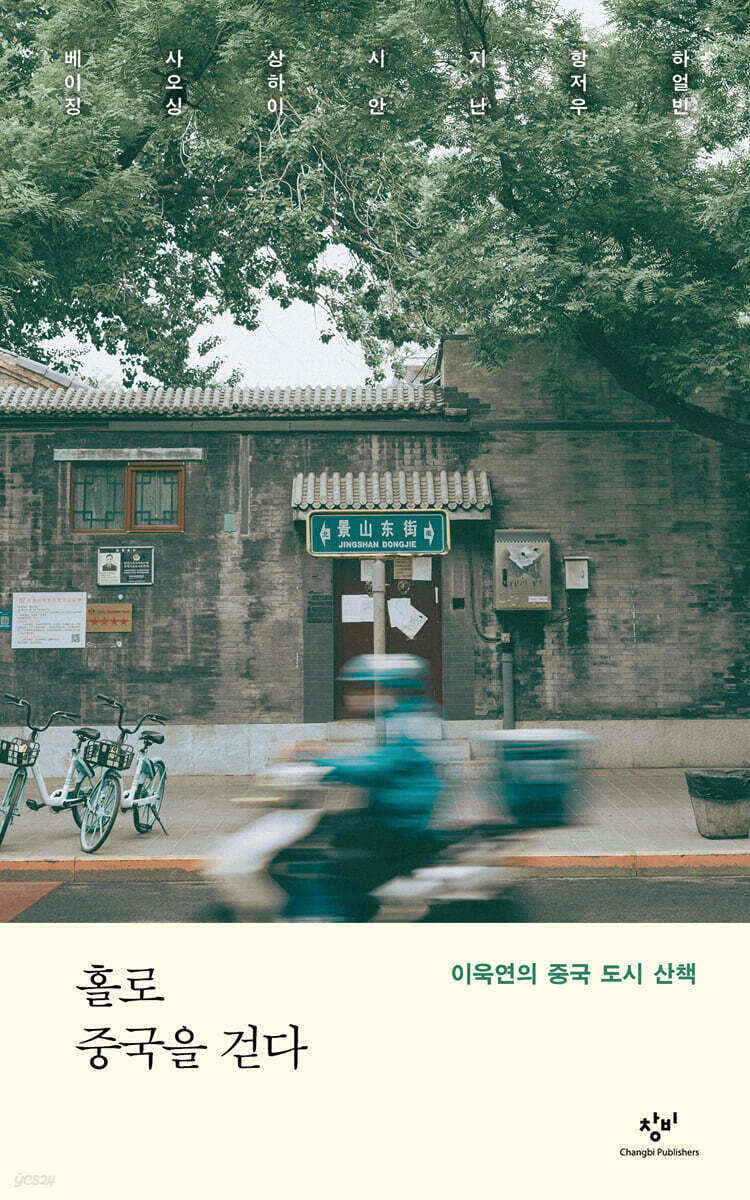
Walking alone in China
 |
Description
Book Introduction
- A word from MD
- [Encountering China through a Walk] Essays on humanist Lee Wook-yeon's travels to China.
Traveling through seven cities in China, including Beijing and Harbin, it tells stories about geography, food, architecture, history, and literature.
As the author explains that the Chinese character for 'humanities' means 'the pattern of people', his travels are not about accumulating knowledge, but rather about gaining wisdom that allows him to gain insight into life.
- Ahn Hyeon-jae, History PD
The best contemporary Chinese culture and literature expert
The Real Story of China by Humanist Lee Wook-yeon
Beyond the thickness of misunderstanding and prejudice
A special walk to read human patterns
The Chinese travel essay 『Walking Alone in China』 by humanist Lee Wook-yeon, who has been actively sharing the true face of China that we never knew about through his lively talk on TV, YouTube, and lectures, has been published.
The author, who especially enjoys walking when traveling, travels through seven cities in China, from Beijing to Harbin, and tells stories about geography, food, architecture, history, literature, and film.
As a first-generation student of Lu Xun, a translator, and a Sinologist who studied in China shortly after the establishment of diplomatic relations between Korea and China, and who has traveled to China countless times, the author says that what he discovered while walking around China was, above all, the diverse humanities, that is, the patterns of people. He says that these patterns engraved in the streets and scenery cannot be properly perceived with a quick glance or a superficial look.
Let's take a walk through China with his eyes that find human stories piled up over a long period of time in even the smallest, most ordinary things, such as Harbin's Guo Bao Rou, the Shanghai-set film "Us in the Future," and the bars Lu Xun frequented.
This will be a very special journey that will allow you to see the true face of China beyond the distortions and prejudices that have been attached to the country.
The Real Story of China by Humanist Lee Wook-yeon
Beyond the thickness of misunderstanding and prejudice
A special walk to read human patterns
The Chinese travel essay 『Walking Alone in China』 by humanist Lee Wook-yeon, who has been actively sharing the true face of China that we never knew about through his lively talk on TV, YouTube, and lectures, has been published.
The author, who especially enjoys walking when traveling, travels through seven cities in China, from Beijing to Harbin, and tells stories about geography, food, architecture, history, literature, and film.
As a first-generation student of Lu Xun, a translator, and a Sinologist who studied in China shortly after the establishment of diplomatic relations between Korea and China, and who has traveled to China countless times, the author says that what he discovered while walking around China was, above all, the diverse humanities, that is, the patterns of people. He says that these patterns engraved in the streets and scenery cannot be properly perceived with a quick glance or a superficial look.
Let's take a walk through China with his eyes that find human stories piled up over a long period of time in even the smallest, most ordinary things, such as Harbin's Guo Bao Rou, the Shanghai-set film "Us in the Future," and the bars Lu Xun frequented.
This will be a very special journey that will allow you to see the true face of China beyond the distortions and prejudices that have been attached to the country.
- You can preview some of the book's contents.
Preview
index
At the beginning of the book
Beijing 1. Conditions for a Happy Life
Beijing's New Normal
Jjajangmyeon reborn across borders
Laoshe Tea House, a traditional tea house in Beijing
Lao She loved her country, but her country abandoned her.
How Dreams of Success Are Frustrated
What are the conditions for a happy life?
The sad reality of people flocking to the city in hopes of success
Beijing 2: People Who Can Never Return Home
Dream of walking to Beijing
Park Wan-seo and Kim Yun-sik of Beijing Restaurant
Why Beijing Restaurant Became a Korean Dormitory
A portrait of the lives of Koreans living in Beijing
Donglaishun, the best place for lamb dishes
Why can't they return home?
Beijing's central axis is the line of heaven and people's will.
Shanghai: A desire to transcend the boundaries and illusions of life
Shanghai, a splendid, hybrid international city
The most beautiful iron bridge in China
Hot places in Old Shanghai
Daily life stops and then flows again
Borders of the country, borders of love
A Chinese man who misses his father's cooking
Xi'an, Yan'an: The Hearts of Intellectuals Running for Revolution
Xi'an Fan Samhap Cuisine
Huijok Street, a lamb cuisine paradise
What made the Tang Dynasty the world's greatest nation?
Why Kim Chun-chu gave Silla a Tang Dynasty flavor
If you want to read sutras to a cow, do it like this.
Ding Ling criticizes the reality of Yan'an, the holy land of revolution.
Mao Zedong targets intellectuals' sore spots
How the vitality of the red sorghum fields of the past deteriorated
The humanistic significance of Taesan
The Shandong people, descendants of Confucius, who are fastidious about formality
Confucius, reborn as a source of national pride
Why Was Confucius a Target of Overthrow during the Mao Era?
Red Sorghum Heroes Drinking Red Liquor
The ideal society dreamed of by Confucius and Mao
Why Shandong people are so passionate about alcohol
Shaoxing: The Light and Shadow of Mental Victory That Protects Me
The world of ink and wash paintings, Shaoxing
The sadness that lingers in Lu Xun's birthplace
When we walk together, paths that weren't there before appear.
Why Akyu, the master of mental victory, is always happy
A bitter life of persevering through mental victory
Mental victory is like opium.
Kung-i-ji disappeared leaving behind a trace
The Pain of Pickled Shrimp
Hangzhou: A Life Philosophy for Dealing with Hardship
Judge hands homeless man a novel
Baekbeom Kim Gu's refuge and the writer's burial site
Happiness is not the intensity of joy, but its frequency.
A philosophy of life that considers fate as a friend
Like water, it overcomes rocks, like grass, it endures the wind.
Unequal lives, summed up with a glass of Hwangju
A stroll through the world-famous Sihu
Korean youths singing the national anthem at the top of their lungs in Shihu
Harbin: Living for Righteousness
Guo Bao Rou originated in Harbin.
The sadness of Harbin, a European-style international city
Harbin today, restored in Russian style
A 'black hand' child pushed out of the white world
The "sleep rules" that govern the daily lives of Chinese people
Harbin is the city of Ahn Jung-geun.
Ahn Jung-geun, a modern hero of East Asia
There is no peace in Korea without peace in East Asia.
References
Beijing 1. Conditions for a Happy Life
Beijing's New Normal
Jjajangmyeon reborn across borders
Laoshe Tea House, a traditional tea house in Beijing
Lao She loved her country, but her country abandoned her.
How Dreams of Success Are Frustrated
What are the conditions for a happy life?
The sad reality of people flocking to the city in hopes of success
Beijing 2: People Who Can Never Return Home
Dream of walking to Beijing
Park Wan-seo and Kim Yun-sik of Beijing Restaurant
Why Beijing Restaurant Became a Korean Dormitory
A portrait of the lives of Koreans living in Beijing
Donglaishun, the best place for lamb dishes
Why can't they return home?
Beijing's central axis is the line of heaven and people's will.
Shanghai: A desire to transcend the boundaries and illusions of life
Shanghai, a splendid, hybrid international city
The most beautiful iron bridge in China
Hot places in Old Shanghai
Daily life stops and then flows again
Borders of the country, borders of love
A Chinese man who misses his father's cooking
Xi'an, Yan'an: The Hearts of Intellectuals Running for Revolution
Xi'an Fan Samhap Cuisine
Huijok Street, a lamb cuisine paradise
What made the Tang Dynasty the world's greatest nation?
Why Kim Chun-chu gave Silla a Tang Dynasty flavor
If you want to read sutras to a cow, do it like this.
Ding Ling criticizes the reality of Yan'an, the holy land of revolution.
Mao Zedong targets intellectuals' sore spots
How the vitality of the red sorghum fields of the past deteriorated
The humanistic significance of Taesan
The Shandong people, descendants of Confucius, who are fastidious about formality
Confucius, reborn as a source of national pride
Why Was Confucius a Target of Overthrow during the Mao Era?
Red Sorghum Heroes Drinking Red Liquor
The ideal society dreamed of by Confucius and Mao
Why Shandong people are so passionate about alcohol
Shaoxing: The Light and Shadow of Mental Victory That Protects Me
The world of ink and wash paintings, Shaoxing
The sadness that lingers in Lu Xun's birthplace
When we walk together, paths that weren't there before appear.
Why Akyu, the master of mental victory, is always happy
A bitter life of persevering through mental victory
Mental victory is like opium.
Kung-i-ji disappeared leaving behind a trace
The Pain of Pickled Shrimp
Hangzhou: A Life Philosophy for Dealing with Hardship
Judge hands homeless man a novel
Baekbeom Kim Gu's refuge and the writer's burial site
Happiness is not the intensity of joy, but its frequency.
A philosophy of life that considers fate as a friend
Like water, it overcomes rocks, like grass, it endures the wind.
Unequal lives, summed up with a glass of Hwangju
A stroll through the world-famous Sihu
Korean youths singing the national anthem at the top of their lungs in Shihu
Harbin: Living for Righteousness
Guo Bao Rou originated in Harbin.
The sadness of Harbin, a European-style international city
Harbin today, restored in Russian style
A 'black hand' child pushed out of the white world
The "sleep rules" that govern the daily lives of Chinese people
Harbin is the city of Ahn Jung-geun.
Ahn Jung-geun, a modern hero of East Asia
There is no peace in Korea without peace in East Asia.
References
Detailed image

Into the book
The meaning of the Chinese character for humanities is human pattern (人紋).
A person's pattern cannot be revealed by a quick glance or by looking at the outside.
You must have eyes to see to see, and you must have a heart to feel to see.
Only then can we see the human patterns carved into the buildings, streets, and landscape.
--- p.177
What is the story of Mr. Kim Yun-sik, who led Ms. Park Wan-seo into a hallucination at the Beijing Restaurant? Mr. Kim's story takes us on a time machine to the late 1930s and 1940s, during the Second Sino-Japanese War.
The story of critic Baek Cheol, who was then a Beijing correspondent for the Maeil Shinmun, pretending to be a traitor and getting addicted to gambling at a Beijing restaurant, the story of writer No Cheon-myeong, who was a reporter for the Maeil Shinmun, taking a vacation to Beijing and not returning even after the vacation was over, and the story of Kim Sa-ryang, who was going to Yan'an, the holy land of the red revolution, buying shoes and sending them to No Cheon-myeong on his way back to Korea, asking him to deliver them to his family, continued endlessly.
Professor Park Wan-seo wrote about that moment in her prose:
“In the spacious hall of that luxurious hotel, listening to Lee Hyang-ran’s songs, I fell into a hallucination where I was dancing like butterflies with pro-Japanese collaborators, independence fighters, journalists, spies, opium dealers, and Japanese warlords.”
--- p.51~52
I walked along the Waitan stone buildings and reached the end of the road.
There is the famous Waldorf Astoria Hotel.
This is the old Shanghai Club building.
It was built in 1905 in the classical style.
It was a place where women and Chinese people were not allowed to enter.
It was famous for having the world's longest bar table at 33 meters.
It's not quite there now, but there are still long bar tables.
The name itself is long bar.
In 1989, China opened its first Kentucky Fried Chicken (KFC) store here to spread its message of reform and opening up to the world.
So even now, there is KFC chicken on the menu here, which is out of place.
--- p.86~87
If, not only in 1940s Shanghai, but also in our own lives, there were times of lockdown when air-raid warnings suddenly sounded and daily life came to a halt, would we be able to confront our true selves? In the novel, the woman says, "There are far more kind people in the world than genuine people."
Yes, that's right.
Everyone lives a generous life in their daily lives.
However, this novel tells us that the life of a kind person may not necessarily be the life of a true person living as their true self.
Perhaps we always dream of becoming a true person or meeting a true person, and we live our lives as a good person, living our daily lives as a good person.
Even if it is shabby, that is life, the boundary of everyday life.
I live like that, sometimes inevitably yearning for the boundaries of my dreams to crumble.
--- p.98
“We only have one mountain, one river, and one saint (一山一水一聖人).” This is the Shandong style flex of the Shandong people.
In Shandong, there is only one Confucius, one Mount Tai, and one Yellow River.
Shandong people show off Shandong to people from other regions of China like this.
It is an ironic display by the people of Shandong Province, which possesses Confucius, Mount Tai, and the Yellow River.
--- p.146
Shaoxing cuisine features many freshwater shrimp dishes.
Among them, the drunken shrimp dish called Zhuisha is famous.
It is a dish made by soaking mountain shrimp in alcohol and then grilling them over a fire.
The fresher the shrimp, the more they will flop around when soaked in alcohol, and the better the shrimp taste.
(…) Lu Xun also likened himself to a chef who cooks shrimp dishes like this.
As Lu Xun criticized the darkness in China and resolutely resisted power, college students and young people who were angry about the reality of China and longed for change became enthusiastic about Lu Xun's writing.
However, many young people who were awakened by reading Lu Xun's writings were sacrificed while resisting the Chinese dictatorship.
Lu Xun was heartbroken.
He felt a pang of guilt and self-reproach, wondering if he was awakening the young man, sharpening his senses, and giving pleasure to the humans who subjugate him, just like a chef cooking shrimp.
--- p.199~200
Guo Bao Rou originated in Harbin.
You can eat it in our country now, but it wasn't like that in the early 2000s.
I thought it was a sweet and sour pork that was made wide on purpose.
But it was chewier and crispier than sweet and sour pork.
If you like sweet and sour pork, you can't help but like this flavor.
The store that developed this type of guo bao rou is Lao Chu Jiao in Harbin.
It means the home of a veteran chef.
This house opened in 1907.
This time, I plan to taste the original Guo Bao Rou at home alone.
A person's pattern cannot be revealed by a quick glance or by looking at the outside.
You must have eyes to see to see, and you must have a heart to feel to see.
Only then can we see the human patterns carved into the buildings, streets, and landscape.
--- p.177
What is the story of Mr. Kim Yun-sik, who led Ms. Park Wan-seo into a hallucination at the Beijing Restaurant? Mr. Kim's story takes us on a time machine to the late 1930s and 1940s, during the Second Sino-Japanese War.
The story of critic Baek Cheol, who was then a Beijing correspondent for the Maeil Shinmun, pretending to be a traitor and getting addicted to gambling at a Beijing restaurant, the story of writer No Cheon-myeong, who was a reporter for the Maeil Shinmun, taking a vacation to Beijing and not returning even after the vacation was over, and the story of Kim Sa-ryang, who was going to Yan'an, the holy land of the red revolution, buying shoes and sending them to No Cheon-myeong on his way back to Korea, asking him to deliver them to his family, continued endlessly.
Professor Park Wan-seo wrote about that moment in her prose:
“In the spacious hall of that luxurious hotel, listening to Lee Hyang-ran’s songs, I fell into a hallucination where I was dancing like butterflies with pro-Japanese collaborators, independence fighters, journalists, spies, opium dealers, and Japanese warlords.”
--- p.51~52
I walked along the Waitan stone buildings and reached the end of the road.
There is the famous Waldorf Astoria Hotel.
This is the old Shanghai Club building.
It was built in 1905 in the classical style.
It was a place where women and Chinese people were not allowed to enter.
It was famous for having the world's longest bar table at 33 meters.
It's not quite there now, but there are still long bar tables.
The name itself is long bar.
In 1989, China opened its first Kentucky Fried Chicken (KFC) store here to spread its message of reform and opening up to the world.
So even now, there is KFC chicken on the menu here, which is out of place.
--- p.86~87
If, not only in 1940s Shanghai, but also in our own lives, there were times of lockdown when air-raid warnings suddenly sounded and daily life came to a halt, would we be able to confront our true selves? In the novel, the woman says, "There are far more kind people in the world than genuine people."
Yes, that's right.
Everyone lives a generous life in their daily lives.
However, this novel tells us that the life of a kind person may not necessarily be the life of a true person living as their true self.
Perhaps we always dream of becoming a true person or meeting a true person, and we live our lives as a good person, living our daily lives as a good person.
Even if it is shabby, that is life, the boundary of everyday life.
I live like that, sometimes inevitably yearning for the boundaries of my dreams to crumble.
--- p.98
“We only have one mountain, one river, and one saint (一山一水一聖人).” This is the Shandong style flex of the Shandong people.
In Shandong, there is only one Confucius, one Mount Tai, and one Yellow River.
Shandong people show off Shandong to people from other regions of China like this.
It is an ironic display by the people of Shandong Province, which possesses Confucius, Mount Tai, and the Yellow River.
--- p.146
Shaoxing cuisine features many freshwater shrimp dishes.
Among them, the drunken shrimp dish called Zhuisha is famous.
It is a dish made by soaking mountain shrimp in alcohol and then grilling them over a fire.
The fresher the shrimp, the more they will flop around when soaked in alcohol, and the better the shrimp taste.
(…) Lu Xun also likened himself to a chef who cooks shrimp dishes like this.
As Lu Xun criticized the darkness in China and resolutely resisted power, college students and young people who were angry about the reality of China and longed for change became enthusiastic about Lu Xun's writing.
However, many young people who were awakened by reading Lu Xun's writings were sacrificed while resisting the Chinese dictatorship.
Lu Xun was heartbroken.
He felt a pang of guilt and self-reproach, wondering if he was awakening the young man, sharpening his senses, and giving pleasure to the humans who subjugate him, just like a chef cooking shrimp.
--- p.199~200
Guo Bao Rou originated in Harbin.
You can eat it in our country now, but it wasn't like that in the early 2000s.
I thought it was a sweet and sour pork that was made wide on purpose.
But it was chewier and crispier than sweet and sour pork.
If you like sweet and sour pork, you can't help but like this flavor.
The store that developed this type of guo bao rou is Lao Chu Jiao in Harbin.
It means the home of a veteran chef.
This house opened in 1907.
This time, I plan to taste the original Guo Bao Rou at home alone.
--- p.238
Publisher's Review
From Beijing to Harbin,
Walking through the seven cities of China
Why do luxury hotel bars in Shanghai serve fast-food chicken? To truly answer this question, we must begin with the story of Shanghai, a small port city forced to open its ports after its defeat in the Opium Wars in the 19th century, and the Bund area, which quickly grew and prospered as a concession for Western empires.
Professor Lee Wook-yeon walks alone along this path, starting from the Waidubai Bridge and following the Bund, enjoying both the splendor of Shanghai's colonial era and the splendor of modern China's rise as a powerful nation.
Huangpu Park, a Western-style park built by the British, features a scene from the film "Fist of Fury," where Bruce Lee kicks away a "No Chinese Entry" sign at the entrance. The story of China's first Kentucky Fried Chicken restaurant illuminates China's message of reform and openness to the world, offering a vivid glimpse into a China we never knew existed. (Chapter 3: Shanghai, "The Boundaries of Life and the Desire to Transcend Illusion")
Another unique charm of this book is that it captures the unfamiliar aspects of cities that have not been well known to us before, such as Yan'an, Jinan, and Shaoxing.
Shaoxing, a city of beautiful canals that resemble a sumi-e painting, is the hometown of Lu Xun, a Chinese novelist and philosopher, and is famous for its traditional liquor, huangjiu.
As expected from an author who has studied Lu Xun for a long time, his commentary on this region is particularly informative.
The author not only offers a fascinating glimpse into Lu Xun's life and works while strolling leisurely around his birthplace, but also illustrates his resolute and resistant intellectual side, always steadfast in his opposition to those in power, through the fragrance of the local specialty, Shaoxing wine (Chapter 6: Shaoxing, "The Light and Shadow of the Mental Victory That Protects Me").
Additionally, the author visits the Confucius Theme Park in Jinan, Shandong Peninsula.
The recently aired Netflix drama "The Three-Body Problem" has garnered global attention for its depiction of the Cultural Revolution.
This region, too, is filled with fascinating topics, including why Confucius, once a target of fierce persecution, is once again permeating modern Chinese culture, what Confucius has meant to the Chinese historically, and how Mao Zedong's thinking mirrors the Confucian ideals he so desperately sought to reject. (Chapter 5: "How the Vitality of Red Sorghum Fields Decayed")
Rich historical and cultural knowledge
Questions to Discover Me
The author, who says that a true humanistic journey is “not a journey to accumulate knowledge, but a journey to gain wisdom that allows us to see into life,” says that while putting together this book, he thought particularly about the greatness and splendor of life, as well as its hardships and meanness.
His gaze, which follows the paths of characters mainly in movies and novels, deeply affectionately observes not only extraordinary lives but also wretched lives that evoke poignant emotions. Through this gaze, the finite life of a single human being is seen as part of a larger flow, giving rise to various resonances and emotions.
The part that keenly captures the human desire that moves between daily life and dreams, centered around the short story "Blockade" by Zhang Ailing, a representative Chinese writer famous for "Lust, Caution," is the most lingering part of the Shanghai section and the entire book.
An ordinary man with a wife and a woman who has lived their entire lives trapped by adjectives like "good" and "excellent" have a brief moment of complete understanding and true self-identity when they stand before each other on a train stopped by a Japanese air raid warning on their way home from work.
The two vow to live different lives from now on, but as the blockade is lifted and the trams begin to move, the fractured routine begins to flow again, and the man, returning to reality, declares to the woman, "This can't be done." (Chapter 3, Shanghai, "Desire Beyond the Boundaries of Life and Illusion")
There is a passage like this in this novel.
“There are far more kind people in the world than genuine people.” This probably means that there are more people who live to look good to others than those who live as their true selves.
As we stroll through Shanghai, the author tells us that the air-raid alarms of the 1940s can suddenly sound in our lives.
In that moment of lockdown, will we be able to face our true selves?
Traveling is an act of leaving everyday life, but it is also an act of taking care of oneself by rescuing it from the daily grind.
Throughout the book, the author poses these questions of 'discovering myself' based on a rich historical and cultural background.
That is another pleasure that accompanies the author on his journey.
From the best Chinese experts,
A travelogue that is enjoyable no matter how you read it.
As demonstrated by titles such as “Multiple videos with 1 million views on YouTube” and “Top China expert receiving media attention,” the author tells vivid stories in this book, crossing over history, literature, geography, architecture, and film.
In particular, the fact that this book richly captures the aspects of modern China without being confined to a specific era makes it a useful reference for actual travel.
If you read it from beginning to end, it is intertwined in a grand flow, giving you the excitement of reading a long novel, but if you read it in parts, it is easy to read as if you were watching short clips.
In particular, if you find a place you have personally visited and read about it, you can have the unique pleasure of discovering the hidden stories of that place.
For Koreans today, China is a more complex entity than ever.
Although East Asia has long been an economically inseparable nation, the political situation in the region is becoming increasingly complex and cultural animosity is running extremely high.
The more this happens, the more the 'real' China becomes distorted, what kind of country it is, what kind of people live there, and what kind of culture breathes within it.
The more so, the more important it is that this book exists, allowing us to get one step closer to the true face of China through its history and culture.
The author, in a Harbin restaurant, pours down a glass of "Wichian sorghum liquor"—the liquor that Ahn Jung-geun is said to have drunk before his assassination—and softly says, "Without peace in East Asia, there can be no peace in Korea." (Chapter 8, Harbin, "Living for Righteousness") The author's solitary walk through China is ultimately a journey toward this peace.
I invite all readers who will walk this road alone someday.
We live in an age where knowledge and information are abundant, but wisdom is scarce.
A true humanistic journey is not a journey to accumulate knowledge, but a journey to gain wisdom that provides insight into life.
Although humans seem to live in the time of a one-time animal, human life is like living in the time of a plant that dies, dries, and withers, then sprouts leaves, blooms, and comes back to life.
The greatness of life lies here.
Through this book, I hope to follow the lives of the people I met along the path I walked alone, and it will become a humanities journey that allows me to contemplate humanity and life, sometimes at the pace of the world, and sometimes at my own pace.
Walking through the seven cities of China
Why do luxury hotel bars in Shanghai serve fast-food chicken? To truly answer this question, we must begin with the story of Shanghai, a small port city forced to open its ports after its defeat in the Opium Wars in the 19th century, and the Bund area, which quickly grew and prospered as a concession for Western empires.
Professor Lee Wook-yeon walks alone along this path, starting from the Waidubai Bridge and following the Bund, enjoying both the splendor of Shanghai's colonial era and the splendor of modern China's rise as a powerful nation.
Huangpu Park, a Western-style park built by the British, features a scene from the film "Fist of Fury," where Bruce Lee kicks away a "No Chinese Entry" sign at the entrance. The story of China's first Kentucky Fried Chicken restaurant illuminates China's message of reform and openness to the world, offering a vivid glimpse into a China we never knew existed. (Chapter 3: Shanghai, "The Boundaries of Life and the Desire to Transcend Illusion")
Another unique charm of this book is that it captures the unfamiliar aspects of cities that have not been well known to us before, such as Yan'an, Jinan, and Shaoxing.
Shaoxing, a city of beautiful canals that resemble a sumi-e painting, is the hometown of Lu Xun, a Chinese novelist and philosopher, and is famous for its traditional liquor, huangjiu.
As expected from an author who has studied Lu Xun for a long time, his commentary on this region is particularly informative.
The author not only offers a fascinating glimpse into Lu Xun's life and works while strolling leisurely around his birthplace, but also illustrates his resolute and resistant intellectual side, always steadfast in his opposition to those in power, through the fragrance of the local specialty, Shaoxing wine (Chapter 6: Shaoxing, "The Light and Shadow of the Mental Victory That Protects Me").
Additionally, the author visits the Confucius Theme Park in Jinan, Shandong Peninsula.
The recently aired Netflix drama "The Three-Body Problem" has garnered global attention for its depiction of the Cultural Revolution.
This region, too, is filled with fascinating topics, including why Confucius, once a target of fierce persecution, is once again permeating modern Chinese culture, what Confucius has meant to the Chinese historically, and how Mao Zedong's thinking mirrors the Confucian ideals he so desperately sought to reject. (Chapter 5: "How the Vitality of Red Sorghum Fields Decayed")
Rich historical and cultural knowledge
Questions to Discover Me
The author, who says that a true humanistic journey is “not a journey to accumulate knowledge, but a journey to gain wisdom that allows us to see into life,” says that while putting together this book, he thought particularly about the greatness and splendor of life, as well as its hardships and meanness.
His gaze, which follows the paths of characters mainly in movies and novels, deeply affectionately observes not only extraordinary lives but also wretched lives that evoke poignant emotions. Through this gaze, the finite life of a single human being is seen as part of a larger flow, giving rise to various resonances and emotions.
The part that keenly captures the human desire that moves between daily life and dreams, centered around the short story "Blockade" by Zhang Ailing, a representative Chinese writer famous for "Lust, Caution," is the most lingering part of the Shanghai section and the entire book.
An ordinary man with a wife and a woman who has lived their entire lives trapped by adjectives like "good" and "excellent" have a brief moment of complete understanding and true self-identity when they stand before each other on a train stopped by a Japanese air raid warning on their way home from work.
The two vow to live different lives from now on, but as the blockade is lifted and the trams begin to move, the fractured routine begins to flow again, and the man, returning to reality, declares to the woman, "This can't be done." (Chapter 3, Shanghai, "Desire Beyond the Boundaries of Life and Illusion")
There is a passage like this in this novel.
“There are far more kind people in the world than genuine people.” This probably means that there are more people who live to look good to others than those who live as their true selves.
As we stroll through Shanghai, the author tells us that the air-raid alarms of the 1940s can suddenly sound in our lives.
In that moment of lockdown, will we be able to face our true selves?
Traveling is an act of leaving everyday life, but it is also an act of taking care of oneself by rescuing it from the daily grind.
Throughout the book, the author poses these questions of 'discovering myself' based on a rich historical and cultural background.
That is another pleasure that accompanies the author on his journey.
From the best Chinese experts,
A travelogue that is enjoyable no matter how you read it.
As demonstrated by titles such as “Multiple videos with 1 million views on YouTube” and “Top China expert receiving media attention,” the author tells vivid stories in this book, crossing over history, literature, geography, architecture, and film.
In particular, the fact that this book richly captures the aspects of modern China without being confined to a specific era makes it a useful reference for actual travel.
If you read it from beginning to end, it is intertwined in a grand flow, giving you the excitement of reading a long novel, but if you read it in parts, it is easy to read as if you were watching short clips.
In particular, if you find a place you have personally visited and read about it, you can have the unique pleasure of discovering the hidden stories of that place.
For Koreans today, China is a more complex entity than ever.
Although East Asia has long been an economically inseparable nation, the political situation in the region is becoming increasingly complex and cultural animosity is running extremely high.
The more this happens, the more the 'real' China becomes distorted, what kind of country it is, what kind of people live there, and what kind of culture breathes within it.
The more so, the more important it is that this book exists, allowing us to get one step closer to the true face of China through its history and culture.
The author, in a Harbin restaurant, pours down a glass of "Wichian sorghum liquor"—the liquor that Ahn Jung-geun is said to have drunk before his assassination—and softly says, "Without peace in East Asia, there can be no peace in Korea." (Chapter 8, Harbin, "Living for Righteousness") The author's solitary walk through China is ultimately a journey toward this peace.
I invite all readers who will walk this road alone someday.
We live in an age where knowledge and information are abundant, but wisdom is scarce.
A true humanistic journey is not a journey to accumulate knowledge, but a journey to gain wisdom that provides insight into life.
Although humans seem to live in the time of a one-time animal, human life is like living in the time of a plant that dies, dries, and withers, then sprouts leaves, blooms, and comes back to life.
The greatness of life lies here.
Through this book, I hope to follow the lives of the people I met along the path I walked alone, and it will become a humanities journey that allows me to contemplate humanity and life, sometimes at the pace of the world, and sometimes at my own pace.
GOODS SPECIFICS
- Date of issue: September 23, 2024
- Format: Paperback book binding method guide
- Page count, weight, size: 268 pages | 302g | 125*200*16mm
- ISBN13: 9788936480554
You may also like
카테고리
korean


korean

![GQ KOREA Mark (Monthly): December [2025]](http://librairie.coreenne.fr/cdn/shop/files/8ef265dbbfbf186523ed75ba7319009d.jpg?v=1765340328&width=3840)


