

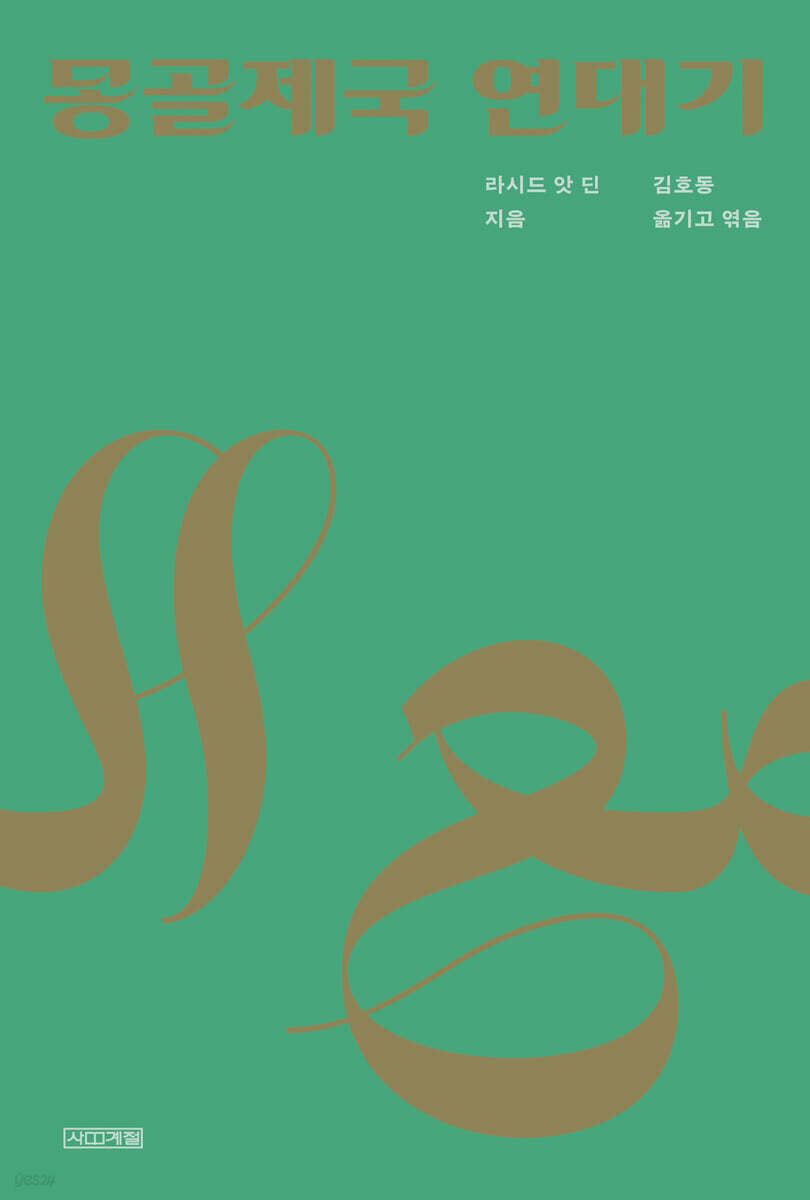
Chronicles of the Mongol Empire
 |
Description
Book Introduction
Professor Emeritus Kim Ho-dong of Seoul National University, the Great Khan of Mongol Empire History Research
Rewriting the Legend of Genghis Khan and His Descendants
Professor Kim Ho-dong of Seoul National University, recognized for his unparalleled achievements in the field of Central Eurasian history, has completed 『Chronicles of the Mongol Empire』, the world's first abridged version of 『The History of the World』, the world's first world history book.
He first read the Persian original while studying abroad at Harvard University in the early 1980s, and says that through this book written by Rashid ad-Din, the prime minister of the Ilkhanate, he was able to vividly convey the atmosphere and mood of the contemporary Mongol Empire.
When the Mongol cavalry began to ride horses in the 13th century, East and West became so close that they could never be the same again.
The Butler, often referred to as the 'first world history', is the result of that combination and connection.
Professor Kim Ho-dong summarized and condensed the contents of 『The Butler』, which covers not only the Mongolian steppe, the Silk Road, and the history of China, but also Persia, Arabia, India, Southeast Asia, Korea, Japan, Armenia, Georgia, Poland, Hungary, Russia, and Byzantium, into a complete book.
『Chronicles of the Mongol Empire』 is a condensed version of 『The Steward of Rashid ad-Din』, which consists of five volumes and 2,246 pages, and focuses on the rise, expansion, and completion of the empire.
The pleasure of reading history books has been doubled by adding a genealogy chart of the Golden Clan and the four great Ulus monarchs of the Mongol Empire, as well as detailed maps of the empire's expansion and major events.
“Forty years have already passed since I first read Rashid ad-Din’s ‘The Butler.’
Let's embark on a historical journey to the steppes of Central Eurasia, guided by Professor Kim Ho-dong, who says, "This book still draws me into the history of the Mongol Empire."
Rewriting the Legend of Genghis Khan and His Descendants
Professor Kim Ho-dong of Seoul National University, recognized for his unparalleled achievements in the field of Central Eurasian history, has completed 『Chronicles of the Mongol Empire』, the world's first abridged version of 『The History of the World』, the world's first world history book.
He first read the Persian original while studying abroad at Harvard University in the early 1980s, and says that through this book written by Rashid ad-Din, the prime minister of the Ilkhanate, he was able to vividly convey the atmosphere and mood of the contemporary Mongol Empire.
When the Mongol cavalry began to ride horses in the 13th century, East and West became so close that they could never be the same again.
The Butler, often referred to as the 'first world history', is the result of that combination and connection.
Professor Kim Ho-dong summarized and condensed the contents of 『The Butler』, which covers not only the Mongolian steppe, the Silk Road, and the history of China, but also Persia, Arabia, India, Southeast Asia, Korea, Japan, Armenia, Georgia, Poland, Hungary, Russia, and Byzantium, into a complete book.
『Chronicles of the Mongol Empire』 is a condensed version of 『The Steward of Rashid ad-Din』, which consists of five volumes and 2,246 pages, and focuses on the rise, expansion, and completion of the empire.
The pleasure of reading history books has been doubled by adding a genealogy chart of the Golden Clan and the four great Ulus monarchs of the Mongol Empire, as well as detailed maps of the empire's expansion and major events.
“Forty years have already passed since I first read Rashid ad-Din’s ‘The Butler.’
Let's embark on a historical journey to the steppes of Central Eurasia, guided by Professor Kim Ho-dong, who says, "This book still draws me into the history of the Mongol Empire."
- You can preview some of the book's contents.
Preview
index
Preface to the Chronicles of the Mongol Empire
Note
prolog
Part 1: Genghis Khan and the Rising Empire
Chapter 1: The Age of Zeal
Chapter 2: The First Half of Genghis Khan's Life
Chapter 3: Foreign Expeditions and Imperial Expansion
Part 2: The Birth of a World Empire
Chapter 1: Ogedei Khan's World Conquest
Chapter 2: The Short-Lived Reign of King Guryuk
Chapter 3: Mongke's Revolution and Rise to Power
Part 3: The Era of Kublai Khan
Chapter 1: Accession to the Throne and Civil War
Chapter 2: The Ongoing Challenge
Chapter 3: The Completion and Reign of the Khan Ulus
Chapter 4: The Successor, Temur Khan
Epilogue
Source of visual material
References
Find a person's name
Note
prolog
Part 1: Genghis Khan and the Rising Empire
Chapter 1: The Age of Zeal
Chapter 2: The First Half of Genghis Khan's Life
Chapter 3: Foreign Expeditions and Imperial Expansion
Part 2: The Birth of a World Empire
Chapter 1: Ogedei Khan's World Conquest
Chapter 2: The Short-Lived Reign of King Guryuk
Chapter 3: Mongke's Revolution and Rise to Power
Part 3: The Era of Kublai Khan
Chapter 1: Accession to the Throne and Civil War
Chapter 2: The Ongoing Challenge
Chapter 3: The Completion and Reign of the Khan Ulus
Chapter 4: The Successor, Temur Khan
Epilogue
Source of visual material
References
Find a person's name
Detailed image

Into the book
Many scholars have nicknamed "The Butler" the "first world history."
This is no exaggeration.
From the birth of Genghis Khan's empire in the early 13th century until the fragmentation and collapse of the Mongol regimes that ruled various regions in the late 14th century, the history of the Mongol Empire was itself world history.
The numerous wars of conquest, diplomatic negotiations and visits by envoys, economic exchanges and merchant activities, the spread of religion and the movement of missionaries, all waged by the Mongols, connected countless regions of the globe into a single network.
It was the 'Mongol Web' that politically and culturally connected Eurasia in the 13th and 14th centuries.
"The Butler" is a narrative that covers the entire empire encompassed by the Mongolian web.
Therefore, anyone who wishes to correctly understand the history of the Mongol Empire, which was the core and axis of world history in the 13th and 14th centuries, must start from 『The Book of Changes』.
---From the "Preface to the Chronicles of the Mongol Empire"
It is universally acknowledged by wise men that history is the collection and compilation of rare and extraordinary circumstances and surprising events, written down and recorded in books.
It is the scholar's duty to describe the good, bad, and important events of each age so that they may serve as examples for future generations, to inform the future of the circumstances of past ages, and in so doing to ensure that the accounts of famous monarchs and powerful kings remain forever on the pages of the ages.
Otherwise, events and facts would disappear with the passage of time and the flow of time.
---From the "Prologue"
In the mid-12th century, around the time of Genghis Khan's birth, the nomads of the Mongolian Plateau were divided into groups called ulus.
The word ulus originally meant 'people' or 'subject', but was also used to mean 'tribe' or 'country'.
Representative uluses of the time included the Naiman, Kerait, Tatar, Merkit, Oirat, and Mongol.
Naiman was located in the westernmost part of the plateau, in the Altai region, while Kereit was located in the central region of the Mongolian Plateau.
In the eastern part of the plateau there were the Tatars, and in the northern part of the steppe, in the Selenge River basin south of Lake Baikal, there were the Merkits.
In the northwesternmost part of the Irtysh River basin, there were the Oirats, who were called the 'forest people'.
'Mongolia' was located in the Khentii Mountains in the central and northern part of the plateau.
Their base was near Burkhan Khaldun, where the 'headwaters of the three rivers', the Onon, Kerulen, and Tola rivers, originate.
In 1206, Temujin held a kurultai at the source of the Onon River.
He declared that all the nomads of the Mongolian Plateau were united under his rule and took the title 'Genghis Khan'.
There are various opinions about his year of birth, ranging from 1155 to 1167, but Mongolia currently officially recognizes 1162.
When he was about ten years old, his father, Isugei, was poisoned by the Tatars. After that, Temujin and his family went into hiding in the Burkhan Khaldun Mountains and lived a miserable life.
But as he and his brothers grew up, things gradually improved.
After marrying Burte, daughter of Onggiratsi Dey Sethen, Temujin went to visit Tooril (Ong Khan) of Kerait, who was his father's brother-in-law, and became his vassal.
And from this time on, the enemy forces were defeated one by one.
He broke with his brother Jamukha, clashed with his patron Toril, and defeated the Taichiuts, Merkits, and Tatars.
And finally, he achieved the feat of unification by defeating the two most powerful groups on the Mongolian Plateau, the Kerait and the Naiman.
Afterwards, Genghis Khan spent most of his time on foreign expeditions until his death in 1227.
First, he subdued the Kyrgyz (1207) and Oirats (1208) around the Mongolian Plateau, and then sent an army to Central Asia to pursue the Naiman prince Kuchulug, who had fled.
In 1209, he personally attacked the Tangut (Western Xia), subdued them the following year, and finally started a war with the Jurchen Jin in 1211.
The Jin, whose capital Zhongdu was under siege, accepted the Mongols' demands and agreed to peace in 1214, but when the Mongols withdrew, they moved their capital to Kaifeng, south of the Yellow River, in the summer of that year.
The Mongol army moved south again, occupied northern China, and continued the war with the Jin.
Meanwhile, the massacre of the envoys sent to Khwarazm at Otrar in the lower Syr Darya in 1218 prompted Genghis Khan to launch a western expedition.
After seven years of war from 1219 to 1225, the emerging great power of Khwarazm was destroyed, and many prosperous cities in Central and West Asia were reduced to ruins and their inhabitants massacred.
Although the number of people killed recorded in Islamic sources is greatly exaggerated, the extent of the destruction is horrific.
After returning, Genghis Khan went on another expedition against the Tanguts and died in 1227.
He may not have thought of conquering the world and building an empire that would rule all nations.
However, as the expeditions became a reality and his control over the agricultural regions of China and Central Asia became a reality, his empire gradually began to transform into a world empire.
---From the opening of Part 1 [Genghis Khan, the Rising Empire]
The year 1206, the Year of the Tiger, has arrived.
In early spring, Genghis Khan raised the 'White Flag with Nine Legs' and held a grand kurultai with many people.
There he sat on the throne, receiving a blessing.
The person who gave the title 'Genghis Khan' was the shaman Kukechu, also known as 'Tep Tengri', the son of Munglik Echige from Kongotan.
'Ching' means strong and firm, and 'Chinggis' is its plural form.
It is similar to the title of the Kara-Khitai rulers, 'Gur Khan', which means strength and greatness.
After the Kuriltai, Genghis Khan launched an expedition against Buyuk Khan of the Naimans.
Buiruk was hunting in the Sujau River near Ulukg Tak, but he didn't catch the scent.
Genghis Khan and his army suddenly came and killed him, taking away his kingdom, his tents, his wife and children, his horses and livestock.
When his father Tayang Khan was murdered, Kuchuluk Khan fled to his uncle, Buyruk Khan, and the Merkit ruler Toktai Beki also went there, as explained above.
These two men fled again and took refuge in the Irtysh, a border region of the Naiman region.
In the autumn of 1207, the year of the rabbit, Genghis Khan again went on an expedition to the Tangut region because they had rebelled and were not sending supplies or following orders.
In this expedition, he conquered the entire region and returned proudly.
In the same year, Genghis Khan sent Altan and Bura as envoys to the Kyrgyz leaders.
The two Kyrgyz leaders received the envoy with great hospitality, each sending his men with him, offering a white falcon and surrendering to Genghis Khan.
After his victories in the Tangut and Kyrgyz regions, Genghis Khan returned to his homeland in 1208 and spent the summer there.
In winter, he went out to attack the Toktai Beki and Kuchuluks who had fled to the Irtysh.
On the way, the vanguard and the advance guard suddenly encountered the Oirat tribe led by Kutuka Beki.
Realizing that they could not stand up to Genghis Khan's army, they surrendered and served as guides.
The army raided and defeated Toktai Beki and Kuchuluq, plundering all their property, horses, and livestock.
Toktai was killed in the battle, and Kuchuluk fled again with a small group of men and took refuge with the Gur Khan in the Kara-Khitai region, where he remained for a while.
Gur Khan comforted him and called him 'son'.
After a while, she gave him her own daughter, and I will tell you about her end later.
---「From the scene of Genghis Khan's accession to the throne in Chapter 3, Foreign Expeditions and Expansion of the Empire, in Part 1 [Genghis Khan, the Rising Empire]
No history book has ever been written that records the circumstances of all the peoples and all the classes of the world in any era.
But now many nations on earth uphold the edicts of the Genghis Khan clan, and wise men, astrologers, scholars and historians of all religions and nations, including the Khitai and the Machinis, the Indians and the Kashmirs, the Tibetans, the Uighurs and other Turkic peoples, the Arabs and the Franks, have gathered before me.
They each have writings about their own tribe's history, folk tales, and beliefs.
So, based on these, complete a complete outline in the name of Jim, and write it in two parts together with a book describing the world's regions and geography.
If it were made into a sequel to the aforementioned 『Ghazan Blessing』, it would be an unprecedented compilation.
Such a monument, which no king of any age has ever possessed, must be completed without delay, so that my name and honor may be eternal.
This is no exaggeration.
From the birth of Genghis Khan's empire in the early 13th century until the fragmentation and collapse of the Mongol regimes that ruled various regions in the late 14th century, the history of the Mongol Empire was itself world history.
The numerous wars of conquest, diplomatic negotiations and visits by envoys, economic exchanges and merchant activities, the spread of religion and the movement of missionaries, all waged by the Mongols, connected countless regions of the globe into a single network.
It was the 'Mongol Web' that politically and culturally connected Eurasia in the 13th and 14th centuries.
"The Butler" is a narrative that covers the entire empire encompassed by the Mongolian web.
Therefore, anyone who wishes to correctly understand the history of the Mongol Empire, which was the core and axis of world history in the 13th and 14th centuries, must start from 『The Book of Changes』.
---From the "Preface to the Chronicles of the Mongol Empire"
It is universally acknowledged by wise men that history is the collection and compilation of rare and extraordinary circumstances and surprising events, written down and recorded in books.
It is the scholar's duty to describe the good, bad, and important events of each age so that they may serve as examples for future generations, to inform the future of the circumstances of past ages, and in so doing to ensure that the accounts of famous monarchs and powerful kings remain forever on the pages of the ages.
Otherwise, events and facts would disappear with the passage of time and the flow of time.
---From the "Prologue"
In the mid-12th century, around the time of Genghis Khan's birth, the nomads of the Mongolian Plateau were divided into groups called ulus.
The word ulus originally meant 'people' or 'subject', but was also used to mean 'tribe' or 'country'.
Representative uluses of the time included the Naiman, Kerait, Tatar, Merkit, Oirat, and Mongol.
Naiman was located in the westernmost part of the plateau, in the Altai region, while Kereit was located in the central region of the Mongolian Plateau.
In the eastern part of the plateau there were the Tatars, and in the northern part of the steppe, in the Selenge River basin south of Lake Baikal, there were the Merkits.
In the northwesternmost part of the Irtysh River basin, there were the Oirats, who were called the 'forest people'.
'Mongolia' was located in the Khentii Mountains in the central and northern part of the plateau.
Their base was near Burkhan Khaldun, where the 'headwaters of the three rivers', the Onon, Kerulen, and Tola rivers, originate.
In 1206, Temujin held a kurultai at the source of the Onon River.
He declared that all the nomads of the Mongolian Plateau were united under his rule and took the title 'Genghis Khan'.
There are various opinions about his year of birth, ranging from 1155 to 1167, but Mongolia currently officially recognizes 1162.
When he was about ten years old, his father, Isugei, was poisoned by the Tatars. After that, Temujin and his family went into hiding in the Burkhan Khaldun Mountains and lived a miserable life.
But as he and his brothers grew up, things gradually improved.
After marrying Burte, daughter of Onggiratsi Dey Sethen, Temujin went to visit Tooril (Ong Khan) of Kerait, who was his father's brother-in-law, and became his vassal.
And from this time on, the enemy forces were defeated one by one.
He broke with his brother Jamukha, clashed with his patron Toril, and defeated the Taichiuts, Merkits, and Tatars.
And finally, he achieved the feat of unification by defeating the two most powerful groups on the Mongolian Plateau, the Kerait and the Naiman.
Afterwards, Genghis Khan spent most of his time on foreign expeditions until his death in 1227.
First, he subdued the Kyrgyz (1207) and Oirats (1208) around the Mongolian Plateau, and then sent an army to Central Asia to pursue the Naiman prince Kuchulug, who had fled.
In 1209, he personally attacked the Tangut (Western Xia), subdued them the following year, and finally started a war with the Jurchen Jin in 1211.
The Jin, whose capital Zhongdu was under siege, accepted the Mongols' demands and agreed to peace in 1214, but when the Mongols withdrew, they moved their capital to Kaifeng, south of the Yellow River, in the summer of that year.
The Mongol army moved south again, occupied northern China, and continued the war with the Jin.
Meanwhile, the massacre of the envoys sent to Khwarazm at Otrar in the lower Syr Darya in 1218 prompted Genghis Khan to launch a western expedition.
After seven years of war from 1219 to 1225, the emerging great power of Khwarazm was destroyed, and many prosperous cities in Central and West Asia were reduced to ruins and their inhabitants massacred.
Although the number of people killed recorded in Islamic sources is greatly exaggerated, the extent of the destruction is horrific.
After returning, Genghis Khan went on another expedition against the Tanguts and died in 1227.
He may not have thought of conquering the world and building an empire that would rule all nations.
However, as the expeditions became a reality and his control over the agricultural regions of China and Central Asia became a reality, his empire gradually began to transform into a world empire.
---From the opening of Part 1 [Genghis Khan, the Rising Empire]
The year 1206, the Year of the Tiger, has arrived.
In early spring, Genghis Khan raised the 'White Flag with Nine Legs' and held a grand kurultai with many people.
There he sat on the throne, receiving a blessing.
The person who gave the title 'Genghis Khan' was the shaman Kukechu, also known as 'Tep Tengri', the son of Munglik Echige from Kongotan.
'Ching' means strong and firm, and 'Chinggis' is its plural form.
It is similar to the title of the Kara-Khitai rulers, 'Gur Khan', which means strength and greatness.
After the Kuriltai, Genghis Khan launched an expedition against Buyuk Khan of the Naimans.
Buiruk was hunting in the Sujau River near Ulukg Tak, but he didn't catch the scent.
Genghis Khan and his army suddenly came and killed him, taking away his kingdom, his tents, his wife and children, his horses and livestock.
When his father Tayang Khan was murdered, Kuchuluk Khan fled to his uncle, Buyruk Khan, and the Merkit ruler Toktai Beki also went there, as explained above.
These two men fled again and took refuge in the Irtysh, a border region of the Naiman region.
In the autumn of 1207, the year of the rabbit, Genghis Khan again went on an expedition to the Tangut region because they had rebelled and were not sending supplies or following orders.
In this expedition, he conquered the entire region and returned proudly.
In the same year, Genghis Khan sent Altan and Bura as envoys to the Kyrgyz leaders.
The two Kyrgyz leaders received the envoy with great hospitality, each sending his men with him, offering a white falcon and surrendering to Genghis Khan.
After his victories in the Tangut and Kyrgyz regions, Genghis Khan returned to his homeland in 1208 and spent the summer there.
In winter, he went out to attack the Toktai Beki and Kuchuluks who had fled to the Irtysh.
On the way, the vanguard and the advance guard suddenly encountered the Oirat tribe led by Kutuka Beki.
Realizing that they could not stand up to Genghis Khan's army, they surrendered and served as guides.
The army raided and defeated Toktai Beki and Kuchuluq, plundering all their property, horses, and livestock.
Toktai was killed in the battle, and Kuchuluk fled again with a small group of men and took refuge with the Gur Khan in the Kara-Khitai region, where he remained for a while.
Gur Khan comforted him and called him 'son'.
After a while, she gave him her own daughter, and I will tell you about her end later.
---「From the scene of Genghis Khan's accession to the throne in Chapter 3, Foreign Expeditions and Expansion of the Empire, in Part 1 [Genghis Khan, the Rising Empire]
No history book has ever been written that records the circumstances of all the peoples and all the classes of the world in any era.
But now many nations on earth uphold the edicts of the Genghis Khan clan, and wise men, astrologers, scholars and historians of all religions and nations, including the Khitai and the Machinis, the Indians and the Kashmirs, the Tibetans, the Uighurs and other Turkic peoples, the Arabs and the Franks, have gathered before me.
They each have writings about their own tribe's history, folk tales, and beliefs.
So, based on these, complete a complete outline in the name of Jim, and write it in two parts together with a book describing the world's regions and geography.
If it were made into a sequel to the aforementioned 『Ghazan Blessing』, it would be an unprecedented compilation.
Such a monument, which no king of any age has ever possessed, must be completed without delay, so that my name and honor may be eternal.
---From "[Epilogue] Uljeitu Khan's Order to Compile "The Butler""
Publisher's Review
If you want to know the beginning of world history, look at the history of the Mongol Empire.
If you want to know it properly, start with "The Butler"
The Mongol Empire was the empire that conquered and ruled the most extensive territory on the Eurasian continent, which was the main stage of human history for the past several thousand years.
For a considerable period of nearly two centuries, from the early 13th century to the late 14th century, few groups were free from the direct or indirect influence of the Mongol Empire.
The Goryeo Dynasty on the Korean Peninsula also came under its control around 1260, and was only able to escape its grasp after 100 years.
No one can deny that the emergence and rule of the Mongol Empire was a major event in world history.
However, as the modern era began and a historical view that recognized and described Europe as the protagonist of world history took hold, the history of regions other than Europe was not properly evaluated.
The history of many Asian nations and peoples was branded as stagnant because they lacked the power to advance human history.
On the other hand, Europeans, who inherited the torch of the dazzling achievements of Greece and Rome, colonized various parts of the world during the Age of Exploration, and it was evaluated that only then could the non-European world join the mainstream of human history.
This Eurocentric view of history was an unchanging position common to both the Marxist materialist view of history, which had been popular since the 19th century, and the Weberian historical theory that criticized it.
In this trend of placing Europe at the center of history, it was impossible for the history of the Mongol Empire to be properly evaluated.
The Mongol Empire was portrayed as the embodiment of massacre and destruction, a direct contradiction of the values that Europe pursued, such as humanism, enlightenment, freedom, equality, and democracy, and as the main culprit in bringing about an era of tyranny and chaos.
Genghis Khan succeeded Attila and was called the "Scourge of God," and Russia suffered under the "Tatar Yoke" for many years, distorting its history and ultimately leading to Soviet totalitarianism.
The outbreak of the two World Wars and the destruction they brought in the first half of the 20th century fundamentally shook this Western-centric view of history, and in response, the need for an integrated historical understanding encompassing both Western and non-Western societies was raised.
A new understanding of the development of world history also brought about significant changes in the perspective on the history of the Mongol Empire.
If the canvas had been covered with dark tones of destruction and massacre until now, now those overly painted shades are slowly peeling away, revealing new patterns that had been hidden beneath.
As the various peoples and nations of Eurasia intertwined and revolved around the great wheel of the Mongol Empire, contact and exchange with geographically distant external worlds, previously unknown, became possible, which soon led to the establishment of a modern worldview.
As this new approach to history in general, and the new understanding of the history of the Mongol Empire in particular, was emphasized, the 『Chisha』, compiled in the early 14th century by Rashid ad-Din, the prime minister of the Mongol Empire that ruled West Asia, began to attract attention.
Many scholars have nicknamed "The Butler" the "first world history."
This is no exaggeration.
From the birth of Genghis Khan's empire in the early 13th century until the fragmentation and collapse of the Mongol regimes that ruled various regions in the late 14th century, the history of the Mongol Empire was itself world history.
The numerous wars of conquest, diplomatic negotiations and visits by envoys, economic exchanges and merchant activities, the spread of religion and the movement of missionaries, all waged by the Mongols, connected countless regions of the globe into a single network.
It was the 'Mongol Web' that politically and culturally connected Eurasia in the 13th and 14th centuries.
"The Butler" is a narrative that covers the entire empire encompassed by the Mongolian web.
Therefore, anyone who wishes to correctly understand the history of the Mongol Empire, which was the core and axis of world history in the 13th and 14th centuries, must start from 『The Book of Changes』.
At the end of the 20-year journey of translating 『The Butler』
Translating the Mongol Empire's epic into Korean
By the 13th century, Genghis Khan and his descendants had conquered almost the entire known world.
The Mongol cavalry galloped like a whirlwind, conquering the world and creating an empire unlike any other in history.
The emergence of a world empire was a surprising historical event not only for us modern people but also for the people of that time.
At that time, numerous countries and peoples had already recorded the rise and expansion of the Mongol Empire in their own languages and scripts (Mongolia, China, Iran, Russia, Goryeo, India, Egypt, and several European countries).
Even the inhabitants of the distant Caucasus Mountains recorded in their books the shock they felt from the Mongol attacks.
And in the early 1300s, at the dawn of the new century, Ghazan Khan of the Hulegu Ulus, a descendant of Genghis Khan, ordered his vizier Rashid ad-Din to create “the only book in the world.”
That is the 『Butler』, which is titled ‘The Compilation of Chronicles’.
Rashid ad-Din compiled the history of the Mongol Empire, encompassing the history of the Mongolian steppe, the Silk Road, China, Persia, Arabia, India, Southeast Asia, Korea, Japan, Armenia, Georgia, Poland, Hungary, and even Russia and Byzantium, covering the entire world where the Mongol cavalry troop had traveled.
A large-scale work that encompassed the history of almost all the countries and peoples of the Eurasian continent was unprecedented, regardless of time or place, and so today we call the "Housekeeper" the "first world history."
In the spring of 2023, Professor Emeritus Kim Ho-dong of Seoul National University put an end to his 20-year-long translation project of The Butler.
The work began with the publication of the first volume, "Tribes," in September 2002, when the heat of the World Cup semifinal myth was still lingering, and concluded 20 years later with the publication of the fifth volume, "The Emperor of Islam," in March 2023.
The Korean version of 『The Butler』, the third in the world after the US and Russian editions, is based on Revan Kosku 1518, which was transcribed during the lifetime of Rashid ad-Din and is currently housed in the Topkapi Library in Istanbul, and its contents are compared with no. 1620, which is housed in the Al-Biruni Institute in Tashkent.
In addition, six manuscripts were compared and examined, including manuscript no. 2294 stored in the Library of the National Assembly of Iran in Tehran, manuscript Add. 7628 stored in the British Museum in London, manuscript Bagdat Kosku 282 stored in the Topkapi Library, and manuscript Supplement Persan 1113 stored in the Bibliothèque nationale de France in Paris.
In addition, it was supplemented by referencing the symposium of Russian scholars published in Baku, Azerbaijan in 1957, the symposium of Muhammad Roshan published in Tehran, Iran in 1995, and the symposium of Jan published in 1940.
Through this process, not only were the errors in the previously translated English and Russian versions corrected, but the world's best translation of "The Butler" was born, reflecting the latest research findings on the history of the Mongol Empire.
The fact that the world's most outstanding academic resources have been completed in Korean is a cause for celebration in the academic world and a source of pride for the Korean publishing industry.
Based on these achievements, Professor Kim Ho-dong also served as the lead author of 『The Cambridge History of the Mongol Empire』.
A vast history encompassing the East and West from the Mediterranean Sea to the East Sea
Translated into one volume by the hands of a scholar
However, the sheer volume of 5 volumes and 2,246 pages can be overwhelming for readers.
Accordingly, Professor Kim Ho-dong began writing a new version of 『Shisa』 at the same time as the publication of the complete volume of 『Shisa』, and the result was 『Chronicles of the Mongol Empire』.
Professor Kim Ho-dong recalled that during his undergraduate and graduate school years, he first encountered great works such as Arnold Toynbee's A Study of History and Ibn Khaldun's Discourse on History through abridged versions rather than complete translations.
From there, he resolved to write an abridged version that would convey the excitement and joy of the original to sophisticated readers without being overwhelmed by the vast volume and specialized content, while also serving as a stepping stone for novice experts to advance to the full original.
As a result, this book, 『Chronicles of the Mongol Empire』, which can be called “a book that can be read in one volume,” was published as an abridged version that clearly summarizes the contents of 『The Butler』, and as a complete version that includes genealogical charts, maps, and photos to help readers understand it in detail.
In this book, Professor Kim Ho-dong unfolds the process of Genghis Khan and his descendants unifying the Mongolian Plateau and continuously expanding their power, ultimately completing a world empire connecting Goryeo in the east and Constantinople in the west.
With a story condensed to just 400 pages and rich visual aids such as maps, genealogical charts, and photographs, "Chronicles of the Mongol Empire" will become a "one-of-a-kind book" that will forever be in the hands of those who read the history of the Mongol Empire.
Another issue raised by the 『Chronicles of the Mongol Empire』:
The purpose of compiling history
Ghazan Khan, the author of 『The Butler』, pursued reforms to restore the economy of the declining Hulegu Ulus (Ilkhanate) and to strengthen Mongolia's political and social dominance.
To this end, I felt it necessary to clearly state the facts, such as the process through which our ancestors, including Genghis Khan, built the Mongol Empire, and how the legitimacy of rule was established from the time of Hulegu's conquest of West Asia to his own time.
It was with this intention that he instructed Rashid ad-Din to compile the History of the Mongol Empire.
“It is the scholar's duty to describe the good and bad and important events of each age, so as to serve as an example to posterity, to inform the coming ages of the circumstances of past times, and in so doing to ensure that the accounts of famous monarchs and powerful kings remain forever on the pages of the ages.
The purpose of compiling history is clearly revealed in Rashid ad-Din's compilation history: "If we do not do so, events and facts will disappear with the passage of time and the flow of the times" (p. 21).
In this way, ‘history’ is often recorded and passed down for the purpose of establishing the legitimacy of a nation and forming a national identity.
It is also true that strongly ideologizing only that purpose has caused numerous problems.
From there, topics such as ‘world history’, ‘regional history’, and ‘environmental history’ that transcend ‘national history’ or ‘ethnic history’ were raised.
However, in recent years in South Korea, the word 'history' has been misused and looked at in strange directions.
As we watch the government, the very core of the "nation," explain the forced invasion by Japanese imperialism as "just rule and assimilation," define independence/liberation/consolidation as "separation," and attempt to completely neutralize the nation's legitimacy and national identity, we cannot help but think again about the historical purpose that Ghazan sought to achieve through "The Butler."
If you want to know it properly, start with "The Butler"
The Mongol Empire was the empire that conquered and ruled the most extensive territory on the Eurasian continent, which was the main stage of human history for the past several thousand years.
For a considerable period of nearly two centuries, from the early 13th century to the late 14th century, few groups were free from the direct or indirect influence of the Mongol Empire.
The Goryeo Dynasty on the Korean Peninsula also came under its control around 1260, and was only able to escape its grasp after 100 years.
No one can deny that the emergence and rule of the Mongol Empire was a major event in world history.
However, as the modern era began and a historical view that recognized and described Europe as the protagonist of world history took hold, the history of regions other than Europe was not properly evaluated.
The history of many Asian nations and peoples was branded as stagnant because they lacked the power to advance human history.
On the other hand, Europeans, who inherited the torch of the dazzling achievements of Greece and Rome, colonized various parts of the world during the Age of Exploration, and it was evaluated that only then could the non-European world join the mainstream of human history.
This Eurocentric view of history was an unchanging position common to both the Marxist materialist view of history, which had been popular since the 19th century, and the Weberian historical theory that criticized it.
In this trend of placing Europe at the center of history, it was impossible for the history of the Mongol Empire to be properly evaluated.
The Mongol Empire was portrayed as the embodiment of massacre and destruction, a direct contradiction of the values that Europe pursued, such as humanism, enlightenment, freedom, equality, and democracy, and as the main culprit in bringing about an era of tyranny and chaos.
Genghis Khan succeeded Attila and was called the "Scourge of God," and Russia suffered under the "Tatar Yoke" for many years, distorting its history and ultimately leading to Soviet totalitarianism.
The outbreak of the two World Wars and the destruction they brought in the first half of the 20th century fundamentally shook this Western-centric view of history, and in response, the need for an integrated historical understanding encompassing both Western and non-Western societies was raised.
A new understanding of the development of world history also brought about significant changes in the perspective on the history of the Mongol Empire.
If the canvas had been covered with dark tones of destruction and massacre until now, now those overly painted shades are slowly peeling away, revealing new patterns that had been hidden beneath.
As the various peoples and nations of Eurasia intertwined and revolved around the great wheel of the Mongol Empire, contact and exchange with geographically distant external worlds, previously unknown, became possible, which soon led to the establishment of a modern worldview.
As this new approach to history in general, and the new understanding of the history of the Mongol Empire in particular, was emphasized, the 『Chisha』, compiled in the early 14th century by Rashid ad-Din, the prime minister of the Mongol Empire that ruled West Asia, began to attract attention.
Many scholars have nicknamed "The Butler" the "first world history."
This is no exaggeration.
From the birth of Genghis Khan's empire in the early 13th century until the fragmentation and collapse of the Mongol regimes that ruled various regions in the late 14th century, the history of the Mongol Empire was itself world history.
The numerous wars of conquest, diplomatic negotiations and visits by envoys, economic exchanges and merchant activities, the spread of religion and the movement of missionaries, all waged by the Mongols, connected countless regions of the globe into a single network.
It was the 'Mongol Web' that politically and culturally connected Eurasia in the 13th and 14th centuries.
"The Butler" is a narrative that covers the entire empire encompassed by the Mongolian web.
Therefore, anyone who wishes to correctly understand the history of the Mongol Empire, which was the core and axis of world history in the 13th and 14th centuries, must start from 『The Book of Changes』.
At the end of the 20-year journey of translating 『The Butler』
Translating the Mongol Empire's epic into Korean
By the 13th century, Genghis Khan and his descendants had conquered almost the entire known world.
The Mongol cavalry galloped like a whirlwind, conquering the world and creating an empire unlike any other in history.
The emergence of a world empire was a surprising historical event not only for us modern people but also for the people of that time.
At that time, numerous countries and peoples had already recorded the rise and expansion of the Mongol Empire in their own languages and scripts (Mongolia, China, Iran, Russia, Goryeo, India, Egypt, and several European countries).
Even the inhabitants of the distant Caucasus Mountains recorded in their books the shock they felt from the Mongol attacks.
And in the early 1300s, at the dawn of the new century, Ghazan Khan of the Hulegu Ulus, a descendant of Genghis Khan, ordered his vizier Rashid ad-Din to create “the only book in the world.”
That is the 『Butler』, which is titled ‘The Compilation of Chronicles’.
Rashid ad-Din compiled the history of the Mongol Empire, encompassing the history of the Mongolian steppe, the Silk Road, China, Persia, Arabia, India, Southeast Asia, Korea, Japan, Armenia, Georgia, Poland, Hungary, and even Russia and Byzantium, covering the entire world where the Mongol cavalry troop had traveled.
A large-scale work that encompassed the history of almost all the countries and peoples of the Eurasian continent was unprecedented, regardless of time or place, and so today we call the "Housekeeper" the "first world history."
In the spring of 2023, Professor Emeritus Kim Ho-dong of Seoul National University put an end to his 20-year-long translation project of The Butler.
The work began with the publication of the first volume, "Tribes," in September 2002, when the heat of the World Cup semifinal myth was still lingering, and concluded 20 years later with the publication of the fifth volume, "The Emperor of Islam," in March 2023.
The Korean version of 『The Butler』, the third in the world after the US and Russian editions, is based on Revan Kosku 1518, which was transcribed during the lifetime of Rashid ad-Din and is currently housed in the Topkapi Library in Istanbul, and its contents are compared with no. 1620, which is housed in the Al-Biruni Institute in Tashkent.
In addition, six manuscripts were compared and examined, including manuscript no. 2294 stored in the Library of the National Assembly of Iran in Tehran, manuscript Add. 7628 stored in the British Museum in London, manuscript Bagdat Kosku 282 stored in the Topkapi Library, and manuscript Supplement Persan 1113 stored in the Bibliothèque nationale de France in Paris.
In addition, it was supplemented by referencing the symposium of Russian scholars published in Baku, Azerbaijan in 1957, the symposium of Muhammad Roshan published in Tehran, Iran in 1995, and the symposium of Jan published in 1940.
Through this process, not only were the errors in the previously translated English and Russian versions corrected, but the world's best translation of "The Butler" was born, reflecting the latest research findings on the history of the Mongol Empire.
The fact that the world's most outstanding academic resources have been completed in Korean is a cause for celebration in the academic world and a source of pride for the Korean publishing industry.
Based on these achievements, Professor Kim Ho-dong also served as the lead author of 『The Cambridge History of the Mongol Empire』.
A vast history encompassing the East and West from the Mediterranean Sea to the East Sea
Translated into one volume by the hands of a scholar
However, the sheer volume of 5 volumes and 2,246 pages can be overwhelming for readers.
Accordingly, Professor Kim Ho-dong began writing a new version of 『Shisa』 at the same time as the publication of the complete volume of 『Shisa』, and the result was 『Chronicles of the Mongol Empire』.
Professor Kim Ho-dong recalled that during his undergraduate and graduate school years, he first encountered great works such as Arnold Toynbee's A Study of History and Ibn Khaldun's Discourse on History through abridged versions rather than complete translations.
From there, he resolved to write an abridged version that would convey the excitement and joy of the original to sophisticated readers without being overwhelmed by the vast volume and specialized content, while also serving as a stepping stone for novice experts to advance to the full original.
As a result, this book, 『Chronicles of the Mongol Empire』, which can be called “a book that can be read in one volume,” was published as an abridged version that clearly summarizes the contents of 『The Butler』, and as a complete version that includes genealogical charts, maps, and photos to help readers understand it in detail.
In this book, Professor Kim Ho-dong unfolds the process of Genghis Khan and his descendants unifying the Mongolian Plateau and continuously expanding their power, ultimately completing a world empire connecting Goryeo in the east and Constantinople in the west.
With a story condensed to just 400 pages and rich visual aids such as maps, genealogical charts, and photographs, "Chronicles of the Mongol Empire" will become a "one-of-a-kind book" that will forever be in the hands of those who read the history of the Mongol Empire.
Another issue raised by the 『Chronicles of the Mongol Empire』:
The purpose of compiling history
Ghazan Khan, the author of 『The Butler』, pursued reforms to restore the economy of the declining Hulegu Ulus (Ilkhanate) and to strengthen Mongolia's political and social dominance.
To this end, I felt it necessary to clearly state the facts, such as the process through which our ancestors, including Genghis Khan, built the Mongol Empire, and how the legitimacy of rule was established from the time of Hulegu's conquest of West Asia to his own time.
It was with this intention that he instructed Rashid ad-Din to compile the History of the Mongol Empire.
“It is the scholar's duty to describe the good and bad and important events of each age, so as to serve as an example to posterity, to inform the coming ages of the circumstances of past times, and in so doing to ensure that the accounts of famous monarchs and powerful kings remain forever on the pages of the ages.
The purpose of compiling history is clearly revealed in Rashid ad-Din's compilation history: "If we do not do so, events and facts will disappear with the passage of time and the flow of the times" (p. 21).
In this way, ‘history’ is often recorded and passed down for the purpose of establishing the legitimacy of a nation and forming a national identity.
It is also true that strongly ideologizing only that purpose has caused numerous problems.
From there, topics such as ‘world history’, ‘regional history’, and ‘environmental history’ that transcend ‘national history’ or ‘ethnic history’ were raised.
However, in recent years in South Korea, the word 'history' has been misused and looked at in strange directions.
As we watch the government, the very core of the "nation," explain the forced invasion by Japanese imperialism as "just rule and assimilation," define independence/liberation/consolidation as "separation," and attempt to completely neutralize the nation's legitimacy and national identity, we cannot help but think again about the historical purpose that Ghazan sought to achieve through "The Butler."
GOODS SPECIFICS
- Date of issue: August 23, 2024
- Page count, weight, size: 432 pages | 796g | 152*225*26mm
- ISBN13: 9791169812207
- ISBN10: 1169812201
You may also like
카테고리
korean


korean

![GQ KOREA Mark (Monthly): December [2025]](http://librairie.coreenne.fr/cdn/shop/files/8ef265dbbfbf186523ed75ba7319009d.jpg?v=1765340328&width=3840)


