

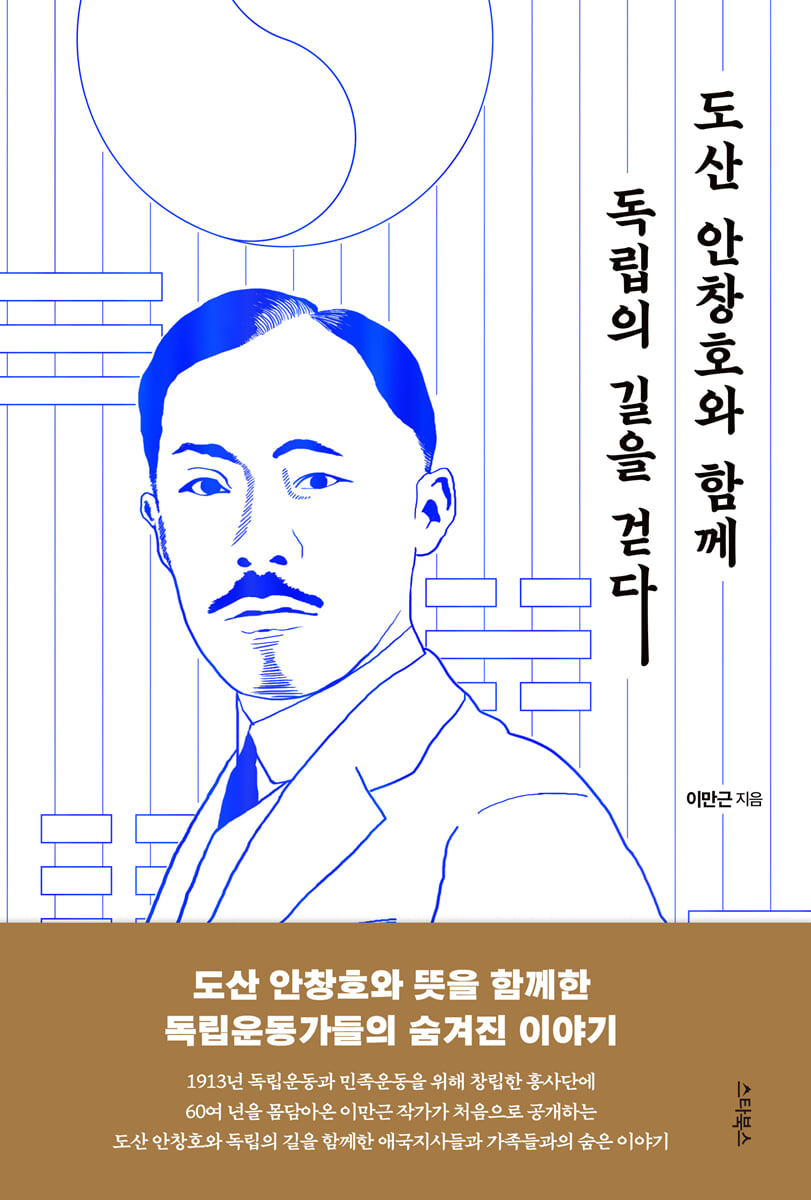
Walking the Path to Independence with Dosan Ahn Chang-ho
 |
Description
Book Introduction
The Hidden Stories of Independence Activists Who Shared the same Vision as Dosan Ahn Chang-ho
Despair is the death of youth, and when youth dies, the nation dies!
This book is the first to be revealed by author Lee Man-geun, who has been a member of Heungsadan, which was founded in 1913 for the independence movement and national movement, for over 60 years. It reveals the hidden stories of Dosan Ahn Chang-ho, the patriotic martyrs who walked the path to independence with him and put it into practice through action, and Ahn Chang-ho's family.
The extent to which the family passionately participated in the independence movement can be seen in the fact that his wife, Lee Hye-ryeon, eldest son, eldest daughter, nephew, and nephew-in-law received the Order of Merit for National Foundation and the Presidential Citation for their contributions to independence from the South Korean government.
There is Dosan Park in Sinsa-dong, Gangnam-gu.
There is a memorial hall and statue of Dosan Ahn Chang-ho there, and a grave where he is buried with his wife, Lee Hye-ryeon.
In the history of the Korean independence movement, Dosan Ahn Chang-ho is a widely known figure for his dedicated independence movement and national enlightenment activities.
He was a revolutionary who dedicated his life to the independence and democracy of his country, and he founded and led numerous independence movement groups and organizations.
His representative achievements include the founding of Heungsadan and Shinminhoe, and his activities in the Shanghai Provisional Government.
But many people don't know that behind these great achievements were countless comrades.
Despair is the death of youth, and when youth dies, the nation dies!
This book is the first to be revealed by author Lee Man-geun, who has been a member of Heungsadan, which was founded in 1913 for the independence movement and national movement, for over 60 years. It reveals the hidden stories of Dosan Ahn Chang-ho, the patriotic martyrs who walked the path to independence with him and put it into practice through action, and Ahn Chang-ho's family.
The extent to which the family passionately participated in the independence movement can be seen in the fact that his wife, Lee Hye-ryeon, eldest son, eldest daughter, nephew, and nephew-in-law received the Order of Merit for National Foundation and the Presidential Citation for their contributions to independence from the South Korean government.
There is Dosan Park in Sinsa-dong, Gangnam-gu.
There is a memorial hall and statue of Dosan Ahn Chang-ho there, and a grave where he is buried with his wife, Lee Hye-ryeon.
In the history of the Korean independence movement, Dosan Ahn Chang-ho is a widely known figure for his dedicated independence movement and national enlightenment activities.
He was a revolutionary who dedicated his life to the independence and democracy of his country, and he founded and led numerous independence movement groups and organizations.
His representative achievements include the founding of Heungsadan and Shinminhoe, and his activities in the Shanghai Provisional Government.
But many people don't know that behind these great achievements were countless comrades.
- You can preview some of the book's contents.
Preview
index
preface
1.
It's strength, let's develop strength
Independent in eating, independent in sleeping
Born as the son of a poor farmer
Meeting Pil Dae-eun and entering Miller School
Pil Dae-eun, who awakened national consciousness
Miller, who opened the way to learning
2.
Join the independence and national salvation movement
Gaining fame with the 'Kwaejaejeong' speech
Establishing the Jinjin School and Tanpo-ri Church
Lim Ki-ban, who led the enlightenment movement in the Pyongyang region
Comrade and sworn brother, Dr. Kim Pil-sun
3.
Compatriots come before studies
My future dream is to be a teacher.
Postponing one's dream of studying abroad
Lifelong comrade and supporter Lee Kang
Jeong Jae-gwan, who led the independence movement in the Primorsky Krai
4.
Building a new people and a new nation
Returning home after five years and Shinmin's dream
Establishment of Daeseong School and organization of the Youth Alumni Association
Yu Gil-jun, an enlightenment activist who influenced Dosan
Lee Seung-hoon, who promoted education and model villages
Lee Tae-jun, the Uiyoldan member who became Mongolia's "precious diamond"
5.
My love, the Korean Peninsula
Leaving behind a 'national anthem'
Lee Gap, a man of great talent and military background
6.
The foundation of the great work of national evangelism
Back to my family after 4 years
Founding of Heungsadan
Launch of the Korean National Association
Song Jong-ik, who helped Dosan from the shadows
Kim Jong-rim, who founded the Korean Aviation Training Institute
7.
Achieving unification of the provisional government
Go to Shanghai
Establishment of the Provisional Government of the Republic of Korea
Launch of the Heungsadan Wondong Temporary Committee
Kim Chang-se, a physician and independence activist
An Tae-guk, who led the independence movement in the Primorsky Krai
8.
Visiting Korean Americans again
Caring for the lives of our fellow countrymen
Meet Seo Jae-pil
Jang Ri-wook, known as the "second Dosan"
Gwak Rim-dae, Dosan's closest confidant in the American independence movement
9.
Construction of a model village as a base for the independence movement
The establishment of the National Independence Party and the search for a model village site
Founding the Korean Independence Party
Arrested for Yun Bong-gil's righteous deed
Lee Tak of the '27-Man Suicide Squad'
Dosan's Shadow, the Provisional Government's Watchman, Cha Ri-seok
10.
Visiting Songtaesanjang's Seobyeoksa Temple
be released on parole
Jo Shin-seong, Dosan's adopted brother who devoted himself to women's education
Pastor Han Seung-gon, who promotes patriotism
Author Han Heuk-gu, who did not write a single pro-Japanese sentence
11.
Deep night, a big star falls
I have no fear of death
Fall asleep next to Yoo Sang-gyu
Relocation to Dosan Park, joint burial
Yoo Sang-gyu, who took Dosan as his father
Kim Bong-seong, the nephew-in-law who provided Dosan with his family's remains
An Maek-gyeol, nephew of the factory owner who makes patriots
North Korea's younger sister Ahn Shin-ho
12.
Family is strength
Father of 20 million
“My beloved wife, Hye-ryeon”
Lee Hye-ryeon, the wife of a female warrior
Hollywood star Philip Ahn
Hughes Airways Vice President Ahn Pil-seon
American female hero Ansusan
Ansura, who took care of household chores and ran Moon Gate
An Pil-young, who never saw his father's face
Ahn Chang-ho's chronology
References
1.
It's strength, let's develop strength
Independent in eating, independent in sleeping
Born as the son of a poor farmer
Meeting Pil Dae-eun and entering Miller School
Pil Dae-eun, who awakened national consciousness
Miller, who opened the way to learning
2.
Join the independence and national salvation movement
Gaining fame with the 'Kwaejaejeong' speech
Establishing the Jinjin School and Tanpo-ri Church
Lim Ki-ban, who led the enlightenment movement in the Pyongyang region
Comrade and sworn brother, Dr. Kim Pil-sun
3.
Compatriots come before studies
My future dream is to be a teacher.
Postponing one's dream of studying abroad
Lifelong comrade and supporter Lee Kang
Jeong Jae-gwan, who led the independence movement in the Primorsky Krai
4.
Building a new people and a new nation
Returning home after five years and Shinmin's dream
Establishment of Daeseong School and organization of the Youth Alumni Association
Yu Gil-jun, an enlightenment activist who influenced Dosan
Lee Seung-hoon, who promoted education and model villages
Lee Tae-jun, the Uiyoldan member who became Mongolia's "precious diamond"
5.
My love, the Korean Peninsula
Leaving behind a 'national anthem'
Lee Gap, a man of great talent and military background
6.
The foundation of the great work of national evangelism
Back to my family after 4 years
Founding of Heungsadan
Launch of the Korean National Association
Song Jong-ik, who helped Dosan from the shadows
Kim Jong-rim, who founded the Korean Aviation Training Institute
7.
Achieving unification of the provisional government
Go to Shanghai
Establishment of the Provisional Government of the Republic of Korea
Launch of the Heungsadan Wondong Temporary Committee
Kim Chang-se, a physician and independence activist
An Tae-guk, who led the independence movement in the Primorsky Krai
8.
Visiting Korean Americans again
Caring for the lives of our fellow countrymen
Meet Seo Jae-pil
Jang Ri-wook, known as the "second Dosan"
Gwak Rim-dae, Dosan's closest confidant in the American independence movement
9.
Construction of a model village as a base for the independence movement
The establishment of the National Independence Party and the search for a model village site
Founding the Korean Independence Party
Arrested for Yun Bong-gil's righteous deed
Lee Tak of the '27-Man Suicide Squad'
Dosan's Shadow, the Provisional Government's Watchman, Cha Ri-seok
10.
Visiting Songtaesanjang's Seobyeoksa Temple
be released on parole
Jo Shin-seong, Dosan's adopted brother who devoted himself to women's education
Pastor Han Seung-gon, who promotes patriotism
Author Han Heuk-gu, who did not write a single pro-Japanese sentence
11.
Deep night, a big star falls
I have no fear of death
Fall asleep next to Yoo Sang-gyu
Relocation to Dosan Park, joint burial
Yoo Sang-gyu, who took Dosan as his father
Kim Bong-seong, the nephew-in-law who provided Dosan with his family's remains
An Maek-gyeol, nephew of the factory owner who makes patriots
North Korea's younger sister Ahn Shin-ho
12.
Family is strength
Father of 20 million
“My beloved wife, Hye-ryeon”
Lee Hye-ryeon, the wife of a female warrior
Hollywood star Philip Ahn
Hughes Airways Vice President Ahn Pil-seon
American female hero Ansusan
Ansura, who took care of household chores and ran Moon Gate
An Pil-young, who never saw his father's face
Ahn Chang-ho's chronology
References
Detailed image

Into the book
“Do you plan to continue the independence movement?”
“Whether I eat, I do it for Korea’s independence. Whether I sleep, I do it for Korea’s independence.
This will remain unchanged until my life is over.”
“So, do you think independence for Joseon is possible?”
“I believe that Korea’s independence will definitely be achieved.”
“What makes you believe that?”
“Because the entire Korean people believe in Korea’s independence, Korea will become independent. Because the justice of the world desires Korea’s independence, Korea will become independent. Because Heaven decrees Korea’s independence, Korea will certainly become independent.”
---From "Independence in Eating, Independence in Sleeping"
On July 25, 1898 (lunar calendar), Im Gi-ban took the lead in actively supporting and sponsoring the founding ceremony of the Pyongyang branch of the Independence Association and the so-called Pyongyang People's Common Assembly's 'Kwaejaejeong' speech.
Many patriotic young people and local leaders frequented the Sarangbang of Im Gi-ban, who led the enlightenment movement and the freedom and civil rights movement in the Pyongyang region.
Im Gi-ban encouraged and advised them to participate in the Pyongyang branch of the Independence Association and the People's Joint Meeting, and he himself took the lead.
When Ahn Chang-ho established Jeomjin School and Tanpo-ri Church, Im Gi-ban also actively supported and sponsored him.
At this time, Ahn Chang-ho met Lee Kang, Im Jun-gi, and Lee Gap in the guest room of Lim Gi-ban's house, and became lifelong comrades with them.
Lim Jun-gi, who was the grandson of Im Gi-ban, participated in the independence movement with Ahn Chang-ho not only in the United States but also in China and Russia.
---From "Im Gi-ban, who led the enlightenment movement in the Pyongyang region"
The New People's Association started with the goal of restoring national sovereignty and establishing a republican government to establish a free and independent nation.
Since the Shinminhoe was a secret organization, Dosan actively promoted patriotic enlightenment movements through lectures and academic activities, and promoted educational national salvation movements through the establishment of schools to avoid the eyes of the Japanese, and national industrial movements such as publishing magazines and books and establishing companies, and even planned to build independence army bases overseas.
It is said that by the time Dosan went into exile in China, the number of members of the Shinminhoe had reached around 300.
However, Kim Gu recorded that there were 400 people, and Park Eun-sik that there were 800 people.
After founding the Shinminhoe, Dosan spent two to three years traveling around the country, including Seoul, Pyeongan Province, and Hwanghae Province, focusing on giving patriotic lectures.
---From "Returning Home After 5 Years and Citizen's Dream"
Upon returning to the United States, Dosan immediately devoted himself to gathering comrades for the establishment of Heungsa Dan, and held several preparatory meetings with Ha Sang-ok, Jeong Won-do, and Kang Young-so at the home of Kang Young-so (1886-1934) in San Francisco.
Dosan decided to use the name 'Heungsa Dan (興士團)', which was previously organized by Yu Gil-jun.
Dosan stated, “The only way for our people to fully respond, enjoy survival and prosperity, and further achieve the great mission of contributing to the coexistence and prosperity of all human society is through the teachings of Heungsadan.”
Heungsadan was founded on May 13, 1913, at Kang Young-so's house in San Francisco (1914 Lyen St.), succeeding the domestic Youth Student Association.
---From "The Founding of Heungsadan"
Also, on September 6, the Provisional Government elected Dosan as the 'Acting President' until Provisional President Syngman Rhee took office, but Dosan firmly refused.
Dosan, through self-abasement and sacrifice, overcame all opposition and conflicts with meticulous organizational skills and finally achieved the seemingly difficult and arduous unification of the provisional government.
The Provisional Government resolved on September 10th to have the Prime Minister act as Acting Prime Minister until the new President and Prime Minister take office.
The following day, September 11, the establishment of the Provisional Government of the Republic of Korea was announced.
However, the inauguration of the Prime Minister and the Commissioner General was delayed, and the inauguration ceremony for Prime Minister Lee Dong-hwi, Minister of Home Affairs Lee Dong-nyeong, Minister of Finance Lee Si-young, and Minister of Justice Shin Gyu-sik was held on November 3, and Dosan gave a congratulatory speech.
---From “The Establishment of the Provisional Government of the Republic of Korea”
Gwak Rim-dae worked closely with Dosan for five years, including drafting the early constitution of Heungsa Dan.
When Dosan visited Hawaii for about six months in 1917 due to the feud between Syngman Rhee and Yongman Park, or when he left Los Angeles in 1918 to visit Mexico for eight months to resolve the issue of Korean employment on diaper farms, Dosan always asked Kwak Rim-dae to take care of all the affairs of Heungsadan.
He also actively assisted in the affairs of the Heungsadan during his stay in New York for about eight years from 1922 to 1929, and in 1929 he served as the Vice President of the Heungsadan Board of Directors (currently the Chairman of the Board of Directors).
---From "Gwak Rim-dae, Dosan's closest confidant in the American independence movement"
Lee Tak's '27th Death Squadron' was set to punish the seven traitors and others during the Samwooje on March 3, 1919, the day after Emperor Gojong's state funeral, and was lying in ambush at Mangwoo Pass, where the procession was passing that day.
However, the carriage in which Emperor Sunjong was riding was too close to the carriage in which traitors such as Yi Wan-yong were carrying, and there was a risk of injury to the emperor, so he failed to punish them. Instead, he threw a denunciation denouncing the truth about the poisoning of Emperor Gojong and the crimes of the seven traitors into the carriage in which Emperor Sunjong was riding and escaped to Manchuria.
While working as an executive of the Hanjokhoe (Korean Association) in Manchuria in 1920, Lee Tak also participated in the organization of the Korean Youth League and was appointed as the Minister of Education.
Lee Tak, who was elected as the head of the Korean Liberation Corps in March of the same year, attended the general meeting of the Korean Youth Corps held on April 19.
---From "The 27-Man Suicide Squad's Decision"
Han Seung-gon was elected as the head of the Heungsa Dan medical department (currently the chairman of the council) in 1920 and led the Heungsa Dan. He cooperated with the board of directors to promote the establishment of a base for the Heungsa Dan Won-dong temporary committee and to support the construction costs of the new Dongmyeong Academy.
He also served as the secretary of the Danube branch of the North American General Assembly of the Korean National Association, and devoted himself to raising independence funds to be sent to the Provisional Government of the Republic of Korea in Shanghai and selling independence bonds.
While carrying out his pastoral work, he demonstrated leadership by adjusting the schedule of the 11th Western Conference of the Heungsa Dan, to be held at the Los Angeles Youth Center on January 1-2, 1925, to coincide with Dosan's visit to the United States, thereby inviting many members to join.
On August 24, 1926, Han Seung-gon received a letter from Dosan detailing the situation of the Provisional Government to Han Seung-gon and Jang Ri-uk.
As if complaining to a trusted comrade, Dosan's concerns were vividly expressed that the situation was very different from the old Shanghai, with divisions becoming severe and chaotic, and that the existence of the provisional government was becoming difficult.
---From "Pastor Han Seung-gon, who encouraged patriotism"
After being released, Han Heuk-gu moved to Anmal, Yeongok-ri, Seongtae-myeon, Kangseo-gun, Pyeongannam-do, near Dosan's hometown, and lived there, working in an orchard and writing.
The period in which Han Heuk-gu's life and literature created valuable meaning in the history of modern Korean literature was his five years of study and wandering in the United States from March 1929 to March 1934, the literary works he created and his actions during that period, and the literary works and literary activities he published in Pyongyang after returning to Korea based on his studies and experiences during that time.
In particular, he is called a representative translator who first translated and introduced black poetry in works such as 『Donggwang』 and 『Gaebyeok』.
---From "Writer Han Heuk-gu, who did not write a single pro-Japanese sentence"
One day in early 1938, Dosan said to Seonwoo Hoon (1892-1961), who had come to visit him in his hospital room, “I have no fear of death… I am about to die, but I feel sorry and my heart aches that my beloved compatriots are suffering so much… Japan has started a war that is too great for its own strength, and it will inevitably be defeated because of this war… Please endure no matter what difficulties you face…”
He continued, “I love Daebosan Mountain… Choosing a place to be buried is a matter of greed, but if circumstances allow, I will take it to Daebosan Mountain… If that is not possible, I like Manguri… If I go to Manguri, I will bury it next to Yu Sang-gyu (1897-1936)…”
---From "I Have No Fear of Death"
Dosan expressed his gratitude to the compatriots in attendance for their continued support, and urged them not to be shaken by the prolonged independence movement, not to lose hope, and to unite and move forward together.
Jang Ri-wook, who was present at the scene, testified that he then looked at his wife, Lee Hye-ryeon, and said, “I am a lacking husband who has never been able to buy you a skirt or a jacket in my entire life.” He also said to his eldest son, Philip, and his younger siblings, “I am a father who has never been able to buy you a notebook or a pencil while you were graduating from elementary and middle school.”
Dosan, as if he knew that if he left now, it would be the last time they would ever meet again, said to Philip, “I feel like I would be committing a sin against heaven by leaving my family in the care of a young you.”
---From "Father of 20 Million"
Ahn Philippe not only acted as a movie actor, but also took it upon himself to carry on his parents' dedicated love for their country and independence movement.
As the first second-generation Korean-American, he organized the first second-generation Korean-American youth group and the '2-8 Club' to support second-generation Korean-Americans in the 1930s.
These groups engaged in various activities, but above all, they took the lead in arranging and supporting 'Meetings with Parents,' where Korean independence activists and their descendants meet.
On April 29, 1932, when his father was arrested in Shanghai, Ahn Philip appealed to political parties and members of the U.S. Congress for help in securing his release, and directly to the consul at the U.S. Embassy in Shanghai and the ambassador and consul in Korea.
Also, when his father, Dosan, was imprisoned again in 1937 for the 'Dongwoohoe Incident', he sent a letter to the consul at the U.S. Embassy in Korea.
“Whether I eat, I do it for Korea’s independence. Whether I sleep, I do it for Korea’s independence.
This will remain unchanged until my life is over.”
“So, do you think independence for Joseon is possible?”
“I believe that Korea’s independence will definitely be achieved.”
“What makes you believe that?”
“Because the entire Korean people believe in Korea’s independence, Korea will become independent. Because the justice of the world desires Korea’s independence, Korea will become independent. Because Heaven decrees Korea’s independence, Korea will certainly become independent.”
---From "Independence in Eating, Independence in Sleeping"
On July 25, 1898 (lunar calendar), Im Gi-ban took the lead in actively supporting and sponsoring the founding ceremony of the Pyongyang branch of the Independence Association and the so-called Pyongyang People's Common Assembly's 'Kwaejaejeong' speech.
Many patriotic young people and local leaders frequented the Sarangbang of Im Gi-ban, who led the enlightenment movement and the freedom and civil rights movement in the Pyongyang region.
Im Gi-ban encouraged and advised them to participate in the Pyongyang branch of the Independence Association and the People's Joint Meeting, and he himself took the lead.
When Ahn Chang-ho established Jeomjin School and Tanpo-ri Church, Im Gi-ban also actively supported and sponsored him.
At this time, Ahn Chang-ho met Lee Kang, Im Jun-gi, and Lee Gap in the guest room of Lim Gi-ban's house, and became lifelong comrades with them.
Lim Jun-gi, who was the grandson of Im Gi-ban, participated in the independence movement with Ahn Chang-ho not only in the United States but also in China and Russia.
---From "Im Gi-ban, who led the enlightenment movement in the Pyongyang region"
The New People's Association started with the goal of restoring national sovereignty and establishing a republican government to establish a free and independent nation.
Since the Shinminhoe was a secret organization, Dosan actively promoted patriotic enlightenment movements through lectures and academic activities, and promoted educational national salvation movements through the establishment of schools to avoid the eyes of the Japanese, and national industrial movements such as publishing magazines and books and establishing companies, and even planned to build independence army bases overseas.
It is said that by the time Dosan went into exile in China, the number of members of the Shinminhoe had reached around 300.
However, Kim Gu recorded that there were 400 people, and Park Eun-sik that there were 800 people.
After founding the Shinminhoe, Dosan spent two to three years traveling around the country, including Seoul, Pyeongan Province, and Hwanghae Province, focusing on giving patriotic lectures.
---From "Returning Home After 5 Years and Citizen's Dream"
Upon returning to the United States, Dosan immediately devoted himself to gathering comrades for the establishment of Heungsa Dan, and held several preparatory meetings with Ha Sang-ok, Jeong Won-do, and Kang Young-so at the home of Kang Young-so (1886-1934) in San Francisco.
Dosan decided to use the name 'Heungsa Dan (興士團)', which was previously organized by Yu Gil-jun.
Dosan stated, “The only way for our people to fully respond, enjoy survival and prosperity, and further achieve the great mission of contributing to the coexistence and prosperity of all human society is through the teachings of Heungsadan.”
Heungsadan was founded on May 13, 1913, at Kang Young-so's house in San Francisco (1914 Lyen St.), succeeding the domestic Youth Student Association.
---From "The Founding of Heungsadan"
Also, on September 6, the Provisional Government elected Dosan as the 'Acting President' until Provisional President Syngman Rhee took office, but Dosan firmly refused.
Dosan, through self-abasement and sacrifice, overcame all opposition and conflicts with meticulous organizational skills and finally achieved the seemingly difficult and arduous unification of the provisional government.
The Provisional Government resolved on September 10th to have the Prime Minister act as Acting Prime Minister until the new President and Prime Minister take office.
The following day, September 11, the establishment of the Provisional Government of the Republic of Korea was announced.
However, the inauguration of the Prime Minister and the Commissioner General was delayed, and the inauguration ceremony for Prime Minister Lee Dong-hwi, Minister of Home Affairs Lee Dong-nyeong, Minister of Finance Lee Si-young, and Minister of Justice Shin Gyu-sik was held on November 3, and Dosan gave a congratulatory speech.
---From “The Establishment of the Provisional Government of the Republic of Korea”
Gwak Rim-dae worked closely with Dosan for five years, including drafting the early constitution of Heungsa Dan.
When Dosan visited Hawaii for about six months in 1917 due to the feud between Syngman Rhee and Yongman Park, or when he left Los Angeles in 1918 to visit Mexico for eight months to resolve the issue of Korean employment on diaper farms, Dosan always asked Kwak Rim-dae to take care of all the affairs of Heungsadan.
He also actively assisted in the affairs of the Heungsadan during his stay in New York for about eight years from 1922 to 1929, and in 1929 he served as the Vice President of the Heungsadan Board of Directors (currently the Chairman of the Board of Directors).
---From "Gwak Rim-dae, Dosan's closest confidant in the American independence movement"
Lee Tak's '27th Death Squadron' was set to punish the seven traitors and others during the Samwooje on March 3, 1919, the day after Emperor Gojong's state funeral, and was lying in ambush at Mangwoo Pass, where the procession was passing that day.
However, the carriage in which Emperor Sunjong was riding was too close to the carriage in which traitors such as Yi Wan-yong were carrying, and there was a risk of injury to the emperor, so he failed to punish them. Instead, he threw a denunciation denouncing the truth about the poisoning of Emperor Gojong and the crimes of the seven traitors into the carriage in which Emperor Sunjong was riding and escaped to Manchuria.
While working as an executive of the Hanjokhoe (Korean Association) in Manchuria in 1920, Lee Tak also participated in the organization of the Korean Youth League and was appointed as the Minister of Education.
Lee Tak, who was elected as the head of the Korean Liberation Corps in March of the same year, attended the general meeting of the Korean Youth Corps held on April 19.
---From "The 27-Man Suicide Squad's Decision"
Han Seung-gon was elected as the head of the Heungsa Dan medical department (currently the chairman of the council) in 1920 and led the Heungsa Dan. He cooperated with the board of directors to promote the establishment of a base for the Heungsa Dan Won-dong temporary committee and to support the construction costs of the new Dongmyeong Academy.
He also served as the secretary of the Danube branch of the North American General Assembly of the Korean National Association, and devoted himself to raising independence funds to be sent to the Provisional Government of the Republic of Korea in Shanghai and selling independence bonds.
While carrying out his pastoral work, he demonstrated leadership by adjusting the schedule of the 11th Western Conference of the Heungsa Dan, to be held at the Los Angeles Youth Center on January 1-2, 1925, to coincide with Dosan's visit to the United States, thereby inviting many members to join.
On August 24, 1926, Han Seung-gon received a letter from Dosan detailing the situation of the Provisional Government to Han Seung-gon and Jang Ri-uk.
As if complaining to a trusted comrade, Dosan's concerns were vividly expressed that the situation was very different from the old Shanghai, with divisions becoming severe and chaotic, and that the existence of the provisional government was becoming difficult.
---From "Pastor Han Seung-gon, who encouraged patriotism"
After being released, Han Heuk-gu moved to Anmal, Yeongok-ri, Seongtae-myeon, Kangseo-gun, Pyeongannam-do, near Dosan's hometown, and lived there, working in an orchard and writing.
The period in which Han Heuk-gu's life and literature created valuable meaning in the history of modern Korean literature was his five years of study and wandering in the United States from March 1929 to March 1934, the literary works he created and his actions during that period, and the literary works and literary activities he published in Pyongyang after returning to Korea based on his studies and experiences during that time.
In particular, he is called a representative translator who first translated and introduced black poetry in works such as 『Donggwang』 and 『Gaebyeok』.
---From "Writer Han Heuk-gu, who did not write a single pro-Japanese sentence"
One day in early 1938, Dosan said to Seonwoo Hoon (1892-1961), who had come to visit him in his hospital room, “I have no fear of death… I am about to die, but I feel sorry and my heart aches that my beloved compatriots are suffering so much… Japan has started a war that is too great for its own strength, and it will inevitably be defeated because of this war… Please endure no matter what difficulties you face…”
He continued, “I love Daebosan Mountain… Choosing a place to be buried is a matter of greed, but if circumstances allow, I will take it to Daebosan Mountain… If that is not possible, I like Manguri… If I go to Manguri, I will bury it next to Yu Sang-gyu (1897-1936)…”
---From "I Have No Fear of Death"
Dosan expressed his gratitude to the compatriots in attendance for their continued support, and urged them not to be shaken by the prolonged independence movement, not to lose hope, and to unite and move forward together.
Jang Ri-wook, who was present at the scene, testified that he then looked at his wife, Lee Hye-ryeon, and said, “I am a lacking husband who has never been able to buy you a skirt or a jacket in my entire life.” He also said to his eldest son, Philip, and his younger siblings, “I am a father who has never been able to buy you a notebook or a pencil while you were graduating from elementary and middle school.”
Dosan, as if he knew that if he left now, it would be the last time they would ever meet again, said to Philip, “I feel like I would be committing a sin against heaven by leaving my family in the care of a young you.”
---From "Father of 20 Million"
Ahn Philippe not only acted as a movie actor, but also took it upon himself to carry on his parents' dedicated love for their country and independence movement.
As the first second-generation Korean-American, he organized the first second-generation Korean-American youth group and the '2-8 Club' to support second-generation Korean-Americans in the 1930s.
These groups engaged in various activities, but above all, they took the lead in arranging and supporting 'Meetings with Parents,' where Korean independence activists and their descendants meet.
On April 29, 1932, when his father was arrested in Shanghai, Ahn Philip appealed to political parties and members of the U.S. Congress for help in securing his release, and directly to the consul at the U.S. Embassy in Shanghai and the ambassador and consul in Korea.
Also, when his father, Dosan, was imprisoned again in 1937 for the 'Dongwoohoe Incident', he sent a letter to the consul at the U.S. Embassy in Korea.
---From "Hollywood Star Philippe"
Publisher's Review
“Whether I eat, I do it for Korea’s independence. Whether I sleep, I do it for Korea’s independence.
This will remain unchanged until my life is over.”
“Without a nation, there can be no house or body, and when the people are despised, no one can enjoy glory alone.”
Achievements of Ahn Chang-ho, a leader of unity, harmony, and organization
Unification of three provisional governments into the Provisional Government of the Republic of Korea
Established a headquarters with $25,000 brought directly from the United States
Implement a communication system and establish a traffic bureau for systematic command and communication.
The Korean Red Cross was founded to link the treatment of wounded soldiers with international organizations.
The Provisional Government's organ, the Independence Newspaper, was launched to publicize the independence movement.
A record of the author's 60-year career in the Heungsadan.
Awakening the enlightenment movement and national spirit of Dosan Ahn Chang-ho!!
In 『Walking the Path to Independence with Dosan Ahn Chang-ho』, the author, who has been a member of Heungsadan for over 60 years, has tracked down and included little-known independence activists who shared Dosan Ahn Chang-ho's ideals and put them into action, and has even included hidden stories from their families' independence movement history. This is a novel book planned as a new attempt.
In the history of the Korean independence movement, Dosan Ahn Chang-ho is a widely known figure for his dedicated independence movement and national enlightenment activities.
He was a revolutionary who dedicated his life to the independence and democracy of his country, and he founded and led numerous independence movement groups and organizations.
His representative achievements include the founding of Heungsadan and Shinminhoe, and his activities in the Shanghai Provisional Government.
But many people don't know that behind these great achievements were countless comrades.
Pil Dae-eun, who laid the foundation for the independence movement and awakened national consciousness; Miller, a foreign independence activist who opened the way for learning to Korean students; Lim Ki-ban, who was 10 years older than Dosan Ahn Chang-ho and helped the independence movement from an early age in a neighboring village; Kim Pil-soon, who co-organized the New People's Association as the personal physician of the independence army; Lee Kang, a member of Heungsadan who sent Ahn Chang-ho to Korea; Jeong Jae-gwan, who went to the United States with Ahn Chang-ho and founded the Public Association; Yu Gil-jun, who led national education and the independence movement; Lee Seung-hun, a former peddler who was captivated by Ahn Chang-ho's lectures, quit drinking and smoking, got his hair cut short, and joined the New People's Association; Lee Tae-jun, who introduced a bomb manufacturing technician to the Uiyoldan; Lee Gap, a man of great virtue who was a military officer; Song Jong-ik, who devoted his life to the Heungsadan by providing independence funds from behind the scenes; Kim Jong-rim, the king of rice who personally purchased two airplanes and attempted to train combat pilots; and Dosan's personal physician and brother-in-law. Kim Chang-se, Ahn Tae-guk who led the independence movement in the Maritime Province, Jang Ri-uk who is called the second Dosan, Kwak Rim-dae who was the closest aide to the independence movement in the Americas, Lee Tak of the 27-member suicide squad, Cha Ri-seok who was the watchman of the provisional government, Jo Shin-seong who was Dosan's adopted brother, Han Seung-gon who inspired patriotism, Han Heuk-gu who did not write a single line of pro-Japanese slang, Yu Sang-gyu who worked as Ahn Chang-ho's secretary in the provisional government in Shanghai, etc. These people led the independence movement together with Dosan Ahn Chang-ho and devoted themselves to the freedom and independence of their country, but their names are relatively less well known because they are overshadowed by the huge name of Dosan Ahn Chang-ho.
Not only that, but his family members also participated in the independence movement, but many of them are not well known.
For example, Dosan's wife, Kim Hye-ryeon, led the Korean Women's Patriotic Corps and sent $300, which was the sum of money saved through laundry and sewing, and a travel certificate inviting Lee Gap to St. Petersburg to become the editor-in-chief of the Shinhan Minbo.
Kim Pil-sun's family is a prominent family of independence activists.
Kim Yun-bang (founder of Sorae Church and School) and his second older brother, Kim Yun-o (founder), organized the Seowoo Society and merged it with the Hanbuk Society.
He founded the Northwest Society, his third older brother Kim Yun-ryeol (who died young), his younger sisters Kim Gu-rye and Kim Sun-ae (president of the Shanghai Korean Patriotic Women's Association), and Kim Pil-rye (founder of the Korean YWCA, founder of Geunwoohoe), his niece Kim Maria (president of the Korean Patriotic Women's Association, donated military funds to the Provisional Government), his second sister Kim Sun-ae's husband Kim Kyu-sik (vice president and foreign minister of the Provisional Government of the Republic of Korea), and his first sister Kim Gu-rye's husband Seo Byeong-ho (founder of the Shinhan Youth Party, founded the Korean Red Cross with Ahn Chang-ho, grandfather of Reverend Seo Gyeong-seok).
Kim Pil-sun's third son was Kim Yeom, who was the 'Emperor of Film' in China.
After achieving great success as an actor, he participated in the independence movement by producing only anti-Japanese films and appearing only in anti-Japanese films.
He also helped his compatriots by sponsoring Korean schools and providing funds for anti-Japanese activities.
Song Jong-ik's son, Willie, fled to China to avoid being drafted into the Japanese student army while attending middle school in Seoul. He joined the U.S. Army Office of Strategic Services (OSS) intelligence unit in Chongqing, participated in the anti-Japanese underground movement, and donated $15,000 to the Heungsadan to be used as a scholarship fund.
Kim Bong-seong, the husband of An Maek-gyeol, was also appointed as a teacher at Jeonjim School and worked hard to cultivate national consciousness among the youth, but was arrested by the police in 1937 in connection with the 'Dongwoohoe' incident.
In this way, this book was published to highlight not only the achievements of Dosan Ahn Chang-ho, but also those of his comrades and his unknown family members, and it also has the character of commemorating Ahn Chang-ho, his comrades, and his family.
The path to independence that Dosan Ahn Chang-ho walked was by no means alone.
He had many comrades by his side, and there were family members who supported him.
Their efforts formed a crucial axis of the Korean independence movement, and Dosan Ahn Chang-ho and his comrades played a crucial role in realizing Korea's independence and democracy. Their dedicated efforts and sacrifices laid the foundation for the freedom and peace we enjoy today.
In addition to the independence movement, Dosan Ahn Chang-ho devoted much of his energy to education and enlightenment activities. He emphasized the importance of education to young people and launched a movement to cultivate their abilities.
Ahn Chang-ho believed that developing the capabilities of each citizen through education was the way to build a strong nation.
This belief is clearly revealed in the activities of Heungsa Dan, Daeseong School, and Shinminhoe, which he and his comrades founded together.
Through the publication of this book, we hope to widely publicize the achievements of Dosan Ahn Chang-ho, as well as those of those who have been hidden under his name.
I hope this will be a valuable opportunity to reflect on the lives and achievements of independence activists who have been buried without a trace, and to honor the countless comrades who dedicated themselves to the independence of the Republic of Korea.
By shedding new light on the unsung heroes of the independence movement, we hope to demonstrate how their sacrifice and dedication have profoundly impacted today's Republic of Korea. Through this, future generations will be able to remember the noble spirit of our ancestors, carry on their legacy, and forge a brighter future.
The history of the Korean independence movement achieved by Dosan Ahn Chang-ho and his comrades is deeply rooted in our lives today.
Without their dedication and sacrifice, the Republic of Korea would not exist today.
I hope that this book will spread the noble spirit of Dosan Ahn Chang-ho and his comrades and serve as an opportunity to carry on their legacy.
This will remain unchanged until my life is over.”
“Without a nation, there can be no house or body, and when the people are despised, no one can enjoy glory alone.”
Achievements of Ahn Chang-ho, a leader of unity, harmony, and organization
Unification of three provisional governments into the Provisional Government of the Republic of Korea
Established a headquarters with $25,000 brought directly from the United States
Implement a communication system and establish a traffic bureau for systematic command and communication.
The Korean Red Cross was founded to link the treatment of wounded soldiers with international organizations.
The Provisional Government's organ, the Independence Newspaper, was launched to publicize the independence movement.
A record of the author's 60-year career in the Heungsadan.
Awakening the enlightenment movement and national spirit of Dosan Ahn Chang-ho!!
In 『Walking the Path to Independence with Dosan Ahn Chang-ho』, the author, who has been a member of Heungsadan for over 60 years, has tracked down and included little-known independence activists who shared Dosan Ahn Chang-ho's ideals and put them into action, and has even included hidden stories from their families' independence movement history. This is a novel book planned as a new attempt.
In the history of the Korean independence movement, Dosan Ahn Chang-ho is a widely known figure for his dedicated independence movement and national enlightenment activities.
He was a revolutionary who dedicated his life to the independence and democracy of his country, and he founded and led numerous independence movement groups and organizations.
His representative achievements include the founding of Heungsadan and Shinminhoe, and his activities in the Shanghai Provisional Government.
But many people don't know that behind these great achievements were countless comrades.
Pil Dae-eun, who laid the foundation for the independence movement and awakened national consciousness; Miller, a foreign independence activist who opened the way for learning to Korean students; Lim Ki-ban, who was 10 years older than Dosan Ahn Chang-ho and helped the independence movement from an early age in a neighboring village; Kim Pil-soon, who co-organized the New People's Association as the personal physician of the independence army; Lee Kang, a member of Heungsadan who sent Ahn Chang-ho to Korea; Jeong Jae-gwan, who went to the United States with Ahn Chang-ho and founded the Public Association; Yu Gil-jun, who led national education and the independence movement; Lee Seung-hun, a former peddler who was captivated by Ahn Chang-ho's lectures, quit drinking and smoking, got his hair cut short, and joined the New People's Association; Lee Tae-jun, who introduced a bomb manufacturing technician to the Uiyoldan; Lee Gap, a man of great virtue who was a military officer; Song Jong-ik, who devoted his life to the Heungsadan by providing independence funds from behind the scenes; Kim Jong-rim, the king of rice who personally purchased two airplanes and attempted to train combat pilots; and Dosan's personal physician and brother-in-law. Kim Chang-se, Ahn Tae-guk who led the independence movement in the Maritime Province, Jang Ri-uk who is called the second Dosan, Kwak Rim-dae who was the closest aide to the independence movement in the Americas, Lee Tak of the 27-member suicide squad, Cha Ri-seok who was the watchman of the provisional government, Jo Shin-seong who was Dosan's adopted brother, Han Seung-gon who inspired patriotism, Han Heuk-gu who did not write a single line of pro-Japanese slang, Yu Sang-gyu who worked as Ahn Chang-ho's secretary in the provisional government in Shanghai, etc. These people led the independence movement together with Dosan Ahn Chang-ho and devoted themselves to the freedom and independence of their country, but their names are relatively less well known because they are overshadowed by the huge name of Dosan Ahn Chang-ho.
Not only that, but his family members also participated in the independence movement, but many of them are not well known.
For example, Dosan's wife, Kim Hye-ryeon, led the Korean Women's Patriotic Corps and sent $300, which was the sum of money saved through laundry and sewing, and a travel certificate inviting Lee Gap to St. Petersburg to become the editor-in-chief of the Shinhan Minbo.
Kim Pil-sun's family is a prominent family of independence activists.
Kim Yun-bang (founder of Sorae Church and School) and his second older brother, Kim Yun-o (founder), organized the Seowoo Society and merged it with the Hanbuk Society.
He founded the Northwest Society, his third older brother Kim Yun-ryeol (who died young), his younger sisters Kim Gu-rye and Kim Sun-ae (president of the Shanghai Korean Patriotic Women's Association), and Kim Pil-rye (founder of the Korean YWCA, founder of Geunwoohoe), his niece Kim Maria (president of the Korean Patriotic Women's Association, donated military funds to the Provisional Government), his second sister Kim Sun-ae's husband Kim Kyu-sik (vice president and foreign minister of the Provisional Government of the Republic of Korea), and his first sister Kim Gu-rye's husband Seo Byeong-ho (founder of the Shinhan Youth Party, founded the Korean Red Cross with Ahn Chang-ho, grandfather of Reverend Seo Gyeong-seok).
Kim Pil-sun's third son was Kim Yeom, who was the 'Emperor of Film' in China.
After achieving great success as an actor, he participated in the independence movement by producing only anti-Japanese films and appearing only in anti-Japanese films.
He also helped his compatriots by sponsoring Korean schools and providing funds for anti-Japanese activities.
Song Jong-ik's son, Willie, fled to China to avoid being drafted into the Japanese student army while attending middle school in Seoul. He joined the U.S. Army Office of Strategic Services (OSS) intelligence unit in Chongqing, participated in the anti-Japanese underground movement, and donated $15,000 to the Heungsadan to be used as a scholarship fund.
Kim Bong-seong, the husband of An Maek-gyeol, was also appointed as a teacher at Jeonjim School and worked hard to cultivate national consciousness among the youth, but was arrested by the police in 1937 in connection with the 'Dongwoohoe' incident.
In this way, this book was published to highlight not only the achievements of Dosan Ahn Chang-ho, but also those of his comrades and his unknown family members, and it also has the character of commemorating Ahn Chang-ho, his comrades, and his family.
The path to independence that Dosan Ahn Chang-ho walked was by no means alone.
He had many comrades by his side, and there were family members who supported him.
Their efforts formed a crucial axis of the Korean independence movement, and Dosan Ahn Chang-ho and his comrades played a crucial role in realizing Korea's independence and democracy. Their dedicated efforts and sacrifices laid the foundation for the freedom and peace we enjoy today.
In addition to the independence movement, Dosan Ahn Chang-ho devoted much of his energy to education and enlightenment activities. He emphasized the importance of education to young people and launched a movement to cultivate their abilities.
Ahn Chang-ho believed that developing the capabilities of each citizen through education was the way to build a strong nation.
This belief is clearly revealed in the activities of Heungsa Dan, Daeseong School, and Shinminhoe, which he and his comrades founded together.
Through the publication of this book, we hope to widely publicize the achievements of Dosan Ahn Chang-ho, as well as those of those who have been hidden under his name.
I hope this will be a valuable opportunity to reflect on the lives and achievements of independence activists who have been buried without a trace, and to honor the countless comrades who dedicated themselves to the independence of the Republic of Korea.
By shedding new light on the unsung heroes of the independence movement, we hope to demonstrate how their sacrifice and dedication have profoundly impacted today's Republic of Korea. Through this, future generations will be able to remember the noble spirit of our ancestors, carry on their legacy, and forge a brighter future.
The history of the Korean independence movement achieved by Dosan Ahn Chang-ho and his comrades is deeply rooted in our lives today.
Without their dedication and sacrifice, the Republic of Korea would not exist today.
I hope that this book will spread the noble spirit of Dosan Ahn Chang-ho and his comrades and serve as an opportunity to carry on their legacy.
GOODS SPECIFICS
- Date of issue: August 15, 2024
- Format: Hardcover book binding method guide
- Page count, weight, size: 448 pages | 143*210*30mm
- ISBN13: 9791157957453
- ISBN10: 1157957455
You may also like
카테고리
korean


korean

![GQ KOREA Mark (Monthly): December [2025]](http://librairie.coreenne.fr/cdn/shop/files/8ef265dbbfbf186523ed75ba7319009d.jpg?v=1765340328&width=3840)


