

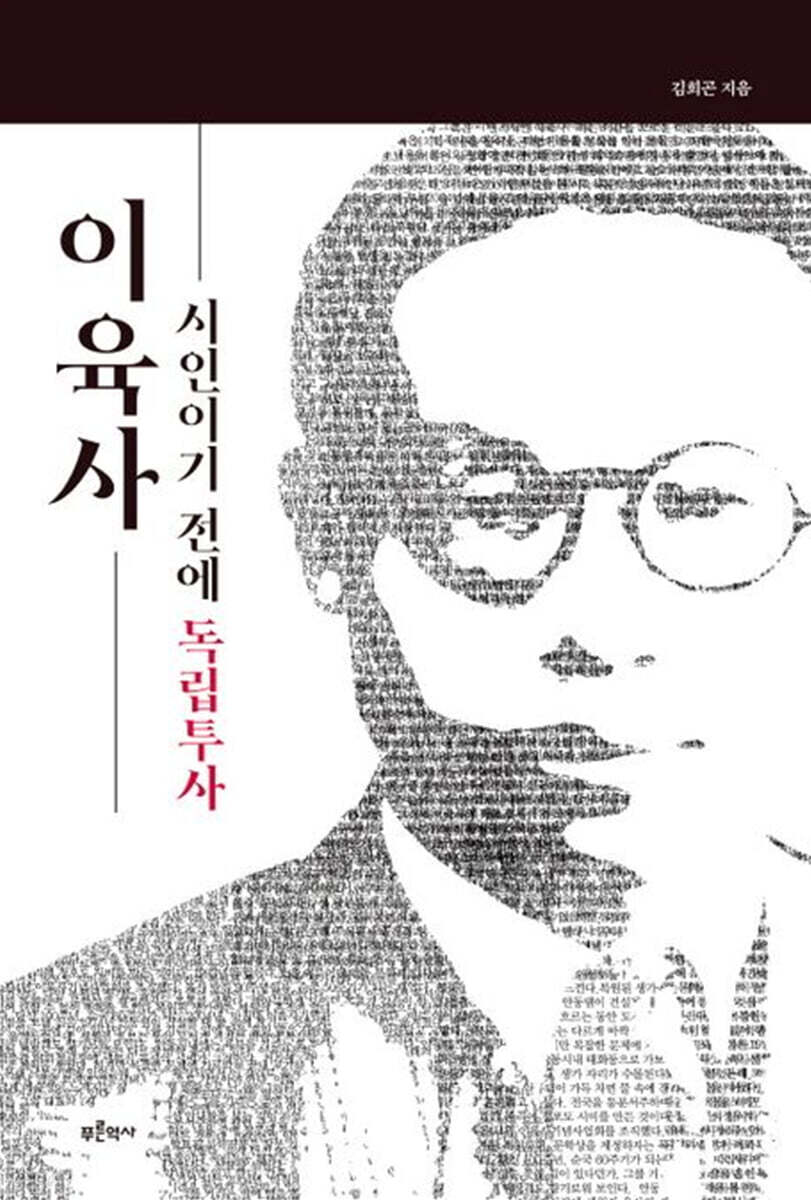
Lee Yuk-sa, an independence fighter before being a poet
 |
Description
Book Introduction
To Koreans, Lee Yuk-sa is a very familiar name.
From textbooks to subway station shelters, his poems such as “Green Grapes” and “Wilderness” can be found in everyday life, and his life story is also widely known through various media.
However, the life of Yuk Sa Lee, as known so far, has focused only on his pursuit of literary achievements and has only been described as a poet, failing to capture all of his diverse aspects and intense resistance activities.
Even that was largely misunderstood.
"Yi Yuk-sa, an Independence Fighter Before a Poet" restores the life of Yi Yuk-sa, who engaged in various activities for 40 years, from his life as a journalist to his armed struggle, and sheds new light on Yi Yuk-sa as an independence activist who put his resistance poetry into practice through his life, rather than as a poet who wrote resistance poetry.
This shows that our belief that we know Lee Yuk-sa very well is wrong.
This is a revised edition of the Biography of Yuksa Lee, published in 2010. To commemorate the 120th anniversary of his birth and the 80th anniversary of his death, the book has been reorganized to incorporate new research findings, add some illustrations, and make the format larger.
From textbooks to subway station shelters, his poems such as “Green Grapes” and “Wilderness” can be found in everyday life, and his life story is also widely known through various media.
However, the life of Yuk Sa Lee, as known so far, has focused only on his pursuit of literary achievements and has only been described as a poet, failing to capture all of his diverse aspects and intense resistance activities.
Even that was largely misunderstood.
"Yi Yuk-sa, an Independence Fighter Before a Poet" restores the life of Yi Yuk-sa, who engaged in various activities for 40 years, from his life as a journalist to his armed struggle, and sheds new light on Yi Yuk-sa as an independence activist who put his resistance poetry into practice through his life, rather than as a poet who wrote resistance poetry.
This shows that our belief that we know Lee Yuk-sa very well is wrong.
This is a revised edition of the Biography of Yuksa Lee, published in 2010. To commemorate the 120th anniversary of his birth and the 80th anniversary of his death, the book has been reorganized to incorporate new research findings, add some illustrations, and make the format larger.
index
In publishing the book
Lee Yuk-sa's chronology
Rewriting the biography
The name used by the military, from 264 to 戮史
From 'Lee Won-sam' to 'Lee Hwal'
Lee Hwal and Daegu 264
From 264 to the history of meat and fish, to the history of land
881 Wonchon Village, the hometown of the military academy
On the way to meet the military academy
Wonchon Village in "The Five Elements of the Seasons"
1904, the birth and family tradition of Yook Sa
The 'terrifying scale' surrounding the Korea Military Academy
Brothers of the Military Academy
1909-1924, the education he received while growing up at the military academy
Growing up learning Chinese characters
After graduating from Bomun Uisuk, he attended Dosan Public Elementary School.
Get married and move to Daegu
Studying in Japan
1925-1926, traveling to and from China to foster national consciousness
Cultural activities at the Daegu Joyang Hall
Beijing outing
Attending the Department of Commerce at China University in Beijing
1927-1930, unwavering despite being in and out of prison
1 year and 7 months of imprisonment for Jang Jin-hong's uprising
Life as a reporter in Daegu
Detained for two months for the 'Daegu Gyeokmun Incident'
Frequent trips to Manchuria, eventually ending in Beijing
From JoongAng Ilbo to Chosun Ilbo
1931-1933, became a junior military officer
Yun Se-ju was given the authority to go to Nanjing
The Righteous Army arrived in Nanjing via Beijing
Uiyoldan opens the Korean Revolutionary Military and Political Cadre School.
The Army Academy meets Kim Won-bong, the leader of the Uiyoldan, in Nanjing.
Attending the Korean Revolutionary Military and Political Cadre School
Perform a play to commemorate graduation
The mission of the military academy
Preparing for domestic infiltration in Nanjing, where spring rain falls
You said you didn't join Uiyeoldan
1933-1934, arrested while securing a domestic base
Meeting Lu Xun in Shanghai
Imprisoned in Seodaemun Prison
The life of a critic, essayist, and poet, 1930–1944
Full-fledged writing and social activities
Green Grapes and Peak
His perception of the times as seen in his current affairs commentary from 1933 to 1936
Military Academy as a current affairs commentator
Military Academy's perception of the situation
In 1943, he fought against the tide of pro-Japanese sentiment and embarked on the path of struggle.
The reason I went to Beijing again
Attempting to connect Chongqing and Yan'an
Martyred in Beijing
Where is the 'Beijing Prison'?
be buried in one's hometown
The superman who came riding a white horse, Lee Yuk-sa
main
Search
Publisher's Review
Resistance like poetry, poetry like resistance
The superhuman Lee Yuk-sa riding a white horse
120th anniversary of birth and 80th anniversary of martyrdom, looking into the life of Lee Yuk-sa
To Koreans, Lee Yuk-sa is a very familiar name.
From textbooks to subway station shelters, his poems such as “Green Grapes” and “Wilderness” can be found in everyday life, and his life story is also widely known through various media.
However, the life of Yuk Sa Lee, as known so far, has focused only on his pursuit of literary achievements and has only been described as a poet, failing to capture all of his diverse aspects and intense resistance activities.
Even that was largely misunderstood.
"Yi Yuk-sa, an Independence Fighter Before a Poet" restores the life of Yi Yuk-sa, who engaged in various activities for 40 years, from his life as a journalist to his armed struggle, and sheds new light on Yi Yuk-sa as an independence activist who put his resistance poetry into practice through his life, rather than as a poet who wrote resistance poetry.
This shows that our belief that we know Lee Yuk-sa very well is wrong.
This is a revised edition of the Biography of Yuksa Lee, published in 2010. To commemorate the 120th anniversary of his birth and the 80th anniversary of his death, the book has been reorganized to incorporate new research findings, add some illustrations, and make the format larger.
So familiar to us, yet still unfamiliar
Many of the existing articles introducing the life of Yuk Sa have often been limited to organizing stories that have been passed down without accurate information about Yuk Sa's activities.
"Yi Yuk-sa, an Independence Fighter Before a Poet" overcomes these limitations and approaches the life of Yi Yuk-sa through a fresh perspective on the history of the independence movement and through a meticulous process of research and verification.
This book corrects inaccurate historical records and introduces little-known details about the military academy's activities, adding to the materials left by literary figures of the time, records of the Japanese police and prosecutors, press reports, and field trips and interviews from Andong, Gyeongsangbuk-do to China.
Since its first publication in 2000, the first edition has been revised and supplemented to reflect the insights and newly discovered findings of researchers in various fields, including linguistics and history, thereby enhancing the completeness of the reconstruction of Yuksa Lee's life.
The hidden meaning of '264'
The history of the changes in the pen names used by Lee Yuk-sa in “Lee Yuk-sa, an independence fighter before being a poet” is a representative example of this correct understanding of Lee Yuk-sa.
The episode that his pen name, Yuksa Lee, came from his prison number is quite famous.
However, the reason why the number was chosen as the name and the meaning behind 'Yuksa' are not well known.
This book introduces the fact that the Chinese characters for the military academy were not originally written as '陸史', and explains the process of change in the name and the meaning of each name.
'Yi Yuk-sa' started with the prisoner number '264264', and went through '肉瀉' (having diarrhea after eating meat) which contained a terrible cynicism about the world, and '戮史' (killing history) which revealed a strong revolutionary will, and it was established as '陸史' which contained all these meanings.
This book also reveals that Yuk Sa also used pen names other than 'Yuk Sa'.
As much as he devoted himself to poetry, Yuk Sa also devoted himself to current affairs commentary, and he was also a journalist who left behind many critical pieces that showed keen insight into the world situation, from criticism of Chiang Kai-shek's policies and the decline of rural China to international trade.
However, at this time, most current affairs commentaries used the pen name 'Lee Hwal' rather than 'Yuk Sa'.
Introducing a new version of Lee Yuk-sa as an unmanned person
It is easy to think of him as a sickly man of letters because he recuperated at Donghae Songdowon, but he was also a soldier who entered the Korean Revolutionary Political and Military Cadre School run by Kim Won-bong for the purpose of anti-Japanese armed struggle and received military training ranging from infantry tactics to special operations.
This is quite different from the common belief that he is only known as an elegant poet.
Ahn Byeong-cheol, a classmate and brother-in-law of mine at the Military Academy, also recalls that he was a sharpshooter at the Military Academy.
Based on this spirit of unmanned activity, the military academy traveled between Chongqing and Yan'an until his death, working to unify the front lines of the Provisional Government of the Republic of Korea and the Korean Independence Alliance, while also bringing weapons into the country to prepare for the anti-Japanese armed struggle.
Correcting the Misconception of 'Lee Yuk-sa'
Moreover, this book provides a wealth of documentary evidence and corrects misconceptions about Lee Yuk-sa one by one.
For example, it is revealed that the common knowledge that Lee Yuk-sa was active as a member of Uiyoldan needs to be reconsidered.
As an independence activist, he followed Kim Won-bong, the leader of Uiyoldan, and shared his views, but at the same time, as a Leninist, he clashed with Kim Won-bong ideologically, which led to conflicts such as being excluded from the Uiyoldan group.
Therefore, the author says that although Lee Yuk-sa can broadly fall into the category of Uiyoldan, it is difficult to see him as a member of Uiyoldan.
The fact that a Korean himself is carrying out revolutionary work in Korea in China, in violation of the Comintern's one-country, one-party principle, makes us doubt his revolutionary spirit.
- Lee Yuk-sa criticizes Kim Won-bong
The author also points out that there is little evidence to support the claim that the Military Academy was directly involved in Jang Jin-hong's uprising.
It is true that the military academy was imprisoned on charges of involvement in Jang Jin-hong's uprising, but this was a suffering that not only the military academy but also many intellectuals active in Daegu suffered due to the haphazard investigation of the Japanese police.
At the time, the military academy was arrested because the handwriting on the bomb box was similar to that of his younger brother, Won-il Lee.
We also reveal that the story that the Korea Military Academy held a contest for a novel in the Chosun Ilbo is false.
It is true that the name 'Lee Hwal' appears in the September 20, 1933 Chosun Ilbo article titled "Current Status of Preliminary Winners of the Novel Contest," but the Lee Hwal mentioned here is a writer from Hwanghae Province with the same name as the military academy.
Revealing the unsolved mystery of 'Lee Yuk-sa'
The time period of Yuk Sa's study abroad in China is unclear and the location is unclear in various sources, so it is not yet clear.
For example, Park Hoon-shin and Jo Ji-hun mention that Yuk Sa attended Peking University, but newspaper articles written by the Japanese state that Yuk Sa studied at Zongguo University in Beijing.
Accordingly, the author mentioned the possibility that he was attending Zhongshan University in the first edition in 2000 through a field trip to China.
Based on the verification efforts of various researchers accumulated over the past decade, the revised edition introduces new perspectives on studying abroad in Beijing, along with the reality of 'Zhongguo University.'
In addition, by revealing that the Eastern Cultural Affairs Committee, a special Japanese cultural agency, was located at Dongchanghutong No. 1 in Beijing, where Liu Shi died, it raises suspicions about the connection between Liu Shi's death and a Japanese agency.
A Look Back at Lee Yuk-sa, the Superman Who Sowed the Seeds of Song in the Wilderness
Pro-Japanese collaborators make excuses by saying that their pro-Japanese activities were an inevitable choice made under pressure from the Japanese and that almost all Koreans at the time were collaborators with Japan.
However, while enduring the same period of Japanese colonial rule, there are lives that are starkly contrasted between pro-Japanese and anti-Japanese.
At a time when even denying the prevailing trend in the face of barbarism required great courage, Lee Yuk-sa abandoned everything and rejoined the ranks of the anti-Japanese struggle he had once left behind. He lived a life that matched the poetry he sang, and he was a true poet and independence fighter who left behind such a life in poetry.
The six soldiers sowed the seeds of poor song in the wilderness through poetry, waiting for the future superman on a white horse.
Just as new research achievements emerged following the publication of the 2010 Biography of Yuksa Lee, I hope that both the achievements and the unresolved issues in this revised edition will serve as a stepping stone for new pursuits and research, thereby reaping the fruits of the seeds sown by Yuksa Lee.
The superhuman Lee Yuk-sa riding a white horse
120th anniversary of birth and 80th anniversary of martyrdom, looking into the life of Lee Yuk-sa
To Koreans, Lee Yuk-sa is a very familiar name.
From textbooks to subway station shelters, his poems such as “Green Grapes” and “Wilderness” can be found in everyday life, and his life story is also widely known through various media.
However, the life of Yuk Sa Lee, as known so far, has focused only on his pursuit of literary achievements and has only been described as a poet, failing to capture all of his diverse aspects and intense resistance activities.
Even that was largely misunderstood.
"Yi Yuk-sa, an Independence Fighter Before a Poet" restores the life of Yi Yuk-sa, who engaged in various activities for 40 years, from his life as a journalist to his armed struggle, and sheds new light on Yi Yuk-sa as an independence activist who put his resistance poetry into practice through his life, rather than as a poet who wrote resistance poetry.
This shows that our belief that we know Lee Yuk-sa very well is wrong.
This is a revised edition of the Biography of Yuksa Lee, published in 2010. To commemorate the 120th anniversary of his birth and the 80th anniversary of his death, the book has been reorganized to incorporate new research findings, add some illustrations, and make the format larger.
So familiar to us, yet still unfamiliar
Many of the existing articles introducing the life of Yuk Sa have often been limited to organizing stories that have been passed down without accurate information about Yuk Sa's activities.
"Yi Yuk-sa, an Independence Fighter Before a Poet" overcomes these limitations and approaches the life of Yi Yuk-sa through a fresh perspective on the history of the independence movement and through a meticulous process of research and verification.
This book corrects inaccurate historical records and introduces little-known details about the military academy's activities, adding to the materials left by literary figures of the time, records of the Japanese police and prosecutors, press reports, and field trips and interviews from Andong, Gyeongsangbuk-do to China.
Since its first publication in 2000, the first edition has been revised and supplemented to reflect the insights and newly discovered findings of researchers in various fields, including linguistics and history, thereby enhancing the completeness of the reconstruction of Yuksa Lee's life.
The hidden meaning of '264'
The history of the changes in the pen names used by Lee Yuk-sa in “Lee Yuk-sa, an independence fighter before being a poet” is a representative example of this correct understanding of Lee Yuk-sa.
The episode that his pen name, Yuksa Lee, came from his prison number is quite famous.
However, the reason why the number was chosen as the name and the meaning behind 'Yuksa' are not well known.
This book introduces the fact that the Chinese characters for the military academy were not originally written as '陸史', and explains the process of change in the name and the meaning of each name.
'Yi Yuk-sa' started with the prisoner number '264264', and went through '肉瀉' (having diarrhea after eating meat) which contained a terrible cynicism about the world, and '戮史' (killing history) which revealed a strong revolutionary will, and it was established as '陸史' which contained all these meanings.
This book also reveals that Yuk Sa also used pen names other than 'Yuk Sa'.
As much as he devoted himself to poetry, Yuk Sa also devoted himself to current affairs commentary, and he was also a journalist who left behind many critical pieces that showed keen insight into the world situation, from criticism of Chiang Kai-shek's policies and the decline of rural China to international trade.
However, at this time, most current affairs commentaries used the pen name 'Lee Hwal' rather than 'Yuk Sa'.
Introducing a new version of Lee Yuk-sa as an unmanned person
It is easy to think of him as a sickly man of letters because he recuperated at Donghae Songdowon, but he was also a soldier who entered the Korean Revolutionary Political and Military Cadre School run by Kim Won-bong for the purpose of anti-Japanese armed struggle and received military training ranging from infantry tactics to special operations.
This is quite different from the common belief that he is only known as an elegant poet.
Ahn Byeong-cheol, a classmate and brother-in-law of mine at the Military Academy, also recalls that he was a sharpshooter at the Military Academy.
Based on this spirit of unmanned activity, the military academy traveled between Chongqing and Yan'an until his death, working to unify the front lines of the Provisional Government of the Republic of Korea and the Korean Independence Alliance, while also bringing weapons into the country to prepare for the anti-Japanese armed struggle.
Correcting the Misconception of 'Lee Yuk-sa'
Moreover, this book provides a wealth of documentary evidence and corrects misconceptions about Lee Yuk-sa one by one.
For example, it is revealed that the common knowledge that Lee Yuk-sa was active as a member of Uiyoldan needs to be reconsidered.
As an independence activist, he followed Kim Won-bong, the leader of Uiyoldan, and shared his views, but at the same time, as a Leninist, he clashed with Kim Won-bong ideologically, which led to conflicts such as being excluded from the Uiyoldan group.
Therefore, the author says that although Lee Yuk-sa can broadly fall into the category of Uiyoldan, it is difficult to see him as a member of Uiyoldan.
The fact that a Korean himself is carrying out revolutionary work in Korea in China, in violation of the Comintern's one-country, one-party principle, makes us doubt his revolutionary spirit.
- Lee Yuk-sa criticizes Kim Won-bong
The author also points out that there is little evidence to support the claim that the Military Academy was directly involved in Jang Jin-hong's uprising.
It is true that the military academy was imprisoned on charges of involvement in Jang Jin-hong's uprising, but this was a suffering that not only the military academy but also many intellectuals active in Daegu suffered due to the haphazard investigation of the Japanese police.
At the time, the military academy was arrested because the handwriting on the bomb box was similar to that of his younger brother, Won-il Lee.
We also reveal that the story that the Korea Military Academy held a contest for a novel in the Chosun Ilbo is false.
It is true that the name 'Lee Hwal' appears in the September 20, 1933 Chosun Ilbo article titled "Current Status of Preliminary Winners of the Novel Contest," but the Lee Hwal mentioned here is a writer from Hwanghae Province with the same name as the military academy.
Revealing the unsolved mystery of 'Lee Yuk-sa'
The time period of Yuk Sa's study abroad in China is unclear and the location is unclear in various sources, so it is not yet clear.
For example, Park Hoon-shin and Jo Ji-hun mention that Yuk Sa attended Peking University, but newspaper articles written by the Japanese state that Yuk Sa studied at Zongguo University in Beijing.
Accordingly, the author mentioned the possibility that he was attending Zhongshan University in the first edition in 2000 through a field trip to China.
Based on the verification efforts of various researchers accumulated over the past decade, the revised edition introduces new perspectives on studying abroad in Beijing, along with the reality of 'Zhongguo University.'
In addition, by revealing that the Eastern Cultural Affairs Committee, a special Japanese cultural agency, was located at Dongchanghutong No. 1 in Beijing, where Liu Shi died, it raises suspicions about the connection between Liu Shi's death and a Japanese agency.
A Look Back at Lee Yuk-sa, the Superman Who Sowed the Seeds of Song in the Wilderness
Pro-Japanese collaborators make excuses by saying that their pro-Japanese activities were an inevitable choice made under pressure from the Japanese and that almost all Koreans at the time were collaborators with Japan.
However, while enduring the same period of Japanese colonial rule, there are lives that are starkly contrasted between pro-Japanese and anti-Japanese.
At a time when even denying the prevailing trend in the face of barbarism required great courage, Lee Yuk-sa abandoned everything and rejoined the ranks of the anti-Japanese struggle he had once left behind. He lived a life that matched the poetry he sang, and he was a true poet and independence fighter who left behind such a life in poetry.
The six soldiers sowed the seeds of poor song in the wilderness through poetry, waiting for the future superman on a white horse.
Just as new research achievements emerged following the publication of the 2010 Biography of Yuksa Lee, I hope that both the achievements and the unresolved issues in this revised edition will serve as a stepping stone for new pursuits and research, thereby reaping the fruits of the seeds sown by Yuksa Lee.
GOODS SPECIFICS
- Date of issue: July 9, 2024
- Page count, weight, size: 328 pages | 512g | 140*207*21mm
- ISBN13: 9791156122791
- ISBN10: 1156122791
You may also like
카테고리
korean


korean

![GQ KOREA Mark (Monthly): December [2025]](http://librairie.coreenne.fr/cdn/shop/files/8ef265dbbfbf186523ed75ba7319009d.jpg?v=1765340328&width=3840)


