

Material Civilization and Capitalism 1: The Structure of Everyday Life
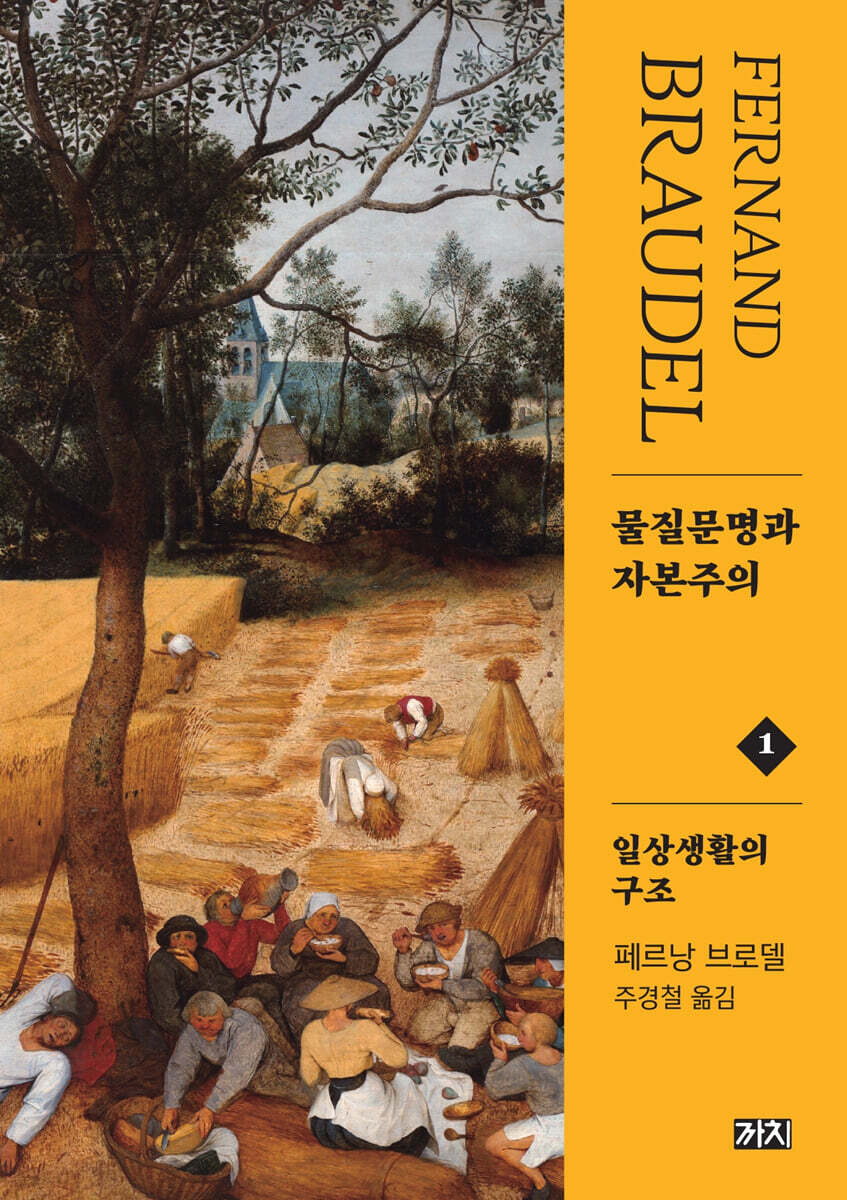 |
Description
Book Introduction
The great classic by Fernand Braudel, “the Pope of History”
The second edition is published 30 years after the first edition.
From everyday life such as food, clothing, and luxury goods to the economy, the Industrial Revolution, and capitalism.
A masterpiece that opens new horizons in the study of modern history with its unique perspective and insight.
『Material Civilization and Capitalism』, a masterpiece by Fernand Braudel, a leading historian of the French Annales School that led world historiography and considered one of the greatest history books of the 20th century, has been published in hardcover with a revised translation to improve readability and a new cover and text design.
This masterpiece, which took twelve years to complete in 1979 after the first volume was published in France in 1967, is considered one of Braudel's representative works along with "Mediterranean: The Mediterranean World in the Age of Philip II" and is evaluated to have completed the historical perspective of the Annales School.
It has also established itself as a modern classic and must-read that illuminates the structure, origins, and development of the capitalist world, and has been widely read and loved not only by historians but also by economists and the general public.
The second edition was translated by Professor Kyung-chul Joo of the Department of History at Seoul National University, who was in charge of translating the first edition from 1995 to 1997. He meticulously reviewed the entire book and refined the sentences based on the 2022 revised edition published by Armand Colin.
Additionally, the first edition, which was divided into upper and lower volumes and had 6 volumes, was combined into 3 volumes.
The second edition is published 30 years after the first edition.
From everyday life such as food, clothing, and luxury goods to the economy, the Industrial Revolution, and capitalism.
A masterpiece that opens new horizons in the study of modern history with its unique perspective and insight.
『Material Civilization and Capitalism』, a masterpiece by Fernand Braudel, a leading historian of the French Annales School that led world historiography and considered one of the greatest history books of the 20th century, has been published in hardcover with a revised translation to improve readability and a new cover and text design.
This masterpiece, which took twelve years to complete in 1979 after the first volume was published in France in 1967, is considered one of Braudel's representative works along with "Mediterranean: The Mediterranean World in the Age of Philip II" and is evaluated to have completed the historical perspective of the Annales School.
It has also established itself as a modern classic and must-read that illuminates the structure, origins, and development of the capitalist world, and has been widely read and loved not only by historians but also by economists and the general public.
The second edition was translated by Professor Kyung-chul Joo of the Department of History at Seoul National University, who was in charge of translating the first edition from 1995 to 1997. He meticulously reviewed the entire book and refined the sentences based on the 2022 revised edition published by Armand Colin.
Additionally, the first edition, which was divided into upper and lower volumes and had 6 volumes, was combined into 3 volumes.
- You can preview some of the book's contents.
Preview
index
introduction
introduction
Chapter 1: The Weight of Numbers
World Population: Made-Up Numbers
Ebb and flow / Insufficient statistics / How to calculate? / Equivalence of Chinese and European populations / World population / Numbers that remain a matter of debate /
Centuries of Population Change / Previous Inadequate Explanations / Climate Rhythms
Scale for reference
Cities, Armies, and Fleets / France's Early Overpopulation / Population Density and the Level of Civilization / Other Facts Revealed by Gordon Hughes's Maps / The Jungle Book: Man and Wildlife
The biological ancien régime that ended in the 18th century
Balance / Famine / Disease / Plague / Cycle of Disease / 1400-1800: The Long-Term Biological Ancien Régime
majority vs. minority
Against the Barbarians / The disappearance of the great nomads before the 17th century / The conquest of space / When culture resists / Civilization versus civilization
Chapter 2: Daily Bread
wheat
Wheat and Grains / Wheat and Crop Rotation / Low Harvests, Their Rewards and Ruin / Increased Harvest and Sowing / Grain Trade: Local and International Trade / Wheat and Calories /
Wheat Prices and Living Standards / The Rich's Bread, the Poor's Bread and Porridge / Buy Bread or Make Your Own? / Grain is King
rice
Rice in the Paddy Fields and Upland Rice / The Miracle of the Rice Fields / The Responsibility of Rice
corner
Origins Finally Revealed / Corn and the American Civilizations
The food revolution of the 18th century
Corn/potatoes, more important crops outside of America/aversion to foods from other regions
Other parts of the world
People who use hoes / What about primitive people?
Chapter 3: Luxury Goods and Daily Necessities: Food and Beverage
Table: Luxurious and Popular Food
A Late-Born Luxury / Meat-Eating Europe / Meat Consumption Declines Since 1550 / Still, Europe Has the Edge / A Fantastic Table
Setting the Table / Good Manners Are Gradually Established / At Christ's Table / Daily Bread: Salt / Daily Foods: Dairy, Fat, Eggs /
Everyday Food: Seafood / Cod Fishing / Pepper Loses Popularity After 1650 / Sugar Conquers the World
Drinks and “stimulants”
Water / Wine / Beer / Cider / The Late Success of Distilled Spirits in Europe / Distilled Spirits Outside Europe / Cocoa, Tea, and Coffee / Stimulants: The Glory of Tobacco
Chapter 4: Luxury and Everyday Uses: Housing, Clothing, and Fashion
Houses around the world
Expensive building materials: stone and brick / Other building materials: wood, earth, fabric / European country dwellings / City houses and lodgings / Urbanized countryside
indoor
The poor who have nothing / Traditional civilization, or the unchanging interior / The duality of Chinese furniture / Black Africa / Western Europe and various furniture /
Floors, walls, ceilings, doors, and windows / Fireplaces / Furnaces and hearths / The vanity of the furniture craftsman and the buyer / The important thing is the whole / Luxury and comfort
Clothing and Fashion
If society doesn't move... / If there are only poor people... / Europe and the madness of fashion / Is fashion fickle? /
A word or two on the geography of textiles / Fashion in the broad sense and long-term, sustained change / What is the conclusion?
Chapter 5: The Diffusion of Technology: Energy Sources and Metallurgy
The core issue: energy sources
"Human Motor" / Livestock Power / Water and Wind Power / Sails: The Case of the European Fleet / Wood: A Common Energy Source / Coal / Conclusion
Iron: Poor relative
Metallurgy was rudimentary except in China / Progress in the 11th-15th centuries: Styria and the Dauphiné region / Preliminary stages of concentration / Some figures
/ other metals
Chapter 6: The Diffusion of Technology: Revolution and Delay
Three major technological innovations
The Origin of Gunpowder / Cannons in Motion / Cannons on Ships / Matchlocks, Muskets, and Rifles / Production and Costs / Cannons on a Global Scale /
From Paper to Printing / The Invention of Movable Type / Printing and Its History / Western European Achievements: Ocean Navigation / Old World Fleets / World Routes /
Atlantic: A Simple Problem
The gradualness of transportation
Fixed Routes / Beyond the Case of Transport / Water Transport / Outdated Transport: Fixed Routes, Delays… / Europe /
Laughable speeds and loads / Transporters and transport / Transport: the limits of the economy
The weight of technological history
Technology and Agriculture / Technology itself
Chapter 7 Currency
Economy and Imperfect Currencies
Barter that occurred in the depths of the primitive currency/monetary economy
Outside Europe: Developing economies and metallic currencies
Japan and the Ottoman Empire / India / China
Some rules about currency
The Battle of the Precious Metals / Outflows, Savings, and Withdrawals / Fiat Money / Stocks of Metals and the Velocity of Money / Outside the Market Economy
Banknotes and credits
Old Practices / Money and Credit / Schumpeter: Everything is Money and Everything is Credit / Money and Credit are Language
Chapter 8: Cities
The city itself
From the "Lightweight" City to the "Heavyweight" City / Division of Labor: A Constantly Recurring Issue / Cities and Migrants, Especially the Poor / Urban Self-Consciousness /
Western Europe: Cities, Cannons, and Vehicles / Geography and the Connections Between Cities / Urban Hierarchies / Cities and Civilization: The Case of Islam
The uniqueness of Western European cities
A Free World / Urban Modernity / Is There a "Model" for Western European Urban Form? / Diverse Evolution
big cities
The Responsibilities of the State / What Role Did Cities Play? / An Unbalanced World / Naples, From the Royal Palace to the Mercato (Marketplace) /
St. Petersburg in 1790 / The penultimate journey: Beijing / London from Elizabeth I to George III /
Urbanization, a harbinger of a new human
conclusion
main
Translator's Note to the Second Edition
Translator's Note on the First Edition
Biographical Index
introduction
Chapter 1: The Weight of Numbers
World Population: Made-Up Numbers
Ebb and flow / Insufficient statistics / How to calculate? / Equivalence of Chinese and European populations / World population / Numbers that remain a matter of debate /
Centuries of Population Change / Previous Inadequate Explanations / Climate Rhythms
Scale for reference
Cities, Armies, and Fleets / France's Early Overpopulation / Population Density and the Level of Civilization / Other Facts Revealed by Gordon Hughes's Maps / The Jungle Book: Man and Wildlife
The biological ancien régime that ended in the 18th century
Balance / Famine / Disease / Plague / Cycle of Disease / 1400-1800: The Long-Term Biological Ancien Régime
majority vs. minority
Against the Barbarians / The disappearance of the great nomads before the 17th century / The conquest of space / When culture resists / Civilization versus civilization
Chapter 2: Daily Bread
wheat
Wheat and Grains / Wheat and Crop Rotation / Low Harvests, Their Rewards and Ruin / Increased Harvest and Sowing / Grain Trade: Local and International Trade / Wheat and Calories /
Wheat Prices and Living Standards / The Rich's Bread, the Poor's Bread and Porridge / Buy Bread or Make Your Own? / Grain is King
rice
Rice in the Paddy Fields and Upland Rice / The Miracle of the Rice Fields / The Responsibility of Rice
corner
Origins Finally Revealed / Corn and the American Civilizations
The food revolution of the 18th century
Corn/potatoes, more important crops outside of America/aversion to foods from other regions
Other parts of the world
People who use hoes / What about primitive people?
Chapter 3: Luxury Goods and Daily Necessities: Food and Beverage
Table: Luxurious and Popular Food
A Late-Born Luxury / Meat-Eating Europe / Meat Consumption Declines Since 1550 / Still, Europe Has the Edge / A Fantastic Table
Setting the Table / Good Manners Are Gradually Established / At Christ's Table / Daily Bread: Salt / Daily Foods: Dairy, Fat, Eggs /
Everyday Food: Seafood / Cod Fishing / Pepper Loses Popularity After 1650 / Sugar Conquers the World
Drinks and “stimulants”
Water / Wine / Beer / Cider / The Late Success of Distilled Spirits in Europe / Distilled Spirits Outside Europe / Cocoa, Tea, and Coffee / Stimulants: The Glory of Tobacco
Chapter 4: Luxury and Everyday Uses: Housing, Clothing, and Fashion
Houses around the world
Expensive building materials: stone and brick / Other building materials: wood, earth, fabric / European country dwellings / City houses and lodgings / Urbanized countryside
indoor
The poor who have nothing / Traditional civilization, or the unchanging interior / The duality of Chinese furniture / Black Africa / Western Europe and various furniture /
Floors, walls, ceilings, doors, and windows / Fireplaces / Furnaces and hearths / The vanity of the furniture craftsman and the buyer / The important thing is the whole / Luxury and comfort
Clothing and Fashion
If society doesn't move... / If there are only poor people... / Europe and the madness of fashion / Is fashion fickle? /
A word or two on the geography of textiles / Fashion in the broad sense and long-term, sustained change / What is the conclusion?
Chapter 5: The Diffusion of Technology: Energy Sources and Metallurgy
The core issue: energy sources
"Human Motor" / Livestock Power / Water and Wind Power / Sails: The Case of the European Fleet / Wood: A Common Energy Source / Coal / Conclusion
Iron: Poor relative
Metallurgy was rudimentary except in China / Progress in the 11th-15th centuries: Styria and the Dauphiné region / Preliminary stages of concentration / Some figures
/ other metals
Chapter 6: The Diffusion of Technology: Revolution and Delay
Three major technological innovations
The Origin of Gunpowder / Cannons in Motion / Cannons on Ships / Matchlocks, Muskets, and Rifles / Production and Costs / Cannons on a Global Scale /
From Paper to Printing / The Invention of Movable Type / Printing and Its History / Western European Achievements: Ocean Navigation / Old World Fleets / World Routes /
Atlantic: A Simple Problem
The gradualness of transportation
Fixed Routes / Beyond the Case of Transport / Water Transport / Outdated Transport: Fixed Routes, Delays… / Europe /
Laughable speeds and loads / Transporters and transport / Transport: the limits of the economy
The weight of technological history
Technology and Agriculture / Technology itself
Chapter 7 Currency
Economy and Imperfect Currencies
Barter that occurred in the depths of the primitive currency/monetary economy
Outside Europe: Developing economies and metallic currencies
Japan and the Ottoman Empire / India / China
Some rules about currency
The Battle of the Precious Metals / Outflows, Savings, and Withdrawals / Fiat Money / Stocks of Metals and the Velocity of Money / Outside the Market Economy
Banknotes and credits
Old Practices / Money and Credit / Schumpeter: Everything is Money and Everything is Credit / Money and Credit are Language
Chapter 8: Cities
The city itself
From the "Lightweight" City to the "Heavyweight" City / Division of Labor: A Constantly Recurring Issue / Cities and Migrants, Especially the Poor / Urban Self-Consciousness /
Western Europe: Cities, Cannons, and Vehicles / Geography and the Connections Between Cities / Urban Hierarchies / Cities and Civilization: The Case of Islam
The uniqueness of Western European cities
A Free World / Urban Modernity / Is There a "Model" for Western European Urban Form? / Diverse Evolution
big cities
The Responsibilities of the State / What Role Did Cities Play? / An Unbalanced World / Naples, From the Royal Palace to the Mercato (Marketplace) /
St. Petersburg in 1790 / The penultimate journey: Beijing / London from Elizabeth I to George III /
Urbanization, a harbinger of a new human
conclusion
main
Translator's Note to the Second Edition
Translator's Note on the First Edition
Biographical Index
Detailed image

Publisher's Review
A representative historian of the French Annales School, which led world historiography
Fernand Braudel, “The Pope of History”
In 20th century France, a movement arose to look at history from a new perspective.
Along with this movement, the 'Annales School' was born, centered around the academic journal 'Annales' co-founded by Lucien Febvre and Marc Bloch in 1929.
They argued that history should be interpreted based on society rather than politics, on groups rather than individuals, and on structures rather than chronologies.
Fernand Braudel was a second-generation scholar and representative scholar of the Annales School. He deepened the Annales School's perspective of "new history" and expanded the scope of history to include economic and social history.
Braudel wanted to look at the history of mankind as a whole rather than a fragmentary history.
To this end, he closely studied the daily lives of people, such as population changes, food, clothing, and shelter, and luxuries, which scholars of the time had overlooked.
Believing that the lifestyles of people over centuries ultimately shaped the world, he statistically analyzed and quantified the vast archives of ancient documents containing information on commerce and daily life.
Braudel believed that a solid 'structure' was created through the 'continuation' of small, trivial events repeated every day.
He is still called the 'godfather' of French history today, having gained insight into history and the driving force that changes the world through the structure that defines the basic aspects of people's lives and their limitations.
Material life of the pre-industrial era of the 15th to 18th centuries
A monumental masterpiece viewed from a macroscopic perspective
"Material Civilization and Capitalism," a masterpiece that has led the world's historiography, examines the past, present, and future of material civilization and capitalism through a detailed study of human society before industrialization.
This work, the product of decades of in-depth research into vast amounts of material, including ancient documents, pamphlets, and past and contemporary papers, comprehensively examines not only world historical events but also various fields such as economy, culture, geography, and society, capturing the dynamic flow of material civilization and capitalism.
Volume 1, "The Structure of Everyday Life," examines the framework of civilization created by everyday life by examining material culture, including objects, tools, everyday activities, currency, and cities.
It is on the basis of this material culture that economic activities such as peddlers, merchants, shops, markets, and regular markets arise.
Large corporations conduct remote trade, and exchanges emerge to handle international trading activities.
In Volume 2, "The World of Exchange," I trace the two realms of "market economy" and "capitalism," and attempt to structurally explain these two dynamic realms that build upon the material culture covered in Volume 1.
The market economy and capitalism are intertwined yet distinct and opposed to each other, and this paper examines what inequalities create this duality.
Volume 3, "Time of the World," examines the rise and decline of cities that exerted capitalist influence globally.
Cities such as Venice, Antwerp, Genoa, and Amsterdam took the lead in turn, national economies emerged in France and England, and England later dominated the world through the Industrial Revolution.
Praise poured in for this book
There is no denying that this book is full of detailed information and bold hypotheses… … It shows the endless variety of commercial possibilities that humans are capable of.
—Jonathan Spence, [New York Times Book Review]
The renowned French historian Fernand Braudel argues that we can gain a deeper understanding of history by studying how people ate and dressed, where they lived, and where they obtained their necessities and luxuries.
Braudel shows in detail how the great flow of history is created from small parts.
―Elizabeth Grossman, [Saturday Review]
This book is alive and breathing, not only with the author's long-standing scholarship and refined writing style, but also with his understanding of humanity and sharp metaphors for modern society.
― [Economist]
Fernand Braudel wanted to write a 'history closely related to humanity'.
He started a revolution.
He made the suffering of the 20th century a land of discovery.
― [La Croix]
Fernand Braudel, “The Pope of History”
In 20th century France, a movement arose to look at history from a new perspective.
Along with this movement, the 'Annales School' was born, centered around the academic journal 'Annales' co-founded by Lucien Febvre and Marc Bloch in 1929.
They argued that history should be interpreted based on society rather than politics, on groups rather than individuals, and on structures rather than chronologies.
Fernand Braudel was a second-generation scholar and representative scholar of the Annales School. He deepened the Annales School's perspective of "new history" and expanded the scope of history to include economic and social history.
Braudel wanted to look at the history of mankind as a whole rather than a fragmentary history.
To this end, he closely studied the daily lives of people, such as population changes, food, clothing, and shelter, and luxuries, which scholars of the time had overlooked.
Believing that the lifestyles of people over centuries ultimately shaped the world, he statistically analyzed and quantified the vast archives of ancient documents containing information on commerce and daily life.
Braudel believed that a solid 'structure' was created through the 'continuation' of small, trivial events repeated every day.
He is still called the 'godfather' of French history today, having gained insight into history and the driving force that changes the world through the structure that defines the basic aspects of people's lives and their limitations.
Material life of the pre-industrial era of the 15th to 18th centuries
A monumental masterpiece viewed from a macroscopic perspective
"Material Civilization and Capitalism," a masterpiece that has led the world's historiography, examines the past, present, and future of material civilization and capitalism through a detailed study of human society before industrialization.
This work, the product of decades of in-depth research into vast amounts of material, including ancient documents, pamphlets, and past and contemporary papers, comprehensively examines not only world historical events but also various fields such as economy, culture, geography, and society, capturing the dynamic flow of material civilization and capitalism.
Volume 1, "The Structure of Everyday Life," examines the framework of civilization created by everyday life by examining material culture, including objects, tools, everyday activities, currency, and cities.
It is on the basis of this material culture that economic activities such as peddlers, merchants, shops, markets, and regular markets arise.
Large corporations conduct remote trade, and exchanges emerge to handle international trading activities.
In Volume 2, "The World of Exchange," I trace the two realms of "market economy" and "capitalism," and attempt to structurally explain these two dynamic realms that build upon the material culture covered in Volume 1.
The market economy and capitalism are intertwined yet distinct and opposed to each other, and this paper examines what inequalities create this duality.
Volume 3, "Time of the World," examines the rise and decline of cities that exerted capitalist influence globally.
Cities such as Venice, Antwerp, Genoa, and Amsterdam took the lead in turn, national economies emerged in France and England, and England later dominated the world through the Industrial Revolution.
Praise poured in for this book
There is no denying that this book is full of detailed information and bold hypotheses… … It shows the endless variety of commercial possibilities that humans are capable of.
—Jonathan Spence, [New York Times Book Review]
The renowned French historian Fernand Braudel argues that we can gain a deeper understanding of history by studying how people ate and dressed, where they lived, and where they obtained their necessities and luxuries.
Braudel shows in detail how the great flow of history is created from small parts.
―Elizabeth Grossman, [Saturday Review]
This book is alive and breathing, not only with the author's long-standing scholarship and refined writing style, but also with his understanding of humanity and sharp metaphors for modern society.
― [Economist]
Fernand Braudel wanted to write a 'history closely related to humanity'.
He started a revolution.
He made the suffering of the 20th century a land of discovery.
― [La Croix]
GOODS SPECIFICS
- Date of issue: March 15, 2024
- Page count, weight, size: 816 pages | 1,244g | 152*225*40mm
- ISBN13: 9788972918233
- ISBN10: 8972918237
You may also like
카테고리
korean


korean

![GQ KOREA Mark (Monthly): December [2025]](http://librairie.coreenne.fr/cdn/shop/files/8ef265dbbfbf186523ed75ba7319009d.jpg?v=1765340328&width=3840)


