

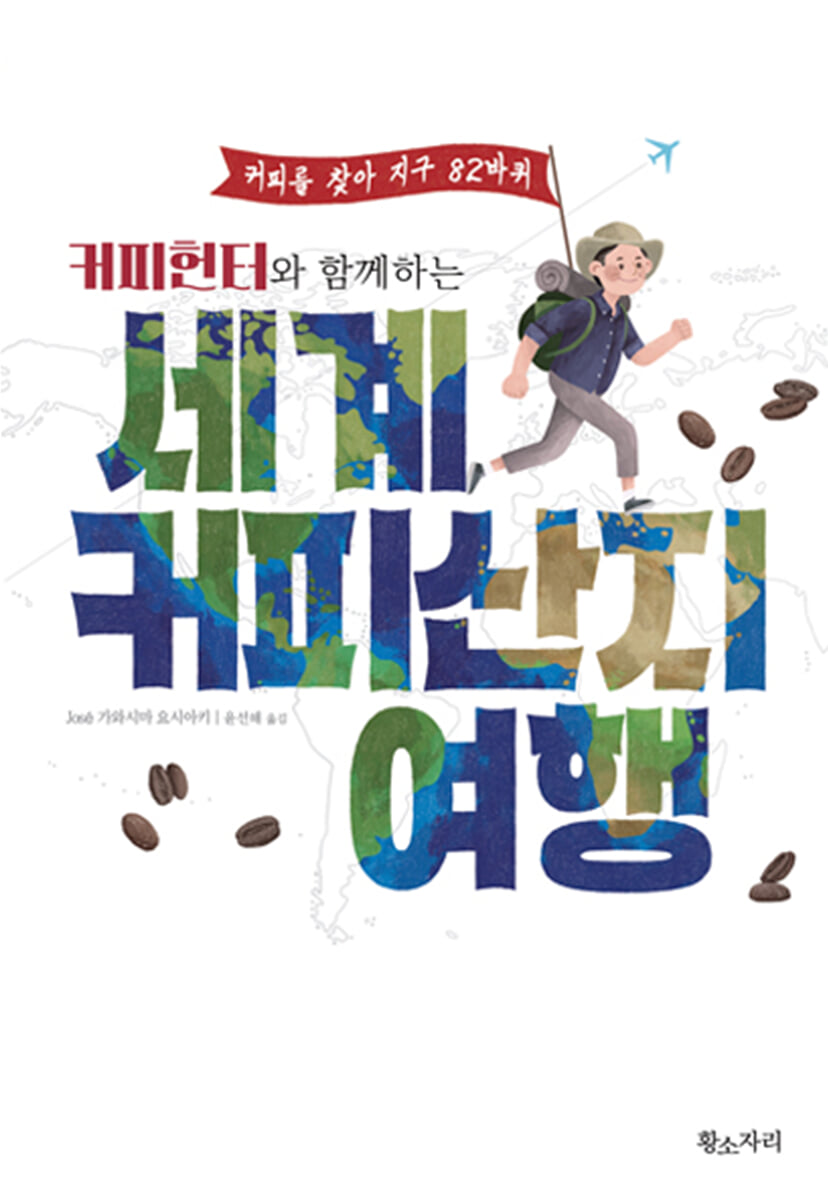
A World Coffee Tour with Coffee Hunter
 |
Description
Book Introduction
In search of coffee for over 50 years,
Travel around the Earth 82 times
When diplomats from coffee-exporting countries around the world arrive in Tokyo, the first person they look for is not the Prime Minister or the Minister of Foreign Affairs.
As if by appointment, the first person they ask to meet is Jose Kawashima Yoshiaki.
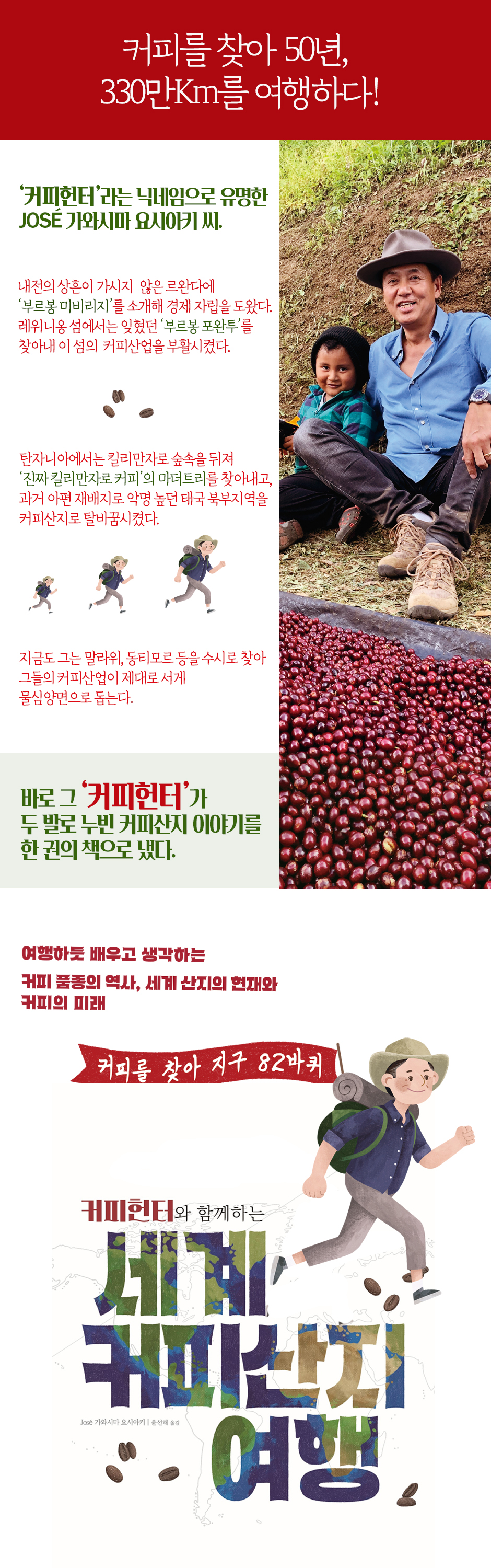
He is a coffee researcher, farmer, and social activist, and is better known among coffee lovers by his nickname, 'Coffee Hunter.'
This is because the fate of the country's industry depends on his support, as he has spent the past 50 years traveling around the world, promoting the selection of varieties and sustainable farming methods for each region.
In particular, his achievements are legendary among coffee lovers around the world, including rediscovering and preserving the endemic Mascarocophea that was buried in the jungles of Madagascar, cultivating the 'Bourbon Mivirige' clone in Rwanda to lead to economic self-sufficiency, and reviving the coffee industry on Reunion Island, which had been lost, by discovering the 'Bourbon Powantu' that was thought to be extinct.
『A World Coffee Region Tour with Coffee Hunter』 is a book in which Mr. Jose Kawashima tells the stories of coffee regions around the world he has visited over the past 50 years.
Africa and the Middle East, Asia and across the Pacific, to North America, Central and South America and the Caribbean countries… .
The book introduces the history and culture of 36 coffee countries, as well as the daily lives of producers, with hundreds of photographs, from countries where the author personally cultivated the coffee industry while living there for several years, to places where he visited dozens of times to teach about coffee varieties and cultivation methods, to production sites where he briefly visited due to practical circumstances.
Travel around the Earth 82 times
When diplomats from coffee-exporting countries around the world arrive in Tokyo, the first person they look for is not the Prime Minister or the Minister of Foreign Affairs.
As if by appointment, the first person they ask to meet is Jose Kawashima Yoshiaki.
He is a coffee researcher, farmer, and social activist, and is better known among coffee lovers by his nickname, 'Coffee Hunter.'
This is because the fate of the country's industry depends on his support, as he has spent the past 50 years traveling around the world, promoting the selection of varieties and sustainable farming methods for each region.
In particular, his achievements are legendary among coffee lovers around the world, including rediscovering and preserving the endemic Mascarocophea that was buried in the jungles of Madagascar, cultivating the 'Bourbon Mivirige' clone in Rwanda to lead to economic self-sufficiency, and reviving the coffee industry on Reunion Island, which had been lost, by discovering the 'Bourbon Powantu' that was thought to be extinct.
『A World Coffee Region Tour with Coffee Hunter』 is a book in which Mr. Jose Kawashima tells the stories of coffee regions around the world he has visited over the past 50 years.
Africa and the Middle East, Asia and across the Pacific, to North America, Central and South America and the Caribbean countries… .
The book introduces the history and culture of 36 coffee countries, as well as the daily lives of producers, with hundreds of photographs, from countries where the author personally cultivated the coffee industry while living there for several years, to places where he visited dozens of times to teach about coffee varieties and cultivation methods, to production sites where he briefly visited due to practical circumstances.
- You can preview some of the book's contents.
Preview
index
004 Preface to the Korean Edition
006 Starting
008 How is coffee made?
010 Good breed knowledge to remember
PART 1 Coffee producing regions of the world
Africa/Middle East
018 Ethiopia
024 Kenya
026 Tanzania
030 Rwanda
034 Burundi
036 Malawi
038 Zambia
040 Angola
044 Madagascar
050 Reunion Island
054 Yemen
Asia-Pacific-North America
060 Thailand
064 Vietnam
070 Laos
072 Myanmar
074 China
076 Indonesia
080 East Timor
084 Hawaii
090 California
092 Mexico
Central America and the Caribbean
100 Guatemala
106 Belize
108 Honduras
112 El Salvador
116 Nicaragua
118 Costa Rica
120 Panama
124 Cuba
128 Jamaica
134 Dominican Republic
138 Puerto Rico
South America
142 Venezuela
144 Colombia
148 Brazil
152 Peru
Column
042 Portuguese Rust Research Institute
096 Coffee Shops of the World
122 Farm currency representing history and credit
140 Coffee Products of the World
156 Drinking and pouring methods from various countries
PART 2: Delicious Coffee You Want to Know More About
160 Differences in harvesting methods and their impact
162 Types and flavors of the process (refining method)
164 How to distinguish between defects and their effects on taste
166 On seedling creation and crossbreeding
168 The Importance of Transportation Methods and Temperature Control
170 What is the 'delicacy' of coffee?
174 Problems and Solutions on the Farm
180 'Coffee's 2050 Problem' and Solutions
184 Important Things About Coffee
188 Appendix: A Dictionary of Useful Coffee Terms
195 In conclusion
196 Translator's Note
006 Starting
008 How is coffee made?
010 Good breed knowledge to remember
PART 1 Coffee producing regions of the world
Africa/Middle East
018 Ethiopia
024 Kenya
026 Tanzania
030 Rwanda
034 Burundi
036 Malawi
038 Zambia
040 Angola
044 Madagascar
050 Reunion Island
054 Yemen
Asia-Pacific-North America
060 Thailand
064 Vietnam
070 Laos
072 Myanmar
074 China
076 Indonesia
080 East Timor
084 Hawaii
090 California
092 Mexico
Central America and the Caribbean
100 Guatemala
106 Belize
108 Honduras
112 El Salvador
116 Nicaragua
118 Costa Rica
120 Panama
124 Cuba
128 Jamaica
134 Dominican Republic
138 Puerto Rico
South America
142 Venezuela
144 Colombia
148 Brazil
152 Peru
Column
042 Portuguese Rust Research Institute
096 Coffee Shops of the World
122 Farm currency representing history and credit
140 Coffee Products of the World
156 Drinking and pouring methods from various countries
PART 2: Delicious Coffee You Want to Know More About
160 Differences in harvesting methods and their impact
162 Types and flavors of the process (refining method)
164 How to distinguish between defects and their effects on taste
166 On seedling creation and crossbreeding
168 The Importance of Transportation Methods and Temperature Control
170 What is the 'delicacy' of coffee?
174 Problems and Solutions on the Farm
180 'Coffee's 2050 Problem' and Solutions
184 Important Things About Coffee
188 Appendix: A Dictionary of Useful Coffee Terms
195 In conclusion
196 Translator's Note
Detailed image
Into the book
This book tells the story of where and by whom the coffee you drink is made.
Furthermore, I wanted to share the country's coffee history and culture, as well as the lives and diet of its producers, so I recorded the coffee producing regions I've visited so far with photos.
--- p.4 From the “Korean Edition Preface”
According to local research, the origin of Tanzanian coffee began in 1893 when a French missionary brought Bourbon seedlings from Reunion Island and planted them in a monastery in the mountain village of Kilema on the Kilimanjaro Mountains.
I asked a trusted coffee industry friend and set out to find the mother tree.
At that time, Kilema was a prosperous village near Mount Kilimanjaro, and a very fine monastery remained there.
Fortunately, the mother tree, the origin of Tanzanian coffee, and the grave of the French missionary who planted the tree still remain.
--- p.29 From “Tanzania”
The Rwandan government wanted to plant cultivars that were resistant to rust and had high yields.
However, I think that since Rwanda is a landlocked country, additional land transportation costs are incurred, and its brand recognition is low, if the coffee is the same variety as coffee from other countries, it will not be accepted in the market.
He persuaded us that we must create a specialty product unique to Rwanda.
And after searching through literature and history, the variety we finally decided on was Bourbon Mivirige.
(…) It is said that the quality of the coffee planted in the backyard of the Mibiriji Church by a German missionary in the past was so good that it was adopted as the name of the variety.
As a specialty product, there were no further requirements.
--- p.33 From "Rwanda"
As we went further into the forest, we found some Mascarocophea that survived in the wild.
At that time, an excited Malagasy guide suddenly shouted, “You are a coffee hunter!” and from that moment on, I began to be called a “coffee hunter” in the coffee industry.
--- pp.46~47 from "Madagascar"
We visited the Western Highlands Institute of Agro-Forestry Science and Technology (WASI) in the Central Highlands of Vietnam and received explanations on species management and cultivation techniques.
There I learned the reason for the high yield and was amazed by the farmers who put it into practice.
Seven different types of Robusta trees were planted neatly in sections.
It was a curious sight, with many trunks growing out of the low trees that had been pruned.
--- p.68 From "Vietnam"
When I saw the peach orchard at an altitude of 2,000 meters, I made a suggestion without realizing it.
“Let’s plant coffee here.
“This field will produce a solid coffee with excellent density,” Mario answered.
“The low temperatures are risky, growth is slow, and yields are not expected to be high.
But if you say so, you're sure to make some of the most delicious coffee you've ever had.
“Let’s try it!” At that time, the altitude of the Antiqua coffee fields was around 1,800m, and there were no fields above 2,000m.
--- p.105 From "Guatemala"
The genetic research department conducted experiments to create artificial crosses between the Maragogype planted in this garden and the Bourbon mutant 'Pacas' grown in El Salvador.
I, who was receiving training in the genetic research department, also participated in this crossbreeding experiment.
It was introduced to the world in the 1980s under the name of 'Pacamarajong'.
It is a breed that holds very special memories for me.
Furthermore, I wanted to share the country's coffee history and culture, as well as the lives and diet of its producers, so I recorded the coffee producing regions I've visited so far with photos.
--- p.4 From the “Korean Edition Preface”
According to local research, the origin of Tanzanian coffee began in 1893 when a French missionary brought Bourbon seedlings from Reunion Island and planted them in a monastery in the mountain village of Kilema on the Kilimanjaro Mountains.
I asked a trusted coffee industry friend and set out to find the mother tree.
At that time, Kilema was a prosperous village near Mount Kilimanjaro, and a very fine monastery remained there.
Fortunately, the mother tree, the origin of Tanzanian coffee, and the grave of the French missionary who planted the tree still remain.
--- p.29 From “Tanzania”
The Rwandan government wanted to plant cultivars that were resistant to rust and had high yields.
However, I think that since Rwanda is a landlocked country, additional land transportation costs are incurred, and its brand recognition is low, if the coffee is the same variety as coffee from other countries, it will not be accepted in the market.
He persuaded us that we must create a specialty product unique to Rwanda.
And after searching through literature and history, the variety we finally decided on was Bourbon Mivirige.
(…) It is said that the quality of the coffee planted in the backyard of the Mibiriji Church by a German missionary in the past was so good that it was adopted as the name of the variety.
As a specialty product, there were no further requirements.
--- p.33 From "Rwanda"
As we went further into the forest, we found some Mascarocophea that survived in the wild.
At that time, an excited Malagasy guide suddenly shouted, “You are a coffee hunter!” and from that moment on, I began to be called a “coffee hunter” in the coffee industry.
--- pp.46~47 from "Madagascar"
We visited the Western Highlands Institute of Agro-Forestry Science and Technology (WASI) in the Central Highlands of Vietnam and received explanations on species management and cultivation techniques.
There I learned the reason for the high yield and was amazed by the farmers who put it into practice.
Seven different types of Robusta trees were planted neatly in sections.
It was a curious sight, with many trunks growing out of the low trees that had been pruned.
--- p.68 From "Vietnam"
When I saw the peach orchard at an altitude of 2,000 meters, I made a suggestion without realizing it.
“Let’s plant coffee here.
“This field will produce a solid coffee with excellent density,” Mario answered.
“The low temperatures are risky, growth is slow, and yields are not expected to be high.
But if you say so, you're sure to make some of the most delicious coffee you've ever had.
“Let’s try it!” At that time, the altitude of the Antiqua coffee fields was around 1,800m, and there were no fields above 2,000m.
--- p.105 From "Guatemala"
The genetic research department conducted experiments to create artificial crosses between the Maragogype planted in this garden and the Bourbon mutant 'Pacas' grown in El Salvador.
I, who was receiving training in the genetic research department, also participated in this crossbreeding experiment.
It was introduced to the world in the 1980s under the name of 'Pacamarajong'.
It is a breed that holds very special memories for me.
--- p.114 From "El Salvador"
Publisher's Review
Learning and thinking like traveling
The history of coffee varieties, the present of the world's producing regions, and the future of coffee.
Wherever I went, I met many producers and learned about the unique farming methods, coffee history, and culture of each region.
I also discovered the depth of coffee through searching for extinct varieties and accidentally encountering rare varieties.
The coffee journey will continue in the future.
I always dream, believing that somewhere in the world there is a producer waiting for me to meet him, and a coffee tree waiting for me to find it.
-Jose Kawashima Yoshiaki (author)
This book concisely introduces his journey and experiences over the past 50 years as a coffee hunter.
Even if this is just a glimpse into his boundless passion for coffee, I'm incredibly proud to be able to bring his voice to Korea for the first time.
I am truly delighted to be able to share this vivid story of coffee production with Korean coffee lovers.
-Yoon Seon-hae (translator)
In search of coffee for over 50 years,
Travel around the Earth 82 times
When diplomats from coffee-exporting countries around the world arrive in Tokyo, the first person they look for is not the Prime Minister or the Minister of Foreign Affairs.
As if they had made a promise, the first person they ask to meet is none other than Jose, Yoshiaki Kawashima.
He is a coffee researcher, farmer, and social activist, and is better known among coffee lovers by his nickname, 'Coffee Hunter.'
This is because the fate of the country's industry depends on his support, as he has spent the past 50 years traveling around the world, promoting the selection of varieties and sustainable farming methods for each region.
In particular, his achievements are legendary among coffee lovers around the world, including rediscovering and preserving the endemic Mascarocophea that was buried in the jungles of Madagascar, cultivating the 'Bourbon Mivirige' clone in Rwanda to lead to economic self-sufficiency, and reviving the coffee industry on Reunion Island, which had been lost, by discovering the 'Bourbon Powantu' that was thought to be extinct.
《Traveling the World's Coffee Regions with a Coffee Hunter》 This is a book in which Mr. Jose Kawashima tells the stories of the coffee regions around the world he has visited over the past 50 years.
Africa and the Middle East, Asia and across the Pacific, to North America, Central and South America and the Caribbean countries… .
The book introduces the history and culture of 36 coffee countries, as well as the daily lives of producers, with hundreds of photographs, from countries where the author personally cultivated the coffee industry while living there for several years, to places where he visited dozens of times to teach about coffee varieties and cultivation methods, to production sites where he briefly visited due to practical circumstances.
In January 1975, after graduating from high school, nineteen-year-old Yoshiaki Kawashima went to study abroad in El Salvador, then a leading coffee producing country, to take over his parents' business of running a coffee roasting house in Shizuoka.
However, the Latin water suited him well, so he took a leave of absence from school without telling his parents, entered the National Coffee Research Institute of El Salvador, and became absorbed in researching coffee varieties and cultivation methods.
Although his parents belatedly found out about this and he was cut off, Mr. Kawashima's coffee life took off in a brilliant way.
Hard-working and curious by nature, he began to travel to neighboring Central and South American countries for coffee whenever he had time, not long after arriving.
He traveled between Guatemala, Nicaragua, and Mexico, and gradually expanded his scope of activities to the mountainous regions of Africa, the Middle East, and Asia, where he lived and ate with local farmers and passed on his knowledge of coffee variety selection, cultivation, and refining.
He went to Tanzania and searched Mount Kilimanjaro to find the mother tree of 'real Kilimanjaro coffee', and stayed in Hawaii and Jamaica to lead the revival of Kona coffee and Blue Mountain coffee.
He also participated in the Doi Tung development project led by the Thai royal family, transforming the northern region, formerly notorious for opium cultivation, into a coffee-producing region.
Even now, as he approaches his seventies, he frequently visits poor coffee-growing countries such as Rwanda, Malawi, and East Timor to help them achieve economic independence in both material and spiritual ways.
Mr. Kawashima is a celebrity among coffee lovers, but he also calls himself a farmer and a social activist who has rolled up his sleeves for 'sustainable coffee.'
This book, "Traveling the World's Coffee Regions with a Coffee Hunter," is packed with interesting and useful stories, like hidden pictures, not only about the various coffee producing countries he encountered around the world, but also about unique coffee extraction methods and coffee products from each country, eco-friendly cultivation methods being implemented by producers for the future of coffee, and coffee knowledge that consumers should know.
The history of coffee varieties, the present of the world's producing regions, and the future of coffee.
Wherever I went, I met many producers and learned about the unique farming methods, coffee history, and culture of each region.
I also discovered the depth of coffee through searching for extinct varieties and accidentally encountering rare varieties.
The coffee journey will continue in the future.
I always dream, believing that somewhere in the world there is a producer waiting for me to meet him, and a coffee tree waiting for me to find it.
-Jose Kawashima Yoshiaki (author)
This book concisely introduces his journey and experiences over the past 50 years as a coffee hunter.
Even if this is just a glimpse into his boundless passion for coffee, I'm incredibly proud to be able to bring his voice to Korea for the first time.
I am truly delighted to be able to share this vivid story of coffee production with Korean coffee lovers.
-Yoon Seon-hae (translator)
In search of coffee for over 50 years,
Travel around the Earth 82 times
When diplomats from coffee-exporting countries around the world arrive in Tokyo, the first person they look for is not the Prime Minister or the Minister of Foreign Affairs.
As if they had made a promise, the first person they ask to meet is none other than Jose, Yoshiaki Kawashima.
He is a coffee researcher, farmer, and social activist, and is better known among coffee lovers by his nickname, 'Coffee Hunter.'
This is because the fate of the country's industry depends on his support, as he has spent the past 50 years traveling around the world, promoting the selection of varieties and sustainable farming methods for each region.
In particular, his achievements are legendary among coffee lovers around the world, including rediscovering and preserving the endemic Mascarocophea that was buried in the jungles of Madagascar, cultivating the 'Bourbon Mivirige' clone in Rwanda to lead to economic self-sufficiency, and reviving the coffee industry on Reunion Island, which had been lost, by discovering the 'Bourbon Powantu' that was thought to be extinct.
《Traveling the World's Coffee Regions with a Coffee Hunter》 This is a book in which Mr. Jose Kawashima tells the stories of the coffee regions around the world he has visited over the past 50 years.
Africa and the Middle East, Asia and across the Pacific, to North America, Central and South America and the Caribbean countries… .
The book introduces the history and culture of 36 coffee countries, as well as the daily lives of producers, with hundreds of photographs, from countries where the author personally cultivated the coffee industry while living there for several years, to places where he visited dozens of times to teach about coffee varieties and cultivation methods, to production sites where he briefly visited due to practical circumstances.
In January 1975, after graduating from high school, nineteen-year-old Yoshiaki Kawashima went to study abroad in El Salvador, then a leading coffee producing country, to take over his parents' business of running a coffee roasting house in Shizuoka.
However, the Latin water suited him well, so he took a leave of absence from school without telling his parents, entered the National Coffee Research Institute of El Salvador, and became absorbed in researching coffee varieties and cultivation methods.
Although his parents belatedly found out about this and he was cut off, Mr. Kawashima's coffee life took off in a brilliant way.
Hard-working and curious by nature, he began to travel to neighboring Central and South American countries for coffee whenever he had time, not long after arriving.
He traveled between Guatemala, Nicaragua, and Mexico, and gradually expanded his scope of activities to the mountainous regions of Africa, the Middle East, and Asia, where he lived and ate with local farmers and passed on his knowledge of coffee variety selection, cultivation, and refining.
He went to Tanzania and searched Mount Kilimanjaro to find the mother tree of 'real Kilimanjaro coffee', and stayed in Hawaii and Jamaica to lead the revival of Kona coffee and Blue Mountain coffee.
He also participated in the Doi Tung development project led by the Thai royal family, transforming the northern region, formerly notorious for opium cultivation, into a coffee-producing region.
Even now, as he approaches his seventies, he frequently visits poor coffee-growing countries such as Rwanda, Malawi, and East Timor to help them achieve economic independence in both material and spiritual ways.
Mr. Kawashima is a celebrity among coffee lovers, but he also calls himself a farmer and a social activist who has rolled up his sleeves for 'sustainable coffee.'
This book, "Traveling the World's Coffee Regions with a Coffee Hunter," is packed with interesting and useful stories, like hidden pictures, not only about the various coffee producing countries he encountered around the world, but also about unique coffee extraction methods and coffee products from each country, eco-friendly cultivation methods being implemented by producers for the future of coffee, and coffee knowledge that consumers should know.
GOODS SPECIFICS
- Date of issue: October 25, 2024
- Page count, weight, size: 200 pages | 402g | 145*210*14mm
- ISBN13: 9791191290400
- ISBN10: 1191290409
You may also like
카테고리
korean


korean

![GQ KOREA Mark (Monthly): December [2025]](http://librairie.coreenne.fr/cdn/shop/files/8ef265dbbfbf186523ed75ba7319009d.jpg?v=1765340328&width=3840)


