

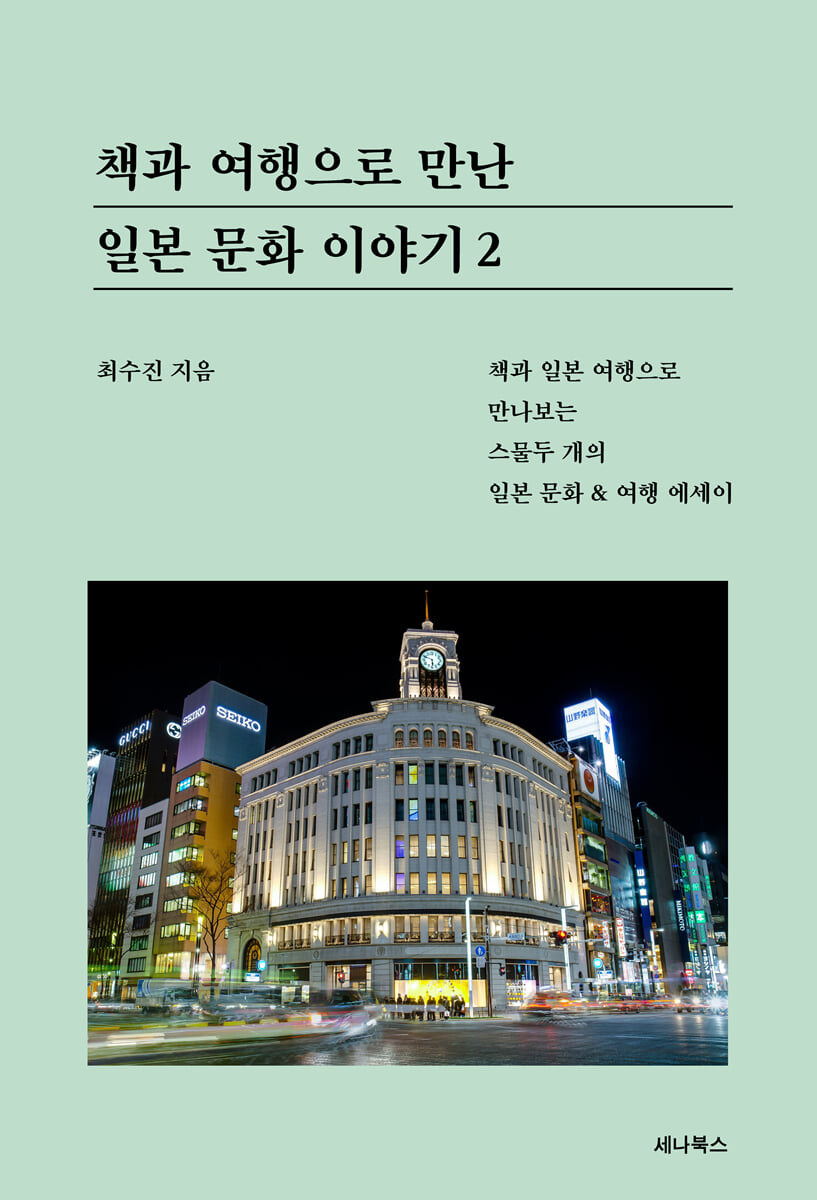
Stories of Japanese Culture Through Books and Travel 2
 |
Description
Book Introduction
Twenty-Two Essays on Japanese Culture and Travel Through Books and Travel
Let's read stories about Japanese culture in general, including books written by Japanese authors, books about Japan written by Koreans, and travel stories about Japan, and experience Japanese culture you didn't know much about and feel like you're briefly traveling to Japan.
You will have the pleasure of getting to know aspects of Japanese culture you may not have known about before while getting a glimpse into one way of consuming Japanese culture.
You will also be able to receive fresh stimulation by encountering new and unique cultures and cultural phenomena.
Let's read stories about Japanese culture in general, including books written by Japanese authors, books about Japan written by Koreans, and travel stories about Japan, and experience Japanese culture you didn't know much about and feel like you're briefly traveling to Japan.
You will have the pleasure of getting to know aspects of Japanese culture you may not have known about before while getting a glimpse into one way of consuming Japanese culture.
You will also be able to receive fresh stimulation by encountering new and unique cultures and cultural phenomena.
- You can preview some of the book's contents.
Preview
index
Entering _016
Chapter 1: Stories of Japanese Culture Encountered in Books
Muji: A Company Without Overtime _028
Why is Tokyu Hands so fun? _038
A Foreigner's View of Tokyo _046
Japanese national writer Jiro Asada _052
Exploring the inner thoughts of Japanese working moms through Amazon comments _058
Why Japan's Daycare Centers Are Short _064
Seeing Japan Accurately, Without Overestimating or Underestimating _074
True art is directed toward humanity _082
The Relationship Between Spring Bear and Haruki Murakami _090
I don't even envy Google, Mirai Industries _096
A message to live your life outside the box _102
The Thinking and Life Stories of Two Nobel Prize-Winning Scientists _108
A cafe is a comfortable public space _114
Honest and Candid Life Healing Essay _122
The happiest Japanese are housewives in their 30s _132
What will Japan's Satori Generation look like in 20 years? _140
Chapter 2: Stories of Japanese Culture Encountered Through Travel
Miyazaki Department Store Bonvelta Tachibana _158
Watayabesso Ryokan Kashikiri Onsen Experience _172
Going to Takachiho Gorge in Miyazaki _186
Visiting Miyazaki Obi Castle Town _204
Tokyo Travel Story 1_224
Tokyo Travel Story 2_244
Chapter 1: Stories of Japanese Culture Encountered in Books
Muji: A Company Without Overtime _028
Why is Tokyu Hands so fun? _038
A Foreigner's View of Tokyo _046
Japanese national writer Jiro Asada _052
Exploring the inner thoughts of Japanese working moms through Amazon comments _058
Why Japan's Daycare Centers Are Short _064
Seeing Japan Accurately, Without Overestimating or Underestimating _074
True art is directed toward humanity _082
The Relationship Between Spring Bear and Haruki Murakami _090
I don't even envy Google, Mirai Industries _096
A message to live your life outside the box _102
The Thinking and Life Stories of Two Nobel Prize-Winning Scientists _108
A cafe is a comfortable public space _114
Honest and Candid Life Healing Essay _122
The happiest Japanese are housewives in their 30s _132
What will Japan's Satori Generation look like in 20 years? _140
Chapter 2: Stories of Japanese Culture Encountered Through Travel
Miyazaki Department Store Bonvelta Tachibana _158
Watayabesso Ryokan Kashikiri Onsen Experience _172
Going to Takachiho Gorge in Miyazaki _186
Visiting Miyazaki Obi Castle Town _204
Tokyo Travel Story 1_224
Tokyo Travel Story 2_244
Detailed image

Into the book
* The new look that retail stores should have is vitality, and a representative example is IKEA in Sweden.
IKEA is characterized by its thorough design concept.
Tokyu Hands offers products that are thoroughly 'functional in pursuit of functionality.'
Tokyu Hands has established itself as a powerhouse in the retail industry, boasting an overwhelming product selection and entertainment value.
--- p.
42
* Life is too short to accomplish anything.
If you want to achieve something, you have to dedicate yourself to it all day, every day.
I'm not sure if that's okay or not.
Ordinary people can't even do this.
I'm just busy making a living day by day.
It is important to create an environment where you can devote yourself to something while you are still young.
Once you've established a certain foundation as a full-time writer, you'll be able to dedicate all your time to writing.
Even if a writer doesn't write all day, everything he experiences adds to his writing.
--- p.
54
* What's the most fundamental condition for balancing work and family? It's "a trustworthy caregiver or institution."
Many working moms find it difficult to leave their children at daycare and then turn around.
If your child is sick, you can't even focus on your work.
Even today, many working moms in Korea are wondering, “What kind of movie am I supposed to watch for this?
You might be thinking, “Should I just throw this away?”
So how are working mothers in neighboring Japan solving childcare issues and balancing work and family life?
--- p.
65
* Educational issues are pointed out as a cause of the downward trend of the younger generation.
Because the overall learning decline is so severe, they don't even realize that there is a problem.
It is said that the environment in which students can enter any university with elementary school level skills also played a role.
I don't want to study or do anything proper.
It is said that there are cases where capable non-regular workers decline the offer to become regular workers.
--- p.
75
* Japanese youth long for Tokyo.
For people living in the countryside, Tokyo is said to be a city of dreams.
Our love for Seoul is on another level.
But in the end, a city is just a city and a place of life.
In some ways, youth and the city seem to go together quite well.
--- p.
82
* How did President Yamada create a paradise for salarymen? He says the secret to a company's growth is treating people with respect and inspiring employees.
It's easier said than done, but you'll understand once you start working at the company.
How companies treat people like 'money' and 'expenses' and demand 'performance' without giving them anything in return.
Office workers say:
“All workplaces are the same.
“If you go there, there are no weird jobs!”
--- p.
97
* Both Japan and Korea are suffering from youth unemployment, stagnant growth, and distrust in the government.
Japan experienced the Great East Japan Earthquake and the nuclear power plant accident, while South Korea experienced the Sewol Ferry Disaster, leading to concerns about whether the national system can truly be trusted.
The author says that the state plays into the hands of the rich rather than serving the powerless.
Can we say that this is wrong?
--- p.
103
* I was always wondering why the cafe had that mysterious power, but the author, Takashi Saito, had the answer.
The point is that cafes have a ‘comfortable publicness’.
At home, I can't concentrate very hard when I'm writing or reading in the early morning.
But cafes are different.
First of all, because there is a time limit, such as 30 minutes before work, and so on, it makes me hyper-focused.
--- p.
116
* Women who graduate from school and enter society are often at their busiest at work or are about to be promoted when marriage and childcare overlap.
It's a tough time for young women.
It is said that Banana Yoshimoto also went through such a time.
I will tell you a story about a time when I lived so tenaciously that my body and mind were in pain.
Just this story alone makes the author and I comrades.
The heaviness of daily life that even famous writers cannot avoid.
The irony of her pain being a comfort to others.
This book may be a healing essay.
--- p.
127
* Still, in an age like today where women's advancement in society is taken for granted, the story that society and individuals prefer stay-at-home mothers is unusual, if not refreshing.
I'm starting to wonder if this is just a Japanese story.
--- p.
135
* I wanted to make the most of the two days I suddenly had, so I mobilized all kinds of resources to look for tourist attractions and places to visit.
I looked at the tourist guidebook the hotel gave me and the one I brought from Korea, and wondered where to go.
Isn't happiness even in moments like these the gift of travel? Yes, let's go to the busiest place in Miyazaki! Then, of course, it's near the department store, right?
--- p.
159
* Ureshino Onsen has a history of about 1,300 years and is famous for its good water, so much so that it is called the Beauty Onsen.
Watayabesso, the ryokan I visited twice, was the largest in Ureshino, with a Japanese garden, five accommodation buildings, and 131 guest rooms spread over 30,000 square meters of land.
It was only after my visit that I learned that this Wataya Bessou was designed by the famous Japanese architect, Kisho Kurokawa.
--- p.
172
* The Sheraton Walkerhill Hotel Miyazaki, where the day begins with the sun rising from the sea, is a room you will never tire of, no matter how many times you stay there.
That day too, I woke up on my own at around 5:15 in the morning.
The sea where the sunrise is just beginning, I can still feel that excitement.
The hotel is located within the Seagaia Resort and is surrounded by a lush pine forest of 170,000 trees.
Just looking at it gives me a healing feeling.
--- p.
186
* After arriving at Narita, going to Shinjuku, and checking into my hotel, it felt like the whole day would pass.
How can I possibly be in Tokyo! I can't waste a single day.
My head gets complicated.
First, I decided to take the Narita Express and arrived at the platform.
I buy a can of coffee from the vending machine.
Ah, I love this kind of thing! The moment I drink the coffee, I feel like, 'I'm really in Tokyo.'
--- p.
225
* It was a cute and well-kept garden with a small pond.
It was perfect for a morning walk as there were no people around.
It is also connected to Waseda University, so it is often used as a resting place for students.
General public can also enter.
There was also an old house in the garden.
I only learned the true nature of that house after returning to Korea and reading “The Japanese Mind.”
When I first saw it, I honestly thought it was a warehouse.
But it was a famous place known only to those in the know!
--- p.
247
* There are about 40 tea rooms built by Sen no Rikyu, but only one remains, the Daian.
He created Daian in 1582 at the age of 61, and it is said to be the legacy that best represents Rikyu's ideal tea room.
It is currently designated as a National Treasure of Japan and is located in Myokian, a temple at the foot of Tennozan in Kyoto, Japan.
--- p.
248
* Ginza Six Tsutaya is a bookstore that mainly curates books on culture and art, but it also has a good selection of books on popular topics these days, so it was fun to browse.
It was exactly my type of bookstore.
There were also many pretty props on display, so there was a lot to see.
There were also rest areas with chairs and other facilities where you could sit and read a book.
The long bookshelves somehow give off a warm and comfortable feeling.
I thought the spatial composition of Ginza Six Tsutaya was very meticulous.
It didn't give me a moment to be bored.
IKEA is characterized by its thorough design concept.
Tokyu Hands offers products that are thoroughly 'functional in pursuit of functionality.'
Tokyu Hands has established itself as a powerhouse in the retail industry, boasting an overwhelming product selection and entertainment value.
--- p.
42
* Life is too short to accomplish anything.
If you want to achieve something, you have to dedicate yourself to it all day, every day.
I'm not sure if that's okay or not.
Ordinary people can't even do this.
I'm just busy making a living day by day.
It is important to create an environment where you can devote yourself to something while you are still young.
Once you've established a certain foundation as a full-time writer, you'll be able to dedicate all your time to writing.
Even if a writer doesn't write all day, everything he experiences adds to his writing.
--- p.
54
* What's the most fundamental condition for balancing work and family? It's "a trustworthy caregiver or institution."
Many working moms find it difficult to leave their children at daycare and then turn around.
If your child is sick, you can't even focus on your work.
Even today, many working moms in Korea are wondering, “What kind of movie am I supposed to watch for this?
You might be thinking, “Should I just throw this away?”
So how are working mothers in neighboring Japan solving childcare issues and balancing work and family life?
--- p.
65
* Educational issues are pointed out as a cause of the downward trend of the younger generation.
Because the overall learning decline is so severe, they don't even realize that there is a problem.
It is said that the environment in which students can enter any university with elementary school level skills also played a role.
I don't want to study or do anything proper.
It is said that there are cases where capable non-regular workers decline the offer to become regular workers.
--- p.
75
* Japanese youth long for Tokyo.
For people living in the countryside, Tokyo is said to be a city of dreams.
Our love for Seoul is on another level.
But in the end, a city is just a city and a place of life.
In some ways, youth and the city seem to go together quite well.
--- p.
82
* How did President Yamada create a paradise for salarymen? He says the secret to a company's growth is treating people with respect and inspiring employees.
It's easier said than done, but you'll understand once you start working at the company.
How companies treat people like 'money' and 'expenses' and demand 'performance' without giving them anything in return.
Office workers say:
“All workplaces are the same.
“If you go there, there are no weird jobs!”
--- p.
97
* Both Japan and Korea are suffering from youth unemployment, stagnant growth, and distrust in the government.
Japan experienced the Great East Japan Earthquake and the nuclear power plant accident, while South Korea experienced the Sewol Ferry Disaster, leading to concerns about whether the national system can truly be trusted.
The author says that the state plays into the hands of the rich rather than serving the powerless.
Can we say that this is wrong?
--- p.
103
* I was always wondering why the cafe had that mysterious power, but the author, Takashi Saito, had the answer.
The point is that cafes have a ‘comfortable publicness’.
At home, I can't concentrate very hard when I'm writing or reading in the early morning.
But cafes are different.
First of all, because there is a time limit, such as 30 minutes before work, and so on, it makes me hyper-focused.
--- p.
116
* Women who graduate from school and enter society are often at their busiest at work or are about to be promoted when marriage and childcare overlap.
It's a tough time for young women.
It is said that Banana Yoshimoto also went through such a time.
I will tell you a story about a time when I lived so tenaciously that my body and mind were in pain.
Just this story alone makes the author and I comrades.
The heaviness of daily life that even famous writers cannot avoid.
The irony of her pain being a comfort to others.
This book may be a healing essay.
--- p.
127
* Still, in an age like today where women's advancement in society is taken for granted, the story that society and individuals prefer stay-at-home mothers is unusual, if not refreshing.
I'm starting to wonder if this is just a Japanese story.
--- p.
135
* I wanted to make the most of the two days I suddenly had, so I mobilized all kinds of resources to look for tourist attractions and places to visit.
I looked at the tourist guidebook the hotel gave me and the one I brought from Korea, and wondered where to go.
Isn't happiness even in moments like these the gift of travel? Yes, let's go to the busiest place in Miyazaki! Then, of course, it's near the department store, right?
--- p.
159
* Ureshino Onsen has a history of about 1,300 years and is famous for its good water, so much so that it is called the Beauty Onsen.
Watayabesso, the ryokan I visited twice, was the largest in Ureshino, with a Japanese garden, five accommodation buildings, and 131 guest rooms spread over 30,000 square meters of land.
It was only after my visit that I learned that this Wataya Bessou was designed by the famous Japanese architect, Kisho Kurokawa.
--- p.
172
* The Sheraton Walkerhill Hotel Miyazaki, where the day begins with the sun rising from the sea, is a room you will never tire of, no matter how many times you stay there.
That day too, I woke up on my own at around 5:15 in the morning.
The sea where the sunrise is just beginning, I can still feel that excitement.
The hotel is located within the Seagaia Resort and is surrounded by a lush pine forest of 170,000 trees.
Just looking at it gives me a healing feeling.
--- p.
186
* After arriving at Narita, going to Shinjuku, and checking into my hotel, it felt like the whole day would pass.
How can I possibly be in Tokyo! I can't waste a single day.
My head gets complicated.
First, I decided to take the Narita Express and arrived at the platform.
I buy a can of coffee from the vending machine.
Ah, I love this kind of thing! The moment I drink the coffee, I feel like, 'I'm really in Tokyo.'
--- p.
225
* It was a cute and well-kept garden with a small pond.
It was perfect for a morning walk as there were no people around.
It is also connected to Waseda University, so it is often used as a resting place for students.
General public can also enter.
There was also an old house in the garden.
I only learned the true nature of that house after returning to Korea and reading “The Japanese Mind.”
When I first saw it, I honestly thought it was a warehouse.
But it was a famous place known only to those in the know!
--- p.
247
* There are about 40 tea rooms built by Sen no Rikyu, but only one remains, the Daian.
He created Daian in 1582 at the age of 61, and it is said to be the legacy that best represents Rikyu's ideal tea room.
It is currently designated as a National Treasure of Japan and is located in Myokian, a temple at the foot of Tennozan in Kyoto, Japan.
--- p.
248
* Ginza Six Tsutaya is a bookstore that mainly curates books on culture and art, but it also has a good selection of books on popular topics these days, so it was fun to browse.
It was exactly my type of bookstore.
There were also many pretty props on display, so there was a lot to see.
There were also rest areas with chairs and other facilities where you could sit and read a book.
The long bookshelves somehow give off a warm and comfortable feeling.
I thought the spatial composition of Ginza Six Tsutaya was very meticulous.
It didn't give me a moment to be bored.
--- p.
253
253
GOODS SPECIFICS
- Date of issue: June 30, 2022
- Page count, weight, size: 276 pages | 362g | 128*188*17mm
- ISBN13: 9791187316411
- ISBN10: 1187316415
You may also like
카테고리
korean


korean

![GQ KOREA Mark (Monthly): December [2025]](http://librairie.coreenne.fr/cdn/shop/files/8ef265dbbfbf186523ed75ba7319009d.jpg?v=1765340328&width=3840)


