

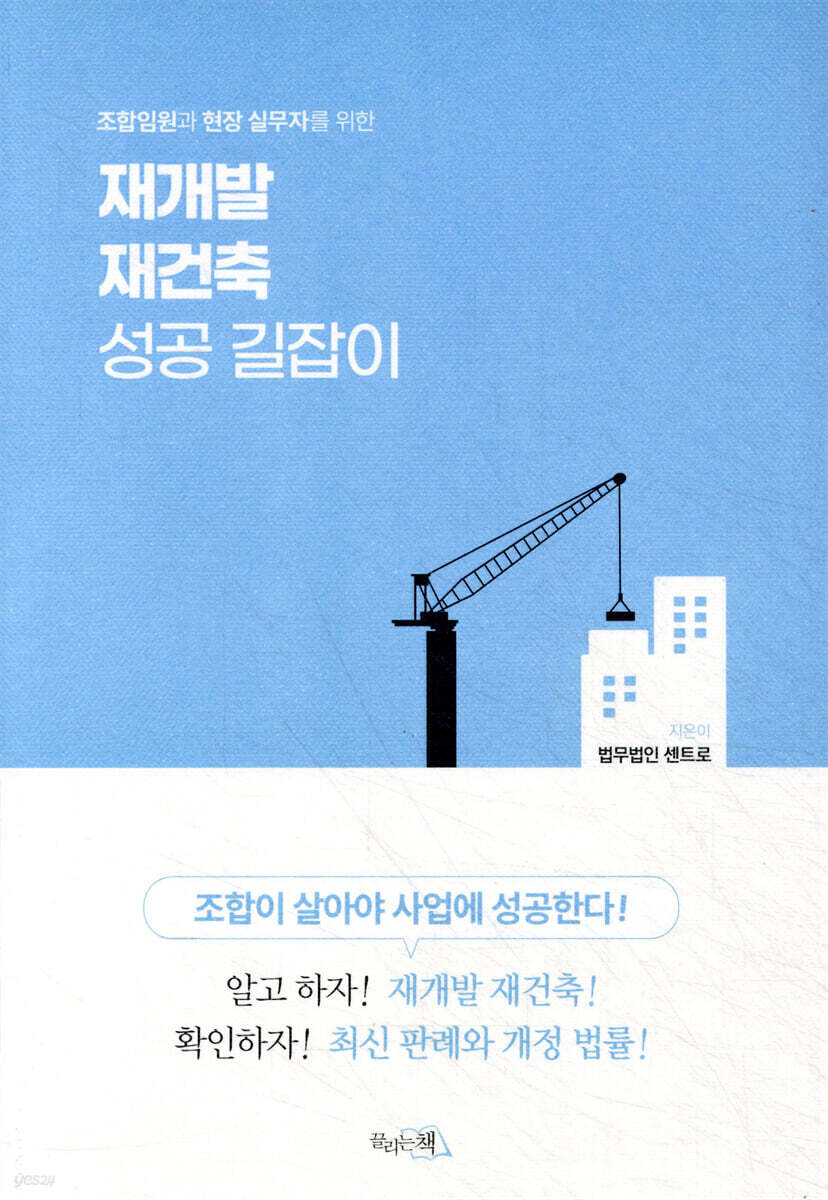
A Guide to Successful Redevelopment and Reconstruction
 |
Description
Book Introduction
Reduces on-site confusion and reduces combination failures.
Redevelopment and reconstruction are not simply real estate development projects.
It involves decades of life's memories, the future of a community, complex administrative procedures, and the potential for legal disputes.
It is also a long-term war that has lasted for years.
Things keep changing, and laws keep changing.
This book explains the entire maintenance project process, focusing on actual incidents, to help union executives prevent large-scale losses due to minor mistakes.
We have compiled case law and practical advice focusing on issues that frequently arise in the field, such as union establishment, construction company selection, information disclosure, title lawsuits, and occupancy rights disputes.
This is a practical guidebook that compiles “the legal common sense and response strategies that union executives and practitioners must know, written in the language of the field and through actual incidents that occurred in the field,” based on actual litigation experience and judgments, rather than a formal explanation.
It covers in detail the new regulations and procedures that will be implemented in June 2025 (e.g., allowing the formation of a promotion committee at the maintenance plan drafting stage), so it can be applied immediately in the field.
Attorneys at Centro Law Firm, with over 20,000 cases of redevelopment and reconstruction litigation and advisory experience, participated in the writing process, identifying key issues in practice and presenting practical solutions.
Redevelopment and reconstruction are not simply real estate development projects.
It involves decades of life's memories, the future of a community, complex administrative procedures, and the potential for legal disputes.
It is also a long-term war that has lasted for years.
Things keep changing, and laws keep changing.
This book explains the entire maintenance project process, focusing on actual incidents, to help union executives prevent large-scale losses due to minor mistakes.
We have compiled case law and practical advice focusing on issues that frequently arise in the field, such as union establishment, construction company selection, information disclosure, title lawsuits, and occupancy rights disputes.
This is a practical guidebook that compiles “the legal common sense and response strategies that union executives and practitioners must know, written in the language of the field and through actual incidents that occurred in the field,” based on actual litigation experience and judgments, rather than a formal explanation.
It covers in detail the new regulations and procedures that will be implemented in June 2025 (e.g., allowing the formation of a promotion committee at the maintenance plan drafting stage), so it can be applied immediately in the field.
Attorneys at Centro Law Firm, with over 20,000 cases of redevelopment and reconstruction litigation and advisory experience, participated in the writing process, identifying key issues in practice and presenting practical solutions.
index
Prologue - To those who are sweating at redevelopment and reconstruction sites today.
Chapter 1: Who is promoting redevelopment and reconstruction?
1.
The Beginning of the Maintenance Project: The Significance of the Redevelopment and Reconstruction Preparatory Committee and the Association Establishment Promotion Committee
2.
Composition of the Redevelopment and Reconstruction Preparation Committee and the Association Establishment Promotion Committee and Qualifications of Members
3.
Who designates maintenance areas and how?
4.
Various issues related to the establishment of a resident-proposed redevelopment plan
5.
Who is responsible for the contracts concluded by the Union Establishment Promotion Committee?
6.
Comprehensive succession scope of maintenance companies selected by the union establishment promotion committee
7.
Is the agreement between the cooperative establishment promotion committee and the commercial district binding on the cooperative?
Chapter 2: How to Navigate the Minefield of Conflict
1.
Can I sign the union establishment agreement on behalf of a branch manager?
2.
Special provisions for reusing union establishment consent forms: To what extent can consent forms be reused?
3.
Recent dispute cases regarding the qualifications and disqualifications of executives of redevelopment and reconstruction associations
4.
Is it possible for a redevelopment or reconstruction association to have a non-executive chairman?
5.
The right to perform duties of union executives whose term of office has expired
6.
When a union executive is reappointed, must the executive election process be repeated?
7.
How are delegate elections held when the number of delegates is insufficient?
8.
If minor changes accumulate and increase the cost of the project by more than 10%,
9.
Things to know about information disclosure obligations
10.
Why Revision of Information Disclosure Regulations Is Urgently Needed
11.
How the Union Responds to Unclear or Extensive Access and Copy Requests
Chapter 3: Surviving the Reversed Power-Gap Relationship
1.
Redevelopment and reconstruction construction contractor selection process and legal issues
2.
Support for work related to construction company selection and criminal punishment
3.
Things to know when selecting a maintenance business partner
4.
Things to consider when selecting a partner for a redevelopment, reconstruction, or maintenance project
Chapter 4: Accurately Understanding Union Member Qualifications and Occupancy Rights Disputes
1.
Recent dispute cases regarding the sale of apartments to union members in redevelopment and reconstruction zones
2.
The contents and problems of the 5-year re-winning restriction on redevelopment and reconstruction projects
3.
If you buy a property with multiple rights without knowing the Supreme Court's ruling, you'll be in trouble.
4.
Latecomer multi-owner and union member status
5.
Will cash be paid when acquiring some shares in a redevelopment soccer field in a speculative overheated area?
6.
Apartment sales to members of a redevelopment commercial complex that require the consent of all members
Chapter 5: The Secret to Selling Claims and Eviction Lawsuits That Save Hundreds of Millions of Won
1.
Request for sale against those who did not consent to the establishment of a reconstruction association
2.
Things to know about selling to those who have not applied for reconstruction sales
3.
The Importance of the "Blank Title" Lawsuit for Redevelopment, Reconstruction, and Maintenance Projects
4.
Cash settlement and title issues in case of non-conclusion of sales contract
Chapter 6: Management and Disposition Plans and Cash Settlement: Make Sure to Check These
1.
The illegality of the trust protection principle and the management disposition plan
2.
Union members are in tears over the dispute over religious facilities in redevelopment zones.
3.
Symbiosis between redevelopment and reconstruction associations and religious groups
4.
How can a union charge maintenance costs to cash settlers?
5.
Essential Checkpoints Related to Cash Settlement Operators' Maintenance Cost Burden
6.
Claims for damages against non-residents within the business area
Chapter 7: Revealing the Secrets of Redevelopment Acceptance and Decision-Making Practices
1.
Can the union proceed with land acquisition procedures immediately after the expiration of the consultation period without waiting for the management disposal plan notification?
2.
In a lawsuit for compensation increase, if the claim is dismissed even if the compensation amount is increased based on the appraisal results
3.
If you do not move despite a decision to accept, you will be subject to criminal punishment.
4.
The relocation loan and its interest are subject to return or deduction from the cash settlement amount.
5.
If the application period for subscription is extended within 20 days
6.
Can the cash settlement amount be lower than the negotiated amount?
Chapter 8: Methods for requesting refunds of various union member fees and concluding union business
1.
Response measures to the imposition of school land charges
2.
The issue of returning unjust profits related to national and public land sales contracts
3.
The 'reconstruction excess profit recovery system' is a black comedy.
4.
A Principle Study on the Recovery of Excess Profits from Reconstruction
5.
The regulations for dissolution of redevelopment and reconstruction associations need to be supplemented.
Epilogue - I hope this will serve as a standard and compass for redevelopment and reconstruction.
Chapter 1: Who is promoting redevelopment and reconstruction?
1.
The Beginning of the Maintenance Project: The Significance of the Redevelopment and Reconstruction Preparatory Committee and the Association Establishment Promotion Committee
2.
Composition of the Redevelopment and Reconstruction Preparation Committee and the Association Establishment Promotion Committee and Qualifications of Members
3.
Who designates maintenance areas and how?
4.
Various issues related to the establishment of a resident-proposed redevelopment plan
5.
Who is responsible for the contracts concluded by the Union Establishment Promotion Committee?
6.
Comprehensive succession scope of maintenance companies selected by the union establishment promotion committee
7.
Is the agreement between the cooperative establishment promotion committee and the commercial district binding on the cooperative?
Chapter 2: How to Navigate the Minefield of Conflict
1.
Can I sign the union establishment agreement on behalf of a branch manager?
2.
Special provisions for reusing union establishment consent forms: To what extent can consent forms be reused?
3.
Recent dispute cases regarding the qualifications and disqualifications of executives of redevelopment and reconstruction associations
4.
Is it possible for a redevelopment or reconstruction association to have a non-executive chairman?
5.
The right to perform duties of union executives whose term of office has expired
6.
When a union executive is reappointed, must the executive election process be repeated?
7.
How are delegate elections held when the number of delegates is insufficient?
8.
If minor changes accumulate and increase the cost of the project by more than 10%,
9.
Things to know about information disclosure obligations
10.
Why Revision of Information Disclosure Regulations Is Urgently Needed
11.
How the Union Responds to Unclear or Extensive Access and Copy Requests
Chapter 3: Surviving the Reversed Power-Gap Relationship
1.
Redevelopment and reconstruction construction contractor selection process and legal issues
2.
Support for work related to construction company selection and criminal punishment
3.
Things to know when selecting a maintenance business partner
4.
Things to consider when selecting a partner for a redevelopment, reconstruction, or maintenance project
Chapter 4: Accurately Understanding Union Member Qualifications and Occupancy Rights Disputes
1.
Recent dispute cases regarding the sale of apartments to union members in redevelopment and reconstruction zones
2.
The contents and problems of the 5-year re-winning restriction on redevelopment and reconstruction projects
3.
If you buy a property with multiple rights without knowing the Supreme Court's ruling, you'll be in trouble.
4.
Latecomer multi-owner and union member status
5.
Will cash be paid when acquiring some shares in a redevelopment soccer field in a speculative overheated area?
6.
Apartment sales to members of a redevelopment commercial complex that require the consent of all members
Chapter 5: The Secret to Selling Claims and Eviction Lawsuits That Save Hundreds of Millions of Won
1.
Request for sale against those who did not consent to the establishment of a reconstruction association
2.
Things to know about selling to those who have not applied for reconstruction sales
3.
The Importance of the "Blank Title" Lawsuit for Redevelopment, Reconstruction, and Maintenance Projects
4.
Cash settlement and title issues in case of non-conclusion of sales contract
Chapter 6: Management and Disposition Plans and Cash Settlement: Make Sure to Check These
1.
The illegality of the trust protection principle and the management disposition plan
2.
Union members are in tears over the dispute over religious facilities in redevelopment zones.
3.
Symbiosis between redevelopment and reconstruction associations and religious groups
4.
How can a union charge maintenance costs to cash settlers?
5.
Essential Checkpoints Related to Cash Settlement Operators' Maintenance Cost Burden
6.
Claims for damages against non-residents within the business area
Chapter 7: Revealing the Secrets of Redevelopment Acceptance and Decision-Making Practices
1.
Can the union proceed with land acquisition procedures immediately after the expiration of the consultation period without waiting for the management disposal plan notification?
2.
In a lawsuit for compensation increase, if the claim is dismissed even if the compensation amount is increased based on the appraisal results
3.
If you do not move despite a decision to accept, you will be subject to criminal punishment.
4.
The relocation loan and its interest are subject to return or deduction from the cash settlement amount.
5.
If the application period for subscription is extended within 20 days
6.
Can the cash settlement amount be lower than the negotiated amount?
Chapter 8: Methods for requesting refunds of various union member fees and concluding union business
1.
Response measures to the imposition of school land charges
2.
The issue of returning unjust profits related to national and public land sales contracts
3.
The 'reconstruction excess profit recovery system' is a black comedy.
4.
A Principle Study on the Recovery of Excess Profits from Reconstruction
5.
The regulations for dissolution of redevelopment and reconstruction associations need to be supplemented.
Epilogue - I hope this will serve as a standard and compass for redevelopment and reconstruction.
Detailed image

Into the book
Recently, the Ministry of Government Legislation also interpreted that, despite the provisions of Article 33, Paragraph 5 of the Urban Planning Act, Article 41, Paragraph 1 of the Urban Planning Act does not apply to the chairperson of the promotion committee, and thus, the chairperson is not automatically dismissed even if he or she does not reside in the relevant development zone until the approval for establishment of the association is received.
--- p.26
The Urban Planning Act regulates the ‘Combination Establishment Promotion Committee’ as a group.
The 'Promotion Committee' must meet certain requirements, such as the consent of a majority of landowners within the development target area, and must receive approval from the competent authority. If this is not obtained, the 'Promotion Committee' cannot become one, and is prohibited from operating under the name of the 'Promotion Committee'.
--- p.36
There is no provision in the Urban Planning Act, its enforcement decree, or its enforcement rules that requires the union head to be on duty and perform his/her duties.
The standard articles of incorporation for maintenance projects notified by the Ministry of Land, Infrastructure and Transport only stipulates that “when the association deems it necessary to execute its affairs, it may appoint full-time executives or paid employees in accordance with the association’s personnel regulations,” but there is no provision that requires them to be full-time.
Moreover, most unions are using the contents of the above standard articles of association as they are.
--- p.65
If a union executive refuses a request for inspection or copying by a union member, etc. pursuant to Article 124, Paragraph 4 of the Urban Planning Act, he or she will be subject to criminal punishment.
Therefore, the subjects of inspection and copying requests from union members, etc. must be specific enough to enable union executives to determine which of the documents and materials specified in Article 124, Paragraphs 1 and 4 of the Urban Planning Act they fall under.
--- p.93
If there is no separate provision regarding the quorum for resolutions in the Articles of Incorporation, the contractor must be selected by a majority vote of the members present at the general meeting of members.
In case the first round of voting does not obtain the approval of a majority of the members present, the union may decide in advance on the method of a runoff or second round of voting.
In this case, it is advisable to confirm whether more than half of the union members are present in person before re-voting.
--- p.102
In the case of reconstruction, landowners of reconstruction projects that are not located in over-congested areas may be supplied with housing equivalent to the number of houses they own, and landowners of reconstruction projects that are located in over-congested areas may be supplied with housing up to three houses within the number of houses they own.
However, this does not apply to reconstruction projects that apply for approval of the first business implementation plan in speculative overheated areas or regulated areas.
--- p.119
In a case where the father owned 50% of the shares and the son owned 50% of the shares in a redevelopment soccer district in a speculative overheated area, and then the father gifted all of the shares to the son after the establishment of the cooperative, the Seoul High Court ruled that the son was not recognized as a cooperative member for the 50% shares gifted to him by his father and was subject to cash settlement.
--- p.137~138
If you become a cash liquidator, you will receive cash settlement through a method of compensation for losses in accordance with the Land Compensation Act in the case of redevelopment, and in the case of reconstruction, the Land Compensation Act is not applied in principle, so you will receive cash settlement through a sale claim lawsuit or a cash settlement payment lawsuit.
In contrast, members are obligated to contribute and relocate their previous assets upon the announcement of the management disposal plan.
--- p.160
Those who become cash settlers in redevelopment projects will negotiate with the association regarding the cash settlement amount.
If an agreement is not reached, the union may apply to the local land expropriation committee for an expropriation decision.
If the cash liquidator is not satisfied with the compensation amount determined by the expropriation decision, he or she may file an objection with the Central Land Expropriation Committee.
If you are not satisfied with the Central Land Expropriation Committee's decision, you can file a lawsuit to increase the compensation amount with the competent administrative court.
--- p.202
Usually, the interest on the moving expenses loan is settled when the members move in.
Therefore, it is clear that the union members did not pay interest on the loan amount and made a profit equivalent to the amount before becoming cash settlers after receiving the loan amount.
Therefore, the accumulated interest must be returned to the association from the time the loan is executed until the loan is fully repaid.
--- p.26
The Urban Planning Act regulates the ‘Combination Establishment Promotion Committee’ as a group.
The 'Promotion Committee' must meet certain requirements, such as the consent of a majority of landowners within the development target area, and must receive approval from the competent authority. If this is not obtained, the 'Promotion Committee' cannot become one, and is prohibited from operating under the name of the 'Promotion Committee'.
--- p.36
There is no provision in the Urban Planning Act, its enforcement decree, or its enforcement rules that requires the union head to be on duty and perform his/her duties.
The standard articles of incorporation for maintenance projects notified by the Ministry of Land, Infrastructure and Transport only stipulates that “when the association deems it necessary to execute its affairs, it may appoint full-time executives or paid employees in accordance with the association’s personnel regulations,” but there is no provision that requires them to be full-time.
Moreover, most unions are using the contents of the above standard articles of association as they are.
--- p.65
If a union executive refuses a request for inspection or copying by a union member, etc. pursuant to Article 124, Paragraph 4 of the Urban Planning Act, he or she will be subject to criminal punishment.
Therefore, the subjects of inspection and copying requests from union members, etc. must be specific enough to enable union executives to determine which of the documents and materials specified in Article 124, Paragraphs 1 and 4 of the Urban Planning Act they fall under.
--- p.93
If there is no separate provision regarding the quorum for resolutions in the Articles of Incorporation, the contractor must be selected by a majority vote of the members present at the general meeting of members.
In case the first round of voting does not obtain the approval of a majority of the members present, the union may decide in advance on the method of a runoff or second round of voting.
In this case, it is advisable to confirm whether more than half of the union members are present in person before re-voting.
--- p.102
In the case of reconstruction, landowners of reconstruction projects that are not located in over-congested areas may be supplied with housing equivalent to the number of houses they own, and landowners of reconstruction projects that are located in over-congested areas may be supplied with housing up to three houses within the number of houses they own.
However, this does not apply to reconstruction projects that apply for approval of the first business implementation plan in speculative overheated areas or regulated areas.
--- p.119
In a case where the father owned 50% of the shares and the son owned 50% of the shares in a redevelopment soccer district in a speculative overheated area, and then the father gifted all of the shares to the son after the establishment of the cooperative, the Seoul High Court ruled that the son was not recognized as a cooperative member for the 50% shares gifted to him by his father and was subject to cash settlement.
--- p.137~138
If you become a cash liquidator, you will receive cash settlement through a method of compensation for losses in accordance with the Land Compensation Act in the case of redevelopment, and in the case of reconstruction, the Land Compensation Act is not applied in principle, so you will receive cash settlement through a sale claim lawsuit or a cash settlement payment lawsuit.
In contrast, members are obligated to contribute and relocate their previous assets upon the announcement of the management disposal plan.
--- p.160
Those who become cash settlers in redevelopment projects will negotiate with the association regarding the cash settlement amount.
If an agreement is not reached, the union may apply to the local land expropriation committee for an expropriation decision.
If the cash liquidator is not satisfied with the compensation amount determined by the expropriation decision, he or she may file an objection with the Central Land Expropriation Committee.
If you are not satisfied with the Central Land Expropriation Committee's decision, you can file a lawsuit to increase the compensation amount with the competent administrative court.
--- p.202
Usually, the interest on the moving expenses loan is settled when the members move in.
Therefore, it is clear that the union members did not pay interest on the loan amount and made a profit equivalent to the amount before becoming cash settlers after receiving the loan amount.
Therefore, the accumulated interest must be returned to the association from the time the loan is executed until the loan is fully repaid.
--- p.211
Publisher's Review
Presenting the 'legal judgment criteria' essential for union executives.
This book covers all stages of redevelopment, reconstruction, and maintenance projects.
It covers the formation of the preparatory committee, requirements for approval by the promotion committee, procedures for drafting a maintenance plan and designating a maintenance area, approval of the business implementation plan and management disposal plan, major disputes, settlement of occupancy rights and handling of cash liquidators, and procedures for dissolution and liquidation of the association.
This book systematically outlines the legal standards and procedures that union executives must follow in almost every crucial decision-making moment they face during redevelopment and reconstruction, and presents a path for union operation from a "legal perspective."
- Qualifications and disqualifications for union president, auditor, and director
- Whether or not one can perform duties after the term of office expires
- Whether the election process will be re-executed in case of re-election
- Legal response methods in the event of a shortage of delegates, etc.
It also helps prevent mistakes by reflecting all 2025 revisions to major related laws, including the Urban Planning Act.
The main revisions reflected are as follows:
- Allowing the formation of a promotion committee prior to designating a maintenance area.
- The name and procedure were relaxed from safety diagnosis to reconstruction diagnosis.
- Changes in the requirements for drafting resident-proposed maintenance plans and enabling proposals from the promotion committee, etc.
In maintenance projects, various disputes related to unions arise. This article interprets these situations based on actual case law and provides strategies for preventive measures, necessary documents, and procedural precautions.
- Problems with the succession of maintenance company contracts during the union establishment promotion stage
- Criminal liability in case of suspicion of bribery and the construction contractor selection process
- Responding to those who refuse to move when a lawsuit for title is filed and a judgment is made on a claim for sale
- Disputes over membership qualifications, conflicts over commercial property sales, legal status of cash liquidators, etc.
Widely applicable to union executives, practitioners, civil servants, and investors
Redevelopment, reconstruction, and maintenance projects are a reality that are carried out in the name of law.
Thus, a union can avoid disputes simply because it "knows" the law, while a union can suffer billions in losses simply because it "doesn't" know the law. "A Guide to Successful Redevelopment and Reconstruction" is a guidebook that serves as a fundamental yet powerful legal partner for unions to become prepared in the field and in practice.
However, this book cannot be dismissed as solely for union executives. Working-level staff at partner companies, such as project managers, maintenance companies, and appraisers, can understand the project's progress and legal risks. Local government officials can grasp the core procedures of redevelopment projects through complaints and administrative processing. Redevelopment investors can make wiser decisions by understanding the challenges of union operation and the decision-making process.
This book covers all stages of redevelopment, reconstruction, and maintenance projects.
It covers the formation of the preparatory committee, requirements for approval by the promotion committee, procedures for drafting a maintenance plan and designating a maintenance area, approval of the business implementation plan and management disposal plan, major disputes, settlement of occupancy rights and handling of cash liquidators, and procedures for dissolution and liquidation of the association.
This book systematically outlines the legal standards and procedures that union executives must follow in almost every crucial decision-making moment they face during redevelopment and reconstruction, and presents a path for union operation from a "legal perspective."
- Qualifications and disqualifications for union president, auditor, and director
- Whether or not one can perform duties after the term of office expires
- Whether the election process will be re-executed in case of re-election
- Legal response methods in the event of a shortage of delegates, etc.
It also helps prevent mistakes by reflecting all 2025 revisions to major related laws, including the Urban Planning Act.
The main revisions reflected are as follows:
- Allowing the formation of a promotion committee prior to designating a maintenance area.
- The name and procedure were relaxed from safety diagnosis to reconstruction diagnosis.
- Changes in the requirements for drafting resident-proposed maintenance plans and enabling proposals from the promotion committee, etc.
In maintenance projects, various disputes related to unions arise. This article interprets these situations based on actual case law and provides strategies for preventive measures, necessary documents, and procedural precautions.
- Problems with the succession of maintenance company contracts during the union establishment promotion stage
- Criminal liability in case of suspicion of bribery and the construction contractor selection process
- Responding to those who refuse to move when a lawsuit for title is filed and a judgment is made on a claim for sale
- Disputes over membership qualifications, conflicts over commercial property sales, legal status of cash liquidators, etc.
Widely applicable to union executives, practitioners, civil servants, and investors
Redevelopment, reconstruction, and maintenance projects are a reality that are carried out in the name of law.
Thus, a union can avoid disputes simply because it "knows" the law, while a union can suffer billions in losses simply because it "doesn't" know the law. "A Guide to Successful Redevelopment and Reconstruction" is a guidebook that serves as a fundamental yet powerful legal partner for unions to become prepared in the field and in practice.
However, this book cannot be dismissed as solely for union executives. Working-level staff at partner companies, such as project managers, maintenance companies, and appraisers, can understand the project's progress and legal risks. Local government officials can grasp the core procedures of redevelopment projects through complaints and administrative processing. Redevelopment investors can make wiser decisions by understanding the challenges of union operation and the decision-making process.
GOODS SPECIFICS
- Date of issue: June 24, 2025
- Page count, weight, size: 252 pages | 145*210*20mm
- ISBN13: 9791198939753
- ISBN10: 1198939753
You may also like
카테고리
korean


korean

![GQ KOREA Mark (Monthly): December [2025]](http://librairie.coreenne.fr/cdn/shop/files/8ef265dbbfbf186523ed75ba7319009d.jpg?v=1765340328&width=3840)


