

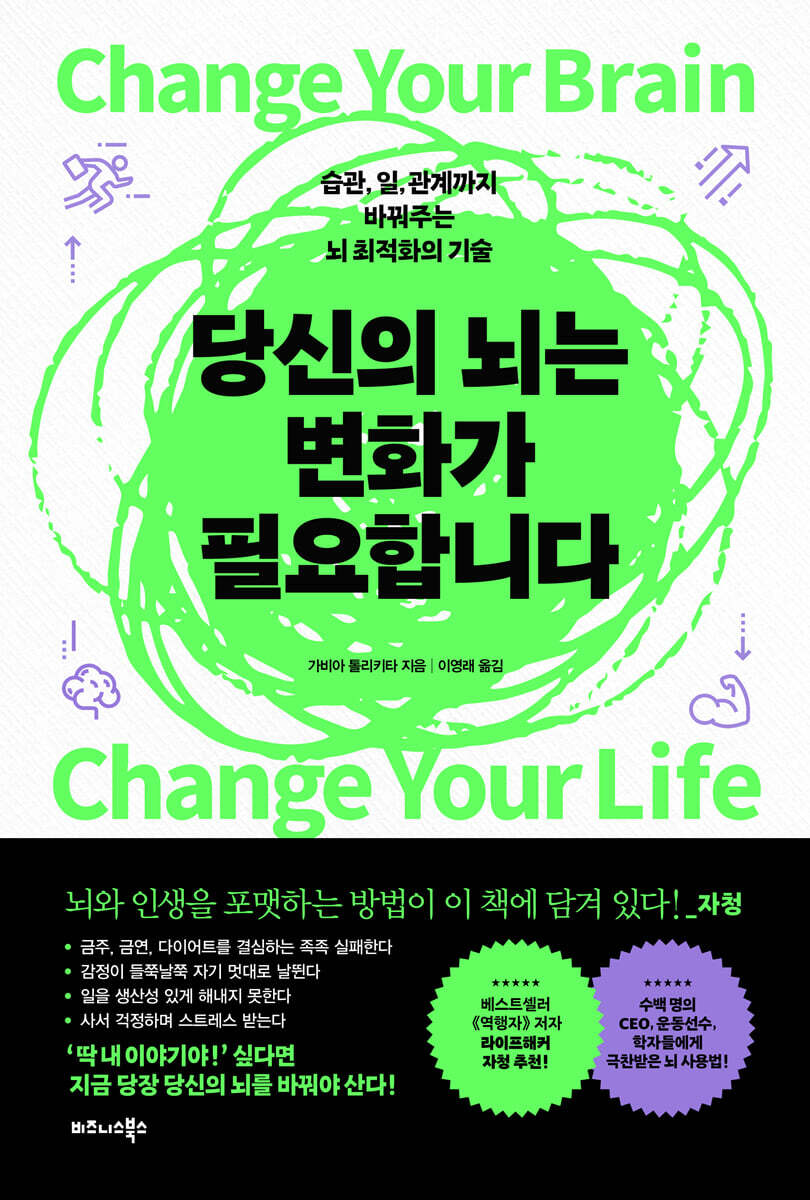
Your brain needs a change
 |
Description
Book Introduction
“It’s incredibly hard to change, because your brain won’t help you!”
A neuroscientist who has changed hundreds of lives tells us
The power of small actions designed to change your brain right now!
When the new year comes, all kinds of challenges are posted on social media.
From quitting drinking and smoking to practicing the Miracle Morning and taking body profile pictures, everyone is starting to tackle the plans they've been putting off.
But after three days, after three months, the upload speed of posts slowly slows down.
Why? Why does the desire to change always end in a three-day stalemate? It's because we haven't changed our "brain"! Our brain, which prefers the same old, familiar, and comfortable routines, perceives any action we take to change as a threat.
So we keep going back to our original habits and behavior patterns.
If you really want to change your life, you have to change your brain.
We need to transform our current brain, which tends to settle for the present, into a brain that is not afraid to challenge, learn, and grow.
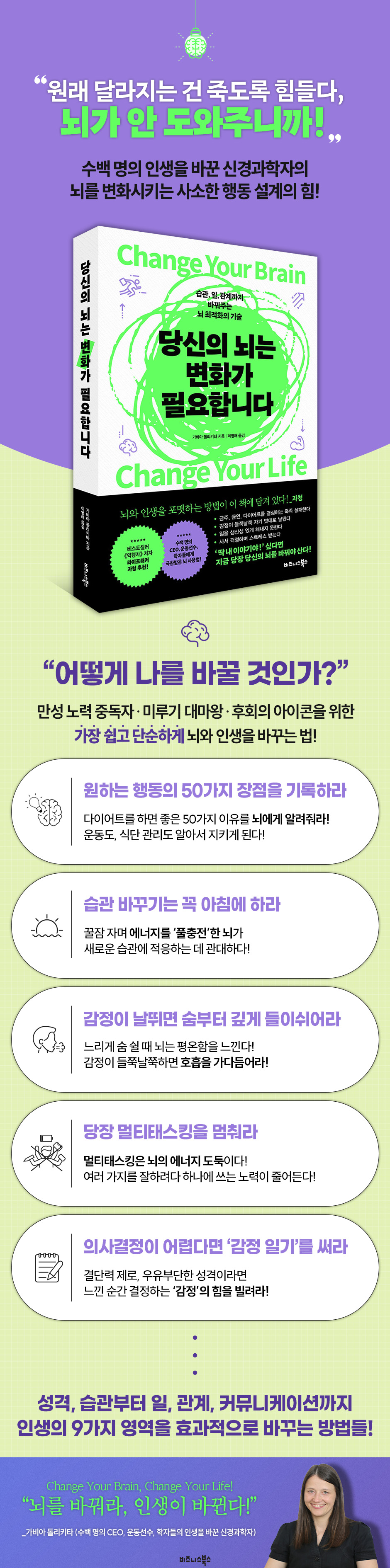
To this end, this book introduces the "Brain Optimization Technique," which has been verified by hundreds of clinical cases and the latest neuroscience research and praised by hundreds of CEOs, athletes, and scholars.
These are ways to effectively change nine areas of your life, from habits and personality to work and relationships, by understanding how your brain works and designing simple, subtle behaviors.
If you're thinking, 'Changing the way my brain works... isn't that too difficult?' don't worry.
The author introduces easy and effective methods that anyone can use, such as starting a new habit in the morning, practicing breathing exercises when you have trouble controlling your emotions, and asking yourself "why you have to do something" to break the habit of procrastination.
If you have the will to try these methods, changing your brain and bringing about changes in your life that usually only last three days becomes surprisingly easy.
So, let's follow this book and change small actions in our daily lives one by one.
You will be able to live a life that continues to move towards a better path without stopping in the middle.
A neuroscientist who has changed hundreds of lives tells us
The power of small actions designed to change your brain right now!
When the new year comes, all kinds of challenges are posted on social media.
From quitting drinking and smoking to practicing the Miracle Morning and taking body profile pictures, everyone is starting to tackle the plans they've been putting off.
But after three days, after three months, the upload speed of posts slowly slows down.
Why? Why does the desire to change always end in a three-day stalemate? It's because we haven't changed our "brain"! Our brain, which prefers the same old, familiar, and comfortable routines, perceives any action we take to change as a threat.
So we keep going back to our original habits and behavior patterns.
If you really want to change your life, you have to change your brain.
We need to transform our current brain, which tends to settle for the present, into a brain that is not afraid to challenge, learn, and grow.
To this end, this book introduces the "Brain Optimization Technique," which has been verified by hundreds of clinical cases and the latest neuroscience research and praised by hundreds of CEOs, athletes, and scholars.
These are ways to effectively change nine areas of your life, from habits and personality to work and relationships, by understanding how your brain works and designing simple, subtle behaviors.
If you're thinking, 'Changing the way my brain works... isn't that too difficult?' don't worry.
The author introduces easy and effective methods that anyone can use, such as starting a new habit in the morning, practicing breathing exercises when you have trouble controlling your emotions, and asking yourself "why you have to do something" to break the habit of procrastination.
If you have the will to try these methods, changing your brain and bringing about changes in your life that usually only last three days becomes surprisingly easy.
So, let's follow this book and change small actions in our daily lives one by one.
You will be able to live a life that continues to move towards a better path without stopping in the middle.
- You can preview some of the book's contents.
Preview
index
A recommendation (by bestseller "The Retrograde" author and life hacker "Jacheong")
If your New Year's resolutions are always the same, check your brain first.
Part 1 - I'm finally starting to change.
Chapter 1 - Changing Your Life with Simple Habit Design
New habits will start as soon as you open your eyes.
Why do I keep glancing at snacks?
Letting your mayfly brain know there's always tomorrow
Change your entire diet vs.
Just change the rice to brown rice
If you repeat this for just 30 days, you will automatically achieve 30 years.
Closing this Chapter: Zero-Fail Habit Strategy
Chapter 2 - The Art of Not Being Swayed by My Emotions
Emotions emerged as a weapon for survival.
Emotions that make me cry, laugh, and go crazy
Seven Emotion Controllers in My Head
A sense of security, a prerequisite for composure
Calming a Frightened Brain Like a Child
Closing this chapter: Don't be ruled by emotional patterns.
Chapter 3 - Changing 35 Percent of Your Personality
How was my personality formed?
Why You Only See Hobby Supplies at the Supermarket
Is that really 'your' duty?
Personality changes as much as you believe it can.
The world won't turn upside down just because you try something new.
Closing this chapter: How to stop making excuses for your personality
Part 2 - From today on, work and study will be twice as good.
Chapter 4 - How to Hear Someone Saying You Have Some Work
Optimize your mind
Building a brain that can quickly see and remember everything
Multitasking is an energy thief.
Motivation soars when the brain is tickled
Customized solutions for professional mirror users
Closing this chapter: Goodbye, Days of Inefficiency
Chapter 5 - Creating a Brain Condition That Operates at 120 Percent
The mental switch that turns on positive mode
Can't I be Superman for a little while?
Why we need thrills in our everyday lives
What is my sleep score out of 10?
Going to the bathroom regularly also makes your brain healthy.
Closing this chapter: Your brain wants well-being too.
Chapter 6 - How to Make Wise Decisions Without Hesitation
When you don't know whose side to take, between your head and your heart
Why do we struggle in the swamp of prejudice?
My head is full of thoughts
To escape the perception of being indecisive
Sometimes, leave yourself to chance.
Concluding this chapter: Making decisions quickly and rationally
Part 3 - Change Your Brain and Find Better Relationships
Chapter 7 - The Wisdom That Leads People, Revealed by the Brain
People First vs.
Homework comes first
Can't a leader be both rational and emotional?
The misconception that if you don't empathize, you're necessarily bad
Why 15 Minutes of "Transition Time" Is Necessary
GROW, How to Lead and Grow People
Become a leader people want to emulate, like a mirror.
Concluding this Chapter: Skills for Becoming a Better Mentor
Chapter 8 - How to Reconcile with Your Wounded Inner Child
My childhood self created the relationship I have today.
The child inside me is crying
Why am I obsessed with that person?
When a person's charm begins to appear as a flaw
For a relationship that looks in the same direction
Seven Principles for Building Unwavering Relationships
Concluding this Chapter: Relationship Exercises for Adults
Chapter 9 - The Art of Conversation That Doesn't Hurt Anyone
An immediate escape from an emotional conversation
You are a unique person just like me.
4-Step Technique to Stop Endless Arguments in an Instant
The secret to catching someone's true feelings
Stop the 'blaming' and 'building walls'
Closing this chapter: In the end, the answer is yes.
Going Out - Life is more enjoyable when you get your brain on your side.
Acknowledgements
References
If your New Year's resolutions are always the same, check your brain first.
Part 1 - I'm finally starting to change.
Chapter 1 - Changing Your Life with Simple Habit Design
New habits will start as soon as you open your eyes.
Why do I keep glancing at snacks?
Letting your mayfly brain know there's always tomorrow
Change your entire diet vs.
Just change the rice to brown rice
If you repeat this for just 30 days, you will automatically achieve 30 years.
Closing this Chapter: Zero-Fail Habit Strategy
Chapter 2 - The Art of Not Being Swayed by My Emotions
Emotions emerged as a weapon for survival.
Emotions that make me cry, laugh, and go crazy
Seven Emotion Controllers in My Head
A sense of security, a prerequisite for composure
Calming a Frightened Brain Like a Child
Closing this chapter: Don't be ruled by emotional patterns.
Chapter 3 - Changing 35 Percent of Your Personality
How was my personality formed?
Why You Only See Hobby Supplies at the Supermarket
Is that really 'your' duty?
Personality changes as much as you believe it can.
The world won't turn upside down just because you try something new.
Closing this chapter: How to stop making excuses for your personality
Part 2 - From today on, work and study will be twice as good.
Chapter 4 - How to Hear Someone Saying You Have Some Work
Optimize your mind
Building a brain that can quickly see and remember everything
Multitasking is an energy thief.
Motivation soars when the brain is tickled
Customized solutions for professional mirror users
Closing this chapter: Goodbye, Days of Inefficiency
Chapter 5 - Creating a Brain Condition That Operates at 120 Percent
The mental switch that turns on positive mode
Can't I be Superman for a little while?
Why we need thrills in our everyday lives
What is my sleep score out of 10?
Going to the bathroom regularly also makes your brain healthy.
Closing this chapter: Your brain wants well-being too.
Chapter 6 - How to Make Wise Decisions Without Hesitation
When you don't know whose side to take, between your head and your heart
Why do we struggle in the swamp of prejudice?
My head is full of thoughts
To escape the perception of being indecisive
Sometimes, leave yourself to chance.
Concluding this chapter: Making decisions quickly and rationally
Part 3 - Change Your Brain and Find Better Relationships
Chapter 7 - The Wisdom That Leads People, Revealed by the Brain
People First vs.
Homework comes first
Can't a leader be both rational and emotional?
The misconception that if you don't empathize, you're necessarily bad
Why 15 Minutes of "Transition Time" Is Necessary
GROW, How to Lead and Grow People
Become a leader people want to emulate, like a mirror.
Concluding this Chapter: Skills for Becoming a Better Mentor
Chapter 8 - How to Reconcile with Your Wounded Inner Child
My childhood self created the relationship I have today.
The child inside me is crying
Why am I obsessed with that person?
When a person's charm begins to appear as a flaw
For a relationship that looks in the same direction
Seven Principles for Building Unwavering Relationships
Concluding this Chapter: Relationship Exercises for Adults
Chapter 9 - The Art of Conversation That Doesn't Hurt Anyone
An immediate escape from an emotional conversation
You are a unique person just like me.
4-Step Technique to Stop Endless Arguments in an Instant
The secret to catching someone's true feelings
Stop the 'blaming' and 'building walls'
Closing this chapter: In the end, the answer is yes.
Going Out - Life is more enjoyable when you get your brain on your side.
Acknowledgements
References
Detailed image
Into the book
If you want to create a new habit, don't wait until the end of the day.
Because our willpower, which is controlled by the prefrontal cortex, is almost at rock bottom at that point.
This phenomenon is called ego depletion.
In the evening, when the brain has little energy left and the prefrontal cortex needs rest, many of its important qualities, including willpower, are weakened.
Doing things in a new way requires using more developed brain centers, which requires much more energy.
Therefore, the first rule of forming a new habit should be, “Do new things in the morning or right after resting.”
---From "Chapter 1_ Your life will change just by designing simple habits"
According to Carol Dweck, this process can be difficult or easy depending on our attitude and mindset.
A 'fixed mindset' that believes personality traits are innate will not allow you to do what it takes to change your existing personality.
The good news is that neuroscience supports a "growth mindset," with ample evidence that our brains can change throughout our lives.
So in this chapter, we'll explore why we sometimes get "stuck" in a fixed mindset, how it affects brain plasticity, and how to "liberate" our brains and cultivate a growth mindset, which is essential for changing personality traits, attitudes, and behaviors.
---From "Chapter 3_ Changing 35% of My Personality to What I Want"
I encourage you to start your day by asking yourself this question:
'What is the most important thing I need to do today?' If possible, start that task first, and then ask yourself the following question after you finish it.
'What is the second most important thing I need to do today?' This is how you tackle your tasks sequentially rather than in parallel.
This reduces the prefrontal cortex's ability to focus and greatly reduces the likelihood of procrastination.
---From "Chapter 4_ How to Hear That You Have Some Work"
But sometimes indecision can be a 'learned response' to difficult decisions or situations where our decisions are unfavorable.
If you're having trouble making decisions, start small.
If you go to the supermarket and have trouble deciding which yogurt to buy, flip a coin.
When there are ten kinds of yogurt and I can't narrow down my choices, I make my own rules, like choosing the third one from the left.
In this way, we teach the mammalian brain that many everyday decisions are not life-or-death matters.
If you spend a lot of time considering what to choose, you are imprinting on your brain that this decision is very important.
---From “Chapter 6_ How to Make Wise Decisions Without Hesitation”
Past traumas are not easily changed.
For change to occur, that is, for new networks to be built, repeated and sustained exposure to situations that are the opposite of the trauma is necessary.
Interestingly, brain plasticity is further enhanced when we are in loving, consistent relationships, as oxytocin is released.
Oxytocin has an immediate effect that shifts the brain into thriving mode by creating feelings of trust and security.
---From "Chapter 8_ How to Reconcile with Your Hurt Childhood"
Only when the amygdala feels sufficiently stable can we expect the prefrontal cortex to exert its power and produce prefrontal-dominant thoughts.
This allows you to share your thoughts and positions in a constructive way and learn about others' positions (intellectual discussion).
Only when the prefrontal cortex is dominant can we empathize with our own emotions and those of others.
It also allows you to accurately identify how the topic being discussed makes you feel and empathize with the emotions the other person is expressing (honest conversation).
Because our willpower, which is controlled by the prefrontal cortex, is almost at rock bottom at that point.
This phenomenon is called ego depletion.
In the evening, when the brain has little energy left and the prefrontal cortex needs rest, many of its important qualities, including willpower, are weakened.
Doing things in a new way requires using more developed brain centers, which requires much more energy.
Therefore, the first rule of forming a new habit should be, “Do new things in the morning or right after resting.”
---From "Chapter 1_ Your life will change just by designing simple habits"
According to Carol Dweck, this process can be difficult or easy depending on our attitude and mindset.
A 'fixed mindset' that believes personality traits are innate will not allow you to do what it takes to change your existing personality.
The good news is that neuroscience supports a "growth mindset," with ample evidence that our brains can change throughout our lives.
So in this chapter, we'll explore why we sometimes get "stuck" in a fixed mindset, how it affects brain plasticity, and how to "liberate" our brains and cultivate a growth mindset, which is essential for changing personality traits, attitudes, and behaviors.
---From "Chapter 3_ Changing 35% of My Personality to What I Want"
I encourage you to start your day by asking yourself this question:
'What is the most important thing I need to do today?' If possible, start that task first, and then ask yourself the following question after you finish it.
'What is the second most important thing I need to do today?' This is how you tackle your tasks sequentially rather than in parallel.
This reduces the prefrontal cortex's ability to focus and greatly reduces the likelihood of procrastination.
---From "Chapter 4_ How to Hear That You Have Some Work"
But sometimes indecision can be a 'learned response' to difficult decisions or situations where our decisions are unfavorable.
If you're having trouble making decisions, start small.
If you go to the supermarket and have trouble deciding which yogurt to buy, flip a coin.
When there are ten kinds of yogurt and I can't narrow down my choices, I make my own rules, like choosing the third one from the left.
In this way, we teach the mammalian brain that many everyday decisions are not life-or-death matters.
If you spend a lot of time considering what to choose, you are imprinting on your brain that this decision is very important.
---From “Chapter 6_ How to Make Wise Decisions Without Hesitation”
Past traumas are not easily changed.
For change to occur, that is, for new networks to be built, repeated and sustained exposure to situations that are the opposite of the trauma is necessary.
Interestingly, brain plasticity is further enhanced when we are in loving, consistent relationships, as oxytocin is released.
Oxytocin has an immediate effect that shifts the brain into thriving mode by creating feelings of trust and security.
---From "Chapter 8_ How to Reconcile with Your Hurt Childhood"
Only when the amygdala feels sufficiently stable can we expect the prefrontal cortex to exert its power and produce prefrontal-dominant thoughts.
This allows you to share your thoughts and positions in a constructive way and learn about others' positions (intellectual discussion).
Only when the prefrontal cortex is dominant can we empathize with our own emotions and those of others.
It also allows you to accurately identify how the topic being discussed makes you feel and empathize with the emotions the other person is expressing (honest conversation).
---From "Chapter 9_ The Art of Conversation That Doesn't Hurt Anyone"
Publisher's Review
For those of you who wonder, 'Can I change my lazy brain?'
The easiest and simplest way to change your brain and life!
People often think that the 'brain' is difficult to understand and difficult to change.
So when I explain to them the concept that work, achievements, relationships, etc. originate in the brain and that changing the brain can change one's life, they get scared.
But that doesn't have to be the case.
Changing your brain and leading your life in a better direction is possible with just a few small daily practices.
For over a decade, the author, a renowned neuroscientist and business and performance coach, has helped hundreds of CEOs, athletes, and academics transform their lives by reshaping their brains, using his unique coaching tools based on cutting-edge neuroscience research.
It helps them break harmful habits in their work and life, learn to control their emotions, and live more productive lives.
What the author told those who came to him was not, “Understand what chemicals your amygdala releases that reduce your ability to focus.”
“If you want to create a new habit, try doing it every morning as soon as you wake up.
“Just for a few days.”
He added an easy-to-understand explanation that the brain, which is 100% recharged through sleep, is more tolerant of new habits and adapts better.
The author's advice presented in this book is easy to follow and is scientifically backed, making it effective.
So, if you've decided to change, try the methods recommended in this book.
If you consciously practice them one by one, your brain, which was previously content with its current habits and ways of life and resisting change, will naturally change.
“How will you change me?”
How to change your habits, emotions, and personality and become a completely different person!
This book teaches us how to change each of the nine areas that make up our lives.
Part 1 consists of three chapters that teach you how to change yourself.
Chapter 1 deals with how to change habits.
Why can't we break bad habits? It's because there's a need the bad habit was satisfying.
This chapter will help you understand what cravings you might be satisfying, such as smoking, drinking, or eating late at night, and how to replace them with healthy, good habits.
Chapter 2 is a must-read if you have trouble controlling your emotions.
It tells us how to prevent ourselves from being swayed by emotions such as joy, sadness, and pleasure by letting us know when and how they come.
In particular, when daily life becomes difficult due to feelings of tension, guilt, etc., we introduce effective breathing techniques to help you regain peace.
In the third part, we talk about how to change your personality.
35 percent of our personality is determined by the choices we make.
In this chapter, we will introduce a method to adopt a 'growth mindset' that will dramatically change this 35 percent.
Through this, you can develop a personality that is not afraid of challenges and is willing to 'just give it a try'.
More efficient, more productive!
If you change your brain, your work and studies will be twice as good!
Part 2 talks about how to increase 'productivity' in work and life.
Chapter 4 provides tips on how to overcome procrastination and inefficiency.
Let's find out which of the six procrastination types you fall into and learn appropriate ways to improve.
For example, if you have perfectionist tendencies, it might be helpful to work focused for 40 minutes and then take a 15-minute break.
Chapter 5 introduces how to create brain conditions that will make work, study, and other activities more productive.
Our brain requires sufficient energy and is greatly affected by our condition, and the most necessary thing is 'sleep'.
This chapter will teach you how to create optimal brain condition by specifically introducing the behavioral guidelines necessary for a good night's sleep.
Chapter 6 discusses how to make decisions rationally and quickly.
You will learn to balance your decision-making system 1, which makes quick judgments but is emotional and fails to fully consider options, with your mental decision-making system 2, which makes rational decisions but takes time.
Ultimately, it is the brain that creates the relationships around me!
The wisdom to find and lead the person you have found in your brain!
Part 3 explains, through neuroscientific knowledge, how to properly manage 'relationships', something we always worry about in life.
Chapter 7 deals with leadership.
It tells you which parts of the brain to activate and how to do it when you need to lead people.
What we focus on in this chapter is ‘empathy.’
By learning to turn on empathy mode in your head, you will be equipped with leadership skills that kill two birds with one stone: work and people.
Chapter 8 explores how our inner child—our childhood attachment styles and traumas—shape our current relationships.
And it teaches you how to build better relationships through healing your inner child.
The final chapter, chapter 9, talks about ways to communicate without hurting anyone's feelings.
In this chapter, you will learn conversation techniques that allow the brain, which strongly dislikes risky situations, to flexibly respond to criticism from others.
The author says:
“The brain has incredible capabilities and can do amazing things.” That’s why it’s crucial to learn how to better understand and utilize the brain.
Once we learn how to use our brains in this way, our brains will automatically lead us to a successful life without any effort or innate willpower.
And this book is the beginning of that change!
The easiest and simplest way to change your brain and life!
People often think that the 'brain' is difficult to understand and difficult to change.
So when I explain to them the concept that work, achievements, relationships, etc. originate in the brain and that changing the brain can change one's life, they get scared.
But that doesn't have to be the case.
Changing your brain and leading your life in a better direction is possible with just a few small daily practices.
For over a decade, the author, a renowned neuroscientist and business and performance coach, has helped hundreds of CEOs, athletes, and academics transform their lives by reshaping their brains, using his unique coaching tools based on cutting-edge neuroscience research.
It helps them break harmful habits in their work and life, learn to control their emotions, and live more productive lives.
What the author told those who came to him was not, “Understand what chemicals your amygdala releases that reduce your ability to focus.”
“If you want to create a new habit, try doing it every morning as soon as you wake up.
“Just for a few days.”
He added an easy-to-understand explanation that the brain, which is 100% recharged through sleep, is more tolerant of new habits and adapts better.
The author's advice presented in this book is easy to follow and is scientifically backed, making it effective.
So, if you've decided to change, try the methods recommended in this book.
If you consciously practice them one by one, your brain, which was previously content with its current habits and ways of life and resisting change, will naturally change.
“How will you change me?”
How to change your habits, emotions, and personality and become a completely different person!
This book teaches us how to change each of the nine areas that make up our lives.
Part 1 consists of three chapters that teach you how to change yourself.
Chapter 1 deals with how to change habits.
Why can't we break bad habits? It's because there's a need the bad habit was satisfying.
This chapter will help you understand what cravings you might be satisfying, such as smoking, drinking, or eating late at night, and how to replace them with healthy, good habits.
Chapter 2 is a must-read if you have trouble controlling your emotions.
It tells us how to prevent ourselves from being swayed by emotions such as joy, sadness, and pleasure by letting us know when and how they come.
In particular, when daily life becomes difficult due to feelings of tension, guilt, etc., we introduce effective breathing techniques to help you regain peace.
In the third part, we talk about how to change your personality.
35 percent of our personality is determined by the choices we make.
In this chapter, we will introduce a method to adopt a 'growth mindset' that will dramatically change this 35 percent.
Through this, you can develop a personality that is not afraid of challenges and is willing to 'just give it a try'.
More efficient, more productive!
If you change your brain, your work and studies will be twice as good!
Part 2 talks about how to increase 'productivity' in work and life.
Chapter 4 provides tips on how to overcome procrastination and inefficiency.
Let's find out which of the six procrastination types you fall into and learn appropriate ways to improve.
For example, if you have perfectionist tendencies, it might be helpful to work focused for 40 minutes and then take a 15-minute break.
Chapter 5 introduces how to create brain conditions that will make work, study, and other activities more productive.
Our brain requires sufficient energy and is greatly affected by our condition, and the most necessary thing is 'sleep'.
This chapter will teach you how to create optimal brain condition by specifically introducing the behavioral guidelines necessary for a good night's sleep.
Chapter 6 discusses how to make decisions rationally and quickly.
You will learn to balance your decision-making system 1, which makes quick judgments but is emotional and fails to fully consider options, with your mental decision-making system 2, which makes rational decisions but takes time.
Ultimately, it is the brain that creates the relationships around me!
The wisdom to find and lead the person you have found in your brain!
Part 3 explains, through neuroscientific knowledge, how to properly manage 'relationships', something we always worry about in life.
Chapter 7 deals with leadership.
It tells you which parts of the brain to activate and how to do it when you need to lead people.
What we focus on in this chapter is ‘empathy.’
By learning to turn on empathy mode in your head, you will be equipped with leadership skills that kill two birds with one stone: work and people.
Chapter 8 explores how our inner child—our childhood attachment styles and traumas—shape our current relationships.
And it teaches you how to build better relationships through healing your inner child.
The final chapter, chapter 9, talks about ways to communicate without hurting anyone's feelings.
In this chapter, you will learn conversation techniques that allow the brain, which strongly dislikes risky situations, to flexibly respond to criticism from others.
The author says:
“The brain has incredible capabilities and can do amazing things.” That’s why it’s crucial to learn how to better understand and utilize the brain.
Once we learn how to use our brains in this way, our brains will automatically lead us to a successful life without any effort or innate willpower.
And this book is the beginning of that change!
GOODS SPECIFICS
- Publication date: December 20, 2022
- Page count, weight, size: 336 pages | 596g | 152*225*18mm
- ISBN13: 9791162543184
- ISBN10: 1162543183
You may also like
카테고리
korean


korean

![GQ KOREA Mark (Monthly): December [2025]](http://librairie.coreenne.fr/cdn/shop/files/8ef265dbbfbf186523ed75ba7319009d.jpg?v=1765340328&width=3840)


