

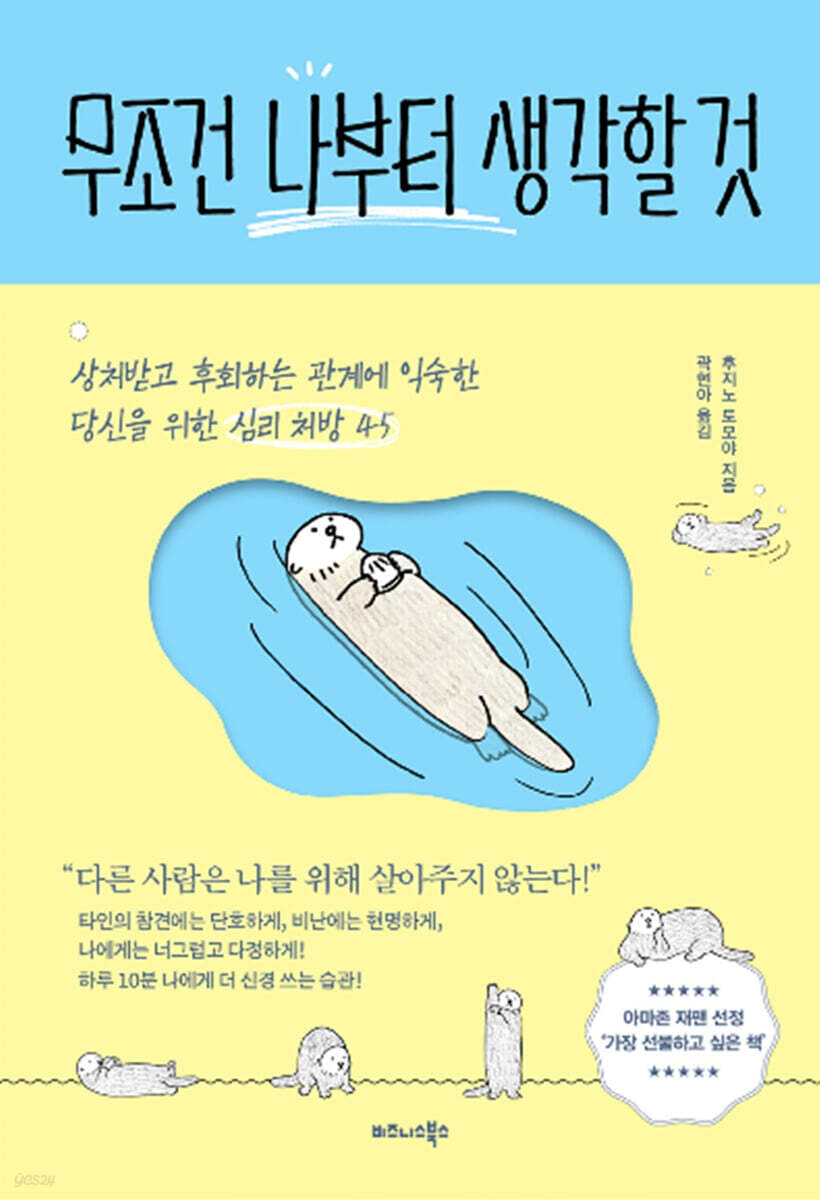
Always think of yourself first
 |
Description
Book Introduction
“No one else lives for me!”
A psychological prescription for those who struggle to live alone while trying to please others!
People who want to get along with everyone vs.
‘A person who only takes care of the people he likes’, ‘A person who values common sense and following rules vs.
‘A person whose standards are important to me’, ‘A person who is nervous and looks at the opinions of others vs.
A person who is relaxed and does not fluctuate emotionally despite changes in their surroundings.
What kind of person are you? If even one of the above applies to you, you need this prescription.
The author of this book, Tomoya Fujino, is a psychiatrist who strongly advocates for "living by thinking of yourself first," and is the most beloved psychiatrist in Japan with 100,000 followers for his warm messages that resonate with everyone who reads them.
The reason his words resonate with people so much is because he himself is a special person who is both a doctor and a patient.
The author suffered from a rare disease at the age of three, which forced him to take medication for the rest of his life and left him with an uncertain lifespan. This led to a period of self-loathing, self-criticism, feelings of inferiority and defeat.
But soon, I changed my mind and started living a life for myself, thinking, 'I don't want to waste my limited time on other people.'
The author captured people's hearts by uploading a post on social media in which he revealed all of his past.
This book teaches people who are going through similar times as the author in the past how to take care of their own lives, such as 'how to not compare myself to others' and 'how to cherish my time'.
If you've been living your life for others, not for yourself, learn the habits of caring for yourself through this book.
From the book's "habit of always taking care of myself first," to the "habit of being free from others," the "habit of creating relationships that uphold goodness," the "habit of creating a positive mood," and the "habit of creating a self-directed attitude," the sequential practices will help you completely change the passive thinking that has made you unconsciously conform to other people's standards.
After turning the last page, I will no longer be hurt by my feelings of 'I have to do it for others'.
A psychological prescription for those who struggle to live alone while trying to please others!
People who want to get along with everyone vs.
‘A person who only takes care of the people he likes’, ‘A person who values common sense and following rules vs.
‘A person whose standards are important to me’, ‘A person who is nervous and looks at the opinions of others vs.
A person who is relaxed and does not fluctuate emotionally despite changes in their surroundings.
What kind of person are you? If even one of the above applies to you, you need this prescription.
The author of this book, Tomoya Fujino, is a psychiatrist who strongly advocates for "living by thinking of yourself first," and is the most beloved psychiatrist in Japan with 100,000 followers for his warm messages that resonate with everyone who reads them.
The reason his words resonate with people so much is because he himself is a special person who is both a doctor and a patient.
The author suffered from a rare disease at the age of three, which forced him to take medication for the rest of his life and left him with an uncertain lifespan. This led to a period of self-loathing, self-criticism, feelings of inferiority and defeat.
But soon, I changed my mind and started living a life for myself, thinking, 'I don't want to waste my limited time on other people.'
The author captured people's hearts by uploading a post on social media in which he revealed all of his past.
This book teaches people who are going through similar times as the author in the past how to take care of their own lives, such as 'how to not compare myself to others' and 'how to cherish my time'.
If you've been living your life for others, not for yourself, learn the habits of caring for yourself through this book.
From the book's "habit of always taking care of myself first," to the "habit of being free from others," the "habit of creating relationships that uphold goodness," the "habit of creating a positive mood," and the "habit of creating a self-directed attitude," the sequential practices will help you completely change the passive thinking that has made you unconsciously conform to other people's standards.
After turning the last page, I will no longer be hurt by my feelings of 'I have to do it for others'.
- You can preview some of the book's contents.
Preview
index
To begin with
Chapter 1: It's hard when you have no appetite:
The habit of always taking care of myself first
When you want to change yourself, it is when you are having a hard time or feeling miserable.
When the food is not tasty, it means 'it's hard'
Accumulated stress doesn't disappear overnight.
I don't mind running away for my life.
A strong person is one who knows how to ask for help.
Hard work isn't the only answer in life.
Don't get used to other people treating you badly.
Don't try to change yourself without a specific goal.
Chapter 2 'Ordinary' is just a majority vote:
The habit of being free from others
Don't take other people's words too seriously.
Aren't you trying to be a good person to everyone?
Don't live for others
SNS is just 'that SNS'
Maybe that's just how I'm accepting it.
Even though we may seem to be looking at the same thing, each person sees it differently.
The general public is just the majority
There is no need to think about the meaning of each and every action of others.
Cherish the 'heart' that wants to do that
Chapter 3 No One Else Lives for Me:
The habit of building relationships that uphold good deeds
You can't change other people
Don't mind people you don't like
Another person's anger is a feeling they have chosen.
If you can't keep physical distance, try keeping psychological distance.
It is important to convey your feelings.
Because it's proof that 'I value my feelings'
Other people don't live for you
Think in advance about who you can work for.
It's okay to tell a 'good' lie
When forgiving others, always focus on yourself.
Don't look for answers when there are no answers.
Chapter 4: Real Life Begins Only After You Accept Me:
Habits for creating positive moods
Don't make being an 'ordinary person' your life goal.
Find out what makes you happy
Don't let other people's words determine the shape of your happiness.
I don't have to be so hard on myself.
Excessive blaming of others is also dangerous.
Don't be too critical of me for making mistakes.
Cherish the original me that I am
Know your limits
Live your future by focusing on what you can change.
Chapter 5: Always Decide from My Perspective:
Developing a proactive attitude habit
When you want to change yourself, you have to decide from your own perspective.
Have the courage to say no
Think about what you need and what you need to let go of.
Being able to rely on others is also a 'strength' thing.
Timing is important when facing yourself.
Focus on what you can do
Humans are inherently weak-willed.
It's okay to groan and worry.
It's okay if you don't find the answer right away
Even that one step that we take for granted is not at all taken for granted.
In conclusion
Chapter 1: It's hard when you have no appetite:
The habit of always taking care of myself first
When you want to change yourself, it is when you are having a hard time or feeling miserable.
When the food is not tasty, it means 'it's hard'
Accumulated stress doesn't disappear overnight.
I don't mind running away for my life.
A strong person is one who knows how to ask for help.
Hard work isn't the only answer in life.
Don't get used to other people treating you badly.
Don't try to change yourself without a specific goal.
Chapter 2 'Ordinary' is just a majority vote:
The habit of being free from others
Don't take other people's words too seriously.
Aren't you trying to be a good person to everyone?
Don't live for others
SNS is just 'that SNS'
Maybe that's just how I'm accepting it.
Even though we may seem to be looking at the same thing, each person sees it differently.
The general public is just the majority
There is no need to think about the meaning of each and every action of others.
Cherish the 'heart' that wants to do that
Chapter 3 No One Else Lives for Me:
The habit of building relationships that uphold good deeds
You can't change other people
Don't mind people you don't like
Another person's anger is a feeling they have chosen.
If you can't keep physical distance, try keeping psychological distance.
It is important to convey your feelings.
Because it's proof that 'I value my feelings'
Other people don't live for you
Think in advance about who you can work for.
It's okay to tell a 'good' lie
When forgiving others, always focus on yourself.
Don't look for answers when there are no answers.
Chapter 4: Real Life Begins Only After You Accept Me:
Habits for creating positive moods
Don't make being an 'ordinary person' your life goal.
Find out what makes you happy
Don't let other people's words determine the shape of your happiness.
I don't have to be so hard on myself.
Excessive blaming of others is also dangerous.
Don't be too critical of me for making mistakes.
Cherish the original me that I am
Know your limits
Live your future by focusing on what you can change.
Chapter 5: Always Decide from My Perspective:
Developing a proactive attitude habit
When you want to change yourself, you have to decide from your own perspective.
Have the courage to say no
Think about what you need and what you need to let go of.
Being able to rely on others is also a 'strength' thing.
Timing is important when facing yourself.
Focus on what you can do
Humans are inherently weak-willed.
It's okay to groan and worry.
It's okay if you don't find the answer right away
Even that one step that we take for granted is not at all taken for granted.
In conclusion
Into the book
If you want to live as yourself, you may be afraid of revealing all of yourself, and you may feel lost as to what to do.
That could very well be the case.
So, in this book, I will suggest how to live as 'a little' of myself, how to live as 'myself' as I am 'now'.
If you've ever thought you need to change yourself, if you've ever thought things can't go on like this, try calming down your emotions for a while.
Try lying down comfortably on the sofa or bed.
Take your time and relax your whole body.
Then consider whether it would be okay to show 'a little' of yourself as you are.
As we live, there will continue to be situations where we cannot live as ourselves.
Sometimes you have to adapt to your surroundings, follow the rules of your company or society, and live with common sense and universality.
However, I hope that you will accept the weak me, the flawed me, the incompetent me, the depressed me, as I am, saying, “This is me too,” and cherish the time you spend living as “yourself.”
--- From "Starting"
Because of the social culture that views 'running away' negatively, everyone has developed the 'habit of not running away'.
But when you're cornered, it's better to run away than to try harder.
For example, among the patients and their families who come to see a psychiatrist like me, there are many who say, "I can't even imagine changing jobs," even though they are suffering and having a hard time every day at their current company.
However, I do recommend changing jobs and keep it in mind as an option, and I have actually seen people whose symptoms improved after changing jobs.
Even in work, there are ‘jobs that suit your aptitude and jobs that don’t’, ‘jobs that suit you and jobs that don’t suit you’.
Even among companies, there are ‘bad companies’ that force excessive labor.
However, when advised to "change jobs if things are difficult," many people feel guilty and think, "Running away is a bad thing."
If you can run away to protect me, then it's okay to run away.
Please praise me for that.
To keep living, to not run away from my life, I'm running away now.
--- From Chapter 1, “It’s also hard when you have no appetite”
Among adults, there are those who have a strong tendency to try to manipulate others by venting their frustrations or anger.
Such people use that attitude as a weapon in their relationships.
Of course, he may not have had the intention of 'getting angry and manipulating the other person as he pleased.'
However, you may have had successful experiences where you got angry and moved the other person.
Through my experiences up to that point, I learned that 'anger' is the fastest and most effective way to move others, so I am applying it in my interpersonal relationships as well.
He's a very uncomfortable person to live with.
It's better to keep your distance from such people.
If you have a friend or someone around you like this, immediately distance yourself from them and, if possible, avoid getting involved with them.
Because venting your strong emotions on others is also a significant act of violence.
--- From Chapter 3, “No One Else Lives for Me”
There is a saying, “God only gives you trials you can overcome.”
Don't take it to heart.
This is what people who are lucky enough to overcome it say.
If you blindly believe and follow such words, you will easily break.
Everyone has different limitations, so you need to decide how important something is to you and invest your time accordingly to win the game.
You have to apply strength where it is needed, take it out where it is needed, and do it cleverly.
When you say "smart person," do you immediately think of someone as being sly, shameless, someone who takes advantage of the powerful, or someone who is mean?
Some people might think, 'I'm more sincere and work harder than that person, but that person seems happy and it's annoying!'
I think a resourceful person is someone who knows what they need and what they don't need, has the courage to let go of things they don't need, knows their limitations, isn't swayed by words like "must do" and "must have to," isn't okay with not doing things perfectly, and doesn't sacrifice themselves by saying, "I just have to endure."
That could very well be the case.
So, in this book, I will suggest how to live as 'a little' of myself, how to live as 'myself' as I am 'now'.
If you've ever thought you need to change yourself, if you've ever thought things can't go on like this, try calming down your emotions for a while.
Try lying down comfortably on the sofa or bed.
Take your time and relax your whole body.
Then consider whether it would be okay to show 'a little' of yourself as you are.
As we live, there will continue to be situations where we cannot live as ourselves.
Sometimes you have to adapt to your surroundings, follow the rules of your company or society, and live with common sense and universality.
However, I hope that you will accept the weak me, the flawed me, the incompetent me, the depressed me, as I am, saying, “This is me too,” and cherish the time you spend living as “yourself.”
--- From "Starting"
Because of the social culture that views 'running away' negatively, everyone has developed the 'habit of not running away'.
But when you're cornered, it's better to run away than to try harder.
For example, among the patients and their families who come to see a psychiatrist like me, there are many who say, "I can't even imagine changing jobs," even though they are suffering and having a hard time every day at their current company.
However, I do recommend changing jobs and keep it in mind as an option, and I have actually seen people whose symptoms improved after changing jobs.
Even in work, there are ‘jobs that suit your aptitude and jobs that don’t’, ‘jobs that suit you and jobs that don’t suit you’.
Even among companies, there are ‘bad companies’ that force excessive labor.
However, when advised to "change jobs if things are difficult," many people feel guilty and think, "Running away is a bad thing."
If you can run away to protect me, then it's okay to run away.
Please praise me for that.
To keep living, to not run away from my life, I'm running away now.
--- From Chapter 1, “It’s also hard when you have no appetite”
Among adults, there are those who have a strong tendency to try to manipulate others by venting their frustrations or anger.
Such people use that attitude as a weapon in their relationships.
Of course, he may not have had the intention of 'getting angry and manipulating the other person as he pleased.'
However, you may have had successful experiences where you got angry and moved the other person.
Through my experiences up to that point, I learned that 'anger' is the fastest and most effective way to move others, so I am applying it in my interpersonal relationships as well.
He's a very uncomfortable person to live with.
It's better to keep your distance from such people.
If you have a friend or someone around you like this, immediately distance yourself from them and, if possible, avoid getting involved with them.
Because venting your strong emotions on others is also a significant act of violence.
--- From Chapter 3, “No One Else Lives for Me”
There is a saying, “God only gives you trials you can overcome.”
Don't take it to heart.
This is what people who are lucky enough to overcome it say.
If you blindly believe and follow such words, you will easily break.
Everyone has different limitations, so you need to decide how important something is to you and invest your time accordingly to win the game.
You have to apply strength where it is needed, take it out where it is needed, and do it cleverly.
When you say "smart person," do you immediately think of someone as being sly, shameless, someone who takes advantage of the powerful, or someone who is mean?
Some people might think, 'I'm more sincere and work harder than that person, but that person seems happy and it's annoying!'
I think a resourceful person is someone who knows what they need and what they don't need, has the courage to let go of things they don't need, knows their limitations, isn't swayed by words like "must do" and "must have to," isn't okay with not doing things perfectly, and doesn't sacrifice themselves by saying, "I just have to endure."
--- From Chapter 5, "You Must Always Decide from Your Own Perspective"
Publisher's Review
Curing the chronic disease of modern people who cannot think of themselves first
A message of comfort and empathy from a young psychiatrist
Let's think about it for a moment.
Maybe you were feeling discouraged at home yesterday because of a mistake you made at work.
You may have fallen asleep on social media for the past week, or you may have been trying to contact someone you haven't been able to connect with for the past month.
If so, it is all a result of 'thinking of others first' rather than myself.
The reason I felt discouraged all day because of a mistake was because I had a strong desire to not be hated by others. The reason I felt bad on social media was because I compared myself to others. The reason I continued to date people who didn't suit me was because I was more accustomed to pleasing others than rejecting them.
The author, who is called 'Teacher Fujino who puts your mind at ease', helps you let go of the 'thinking for others' that has become a habit without you knowing, and regain 'thinking for yourself'.
If someone suddenly gets angry, rather than fidgeting and thinking, "They must be angry because of me," I recommend separating the anger and thinking, "The other person's anger is just a feeling they chose to feel."
Also, if someone criticizes me, instead of thinking, "How can I make them understand my true feelings?", I tell them that it's okay to think, "I'll pay more attention to the person who holds my hand than the person who holds me back."
The best thing is to prevent it before it hurts your heart.
The author also generously included the method of practice in this book.
“It’s tough when you have no appetite.”
A habit of paying more attention to myself for 10 minutes a day!
How much time have you been lounging on the sofa lately? How many times have you deliberately sought out a delicious restaurant and eaten your favorite dish? If you've ever thought, "I don't really have a craving for food," the author has something to say for you.
“It’s hard when you don’t have an appetite.” Many people have difficulty recognizing that they are having a hard time.
Even when we recognize that it is difficult, there are many cases where we focus all of the blame for the problem and the solution on ourselves.
How can I understand my current difficult situation and cope with it well?
I need to take care of myself on a regular basis and know myself well, what makes me happy.
To do this, the author recommends, above all, writing a list.
For example, let's look at a list of things you can and can't change.
If you make a list assuming that you are 'someone who cannot say what they want to say to others', you can write 'the other person pushes their own opinion' and 'I have a painful memory of quitting my job without being able to say anything to my boss who was abusive' on the 'things that cannot be changed' list.
On the 'Things I Can Change' list, you might write things like, 'It's hard for me to turn down invitations to uncomfortable seats,' or 'I unconsciously agree with the opinions of those around me.'
If you write a list like this, you can see that the things that can be changed are related to the 'future' and 'me', and the things that cannot be changed are related to the 'past' or 'others'.
Only then can I see the right solution and start caring about myself.
If you find it difficult to say 'no' to opposing opinions, just remain silent.
Friends who do whatever they want don't respect me, so I should keep my distance.
In addition, the author shares small but effective methods, such as writing a list of "things you don't want to lose" rather than "things you need," expressing your feelings with "I" as the subject, determining who you can give to and the scope of your giving, and utilizing your willingness to give up.
Through this book, let's develop the habit of protecting and caring for ourselves from those who say hurtful things to us, those who interfere excessively, and those who make unreasonable demands.
You will find yourself becoming a better person for yourself little by little every day.
A message of comfort and empathy from a young psychiatrist
Let's think about it for a moment.
Maybe you were feeling discouraged at home yesterday because of a mistake you made at work.
You may have fallen asleep on social media for the past week, or you may have been trying to contact someone you haven't been able to connect with for the past month.
If so, it is all a result of 'thinking of others first' rather than myself.
The reason I felt discouraged all day because of a mistake was because I had a strong desire to not be hated by others. The reason I felt bad on social media was because I compared myself to others. The reason I continued to date people who didn't suit me was because I was more accustomed to pleasing others than rejecting them.
The author, who is called 'Teacher Fujino who puts your mind at ease', helps you let go of the 'thinking for others' that has become a habit without you knowing, and regain 'thinking for yourself'.
If someone suddenly gets angry, rather than fidgeting and thinking, "They must be angry because of me," I recommend separating the anger and thinking, "The other person's anger is just a feeling they chose to feel."
Also, if someone criticizes me, instead of thinking, "How can I make them understand my true feelings?", I tell them that it's okay to think, "I'll pay more attention to the person who holds my hand than the person who holds me back."
The best thing is to prevent it before it hurts your heart.
The author also generously included the method of practice in this book.
“It’s tough when you have no appetite.”
A habit of paying more attention to myself for 10 minutes a day!
How much time have you been lounging on the sofa lately? How many times have you deliberately sought out a delicious restaurant and eaten your favorite dish? If you've ever thought, "I don't really have a craving for food," the author has something to say for you.
“It’s hard when you don’t have an appetite.” Many people have difficulty recognizing that they are having a hard time.
Even when we recognize that it is difficult, there are many cases where we focus all of the blame for the problem and the solution on ourselves.
How can I understand my current difficult situation and cope with it well?
I need to take care of myself on a regular basis and know myself well, what makes me happy.
To do this, the author recommends, above all, writing a list.
For example, let's look at a list of things you can and can't change.
If you make a list assuming that you are 'someone who cannot say what they want to say to others', you can write 'the other person pushes their own opinion' and 'I have a painful memory of quitting my job without being able to say anything to my boss who was abusive' on the 'things that cannot be changed' list.
On the 'Things I Can Change' list, you might write things like, 'It's hard for me to turn down invitations to uncomfortable seats,' or 'I unconsciously agree with the opinions of those around me.'
If you write a list like this, you can see that the things that can be changed are related to the 'future' and 'me', and the things that cannot be changed are related to the 'past' or 'others'.
Only then can I see the right solution and start caring about myself.
If you find it difficult to say 'no' to opposing opinions, just remain silent.
Friends who do whatever they want don't respect me, so I should keep my distance.
In addition, the author shares small but effective methods, such as writing a list of "things you don't want to lose" rather than "things you need," expressing your feelings with "I" as the subject, determining who you can give to and the scope of your giving, and utilizing your willingness to give up.
Through this book, let's develop the habit of protecting and caring for ourselves from those who say hurtful things to us, those who interfere excessively, and those who make unreasonable demands.
You will find yourself becoming a better person for yourself little by little every day.
GOODS SPECIFICS
- Date of issue: December 13, 2024
- Page count, weight, size: 248 pages | 140*205*20mm
- ISBN13: 9791162543993
- ISBN10: 116254399X
You may also like
카테고리
korean


korean

![GQ KOREA Mark (Monthly): December [2025]](http://librairie.coreenne.fr/cdn/shop/files/8ef265dbbfbf186523ed75ba7319009d.jpg?v=1765340328&width=3840)


