

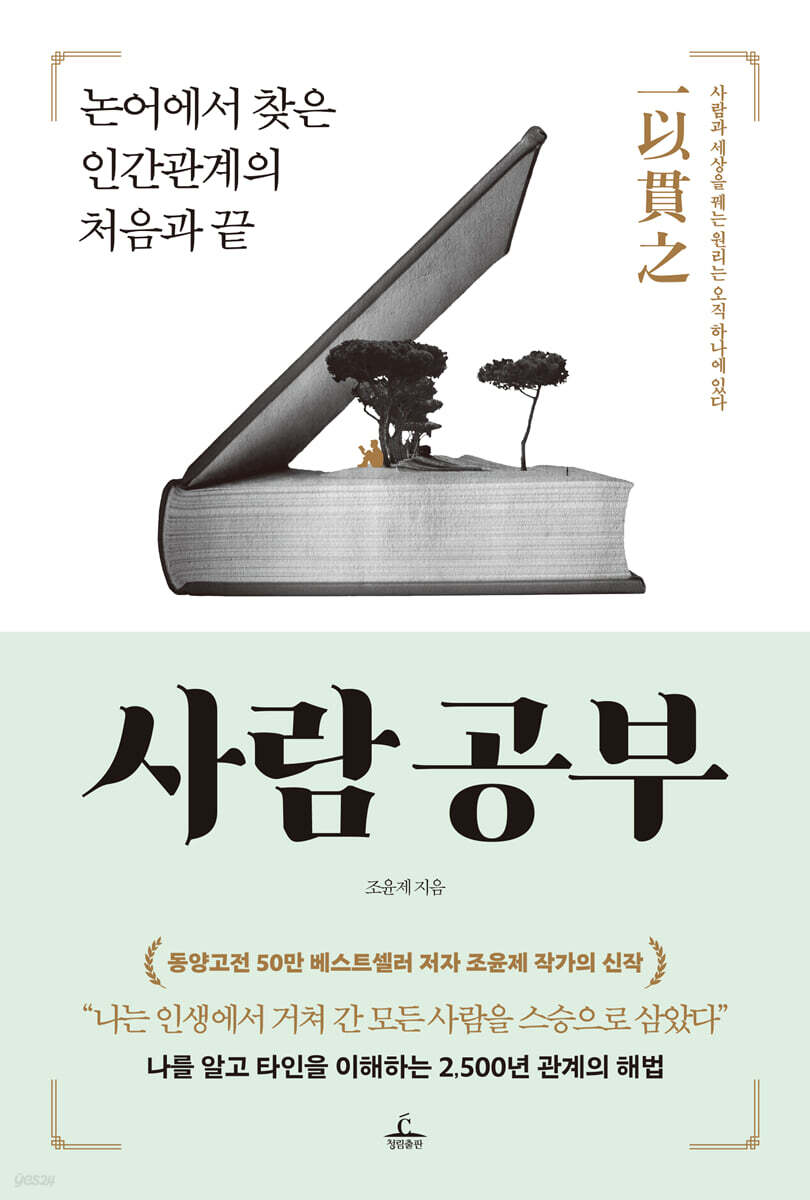
Studying people
 |
Description
Book Introduction
The wisdom of 'human studies' that has been passed down for 2,500 years, drawn from the great sentences of the Analects. Author Jo Yoon-je, who created a new wind of reading Eastern classics with the 'Dasan's Last' series, conveys the path of forming relationships necessary for our lives today. Based on Confucius' core philosophy of loyalty, forgiveness, and sincerity, it provides wisdom to 'rule oneself', 'love others', and 'grow every day' through 61 chapters. This book, which conveys the wisdom and various interpretations of the wisdom gained by the human Confucius through conversations with various people, including the emperor, disciples, and farmers, tells us that a life of daily reflection and learning like Confucius is the shortcut to living a humane life. |
- You can preview some of the book's contents.
Preview
index
Introduction: How to Live Like a Human Being
Part 1: Loyalty: Establishing an Unwavering Center
Loyalty, Liver, Righteousness, and Gallbladder: A person of integrity is ready to live righteously.
A person with class enjoys learning in everyday life.
Talent cannot surpass the skills built up over time.
Learning is a joyful process of breaking down obstacles.
Forty is the age of unwavering adulthood.
Unexpected hardships make me a better person.
Old things are opportunities for creative learning.
Setting myself straight is the first step to justice.
Everyday satisfaction comes from humble learning.
Thoughts without learning lead to distractions and exaggerations.
If you give up on being human, no learning is of any use.
No flashy show can straighten a crooked path.
A well-groomed inner and outer self straighten each other out.
A person with a sense of loyalty knows how to bestow kindness.
There is power in the art of speaking to convey sincerity.
Filial piety is not a grand courtesy, but everyday sincerity.
Broaden your horizons with thought and deepen your understanding with study.
True learning begins with acknowledging ignorance.
If you master life, success will come naturally.
A person who asks good questions is like a carpenter carving wood.
A ruler who serves the people deserves loyalty.
Right and wrong must be established before likes and dislikes.
The quality of the person who fits the position is more important than the position itself.
The best skills come from consistent practice of learning.
A true teacher willingly lends a shoulder to his students.
Part 2: Forgiveness: All human relationships begin with me.
Forgive yourself and forgive others: Treat others with the same mind as you treat yourself.
Even if the world doesn't recognize it, the priests share the same purpose.
Love is shown through actions, not words.
Breaking down the prejudice within myself is an attitude of acknowledging people.
You can become a complete person without outstanding talent.
The ordinariness of adults hides an extraordinary side.
It is wise to associate with those who are better than you.
The more choices are required, the more courageous it is to be cautious.
The trial must be more severe on oneself than on anyone else.
Gain the whole world with an eye for seeing people accurately.
Even the objects around us become channels for learning.
Frugality is not about building wealth, but about building the heart.
If you recognize talent nearby, talent will come to you from far away.
A person who is popular with everyone is not a gentleman.
Don't stop at compassion, put love into practice.
If you do the difficult things first, the rank will follow naturally.
Evaluation of a person can either save or kill him.
Faith is not about being right, but about choosing the right path.
The strength of many people comes not from equality but from unity.
You must protect yourself from those in power who are outrageous.
Good advice impresses others not with words but with the heart.
Teaching different things to different people is what makes studying people different.
Studying people captures the rapidly changing emotions of others.
Part 3: Sincerity: A person who is consistent never fails.
A person who has a pure heart has no pretense.
All this studying is useless if your attitude is not right.
A heart that cares for others will surely bear fruit.
Friendship is a heart that shares in times of hardship.
A heart that embraces the world overcomes the small worries of everyday life.
The Doctrine of the Mean is the process of finding and cultivating the optimal.
The cause of my worry lies not in the situation, but in me.
If a country doesn't live up to its name, it will fall apart.
If you seek small gains, you will never achieve great things.
至誠感天: If you put your heart into even the smallest things, things will definitely work out.
The value of wealth depends on how much I polish myself.
A gentleman is ready to accomplish anything.
My future is what I create today.
If you focus on one thing, you will reach the realm of god.
Music is a tool for achieving a harmonious life.
After a hundred days of hard work comes a day of pleasure.
Education aims at the person, not at success.
Habits change what cannot be changed by nature.
Above all, be careful not to deceive yourself.
Part 1: Loyalty: Establishing an Unwavering Center
Loyalty, Liver, Righteousness, and Gallbladder: A person of integrity is ready to live righteously.
A person with class enjoys learning in everyday life.
Talent cannot surpass the skills built up over time.
Learning is a joyful process of breaking down obstacles.
Forty is the age of unwavering adulthood.
Unexpected hardships make me a better person.
Old things are opportunities for creative learning.
Setting myself straight is the first step to justice.
Everyday satisfaction comes from humble learning.
Thoughts without learning lead to distractions and exaggerations.
If you give up on being human, no learning is of any use.
No flashy show can straighten a crooked path.
A well-groomed inner and outer self straighten each other out.
A person with a sense of loyalty knows how to bestow kindness.
There is power in the art of speaking to convey sincerity.
Filial piety is not a grand courtesy, but everyday sincerity.
Broaden your horizons with thought and deepen your understanding with study.
True learning begins with acknowledging ignorance.
If you master life, success will come naturally.
A person who asks good questions is like a carpenter carving wood.
A ruler who serves the people deserves loyalty.
Right and wrong must be established before likes and dislikes.
The quality of the person who fits the position is more important than the position itself.
The best skills come from consistent practice of learning.
A true teacher willingly lends a shoulder to his students.
Part 2: Forgiveness: All human relationships begin with me.
Forgive yourself and forgive others: Treat others with the same mind as you treat yourself.
Even if the world doesn't recognize it, the priests share the same purpose.
Love is shown through actions, not words.
Breaking down the prejudice within myself is an attitude of acknowledging people.
You can become a complete person without outstanding talent.
The ordinariness of adults hides an extraordinary side.
It is wise to associate with those who are better than you.
The more choices are required, the more courageous it is to be cautious.
The trial must be more severe on oneself than on anyone else.
Gain the whole world with an eye for seeing people accurately.
Even the objects around us become channels for learning.
Frugality is not about building wealth, but about building the heart.
If you recognize talent nearby, talent will come to you from far away.
A person who is popular with everyone is not a gentleman.
Don't stop at compassion, put love into practice.
If you do the difficult things first, the rank will follow naturally.
Evaluation of a person can either save or kill him.
Faith is not about being right, but about choosing the right path.
The strength of many people comes not from equality but from unity.
You must protect yourself from those in power who are outrageous.
Good advice impresses others not with words but with the heart.
Teaching different things to different people is what makes studying people different.
Studying people captures the rapidly changing emotions of others.
Part 3: Sincerity: A person who is consistent never fails.
A person who has a pure heart has no pretense.
All this studying is useless if your attitude is not right.
A heart that cares for others will surely bear fruit.
Friendship is a heart that shares in times of hardship.
A heart that embraces the world overcomes the small worries of everyday life.
The Doctrine of the Mean is the process of finding and cultivating the optimal.
The cause of my worry lies not in the situation, but in me.
If a country doesn't live up to its name, it will fall apart.
If you seek small gains, you will never achieve great things.
至誠感天: If you put your heart into even the smallest things, things will definitely work out.
The value of wealth depends on how much I polish myself.
A gentleman is ready to accomplish anything.
My future is what I create today.
If you focus on one thing, you will reach the realm of god.
Music is a tool for achieving a harmonious life.
After a hundred days of hard work comes a day of pleasure.
Education aims at the person, not at success.
Habits change what cannot be changed by nature.
Above all, be careful not to deceive yourself.
Detailed image
Into the book
Knowing new things, learning new things, knowing new things
The ever-loving Gawisa
“If you cut the wheel too loosely, it will be loose, and if you cut it too tight, it will not go in.
“The ability to cut properly, neither too loose nor too tight, is something learned by hand and reacted to in the heart. It cannot be expressed verbally, but there is a technique within it.”
(…) If you read a classic without thinking about its deeper meaning and just think, “It’s a good saying that touches the heart,” then that classic may be nothing more than the dregs of the past.
Above all, as the carpenter Yunpyeon said, you must be able to apply it to your own work.
The classics contain practical wisdom that can be applied to our work and achieve excellent results, such as peace of mind, wisdom for life, interpersonal relationships, and attitude toward life.
Classics are the best self-help books that are of great help in living today.
If you avoid the classics because they are boring, you may be missing out on the opportunity to live a life of excellence, success, and above all, a life of dignity.
--- From "Old Things Are an Opportunity to Learn Creatively"
Learn about good things and don't hate them.
Min Ihohak's incurable disease
When Confucius, who was acknowledged by all as an expert on etiquette, asked questions at the Imperial Ancestral Temple every day and then acted, people spread rumors as if he had made a great discovery.
It's probably something you see a lot these days.
People cannot remain silent when they see other people's faults.
This is especially true if you have social standing or are a celebrity.
They are not interested in the exact facts or the reasons behind them, nor do they want to know.
Since the purpose of passing on gossip is to stimulate and interest, whether it is true or not is not very important.
Eventually, this rumor reached Confucius's ears.
But Confucius didn't make any excuses, but summarized the situation in one word.
“That’s right!” Asking someone below you is not against etiquette, nor is it shameful.
--- From "A person who is good at asking questions is like a carpenter who shapes wood"
里仁爲美 不處仁 焉得knowledge
Undeukji, the place where two people are not allowed to go
“Living with a good person is like entering an orchid room, and after a while, you become immersed in its fragrance.
Living with bad people is like entering a fish market, and after a while you can no longer smell their stench, so this is also assimilation.
For this reason, a gentleman must carefully choose his residence.”
A person who associates with people better than themselves has a learning attitude.
They grow every day because they always learn good things from everyday life and make them their own.
However, people who like and date people who are inferior to them tend to have a strong tendency to reveal themselves.
There is also an arrogant desire to show off oneself.
Therefore, they are difficult to grow.
People who compare themselves to the small standards in front of them and are always up and down will inevitably have a narrow range of growth.
If you want to reach a higher level, you must dream in a broader space, not just with the people around you or the work in front of you.
--- From "It is wisdom to be close to people who are better than you"
The knowledge of the word, the knowledge of the people, the knowledge of the spirit, the knowledge of the word, the knowledge of the word, the knowledge of the spirit.
Think about it, say it first, say it later, understand it later.
The Bungee Gate, the Muminji Gate, the Gyeonggwisin Garden, and the Scissors' Gate
The writer said, “The person who is good at drawing is a person who is good at drawing.”
It is natural that no matter what you do, you must put in the effort and hard work before you can receive any income.
It's just the way of the world, and doing so doesn't make you a good person.
He is just a person who works hard at his job.
Humanity is not a simple matter, but it is about giving love and consideration first.
This is a difficult and arduous task because it requires self-sacrifice.
And then, taking pleasure and happiness is what a person should do.
In reality, joy and happiness are not something to be pursued diligently, but rather are rewards that come naturally and effortlessly to those who are loving and caring.
Wisdom is knowing people and acting in accordance with human nature.
Humanity is the fulfillment of the universal calling given by heaven to love one another.
A person who makes this their life's purpose and tries to live that way in their daily lives.
He is a man of true wisdom and love.
Of course, his life is happy.
--- From "If you do the difficult things first, the rank will follow naturally"
子而不秀者 有矣夫 秀而不秀者 有矣夫
Jawal, the person who is not a good person, is a good person.
There are people who have outstanding skills and qualities but are unable to make their mark on the world.
An Yeon said so.
It reached the stage of blooming magnificent flowers, but died young without being able to fulfill its purpose.
That is precisely why Confucius lamented and felt sorry.
Among the many disciples, the most outstanding disciple, the one who could converse with his master on an equal footing with respect and reverence, reached almost the pinnacle of learning and cultivation, but was not given the opportunity to achieve his ambitions in the world.
Because the lifespan given by heaven did not reach its limit.
(…) It is not easy for an ordinary person to follow the right path in any situation.
This is especially true if you have risen to a high position and have lived a life of splendid success.
The arrogance that comes from the admiration of others and the resulting self-exaltation prevents us from bearing precious fruit in life.
The fruit of life is to benefit people with that fruit.
Confucius said that such a person was like a sage.
It's not because I did something big or great.
A person who shares the little strength he has and lives is on the path to becoming an adult.
--- From “A heart that cares for people will surely bear fruit”
君子不器
A gentleman's disobedience
The idea of 'a gentleman should not be afraid' is most needed in our education today.
There is no diversity in education that values only wealth and power and instills only the abilities necessary for those values.
There is no time or leisure to gain experience, and even that has been reduced to a tool to get the score needed for the entrance exam.
It has even reached a point where parents are living their children's experiences on their behalf, and even the so-called leaders of society are doing this without any sense of guilt.
The negative effects of this situation can be clearly seen by looking at the use of the 'vessel'.
If you pour water into a teacup, the shape of the water is all the same.
There can be no water that can escape the limits of its vessel.
Confucius must have realized this very thing.
Our lives are destined to face new situations.
This is especially true in times of rapid change like today.
If you insist on sticking to your own mold, like a bowl, it may break.
To survive and overcome various situations, we need the ability to change ourselves and have diversity.
The ever-loving Gawisa
“If you cut the wheel too loosely, it will be loose, and if you cut it too tight, it will not go in.
“The ability to cut properly, neither too loose nor too tight, is something learned by hand and reacted to in the heart. It cannot be expressed verbally, but there is a technique within it.”
(…) If you read a classic without thinking about its deeper meaning and just think, “It’s a good saying that touches the heart,” then that classic may be nothing more than the dregs of the past.
Above all, as the carpenter Yunpyeon said, you must be able to apply it to your own work.
The classics contain practical wisdom that can be applied to our work and achieve excellent results, such as peace of mind, wisdom for life, interpersonal relationships, and attitude toward life.
Classics are the best self-help books that are of great help in living today.
If you avoid the classics because they are boring, you may be missing out on the opportunity to live a life of excellence, success, and above all, a life of dignity.
--- From "Old Things Are an Opportunity to Learn Creatively"
Learn about good things and don't hate them.
Min Ihohak's incurable disease
When Confucius, who was acknowledged by all as an expert on etiquette, asked questions at the Imperial Ancestral Temple every day and then acted, people spread rumors as if he had made a great discovery.
It's probably something you see a lot these days.
People cannot remain silent when they see other people's faults.
This is especially true if you have social standing or are a celebrity.
They are not interested in the exact facts or the reasons behind them, nor do they want to know.
Since the purpose of passing on gossip is to stimulate and interest, whether it is true or not is not very important.
Eventually, this rumor reached Confucius's ears.
But Confucius didn't make any excuses, but summarized the situation in one word.
“That’s right!” Asking someone below you is not against etiquette, nor is it shameful.
--- From "A person who is good at asking questions is like a carpenter who shapes wood"
里仁爲美 不處仁 焉得knowledge
Undeukji, the place where two people are not allowed to go
“Living with a good person is like entering an orchid room, and after a while, you become immersed in its fragrance.
Living with bad people is like entering a fish market, and after a while you can no longer smell their stench, so this is also assimilation.
For this reason, a gentleman must carefully choose his residence.”
A person who associates with people better than themselves has a learning attitude.
They grow every day because they always learn good things from everyday life and make them their own.
However, people who like and date people who are inferior to them tend to have a strong tendency to reveal themselves.
There is also an arrogant desire to show off oneself.
Therefore, they are difficult to grow.
People who compare themselves to the small standards in front of them and are always up and down will inevitably have a narrow range of growth.
If you want to reach a higher level, you must dream in a broader space, not just with the people around you or the work in front of you.
--- From "It is wisdom to be close to people who are better than you"
The knowledge of the word, the knowledge of the people, the knowledge of the spirit, the knowledge of the word, the knowledge of the word, the knowledge of the spirit.
Think about it, say it first, say it later, understand it later.
The Bungee Gate, the Muminji Gate, the Gyeonggwisin Garden, and the Scissors' Gate
The writer said, “The person who is good at drawing is a person who is good at drawing.”
It is natural that no matter what you do, you must put in the effort and hard work before you can receive any income.
It's just the way of the world, and doing so doesn't make you a good person.
He is just a person who works hard at his job.
Humanity is not a simple matter, but it is about giving love and consideration first.
This is a difficult and arduous task because it requires self-sacrifice.
And then, taking pleasure and happiness is what a person should do.
In reality, joy and happiness are not something to be pursued diligently, but rather are rewards that come naturally and effortlessly to those who are loving and caring.
Wisdom is knowing people and acting in accordance with human nature.
Humanity is the fulfillment of the universal calling given by heaven to love one another.
A person who makes this their life's purpose and tries to live that way in their daily lives.
He is a man of true wisdom and love.
Of course, his life is happy.
--- From "If you do the difficult things first, the rank will follow naturally"
子而不秀者 有矣夫 秀而不秀者 有矣夫
Jawal, the person who is not a good person, is a good person.
There are people who have outstanding skills and qualities but are unable to make their mark on the world.
An Yeon said so.
It reached the stage of blooming magnificent flowers, but died young without being able to fulfill its purpose.
That is precisely why Confucius lamented and felt sorry.
Among the many disciples, the most outstanding disciple, the one who could converse with his master on an equal footing with respect and reverence, reached almost the pinnacle of learning and cultivation, but was not given the opportunity to achieve his ambitions in the world.
Because the lifespan given by heaven did not reach its limit.
(…) It is not easy for an ordinary person to follow the right path in any situation.
This is especially true if you have risen to a high position and have lived a life of splendid success.
The arrogance that comes from the admiration of others and the resulting self-exaltation prevents us from bearing precious fruit in life.
The fruit of life is to benefit people with that fruit.
Confucius said that such a person was like a sage.
It's not because I did something big or great.
A person who shares the little strength he has and lives is on the path to becoming an adult.
--- From “A heart that cares for people will surely bear fruit”
君子不器
A gentleman's disobedience
The idea of 'a gentleman should not be afraid' is most needed in our education today.
There is no diversity in education that values only wealth and power and instills only the abilities necessary for those values.
There is no time or leisure to gain experience, and even that has been reduced to a tool to get the score needed for the entrance exam.
It has even reached a point where parents are living their children's experiences on their behalf, and even the so-called leaders of society are doing this without any sense of guilt.
The negative effects of this situation can be clearly seen by looking at the use of the 'vessel'.
If you pour water into a teacup, the shape of the water is all the same.
There can be no water that can escape the limits of its vessel.
Confucius must have realized this very thing.
Our lives are destined to face new situations.
This is especially true in times of rapid change like today.
If you insist on sticking to your own mold, like a bowl, it may break.
To survive and overcome various situations, we need the ability to change ourselves and have diversity.
--- From "A gentleman is ready to accomplish anything"
Publisher's Review
The chaotic Spring and Autumn Period and the Warring States Period,
After losing his beloved disciple Yan Yuan, Confucius asked himself this question:
“How can we live like human beings?”
The founder of human relations theory that has spanned thousands of years
The greatest wisdom we learn from Confucius: studying people.
In a world overflowing with things more important than people,
The Analects of Confucius teach us about humanity.
In this cutting-edge era, information spreads rapidly, we are quickly connected online, and artificial intelligence takes over everything.
There has never been a time when convenience and efficiency were so sought after in every aspect of life.
However, in a world that revolves solely around materialism and profit, courtesy toward others is increasingly disappearing.
News of war, social polarization, and discrimination against the weak, heard everywhere, tell us that the path to a humane life is still a distant goal.
And Confucius, who lived during the Spring and Autumn Period and the Warring States Period about 2,500 years ago, also had similar concerns.
Constant strife and conflict arose between nations, between kings and their subjects, and between people, and trust between people fell to the ground.
To overcome this crisis, Confucius gathered together his disciples who agreed to share his vision, regardless of their status, and taught them about 'humanity.'
And the conversations he left behind as he met people remain as the great classic Analects, and they still teach us to this day.
“There is only one principle that connects people and the world.”
The wisdom of 'human studies': understanding others by governing oneself
As the era of each person living for themselves continues, building relationships solely for 'success' and 'profit' has become a slogan for self-development.
Many of the so-called 'classic' theories of human relations in the West are also often consumed as a way of life to view people as resources and control them as one's own.
Tools like MBTI and social media, which are used to communicate with people with similar personalities, are narrowing our worldview even further, despite the expansion of the online world.
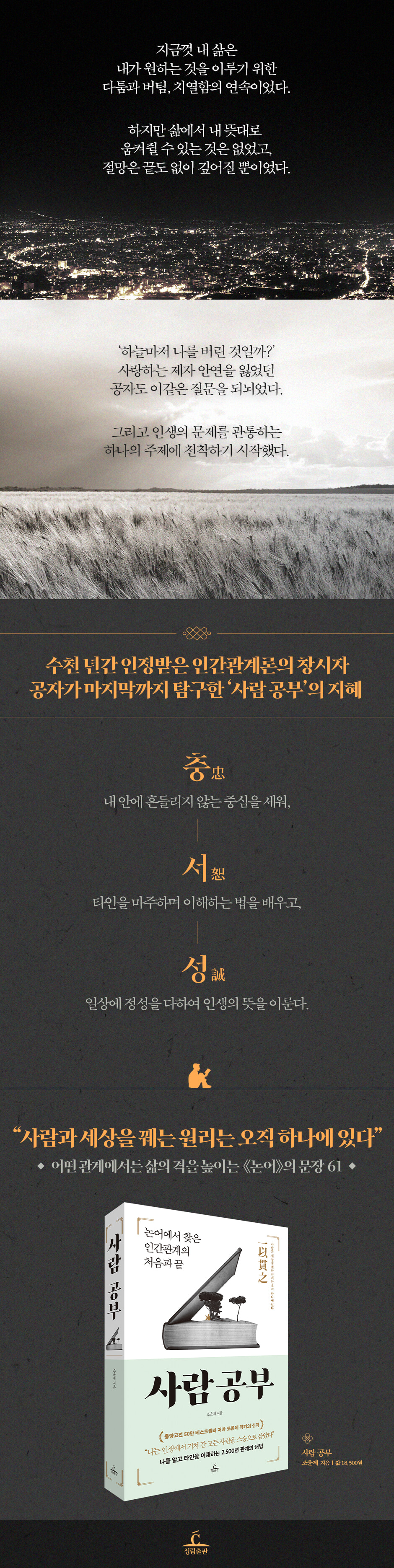
Unlike this way of thinking that tries to completely separate oneself from the world (others) and control the latter, Confucius said in the idiom '一以貫之' that 'there is only one principle that connects people and the world.'
This means that the wisdom to understand people (me) and the world (others) is not separate, but is connected as one.
It is said that through ‘looking back at myself and correcting myself (loyalty)’, we can learn ‘how to understand and face others (forgiveness)’.
Moreover, sincerity is a way of life and practice that mediates and connects the teachings of ‘loyalty’ and ‘seo.’
Correcting one's own faults through constant reflection and training is also a journey toward 'perfecting one's humanity.'
《Study of Humanity》 is based on Confucius' core philosophy of loyalty, forgiveness, and sincerity, and draws out the essence of human relationships that have continued for 2,500 years through the great sentences of 《Analects of Confucius》.
Author Jo Yoon-je, who created a new wind of reading Eastern classics with the 'The Last of Dasan' series, goes beyond the 'instrumental human relationships' demanded by modern people and conveys the way of forming relationships that can be applied as wisdom in human history.
Through the 'study of people' that looks back on oneself and considers others, it gives us the wisdom to discern 'people' that are more precious than any other honorable thing, to gain 'people', and to become 'people'.
“A true man is prepared to live righteously.”
Loyalty: Establishing an unwavering center
As we grow older, we all yearn for the 'wisdom of adults' that allows us to be free from the sway of circumstances and emotions.
Confucius said that at forty we will not be deceived by shallow tricks, and at fifty we will know the will of heaven and be able to deal with any problem.
However, this level of maturity is not something that can be reached automatically as one grows older.
Adulthood begins with breaking free from the attitude of being able to control people as you wish, and with a humble attitude of learning, understanding and accepting all the problems of daily life.
In Chungganeundam, the attitude of loyalty and righteousness is introduced as an adult's attitude toward learning.
Specifically, it introduces an anecdote in which Confucius valued his disciple Ziqian more highly than his nephew Gongmyeo, and tells the story of how, unlike Gongmyeo, who blamed his environment despite being born with a silver spoon in his mouth, Ziqian, who was born with a dirt spoon in his mouth, practiced sharing and consideration even in the midst of his busy life, and practiced the way of a gentleman.
In the book, “The Wind of Loyalty and Kindness,” it talks about how to set standards for a mature life.
For example, it says that the standard for emotions toward people should be based solely on 'right and wrong', and that we should go beyond liking people who are beneficial to us and learn to like 'good people' and hate 'bad people'.
“Treat others with the same mind as you treat yourself.”
Seo: All human relationships begin with me.
The world is made up of 'encounters' with countless others who transcend the self called 'me'.
From family to friends, teachers, seniors, juniors, bosses, CEOs, and customers, we encounter countless faces of others as we move through the social positions we occupy in life.
Relationships with them are not simply about expanding 'my interests', but rather a process of colliding with and breaking apart countless universes and then being rebuilt.
This book guides you to understand and accept that process with a broader mind.
In the Book of Forgiveness, it is introduced how the work of growing oneself is connected to the work of winning people.
It tells the story of Jasan, who was famous for selecting talented people, and how he, too, had long held prejudice against people with disabilities, but was able to break down the wall in his heart.
In the book, Forgiveness and Practice, we learn about the virtues of practice to build better relationships.
Citing the example of Confucius, who gave different teachings depending on a person's personality, he reveals that the ability to accurately identify strengths and weaknesses and to supplement or correct them is the wisdom of knowing oneself and dealing with others.
“If you put your heart into even the smallest things, things will definitely work out.”
Sincerity: A person who is consistent never fails.
Even if we thoroughly cultivate ourselves according to the teachings of Confucius, we sometimes experience serious crises in our lives to the point where all our efforts seem to be in vain.
Confucius, too, lost his beloved disciple Yan Yuan and fell into a bottomless pit, saying, "Even Heaven has abandoned me."
Confucius, who was an infinitely weak 'human' before becoming a teacher of mankind, never gave up on learning the way to 'be a human'.
Confucius, who had a heart that cared for people more than anything else, devoted himself to training disciples with a sincere attitude in order to achieve the fruits that he could not achieve in his own life.
Jeongsimseong (正心誠意) talks about the mind and attitude to continue studying.
Zengzi, the successor of Confucius, emphasized the three ways of a gentleman before he died: the attitude of the body, face, and speech.
It is said that you can become a better person by correcting your daily life habits more than any other ideal values.
The book "Jiseonggamcheon" talks about the changes that occur when our daily attitudes are layered up.
Through the teachings of Confucius, who emphasized being faithful to reality rather than discussing the afterlife or the afterlife, we are encouraged to create tomorrow's self through small acts of sincerity today.
“I have considered everyone I have encountered in life a teacher.”
The Conditions of a Human Being: Learning from Confucius, the 'Possible Human'
The reason the author brought up the Analects again, despite the fact that it has been mentioned and interpreted countless times, is to honestly reveal the "human" side of Confucius, who has been regarded as only a "great teacher" in human history and portrayed only in an idealistic manner, through his relationships with his disciples.
Even a great man like Confucius made mistakes and sometimes learned new things through his relationships with his disciples.
Only by becoming a 'correctable human being' through continuous learning can we reach the level of human study and become a 'great human being' like Confucius.
This book, which conveys the wisdom and various interpretations of the wisdom Confucius gained through conversations with various people, including the emperor, his disciples, and farmers, tells us that a life of daily reflection like Confucius is the shortcut to a "human life."
Confucius' core idea, 'benevolence', is a philosophy that can only be put into practice when two or more people are together.
In this era of economic crisis, this book will serve as a secret weapon for those who feel anxious and troubled by others, navigating a bleak and difficult world.
After losing his beloved disciple Yan Yuan, Confucius asked himself this question:
“How can we live like human beings?”
The founder of human relations theory that has spanned thousands of years
The greatest wisdom we learn from Confucius: studying people.
In a world overflowing with things more important than people,
The Analects of Confucius teach us about humanity.
In this cutting-edge era, information spreads rapidly, we are quickly connected online, and artificial intelligence takes over everything.
There has never been a time when convenience and efficiency were so sought after in every aspect of life.
However, in a world that revolves solely around materialism and profit, courtesy toward others is increasingly disappearing.
News of war, social polarization, and discrimination against the weak, heard everywhere, tell us that the path to a humane life is still a distant goal.
And Confucius, who lived during the Spring and Autumn Period and the Warring States Period about 2,500 years ago, also had similar concerns.
Constant strife and conflict arose between nations, between kings and their subjects, and between people, and trust between people fell to the ground.
To overcome this crisis, Confucius gathered together his disciples who agreed to share his vision, regardless of their status, and taught them about 'humanity.'
And the conversations he left behind as he met people remain as the great classic Analects, and they still teach us to this day.
“There is only one principle that connects people and the world.”
The wisdom of 'human studies': understanding others by governing oneself
As the era of each person living for themselves continues, building relationships solely for 'success' and 'profit' has become a slogan for self-development.
Many of the so-called 'classic' theories of human relations in the West are also often consumed as a way of life to view people as resources and control them as one's own.
Tools like MBTI and social media, which are used to communicate with people with similar personalities, are narrowing our worldview even further, despite the expansion of the online world.
Unlike this way of thinking that tries to completely separate oneself from the world (others) and control the latter, Confucius said in the idiom '一以貫之' that 'there is only one principle that connects people and the world.'
This means that the wisdom to understand people (me) and the world (others) is not separate, but is connected as one.
It is said that through ‘looking back at myself and correcting myself (loyalty)’, we can learn ‘how to understand and face others (forgiveness)’.
Moreover, sincerity is a way of life and practice that mediates and connects the teachings of ‘loyalty’ and ‘seo.’
Correcting one's own faults through constant reflection and training is also a journey toward 'perfecting one's humanity.'
《Study of Humanity》 is based on Confucius' core philosophy of loyalty, forgiveness, and sincerity, and draws out the essence of human relationships that have continued for 2,500 years through the great sentences of 《Analects of Confucius》.
Author Jo Yoon-je, who created a new wind of reading Eastern classics with the 'The Last of Dasan' series, goes beyond the 'instrumental human relationships' demanded by modern people and conveys the way of forming relationships that can be applied as wisdom in human history.
Through the 'study of people' that looks back on oneself and considers others, it gives us the wisdom to discern 'people' that are more precious than any other honorable thing, to gain 'people', and to become 'people'.
“A true man is prepared to live righteously.”
Loyalty: Establishing an unwavering center
As we grow older, we all yearn for the 'wisdom of adults' that allows us to be free from the sway of circumstances and emotions.
Confucius said that at forty we will not be deceived by shallow tricks, and at fifty we will know the will of heaven and be able to deal with any problem.
However, this level of maturity is not something that can be reached automatically as one grows older.
Adulthood begins with breaking free from the attitude of being able to control people as you wish, and with a humble attitude of learning, understanding and accepting all the problems of daily life.
In Chungganeundam, the attitude of loyalty and righteousness is introduced as an adult's attitude toward learning.
Specifically, it introduces an anecdote in which Confucius valued his disciple Ziqian more highly than his nephew Gongmyeo, and tells the story of how, unlike Gongmyeo, who blamed his environment despite being born with a silver spoon in his mouth, Ziqian, who was born with a dirt spoon in his mouth, practiced sharing and consideration even in the midst of his busy life, and practiced the way of a gentleman.
In the book, “The Wind of Loyalty and Kindness,” it talks about how to set standards for a mature life.
For example, it says that the standard for emotions toward people should be based solely on 'right and wrong', and that we should go beyond liking people who are beneficial to us and learn to like 'good people' and hate 'bad people'.
“Treat others with the same mind as you treat yourself.”
Seo: All human relationships begin with me.
The world is made up of 'encounters' with countless others who transcend the self called 'me'.
From family to friends, teachers, seniors, juniors, bosses, CEOs, and customers, we encounter countless faces of others as we move through the social positions we occupy in life.
Relationships with them are not simply about expanding 'my interests', but rather a process of colliding with and breaking apart countless universes and then being rebuilt.
This book guides you to understand and accept that process with a broader mind.
In the Book of Forgiveness, it is introduced how the work of growing oneself is connected to the work of winning people.
It tells the story of Jasan, who was famous for selecting talented people, and how he, too, had long held prejudice against people with disabilities, but was able to break down the wall in his heart.
In the book, Forgiveness and Practice, we learn about the virtues of practice to build better relationships.
Citing the example of Confucius, who gave different teachings depending on a person's personality, he reveals that the ability to accurately identify strengths and weaknesses and to supplement or correct them is the wisdom of knowing oneself and dealing with others.
“If you put your heart into even the smallest things, things will definitely work out.”
Sincerity: A person who is consistent never fails.
Even if we thoroughly cultivate ourselves according to the teachings of Confucius, we sometimes experience serious crises in our lives to the point where all our efforts seem to be in vain.
Confucius, too, lost his beloved disciple Yan Yuan and fell into a bottomless pit, saying, "Even Heaven has abandoned me."
Confucius, who was an infinitely weak 'human' before becoming a teacher of mankind, never gave up on learning the way to 'be a human'.
Confucius, who had a heart that cared for people more than anything else, devoted himself to training disciples with a sincere attitude in order to achieve the fruits that he could not achieve in his own life.
Jeongsimseong (正心誠意) talks about the mind and attitude to continue studying.
Zengzi, the successor of Confucius, emphasized the three ways of a gentleman before he died: the attitude of the body, face, and speech.
It is said that you can become a better person by correcting your daily life habits more than any other ideal values.
The book "Jiseonggamcheon" talks about the changes that occur when our daily attitudes are layered up.
Through the teachings of Confucius, who emphasized being faithful to reality rather than discussing the afterlife or the afterlife, we are encouraged to create tomorrow's self through small acts of sincerity today.
“I have considered everyone I have encountered in life a teacher.”
The Conditions of a Human Being: Learning from Confucius, the 'Possible Human'
The reason the author brought up the Analects again, despite the fact that it has been mentioned and interpreted countless times, is to honestly reveal the "human" side of Confucius, who has been regarded as only a "great teacher" in human history and portrayed only in an idealistic manner, through his relationships with his disciples.
Even a great man like Confucius made mistakes and sometimes learned new things through his relationships with his disciples.
Only by becoming a 'correctable human being' through continuous learning can we reach the level of human study and become a 'great human being' like Confucius.
This book, which conveys the wisdom and various interpretations of the wisdom Confucius gained through conversations with various people, including the emperor, his disciples, and farmers, tells us that a life of daily reflection like Confucius is the shortcut to a "human life."
Confucius' core idea, 'benevolence', is a philosophy that can only be put into practice when two or more people are together.
In this era of economic crisis, this book will serve as a secret weapon for those who feel anxious and troubled by others, navigating a bleak and difficult world.
GOODS SPECIFICS
- Date of issue: December 6, 2023
- Page count, weight, size: 368 pages | 788g | 152*224*30mm
- ISBN13: 9788935214464
- ISBN 10: 8935214469
You may also like
카테고리
korean


korean

![GQ KOREA Mark (Monthly): December [2025]](http://librairie.coreenne.fr/cdn/shop/files/8ef265dbbfbf186523ed75ba7319009d.jpg?v=1765340328&width=3840)


