

Emotional and social skills of children with borderline intelligence
 |
Description
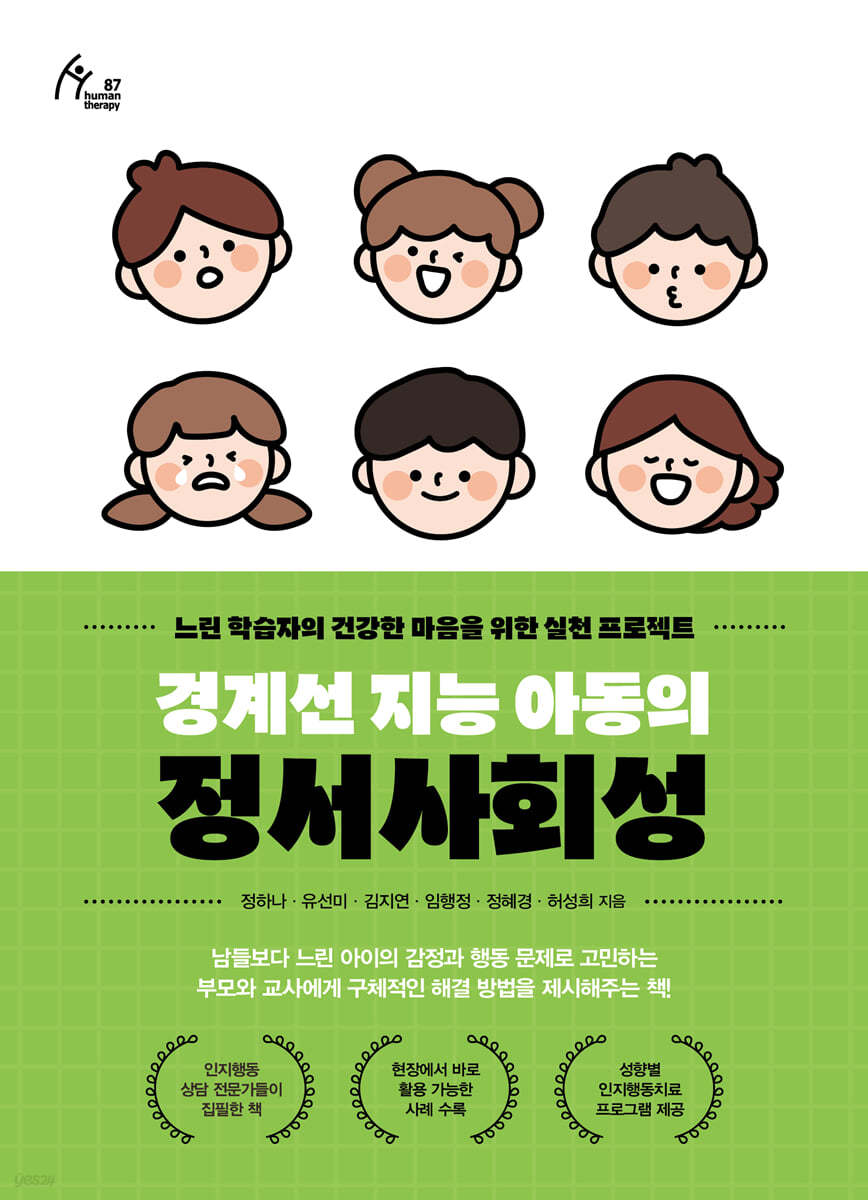
Book Introduction
For the 'Emotional and Social Improvement Project' for children with borderline intelligence
It was written by six cognitive behavioral counseling experts.
Includes case studies that can be used immediately in clinical settings, schools, and homes.
Providing cognitive behavioral therapy/cognitive behavioral play therapy programs tailored to each personality type
Domestic research and data on improving the emotional and social skills of slow learners are still lacking.
Accordingly, professors and doctors specializing in psychotherapy in clinical education settings gathered together to write this book.
We identify the cognitive and emotional characteristics of children with borderline intelligence and introduce a cognitive behavioral therapy program with proven clinical effectiveness by categorizing them into depression, anxiety, anger, and distractibility.
The writing team has been developing emotional and social skills programs that take into account the characteristics of children with borderline intelligence, and has also been working hard to provide training to professionals who work with children.
Now, through this book, I want to show children who learn more by learning slowly that they can also learn about their 'heart'.
This is a must-read for adults interested in children's healthy emotional and social development.
It was written by six cognitive behavioral counseling experts.
Includes case studies that can be used immediately in clinical settings, schools, and homes.
Providing cognitive behavioral therapy/cognitive behavioral play therapy programs tailored to each personality type
Domestic research and data on improving the emotional and social skills of slow learners are still lacking.
Accordingly, professors and doctors specializing in psychotherapy in clinical education settings gathered together to write this book.
We identify the cognitive and emotional characteristics of children with borderline intelligence and introduce a cognitive behavioral therapy program with proven clinical effectiveness by categorizing them into depression, anxiety, anger, and distractibility.
The writing team has been developing emotional and social skills programs that take into account the characteristics of children with borderline intelligence, and has also been working hard to provide training to professionals who work with children.
Now, through this book, I want to show children who learn more by learning slowly that they can also learn about their 'heart'.
This is a must-read for adults interested in children's healthy emotional and social development.
- You can preview some of the book's contents.
Preview
index
prolog
1st period.
A Look Inside Children with Borderline Intelligence
01 Understanding Children with Borderline Intelligence
What is borderline intelligence?
Diagnosis of borderline intelligence
Causes of borderline intelligence
02 Cognitive characteristics of children with borderline intelligence
Verbal coping skills
abstract thinking ability
Spatiotemporal perception
Executive function
Attention and working memory
03 Emotional Characteristics of Children with Borderline Intelligence
Depressed borderline intelligence child
Anxious borderline intelligence children
Children with borderline intelligence who have difficulty controlling their anger
Children with ADHD and borderline intelligence
04 Social Characteristics of Children with Borderline Intelligence
2nd period.
Managing the Thoughts, Feelings, and Behaviors of Children with Borderline Intelligence
01 Children with Borderline Intelligence and Depression
Characteristics of accidents
emotional characteristics
Behavioral characteristics
Depression program for children with borderline intelligence
02 Children with Borderline Intelligence and Anxiety
Characteristics of accidents
emotional characteristics
Behavioral characteristics
Anxiety Program for Children with Borderline Intelligence
03 Children with Borderline Intelligence and Anger
Characteristics of accidents
emotional characteristics
Behavioral characteristics
Anger Management Program for Children with Borderline Intelligence
04 Children with Borderline Intelligence and Distraction
Organizing and Executing Functions
attention span
impulse control
Distraction Management Program for Children with Borderline Intelligence
3rd period.
Managing Social Skills in Children with Borderline Intelligence
01 Children with Borderline Intelligence and Social Cognition
Observe your friend's facial expressions and voice to understand their emotions (emotional perception)
Understanding social context (social perception)
Finding the cause and effect of an event or behavior (attribution style)
Understanding your friends' intentions and desires in social situations (theory of mind)
02 Children with Borderline Intelligence and Social Skills
Approach a friend
Compliment a friend
Apologize to a friend
Ask a friend
Decline a friend's request
Express empathy for your friend's opinions or feelings
03 Children with Borderline Intelligence and Problem-Solving Skills
5 Steps to Problem Solving
Practice problem-solving exercises
4th period.
Emotional and Social Q&A for Children with Borderline Intelligence
“What should I do in this situation?”
01 The Role of Parents and Teachers in “Managing Emotions” of Children with Borderline Intelligence
A child who gets angry easily and throws tantrums
A child who is bored and annoyed by studying
A child who gets a stomachache and gets nervous as the test approaches
A child who ignores and doesn't listen properly whenever his parents talk
A child who hides his feelings tightly
02 The Role of Parents and Teachers in “Handling Social Skills” of Children with Borderline Intelligence
A child who doesn't approach friends first
A child who hurts his friend's feelings without realizing it
A child who cannot logically express his or her thoughts and feelings
supplement
1st period.
A Look Inside Children with Borderline Intelligence
01 Understanding Children with Borderline Intelligence
What is borderline intelligence?
Diagnosis of borderline intelligence
Causes of borderline intelligence
02 Cognitive characteristics of children with borderline intelligence
Verbal coping skills
abstract thinking ability
Spatiotemporal perception
Executive function
Attention and working memory
03 Emotional Characteristics of Children with Borderline Intelligence
Depressed borderline intelligence child
Anxious borderline intelligence children
Children with borderline intelligence who have difficulty controlling their anger
Children with ADHD and borderline intelligence
04 Social Characteristics of Children with Borderline Intelligence
2nd period.
Managing the Thoughts, Feelings, and Behaviors of Children with Borderline Intelligence
01 Children with Borderline Intelligence and Depression
Characteristics of accidents
emotional characteristics
Behavioral characteristics
Depression program for children with borderline intelligence
02 Children with Borderline Intelligence and Anxiety
Characteristics of accidents
emotional characteristics
Behavioral characteristics
Anxiety Program for Children with Borderline Intelligence
03 Children with Borderline Intelligence and Anger
Characteristics of accidents
emotional characteristics
Behavioral characteristics
Anger Management Program for Children with Borderline Intelligence
04 Children with Borderline Intelligence and Distraction
Organizing and Executing Functions
attention span
impulse control
Distraction Management Program for Children with Borderline Intelligence
3rd period.
Managing Social Skills in Children with Borderline Intelligence
01 Children with Borderline Intelligence and Social Cognition
Observe your friend's facial expressions and voice to understand their emotions (emotional perception)
Understanding social context (social perception)
Finding the cause and effect of an event or behavior (attribution style)
Understanding your friends' intentions and desires in social situations (theory of mind)
02 Children with Borderline Intelligence and Social Skills
Approach a friend
Compliment a friend
Apologize to a friend
Ask a friend
Decline a friend's request
Express empathy for your friend's opinions or feelings
03 Children with Borderline Intelligence and Problem-Solving Skills
5 Steps to Problem Solving
Practice problem-solving exercises
4th period.
Emotional and Social Q&A for Children with Borderline Intelligence
“What should I do in this situation?”
01 The Role of Parents and Teachers in “Managing Emotions” of Children with Borderline Intelligence
A child who gets angry easily and throws tantrums
A child who is bored and annoyed by studying
A child who gets a stomachache and gets nervous as the test approaches
A child who ignores and doesn't listen properly whenever his parents talk
A child who hides his feelings tightly
02 The Role of Parents and Teachers in “Handling Social Skills” of Children with Borderline Intelligence
A child who doesn't approach friends first
A child who hurts his friend's feelings without realizing it
A child who cannot logically express his or her thoughts and feelings
supplement
Detailed image

Into the book
Emotional instability experienced by children can impact positive self-concept and self-esteem, two of the most important areas of a child's overall development.
Chronic emotional instability can lead to poor academic performance and low self-esteem, which can lead to a lack of self-efficacy in interpersonal relationships.
Low self-esteem like this can negatively impact children with borderline intelligence in their home, school, learning environment, and experiences with peers.
--- p.17
Teaching children with borderline intelligence to cope rather than control is more effective, as they learn specific, practical behaviors, which allows them to be more adaptable in everyday life.
However, children with borderline intelligence have poor generalization skills, making it difficult to flexibly apply learned skills to various social situations.
Therefore, after explaining social skills in detail, it is necessary to practice through rehearsal how to apply them in which situations.
--- p.30
The Cognitive Behavior Therapy/Cognitive Behavior Play Therapy program provides children with borderline intelligence with a new perspective on themselves through a multifaceted approach to thoughts, feelings, and behaviors, and helps them think flexibly and diversely rather than with a single, extreme way of thinking.
By recognizing your own emotions, recalling happy experiences, and connecting them to activities, you can help your child change his or her emotions and behavior.
Additionally, eating and sleeping problems experienced in daily life can be internalized through a practical success plan, thereby increasing self-confidence and self-efficacy.
--- p.40
Anger and rage are not bad emotions.
These are emotions that we feel naturally, such as joy, sadness, fear, and shame.
How we behave when we are angry or upset is what determines whether our behavior is healthy or unhealthy.
What we need to keep in mind is that 'there is a clear reason for being angry' and 'I can control my behavior even when I am angry.'
This activity personifies the emotion of anger, helping children see anger separately.
When you separate yourself from your anger, you can determine in what situations you explode with anger, how you can control your anger, and what the consequences of your anger outbursts are.
--- p.75
Social perception is the ability to perceive social cues, including social rules, norms, and roles, and to understand and infer social situations and contexts.
The ability to understand and reason about social situations is very important for adapting to peer relationships and group life.
To improve social perception, one must be able to not only perceive and discern various cues provided in social situations (e.g., social roles or social rules), but also understand the social context itself.
Impaired social perception is related to the ability to solve problems in social situations.
--- p.125
Children with borderline intelligence lack the ability to judge situations and cope, so they are unable to resist unfair treatment.
Rather, this behavior is sometimes praised as it is perceived as a child being gentle and accommodating.
Moreover, they tend to depend on those who treat them well and have a strong desire to be noticed, so they have difficulty accurately conveying their thoughts or positions even when they don't want to.
On the one hand, he is perceived as a very difficult child because he cannot delay his desires appropriately in the situation and cannot control his anger.
The immaturity and inadequacy of these social relationships hinders the formation of equal and healthy peer relationships.
Here's why children with borderline intelligence need to learn rejection skills.
--- p.164
If what parents and teachers want is for their children to have a 'fun time learning something' and a 'healthy relationship where they share fun times through learning', it is important to give positive feedback and praise for their learning attitude rather than their learning ability.
To do this, even if they get 7 out of 10 questions wrong, give your child a smile and praise their learning attitude by saying things like, “You probably really don’t want to do this today, but you persevered and got through number 3,” or “You even prepared your writing utensils and books on your own today. That’s amazing.”
Let's look at the healthy learning attitudes I've observed in my child, as shown in the table below, write down how I can praise and encourage them, and then try to apply them in my daily life.
--- p.188
If you are a child who is 'inconsiderate' or 'offends his/her friends', you need active help from those around you.
Because not every child does something to hurt someone else's feelings every minute of every second, 24 hours a day.
At times, he is a child who is close to others, and at other times, he is a child who brings joy and inspiration to others.
Also, the desire to be close with friends is no different from other people's desire.
However, being insensitive and hurting your friends' feelings means that you lack the ability to sensitively perceive your friends' subtle emotional differences or changes in the surrounding situation, and you lack prosocial skills such as empathizing and encouraging them.
We must remember that weak and insufficient abilities do not mean 'limitations', but rather that they can be sufficiently 'grown' through 'help and practice'.
Chronic emotional instability can lead to poor academic performance and low self-esteem, which can lead to a lack of self-efficacy in interpersonal relationships.
Low self-esteem like this can negatively impact children with borderline intelligence in their home, school, learning environment, and experiences with peers.
--- p.17
Teaching children with borderline intelligence to cope rather than control is more effective, as they learn specific, practical behaviors, which allows them to be more adaptable in everyday life.
However, children with borderline intelligence have poor generalization skills, making it difficult to flexibly apply learned skills to various social situations.
Therefore, after explaining social skills in detail, it is necessary to practice through rehearsal how to apply them in which situations.
--- p.30
The Cognitive Behavior Therapy/Cognitive Behavior Play Therapy program provides children with borderline intelligence with a new perspective on themselves through a multifaceted approach to thoughts, feelings, and behaviors, and helps them think flexibly and diversely rather than with a single, extreme way of thinking.
By recognizing your own emotions, recalling happy experiences, and connecting them to activities, you can help your child change his or her emotions and behavior.
Additionally, eating and sleeping problems experienced in daily life can be internalized through a practical success plan, thereby increasing self-confidence and self-efficacy.
--- p.40
Anger and rage are not bad emotions.
These are emotions that we feel naturally, such as joy, sadness, fear, and shame.
How we behave when we are angry or upset is what determines whether our behavior is healthy or unhealthy.
What we need to keep in mind is that 'there is a clear reason for being angry' and 'I can control my behavior even when I am angry.'
This activity personifies the emotion of anger, helping children see anger separately.
When you separate yourself from your anger, you can determine in what situations you explode with anger, how you can control your anger, and what the consequences of your anger outbursts are.
--- p.75
Social perception is the ability to perceive social cues, including social rules, norms, and roles, and to understand and infer social situations and contexts.
The ability to understand and reason about social situations is very important for adapting to peer relationships and group life.
To improve social perception, one must be able to not only perceive and discern various cues provided in social situations (e.g., social roles or social rules), but also understand the social context itself.
Impaired social perception is related to the ability to solve problems in social situations.
--- p.125
Children with borderline intelligence lack the ability to judge situations and cope, so they are unable to resist unfair treatment.
Rather, this behavior is sometimes praised as it is perceived as a child being gentle and accommodating.
Moreover, they tend to depend on those who treat them well and have a strong desire to be noticed, so they have difficulty accurately conveying their thoughts or positions even when they don't want to.
On the one hand, he is perceived as a very difficult child because he cannot delay his desires appropriately in the situation and cannot control his anger.
The immaturity and inadequacy of these social relationships hinders the formation of equal and healthy peer relationships.
Here's why children with borderline intelligence need to learn rejection skills.
--- p.164
If what parents and teachers want is for their children to have a 'fun time learning something' and a 'healthy relationship where they share fun times through learning', it is important to give positive feedback and praise for their learning attitude rather than their learning ability.
To do this, even if they get 7 out of 10 questions wrong, give your child a smile and praise their learning attitude by saying things like, “You probably really don’t want to do this today, but you persevered and got through number 3,” or “You even prepared your writing utensils and books on your own today. That’s amazing.”
Let's look at the healthy learning attitudes I've observed in my child, as shown in the table below, write down how I can praise and encourage them, and then try to apply them in my daily life.
--- p.188
If you are a child who is 'inconsiderate' or 'offends his/her friends', you need active help from those around you.
Because not every child does something to hurt someone else's feelings every minute of every second, 24 hours a day.
At times, he is a child who is close to others, and at other times, he is a child who brings joy and inspiration to others.
Also, the desire to be close with friends is no different from other people's desire.
However, being insensitive and hurting your friends' feelings means that you lack the ability to sensitively perceive your friends' subtle emotional differences or changes in the surrounding situation, and you lack prosocial skills such as empathizing and encouraging them.
We must remember that weak and insufficient abilities do not mean 'limitations', but rather that they can be sufficiently 'grown' through 'help and practice'.
--- p.199
Publisher's Review
The ‘emotions’ and ‘sociality’ of children who are slow learners,
It can be changed at any time with the guidance of an adult!
A Look at Slow Learners, Those Left Behind in Education
"Can we help children with borderline intelligence understand abstract concepts like emotions, friendship, and trust?" "Can we teach children to make healthy changes to their thoughts and behaviors?" These concerns led to research by teachers of slow learners, who discovered that repetitive practice of specific skills is essential to addressing children's emotional and social challenges.
This book was written by cognitive behavioral counseling experts who have met children, parents, and teachers in various fields for the past 10 years.
Slow learners are narrowly defined as people who fall into the category of borderline intelligence, but broadly include all people who have difficulty with literacy and learning compared to their peers or their existing intelligence.
This book focuses on the 'emotional and social skills' of children with borderline intelligence, and aims to provide various practical programs to help them develop healthy minds.
Therefore, in order to teach slow learners who are in the blind spot of education, we must start by understanding their ‘cognitive, emotional, and social characteristics.’
If we, as educators, fail to properly understand the unique characteristics of our children, can we truly be confident that we've taught them effectively? So, how can we educate children so they can act appropriately in different situations? I hope this book provides the answers you need.
“What should I do in this situation?”
Includes specific practical applications that can be implemented immediately in clinical settings, schools, and at home.
This book is divided into chapters from the 1st to the 4th period so that it can be used as a textbook to easily teach children in educational settings.
In the first period, we help students understand the concept of children with borderline intelligence and divide it into cognitive, emotional, and social characteristics.
In the second period, we deal with children's thoughts, feelings, and actions in earnest.
We introduce appropriate cognitive behavioral therapy programs for children who exhibit different characteristics, such as depression, anxiety, anger, and distraction.
In particular, through programs that list activity methods in order, children can learn flexible and diverse thinking rather than one extreme way of thinking.
Third period focuses on children's social skills.
Specific examples of activities were provided to improve social cognition, social skills, and problem-solving skills.
By following the steps, children can discover the causes and effects of events and behaviors and acquire the skills needed in social situations.
In the fourth period, guidelines are provided on the roles of parents and teachers in managing children's emotions and sociality.
We have compiled questions that parents and teachers are likely to have in Q&A format.
I hope that the expert's compassionate solutions will help to gradually resolve some of the headaches that have plagued children in their education.
I am concerned about the emotional and behavioral problems of my child who is slower than others.
A book that provides concrete solutions for parents and teachers!
“Children with borderline intelligence also have their own thoughts and feelings.
“You can express it with appropriate words and actions.”
Teaching children with borderline intelligence to 'cope' rather than 'control' is more effective.
This is because most slow learners lack the ability to flexibly apply skills once learned to a variety of social situations.
So, this book explains social skills in detail and then provides an opportunity to rehearse what to say and do in which situation.
Children can learn systematically, from the easy stage of learning emotional words and their meanings through pictures to the applied stage of talking about their own experiences and looking into the emotions of others through games.
Fun activity schedules, creating coping puzzles, expressing anger, changing angry thoughts, prioritizing tasks, keeping a thought change log, etc.
We provide a variety of programs to help children think about their own thoughts and feelings and control their emotions through conversations with others.
I hope this book will help children change their maladaptive thinking into positive thinking and develop healthy emotional and social skills.
* Human Therapy is a specialized psychotherapy series that helps people understand and change various psychological problems.
It can be changed at any time with the guidance of an adult!
A Look at Slow Learners, Those Left Behind in Education
"Can we help children with borderline intelligence understand abstract concepts like emotions, friendship, and trust?" "Can we teach children to make healthy changes to their thoughts and behaviors?" These concerns led to research by teachers of slow learners, who discovered that repetitive practice of specific skills is essential to addressing children's emotional and social challenges.
This book was written by cognitive behavioral counseling experts who have met children, parents, and teachers in various fields for the past 10 years.
Slow learners are narrowly defined as people who fall into the category of borderline intelligence, but broadly include all people who have difficulty with literacy and learning compared to their peers or their existing intelligence.
This book focuses on the 'emotional and social skills' of children with borderline intelligence, and aims to provide various practical programs to help them develop healthy minds.
Therefore, in order to teach slow learners who are in the blind spot of education, we must start by understanding their ‘cognitive, emotional, and social characteristics.’
If we, as educators, fail to properly understand the unique characteristics of our children, can we truly be confident that we've taught them effectively? So, how can we educate children so they can act appropriately in different situations? I hope this book provides the answers you need.
“What should I do in this situation?”
Includes specific practical applications that can be implemented immediately in clinical settings, schools, and at home.
This book is divided into chapters from the 1st to the 4th period so that it can be used as a textbook to easily teach children in educational settings.
In the first period, we help students understand the concept of children with borderline intelligence and divide it into cognitive, emotional, and social characteristics.
In the second period, we deal with children's thoughts, feelings, and actions in earnest.
We introduce appropriate cognitive behavioral therapy programs for children who exhibit different characteristics, such as depression, anxiety, anger, and distraction.
In particular, through programs that list activity methods in order, children can learn flexible and diverse thinking rather than one extreme way of thinking.
Third period focuses on children's social skills.
Specific examples of activities were provided to improve social cognition, social skills, and problem-solving skills.
By following the steps, children can discover the causes and effects of events and behaviors and acquire the skills needed in social situations.
In the fourth period, guidelines are provided on the roles of parents and teachers in managing children's emotions and sociality.
We have compiled questions that parents and teachers are likely to have in Q&A format.
I hope that the expert's compassionate solutions will help to gradually resolve some of the headaches that have plagued children in their education.
I am concerned about the emotional and behavioral problems of my child who is slower than others.
A book that provides concrete solutions for parents and teachers!
“Children with borderline intelligence also have their own thoughts and feelings.
“You can express it with appropriate words and actions.”
Teaching children with borderline intelligence to 'cope' rather than 'control' is more effective.
This is because most slow learners lack the ability to flexibly apply skills once learned to a variety of social situations.
So, this book explains social skills in detail and then provides an opportunity to rehearse what to say and do in which situation.
Children can learn systematically, from the easy stage of learning emotional words and their meanings through pictures to the applied stage of talking about their own experiences and looking into the emotions of others through games.
Fun activity schedules, creating coping puzzles, expressing anger, changing angry thoughts, prioritizing tasks, keeping a thought change log, etc.
We provide a variety of programs to help children think about their own thoughts and feelings and control their emotions through conversations with others.
I hope this book will help children change their maladaptive thinking into positive thinking and develop healthy emotional and social skills.
* Human Therapy is a specialized psychotherapy series that helps people understand and change various psychological problems.
GOODS SPECIFICS
- Publication date: November 19, 2021
- Page count, weight, size: 208 pages | 376g | 152*210*20mm
- ISBN13: 9791168011632
- ISBN10: 1168011639
You may also like
카테고리
korean


korean

![ELLE 엘르 스페셜 에디션 A형 : 12월 [2025]](http://librairie.coreenne.fr/cdn/shop/files/b8e27a3de6c9538896439686c6b0e8fb.jpg?v=1766436872&width=3840)


