

Girl's Hell
 |
Description
Book Introduction
"A girl's hell is always 'here and now.'" Yumeno Kyusaku's masterpiece short story collection "Girl's Hell" officially released in Korea.
『Girl's Hell』, a masterpiece by Kyusaku Yumeno, considered one of the most bizarre and modern writers in Japanese literature from the 1920s and 1930s, is being officially introduced in Korea.
Yumeno Kyusaku, known as a representative writer of so-called "ero-gro-nonsense" literature along with Edogawa Ranpo, was a name that had been talked about only among a select group of enthusiasts.
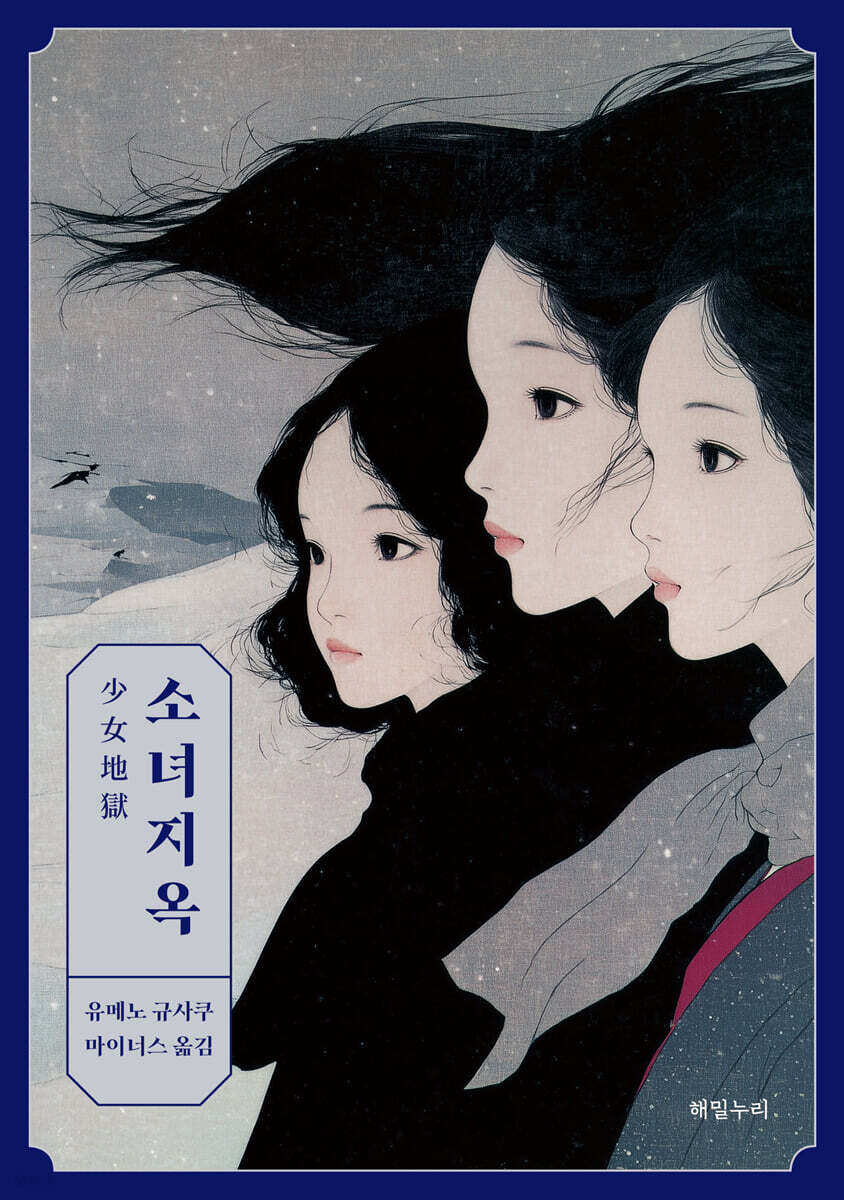
"Girl's Hell" is a collection of three short stories by Yumeno Kyusaku, and as the title suggests, it shows the many faces of "the hell that girls fall into."
The first story, “It Was Nothing,” features Yuriko Himekusa, a “genius liar” who endlessly exaggerates and dramatizes her own existence.
As she skillfully deceives hospitals, police, and intellectual men to become a "special girl," the lines between what is true and what is made up become increasingly blurred.
And the moment that boundary collapses, the reader is left wondering until the very end what the 'truth' she will finally face is.
The second story, “Murder Relay,” is comprised of a confession letter from a female conductor who was caught up in a serial murder case by a male driver, which was reported in the newspaper as “the terrifying murder relay of a pervert.”
In this letter, which begins with the premise that “I am the only one who survived,” the speaker endlessly moves between love and fear, pity and self-loathing, reflecting on his own position in the incident.
The greatest tension in this work lies in the final words she cannot tell her friend, and in the decision she makes at the end of the letter.
The final story, "The Woman from Mars," centers around the narrator, a high school girl with unusually tall stature and overwhelming physical strength.
A girl who is treated like a 'secret weapon' only when needed on the playground, and is completely isolated and ridiculed in everyday life.
As the story unfolds, revealing the abandoned warehouse that has been her only refuge and her entanglement with the respected Christian schoolmaster, the reader follows how a girl came to choose the name "Martian Woman" and what plans she makes for herself.
This work, a collage of newspaper articles, police records, letters, and statements, leaves readers wondering, "How much of it is true?" even after reading to the end.
In this way, all three works of 『Girls' Hell』 tell stories of lies, violence, desire, and vanity, but ultimately persistently show how women are exploited, distrusted, and driven to the edge of a cliff.
Yumeno Kyusaku's unique exaggerated settings and the bizarre structure that mixes letters, reports, and newspaper articles go beyond simple horror and thrills, and twists and exposes the male-centered norms and hypocrisy that supported Japanese society at the time.
Readers follow the records and voices left behind by each girl in each story, and find out for themselves where “hell” really lies—at the scene of the crime, on the pages of the newspaper, or inside the girls themselves.
『Girl's Hell』, a masterpiece by Kyusaku Yumeno, considered one of the most bizarre and modern writers in Japanese literature from the 1920s and 1930s, is being officially introduced in Korea.
Yumeno Kyusaku, known as a representative writer of so-called "ero-gro-nonsense" literature along with Edogawa Ranpo, was a name that had been talked about only among a select group of enthusiasts.
"Girl's Hell" is a collection of three short stories by Yumeno Kyusaku, and as the title suggests, it shows the many faces of "the hell that girls fall into."
The first story, “It Was Nothing,” features Yuriko Himekusa, a “genius liar” who endlessly exaggerates and dramatizes her own existence.
As she skillfully deceives hospitals, police, and intellectual men to become a "special girl," the lines between what is true and what is made up become increasingly blurred.
And the moment that boundary collapses, the reader is left wondering until the very end what the 'truth' she will finally face is.
The second story, “Murder Relay,” is comprised of a confession letter from a female conductor who was caught up in a serial murder case by a male driver, which was reported in the newspaper as “the terrifying murder relay of a pervert.”
In this letter, which begins with the premise that “I am the only one who survived,” the speaker endlessly moves between love and fear, pity and self-loathing, reflecting on his own position in the incident.
The greatest tension in this work lies in the final words she cannot tell her friend, and in the decision she makes at the end of the letter.
The final story, "The Woman from Mars," centers around the narrator, a high school girl with unusually tall stature and overwhelming physical strength.
A girl who is treated like a 'secret weapon' only when needed on the playground, and is completely isolated and ridiculed in everyday life.
As the story unfolds, revealing the abandoned warehouse that has been her only refuge and her entanglement with the respected Christian schoolmaster, the reader follows how a girl came to choose the name "Martian Woman" and what plans she makes for herself.
This work, a collage of newspaper articles, police records, letters, and statements, leaves readers wondering, "How much of it is true?" even after reading to the end.
In this way, all three works of 『Girls' Hell』 tell stories of lies, violence, desire, and vanity, but ultimately persistently show how women are exploited, distrusted, and driven to the edge of a cliff.
Yumeno Kyusaku's unique exaggerated settings and the bizarre structure that mixes letters, reports, and newspaper articles go beyond simple horror and thrills, and twists and exposes the male-centered norms and hypocrisy that supported Japanese society at the time.
Readers follow the records and voices left behind by each girl in each story, and find out for themselves where “hell” really lies—at the scene of the crime, on the pages of the newspaper, or inside the girls themselves.
- You can preview some of the book's contents.
Preview
index
It was nothing special 7
Murder Relay 119
Woman from Mars 149
Translator's Note 242
Murder Relay 119
Woman from Mars 149
Translator's Note 242
Into the book
I am a junior of yours, a graduate of Kyushu Imperial University's Department of Otolaryngology, who, like you, was briefly honored at the Marunouchi Club's last competition.
Since early June of last year, Showa 8, I have been displaying the sign for Usuki ENT Clinic in Miyazaki-cho, Yokohama City. Please forgive my rudeness in suddenly posting such a strange letter.
Himekusa Yuriko committed suicide.
--- p.9
I don't know about other things, but I really can't do that with the female conductor.
It's a lot more boring, a lot more scary, a lot more unpleasant than being a farmer.
The fate of a female conductor is much cheaper than a piece of paper scattered on the street.
You'll soon find out once you become a female conductor.
To put it simply, if you are a farmer's daughter, your parents will choose a groom for you from among the innocent young men in the village.
If you're lucky, you might be with someone you love.
But if you become a female conductor, you have to give up that kind of happiness from the start.
No matter how unfair or unpleasant the words of people like company executives, directors, or the police officer in charge of automobiles may be, you must listen quietly.
Otherwise, you will be fired immediately.
Because they make up some excuse to kick you out.
--- p.120
At around 2:00 a.m. on March 26, a fire broke out in an old warehouse in the corner of the playground of a prefectural girls' high school in the 6th district of the city's Odori district.
Because strong winds were blowing, the fire almost spread into a large fire, but thanks to the quick response of the city fire chief and the fire department, the fire was extinguished with only one warehouse completely burned down.
Fortunately, there was no damage to the school building, so faculty and students breathed a sigh of relief.
However, a few days later, on the 26th of the same month, while cleaning up the site of the fire, a charred body was discovered that was so black that it was impossible to even tell the gender.
The scene was once again thrown into commotion.
A subsequent autopsy at the university confirmed that the body was that of a woman in her twenties.
Traces of fuel placed to focus the fire, particularly around the waist area, were found.
Accordingly, the police reported the incident as an arson-murder case with a sexual motive, and began a thorough investigation while temporarily suspending reporting.
Since early June of last year, Showa 8, I have been displaying the sign for Usuki ENT Clinic in Miyazaki-cho, Yokohama City. Please forgive my rudeness in suddenly posting such a strange letter.
Himekusa Yuriko committed suicide.
--- p.9
I don't know about other things, but I really can't do that with the female conductor.
It's a lot more boring, a lot more scary, a lot more unpleasant than being a farmer.
The fate of a female conductor is much cheaper than a piece of paper scattered on the street.
You'll soon find out once you become a female conductor.
To put it simply, if you are a farmer's daughter, your parents will choose a groom for you from among the innocent young men in the village.
If you're lucky, you might be with someone you love.
But if you become a female conductor, you have to give up that kind of happiness from the start.
No matter how unfair or unpleasant the words of people like company executives, directors, or the police officer in charge of automobiles may be, you must listen quietly.
Otherwise, you will be fired immediately.
Because they make up some excuse to kick you out.
--- p.120
At around 2:00 a.m. on March 26, a fire broke out in an old warehouse in the corner of the playground of a prefectural girls' high school in the 6th district of the city's Odori district.
Because strong winds were blowing, the fire almost spread into a large fire, but thanks to the quick response of the city fire chief and the fire department, the fire was extinguished with only one warehouse completely burned down.
Fortunately, there was no damage to the school building, so faculty and students breathed a sigh of relief.
However, a few days later, on the 26th of the same month, while cleaning up the site of the fire, a charred body was discovered that was so black that it was impossible to even tell the gender.
The scene was once again thrown into commotion.
A subsequent autopsy at the university confirmed that the body was that of a woman in her twenties.
Traces of fuel placed to focus the fire, particularly around the waist area, were found.
Accordingly, the police reported the incident as an arson-murder case with a sexual motive, and began a thorough investigation while temporarily suspending reporting.
--- p.151
Publisher's Review
The word “hell” often refers to the afterlife, but in Yumeno Kyusaku’s “Girl’s Hell,” hell is closer to the space where living girls wander around every day.
School, home, newspapers and rumors, romance and friendship, morality and education - all these things work as mechanisms to quietly squeeze and push away the girl rather than protect her.
In “It Was Nothing,” the girl walks down a path of self-destruction after being piled up with “little lies.”
In "Murder Relay," it is not a specific villain, but rather light words shared by many that push someone into a corner.
In “The Woman from Mars,” the corpse of a female student is consumed only as material under the name “the black girl,” and the real voice hidden behind it barely leaks out through the cracks of articles, references, administrative documents, and “wills.”
This Korean edition aims to capture these three faces of hell in one volume, showcasing the full spectrum of the author, Yumeno Kyusaku.
The sentences, a mixture of love confessions, wills, newspaper articles, reference notes, letters, and long-winded narratives, are not simply for the sake of bizarreness, but function as a device to reveal “how stories save and kill people.”
This book does not offer readers any simple lessons.
Instead, after reading it, you might be left with questions like:
In front of someone's story, how easily did I say, "It's nothing."
Haven't the words exchanged as a joke ever become part of a 'murder relay' for someone?
And even now, somewhere, isn't the "Woman from Mars" desperately waiting for a piece of paper on which to write her story?
The bizarre short story collection "Girl's Hell" from 100 years ago still poses valid questions to us who live here today.
“Did you really know that the world you believed in as ‘normal’ could be hell for some people?”
School, home, newspapers and rumors, romance and friendship, morality and education - all these things work as mechanisms to quietly squeeze and push away the girl rather than protect her.
In “It Was Nothing,” the girl walks down a path of self-destruction after being piled up with “little lies.”
In "Murder Relay," it is not a specific villain, but rather light words shared by many that push someone into a corner.
In “The Woman from Mars,” the corpse of a female student is consumed only as material under the name “the black girl,” and the real voice hidden behind it barely leaks out through the cracks of articles, references, administrative documents, and “wills.”
This Korean edition aims to capture these three faces of hell in one volume, showcasing the full spectrum of the author, Yumeno Kyusaku.
The sentences, a mixture of love confessions, wills, newspaper articles, reference notes, letters, and long-winded narratives, are not simply for the sake of bizarreness, but function as a device to reveal “how stories save and kill people.”
This book does not offer readers any simple lessons.
Instead, after reading it, you might be left with questions like:
In front of someone's story, how easily did I say, "It's nothing."
Haven't the words exchanged as a joke ever become part of a 'murder relay' for someone?
And even now, somewhere, isn't the "Woman from Mars" desperately waiting for a piece of paper on which to write her story?
The bizarre short story collection "Girl's Hell" from 100 years ago still poses valid questions to us who live here today.
“Did you really know that the world you believed in as ‘normal’ could be hell for some people?”
GOODS SPECIFICS
- Date of issue: November 27, 2025
- Page count, weight, size: 252 pages | 138*196*14mm
- ISBN13: 9791175052086
- ISBN10: 1175052086
You may also like
카테고리
korean


korean

![ELLE 엘르 스페셜 에디션 A형 : 12월 [2025]](http://librairie.coreenne.fr/cdn/shop/files/b8e27a3de6c9538896439686c6b0e8fb.jpg?v=1766436872&width=3840)


