

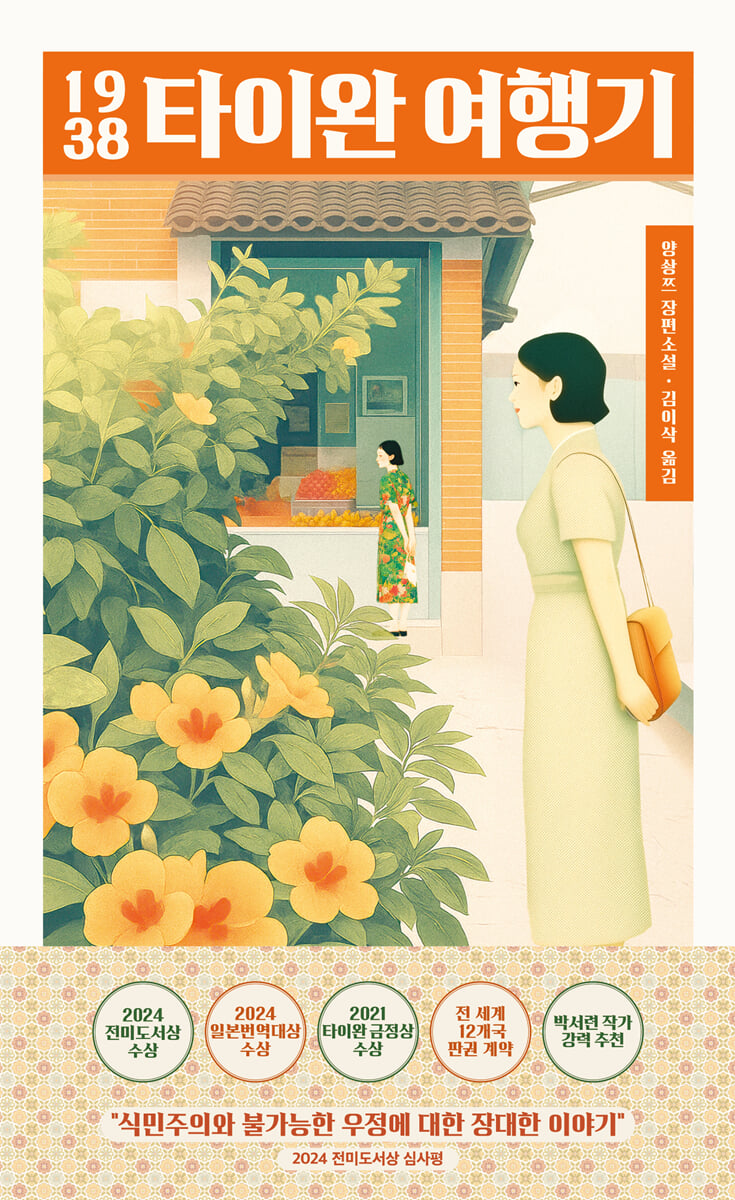
1938 Taiwan Travelogue
 |
Description
Book Introduction
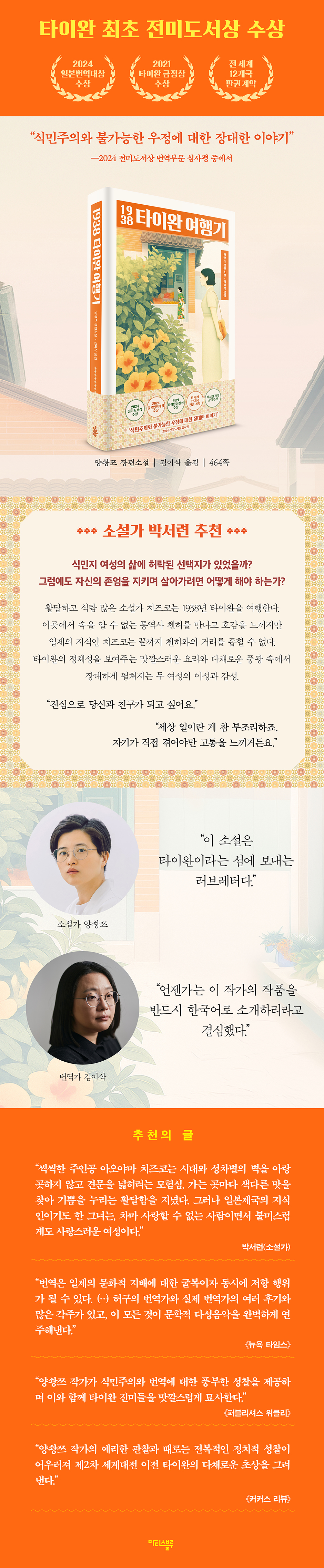
Taiwan's first recipient of the 2024 National Book Award in Translation
Winner of the 2024 Japan Translation Award and the 2021 Taiwan Golden Award
Recommended by author Park Seo-ryeon!
Were there any options available to women in the colony? How could they live with dignity? "A Travelogue to Taiwan in 1938," by Yang Shuang-tzu, the first Taiwanese author to win the 2024 National Book Award for Translation and garnering international attention, has been published in Korea.
This novel, which won the 2024 Japan Translation Award and the 2021 Taiwan Golden Award, has finally met Korean readers through the planning and translation of novelist and translator Lee Isaac Kim, a long-time fan of author Yang Shuang-zhi.
In 1938, Japanese novelist Chizuko Aoyama spent a year in Taiwan. With the help of Wang Chen-he, a Taiwanese woman who served as her interpreter, she traveled around Taiwan and experienced Taiwanese delicacies such as rou sao, Taiwanese curry, muay yin tung, and guo zi.
Chen He was about to get married according to his family's wishes, hiding his dream deep in his heart, and was kind to Chizuko, but kept a certain distance from her.
As Chizuko observes Chen He, she discovers the true face of Taiwan that she, a Japanese person, had not seen before, and a woman struggling to preserve her own dignity.
Hailed by the National Book Award jury as “a magnificent tale of colonialism and impossible friendship,” this novel is also the story of two adventurous women who transcend the differences between colonizer and colonized, employer and employee, heir and illegitimate daughter to explore new horizons.
This novel, which flexibly crosses colonialism, gender, identity, language, and literary boundaries, is a significant work that placed Taiwanese literature on the global literary scene.
As author Yang Shuangzi said in his National Book Award acceptance speech, “The reason we talk about the past is to move forward into the future,” this novel is not a story of the past, but a story needed for the present. As a historical novel, a travel novel, and a women’s novel, it will provide Korean readers with a new perspective on history and deep reflection.
Winner of the 2024 Japan Translation Award and the 2021 Taiwan Golden Award
Recommended by author Park Seo-ryeon!
Were there any options available to women in the colony? How could they live with dignity? "A Travelogue to Taiwan in 1938," by Yang Shuang-tzu, the first Taiwanese author to win the 2024 National Book Award for Translation and garnering international attention, has been published in Korea.
This novel, which won the 2024 Japan Translation Award and the 2021 Taiwan Golden Award, has finally met Korean readers through the planning and translation of novelist and translator Lee Isaac Kim, a long-time fan of author Yang Shuang-zhi.
In 1938, Japanese novelist Chizuko Aoyama spent a year in Taiwan. With the help of Wang Chen-he, a Taiwanese woman who served as her interpreter, she traveled around Taiwan and experienced Taiwanese delicacies such as rou sao, Taiwanese curry, muay yin tung, and guo zi.
Chen He was about to get married according to his family's wishes, hiding his dream deep in his heart, and was kind to Chizuko, but kept a certain distance from her.
As Chizuko observes Chen He, she discovers the true face of Taiwan that she, a Japanese person, had not seen before, and a woman struggling to preserve her own dignity.
Hailed by the National Book Award jury as “a magnificent tale of colonialism and impossible friendship,” this novel is also the story of two adventurous women who transcend the differences between colonizer and colonized, employer and employee, heir and illegitimate daughter to explore new horizons.
This novel, which flexibly crosses colonialism, gender, identity, language, and literary boundaries, is a significant work that placed Taiwanese literature on the global literary scene.
As author Yang Shuangzi said in his National Book Award acceptance speech, “The reason we talk about the past is to move forward into the future,” this novel is not a story of the past, but a story needed for the present. As a historical novel, a travel novel, and a women’s novel, it will provide Korean readers with a new perspective on history and deep reflection.
- You can preview some of the book's contents.
Preview
index
[Preface to the first edition, 1954]
Salty Stir-fried Seeds, Gua-tzu
Hakka rice noodle snack, bitaibak
Muainteng, a soup made with young leaves of the hemp plant
Sashimi, a gourmet food of the locals
Braised minced pork, Rousao
Sweet tea, Donggwacha
Mainland Western Cuisine, Taiwanese Curry
Sukiyaki, a food that shares the heart
Leftover soup, a soup eaten after a banquet
New Year's food, taumi
Salty Cake, Shendangao
Patbingsu, a snack eaten at a street stall in Luchan
[Review of the 1970 Reissue] Memories of a Mother, Yoko Aoyama
[Translator's Note from the 1990 Taiwanese Edition] Noodles Made in a Willow Tree House, by Wang Chenhe
[1990 Taiwanese Edition Editor's Note] A Promise with the Deceased, Woo Jung-mei
[2020 New Edition Translator's Note] Our Two Kohakus, Yang Shuangzi
[Korean Edition Translator's Note] What's Revealed Between Translation and Interpretation, by Isaac Kim
[1938 Taiwan Transcontinental Railway]
Salty Stir-fried Seeds, Gua-tzu
Hakka rice noodle snack, bitaibak
Muainteng, a soup made with young leaves of the hemp plant
Sashimi, a gourmet food of the locals
Braised minced pork, Rousao
Sweet tea, Donggwacha
Mainland Western Cuisine, Taiwanese Curry
Sukiyaki, a food that shares the heart
Leftover soup, a soup eaten after a banquet
New Year's food, taumi
Salty Cake, Shendangao
Patbingsu, a snack eaten at a street stall in Luchan
[Review of the 1970 Reissue] Memories of a Mother, Yoko Aoyama
[Translator's Note from the 1990 Taiwanese Edition] Noodles Made in a Willow Tree House, by Wang Chenhe
[1990 Taiwanese Edition Editor's Note] A Promise with the Deceased, Woo Jung-mei
[2020 New Edition Translator's Note] Our Two Kohakus, Yang Shuangzi
[Korean Edition Translator's Note] What's Revealed Between Translation and Interpretation, by Isaac Kim
[1938 Taiwan Transcontinental Railway]
Detailed image
Into the book
Toshiko's new sister took out another piece of information.
This time it was a handsome bearded officer in a navy uniform.
“This is Professor Suzuki.
Mr. Shiratori's nephew recommended it to me.
“A friend’s comrade… … .”
Is this a result of considering my miserable condition?
The majority were tall, middle-aged men.
Men who are remarried or have little hair.
Even though he was a young man, he had a very polite air about him, and he looked like he would overturn the table as soon as the fight started.
“This is Mr. Amuro.
Aunt Akiko introduced me.
“He is said to be a beloved student of the principal of Edogawa, a local vocational school… … .”
I ate my fourth botamochi and drank all the tea.
I'm full.
As expected, it was impossible to eat four at once.
He stretched out his body, opened the sliding door, and called Haruno.
I asked them to bring me some biscuits to eat with my English tea.
Then, Mitsuko suddenly got angry.
"Cheese, didn't you just eat two servings of chirashizushi by yourself? Eating that much? You're a total monster.
You shouldn't blame these candidates.
“Unless you’re an older, more open-minded man, you won’t be able to feel love for a monster!”
"Mitsuko, how can you say something like that? Hmm, if nothing else comes up, I'll go write my novel."
“Stand there.
A woman's marriage has always been decided by the head of the household.
“Cheeseko, if you keep avoiding me like this, we’ll have no choice but to ask Father to make a decision.”
“Oh, Mitsuko.”
“Excuse me.” Haruno’s voice came from beyond the half-open sliding door.
What Haruno, crawling on her knees, brought was not black tea or biscuits, but a very elaborately decorated envelope.
--- pp.27-28 From "Salty Stir-fried Seeds, Guatz"
Xiao Chen's chopsticks reached for the large plate.
Starting with the first dumpling, I ate in the following order: transparent dumpling, meat dumpling, marinated dumpling, crunchy dumpling, and taro dumpling.
After that, I ate it one more time in the same order.
After eating the same thing for the third time, I drank the soup and ate the pickled radish.
Then in the same order, the fourth, fifth, sixth… … .
I opened my eyes wide and gaped.
It was a look that combined elegance and speed.
Xiao Chen ate all the dumplings in the large plate.
You eat so much.
It's a total monster.
To be honest, even I was skeptical.
I wonder if I can find another monster partner.
"Xiao Chen! This is a fateful encounter!"
I jumped up and spoke loudly and without hesitation.
“Let’s travel all over Taiwan together and enjoy delicious food!”
Xiao Chen looked a little surprised, but soon smiled and nodded.
Sunlight filled the small house.
Ah, the tropical country, the island, Taiwan!
--- pp.117-118 From "Muainteng, a soup made with young leaves of the hemp plant"
The island of Taiwan was the empire's southernmost colony and its first colony.
During my time here, I was fascinated by how these two cultures intersect and influence each other.
There are those who stayed in the mainland, those who moved to the main island, those born on the main island, those born on the main island and raised while accepting the modern civilization of the empire, and those who went to the mainland to study or work.
These differences in their individual education and temperament were revealed in minute details, but they were not something that could be explained in a few words, so I have not written about them until now.
I was just fascinated by the sight of the Hontojins.
I was just a young man and a novelist, so I didn't have the talent of a politician or a scholar.
There was no such thing as an ambition so grand as to be presumptuous.
The only thing I could do was record what I saw and heard.
Or record the true feelings of the moment.
But what exactly is a true feeling?
The empire's 'southern advance' and the empire's 'national spirit mobilization movement' became a movement to assimilate the imperial state from the colony.
This is a violent act that erases the traces of each person's different culture and sophistication.
Isn't that right? Every time I seriously consider this, feelings of resistance and disgust creep up on me without me realizing it.
Just like right now.
--- pp.160-161 From "Braised Minced Pork, Rouxao"
"Riya!"
A low roar came from the counter.
I immediately turned my head.
Xiao Chen stood not far from the counter, his back to the light, his side of his face in shadow.
She stood up straight in the darkness.
His shoulders moved with his breathing, rising and falling just once.
Then Xiaochen walked towards the front.
I followed a few steps and saw the front desk staff's expression filled with displeasure.
“It’s full today, so hurry up and leave.”
The front desk staff used some very abusive language.
It was hard to believe that this was the kind of hospitality provided by a luxury hotel.
But Xiao Chen was very calm.
"Could you please confirm the room reservation status again? Our guest staying tonight is Ms. Chizuko Aoyama of Nisshinkai."
Xiaochen handed over his business card while facing the front desk staff's angry gaze.
“I am Mr. Aoyama’s interpreter on the main island.
Mr. Aoyama is a writer who came from the mainland specially at the invitation of the Governor-General.
If you have any problems, please contact Mr. Aizo Mishima at the Taichung City Hall.”
But I didn't have the patience of Xiao Chen.
“Okay.
There is no need to be treated so rudely.
“The Tainan Railway Hotel wasn’t anything special either!”
It was when I was trying to drag Xiaochen out of there.
The front desk staff came out from inside the front desk as if flying, bowed towards the two of us and said.
“I am very sorry.
It's my fault.
The city office contacted us in advance.
You can go to your room right now.
--- pp.193-194 From “Donggwacha, a Sweet Tea to Drink”
Even after my trip to Keelung ended, I still couldn't forget Xiaochen's changed appearance.
Speaking of which, sharing an umbrella, or more accurately, holding the umbrella for me, wasn't the real reason that made Xiao Chen uncomfortable.
However, even after thinking back in detail about the events that had occurred before coming to the inn, I couldn't figure out why Xiao Chen was upset.
Is this all because of my 'blind spot'? I have no idea.
But there was no time to properly understand the reason.
It was not long after I returned to Taichung that something more troublesome happened.
It really was.
I was pulling my hair out trying to find every possible clue… … .
I could never figure it out.
Sunlight streaming through the window filled the room, and Xiao Chen was looking at me with a serious expression.
“If you absolutely cannot change your attitude, then I should quit this job too.
This time it was a handsome bearded officer in a navy uniform.
“This is Professor Suzuki.
Mr. Shiratori's nephew recommended it to me.
“A friend’s comrade… … .”
Is this a result of considering my miserable condition?
The majority were tall, middle-aged men.
Men who are remarried or have little hair.
Even though he was a young man, he had a very polite air about him, and he looked like he would overturn the table as soon as the fight started.
“This is Mr. Amuro.
Aunt Akiko introduced me.
“He is said to be a beloved student of the principal of Edogawa, a local vocational school… … .”
I ate my fourth botamochi and drank all the tea.
I'm full.
As expected, it was impossible to eat four at once.
He stretched out his body, opened the sliding door, and called Haruno.
I asked them to bring me some biscuits to eat with my English tea.
Then, Mitsuko suddenly got angry.
"Cheese, didn't you just eat two servings of chirashizushi by yourself? Eating that much? You're a total monster.
You shouldn't blame these candidates.
“Unless you’re an older, more open-minded man, you won’t be able to feel love for a monster!”
"Mitsuko, how can you say something like that? Hmm, if nothing else comes up, I'll go write my novel."
“Stand there.
A woman's marriage has always been decided by the head of the household.
“Cheeseko, if you keep avoiding me like this, we’ll have no choice but to ask Father to make a decision.”
“Oh, Mitsuko.”
“Excuse me.” Haruno’s voice came from beyond the half-open sliding door.
What Haruno, crawling on her knees, brought was not black tea or biscuits, but a very elaborately decorated envelope.
--- pp.27-28 From "Salty Stir-fried Seeds, Guatz"
Xiao Chen's chopsticks reached for the large plate.
Starting with the first dumpling, I ate in the following order: transparent dumpling, meat dumpling, marinated dumpling, crunchy dumpling, and taro dumpling.
After that, I ate it one more time in the same order.
After eating the same thing for the third time, I drank the soup and ate the pickled radish.
Then in the same order, the fourth, fifth, sixth… … .
I opened my eyes wide and gaped.
It was a look that combined elegance and speed.
Xiao Chen ate all the dumplings in the large plate.
You eat so much.
It's a total monster.
To be honest, even I was skeptical.
I wonder if I can find another monster partner.
"Xiao Chen! This is a fateful encounter!"
I jumped up and spoke loudly and without hesitation.
“Let’s travel all over Taiwan together and enjoy delicious food!”
Xiao Chen looked a little surprised, but soon smiled and nodded.
Sunlight filled the small house.
Ah, the tropical country, the island, Taiwan!
--- pp.117-118 From "Muainteng, a soup made with young leaves of the hemp plant"
The island of Taiwan was the empire's southernmost colony and its first colony.
During my time here, I was fascinated by how these two cultures intersect and influence each other.
There are those who stayed in the mainland, those who moved to the main island, those born on the main island, those born on the main island and raised while accepting the modern civilization of the empire, and those who went to the mainland to study or work.
These differences in their individual education and temperament were revealed in minute details, but they were not something that could be explained in a few words, so I have not written about them until now.
I was just fascinated by the sight of the Hontojins.
I was just a young man and a novelist, so I didn't have the talent of a politician or a scholar.
There was no such thing as an ambition so grand as to be presumptuous.
The only thing I could do was record what I saw and heard.
Or record the true feelings of the moment.
But what exactly is a true feeling?
The empire's 'southern advance' and the empire's 'national spirit mobilization movement' became a movement to assimilate the imperial state from the colony.
This is a violent act that erases the traces of each person's different culture and sophistication.
Isn't that right? Every time I seriously consider this, feelings of resistance and disgust creep up on me without me realizing it.
Just like right now.
--- pp.160-161 From "Braised Minced Pork, Rouxao"
"Riya!"
A low roar came from the counter.
I immediately turned my head.
Xiao Chen stood not far from the counter, his back to the light, his side of his face in shadow.
She stood up straight in the darkness.
His shoulders moved with his breathing, rising and falling just once.
Then Xiaochen walked towards the front.
I followed a few steps and saw the front desk staff's expression filled with displeasure.
“It’s full today, so hurry up and leave.”
The front desk staff used some very abusive language.
It was hard to believe that this was the kind of hospitality provided by a luxury hotel.
But Xiao Chen was very calm.
"Could you please confirm the room reservation status again? Our guest staying tonight is Ms. Chizuko Aoyama of Nisshinkai."
Xiaochen handed over his business card while facing the front desk staff's angry gaze.
“I am Mr. Aoyama’s interpreter on the main island.
Mr. Aoyama is a writer who came from the mainland specially at the invitation of the Governor-General.
If you have any problems, please contact Mr. Aizo Mishima at the Taichung City Hall.”
But I didn't have the patience of Xiao Chen.
“Okay.
There is no need to be treated so rudely.
“The Tainan Railway Hotel wasn’t anything special either!”
It was when I was trying to drag Xiaochen out of there.
The front desk staff came out from inside the front desk as if flying, bowed towards the two of us and said.
“I am very sorry.
It's my fault.
The city office contacted us in advance.
You can go to your room right now.
--- pp.193-194 From “Donggwacha, a Sweet Tea to Drink”
Even after my trip to Keelung ended, I still couldn't forget Xiaochen's changed appearance.
Speaking of which, sharing an umbrella, or more accurately, holding the umbrella for me, wasn't the real reason that made Xiao Chen uncomfortable.
However, even after thinking back in detail about the events that had occurred before coming to the inn, I couldn't figure out why Xiao Chen was upset.
Is this all because of my 'blind spot'? I have no idea.
But there was no time to properly understand the reason.
It was not long after I returned to Taichung that something more troublesome happened.
It really was.
I was pulling my hair out trying to find every possible clue… … .
I could never figure it out.
Sunlight streaming through the window filled the room, and Xiao Chen was looking at me with a serious expression.
“If you absolutely cannot change your attitude, then I should quit this job too.
--- pp.312-313 From “Soup eaten after a banquet, leftover soup”
Publisher's Review
“A magnificent story of colonialism and impossible friendship.”
- From the National Book Award judges' comments
The novel "1938 Taiwan Travelogue" by Yang Shuang-tzu, the first Taiwanese author to win the 2024 National Book Award for Translation, has been published.
This work, which won the 2024 Japan Translation Award and the 2021 Taiwan Golden Award, was planned and translated by novelist and translator Lee Isaac Kim, a long-time fan of author Yang Shuang-zhi, to meet Korean readers.
1938 was the year when the Second Sino-Japanese War was in full swing, and Korea was experiencing increasingly severe Japanese exploitation, but Taiwan, which was the bridgehead for Japan's southward expansion policy, was not yet significantly affected by the war.
Chizuko, a Japanese novelist who spends a year on the tropical island of Taiwan, travels around Taiwan and enjoys various delicacies with the help of Wang Chen-he, a Taiwanese woman who serves as her interpreter.
Chen He is a talented person who is fluent in several languages, but he is forced to marry according to his family's wishes.
Chizuko feels affection and pity for her, but Chenhe does not open his heart easily.
As she observes and explores the mysterious inner thoughts of Chen He, Chizuko discovers the true face of Taiwan that was invisible to her Japanese eyes, and a woman struggling to preserve her own dignity.
Korea and Taiwan shared a common experience of Japanese colonial rule, and the oppression and yearning for freedom faced by women during that era remain familiar to Korean female readers even after 100 years.
Even though times and places may be different, living as a woman is not much different now than it was in the past.
Chizuko, who only wants to live as a novelist, and Chenhe, who has to hide her dreams as the illegitimate daughter of a family and enter into a political marriage, were able to eat and enjoy freely during their trip together.
A colorful array of dishes showcasing Taiwan's identity
"This story is a banquet.
A year-long banquet featuring twelve dishes, a taste of old Taiwanese culture and customs, and even the bittersweet hearts of two women.
- Park Seo-ryeon (novelist)
In this novel, food is not just a material, but a key code for understanding two women and two cultures.
Japanese people who come to Taiwan usually only look for Japanese food such as high-end sashimi, but Chizuko eats rou sao, a Taiwanese common food, and tastes kiamm laa, a pickled clam.
He is an intellectual who sympathizes with colonial Taiwan and does not support his country's imperialist war, but in fact he knows nothing about Taiwan and is largely motivated by an exotic taste.
However, as I experience Taiwan's diverse cuisine with Chen He, I gradually come to understand the history and culture contained within it.
The local cuisine that Chizuko obsessively seeks out includes not only the now-disappearing traditional Taiwanese dishes, but also the unique dishes of the various ethnic groups that make up Taiwan.
Author Yang Shuangzi said in a special lecture at the 2025 Seoul International Book Fair, “By describing these diverse traditional Taiwanese foods, I wanted to show Taiwan’s unrecorded history and culture.”
In particular, the Taiwanese curry that Chen He made for Chizuko is neither Japanese nor Indian curry, but a food that has been transformed and accepted in a uniquely Taiwanese way, symbolizing Taiwan's flexible yet intact cultural identity.
Metafiction elaborately depicted through the eyes of a Japanese speaker.
Author Yang Shuangzi deliberately portrays Taiwan through the eyes of a Japanese colonizer.
To understand Taiwan under Japanese rule, one must read records written in Japanese, which are bound to be distorted and omitted history.
We must discover the historical truth between the translated lines.
So, author Yang Shuangzi sets herself up as a translator, translating Aoyama Chizuko's novel written in Japanese into Chinese and adding footnotes.
As the New York Times review put it, “The multi-layered structure of translation, like a Russian matryoshka doll, is ultimately a multi-layered structure that reveals power relations within the colony.”
The story of a writer traveling to a foreign land and befriending a local who helps him experience the exotic world while living like a local might seem like a heartwarming story at first glance. However, if that foreign land is a colony and the locals are being forced to accept the culture of the country they are occupying, it becomes a problem of power relations.
Chizuko's innocent words, such as "The cherry trees that the Empire forcibly transplanted are unpleasant, but the beautiful cherry blossoms are not at fault," and "I oppose the Empire's hard-line policies, but I cannot help but praise the construction projects such as the railroad that enrich our lives," evoke a familiar and uncomfortable feeling in Chen He, and perhaps in us as well.
As author Yang Shuangzi said in his National Book Award acceptance speech, “The reason we talk about the past is to move forward into the future,” this novel is not a story about the past, but a story needed for the present.
This work, which fluidly transcends colonialism, gender, identity, language, and literary boundaries, is a significant achievement that has elevated Taiwanese literature to the ranks of world literature. As a historical novel, travel novel, and women's novel, it will offer Korean readers a new perspective on history and profound reflection.
- From the National Book Award judges' comments
The novel "1938 Taiwan Travelogue" by Yang Shuang-tzu, the first Taiwanese author to win the 2024 National Book Award for Translation, has been published.
This work, which won the 2024 Japan Translation Award and the 2021 Taiwan Golden Award, was planned and translated by novelist and translator Lee Isaac Kim, a long-time fan of author Yang Shuang-zhi, to meet Korean readers.
1938 was the year when the Second Sino-Japanese War was in full swing, and Korea was experiencing increasingly severe Japanese exploitation, but Taiwan, which was the bridgehead for Japan's southward expansion policy, was not yet significantly affected by the war.
Chizuko, a Japanese novelist who spends a year on the tropical island of Taiwan, travels around Taiwan and enjoys various delicacies with the help of Wang Chen-he, a Taiwanese woman who serves as her interpreter.
Chen He is a talented person who is fluent in several languages, but he is forced to marry according to his family's wishes.
Chizuko feels affection and pity for her, but Chenhe does not open his heart easily.
As she observes and explores the mysterious inner thoughts of Chen He, Chizuko discovers the true face of Taiwan that was invisible to her Japanese eyes, and a woman struggling to preserve her own dignity.
Korea and Taiwan shared a common experience of Japanese colonial rule, and the oppression and yearning for freedom faced by women during that era remain familiar to Korean female readers even after 100 years.
Even though times and places may be different, living as a woman is not much different now than it was in the past.
Chizuko, who only wants to live as a novelist, and Chenhe, who has to hide her dreams as the illegitimate daughter of a family and enter into a political marriage, were able to eat and enjoy freely during their trip together.
A colorful array of dishes showcasing Taiwan's identity
"This story is a banquet.
A year-long banquet featuring twelve dishes, a taste of old Taiwanese culture and customs, and even the bittersweet hearts of two women.
- Park Seo-ryeon (novelist)
In this novel, food is not just a material, but a key code for understanding two women and two cultures.
Japanese people who come to Taiwan usually only look for Japanese food such as high-end sashimi, but Chizuko eats rou sao, a Taiwanese common food, and tastes kiamm laa, a pickled clam.
He is an intellectual who sympathizes with colonial Taiwan and does not support his country's imperialist war, but in fact he knows nothing about Taiwan and is largely motivated by an exotic taste.
However, as I experience Taiwan's diverse cuisine with Chen He, I gradually come to understand the history and culture contained within it.
The local cuisine that Chizuko obsessively seeks out includes not only the now-disappearing traditional Taiwanese dishes, but also the unique dishes of the various ethnic groups that make up Taiwan.
Author Yang Shuangzi said in a special lecture at the 2025 Seoul International Book Fair, “By describing these diverse traditional Taiwanese foods, I wanted to show Taiwan’s unrecorded history and culture.”
In particular, the Taiwanese curry that Chen He made for Chizuko is neither Japanese nor Indian curry, but a food that has been transformed and accepted in a uniquely Taiwanese way, symbolizing Taiwan's flexible yet intact cultural identity.
Metafiction elaborately depicted through the eyes of a Japanese speaker.
Author Yang Shuangzi deliberately portrays Taiwan through the eyes of a Japanese colonizer.
To understand Taiwan under Japanese rule, one must read records written in Japanese, which are bound to be distorted and omitted history.
We must discover the historical truth between the translated lines.
So, author Yang Shuangzi sets herself up as a translator, translating Aoyama Chizuko's novel written in Japanese into Chinese and adding footnotes.
As the New York Times review put it, “The multi-layered structure of translation, like a Russian matryoshka doll, is ultimately a multi-layered structure that reveals power relations within the colony.”
The story of a writer traveling to a foreign land and befriending a local who helps him experience the exotic world while living like a local might seem like a heartwarming story at first glance. However, if that foreign land is a colony and the locals are being forced to accept the culture of the country they are occupying, it becomes a problem of power relations.
Chizuko's innocent words, such as "The cherry trees that the Empire forcibly transplanted are unpleasant, but the beautiful cherry blossoms are not at fault," and "I oppose the Empire's hard-line policies, but I cannot help but praise the construction projects such as the railroad that enrich our lives," evoke a familiar and uncomfortable feeling in Chen He, and perhaps in us as well.
As author Yang Shuangzi said in his National Book Award acceptance speech, “The reason we talk about the past is to move forward into the future,” this novel is not a story about the past, but a story needed for the present.
This work, which fluidly transcends colonialism, gender, identity, language, and literary boundaries, is a significant achievement that has elevated Taiwanese literature to the ranks of world literature. As a historical novel, travel novel, and women's novel, it will offer Korean readers a new perspective on history and profound reflection.
GOODS SPECIFICS
- Date of issue: November 25, 2025
- Page count, weight, size: 464 pages | 540g | 130*212*23mm
- ISBN13: 9791199242531
- ISBN10: 1199242535
You may also like
카테고리
korean


korean

![GQ KOREA Mark (Monthly): December [2025]](http://librairie.coreenne.fr/cdn/shop/files/8ef265dbbfbf186523ed75ba7319009d.jpg?v=1765340328&width=3840)


