

Bridge of San Luis Rey
 |
Description
Book Introduction
Recommended by Shin Hyeong-cheol, Eunyu, and Haruki Murakami
“A near-perfect moral fable, comparable to the Bible.”
An immortal classic that comforts the sorrow of the survivors
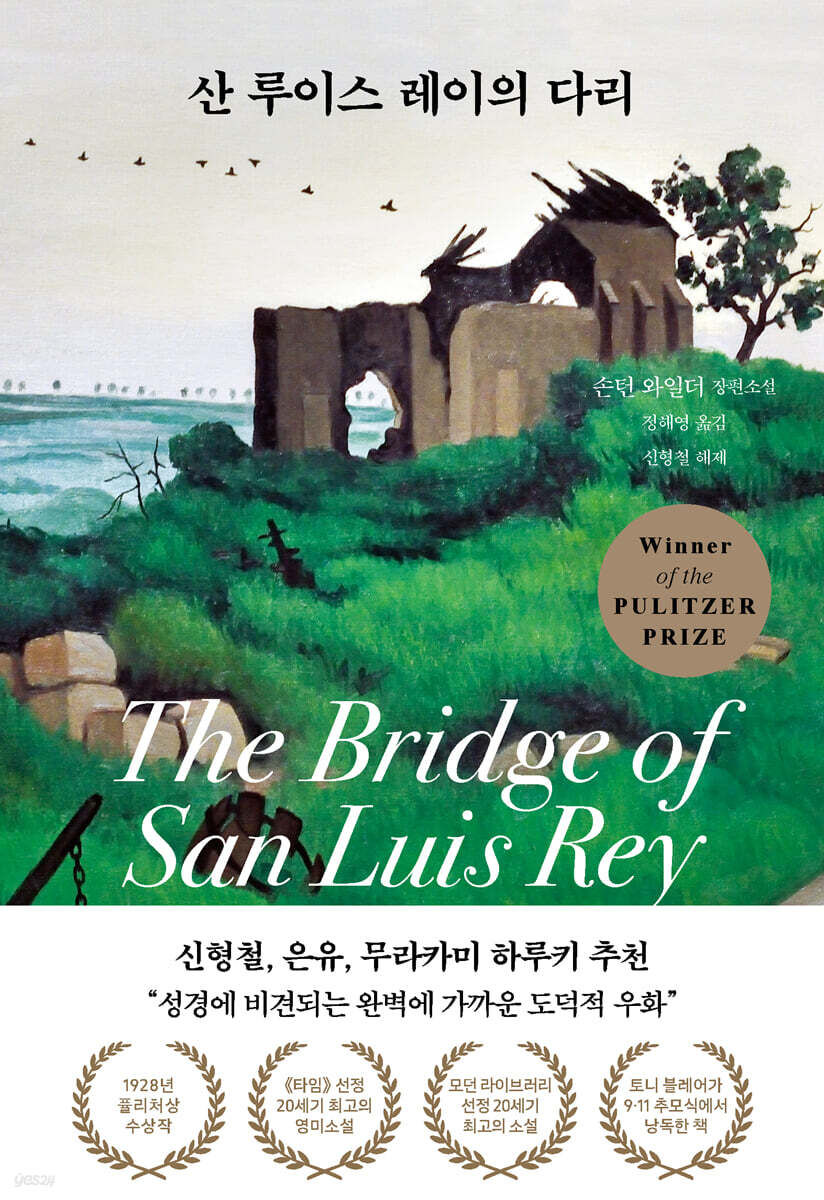
The Bridge of San Luis Rey, the first Pulitzer Prize-winning novel by Thornton Wilder, the only author to have won the Pulitzer Prize for both fiction and drama.
Only when faced with an unexpected tragedy one day do we realize how easily life can fall apart.
Especially when we lose a loved one in an inexplicable accident, we ask ourselves:
"Why did this happen? What is the meaning of it all?" Thornton Wilder's novel The Bridge of San Luis Rey begins with these very questions.
In the early 18th century, the Pont de San Luis Rey, Peru's most magnificent bridge, suddenly collapsed, killing five travelers crossing it.
Franciscan Brother Juniper, who witnessed this tragic accident, investigates the victims' lives to determine whether their deaths were part of God's plan or simply a coincidence.
The novel looks into their lives, asking questions about the meaning of life, love, art, and destiny.
This work, published in 1927, was praised as a “textbook for writers” immediately after its publication and won the Pulitzer Prize in 1928.
It was so popular that 300,000 copies were sold in its first year of publication, and it is also famous for changing the criteria for the Pulitzer Prize, which was previously only awarded to works set in the United States.
The Bridge of San Luis Rey is a work of timeless, universal values, innovative plot, and philosophical reflection, and is still loved by readers around the world today.
“A near-perfect moral fable, comparable to the Bible.”
An immortal classic that comforts the sorrow of the survivors
The Bridge of San Luis Rey, the first Pulitzer Prize-winning novel by Thornton Wilder, the only author to have won the Pulitzer Prize for both fiction and drama.
Only when faced with an unexpected tragedy one day do we realize how easily life can fall apart.
Especially when we lose a loved one in an inexplicable accident, we ask ourselves:
"Why did this happen? What is the meaning of it all?" Thornton Wilder's novel The Bridge of San Luis Rey begins with these very questions.
In the early 18th century, the Pont de San Luis Rey, Peru's most magnificent bridge, suddenly collapsed, killing five travelers crossing it.
Franciscan Brother Juniper, who witnessed this tragic accident, investigates the victims' lives to determine whether their deaths were part of God's plan or simply a coincidence.
The novel looks into their lives, asking questions about the meaning of life, love, art, and destiny.
This work, published in 1927, was praised as a “textbook for writers” immediately after its publication and won the Pulitzer Prize in 1928.
It was so popular that 300,000 copies were sold in its first year of publication, and it is also famous for changing the criteria for the Pulitzer Prize, which was previously only awarded to works set in the United States.
The Bridge of San Luis Rey is a work of timeless, universal values, innovative plot, and philosophical reflection, and is still loved by readers around the world today.
- You can preview some of the book's contents.
Preview
index
Maybe a coincidence
The Marchioness of Montemayor
Esteban
Mr. Pio
Maybe it's God's intention
Release_Shin Hyeong-cheol
Translator's Note_Jeong Hae-young
The Marchioness of Montemayor
Esteban
Mr. Pio
Maybe it's God's intention
Release_Shin Hyeong-cheol
Translator's Note_Jeong Hae-young
Detailed image

Into the book
If it had been anyone else, he would have secretly felt relieved and muttered to himself, “If only I had been ten minutes late, I would have…” But Detective Juniper had a different thought.
“Why did this have to happen to those five people?” If there was a plan to the universe, if there was a pattern to human life, then it was clear that something mysterious would be revealed in the lives of these people, suddenly interrupted.
Do we live by chance and die by chance, or do we live by plan and die by plan?
--- p.14 From "Perhaps Coincidence"
She often asked herself, almost for amusement, as she turned the pages of paper with her jeweled ring-wearing hand.
I wonder if this endless pain has taken root in my heart.
A skilled surgeon, cutting open the broken throne-like heart, would eventually discover some trace.
Then he raises his head and shouts to the students sitting in the stepped lecture hall:
“This woman has suffered greatly, and the suffering has left a mark on her heart.”
--- pp.30-31 From "The Marchioness of Montemayor"
Her daughter's letter, though well-expressed, was full of hurtful words.
I wondered if perhaps it was a clever trick done purely to inflict pain.
Each and every word entered the Marchioness's eyes, was carefully wrapped with understanding and forgiveness, and then permeated her heart.
Finally she got up, gently shooed away the lamas who seemed to sympathize with her, and returned to the holy place with a serious face.
--- p.64 From “The Marchioness of Montemayor”
But it was the first time he had been so deeply immersed in a woman that his will and imagination were overwhelmed.
So we have lost the simple virtue of being able to separate love from pleasure.
Now pleasure was not as simple as eating food.
It got complicated because of love.
Now, I've lost myself to madness, and I've entered a state where I can't think of anything but dramatic thoughts about my loved one.
--- p.85 From "Esteban"
He divided the people of the world into two groups.
There were people who had loved and people who had not.
It was sheer arrogance.
It is argued that those who are incapable of love (more precisely, those who are incapable of feeling the pain of love) cannot be said to be alive, and that they will certainly not live again after death.
--- pp.160-161 From "Uncle Pio"
Like all lonely people, he gave friendship a divine charm.
As I watched people walking down the street laughing together and hugging as they parted ways, and people enjoying dinner together with smiling faces, I imagined, though it was hard to believe, that they were getting immense satisfaction from such intimacy.
--- p.167 From "Uncle Pio"
But we will soon die, and all memory of those five will completely disappear from the face of the earth.
We ourselves will be loved for a while and then forgotten.
But that level of love is enough.
Every impulse of love returns to the love that created it.
Love doesn't even require memories.
There is a land of the living and a land of the dead, and the bridge that connects the two is love.
Only love remains.
Only love has meaning.
--- p.209 From "Perhaps God's Intention"
There is no need to even think about giving the love that should have been given to the five people who went first to someone else later.
As they died, so too do we who remain.
In the sentence 'I love you', what is important is not the subject or the object, but the verb 'love'.
When we feel like refuting that subject and object are very important, the next sentence embraces us.
“Every impulse of love returns to the love that created it.”
--- pp.217-218 From "Annotation: A Spring Hidden in a Spring"
In some ways, living a life of struggling without knowing what will happen next, facing death without preparation, and being remembered for a moment and then forgotten forever can feel futile.
But this novel says that for a while, loving someone and being loved by someone is enough to make life worth living.
“Why did this have to happen to those five people?” If there was a plan to the universe, if there was a pattern to human life, then it was clear that something mysterious would be revealed in the lives of these people, suddenly interrupted.
Do we live by chance and die by chance, or do we live by plan and die by plan?
--- p.14 From "Perhaps Coincidence"
She often asked herself, almost for amusement, as she turned the pages of paper with her jeweled ring-wearing hand.
I wonder if this endless pain has taken root in my heart.
A skilled surgeon, cutting open the broken throne-like heart, would eventually discover some trace.
Then he raises his head and shouts to the students sitting in the stepped lecture hall:
“This woman has suffered greatly, and the suffering has left a mark on her heart.”
--- pp.30-31 From "The Marchioness of Montemayor"
Her daughter's letter, though well-expressed, was full of hurtful words.
I wondered if perhaps it was a clever trick done purely to inflict pain.
Each and every word entered the Marchioness's eyes, was carefully wrapped with understanding and forgiveness, and then permeated her heart.
Finally she got up, gently shooed away the lamas who seemed to sympathize with her, and returned to the holy place with a serious face.
--- p.64 From “The Marchioness of Montemayor”
But it was the first time he had been so deeply immersed in a woman that his will and imagination were overwhelmed.
So we have lost the simple virtue of being able to separate love from pleasure.
Now pleasure was not as simple as eating food.
It got complicated because of love.
Now, I've lost myself to madness, and I've entered a state where I can't think of anything but dramatic thoughts about my loved one.
--- p.85 From "Esteban"
He divided the people of the world into two groups.
There were people who had loved and people who had not.
It was sheer arrogance.
It is argued that those who are incapable of love (more precisely, those who are incapable of feeling the pain of love) cannot be said to be alive, and that they will certainly not live again after death.
--- pp.160-161 From "Uncle Pio"
Like all lonely people, he gave friendship a divine charm.
As I watched people walking down the street laughing together and hugging as they parted ways, and people enjoying dinner together with smiling faces, I imagined, though it was hard to believe, that they were getting immense satisfaction from such intimacy.
--- p.167 From "Uncle Pio"
But we will soon die, and all memory of those five will completely disappear from the face of the earth.
We ourselves will be loved for a while and then forgotten.
But that level of love is enough.
Every impulse of love returns to the love that created it.
Love doesn't even require memories.
There is a land of the living and a land of the dead, and the bridge that connects the two is love.
Only love remains.
Only love has meaning.
--- p.209 From "Perhaps God's Intention"
There is no need to even think about giving the love that should have been given to the five people who went first to someone else later.
As they died, so too do we who remain.
In the sentence 'I love you', what is important is not the subject or the object, but the verb 'love'.
When we feel like refuting that subject and object are very important, the next sentence embraces us.
“Every impulse of love returns to the love that created it.”
--- pp.217-218 From "Annotation: A Spring Hidden in a Spring"
In some ways, living a life of struggling without knowing what will happen next, facing death without preparation, and being remembered for a moment and then forgotten forever can feel futile.
But this novel says that for a while, loving someone and being loved by someone is enough to make life worth living.
--- From the “Translator’s Note” on p.223
Publisher's Review
Life and death, fate and art that transcend time
And a short but powerful story about love
In 1927, about a hundred years ago, Thornton Wilder's novel The Bridge of San Luis Rey was published.
At a time when modernist literature was in its heyday, he completed this work by relying on the simple and refined beauty of classical literature.
The novel sold over 300,000 copies within a year of its publication, an unprecedented success for its time.
The author, Thornton Wilder, was only thirty years old when he wrote this story.
Moreover, beyond its commercial success, this work was praised as a “great literary product,” “a textbook for writers,” and “the greatest work of our time,” and even won the Pulitzer Prize for Fiction in 1928.
At the time, the Pulitzer Prize was awarded to works that captured American life and background well, but this novel set in Peru won the Pulitzer Prize, which changed the criteria for the award.
It was a moment when a masterpiece was born that would not be an exaggeration to say left its mark on the history of literature.
『The Bridge of San Luis Rey』 was first introduced in Korea in 1958 by the publisher Shinyangsa as 『The Bridge of Destiny』, but after going out of print and being republished repeatedly, it was finally translated and published for the fourth time by Clay House in 2025.
Amidst the unusually recurring disasters and catastrophes, Korean society is repeatedly inflicting new wounds before it can even overcome them.
Because the very nature of life is to have to move forward even while bleeding, we are going back nearly a hundred years to read this book once again.
This newly introduced 『The Bridge of San Luis Rey』 features a precise and delicate translation by Jeong Hae-yeong, who also translated 『Gaze at These Ruins』 and 『River Boy』, and an introduction by literary critic Shin Hyeong-cheol, who has declared it to be the book of his life, adding a clear reason why we should still reread this book.
Do we live by chance and die by chance?
Or do we live by the plan and die by the plan?
There are times in life when we face unexpected tragedies, big and small.
And in that moment, we realize how easily life can fall apart, how close we are to death.
Especially when we lose a loved one to an accident, natural disaster, illness, etc., we ask ourselves:
"Why did this happen? What is the meaning of it all?" Thornton Wilder's The Bridge of San Luis Rey begins with these very questions.
At noon on July 20, 1714, Peru's most magnificent bridge suddenly collapsed, killing five travelers.
Detective Juniper, who happened to witness this tragic moment, questions whether their deaths were a mere coincidence or part of God's plan.
He believed that this accident was the perfect opportunity to scientifically prove 'God's intention', and spent six long years researching the victims' lives, leaving behind a dozen volumes of extensive records.
The records detailed the lives of the five victims before their deaths, containing thousands of trivial facts, anecdotes, and related testimonies.
The Marquis of Montemayor, a lonely old woman who longs for her daughter's love; Pepita, a girl who was a loyal maid; Esteban, a young man grieving the loss of his twin brother; Uncle Pio, the patron and mentor of a famous actress; and Don Jaime, a sickly young boy.
As we follow their stories, we discover that they were neither particularly good nor particularly evil, but rather ordinary people, no different from us.
Through their lives, each expressing love in their own way, experiencing loss, and sometimes dreaming of change, however belated, we naturally see reflections of ourselves.
In the face of unbearable loss
What can we really rely on?
Anton Chekhov says:
“The task of literature is not to answer questions, but to ask the right questions.”
Author Thornton Wilder also doesn't give a clear answer to the reasons for the tragedies we experience. Instead, he changes the question, "Why did it happen?" to "Why did we have to live like that?"
And in the final chapter, Wilder leaves us with a small hint, through the words of the Mother Superior, of what we can rely on in the face of unbearable loss.
This passage, which appears in the final chapter, was also read by former British Prime Minister Tony Blair at a memorial service for the victims of the 9/11 terrorist attacks.
“There is a land of the living and a land of the dead, and the bridge that connects them is love.
Only love remains.
“Only love has meaning.”
We live uncertain and unpredictable lives.
But we live in relationships with others, and the traces of love we leave for one another never disappear.
In the end, what connects us and what remains for us is only love.
After closing the book, a lingering feeling of excitement spreads through my heart.
And we are forced to look back at ourselves and our surroundings.
People we pass by every day, people we might not meet tomorrow.
What kind of existence will we be to them? Perhaps we are all crossing a "bridge" between life and death.
Faced with imminent death, how should we live a life of value and meaning? These questions raised by "The Bridge of San Luis Rey" remain relevant even now, nearly a century after its publication, and will likely remain relevant into the distant future.
And a short but powerful story about love
In 1927, about a hundred years ago, Thornton Wilder's novel The Bridge of San Luis Rey was published.
At a time when modernist literature was in its heyday, he completed this work by relying on the simple and refined beauty of classical literature.
The novel sold over 300,000 copies within a year of its publication, an unprecedented success for its time.
The author, Thornton Wilder, was only thirty years old when he wrote this story.
Moreover, beyond its commercial success, this work was praised as a “great literary product,” “a textbook for writers,” and “the greatest work of our time,” and even won the Pulitzer Prize for Fiction in 1928.
At the time, the Pulitzer Prize was awarded to works that captured American life and background well, but this novel set in Peru won the Pulitzer Prize, which changed the criteria for the award.
It was a moment when a masterpiece was born that would not be an exaggeration to say left its mark on the history of literature.
『The Bridge of San Luis Rey』 was first introduced in Korea in 1958 by the publisher Shinyangsa as 『The Bridge of Destiny』, but after going out of print and being republished repeatedly, it was finally translated and published for the fourth time by Clay House in 2025.
Amidst the unusually recurring disasters and catastrophes, Korean society is repeatedly inflicting new wounds before it can even overcome them.
Because the very nature of life is to have to move forward even while bleeding, we are going back nearly a hundred years to read this book once again.
This newly introduced 『The Bridge of San Luis Rey』 features a precise and delicate translation by Jeong Hae-yeong, who also translated 『Gaze at These Ruins』 and 『River Boy』, and an introduction by literary critic Shin Hyeong-cheol, who has declared it to be the book of his life, adding a clear reason why we should still reread this book.
Do we live by chance and die by chance?
Or do we live by the plan and die by the plan?
There are times in life when we face unexpected tragedies, big and small.
And in that moment, we realize how easily life can fall apart, how close we are to death.
Especially when we lose a loved one to an accident, natural disaster, illness, etc., we ask ourselves:
"Why did this happen? What is the meaning of it all?" Thornton Wilder's The Bridge of San Luis Rey begins with these very questions.
At noon on July 20, 1714, Peru's most magnificent bridge suddenly collapsed, killing five travelers.
Detective Juniper, who happened to witness this tragic moment, questions whether their deaths were a mere coincidence or part of God's plan.
He believed that this accident was the perfect opportunity to scientifically prove 'God's intention', and spent six long years researching the victims' lives, leaving behind a dozen volumes of extensive records.
The records detailed the lives of the five victims before their deaths, containing thousands of trivial facts, anecdotes, and related testimonies.
The Marquis of Montemayor, a lonely old woman who longs for her daughter's love; Pepita, a girl who was a loyal maid; Esteban, a young man grieving the loss of his twin brother; Uncle Pio, the patron and mentor of a famous actress; and Don Jaime, a sickly young boy.
As we follow their stories, we discover that they were neither particularly good nor particularly evil, but rather ordinary people, no different from us.
Through their lives, each expressing love in their own way, experiencing loss, and sometimes dreaming of change, however belated, we naturally see reflections of ourselves.
In the face of unbearable loss
What can we really rely on?
Anton Chekhov says:
“The task of literature is not to answer questions, but to ask the right questions.”
Author Thornton Wilder also doesn't give a clear answer to the reasons for the tragedies we experience. Instead, he changes the question, "Why did it happen?" to "Why did we have to live like that?"
And in the final chapter, Wilder leaves us with a small hint, through the words of the Mother Superior, of what we can rely on in the face of unbearable loss.
This passage, which appears in the final chapter, was also read by former British Prime Minister Tony Blair at a memorial service for the victims of the 9/11 terrorist attacks.
“There is a land of the living and a land of the dead, and the bridge that connects them is love.
Only love remains.
“Only love has meaning.”
We live uncertain and unpredictable lives.
But we live in relationships with others, and the traces of love we leave for one another never disappear.
In the end, what connects us and what remains for us is only love.
After closing the book, a lingering feeling of excitement spreads through my heart.
And we are forced to look back at ourselves and our surroundings.
People we pass by every day, people we might not meet tomorrow.
What kind of existence will we be to them? Perhaps we are all crossing a "bridge" between life and death.
Faced with imminent death, how should we live a life of value and meaning? These questions raised by "The Bridge of San Luis Rey" remain relevant even now, nearly a century after its publication, and will likely remain relevant into the distant future.
GOODS SPECIFICS
- Date of issue: May 2, 2025
- Format: Hardcover book binding method guide
- Page count, weight, size: 224 pages | 334g | 128*188*20mm
- ISBN13: 9791193235515
- ISBN10: 1193235510
You may also like
카테고리
korean


korean

![GQ KOREA Mark (Monthly): December [2025]](http://librairie.coreenne.fr/cdn/shop/files/8ef265dbbfbf186523ed75ba7319009d.jpg?v=1765340328&width=3840)


