

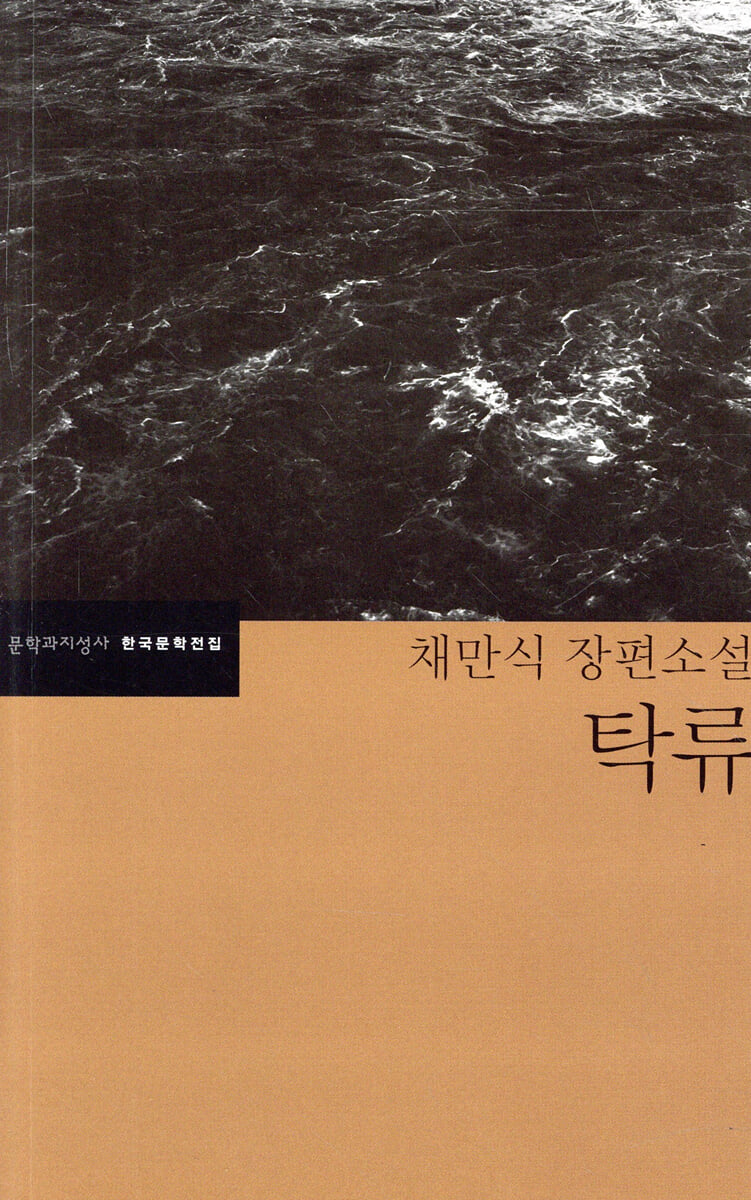
turbid current
 |
Description
Book Introduction
The harm brought about by unchecked capitalism
Can we say that the current situation in 2014 is clear?
Chae Man-sik's masterpiece, "Muddy Stream," which likens the absurd reality of colonial Korea, struggling in the swamp of capital in the 1930s, to the Geumgang River becoming turbid as it reaches its lower reaches, has been published as the forty-second volume in Munhak-kwa-Jiseongsa's Korean Literature Collection.
The work begins with a scene where 'Jeong Ju-sa', who has been misusing money at a rice mill in Gunsan, is insulted by a young man who is old enough to be his son.
Midu is, in modern terms, the equivalent of rice futures trading.
A highly complex and derivative capital growth system like Midu is constantly flowing in, but ordinary people like 'Jeong Ju-sa' are completely oblivious to the structural contradictions and continue to focus only on money, only to end up with their pockets completely emptied.
Chae Man-sik did not dismiss Jeong Ju-sa's behavior, which drove him and his family to ruin, as the twisted desires of an individual.
He detected the pathological structure of society that was encouraging the downfall of ordinary people, and the materialism of the monk was the first point of pain to be found within it.
The rampant slander and fraud surrounding money, which eventually culminates in murder, is not only a social phenomenon of the 1930s, but is still prevalent even now, 80 years later.
Although it deals with a difficult and heavy subject, Chae Man-sik's unique satire, humor, and cynicism make it easy to turn the pages.
It can be said that this is a novel that has all the conditions to become a classic.
Readers interested in novels that deeply root themselves in the world with sharp insights and broaden their scope of critical awareness, while also providing an entertaining narrative through brisk pacing and lively characters, will place "Muddy Stream" at the top of their bookshelves.
Can we say that the current situation in 2014 is clear?
Chae Man-sik's masterpiece, "Muddy Stream," which likens the absurd reality of colonial Korea, struggling in the swamp of capital in the 1930s, to the Geumgang River becoming turbid as it reaches its lower reaches, has been published as the forty-second volume in Munhak-kwa-Jiseongsa's Korean Literature Collection.
The work begins with a scene where 'Jeong Ju-sa', who has been misusing money at a rice mill in Gunsan, is insulted by a young man who is old enough to be his son.
Midu is, in modern terms, the equivalent of rice futures trading.
A highly complex and derivative capital growth system like Midu is constantly flowing in, but ordinary people like 'Jeong Ju-sa' are completely oblivious to the structural contradictions and continue to focus only on money, only to end up with their pockets completely emptied.
Chae Man-sik did not dismiss Jeong Ju-sa's behavior, which drove him and his family to ruin, as the twisted desires of an individual.
He detected the pathological structure of society that was encouraging the downfall of ordinary people, and the materialism of the monk was the first point of pain to be found within it.
The rampant slander and fraud surrounding money, which eventually culminates in murder, is not only a social phenomenon of the 1930s, but is still prevalent even now, 80 years later.
Although it deals with a difficult and heavy subject, Chae Man-sik's unique satire, humor, and cynicism make it easy to turn the pages.
It can be said that this is a novel that has all the conditions to become a classic.
Readers interested in novels that deeply root themselves in the world with sharp insights and broaden their scope of critical awareness, while also providing an entertaining narrative through brisk pacing and lively characters, will place "Muddy Stream" at the top of their bookshelves.
- You can preview some of the book's contents.
Preview
index
Note
human monument
Life Lesson 1
New edition 『Heungbujeon (興甫傳)』
‘… …Life is like a piece of paper for the eyes!’
Lady's Travels
small business
1000,000,000 catfish
On the single-log bridge
The argument of apricot blossoms
Typhoon
Evacuation line
The name of the easygoing person is… …
The shed seeds
Sad Acrobat
Methodology of Appetite
A bouncy morning
Old Boy Training Diary
My Bodhisattva, the Outer Night Car
Overture
main
Commentary on the Work | Tragic Realism and Defeated Individual Desire_Woo Chan-je
Author's chronology
List of works
References
Planning Notes
human monument
Life Lesson 1
New edition 『Heungbujeon (興甫傳)』
‘… …Life is like a piece of paper for the eyes!’
Lady's Travels
small business
1000,000,000 catfish
On the single-log bridge
The argument of apricot blossoms
Typhoon
Evacuation line
The name of the easygoing person is… …
The shed seeds
Sad Acrobat
Methodology of Appetite
A bouncy morning
Old Boy Training Diary
My Bodhisattva, the Outer Night Car
Overture
main
Commentary on the Work | Tragic Realism and Defeated Individual Desire_Woo Chan-je
Author's chronology
List of works
References
Planning Notes
Publisher's Review
The harm brought about by unchecked capitalism
Can we say that the current situation in 2014 is clear?
『Muddy Stream』 Relaunched as Munhak-kwa-Jiseongsa's Korean Literature Collection
Chae Man-sik's masterpiece, "Muddy Stream," which likens the absurd reality of colonial Korea, struggling in the swamp of capital in the 1930s, to the Geumgang River becoming turbid as it reaches its lower reaches, has been published as the forty-second volume in Munhak-kwa-Jiseongsa's Korean Literature Collection.
『Murmur』, along with 『Taepyeongcheonha』, is considered one of the author's representative works. It was serialized in the 『Chosun Ilbo』 from October 12, 1937 to May 17, 1938, for a total of 198 episodes, and the length reached approximately 2,300 pages of 200-character manuscript paper.
Let's meet Chae Man-sik's novel "Muddy Stream," which is always on the must-read lists of leading universities and institutions in Korea, in a refreshing and comfortable edition of the Munhak-kwa-Jiseongsa Korean Literature Collection series.
The series is unrivaled in the Korean modern literature market due to its authenticity through thorough comparison with the original text, footnotes for unfamiliar vocabulary to enhance readability while preserving the spirit of the times reflected in the work, a chronology of the author and his works that unfolds the author's life at a glance, and unique commentary by professors specializing in the subject.
A tragedy that begins with money and spirals out of control into ruin.
The work begins with a scene where 'Jeong Ju-sa', who has been misusing money at a rice mill in Gunsan, is insulted by a young man who is old enough to be his son.
Midu is, in modern terms, the equivalent of rice futures trading.
A highly complex and derivative capital growth system like Midu is constantly flowing in, but ordinary people like 'Jeong Ju-sa' are completely oblivious to the structural contradictions and continue to focus only on money, only to end up with their pockets completely emptied.
Chae Man-sik did not dismiss Jeong Ju-sa's behavior, which drove him and his family to ruin, as the twisted desires of an individual.
He detected the pathological structure of society that was encouraging the downfall of ordinary people, and the materialism of the monk was the first point of pain to be found within it.
The rampant slander and fraud surrounding money, which eventually culminates in murder, is not only a social phenomenon of the 1930s, but is still prevalent even now, 80 years later.
A novelist who wrestled with the turbulent times and directly witnessed the hardships of the times.
After Chae Man-sik made his literary debut in 1925 with the publication of the short story “Segilro” in the Joseon Literature Journal, he portrayed the realities of his time with great keenness through his passionate creative spirit and realist spirit.
In a reality where Japanese colonial policies were strengthened and capitalism was in full swing, he was one of the writers who viewed the fate and reality of the nation with a very negative perspective.
He intuitively perceived the reality in which human life floats without its roots as the evils of devilish capitalism and the problem of anti-national behavior, and showed enthusiasm to seek a new perspective that transcended that reality.
In particular, between 1934 and 1938, Chae Man-sik published many novels that sharply criticized negative reality through satire.
After the Manchurian Incident, Japanese colonial rule was strengthened, and political oppression and economic hardship worsened, making it an inevitable time of cultural hardship.
In short, the writer who wrestled with the turbidity of the times rather than the clear stream, and who tried to bear witness to the hardships of the times through novels and open up a new spirit of prose was none other than Chae Man-sik.
The toxins that arise from unchecked capitalism
The character who leads the narrative of 『Turbulent Stream』 is Chobong.
She is sold into marriage to a conman and lecherous banker named Ko Tae-su because of her father, Jeong Ju-sa, who is blinded by money. However, after barely ten days of marriage, her husband Ko Tae-su is beaten to death by a wicked loan shark named Jang Hyeong-bo. Meanwhile, Jang Hyeong-bo rapes Cho-bong.
Park Je-ho, the owner of a pharmacy who Cho-bong had always trusted and relied on, took advantage of Cho-bong's situation by separating from his wife and taking her as a concubine. However, soon after Cho-bong gave birth to Song-hee, his passion for her faded, and he left the mother and daughter to Jang Hyeong-bo, who showed up claiming custody of Song-hee.
Chobong forces obedience on him and ends up beating Jang Hyeong-bo, who abuses his child, to death with a millstone.
This novel could be summarized as the tragic life story of a poor heroine.
However, if you realize that the unfolding of this tragedy is influenced by the survival of the fittest logic of capital, the story becomes richer.
In this novel, love, humanity, and morality are no longer absolute values, but merely goods to be exchanged for money.
Chobong is annoyed by her father's plan to choose Ko Taesu as her son-in-law instead of Nam Seungjae, a prospective doctor she had her heart set on, but she soon accepts the convenience that Ko Taesu's wealth will bring and adapts. Jang Hyeongbo and Park Jeho, who witnessed that the body and ideals of an individual like Chobong can be bought with money, watch for an opportunity.
Chobong, who had been tormented for half her life in the twisted power structure of men, developed a personality that was once gentle and obedient, but now possesses a venomous nature that is capable of killing people.
The scene where Cho Bong curses Park Je-ho and Jeong Hyeong-bo as if spitting blood at the collusion they are perpetrating over him evokes deep and weighty compassion and foreshadows the murders he will commit later.
“What grudge did I have that you persecute me like this? You wicked bastards!…… I am innocent, untouched, and live without a rustling sound. How can you treat me so rudely…… Oh my, you wicked bastards!” (p.
478)
Still the story of today
Gyebong, Chobong's younger brother, and Seungjae, the prospective doctor whom Chobong initially had a crush on, are the characters portrayed most positively in "The Takryu."
While weaving together the narratives of Chobong and Gyebong and Seungjae, Chae Man-sik constantly examines the origins of the sorrows experienced by the lower class, represented by Chobong.
The conversation between Gyebong and Seungjae in the latter half of the work, who are concerned about the polarization of wealth, is quite meaningful, and as we all know, its relevance continues to this day.
“Well, I want to be poor, but where are the poor people?”
“I guess everyone wants to live a rich life sometimes……”
“I don’t know about the rich, but the poor people these days aren’t that poor. It’s because distribution isn’t fair.”
“Distribution? You say the distribution is not fair?……” (p.
597)
In 2014, this place is still Gunsan from 80 years ago, and many Chobongs still live among us.
They can only maintain a tenuous existence if they accept and obey the order of capital as if poverty were a sin.
These are people whose today is difficult and whose tomorrow is far away.
Meanwhile, capital continues to grow, and the increased money continues to flow to one side.
Chae Man-sik must have written this novel while standing in the middle of a turbid stream and dreaming of a river with clear waters.
However, the author seemed to know that it takes a long time for water that has become cloudy to become clear again, and left the following description.
The small giant, a living entity made up of material, money, and people, had no history of being so bloody or so tragic as to be so fond of the life of a young girl.
[… … ] Meanwhile, the giant walked silently, goods following money, money following goods, people following him, scattering and gathering, gathering and scattering, and so his heart beats without knowing how to grow old… … (pp.
490~91)
Although it deals with difficult and heavy topics, the pages turn without difficulty thanks to the satire, humor, and cynicism unique to Chae Man-sik, as shown in “Readymade Life,” “Chi-suk,” and “Taepyeongcheonha.”
It can be said that this is a novel that has all the conditions to become a classic.
Readers interested in novels that deeply root themselves in the world with sharp insights and broaden their scope of critical awareness, while also providing an entertaining narrative through brisk pacing and lively characters, will place "Muddy Stream" at the top of their bookshelves.
Can we say that the current situation in 2014 is clear?
『Muddy Stream』 Relaunched as Munhak-kwa-Jiseongsa's Korean Literature Collection
Chae Man-sik's masterpiece, "Muddy Stream," which likens the absurd reality of colonial Korea, struggling in the swamp of capital in the 1930s, to the Geumgang River becoming turbid as it reaches its lower reaches, has been published as the forty-second volume in Munhak-kwa-Jiseongsa's Korean Literature Collection.
『Murmur』, along with 『Taepyeongcheonha』, is considered one of the author's representative works. It was serialized in the 『Chosun Ilbo』 from October 12, 1937 to May 17, 1938, for a total of 198 episodes, and the length reached approximately 2,300 pages of 200-character manuscript paper.
Let's meet Chae Man-sik's novel "Muddy Stream," which is always on the must-read lists of leading universities and institutions in Korea, in a refreshing and comfortable edition of the Munhak-kwa-Jiseongsa Korean Literature Collection series.
The series is unrivaled in the Korean modern literature market due to its authenticity through thorough comparison with the original text, footnotes for unfamiliar vocabulary to enhance readability while preserving the spirit of the times reflected in the work, a chronology of the author and his works that unfolds the author's life at a glance, and unique commentary by professors specializing in the subject.
A tragedy that begins with money and spirals out of control into ruin.
The work begins with a scene where 'Jeong Ju-sa', who has been misusing money at a rice mill in Gunsan, is insulted by a young man who is old enough to be his son.
Midu is, in modern terms, the equivalent of rice futures trading.
A highly complex and derivative capital growth system like Midu is constantly flowing in, but ordinary people like 'Jeong Ju-sa' are completely oblivious to the structural contradictions and continue to focus only on money, only to end up with their pockets completely emptied.
Chae Man-sik did not dismiss Jeong Ju-sa's behavior, which drove him and his family to ruin, as the twisted desires of an individual.
He detected the pathological structure of society that was encouraging the downfall of ordinary people, and the materialism of the monk was the first point of pain to be found within it.
The rampant slander and fraud surrounding money, which eventually culminates in murder, is not only a social phenomenon of the 1930s, but is still prevalent even now, 80 years later.
A novelist who wrestled with the turbulent times and directly witnessed the hardships of the times.
After Chae Man-sik made his literary debut in 1925 with the publication of the short story “Segilro” in the Joseon Literature Journal, he portrayed the realities of his time with great keenness through his passionate creative spirit and realist spirit.
In a reality where Japanese colonial policies were strengthened and capitalism was in full swing, he was one of the writers who viewed the fate and reality of the nation with a very negative perspective.
He intuitively perceived the reality in which human life floats without its roots as the evils of devilish capitalism and the problem of anti-national behavior, and showed enthusiasm to seek a new perspective that transcended that reality.
In particular, between 1934 and 1938, Chae Man-sik published many novels that sharply criticized negative reality through satire.
After the Manchurian Incident, Japanese colonial rule was strengthened, and political oppression and economic hardship worsened, making it an inevitable time of cultural hardship.
In short, the writer who wrestled with the turbidity of the times rather than the clear stream, and who tried to bear witness to the hardships of the times through novels and open up a new spirit of prose was none other than Chae Man-sik.
The toxins that arise from unchecked capitalism
The character who leads the narrative of 『Turbulent Stream』 is Chobong.
She is sold into marriage to a conman and lecherous banker named Ko Tae-su because of her father, Jeong Ju-sa, who is blinded by money. However, after barely ten days of marriage, her husband Ko Tae-su is beaten to death by a wicked loan shark named Jang Hyeong-bo. Meanwhile, Jang Hyeong-bo rapes Cho-bong.
Park Je-ho, the owner of a pharmacy who Cho-bong had always trusted and relied on, took advantage of Cho-bong's situation by separating from his wife and taking her as a concubine. However, soon after Cho-bong gave birth to Song-hee, his passion for her faded, and he left the mother and daughter to Jang Hyeong-bo, who showed up claiming custody of Song-hee.
Chobong forces obedience on him and ends up beating Jang Hyeong-bo, who abuses his child, to death with a millstone.
This novel could be summarized as the tragic life story of a poor heroine.
However, if you realize that the unfolding of this tragedy is influenced by the survival of the fittest logic of capital, the story becomes richer.
In this novel, love, humanity, and morality are no longer absolute values, but merely goods to be exchanged for money.
Chobong is annoyed by her father's plan to choose Ko Taesu as her son-in-law instead of Nam Seungjae, a prospective doctor she had her heart set on, but she soon accepts the convenience that Ko Taesu's wealth will bring and adapts. Jang Hyeongbo and Park Jeho, who witnessed that the body and ideals of an individual like Chobong can be bought with money, watch for an opportunity.
Chobong, who had been tormented for half her life in the twisted power structure of men, developed a personality that was once gentle and obedient, but now possesses a venomous nature that is capable of killing people.
The scene where Cho Bong curses Park Je-ho and Jeong Hyeong-bo as if spitting blood at the collusion they are perpetrating over him evokes deep and weighty compassion and foreshadows the murders he will commit later.
“What grudge did I have that you persecute me like this? You wicked bastards!…… I am innocent, untouched, and live without a rustling sound. How can you treat me so rudely…… Oh my, you wicked bastards!” (p.
478)
Still the story of today
Gyebong, Chobong's younger brother, and Seungjae, the prospective doctor whom Chobong initially had a crush on, are the characters portrayed most positively in "The Takryu."
While weaving together the narratives of Chobong and Gyebong and Seungjae, Chae Man-sik constantly examines the origins of the sorrows experienced by the lower class, represented by Chobong.
The conversation between Gyebong and Seungjae in the latter half of the work, who are concerned about the polarization of wealth, is quite meaningful, and as we all know, its relevance continues to this day.
“Well, I want to be poor, but where are the poor people?”
“I guess everyone wants to live a rich life sometimes……”
“I don’t know about the rich, but the poor people these days aren’t that poor. It’s because distribution isn’t fair.”
“Distribution? You say the distribution is not fair?……” (p.
597)
In 2014, this place is still Gunsan from 80 years ago, and many Chobongs still live among us.
They can only maintain a tenuous existence if they accept and obey the order of capital as if poverty were a sin.
These are people whose today is difficult and whose tomorrow is far away.
Meanwhile, capital continues to grow, and the increased money continues to flow to one side.
Chae Man-sik must have written this novel while standing in the middle of a turbid stream and dreaming of a river with clear waters.
However, the author seemed to know that it takes a long time for water that has become cloudy to become clear again, and left the following description.
The small giant, a living entity made up of material, money, and people, had no history of being so bloody or so tragic as to be so fond of the life of a young girl.
[… … ] Meanwhile, the giant walked silently, goods following money, money following goods, people following him, scattering and gathering, gathering and scattering, and so his heart beats without knowing how to grow old… … (pp.
490~91)
Although it deals with difficult and heavy topics, the pages turn without difficulty thanks to the satire, humor, and cynicism unique to Chae Man-sik, as shown in “Readymade Life,” “Chi-suk,” and “Taepyeongcheonha.”
It can be said that this is a novel that has all the conditions to become a classic.
Readers interested in novels that deeply root themselves in the world with sharp insights and broaden their scope of critical awareness, while also providing an entertaining narrative through brisk pacing and lively characters, will place "Muddy Stream" at the top of their bookshelves.
GOODS SPECIFICS
- Date of issue: January 22, 2014
- Page count, weight, size: 758 pages | 750g | 132*212*40mm
- ISBN13: 9788932025322
- ISBN10: 8932025320
You may also like
카테고리
korean


korean

![ELLE 엘르 스페셜 에디션 A형 : 12월 [2025]](http://librairie.coreenne.fr/cdn/shop/files/b8e27a3de6c9538896439686c6b0e8fb.jpg?v=1766436872&width=3840)


