

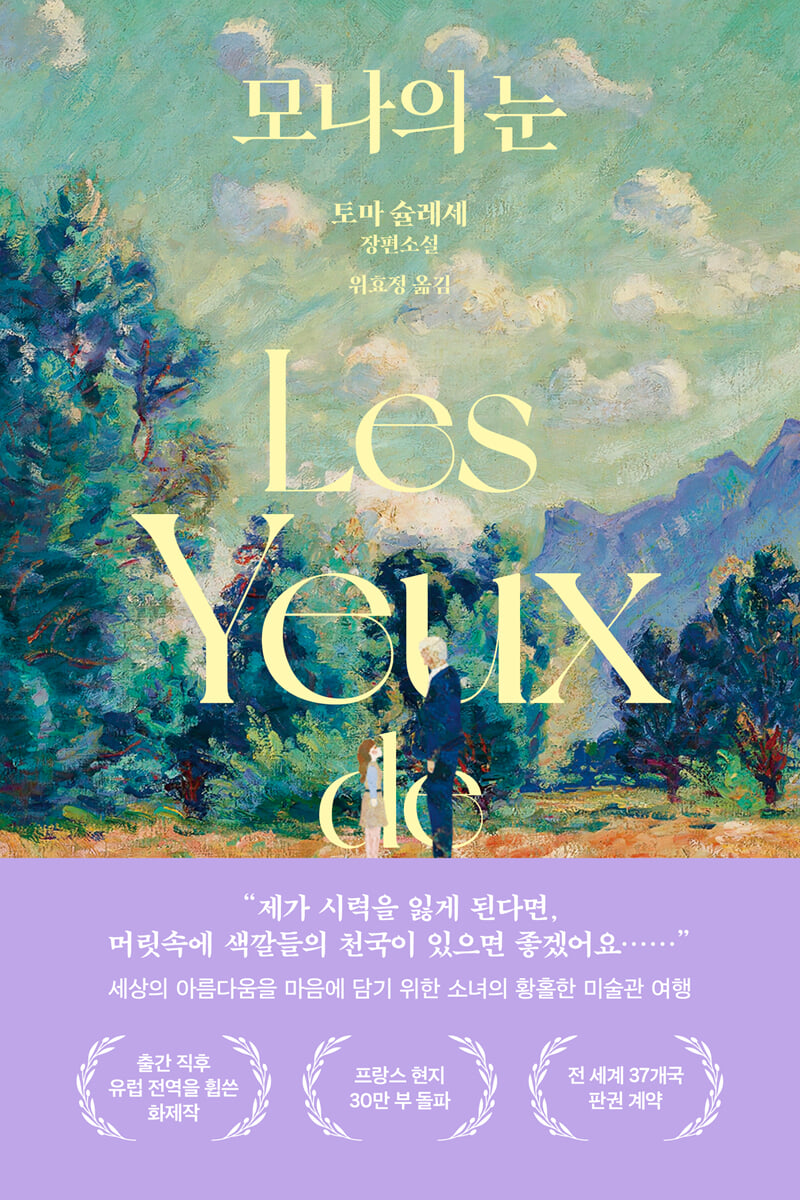
Mona's Eyes
 |
Description
Book Introduction
“If I were to lose my sight,
I wish there was a paradise of colors in my head… … ”
A girl's enchanting art gallery journey to capture the beauty of the world.
A novel that captivated publishers around the world.
An artistic version of "Sophie's World," with added sophistication and sensibility._Livre Hebdo
The Korean edition of "Mona's Eyes," a hit that swept across Europe immediately after its publication, has been published.
It was praised as an artistic novel that brilliantly combined literary quality, emotion, and intelligence.
Thomas Schlesser's novel Mona's Eyes is a work that depicts a year in the life of Mona, a girl on the verge of losing her eyesight, and her grandfather, Henri, who decides to go to the art museum with his granddaughter every week.
Since its publication in France in early 2024, it has received rave reviews from readers and has sold approximately 300,000 copies to date.
Publishers from all over Europe, the UK, the US, and Asia showed great interest, and the book was licensed in 37 countries around the world. It was also introduced as a hot topic at the Frankfurt Book Fair, the world's largest book fair, and all copies were sold out.
The press in France, Italy, and Spain praised it as "a literary phenomenon," "a story that encompasses the entire world, not just an art novel," and "a unique novel that combines literary quality, sensibility, and intelligence, far from being clichéd."
Thomas Schlesse is a French art historian.
He has taught art history for about 20 years and supports the art world as a board member of the Artung-Bergman Foundation, which builds on the legacy of the contemporary painters Hans Artung and Annaeva Bergman.
In addition, he has written various books, mainly researching the relationship between art and politics in the 19th and 20th centuries, and won the 2025 Trophée des Éditions Author of the Year, a French publishing culture award, for his second full-length novel, Mona's Eyes.
"Mona's Eyes" is a masterpiece that brilliantly expresses his values that art can truly help human life, and is a decisive work filled with his earnest desire to write a good novel.
I wish there was a paradise of colors in my head… … ”
A girl's enchanting art gallery journey to capture the beauty of the world.
A novel that captivated publishers around the world.
An artistic version of "Sophie's World," with added sophistication and sensibility._Livre Hebdo
The Korean edition of "Mona's Eyes," a hit that swept across Europe immediately after its publication, has been published.
It was praised as an artistic novel that brilliantly combined literary quality, emotion, and intelligence.
Thomas Schlesser's novel Mona's Eyes is a work that depicts a year in the life of Mona, a girl on the verge of losing her eyesight, and her grandfather, Henri, who decides to go to the art museum with his granddaughter every week.
Since its publication in France in early 2024, it has received rave reviews from readers and has sold approximately 300,000 copies to date.
Publishers from all over Europe, the UK, the US, and Asia showed great interest, and the book was licensed in 37 countries around the world. It was also introduced as a hot topic at the Frankfurt Book Fair, the world's largest book fair, and all copies were sold out.
The press in France, Italy, and Spain praised it as "a literary phenomenon," "a story that encompasses the entire world, not just an art novel," and "a unique novel that combines literary quality, sensibility, and intelligence, far from being clichéd."
Thomas Schlesse is a French art historian.
He has taught art history for about 20 years and supports the art world as a board member of the Artung-Bergman Foundation, which builds on the legacy of the contemporary painters Hans Artung and Annaeva Bergman.
In addition, he has written various books, mainly researching the relationship between art and politics in the 19th and 20th centuries, and won the 2025 Trophée des Éditions Author of the Year, a French publishing culture award, for his second full-length novel, Mona's Eyes.
"Mona's Eyes" is a masterpiece that brilliantly expresses his values that art can truly help human life, and is a decisive work filled with his earnest desire to write a good novel.
- You can preview some of the book's contents.
Preview
index
Prologue Nothing more to see
Part 1 Louvre
1.
Sandro Botticelli - Learn to Receive
2.
Leonardo da Vinci - Smile at Life
3.
Raphael Sanzio - Cultivate Detachment
4.
Titian Vecellio - Trust your imagination
5.
Michelangelo Buonarroti - Free yourself from matter
6.
Frans Hals - Respect the insignificant
7.
Rembrandt van Rijn - Know Thyself
8.
Johannes Vermeer - The infinitely small is infinitely great.
9.
Nicolas Poussin - Nothing should make you tremble
10.
Philippe de Champagne - Always believe that miracles can happen.
11.
Antoine Watteau - The Festival is Ripe and Gloomy
12.
Antonio Canaletto - Stop the World
13.
Thomas Gainsborough - Don't suppress your emotions.
14.
Marguerite Gérard - There is no such thing as weak sex.
15.
Jacques-Louis David - Use antiquity to shape your future.
16.
Marie-Guillemin Benoit - Abolish all discrimination
17.
Francisco Goya - Monsters Lurk Everywhere
18.
Caspar David Friedrich - Close the Eyes of the Body
19.
William Turner - All is dust
Part 2 Orsay
20.
Gustave Courbet - Shout loudly and walk proudly
21.
Henri Fantin-Latour - The dead dwell among the living
22.
Rosa Bonheur - Animals are your equal
23.
James Whistler - There is nothing more noble than a mother.
24.
Julia Margaret Cameron - Blurry is called reality
25.
Edouard Manet - Less is more
26.
Claude Monet - Everything Flows
27.
Edgar Degas - You have to dance your life.
28.
Paul Cézanne - Come, fight, carve your name, hold on
29.
Edward Burne-Jones - Cherish Melancholy
30.
Vincent van Gogh - Settle the Vertigo
31.
Camille Claudel - Love is desire, and desire is lack.
32.
Gustav Klimt - May the death drive live and breathe
33.
Wilhelm Hammershøi - Let your inner self speak
34.
Piet Mondrian - Simplify
Part 3 Beaubourg
35.
Wassily Kandinsky - Find the soul in everything
36.
Marcel Duchamp - Make havoc everywhere
37.
Kazimir Malevich - Develop Autonomy
38.
Georgia O'Keeffe - The World is Flesh
39.
René Magritte - Listen to your unconscious
40.
Constantin Brancusi - Lift Your Eyes
41.
Hannah Höch - Construct Your Own Being
42.
Frida Kahlo - What doesn't kill me makes me stronger
43.
Pablo Picasso - Everything must be destroyed
44.
Jackson Pollock - You have to be crazy
45.
Niki de Saint Phalle - The future of man is woman
46.
Hans Hartung - Go like lightning
47.
Annaeva Bergman - Always start from zero again
48.
Jean-Michel Basquiat - Bring Me Out of the Darkness
49.
Louise Bourgeois - You have to know how to say no.
50.
Marina Abramovic - Breakups are opportunities to be seized.
51.
Christian Boltanski - Archiving Life
52.
Pierre Soulages - Black is also a color
Epilogue Face the Danger
Works included in the appendix
Part 1 Louvre
1.
Sandro Botticelli - Learn to Receive
2.
Leonardo da Vinci - Smile at Life
3.
Raphael Sanzio - Cultivate Detachment
4.
Titian Vecellio - Trust your imagination
5.
Michelangelo Buonarroti - Free yourself from matter
6.
Frans Hals - Respect the insignificant
7.
Rembrandt van Rijn - Know Thyself
8.
Johannes Vermeer - The infinitely small is infinitely great.
9.
Nicolas Poussin - Nothing should make you tremble
10.
Philippe de Champagne - Always believe that miracles can happen.
11.
Antoine Watteau - The Festival is Ripe and Gloomy
12.
Antonio Canaletto - Stop the World
13.
Thomas Gainsborough - Don't suppress your emotions.
14.
Marguerite Gérard - There is no such thing as weak sex.
15.
Jacques-Louis David - Use antiquity to shape your future.
16.
Marie-Guillemin Benoit - Abolish all discrimination
17.
Francisco Goya - Monsters Lurk Everywhere
18.
Caspar David Friedrich - Close the Eyes of the Body
19.
William Turner - All is dust
Part 2 Orsay
20.
Gustave Courbet - Shout loudly and walk proudly
21.
Henri Fantin-Latour - The dead dwell among the living
22.
Rosa Bonheur - Animals are your equal
23.
James Whistler - There is nothing more noble than a mother.
24.
Julia Margaret Cameron - Blurry is called reality
25.
Edouard Manet - Less is more
26.
Claude Monet - Everything Flows
27.
Edgar Degas - You have to dance your life.
28.
Paul Cézanne - Come, fight, carve your name, hold on
29.
Edward Burne-Jones - Cherish Melancholy
30.
Vincent van Gogh - Settle the Vertigo
31.
Camille Claudel - Love is desire, and desire is lack.
32.
Gustav Klimt - May the death drive live and breathe
33.
Wilhelm Hammershøi - Let your inner self speak
34.
Piet Mondrian - Simplify
Part 3 Beaubourg
35.
Wassily Kandinsky - Find the soul in everything
36.
Marcel Duchamp - Make havoc everywhere
37.
Kazimir Malevich - Develop Autonomy
38.
Georgia O'Keeffe - The World is Flesh
39.
René Magritte - Listen to your unconscious
40.
Constantin Brancusi - Lift Your Eyes
41.
Hannah Höch - Construct Your Own Being
42.
Frida Kahlo - What doesn't kill me makes me stronger
43.
Pablo Picasso - Everything must be destroyed
44.
Jackson Pollock - You have to be crazy
45.
Niki de Saint Phalle - The future of man is woman
46.
Hans Hartung - Go like lightning
47.
Annaeva Bergman - Always start from zero again
48.
Jean-Michel Basquiat - Bring Me Out of the Darkness
49.
Louise Bourgeois - You have to know how to say no.
50.
Marina Abramovic - Breakups are opportunities to be seized.
51.
Christian Boltanski - Archiving Life
52.
Pierre Soulages - Black is also a color
Epilogue Face the Danger
Works included in the appendix
Detailed image

Into the book
The pile of rocks behind [La Gioconda], the monkey carved behind Michelangelo's [The Dying Slave], the surprised expression of the blond curly-haired child to the right of [Oath of the Horatii], the strange gelatinous kidney of Goya's [Lamb], the clods of earth in Rosa Bonheur's [The Ploughing in the Nivernais], Whistler's butterfly-shaped signature in his mother's portrait, the tottering little posterior of a church painted by van Gogh... ...and Kandinsky's colors, Picasso's cracks, Soulage's ultra-black.
All of this came pouring in like signals, each pleading to be seen, heard, understood, and loved.
--- p.32
The two walked hand in hand toward the most famous room in the Louvre Palace.
Countless tourists flock there, bewildered, hoping to experience something, but most of them fail, as there are no particularly effective clues to interpret the work.
Henry had thought about this.
The expectations for this painting, so famous and reproduced millions of times, are bound to be enormous, and the disappointments are proportionately high.
So everyone is asking themselves in a state of frustration.
Why is this the most widely known, most highly regarded, and most admired work of art? Why does it not resonate with my sensibilities?
--- p.49
“Vermeer worked alone, content to create whatever scenes he could in the small rooms of his Delft house.
So he never had to leave his quiet life, and when he died, there were almost no records or materials left about him.
So it took time to properly evaluate his worth and discover his truly unique qualities.
I would say that it also required the genius of some viewers.
“Great geniuses need a sharp and perceptive audience, Mona!”
--- p.117
“It is the duty of this good clown to provide entertainment to the people by being faithful to his role, but somehow he seems to be straying from that role.
Every festival has a backstage, and we're in the heart of that backstage.
And that heart is not crushed.
It's still there.
Oh, what the painter depicts is not dark misery.
“I just drew the blank expression of someone tired of entertaining others.” “Harvey, that [Clown] is so sad… … With his nose and cheeks all red, it looks like he just cried… … How can we tell him that we like him?” “Just look at him like you are doing now.”
--- p.153
“This work was a cry in the hushed atmosphere of the social world.
It was a call to gather for a new role for art, and a call for such art to 'walk proudly' without being crushed by the conventions of criticism or the academy.
This cry from the depths of the lungs, filled with sincerity, is called 'realism'.
An artistic movement that, above all, vows to reproduce the truth, while trying to make us feel all the aspects of reality, even its harshness and contradictions, as they are.
Life is inherently imperfect.
But there is a joy in living there.”
--- p.254
Mona was particularly drawn to the bright tones that gave the animals' fur a quivering vibrancy.
I also looked closely at the furrows of the cultivated land bordering the grassy ground, the soil of which was a dark brown.
Mona reproached herself.
'Oh! Harvey is urging us to look at the work intellectually, and I'm thinking of Willy Wonka and the Chocolate River from Charlie and the Chocolate Factory!' The child's mouth watered.
(…) Rosa Bonheur used glassy techniques to achieve an almost appetizing effect, so that the furrows covered with large, clods of earth looked like cacao beans.
--- p.271
“This wonderful name was originally a swear word.
In 1874, an art critic named Louis Leroy saw Monet's painting [Impression, Sunrise] and sarcastically described it as "impressionistic."
What I really regret is the vagueness of the picture, the touch that only hints at something and leaves it lacking in conclusion.
He was close to Monet and lumped together artists who painted in the same style as him, including Renoir, Pissarro, Sisley, and Morisot, as "Impressionists."
What should I do after hearing such abuse? Resignation? Protest? Monet had a much smarter idea.
I took that and put it up as a flag.
He turned an insult into a boast.
Thus, today, Impressionism has become the most famous and most beloved school in the world.”
--- p.320
“What this work tells us is that life shouldn’t just be about living.
Life also needs to be danced.
It's okay if our actions, our movements, our behaviors sometimes deviate from the ordinary flow of things, the mechanical and endless continuity of conventions and constraints.
It's okay to fall a little bit.
“If that’s what it takes to dance your life.”
--- p.332
The child casts no shadows anywhere, and no element is pushed far into the background from the viewpoint.
All motifs have equal importance.
So you could draw a bird in the same proportions as a car.
This is because every time a child adds another motif, he or she wants to make the protagonist the same as the other one.
There is no way to subordinate weak elements to one strong element, or to elevate one over the other.
The same goes for Cezanne.
Mona burst out laughing.
"I didn't understand anything from my grandfather's explanation! Damn it," Henri grumbled instead of answering.
It's not easy, having to make the kids understand their own genius...
--- p.339
He asked his grandfather to lean over so he could whisper in his ear the impression he had received.
What suddenly struck me as so amusing was the thought that van Gogh had painted the buttocks of that sacred 12th-century building, that the artist, when painting a reclining beast, would frame the buttocks, not the head.
“Look, that’s a church butt!” My goodness, this kid’s imagination is truly out of control… … Henri thought to himself.
But it was a review that stood out for its intuitiveness.
I liked the way you saw Van Gogh as a troublemaker.
After all, isn't madness just a carnival full of troubles with oneself?
--- p.362
Mona found Guillaume infinitely beautiful, and as she felt his gaze on her, she felt as if she too was becoming beautiful through a mirror effect, a vaguely repulsive yet deeply ecstatic confusion.
With one accord they wanted to burst the shell of their childhood with a tremendous scream and embrace each other with both arms.
Mona remained silent and Guillaume said nothing.
Mona held her breath and Guillaume didn't move at all.
There was never a time when we could tell each other how wonderful it was that we had met like this in the early morning hours of life.
--- p.378
“It is the audience that creates the work.” The child smiled.
As I savored that decisive sentence, I realized that even I, a young girl, played an important role every time I went to the art museum.
The paintings, sculptures, photographs, and drawings stored in the museum became brighter and more vivid thanks to him.
They have gained their true form and even meaning thanks to you.
--- p.429
“What does Picasso do? He dislocates reality, turns its surface inside out.
In the process, reality ceases to be smooth and flat and suddenly becomes bumpy and angular, broken and bulging.
Mona, I actually think this.
Picasso said he wanted his paintings to have the same effect as the eyelashes in your eyes.
He probably wanted the audience to be overcome with visual discomfort when viewing his work.
Henri Matisse, Picasso's great friend and rival, once said that a painting is like a good armchair that relieves physical fatigue.
[Obad] is the complete opposite.
The painting plunges us into the harshness of the world.
“Here, even the mattresses are like a prison, as you said.”
--- p.497
The child would sometimes make this gesture as if he was sorry for being Mona.
I was worried that closing my eyes and experiencing Maria Abramović's installation might have upset Henri.
But he knew very well that Mona was trying to tame the misfortune that lurked in the dark by such actions.
But that was the most amazing part.
We actually did it.
Marina Abramović's work proved to the child that even in the darkness the abysses of the world still stir, that existence does not remain only in the light of day.
In other words, Mona enjoyed that dark moment, and rather than struggling in the darkness, she immersed herself in it and swam in it.
Being caught in the darkness has become a little less scary.
Just a little bit.
All of this came pouring in like signals, each pleading to be seen, heard, understood, and loved.
--- p.32
The two walked hand in hand toward the most famous room in the Louvre Palace.
Countless tourists flock there, bewildered, hoping to experience something, but most of them fail, as there are no particularly effective clues to interpret the work.
Henry had thought about this.
The expectations for this painting, so famous and reproduced millions of times, are bound to be enormous, and the disappointments are proportionately high.
So everyone is asking themselves in a state of frustration.
Why is this the most widely known, most highly regarded, and most admired work of art? Why does it not resonate with my sensibilities?
--- p.49
“Vermeer worked alone, content to create whatever scenes he could in the small rooms of his Delft house.
So he never had to leave his quiet life, and when he died, there were almost no records or materials left about him.
So it took time to properly evaluate his worth and discover his truly unique qualities.
I would say that it also required the genius of some viewers.
“Great geniuses need a sharp and perceptive audience, Mona!”
--- p.117
“It is the duty of this good clown to provide entertainment to the people by being faithful to his role, but somehow he seems to be straying from that role.
Every festival has a backstage, and we're in the heart of that backstage.
And that heart is not crushed.
It's still there.
Oh, what the painter depicts is not dark misery.
“I just drew the blank expression of someone tired of entertaining others.” “Harvey, that [Clown] is so sad… … With his nose and cheeks all red, it looks like he just cried… … How can we tell him that we like him?” “Just look at him like you are doing now.”
--- p.153
“This work was a cry in the hushed atmosphere of the social world.
It was a call to gather for a new role for art, and a call for such art to 'walk proudly' without being crushed by the conventions of criticism or the academy.
This cry from the depths of the lungs, filled with sincerity, is called 'realism'.
An artistic movement that, above all, vows to reproduce the truth, while trying to make us feel all the aspects of reality, even its harshness and contradictions, as they are.
Life is inherently imperfect.
But there is a joy in living there.”
--- p.254
Mona was particularly drawn to the bright tones that gave the animals' fur a quivering vibrancy.
I also looked closely at the furrows of the cultivated land bordering the grassy ground, the soil of which was a dark brown.
Mona reproached herself.
'Oh! Harvey is urging us to look at the work intellectually, and I'm thinking of Willy Wonka and the Chocolate River from Charlie and the Chocolate Factory!' The child's mouth watered.
(…) Rosa Bonheur used glassy techniques to achieve an almost appetizing effect, so that the furrows covered with large, clods of earth looked like cacao beans.
--- p.271
“This wonderful name was originally a swear word.
In 1874, an art critic named Louis Leroy saw Monet's painting [Impression, Sunrise] and sarcastically described it as "impressionistic."
What I really regret is the vagueness of the picture, the touch that only hints at something and leaves it lacking in conclusion.
He was close to Monet and lumped together artists who painted in the same style as him, including Renoir, Pissarro, Sisley, and Morisot, as "Impressionists."
What should I do after hearing such abuse? Resignation? Protest? Monet had a much smarter idea.
I took that and put it up as a flag.
He turned an insult into a boast.
Thus, today, Impressionism has become the most famous and most beloved school in the world.”
--- p.320
“What this work tells us is that life shouldn’t just be about living.
Life also needs to be danced.
It's okay if our actions, our movements, our behaviors sometimes deviate from the ordinary flow of things, the mechanical and endless continuity of conventions and constraints.
It's okay to fall a little bit.
“If that’s what it takes to dance your life.”
--- p.332
The child casts no shadows anywhere, and no element is pushed far into the background from the viewpoint.
All motifs have equal importance.
So you could draw a bird in the same proportions as a car.
This is because every time a child adds another motif, he or she wants to make the protagonist the same as the other one.
There is no way to subordinate weak elements to one strong element, or to elevate one over the other.
The same goes for Cezanne.
Mona burst out laughing.
"I didn't understand anything from my grandfather's explanation! Damn it," Henri grumbled instead of answering.
It's not easy, having to make the kids understand their own genius...
--- p.339
He asked his grandfather to lean over so he could whisper in his ear the impression he had received.
What suddenly struck me as so amusing was the thought that van Gogh had painted the buttocks of that sacred 12th-century building, that the artist, when painting a reclining beast, would frame the buttocks, not the head.
“Look, that’s a church butt!” My goodness, this kid’s imagination is truly out of control… … Henri thought to himself.
But it was a review that stood out for its intuitiveness.
I liked the way you saw Van Gogh as a troublemaker.
After all, isn't madness just a carnival full of troubles with oneself?
--- p.362
Mona found Guillaume infinitely beautiful, and as she felt his gaze on her, she felt as if she too was becoming beautiful through a mirror effect, a vaguely repulsive yet deeply ecstatic confusion.
With one accord they wanted to burst the shell of their childhood with a tremendous scream and embrace each other with both arms.
Mona remained silent and Guillaume said nothing.
Mona held her breath and Guillaume didn't move at all.
There was never a time when we could tell each other how wonderful it was that we had met like this in the early morning hours of life.
--- p.378
“It is the audience that creates the work.” The child smiled.
As I savored that decisive sentence, I realized that even I, a young girl, played an important role every time I went to the art museum.
The paintings, sculptures, photographs, and drawings stored in the museum became brighter and more vivid thanks to him.
They have gained their true form and even meaning thanks to you.
--- p.429
“What does Picasso do? He dislocates reality, turns its surface inside out.
In the process, reality ceases to be smooth and flat and suddenly becomes bumpy and angular, broken and bulging.
Mona, I actually think this.
Picasso said he wanted his paintings to have the same effect as the eyelashes in your eyes.
He probably wanted the audience to be overcome with visual discomfort when viewing his work.
Henri Matisse, Picasso's great friend and rival, once said that a painting is like a good armchair that relieves physical fatigue.
[Obad] is the complete opposite.
The painting plunges us into the harshness of the world.
“Here, even the mattresses are like a prison, as you said.”
--- p.497
The child would sometimes make this gesture as if he was sorry for being Mona.
I was worried that closing my eyes and experiencing Maria Abramović's installation might have upset Henri.
But he knew very well that Mona was trying to tame the misfortune that lurked in the dark by such actions.
But that was the most amazing part.
We actually did it.
Marina Abramović's work proved to the child that even in the darkness the abysses of the world still stir, that existence does not remain only in the light of day.
In other words, Mona enjoyed that dark moment, and rather than struggling in the darkness, she immersed herself in it and swam in it.
Being caught in the darkness has become a little less scary.
Just a little bit.
--- p.567
Publisher's Review
A grandfather decides to take his granddaughter to an art museum to help her lose her sight.
A heartwarming year for those seeking to capture the beauty of the world in their hearts.
Mona, a ten-year-old girl living in Paris, suddenly loses her sight while doing her homework at home one day.
Fortunately, her eyesight is restored as her shocked parents rush her to the hospital.
After a thorough examination, the doctor found no abnormalities in Mona's eyes, but recommended psychiatric counseling as the dangerous accident may have been caused by psychological factors.
The parents return home too frightened to ask, “Can Mona go blind again?”
But Mona's grandfather, Henriman, looks at this situation coolly.
"A psychiatrist? So, is she really blind?" And at that moment, a completely different treatment for Mona popped into his head.
I take Mona to the art museum every week.
To the place where the most beautiful and magnificent works of mankind are preserved.
Even if the day comes when Mona loses her eyesight, I pray that a reservoir filled with the true beauty of the world will be created in the child's heart.
“I take Mona with me every Wednesday afternoon.
From now on, this regular psychiatric consultation will be Mona and I's job.
Do you agree?
Mona had to go with him to the place where the most beautiful and most human things created in the world were preserved.
I had to go to the art museum with him.
Even if, by some unfortunate chance, Mona's eyesight were to fail her forever, at least she would be able to draw various visual radiances from the reservoir deep within her mind.
Grandfather made a plan… … Once a week, without fail, he would take Mona by the hand and take her to the art gallery to look at one work of art, just one work of art.
At first, I will gaze silently for a long time, allowing the infinite delicacy of colors and lines to penetrate my granddaughter's heart.
After that, I will go beyond the stage of visual delight and put it into words so that you can understand how artists tell us about life and how they brighten it.
(Main text, p. 31)
He knew that life is worth living only when it embraces its bitterness, and that bitterness, once filtered through the sieve of time, reveals the precious and fertile material, the beautiful and useful substance, that makes up true life.
Moreover, thanks to the miracles of childhood, Mona's babbling soon disappeared.
The child began to walk cheerfully and hum.
In these incredibly moving moments, Henri never disturbed Mona.
Then, as they neared the house, Mona suddenly stopped.
The lie they had concocted to avoid seeing a child psychiatrist came back to mind.
The child turned to his grandfather with big, blue eyes wide open and a tomboyish face, smiled, and told him a trick he would use on his parents.
“Harvey, what do you say when Mom and Dad ask you the name of the doctor you’re seeing today?” “Tell them it’s Dr. Botticelli.” (Page 45)
In this way, Mona and her grandfather's secret art museum tour unfolds at the three major art museums in Paris: the Louvre, Orsay, and Beaubourg (Centre Pompidou).
By focusing on just one work per week, you will appreciate a total of 52 works over the course of a year and discover the messages contained within them.
Through this wondrous journey, the questions, sorrows, and fears buried deep within young Mona's heart finally rise to the surface, and the secret behind her sudden blindness crisis is also revealed... ... At the end of her journey, when Mona faces the moment when she must overcome the crisis on her own, will she be able to find the courage?
About the belief and miracle that the power of art can save lives.
Unique and clear messages from three major art museums in Paris.
What Henri asked of Mona was to look at the work of that day in silence for as long as possible and then to tell her what she felt, without holding back.
It would have been difficult for a ten-year-old to achieve such concentration, but as she looked at a work of art each week with her grandfather, Mona's eyes and mind quickly absorbed the wondrous and powerful power of art.
The first work Henri chose for his precious granddaughter was Botticelli's [Venus and the Three Graces].
It was a scene where three goddesses who love to give gave gifts to a young woman.
Henri explains that these goddesses 'symbolize the three stages that make humans social beings' and wants to tell his granddaughter Mona about important elements of life.
“These goddesses are said to symbolize the three stages that make us social beings, welcoming beings, that is, what makes humans truly human.”
“Three steps? What are they?”
“The first step is knowing how to give, the third is knowing how to give back.
And between the two there is a second step, without which nothing can be done.”
“Harvey, what is that?”
“Look.
“What is the young woman on the right doing?”
“Harvey told me that I was lucky enough to receive a gift…”
“That’s correct, Mona.
The woman receives a gift.
And that's absolutely crucial.
Know how to receive.
What this fresco is saying is that we must learn to receive.
To accomplish great and beautiful things, human nature must be prepared to accept them.
To accept the goodwill of others, the desire of others to give joy, to accept what one does not yet have, what one cannot yet become.
There will be plenty of time to return what you have received.
But to give back, that is, to give again, you must first be able to receive.
Do you understand, Mona? (Page 43)
From here, Henri and Mona's journey takes them through classical masters (Botticelli, da Vinci, Michelangelo), Impressionist masters (Manet, Monet, Degas), geniuses who built unique worlds (Rembrandt, van Gogh, Klimt, Picasso), painters who fought against constraints and hardships (Gérard, Benoit, Claudel, Kahlo), and individualists who expanded the world of art (Duchamp, Pollock, Basquiat, Abramović).
The unique and clear message of life, woven through the colorful colors and techniques of these unique works and the exploration of the painters' turbulent lives and historical contexts, serves as a beautiful and reliable guide for Mona as she embarks on the fearful yet exciting path of growth.
A heartwarming year for those seeking to capture the beauty of the world in their hearts.
Mona, a ten-year-old girl living in Paris, suddenly loses her sight while doing her homework at home one day.
Fortunately, her eyesight is restored as her shocked parents rush her to the hospital.
After a thorough examination, the doctor found no abnormalities in Mona's eyes, but recommended psychiatric counseling as the dangerous accident may have been caused by psychological factors.
The parents return home too frightened to ask, “Can Mona go blind again?”
But Mona's grandfather, Henriman, looks at this situation coolly.
"A psychiatrist? So, is she really blind?" And at that moment, a completely different treatment for Mona popped into his head.
I take Mona to the art museum every week.
To the place where the most beautiful and magnificent works of mankind are preserved.
Even if the day comes when Mona loses her eyesight, I pray that a reservoir filled with the true beauty of the world will be created in the child's heart.
“I take Mona with me every Wednesday afternoon.
From now on, this regular psychiatric consultation will be Mona and I's job.
Do you agree?
Mona had to go with him to the place where the most beautiful and most human things created in the world were preserved.
I had to go to the art museum with him.
Even if, by some unfortunate chance, Mona's eyesight were to fail her forever, at least she would be able to draw various visual radiances from the reservoir deep within her mind.
Grandfather made a plan… … Once a week, without fail, he would take Mona by the hand and take her to the art gallery to look at one work of art, just one work of art.
At first, I will gaze silently for a long time, allowing the infinite delicacy of colors and lines to penetrate my granddaughter's heart.
After that, I will go beyond the stage of visual delight and put it into words so that you can understand how artists tell us about life and how they brighten it.
(Main text, p. 31)
He knew that life is worth living only when it embraces its bitterness, and that bitterness, once filtered through the sieve of time, reveals the precious and fertile material, the beautiful and useful substance, that makes up true life.
Moreover, thanks to the miracles of childhood, Mona's babbling soon disappeared.
The child began to walk cheerfully and hum.
In these incredibly moving moments, Henri never disturbed Mona.
Then, as they neared the house, Mona suddenly stopped.
The lie they had concocted to avoid seeing a child psychiatrist came back to mind.
The child turned to his grandfather with big, blue eyes wide open and a tomboyish face, smiled, and told him a trick he would use on his parents.
“Harvey, what do you say when Mom and Dad ask you the name of the doctor you’re seeing today?” “Tell them it’s Dr. Botticelli.” (Page 45)
In this way, Mona and her grandfather's secret art museum tour unfolds at the three major art museums in Paris: the Louvre, Orsay, and Beaubourg (Centre Pompidou).
By focusing on just one work per week, you will appreciate a total of 52 works over the course of a year and discover the messages contained within them.
Through this wondrous journey, the questions, sorrows, and fears buried deep within young Mona's heart finally rise to the surface, and the secret behind her sudden blindness crisis is also revealed... ... At the end of her journey, when Mona faces the moment when she must overcome the crisis on her own, will she be able to find the courage?
About the belief and miracle that the power of art can save lives.
Unique and clear messages from three major art museums in Paris.
What Henri asked of Mona was to look at the work of that day in silence for as long as possible and then to tell her what she felt, without holding back.
It would have been difficult for a ten-year-old to achieve such concentration, but as she looked at a work of art each week with her grandfather, Mona's eyes and mind quickly absorbed the wondrous and powerful power of art.
The first work Henri chose for his precious granddaughter was Botticelli's [Venus and the Three Graces].
It was a scene where three goddesses who love to give gave gifts to a young woman.
Henri explains that these goddesses 'symbolize the three stages that make humans social beings' and wants to tell his granddaughter Mona about important elements of life.
“These goddesses are said to symbolize the three stages that make us social beings, welcoming beings, that is, what makes humans truly human.”
“Three steps? What are they?”
“The first step is knowing how to give, the third is knowing how to give back.
And between the two there is a second step, without which nothing can be done.”
“Harvey, what is that?”
“Look.
“What is the young woman on the right doing?”
“Harvey told me that I was lucky enough to receive a gift…”
“That’s correct, Mona.
The woman receives a gift.
And that's absolutely crucial.
Know how to receive.
What this fresco is saying is that we must learn to receive.
To accomplish great and beautiful things, human nature must be prepared to accept them.
To accept the goodwill of others, the desire of others to give joy, to accept what one does not yet have, what one cannot yet become.
There will be plenty of time to return what you have received.
But to give back, that is, to give again, you must first be able to receive.
Do you understand, Mona? (Page 43)
From here, Henri and Mona's journey takes them through classical masters (Botticelli, da Vinci, Michelangelo), Impressionist masters (Manet, Monet, Degas), geniuses who built unique worlds (Rembrandt, van Gogh, Klimt, Picasso), painters who fought against constraints and hardships (Gérard, Benoit, Claudel, Kahlo), and individualists who expanded the world of art (Duchamp, Pollock, Basquiat, Abramović).
The unique and clear message of life, woven through the colorful colors and techniques of these unique works and the exploration of the painters' turbulent lives and historical contexts, serves as a beautiful and reliable guide for Mona as she embarks on the fearful yet exciting path of growth.
GOODS SPECIFICS
- Date of issue: July 4, 2025
- Page count, weight, size: 672 pages | 860g | 140*210*35mm
- ISBN13: 9791141611019
- ISBN10: 1141611015
You may also like
카테고리
korean


korean

![ELLE 엘르 스페셜 에디션 A형 : 12월 [2025]](http://librairie.coreenne.fr/cdn/shop/files/b8e27a3de6c9538896439686c6b0e8fb.jpg?v=1766436872&width=3840)


