

crash
 |
Description
Book Introduction
J., a writer who touches the central nervous system of existence.
To M. Cootsi
A masterpiece that won the first ever second Booker Prize
The invisible world of South Africa after the end of apartheid
Sharp thinking about cracks
2003 Nobel Prize in Literature
1999 Booker Prize
The Guardian's 100 Best Novels of 2015
BBC's Most Influential Novels of 2019
“It tests the limits not only of love, sex, and politics, but of humanity itself.”
Boyd Tonkin (1999 Booker Prize judge)
Kutsi considers the novel as “a way of thinking,” and is a writer who has profoundly depicted and elevated to a higher level various issues such as imperialism, colonialism, power, gender, race, and animals that have existed in various forms throughout human history.
That is why his novels have an intellectual fragrance and elegance.
"The Fall" is one of the best novels he has ever written.
It is no wonder that this novel was included in the BBC's list of "100 Books to Read Before You Die."
This means that it is a novel with a high degree of artistic perfection.
This novel is so well-written and well-crafted that it makes us feel what the sublime means in art.
It could be said that this is a novel with a majestic and sublime beauty that is imbued with a sense of sorrow and tragedy.
_Wang Eun-cheol (translator)
J. is considered a master who represents South Africa and is called “a writer who touches the central nervous system of existence” and “a writer with an imagination that soars like a lark and looks down like an eagle.”
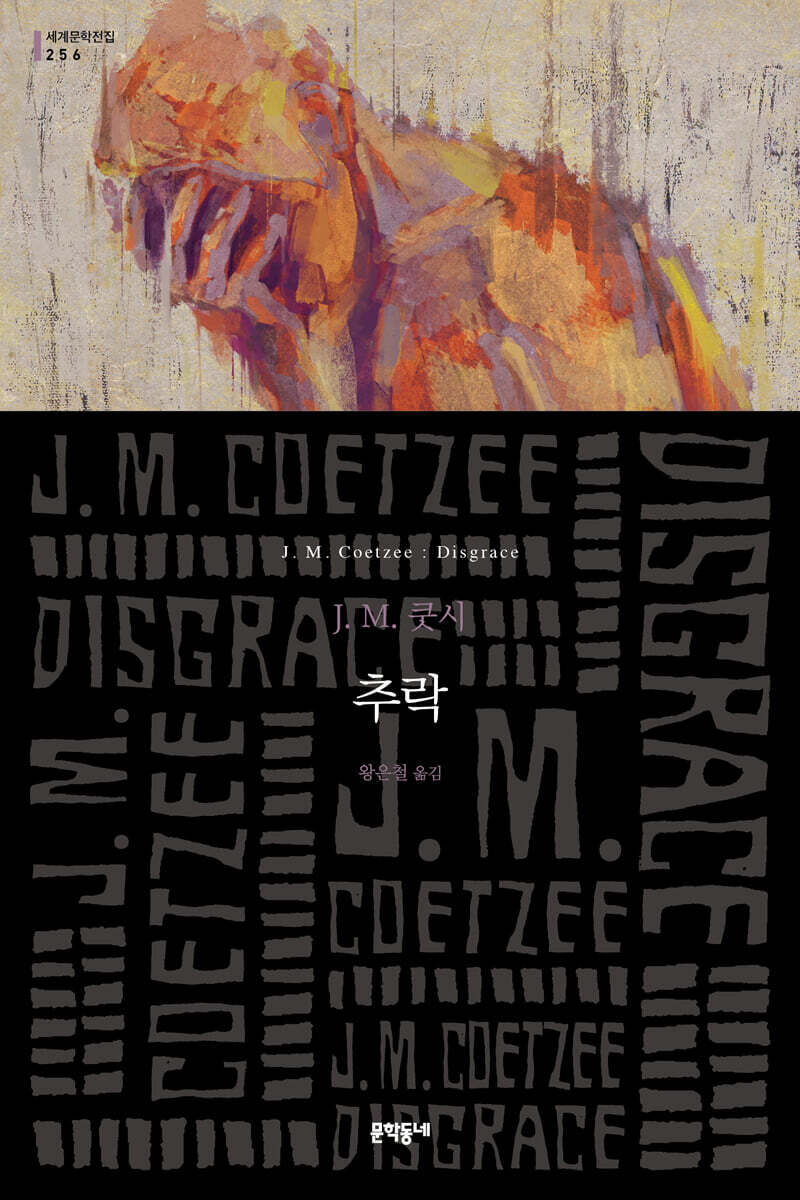
M. Kutsi's masterpiece, "The Fall," is published as volume 256 of Munhakdongne World Literature Collection.
Translated by Wang Eun-cheol, who has consistently translated and introduced Kutsi's works such as "Waiting for the Barbarians," "The Age of Iron," and "The Life and Times of Michael K," this book is being presented in a new, refined translation 24 years after its first introduction in Korea in 2000.
Set in South Africa after the end of apartheid and the subsequent transfer of power from a white to a black government, "The Fall" tells the story of a middle-aged white professor who, embroiled in a scandal, struggles to save his own reputation and that of his daughter.
With this work, Coetzee broke the precedent of not awarding the prize twice to the same author, becoming the first author ever to win the Booker Prize twice.
The 1999 Booker Prize judge, Raelold Kaufman, called it “a fable about what has become of humanity since postcolonialism,” while Boyd Tonkin, another 1999 Booker Prize judge, said it “tests the limits not just of love and sexual politics, but of humanity itself.”
To M. Cootsi
A masterpiece that won the first ever second Booker Prize
The invisible world of South Africa after the end of apartheid
Sharp thinking about cracks
2003 Nobel Prize in Literature
1999 Booker Prize
The Guardian's 100 Best Novels of 2015
BBC's Most Influential Novels of 2019
“It tests the limits not only of love, sex, and politics, but of humanity itself.”
Boyd Tonkin (1999 Booker Prize judge)
Kutsi considers the novel as “a way of thinking,” and is a writer who has profoundly depicted and elevated to a higher level various issues such as imperialism, colonialism, power, gender, race, and animals that have existed in various forms throughout human history.
That is why his novels have an intellectual fragrance and elegance.
"The Fall" is one of the best novels he has ever written.
It is no wonder that this novel was included in the BBC's list of "100 Books to Read Before You Die."
This means that it is a novel with a high degree of artistic perfection.
This novel is so well-written and well-crafted that it makes us feel what the sublime means in art.
It could be said that this is a novel with a majestic and sublime beauty that is imbued with a sense of sorrow and tragedy.
_Wang Eun-cheol (translator)
J. is considered a master who represents South Africa and is called “a writer who touches the central nervous system of existence” and “a writer with an imagination that soars like a lark and looks down like an eagle.”
M. Kutsi's masterpiece, "The Fall," is published as volume 256 of Munhakdongne World Literature Collection.
Translated by Wang Eun-cheol, who has consistently translated and introduced Kutsi's works such as "Waiting for the Barbarians," "The Age of Iron," and "The Life and Times of Michael K," this book is being presented in a new, refined translation 24 years after its first introduction in Korea in 2000.
Set in South Africa after the end of apartheid and the subsequent transfer of power from a white to a black government, "The Fall" tells the story of a middle-aged white professor who, embroiled in a scandal, struggles to save his own reputation and that of his daughter.
With this work, Coetzee broke the precedent of not awarding the prize twice to the same author, becoming the first author ever to win the Booker Prize twice.
The 1999 Booker Prize judge, Raelold Kaufman, called it “a fable about what has become of humanity since postcolonialism,” while Boyd Tonkin, another 1999 Booker Prize judge, said it “tests the limits not just of love and sexual politics, but of humanity itself.”
- You can preview some of the book's contents.
Preview
index
Fall 7
Commentary | Ice Axe 309: Breaking the Frozen Sea Within Us
J.
M. Kutsi Chronology 323
Commentary | Ice Axe 309: Breaking the Frozen Sea Within Us
J.
M. Kutsi Chronology 323
Detailed image

Into the book
He continues to teach.
Because it allows us to make a living.
It also humbles him and makes him realize who he is.
Students who learn learn nothing, but professors who teach learn the sharpest lessons while teaching.
---p.12
“We want to share some of the privileges that humans have with animals.
“I don’t want to be reborn as another being, like a dog or a pig, and live like the dogs and pigs that live under us.”
---p.107
“Lucy, wake up.
Things have changed.
“We can’t continue living where we left off.”
“Why not?”
“Because it’s not a good idea.
“Because it’s not safe.”
“It has never been safe.
Good or bad, that's not a thought.
I'm not going back because of my thoughts.
“It’s just going back.”
She sits up, wearing a borrowed gown.
She stands up straight and faces him with sparkling eyes.
Not my father's little daughter.
Not anymore.
---p.149
“Father, don’t yell at me.
This is my life.
I'm the one who has to live here.
What happens to me is my business.
“If I had one right, it would be to not be involved in this ordeal and not have to justify myself to anyone, including my father.”
---p.187
He believes that people who require cruelty in their work, such as those working in slaughterhouses, develop calluses on their souls.
Habits harden a person.
In most cases, that will be the case.
But that doesn't seem to be the case for him.
He doesn't seem to have any talent for hardening.
---p.201
I fell into a state of shame.
It won't be easy to get me out of there.
What I refused was not punishment.
There is no objection to that.
On the contrary, I try to live by it day by day and accept the shame as the current state of my existence.
---p.242
“Yes, I think so too.
It's humiliating.
But maybe this is a good place to start again.
Maybe that's something I need to learn to accept.
I mean starting from the bottom.
Without anything.
Not something, but nothing.
“No cards, no weapons, no property, no rights, no dignity.”
---p.287
It always gets harder.
Bev Shaw once said:
It gets harder, but it also gets easier.
People get used to things that become difficult.
I'm no longer surprised that what I thought couldn't get more difficult can actually get more difficult.
Because it allows us to make a living.
It also humbles him and makes him realize who he is.
Students who learn learn nothing, but professors who teach learn the sharpest lessons while teaching.
---p.12
“We want to share some of the privileges that humans have with animals.
“I don’t want to be reborn as another being, like a dog or a pig, and live like the dogs and pigs that live under us.”
---p.107
“Lucy, wake up.
Things have changed.
“We can’t continue living where we left off.”
“Why not?”
“Because it’s not a good idea.
“Because it’s not safe.”
“It has never been safe.
Good or bad, that's not a thought.
I'm not going back because of my thoughts.
“It’s just going back.”
She sits up, wearing a borrowed gown.
She stands up straight and faces him with sparkling eyes.
Not my father's little daughter.
Not anymore.
---p.149
“Father, don’t yell at me.
This is my life.
I'm the one who has to live here.
What happens to me is my business.
“If I had one right, it would be to not be involved in this ordeal and not have to justify myself to anyone, including my father.”
---p.187
He believes that people who require cruelty in their work, such as those working in slaughterhouses, develop calluses on their souls.
Habits harden a person.
In most cases, that will be the case.
But that doesn't seem to be the case for him.
He doesn't seem to have any talent for hardening.
---p.201
I fell into a state of shame.
It won't be easy to get me out of there.
What I refused was not punishment.
There is no objection to that.
On the contrary, I try to live by it day by day and accept the shame as the current state of my existence.
---p.242
“Yes, I think so too.
It's humiliating.
But maybe this is a good place to start again.
Maybe that's something I need to learn to accept.
I mean starting from the bottom.
Without anything.
Not something, but nothing.
“No cards, no weapons, no property, no rights, no dignity.”
---p.287
It always gets harder.
Bev Shaw once said:
It gets harder, but it also gets easier.
People get used to things that become difficult.
I'm no longer surprised that what I thought couldn't get more difficult can actually get more difficult.
---p.307
Publisher's Review
The Fall and Resignation of the Arrogant Liberal Intellectual
An allegory of what happened to humanity after postcolonialism
“I fell into a state of shame.
It won't be easy to get me out of there.
What I refused was not punishment.
There is no objection to that.
On the contrary, I try to live by it day by day, accepting the shame as the present state of my existence.” (Text, p. 242)
David Lurie, a 52-year-old divorced college professor, is embroiled in a scandal involving a student.
His scandal spread like wildfire, with articles appearing in not only the university newspaper but also local newspapers, and public opinion boiling over, demanding a sincere apology and reflection from him.
Eventually, a disciplinary committee is held against him, and his fellow professors on the committee demand that he repent, but he refuses and leaves the school.
Once he decides to leave, there is nothing that can hold him back.
He heads straight to his daughter Lucy's country farm.
There he writes about the passionate loves and scandals of the poet Byron, seeking meaning in his own humiliation.
Lucy, Professor Lurie's only child, was born in the Netherlands but immigrated to South Africa with her father.
She settled in the countryside as a member of a commune and remained on her own farm there even after the community disintegrated.
Now she wears a simple dress and walks barefoot on the dirt.
Although he feels unfamiliar with this behavior of his daughter, he tries to understand and adapt.
One day, as peaceful days continued, an unexpected accident occurred.
Three black men broke into the farm and raped Lucy.
Professor Ruri is very indignant about the incident, but Lucy is only trying to cover it up.
Post-apartheid South Africa,
The uneasy gap between what was old and what was hoped to be new
“It is necessary to question whether South Africa has truly entered a new historical era.
“I think we are currently caught in an uneasy and increasingly uncomfortable gap between what we hoped was old and what we hoped would be new.”_J.
M. Cootsi
If 『The Iron Age』, 『Waiting for the Savages』, and 『The Life and Times of Michael K』 depicted the apartheid era, 『The Fall』 deals with the post-apartheid reality.
1994, when Coetzee began writing The Fall, was a watershed year for South Africa.
South Africa's first democratic elections were held, resulting in Nelson Mandela becoming president.
Black people in South Africa, who were treated as subhuman, were made human through arsenic.
Mandela's government established the Truth and Reconciliation Commission, which granted amnesty to those who had committed human rights violations and violence under the apartheid regime if they gave detailed accounts of their crimes during the hearings.
It was a spirit of reconciliation and forgiveness that is hard to find in world history.
Countries that were burdened with the task of coming to terms with their pasts sought to emulate South Africa's example.
Kutsi was not optimistic about South Africa's future.
While everyone applauded South Africa's actions, he questioned the forced reconciliation approach proposed by the political establishment, led by the Truth and Reconciliation Commission.
The history of suffering and its aftereffects could not be resolved overnight.
He keenly recognized the contradictory gap between the remnants of the apartheid era that needed to be liquidated and the hopes of a new era, and questioned whether South Africa had truly entered a new historical era.
For Kutch, who considers the novel as “a way of thinking,” “The Fall” is a reflective reflection on the uneasy gap between what was old and what was hoped to be new.
An allegory of what happened to humanity after postcolonialism
“I fell into a state of shame.
It won't be easy to get me out of there.
What I refused was not punishment.
There is no objection to that.
On the contrary, I try to live by it day by day, accepting the shame as the present state of my existence.” (Text, p. 242)
David Lurie, a 52-year-old divorced college professor, is embroiled in a scandal involving a student.
His scandal spread like wildfire, with articles appearing in not only the university newspaper but also local newspapers, and public opinion boiling over, demanding a sincere apology and reflection from him.
Eventually, a disciplinary committee is held against him, and his fellow professors on the committee demand that he repent, but he refuses and leaves the school.
Once he decides to leave, there is nothing that can hold him back.
He heads straight to his daughter Lucy's country farm.
There he writes about the passionate loves and scandals of the poet Byron, seeking meaning in his own humiliation.
Lucy, Professor Lurie's only child, was born in the Netherlands but immigrated to South Africa with her father.
She settled in the countryside as a member of a commune and remained on her own farm there even after the community disintegrated.
Now she wears a simple dress and walks barefoot on the dirt.
Although he feels unfamiliar with this behavior of his daughter, he tries to understand and adapt.
One day, as peaceful days continued, an unexpected accident occurred.
Three black men broke into the farm and raped Lucy.
Professor Ruri is very indignant about the incident, but Lucy is only trying to cover it up.
Post-apartheid South Africa,
The uneasy gap between what was old and what was hoped to be new
“It is necessary to question whether South Africa has truly entered a new historical era.
“I think we are currently caught in an uneasy and increasingly uncomfortable gap between what we hoped was old and what we hoped would be new.”_J.
M. Cootsi
If 『The Iron Age』, 『Waiting for the Savages』, and 『The Life and Times of Michael K』 depicted the apartheid era, 『The Fall』 deals with the post-apartheid reality.
1994, when Coetzee began writing The Fall, was a watershed year for South Africa.
South Africa's first democratic elections were held, resulting in Nelson Mandela becoming president.
Black people in South Africa, who were treated as subhuman, were made human through arsenic.
Mandela's government established the Truth and Reconciliation Commission, which granted amnesty to those who had committed human rights violations and violence under the apartheid regime if they gave detailed accounts of their crimes during the hearings.
It was a spirit of reconciliation and forgiveness that is hard to find in world history.
Countries that were burdened with the task of coming to terms with their pasts sought to emulate South Africa's example.
Kutsi was not optimistic about South Africa's future.
While everyone applauded South Africa's actions, he questioned the forced reconciliation approach proposed by the political establishment, led by the Truth and Reconciliation Commission.
The history of suffering and its aftereffects could not be resolved overnight.
He keenly recognized the contradictory gap between the remnants of the apartheid era that needed to be liquidated and the hopes of a new era, and questioned whether South Africa had truly entered a new historical era.
For Kutch, who considers the novel as “a way of thinking,” “The Fall” is a reflective reflection on the uneasy gap between what was old and what was hoped to be new.
GOODS SPECIFICS
- Date of issue: December 23, 2024
- Page count, weight, size: 336 pages | 140*210*30mm
- ISBN13: 9791141600150
- ISBN10: 1141600153
You may also like
카테고리
korean


korean

![GQ KOREA Mark (Monthly): December [2025]](http://librairie.coreenne.fr/cdn/shop/files/8ef265dbbfbf186523ed75ba7319009d.jpg?v=1765340328&width=3840)


