

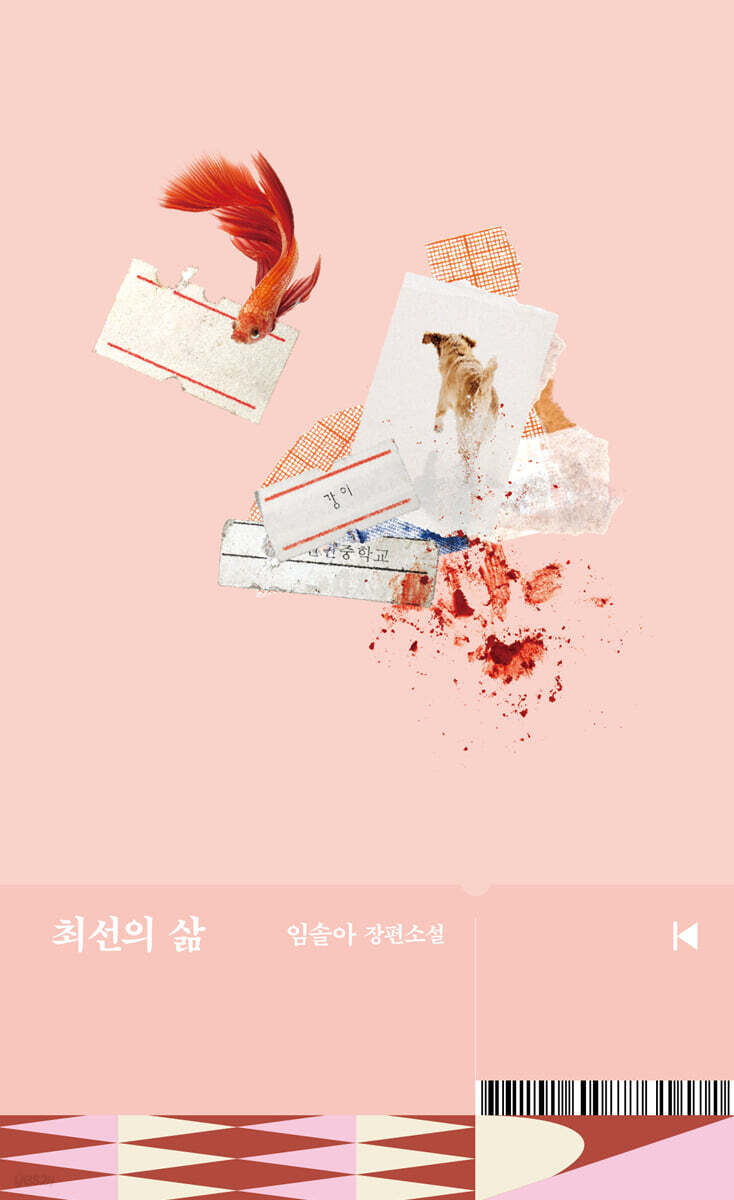
Best life
 |
Description
Book Introduction
The size of the wound is not proportional to age.
A shocking coming-of-age story that remains vivid and resonates with you for a long time.
Im Sol-ah's first full-length novel, revised edition published!
The debut novel 『The Best Life』 by author Im Sol-a, who has been cultivating a wide literary field without boundaries by excelling in both poetry and novels, has been republished as the fifth volume in the Munhakdongne Play series.
This work, written during the author's college years, was praised by literary critic Shin Hyeong-cheol as "a novel in a different 'class'" and won the Munhakdongne University Novel Award.
Through this first full-length novel, Im Sol-ah first introduced her novel world to readers, armed with restrained yet impressive sentences and the qualities of a “good novel” (as novelist Park Seong-won puts it) that “make ordinary material special.”
The author has since published short story collections such as “Snow, People, and Snowmen,” “Saying It’s Nothing,” and the novel “I’m Still There,” and has been actively receiving praise from critics and readers. By winning the grand prize at the 2022 Young Writer’s Award, she has proven that the unique value and charm of Im Sol-ah’s novels have steadily matured.
"The Best Life" is also Im Sol-a's most sharp and honest novel, as it was written by a rookie writer based on instinct rather than technique.
This revised edition, which offers a glimpse into a time in the life of a young writer who “would have written differently if I were here today,” but “chose not to revise” (Im Sol-a, ‘Author’s Note for the Revised Edition’), wants to preserve her work as it is, includes a limited edition of Im Sol-a’s previously unpublished poems as a gift.
These poems, which share the same worldview as "The Best Life," will allow us to experience the novel's emotions in a new and deeper way within a different genre, thereby allowing us to perceive the broad horizons of "Im Sol-ah's World."
A shocking coming-of-age story that remains vivid and resonates with you for a long time.
Im Sol-ah's first full-length novel, revised edition published!
The debut novel 『The Best Life』 by author Im Sol-a, who has been cultivating a wide literary field without boundaries by excelling in both poetry and novels, has been republished as the fifth volume in the Munhakdongne Play series.
This work, written during the author's college years, was praised by literary critic Shin Hyeong-cheol as "a novel in a different 'class'" and won the Munhakdongne University Novel Award.
Through this first full-length novel, Im Sol-ah first introduced her novel world to readers, armed with restrained yet impressive sentences and the qualities of a “good novel” (as novelist Park Seong-won puts it) that “make ordinary material special.”
The author has since published short story collections such as “Snow, People, and Snowmen,” “Saying It’s Nothing,” and the novel “I’m Still There,” and has been actively receiving praise from critics and readers. By winning the grand prize at the 2022 Young Writer’s Award, she has proven that the unique value and charm of Im Sol-ah’s novels have steadily matured.
"The Best Life" is also Im Sol-a's most sharp and honest novel, as it was written by a rookie writer based on instinct rather than technique.
This revised edition, which offers a glimpse into a time in the life of a young writer who “would have written differently if I were here today,” but “chose not to revise” (Im Sol-a, ‘Author’s Note for the Revised Edition’), wants to preserve her work as it is, includes a limited edition of Im Sol-a’s previously unpublished poems as a gift.
These poems, which share the same worldview as "The Best Life," will allow us to experience the novel's emotions in a new and deeper way within a different genre, thereby allowing us to perceive the broad horizons of "Im Sol-ah's World."
- You can preview some of the book's contents.
Preview
index
The Best Life _009
The 4th Munhakdongne University Novel Award
Award Speeches, Jury Comments, and Interviews with Award-Winning Authors _213
Revised Edition Author's Note _240
The 4th Munhakdongne University Novel Award
Award Speeches, Jury Comments, and Interviews with Award-Winning Authors _213
Revised Edition Author's Note _240
Into the book
Eating crackers you've never tried before.
Drinking soju and feeling the numbness of your tongue.
Understanding the color-changing patterns of neon signs.
Smelling the morning mist that rises on the road after the neon signs go out.
The reason I don't go home is because of things like that.
It's about discovering that there's another world within this world that you never knew existed.
It didn't matter whether it was trivial or not.
We kept wanting to go somewhere else.
I wanted to go somewhere unknown.
--- p.35
I washed my hair with the same shampoo and dried it with the same towel.
I applied the skin and lotion together in front of the mirror.
It smelled exactly like any shampoo or lotion that anyone could use, and it became the same smell.
I was friends.
He was the guest who stayed the day before.
The guests were from the next room, the room above, and the room below.
He was a guest staying the next day.
It was anyone.
That day was everyone's birthday in the world.
--- p.39
Aram made an excuse that all the things that wander on the street are sick.
Even cats that look fine have painful spots if you look closely.
Either their backs are sore, they're wearing collars that dig into their fur, or they've lost their mother.
--- pp.73~74
I never answered the questions my mother asked me.
Most of the questions that required choices were childish, and most of the wise answers were cowardly.
--- p.106
There was no child who liked to fight.
There were only moments when you had no choice but to fight to protect yourself.
Soyoung was the same.
Self-protection often became a fierce attack.
It was only in an instant that the fierce protection became mean.
--- p.112
I shouldn't have knelt down.
It seemed that the very attitude of believing that there would be hope if I got down on my knees, the very attitude of trying to reach out to hope, was what was keeping me away from hope.
I tried not to become a cripple, but ended up becoming a cripple.
I imagined the worst kind of cripple.
I started hoping for that.
The worst case scenario was the only way out.
It was a hope that only in those moments when I couldn't reach out anywhere, like when I was indiscriminately grabbing dirt, would I find something to grab onto.
--- p.151
The love of family, which had never been needed, also disappeared.
The school also disappeared.
The horror is gone.
I felt like I had escaped a world.
--- p.169
We must not forget.
You have to fight to survive.
--- p.184
I wondered why I had the same nightmare, and then I wondered why I was writing about it.
I was afraid that I would be trapped in this nightmare for the rest of my life.
After finishing the novel, I realized one thing.
The nightmare that had so persistently haunted me didn't want me to ask 'why'.
It's not that I've been plagued by nightmares, it's that nightmares have been plagued by my questions.
--- From the "Acceptance Speech"
I misunderstood what a nightmare was.
Nightmares occur not while you are dreaming, but when you wake up.
Now I am a person who doesn't care what kind of dreams I have.
I wonder how I will wake up.
What is clear is that this novel has moved me a little.
Me waking up from my dream in the morning.
What is clear is that I became a novelist in order to write this novel.
This fact is inevitably precious to me.
Drinking soju and feeling the numbness of your tongue.
Understanding the color-changing patterns of neon signs.
Smelling the morning mist that rises on the road after the neon signs go out.
The reason I don't go home is because of things like that.
It's about discovering that there's another world within this world that you never knew existed.
It didn't matter whether it was trivial or not.
We kept wanting to go somewhere else.
I wanted to go somewhere unknown.
--- p.35
I washed my hair with the same shampoo and dried it with the same towel.
I applied the skin and lotion together in front of the mirror.
It smelled exactly like any shampoo or lotion that anyone could use, and it became the same smell.
I was friends.
He was the guest who stayed the day before.
The guests were from the next room, the room above, and the room below.
He was a guest staying the next day.
It was anyone.
That day was everyone's birthday in the world.
--- p.39
Aram made an excuse that all the things that wander on the street are sick.
Even cats that look fine have painful spots if you look closely.
Either their backs are sore, they're wearing collars that dig into their fur, or they've lost their mother.
--- pp.73~74
I never answered the questions my mother asked me.
Most of the questions that required choices were childish, and most of the wise answers were cowardly.
--- p.106
There was no child who liked to fight.
There were only moments when you had no choice but to fight to protect yourself.
Soyoung was the same.
Self-protection often became a fierce attack.
It was only in an instant that the fierce protection became mean.
--- p.112
I shouldn't have knelt down.
It seemed that the very attitude of believing that there would be hope if I got down on my knees, the very attitude of trying to reach out to hope, was what was keeping me away from hope.
I tried not to become a cripple, but ended up becoming a cripple.
I imagined the worst kind of cripple.
I started hoping for that.
The worst case scenario was the only way out.
It was a hope that only in those moments when I couldn't reach out anywhere, like when I was indiscriminately grabbing dirt, would I find something to grab onto.
--- p.151
The love of family, which had never been needed, also disappeared.
The school also disappeared.
The horror is gone.
I felt like I had escaped a world.
--- p.169
We must not forget.
You have to fight to survive.
--- p.184
I wondered why I had the same nightmare, and then I wondered why I was writing about it.
I was afraid that I would be trapped in this nightmare for the rest of my life.
After finishing the novel, I realized one thing.
The nightmare that had so persistently haunted me didn't want me to ask 'why'.
It's not that I've been plagued by nightmares, it's that nightmares have been plagued by my questions.
--- From the "Acceptance Speech"
I misunderstood what a nightmare was.
Nightmares occur not while you are dreaming, but when you wake up.
Now I am a person who doesn't care what kind of dreams I have.
I wonder how I will wake up.
What is clear is that this novel has moved me a little.
Me waking up from my dream in the morning.
What is clear is that I became a novelist in order to write this novel.
This fact is inevitably precious to me.
--- From the “Author’s Note for the Revised Edition”
Publisher's Review
In the midst of hurt, betrayal, and violence
To somehow survive the turbulent daily life
A silent growth narrative without adjectives or adverbs.
"The Best Life" caused a sensation by vividly depicting the ways in which young female students form friendships, as well as their stories of running away from home, violence, and revenge.
The main character, 'Kang-i', is a middle school student who feels that the world around him is like a 'snowball'.
Parents who shower you with endless love and attention, even if it's neither desperate nor effective; a home that serves as a shelter, even if it's not as good as your schoolmates; a school where you can hang out with friends, even if there aren't any teachers you can trust and follow.
Kang-i wants to go as far as possible outside of that narrow, artificially constructed world.
At that time, his friend 'Soyoung' gathers friends to run away with him.
Soyoung, who gets what she wants from adults through calculated actions like playing Go, is the object of Kang-i's admiration.
Three children, including Kang-i, who is drawn to So-young, and A-ram, who lives with an abusive father and finds fulfillment in supporting those who evoke compassion, run away from Daejeon to Seoul.
The outside world is not at all safe for young women.
As they rebel against the hostile attitudes of adults and learn to hide their desires behind kindness, the three children grow weary of each other as they depend on each other.
Sometimes Soyoung ignores Kang-i and Aram's opinions, and the children endure each day as Soyoung leads them.
Soyoung's runaway life also begins and ends with her own decision.
Upon returning home, Kang-i and A-ram discover that So-young had another reason for running away, and that not only her parents but also themselves were swayed by So-young's desires.
After that, Kang-i, who has become distant from So-young, experiences certain incidents and ends up becoming isolated at school.
Kang, who was shunned by his friends who had been friendly with him until just a few days ago, sits in the classroom more aggressively than anyone else, ready to defend himself if he were attacked at any moment.
Kang-i's movements, which are focused solely on getting through the day safely, are even more desperate because they are numb and eerie, like sentences that are connected only with verbs without modifiers.
One day, Aram suddenly reaches out to Kang-i, and the lives of the two children take a new turn...
A time when friends were more important than family
Building and breaking nightmare friendships
We are no longer girls
Instead of describing people or events in detail, "The Best Life" presents impressive scenes and conveys the meaning contained within them in a synesthetic way.
This characteristic of the novel led to the great feat of making it into a film just two years after its publication.
The film [The Best Life], directed by Lee Woo-jung, who has captured the cruel side of girls' daily lives, has won various awards and has been praised for "delicately capturing the indefinable sensitivity and intensity of teenage years" (film critic Jeong Han-seok) and for "filming Im Sol-ah's novel, written as if it were her own story, as if it were her own experience," creating "a vividness that is difficult to describe" (film critic Jeong Seong-il). It was also selected as the opening film for the Berlin Korean Independent Film Festival.
There is something special about the harm that teenagers inflict on each other and themselves, even at a time when they do not yet fully understand themselves.
Even if it may seem like a minor scratch to others, it can have the power to destroy a person's entire world within the snowball-like world of the person involved.
"The Best Life" argues that the size of wounds is not proportional to age, and that there is a kind of immense violence and pain that can only be experienced during a certain limited period.
A unique time in adolescence that might not have been so “special” was born as a special story.
When a wounded being desperately tries to live the best life possible, only to reach a vivid, nightmarish ending, we naturally follow the comment of literary critic Shin Hyeong-cheol: “I believe that all these sad and painful things really happened.”
To somehow survive the turbulent daily life
A silent growth narrative without adjectives or adverbs.
"The Best Life" caused a sensation by vividly depicting the ways in which young female students form friendships, as well as their stories of running away from home, violence, and revenge.
The main character, 'Kang-i', is a middle school student who feels that the world around him is like a 'snowball'.
Parents who shower you with endless love and attention, even if it's neither desperate nor effective; a home that serves as a shelter, even if it's not as good as your schoolmates; a school where you can hang out with friends, even if there aren't any teachers you can trust and follow.
Kang-i wants to go as far as possible outside of that narrow, artificially constructed world.
At that time, his friend 'Soyoung' gathers friends to run away with him.
Soyoung, who gets what she wants from adults through calculated actions like playing Go, is the object of Kang-i's admiration.
Three children, including Kang-i, who is drawn to So-young, and A-ram, who lives with an abusive father and finds fulfillment in supporting those who evoke compassion, run away from Daejeon to Seoul.
The outside world is not at all safe for young women.
As they rebel against the hostile attitudes of adults and learn to hide their desires behind kindness, the three children grow weary of each other as they depend on each other.
Sometimes Soyoung ignores Kang-i and Aram's opinions, and the children endure each day as Soyoung leads them.
Soyoung's runaway life also begins and ends with her own decision.
Upon returning home, Kang-i and A-ram discover that So-young had another reason for running away, and that not only her parents but also themselves were swayed by So-young's desires.
After that, Kang-i, who has become distant from So-young, experiences certain incidents and ends up becoming isolated at school.
Kang, who was shunned by his friends who had been friendly with him until just a few days ago, sits in the classroom more aggressively than anyone else, ready to defend himself if he were attacked at any moment.
Kang-i's movements, which are focused solely on getting through the day safely, are even more desperate because they are numb and eerie, like sentences that are connected only with verbs without modifiers.
One day, Aram suddenly reaches out to Kang-i, and the lives of the two children take a new turn...
A time when friends were more important than family
Building and breaking nightmare friendships
We are no longer girls
Instead of describing people or events in detail, "The Best Life" presents impressive scenes and conveys the meaning contained within them in a synesthetic way.
This characteristic of the novel led to the great feat of making it into a film just two years after its publication.
The film [The Best Life], directed by Lee Woo-jung, who has captured the cruel side of girls' daily lives, has won various awards and has been praised for "delicately capturing the indefinable sensitivity and intensity of teenage years" (film critic Jeong Han-seok) and for "filming Im Sol-ah's novel, written as if it were her own story, as if it were her own experience," creating "a vividness that is difficult to describe" (film critic Jeong Seong-il). It was also selected as the opening film for the Berlin Korean Independent Film Festival.
There is something special about the harm that teenagers inflict on each other and themselves, even at a time when they do not yet fully understand themselves.
Even if it may seem like a minor scratch to others, it can have the power to destroy a person's entire world within the snowball-like world of the person involved.
"The Best Life" argues that the size of wounds is not proportional to age, and that there is a kind of immense violence and pain that can only be experienced during a certain limited period.
A unique time in adolescence that might not have been so “special” was born as a special story.
When a wounded being desperately tries to live the best life possible, only to reach a vivid, nightmarish ending, we naturally follow the comment of literary critic Shin Hyeong-cheol: “I believe that all these sad and painful things really happened.”
GOODS SPECIFICS
- Date of issue: June 14, 2024
- Page count, weight, size: 244 pages | 115*188*20mm
- ISBN13: 9791141600877
- ISBN10: 1141600870
You may also like
카테고리
korean


korean

![ELLE 엘르 스페셜 에디션 A형 : 12월 [2025]](http://librairie.coreenne.fr/cdn/shop/files/b8e27a3de6c9538896439686c6b0e8fb.jpg?v=1766436872&width=3840)


