

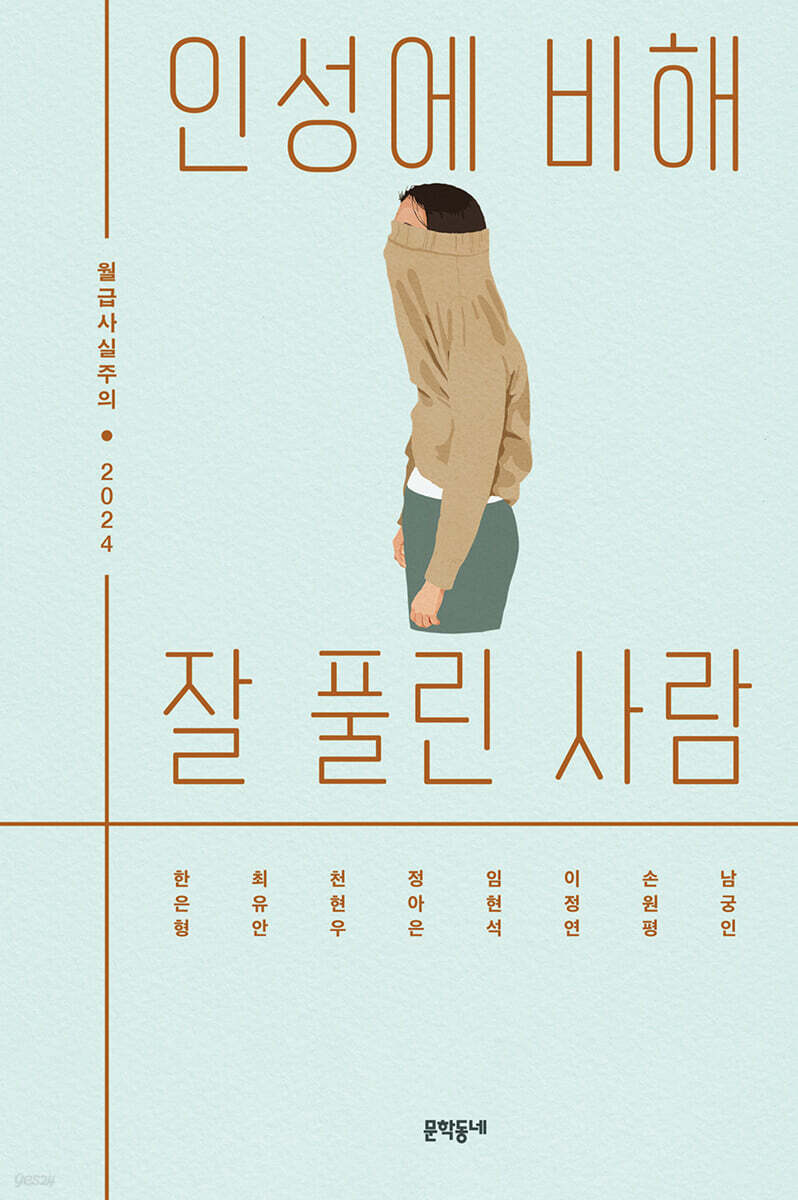
A person who is well-rounded compared to his personality
 |
Description
Book Introduction
Earning money on your own and supporting yourself
Pouring body and soul into that harsh and noble work
About our every day
A literary novel about salary realism
The second extremely realistic story about making a living!
The short story anthology "A Person Who Did Well Compared to Their Character - Salary Realism 2024" by the "Salary Realism" group, which shared the rule of writing realistically about the lives of ordinary people working to make a living in contemporary Korean society, has been published.
Salary Realism is a new trend in Korean fiction that arose from the awareness that more novels that capture the labor scene of our time are needed.
This movement, sparked by novelist Jang Gang-myeong, led to the publication of the first anthology, "Thank You for Your Hard Work," in 2023, and "A Person Who Turns Out Well Compared to Their Character" is the second work from this group.
The new writers who joined the monthly salary realism group this year are Namgung In, Son Won-pyeong, Lee Jeong-yeon, Lim Hyeon-seok, Jeong Ah-eun, Cheon Hyeon-woo, Choi Yu-an, and Han Eun-hyeong.
The stories written by writers with a keen sense of the cross-sections of society, set in the workplace, unfold in an exciting way.
The inclusion of the first short stories successfully completed by Namgung In and Cheon Hyeon-woo, authors who have received much love for their prose, and the latest work by Son Won-pyeong, who has captured the various ways in which the socially disadvantaged relate to the world in full-length novels such as Almond and The Counterattack of Thirty, raises expectations even higher.
The title of the book is taken from the title of a short story by novelist Lim Hyeon-seok.
It's a title that naturally evokes the human conflicts we've all experienced at least once in the labor market, where we must sacrifice our time and energy to make a living.
As the title suggests, the eight short stories included in this book vividly portray various aspects of life, eliciting deep empathy.
This book, for all working beings who struggle every day to feed themselves, is published to coincide with Labor Day, May 1st.
Pouring body and soul into that harsh and noble work
About our every day
A literary novel about salary realism
The second extremely realistic story about making a living!
The short story anthology "A Person Who Did Well Compared to Their Character - Salary Realism 2024" by the "Salary Realism" group, which shared the rule of writing realistically about the lives of ordinary people working to make a living in contemporary Korean society, has been published.
Salary Realism is a new trend in Korean fiction that arose from the awareness that more novels that capture the labor scene of our time are needed.
This movement, sparked by novelist Jang Gang-myeong, led to the publication of the first anthology, "Thank You for Your Hard Work," in 2023, and "A Person Who Turns Out Well Compared to Their Character" is the second work from this group.
The new writers who joined the monthly salary realism group this year are Namgung In, Son Won-pyeong, Lee Jeong-yeon, Lim Hyeon-seok, Jeong Ah-eun, Cheon Hyeon-woo, Choi Yu-an, and Han Eun-hyeong.
The stories written by writers with a keen sense of the cross-sections of society, set in the workplace, unfold in an exciting way.
The inclusion of the first short stories successfully completed by Namgung In and Cheon Hyeon-woo, authors who have received much love for their prose, and the latest work by Son Won-pyeong, who has captured the various ways in which the socially disadvantaged relate to the world in full-length novels such as Almond and The Counterattack of Thirty, raises expectations even higher.
The title of the book is taken from the title of a short story by novelist Lim Hyeon-seok.
It's a title that naturally evokes the human conflicts we've all experienced at least once in the labor market, where we must sacrifice our time and energy to make a living.
As the title suggests, the eight short stories included in this book vividly portray various aspects of life, eliciting deep empathy.
This book, for all working beings who struggle every day to feed themselves, is published to coincide with Labor Day, May 1st.
- You can preview some of the book's contents.
Preview
index
Namgung In, today is a lively morning _007
#Non-regular worker #Announcer #Work vs. Family #Job lifespan
Son Won-pyeong Piano _037
#Studyroom #Carework #SecondhandTrade #Secularity vs. Purity
Lee Jeong-yeon Lighthouse _063
#Pufferfish Restaurant #Trainee #Sensation of Crisis #Conversion to Full-Time Employee vs. Hope Advisor
Lim Hyeon-seok, a person who is well-rounded compared to his personality _091
#Franchise #Headquarters vs. Store Owners #Personality vs. Skills #Organizational Life
Jeong Ah-eun and Two Friends _123
#Nursing Assistant #Hierarchy #Friend's Private Life
Cheon Hyun-woo Villain _155
#Logistics part-time job #Coin crash #Teenage male #Academic background
Choi Yu-an's Useful Life _187
#Freelance #Interpreter #Documentary Production #Edited Words
Han Eun-hyung's Plant View _221
#VeganRestaurant #Management #EntrepreneurMind #PCComputer vs. Latest Trends
In lieu of the planner's words _262
#Non-regular worker #Announcer #Work vs. Family #Job lifespan
Son Won-pyeong Piano _037
#Studyroom #Carework #SecondhandTrade #Secularity vs. Purity
Lee Jeong-yeon Lighthouse _063
#Pufferfish Restaurant #Trainee #Sensation of Crisis #Conversion to Full-Time Employee vs. Hope Advisor
Lim Hyeon-seok, a person who is well-rounded compared to his personality _091
#Franchise #Headquarters vs. Store Owners #Personality vs. Skills #Organizational Life
Jeong Ah-eun and Two Friends _123
#Nursing Assistant #Hierarchy #Friend's Private Life
Cheon Hyun-woo Villain _155
#Logistics part-time job #Coin crash #Teenage male #Academic background
Choi Yu-an's Useful Life _187
#Freelance #Interpreter #Documentary Production #Edited Words
Han Eun-hyung's Plant View _221
#VeganRestaurant #Management #EntrepreneurMind #PCComputer vs. Latest Trends
In lieu of the planner's words _262
Into the book
The payroll system was problematic.
When broadcasting dies down due to the Olympics or World Cup, salaries also decrease.
The Olympics and World Cup, which everyone is looking forward to, were not enjoyable at all for freelance announcers.
Even when I went on vacation, I couldn't rest easy because it was unpaid.
When a program like this was abolished, my weekly salary was reduced to a lump sum, and even then, it was deposited on a different day each week.
It may be the fate of a freelancer, but as my paycheck scattered, my mind also seemed to scatter.
--- From "Namgung In_ Today is a lively morning"
I imagined spending an hour removing my eye makeup, removing my false eyelashes, washing my face, showering, and blow-drying my hair.
“Wash yourself to death.” These words were now stuck in my mouth and would never leave my mouth.
--- From "Namgung In_ Today is a lively morning"
There is no emotion in the world that cannot be exchanged for money.
It was the same at my friend's wedding, my mother's funeral, and every moment of gratitude and farewell.
Aren't we living in a time when the size of sincerity, loyalty, and kindness can all be converted into money?
Of course, there were relationships that weren't like that, but sadly, Hye-shim didn't have many of those left.
Whenever such thoughts suddenly crossed her mind and a loneliness like a desert night came over her, Hye-sim would try hard to shake off those feelings and block them out.
It was because I knew that loneliness was an emotion that could not be filled with money.
--- From "Son Won-pyeong_ Piano"
There was something about the children that was so stubborn that it was almost boring.
That's exactly why children are so lovable and so tiresome.
It was a little bit gratifying to Junyong that all that hadn't evaporated yet.
Junyong didn't know that feelings could be converted into money.
Hye-sim must have been like that at one time.
--- From "Son Won-pyeong_ Piano"
I'd worked hard to secure a comfortable job, so why couldn't I tolerate this little nagging? I spent a couple of months hanging around the restaurant, mulling over the plans I'd laid out.
Just ignore the nonsense, and if you can just endure it, you'll be able to work here for a long time.
Seol-hee suppressed her feelings and made a new promise to herself that she would do well.
However, it would be unacceptable if it was discovered that he had changed jobs frequently to appear more skilled.
--- From "Lee Jeong-yeon_ Lighthouse"
Jinyoung used to give the impression that he was on the same side as the store owner through his grumbling.
I realized early on in my social life that talking nonsense has that kind of effect.
He also nodded when the franchise owner complained.
However, Jinyeong's work was solely to promote the interests of the headquarters.
Jinyoung never forgot that point even when he was cursing the headquarters.
--- From "Lim Hyeon-seok_ A person who is well-rounded compared to his personality"
“Come to me.
“Please.”
The same words kept coming out of Seungmi's mouth.
Come to me.
Come to me.
At first glance, it seemed like vomiting rather than crying.
(……) Jihyun couldn’t move from that spot as if she was being crushed by something.
And I was keenly aware of the words my childhood friend was pouring out through sobs, words that gave me a clear idea of what path someone else was currently taking in life.
--- From "Jeong Ah-eun_ Two Friends"
If I wanted to go out tomorrow, I had to send a text message to Gubbang.
They said that if you don't get a job like this on a first-come, first-served basis, or even end up on a blacklist maintained by the company, you won't even be allowed to come to work.
While I was waiting for the elevator and was hesitating whether to send a text or not, a text came.
It was a deposit notification.
82,840 won per day.
I just let out a hollow laugh and then suddenly realized that I was in a situation where I didn't feel like working anywhere else.
It would be nice to have the academic background to tutor, but most convenience stores don't even pay minimum wage, and the industrial complexes are just like the saying, "infinite profit," and there's nothing better than a bread shop.
--- From "Cheon Hyeon-woo_ Villain"
Working part-time at a gallery has made my life as a slave easier.
I've been working part-time at galleries and the process of finding myself has become less frequent.
My life changed after working part-time at a gallery.
--- From "Cheon Hyeon-woo_ Villain"
In the next screen, Morgan's voice said that young Koreans are no different from me.
What did they have to give up?
The next scene was an interview with a delivery man who said he was giving up on marriage and having children.
Morgan's words about editing the first interview flashed through my mind.
I am the one who tells the woman who quit her good job to become a delivery person that no matter how much money you make with your talents, you will never be able to buy a house.
I appeared on the screen again and spoke with a somewhat pouty expression.
So far, I haven't found anyone I want to marry, and in the meantime, I've just learned how to live well on my own.
--- From "Choi Yu-an_ A Useful Life"
“Minji, you know that just because you have a mouth doesn’t mean everyone has freedom of expression.
Minji is in pain because she can't say what she wants to say, and I'm in pain too.
"Should I live my life saying whatever I want? In an era where hate speech and discrimination are prohibited, is it a problem to exploit hate and discrimination against others? Is it a problem to exploit them in a country where laws and systems are a mess? Where else can I say such things?"
When broadcasting dies down due to the Olympics or World Cup, salaries also decrease.
The Olympics and World Cup, which everyone is looking forward to, were not enjoyable at all for freelance announcers.
Even when I went on vacation, I couldn't rest easy because it was unpaid.
When a program like this was abolished, my weekly salary was reduced to a lump sum, and even then, it was deposited on a different day each week.
It may be the fate of a freelancer, but as my paycheck scattered, my mind also seemed to scatter.
--- From "Namgung In_ Today is a lively morning"
I imagined spending an hour removing my eye makeup, removing my false eyelashes, washing my face, showering, and blow-drying my hair.
“Wash yourself to death.” These words were now stuck in my mouth and would never leave my mouth.
--- From "Namgung In_ Today is a lively morning"
There is no emotion in the world that cannot be exchanged for money.
It was the same at my friend's wedding, my mother's funeral, and every moment of gratitude and farewell.
Aren't we living in a time when the size of sincerity, loyalty, and kindness can all be converted into money?
Of course, there were relationships that weren't like that, but sadly, Hye-shim didn't have many of those left.
Whenever such thoughts suddenly crossed her mind and a loneliness like a desert night came over her, Hye-sim would try hard to shake off those feelings and block them out.
It was because I knew that loneliness was an emotion that could not be filled with money.
--- From "Son Won-pyeong_ Piano"
There was something about the children that was so stubborn that it was almost boring.
That's exactly why children are so lovable and so tiresome.
It was a little bit gratifying to Junyong that all that hadn't evaporated yet.
Junyong didn't know that feelings could be converted into money.
Hye-sim must have been like that at one time.
--- From "Son Won-pyeong_ Piano"
I'd worked hard to secure a comfortable job, so why couldn't I tolerate this little nagging? I spent a couple of months hanging around the restaurant, mulling over the plans I'd laid out.
Just ignore the nonsense, and if you can just endure it, you'll be able to work here for a long time.
Seol-hee suppressed her feelings and made a new promise to herself that she would do well.
However, it would be unacceptable if it was discovered that he had changed jobs frequently to appear more skilled.
--- From "Lee Jeong-yeon_ Lighthouse"
Jinyoung used to give the impression that he was on the same side as the store owner through his grumbling.
I realized early on in my social life that talking nonsense has that kind of effect.
He also nodded when the franchise owner complained.
However, Jinyeong's work was solely to promote the interests of the headquarters.
Jinyoung never forgot that point even when he was cursing the headquarters.
--- From "Lim Hyeon-seok_ A person who is well-rounded compared to his personality"
“Come to me.
“Please.”
The same words kept coming out of Seungmi's mouth.
Come to me.
Come to me.
At first glance, it seemed like vomiting rather than crying.
(……) Jihyun couldn’t move from that spot as if she was being crushed by something.
And I was keenly aware of the words my childhood friend was pouring out through sobs, words that gave me a clear idea of what path someone else was currently taking in life.
--- From "Jeong Ah-eun_ Two Friends"
If I wanted to go out tomorrow, I had to send a text message to Gubbang.
They said that if you don't get a job like this on a first-come, first-served basis, or even end up on a blacklist maintained by the company, you won't even be allowed to come to work.
While I was waiting for the elevator and was hesitating whether to send a text or not, a text came.
It was a deposit notification.
82,840 won per day.
I just let out a hollow laugh and then suddenly realized that I was in a situation where I didn't feel like working anywhere else.
It would be nice to have the academic background to tutor, but most convenience stores don't even pay minimum wage, and the industrial complexes are just like the saying, "infinite profit," and there's nothing better than a bread shop.
--- From "Cheon Hyeon-woo_ Villain"
Working part-time at a gallery has made my life as a slave easier.
I've been working part-time at galleries and the process of finding myself has become less frequent.
My life changed after working part-time at a gallery.
--- From "Cheon Hyeon-woo_ Villain"
In the next screen, Morgan's voice said that young Koreans are no different from me.
What did they have to give up?
The next scene was an interview with a delivery man who said he was giving up on marriage and having children.
Morgan's words about editing the first interview flashed through my mind.
I am the one who tells the woman who quit her good job to become a delivery person that no matter how much money you make with your talents, you will never be able to buy a house.
I appeared on the screen again and spoke with a somewhat pouty expression.
So far, I haven't found anyone I want to marry, and in the meantime, I've just learned how to live well on my own.
--- From "Choi Yu-an_ A Useful Life"
“Minji, you know that just because you have a mouth doesn’t mean everyone has freedom of expression.
Minji is in pain because she can't say what she wants to say, and I'm in pain too.
"Should I live my life saying whatever I want? In an era where hate speech and discrimination are prohibited, is it a problem to exploit hate and discrimination against others? Is it a problem to exploit them in a country where laws and systems are a mess? Where else can I say such things?"
--- From "Han Eun-hyung_ Botanical View"
Publisher's Review
Namgung In, "It's another lively morning."
The story of the daily routine of announcer 'Jimin', who was hired through an open recruitment at a local broadcasting station but works as a freelancer.
The life of a female announcer, who wakes up at the crack of dawn every day to work hard to host a morning broadcast, but earns more from side income from various events than from her regular salary, is not as glamorous as one might think.
But Jimin finds joy in the support and interest of his fans and finds a reason to work from it.
This short film vividly illuminates the unfamiliar side of broadcasters that is not revealed on TV, depicting their arduous daily lives where they gradually give up work to younger junior announcers, cannot stop the broadcast programs they were running from being canceled, and have to promote themselves through social media after work.
I was living hard.
All my friends were also living hard.
I diligently reported the news, took charge of broadcasts, held the microphone at events, and looked after my acquaintances.
I diligently fixed my hair, put on makeup, thought about my outfit for tomorrow before going to bed, and updated my Instagram.
There is nothing that lasts forever, but there are things that you can work hard for.
No matter what the future holds, the work given to me now is what I wanted to do.
Those who have achieved their dreams should not complain. (pp. 35-36)
Son Won-pyeong, "Piano"
Hye-sim, who ran a children's study room in her own house that she had worked hard to save.
Having found a house where she would like to spend the rest of her life, she attempts to move, but due to the tricks of the real estate market, she ends up having to live as a tenant in the study room that used to be her home.
An enraged Hye-sim decides to quit her job at the study room and move to the countryside. She prepares for the move by selling her belongings through second-hand goods transactions.
He hesitated to sell the piano he had brought into the study room out of love for his children, but the piano was not sold and was eventually thrown away as waste.
But one day, Hye-sim goes into a second-hand goods trading app and discovers that the piano she had thrown away is being sold.
Hye-sim, who went to the piano seller's house, encounters Jun-yong, a boy who used to follow her around a lot.
It was when Hye-sim's vanity reached its peak that she brought a piano into the study room.
In a time when work was considered romantic and passion could replace money, I brought in a piano because I thought that if the children who came to the study room to study played the piano for a while during their break, and if the children's melodies filled the study room, they would be happy.
(……) Hye-sim continued to wait for someone to come and take the piano.
I was leaning towards the idea that I might end up having to pay for it and throw it away, but I wanted to get paid for it anyway.
He felt that only then could he be compensated, even if only a little, for the pure heart he had poured into the piano. (pp. 44-46)
Lee Jeong-yeon, "Lighthouse"
A crime thriller set in a puffer fish restaurant.
Seol-hee, who was unfairly fired from her previous job, starts working as a trainee at a puffer fish restaurant she had been keeping an eye on.
While going back and forth between the hall and the kitchen, Seol-hee learns how lethal the pufferfish's poison is.
Seol-hee, who is about to be converted to a full-time employee and begins serving customers directly, discovers that the secret rooms of a puffer fish restaurant are being used as a place for illegal transactions.
When Seol-hee is unjustly implicated in a crime, will the restaurant staff truly protect her from the hardships she's faced? Determined to avoid a repeat of her previous experience, Seol-hee quickly searches the room for a way to obtain pufferfish poison.
Four food carts were lined up in front of the kitchen.
Seol-hee looked down at the empty cart and imagined the future.
It might be safer to deal with angry people than to work in a place where there's a risk of tetrodotoxin, which is difficult to pronounce.
It was best to avoid risk.
Seol-hee reflected on the accidents that resulted in deaths due to puffer fish poisoning and resolved not to be manipulated by people at work and falsely accused any longer.
Then, for a moment, he fantasized about what it would be like to feed tetrodotoxin to those who had cornered him. (p. 78)
Lim Hyeon-seok, "A Person Who Remains Well-Being"
Jinyoung, who works in the sales department of a cosmetics franchise company's headquarters, must manage franchisees to suit the headquarters' tastes.
While managing a new store in a location that doesn't seem like it will do well at all, Jinyoung gradually begins to interact with the store owner, Seonyoung.
In Jinyoung's eyes, Seonyoung is a foolish, ignorant person who is easy to exploit.
Jinyoung tries to coax and pressure Seonyoung as he was taught by his seniors, but he feels uneasy inside.
On the day of the sales department dinner, the head of the headquarters jokes that the store owners seem to be dissatisfied because there isn't much work in cosmetics stores compared to other industries, and the employees sitting around them laugh at the joke.
But Jinyoung, who had to work only for the benefit of the headquarters without any consideration for the store owners, does not laugh at that.
The manual only tells you how to greet guests.
In situations where there is no membership number, products must be recommended based on the skin type.
But business isn't all about that.
Listening to the complaints of the store owners, it always seemed like something was happening that went beyond the manual.
A drunkard comes in, asking if this is a bar. Someone eats cup ramen every morning and leaves it at the door, only to find trash every time the store opens. There's a group of people who smoke cigarettes only in front of the door. You face customers who mock you, asking if the poster model would really use this brand. You discover a product with an open package instead of a tester. These are the kinds of things that happen. (pp. 118-119)
Jeong Ah-eun, "Two Friends"
Ji-hyeon, who suddenly became the head of the household when her husband lost his job, starts working as a nursing assistant. She earns money by running errands for patients in the ward, paying attention to the nurses' reactions, and sometimes getting scolded.
One day, Ji-hyeon meets a neurotic patient and realizes that the patient is her middle school classmate, Seung-mi.
Seungmi has always had an energy that attracts people, and Jihyun has distanced herself from Seungmi because she doesn't want to be swayed by that energy.
Seungmi, whom we meet again in middle age, appears to be still glamorous on the outside, but she also seems to be going through miserable times.
Ji-hyeon works in the ward and observes Seung-mi's various appearances.
And after Seungmi is discharged from the hospital, the truth about the misfortune that has befallen her life is confirmed through an internet article.
Sharing food and conversation with other patients in the hospital room is a sign that a patient who was in pain and shock has found stability.
Jihyun felt touched when she saw that, thinking that people really change from moment to moment depending on the situation, but at the same time, she felt jealous.
I feel envious.
Aren't those who come in sick and weak, but can smile after enduring a certain period of time, the true owners of the hospital?
It's a completely different situation from my own, where I'm constantly running around, trying to meet the needs of over twenty patients. (p. 144)
Cheon Hyun-woo, "Villain"
A short story depicting the extremely realistic life of a man in his 20s.
Do Ji-yoon, a third-time college entrance exam taker and unemployed, invests in coins to make money that he will never forget, but gets scammed and ends up in debt.
Do Ji-yoon, who was hanging around the DC Inside Bitcoin Gallery and investor group chats, receives an offer from another victim to work part-time at a logistics center and begins working as a day laborer.
While the logistics center's entry procedures and work details are clearly revealed, one day a part-timer who claims to be a graduate of a prestigious university comes in and monopolizes the employees' attention, enjoying preferential treatment such as being assigned only easy tasks.
In the part-time job gallery, a post appears in which a person who is presumed to be a student from that prestigious university ignores and mocks other employees.
Do Ji-yoon discovers a secret after investigating the student from the prestigious university, and becomes excited at the thought of quietly squeezing the student's nose.
The task was so simple.
Just open the boxes stacked on the two-story display case, put the items on the cart, and take them to the designated location.
Each worker was given a terminal that looked like a thick smartphone, and all they had to do was follow the machine's instructions.
It was so literally simple labor that at first it felt like shopping at Costco.
When his shoulders and legs began to ache, Do Ji-yoon checked the terminal and was startled.
Only an hour had passed.
(……) Do Ji-yoon slowly packed his luggage, but then realized something as he repeatedly hurriedly ran to the occasional urging announcement.
This simple labor involved simply exchanging time and money, and the pain was not in the physical body, but in the mind, enduring the boredom. (p. 168)
Choi Yu-an, "A Useful Life"
I, a freelance interpreter, am offered a job as a 'local coordinator' to assist a London broadcasting station that is producing a documentary on Korea's birth rate.
I, who enjoyed the pleasure of being absorbed in the meaning of sentences and clearly expressing the meaning contained within them in another language, am stressed out from taking on the role of manager for the documentary team.
One day, when I found out that the documentary director was adapting the story to his own taste, I got angry at the director and decided not to devote myself to documentary production anymore.
After a while, I absentmindedly watch the completed documentary the director sent me and am surprised to see that the broadcast features me as the main character.
I realized that I had crossed the boundaries of my work.
It meant that he had forgotten his professional consciousness.
Then, my feelings, which had started with shame, gradually grew closer to anger.
I am nothing more than a bridge between the speaker and the receiver, my role is merely to convey and connect the words, so why am I raising my voice?
Is it fiction?
I wanted to yell at myself to keep my distance and ask if I even knew what I had just said.
Whether they cite experts or not, whether experts say Korea is going to fail or not, whether Korea really is going to fail or not, what does that have to do with me? (pp. 204-205)
Han Eun-hyeong, "Plantation"
Minji, who was working part-time as a plant care worker at WeWork, catches the eye of Boysa, who runs three vegan restaurants.
What Boysa liked was none other than Minji's aura.
Minji wanted to establish the image of a vegan restaurant by growing plants in the restaurant itself, which looks healthy and natural.
Minji learns from Boysa and grows into a manager.
However, as a manager, it is difficult to follow Boysa's management policy.
While Boysa is an excellent businessman who uses his 'PC skills' by aiming for 'Cosmopolis', hiring all part-time workers as foreigners, having 'handsome black TOs' fill the part-time positions, and designating a building owned by Boysa as a share house for part-time workers to stay in and receiving half of their wages back as monthly rent, Boysa is not a good person.
What kind of reality will Minji face when she can no longer follow Boysa's words?
"What's a fashion vegan? Is there some rule that says only genuine vegans are allowed? No, authenticity is an outdated value.
You could say that the lack of sincerity is the sincerity of this era.
Idealism is all ruined.
Do you know how shocked I was when Eastern Europe collapsed in 1989? It felt like American imperialism had triumphed and we were all doomed.
But that wasn't the case.
I realized that the world shouldn't be approached so emotionally.
(……) A wise and peaceful vegan lifestyle is just an idea.
But we have to do it while pretending to believe it.” (pp. 258-259)
In place of the planner's words
I often get asked questions like, 'Why should we read literature in this day and age?' and 'What do you think is the power of literature?'
Anyone who has even a single step into the literary world is asked similar questions these days.
This question arises because the power of literature is not clearly visible.
No one wonders what the power of money is.
There is an answer that sounds like sophistry to my ears.
Stories like, 'The power of literature comes from powerlessness' and 'Literature is powerful because it is powerless'.
It sounds like empty wordplay.
I suspect that it is not that literature is powerless, but rather that powerful literature has declined.
(……)
A beautiful song can bring comfort to those who have suffered disaster, and that is the power of art.
Sometimes a tearing scream can warn of impending disaster, and that too is the power of art.
There are times when we need a song of comfort, and there are times when we need a siren.
I have a feeling that a new disaster is coming.
I'm not sure what it is or what it will be called.
The middle class is collapsing.
The value of creative ideas and real estate from a few geniuses rises sharply, while the value of honest labor falls.
Platforms and artificial intelligence are shaking up the labor market.
Few people find meaning or fulfillment in their work.
I believe that these phenomena cannot be understood and addressed within the old framework of 'capitalists versus the working class.'
I am in the midst of these phenomena and I do not understand them properly.
I don't know the cause and I don't know the solution.
But knowing that it is painful, I can write about that pain.
There are things that later writers cannot know, things that are visible only to the eyes of contemporary writers.
Steinbeck did not write in his novel that monetary tightening caused the Great Depression or that fiscal spending policies should be implemented.
With this in mind, I wrote the plan and gathered writers.
_Jang Kang-myeong, from “In Place of the Planner’s Words”
The story of the daily routine of announcer 'Jimin', who was hired through an open recruitment at a local broadcasting station but works as a freelancer.
The life of a female announcer, who wakes up at the crack of dawn every day to work hard to host a morning broadcast, but earns more from side income from various events than from her regular salary, is not as glamorous as one might think.
But Jimin finds joy in the support and interest of his fans and finds a reason to work from it.
This short film vividly illuminates the unfamiliar side of broadcasters that is not revealed on TV, depicting their arduous daily lives where they gradually give up work to younger junior announcers, cannot stop the broadcast programs they were running from being canceled, and have to promote themselves through social media after work.
I was living hard.
All my friends were also living hard.
I diligently reported the news, took charge of broadcasts, held the microphone at events, and looked after my acquaintances.
I diligently fixed my hair, put on makeup, thought about my outfit for tomorrow before going to bed, and updated my Instagram.
There is nothing that lasts forever, but there are things that you can work hard for.
No matter what the future holds, the work given to me now is what I wanted to do.
Those who have achieved their dreams should not complain. (pp. 35-36)
Son Won-pyeong, "Piano"
Hye-sim, who ran a children's study room in her own house that she had worked hard to save.
Having found a house where she would like to spend the rest of her life, she attempts to move, but due to the tricks of the real estate market, she ends up having to live as a tenant in the study room that used to be her home.
An enraged Hye-sim decides to quit her job at the study room and move to the countryside. She prepares for the move by selling her belongings through second-hand goods transactions.
He hesitated to sell the piano he had brought into the study room out of love for his children, but the piano was not sold and was eventually thrown away as waste.
But one day, Hye-sim goes into a second-hand goods trading app and discovers that the piano she had thrown away is being sold.
Hye-sim, who went to the piano seller's house, encounters Jun-yong, a boy who used to follow her around a lot.
It was when Hye-sim's vanity reached its peak that she brought a piano into the study room.
In a time when work was considered romantic and passion could replace money, I brought in a piano because I thought that if the children who came to the study room to study played the piano for a while during their break, and if the children's melodies filled the study room, they would be happy.
(……) Hye-sim continued to wait for someone to come and take the piano.
I was leaning towards the idea that I might end up having to pay for it and throw it away, but I wanted to get paid for it anyway.
He felt that only then could he be compensated, even if only a little, for the pure heart he had poured into the piano. (pp. 44-46)
Lee Jeong-yeon, "Lighthouse"
A crime thriller set in a puffer fish restaurant.
Seol-hee, who was unfairly fired from her previous job, starts working as a trainee at a puffer fish restaurant she had been keeping an eye on.
While going back and forth between the hall and the kitchen, Seol-hee learns how lethal the pufferfish's poison is.
Seol-hee, who is about to be converted to a full-time employee and begins serving customers directly, discovers that the secret rooms of a puffer fish restaurant are being used as a place for illegal transactions.
When Seol-hee is unjustly implicated in a crime, will the restaurant staff truly protect her from the hardships she's faced? Determined to avoid a repeat of her previous experience, Seol-hee quickly searches the room for a way to obtain pufferfish poison.
Four food carts were lined up in front of the kitchen.
Seol-hee looked down at the empty cart and imagined the future.
It might be safer to deal with angry people than to work in a place where there's a risk of tetrodotoxin, which is difficult to pronounce.
It was best to avoid risk.
Seol-hee reflected on the accidents that resulted in deaths due to puffer fish poisoning and resolved not to be manipulated by people at work and falsely accused any longer.
Then, for a moment, he fantasized about what it would be like to feed tetrodotoxin to those who had cornered him. (p. 78)
Lim Hyeon-seok, "A Person Who Remains Well-Being"
Jinyoung, who works in the sales department of a cosmetics franchise company's headquarters, must manage franchisees to suit the headquarters' tastes.
While managing a new store in a location that doesn't seem like it will do well at all, Jinyoung gradually begins to interact with the store owner, Seonyoung.
In Jinyoung's eyes, Seonyoung is a foolish, ignorant person who is easy to exploit.
Jinyoung tries to coax and pressure Seonyoung as he was taught by his seniors, but he feels uneasy inside.
On the day of the sales department dinner, the head of the headquarters jokes that the store owners seem to be dissatisfied because there isn't much work in cosmetics stores compared to other industries, and the employees sitting around them laugh at the joke.
But Jinyoung, who had to work only for the benefit of the headquarters without any consideration for the store owners, does not laugh at that.
The manual only tells you how to greet guests.
In situations where there is no membership number, products must be recommended based on the skin type.
But business isn't all about that.
Listening to the complaints of the store owners, it always seemed like something was happening that went beyond the manual.
A drunkard comes in, asking if this is a bar. Someone eats cup ramen every morning and leaves it at the door, only to find trash every time the store opens. There's a group of people who smoke cigarettes only in front of the door. You face customers who mock you, asking if the poster model would really use this brand. You discover a product with an open package instead of a tester. These are the kinds of things that happen. (pp. 118-119)
Jeong Ah-eun, "Two Friends"
Ji-hyeon, who suddenly became the head of the household when her husband lost his job, starts working as a nursing assistant. She earns money by running errands for patients in the ward, paying attention to the nurses' reactions, and sometimes getting scolded.
One day, Ji-hyeon meets a neurotic patient and realizes that the patient is her middle school classmate, Seung-mi.
Seungmi has always had an energy that attracts people, and Jihyun has distanced herself from Seungmi because she doesn't want to be swayed by that energy.
Seungmi, whom we meet again in middle age, appears to be still glamorous on the outside, but she also seems to be going through miserable times.
Ji-hyeon works in the ward and observes Seung-mi's various appearances.
And after Seungmi is discharged from the hospital, the truth about the misfortune that has befallen her life is confirmed through an internet article.
Sharing food and conversation with other patients in the hospital room is a sign that a patient who was in pain and shock has found stability.
Jihyun felt touched when she saw that, thinking that people really change from moment to moment depending on the situation, but at the same time, she felt jealous.
I feel envious.
Aren't those who come in sick and weak, but can smile after enduring a certain period of time, the true owners of the hospital?
It's a completely different situation from my own, where I'm constantly running around, trying to meet the needs of over twenty patients. (p. 144)
Cheon Hyun-woo, "Villain"
A short story depicting the extremely realistic life of a man in his 20s.
Do Ji-yoon, a third-time college entrance exam taker and unemployed, invests in coins to make money that he will never forget, but gets scammed and ends up in debt.
Do Ji-yoon, who was hanging around the DC Inside Bitcoin Gallery and investor group chats, receives an offer from another victim to work part-time at a logistics center and begins working as a day laborer.
While the logistics center's entry procedures and work details are clearly revealed, one day a part-timer who claims to be a graduate of a prestigious university comes in and monopolizes the employees' attention, enjoying preferential treatment such as being assigned only easy tasks.
In the part-time job gallery, a post appears in which a person who is presumed to be a student from that prestigious university ignores and mocks other employees.
Do Ji-yoon discovers a secret after investigating the student from the prestigious university, and becomes excited at the thought of quietly squeezing the student's nose.
The task was so simple.
Just open the boxes stacked on the two-story display case, put the items on the cart, and take them to the designated location.
Each worker was given a terminal that looked like a thick smartphone, and all they had to do was follow the machine's instructions.
It was so literally simple labor that at first it felt like shopping at Costco.
When his shoulders and legs began to ache, Do Ji-yoon checked the terminal and was startled.
Only an hour had passed.
(……) Do Ji-yoon slowly packed his luggage, but then realized something as he repeatedly hurriedly ran to the occasional urging announcement.
This simple labor involved simply exchanging time and money, and the pain was not in the physical body, but in the mind, enduring the boredom. (p. 168)
Choi Yu-an, "A Useful Life"
I, a freelance interpreter, am offered a job as a 'local coordinator' to assist a London broadcasting station that is producing a documentary on Korea's birth rate.
I, who enjoyed the pleasure of being absorbed in the meaning of sentences and clearly expressing the meaning contained within them in another language, am stressed out from taking on the role of manager for the documentary team.
One day, when I found out that the documentary director was adapting the story to his own taste, I got angry at the director and decided not to devote myself to documentary production anymore.
After a while, I absentmindedly watch the completed documentary the director sent me and am surprised to see that the broadcast features me as the main character.
I realized that I had crossed the boundaries of my work.
It meant that he had forgotten his professional consciousness.
Then, my feelings, which had started with shame, gradually grew closer to anger.
I am nothing more than a bridge between the speaker and the receiver, my role is merely to convey and connect the words, so why am I raising my voice?
Is it fiction?
I wanted to yell at myself to keep my distance and ask if I even knew what I had just said.
Whether they cite experts or not, whether experts say Korea is going to fail or not, whether Korea really is going to fail or not, what does that have to do with me? (pp. 204-205)
Han Eun-hyeong, "Plantation"
Minji, who was working part-time as a plant care worker at WeWork, catches the eye of Boysa, who runs three vegan restaurants.
What Boysa liked was none other than Minji's aura.
Minji wanted to establish the image of a vegan restaurant by growing plants in the restaurant itself, which looks healthy and natural.
Minji learns from Boysa and grows into a manager.
However, as a manager, it is difficult to follow Boysa's management policy.
While Boysa is an excellent businessman who uses his 'PC skills' by aiming for 'Cosmopolis', hiring all part-time workers as foreigners, having 'handsome black TOs' fill the part-time positions, and designating a building owned by Boysa as a share house for part-time workers to stay in and receiving half of their wages back as monthly rent, Boysa is not a good person.
What kind of reality will Minji face when she can no longer follow Boysa's words?
"What's a fashion vegan? Is there some rule that says only genuine vegans are allowed? No, authenticity is an outdated value.
You could say that the lack of sincerity is the sincerity of this era.
Idealism is all ruined.
Do you know how shocked I was when Eastern Europe collapsed in 1989? It felt like American imperialism had triumphed and we were all doomed.
But that wasn't the case.
I realized that the world shouldn't be approached so emotionally.
(……) A wise and peaceful vegan lifestyle is just an idea.
But we have to do it while pretending to believe it.” (pp. 258-259)
In place of the planner's words
I often get asked questions like, 'Why should we read literature in this day and age?' and 'What do you think is the power of literature?'
Anyone who has even a single step into the literary world is asked similar questions these days.
This question arises because the power of literature is not clearly visible.
No one wonders what the power of money is.
There is an answer that sounds like sophistry to my ears.
Stories like, 'The power of literature comes from powerlessness' and 'Literature is powerful because it is powerless'.
It sounds like empty wordplay.
I suspect that it is not that literature is powerless, but rather that powerful literature has declined.
(……)
A beautiful song can bring comfort to those who have suffered disaster, and that is the power of art.
Sometimes a tearing scream can warn of impending disaster, and that too is the power of art.
There are times when we need a song of comfort, and there are times when we need a siren.
I have a feeling that a new disaster is coming.
I'm not sure what it is or what it will be called.
The middle class is collapsing.
The value of creative ideas and real estate from a few geniuses rises sharply, while the value of honest labor falls.
Platforms and artificial intelligence are shaking up the labor market.
Few people find meaning or fulfillment in their work.
I believe that these phenomena cannot be understood and addressed within the old framework of 'capitalists versus the working class.'
I am in the midst of these phenomena and I do not understand them properly.
I don't know the cause and I don't know the solution.
But knowing that it is painful, I can write about that pain.
There are things that later writers cannot know, things that are visible only to the eyes of contemporary writers.
Steinbeck did not write in his novel that monetary tightening caused the Great Depression or that fiscal spending policies should be implemented.
With this in mind, I wrote the plan and gathered writers.
_Jang Kang-myeong, from “In Place of the Planner’s Words”
GOODS SPECIFICS
- Date of issue: May 1, 2024
- Page count, weight, size: 268 pages | 326g | 133*200*16mm
- ISBN13: 9791141600143
- ISBN10: 1141600145
You may also like
카테고리
korean


korean

![ELLE 엘르 스페셜 에디션 A형 : 12월 [2025]](http://librairie.coreenne.fr/cdn/shop/files/b8e27a3de6c9538896439686c6b0e8fb.jpg?v=1766436872&width=3840)


